JONESBORO, ARK – The Bradbury Art Museum is working to expand its connection with the Jonesboro community through outreach, partnerships and access to free art.
BAM Education coordinator Paden DeVita said building trust in a largely rural community has been key to the museum’s growth.
“We’ve built a lot of trust with the community. We hope to continue expanding programs while strengthening relationships we already have,” DeVita said.
The museum started as a gallery in 2001 and became a museum in 2007. It serves both Arkansas State University and the surrounding community.
The museum increased its outreach and programming in recent years, including partnering with the fine arts department on campus to showcase art, as well as expanding its reach to other colleges on the university campus. Outreach efforts expanded through summer workshops and partnerships with local organizations such as the Craighead County Public Library, offering programs and activities for students.
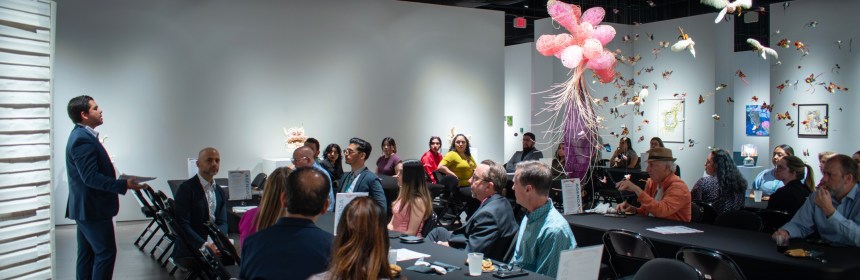
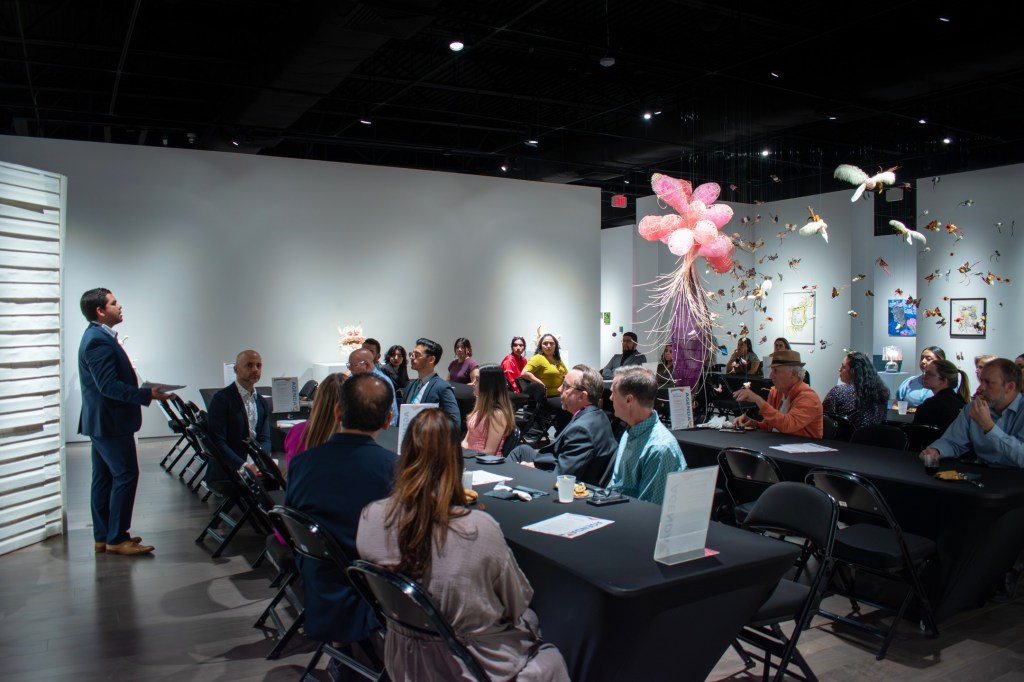
Attendees listen to a presentation at An Evening At The Museum, an event hosted by BAM and the Northeast Arkansas Hispanic Professional Network. The event, held April 23, 2026, represented a partnership between BAM and local organizations. Photo Courtesy of BAM Facebook page.
One recent workshop focused on linocut printmaking, a hands-on art form that allows students to carve designs and create prints. Museum photographer and outreach assistant Savannah Sifford said programs like these help introduce different types of art to the community.
“These workshops give people the chance to experience art in a hands-on way,” Sifford said.
Being located on a college campus, the museum draws a mix of students and local residents. Front desk manager and Graphic Designer AnnEllise Jarrett said recent visitors have included students and adults in their 20s and 30s.
Click to View!
“Recently, many have said they have found the museum through social media and online searches,” Jarrett said.
Even with increased engagement, visibility remains a challenge as the museum is tucked away on the side of the Fowler Center.
“Getting people through the door is one of the biggest challenges. We’re always trying to increase engagement,” DeVita said.
Jarret said having a museum like BAM is important, especially in rural communities, for allowing students and adults the opportunity to engage with art.
The museum plans to continue expanding its programming with additional gallery activities and partnerships aimed at increasing community engagement.
JONESBORO, Ark. – The Arkansas State University Museum is not only a place where people can see parts of history, but also an educational resource for teachers, professors and students.
Many students spend four or more years at A-State without visiting the museum, missing a valuable interactive educational experience that could help them better understand what they learn in history classes. The museum focuses not only on Arkansas history, but also on preserving and showcasing the history of northeast Arkansas and the Delta region.
The museum serves as an informal learning environment, according to Elisabeth Engel, director of the A-State Museum.
“You don’t have to be here. It’s not like class,” Engel said. “So, you know, we value the people that come through because they’ve made an effort to come see us. We hope that they walk away feeling like that effort to brave campus, find a parking spot, and all of those kinds of things, in our particular environment, was well worth it.”
Students, faculty, staff and Jonesboro residents can visit the museum on their own or book a tour with Jill Kary, curator of education at the museum. For teachers and professors, the experience can be especially valuable.
Lillie Fears, professor and interim director in the School of Media and Journalism, brings her classes to the museum every semester to help students understand historical events in ways a textbook cannot.
“My favorite part about taking students to the museum is seeing their reactions when they see something old that we’ve talked about in class, or that is mentioned in our book or in a documentary. These types of experiences can allow them to step out of present-mindedness and to realize how the tools and technology they use in modern times evolved at different eras in U.S. and world history,” Fears said.
Many groups, Engel said, visit the museum with a specific purpose. For some groups, Engel pulls artifacts from storage and creates a “mini exhibit” tailored to their interests.
Fears prefers tours focused on communication history and artifacts, so Engel often brings out old newspapers, cameras and photographs for her students.
“I really appreciate how the director, Elisabeth Engel, is always willing to bring out old artifacts that pertain to mass communications and provide us with special lectures on the history of these media tools. A textbook or video could never do what she and Jill Kary, education coordinator, do for my classes,”
For some students, a focused tour helps them better understand what they have been learning in class.
“It made a lot of the concepts feel more real. In class, we talk about the history of media, but actually seeing the artifacts and examples in person helped me connect everything more clearly, especially how media has evolved and impacted society,” Kaysen Lomax, a junior creative media production major from Jonesboro, said.
For other students, seeing everything the museum offers gives them a perspective they otherwise might not have considered.
“Yes, I did thoroughly enjoy the tour Dr. Fears took us on. Seeing how passionate Jill Kary was about the black business district was inspirational. I enjoyed looking at all the old pictures of old businesses and equipment/technology, and find it crazy to see how much those things have changed,” Alexander Riggs, a junior creative media major from Forrest City, Arkansas, said.
While the museum serves as a tool for professors on campus, teachers in surrounding school districts also can use it as a resource.
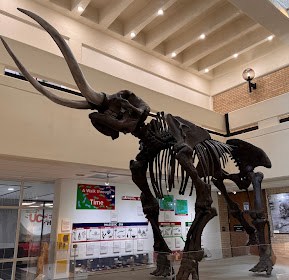
Photo courtesy of Arkansas State University.
Traveling suitcase exhibits are smaller exhibits teachers can check out for two weeks at a time. They offer hands-on materials, visual aids and lesson plans for each exhibit. Teachers can choose from five options, including Pioneer Living, Portals of the Soul: Native American Culture, World War II on the Arkansas Homefront and more.
“All of them are linked to the educational standards that are dictated by the state,” Kary said.
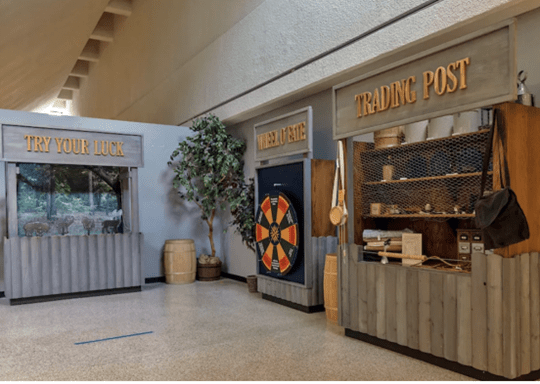
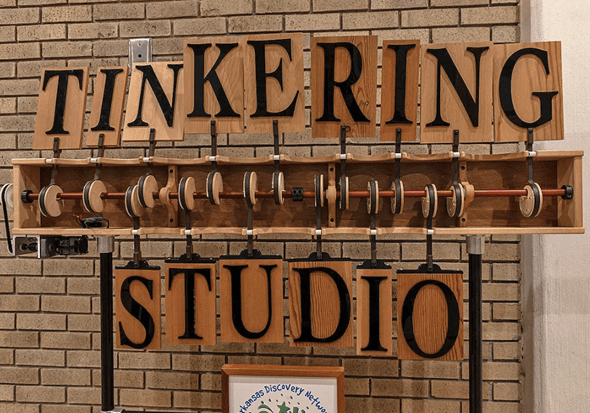
Visitors can also explore the tinkering studio to test whether they have the same innovation skills as people on the Arkansas frontier.
“If the kids have been paying attention, in every gallery they’re seeing innovation happen,” Kary said. “So they are told to invent things, make something, and if it doesn’t work, tweak it, fix it.”
Learning does not just happen in the classroom; it can happen in many places, including the museum. And learning is not just for students. Anyone who visits the museum is welcome, whether for a specific purpose or simply for fun.