Monthly Archives: October 2020

OPINION: TikTok’s Dilemma in U.S. — Should it be banned?

By Yu Bai
Delta Digital News Service

Yu Bai is a Chinese national and multimedia journalism major at Arkansas State University.

JONESBORO – TikTok is a Chinese video-sharing social networking service by ByteDance, and is used to create videos such as short music, lip-sync, and comedy of 3 to 15 seconds. The app’s most popular function amongst its users is to create lip-syncing and dancing videos. It is simple but omnipotent. TikTok includes interesting videos like Youtube, music like Myspace, filters like Instagram or Snapchat, and communication like Whatsapp.

Recently, President Donald Trump suddenly announced that the U.S. government would consider banning the use of TikTok because of concerns about national security. The executive orders argue the Chinese government can access data from TikTok which utilizes an artificial intelligence algorithm to grab content from its user’s information stream and push it after deep mining, which can be potentially leveraged for espionage or blackmail.

I think this is absurd hegemonic behavior of the American government. The Chinese government responded strongly believing the U.S. has blurred the concept of national security, and made resumptions of guilt and issued threats to relevant companies without any evidence, which violated the principles of market economy. TikTok should not be banned and treated in such a threatening way.

TikTok operates strictly in accordance with the laws of the United States. As a short video application, it aims to provide entertainment for the public. Donald Trump should not use political means to suppress U.S. competitors. It is an example of extreme protectionism, which directly disrupts the free market economy.

According to investment bank Piper Sandler’s report, TikTok surpassed Instagram in the United States and became the second favorite social application amongst teenagers.

Also, the ban has been widely resisted by well-known bloggers on TikTok. Nine bloggers with around 54 million fans stated in an open letter to Trump that TikTok has achieved interactions that cannot be achieved on social media such as Facebook and Instagram. TikTok gives them a platform to show their talents and bring joy to other people. If the platform is banned, they will lose a major source of creativity and their happiness in life.

I disagree with the argument that TikTok is an urgent threat to U.S. national security. Like all Chinese technology companies, ByteDance must comply with Chinese censorship laws, which forces the app to provide user data to the Chinese government. But TikTok’s content review work is led by the American team and is not effected by any foreign government. In addition, if TikTok is a threat to American national security, so then are popular video games such as League of Legends, whose maker Riot Games is owned by China’s Tencent.

If all countries in the world use imaginary risks to make things difficult for these popular social platforms, will there still be common applications in this world? If such unfounded national security principles are promoted globally, the biggest losses will undoubtedly be American tech giants such as Apple and Microsoft.

For people who are not American citizens, such as me, an international student, this ban order will have a great negative impact on our lives. TikTok is a platform for us to communicate with family and friends far away in the United States, and it means that we will lose the opportunity for long-distance communication if it’s banned. Trump’s executive order is going to make the U.S. a hostile place to visit, study in, or immigrate to. For a diversified immigration country like the United States, banning TikTok is not a wise decision.

The current series of American crackdowns on TikTok are actually an act of anger under the failure of competition. Behind the legitimate success of Chinese companies and the suppression of a Chinese app that is highly recognized by the American people, is an unfair ban that attempts to obviously make the Trump administration gain favorable interests.

If the government really cares about privacy and data collection, then it is better to find an unbiased solution to their problem than to ban the app by using mandatory administrative orders.

COVID-19 hampers holiday, economy

By Yu Bai
Delta Digital News Service

The first Monday in September is the traditional Labor Day in the United States. However, due to the impact of COVID-19, most people recognized the holiday at home rather than attending public settings.

Jonesboro physician Chance Smith stayed home for the holiday. “I did have a barbecue, and I swam with friends and family only on Labor Day,” said Smith.

Smith practiced safety precautions by staying home and only being close to those familiar to him.

To contain the spread of COVID-19, the city Jonesboro strongly encourages residents to keep social distance and avoid gatherings of more than 10 people.

Businesses such as restaurants and bars are limited to takeout or delivery while personal care services, and gyms have been closed.

Slowing customer traffic has caused small businesses to have limited profits limiting funds for overhead costs. The city provides some grants and loans to help these companies survive the temporary closures and loss of customers.

Director of Communications for Jonesboro Bill Campbell said, “We have built reserves to get through what we call ‘rainy days,’ which means the periods of emergency or catastrophe or anything like that.”

Employment in the leisure and hospitality industry has always been a dominant area of Jonesboro’s economy, and the permanent closure of these businesses will make many people in Jonesboro unemployed.

Labor Finders is a temporary staffing and employment agency in Jonesboro, which provides good short-term services for those who are unemployed. It can immediately provide jobs for people who need to find a job and pay a daily salary.

Debra Dunaway, the assistant manager of Labor Finders, said, “ We provide construction workers and construction clean up, and we give them money right away when they’re in need.”

However, Dunaway said that they did not recruit too many workers to work in recent days compared with before because so many things are shut down right now.

Jessica Tran is a local resident whose parents have a business. “My parents were forced to close their business for a few months due to a mandate ordered by the governor. As for me, I actually had a job as a desk assistant. However, when the virus started spreading more, everyone was sent home, including me.”

The epidemic has suppressed the development of many private small businesses, and it also has diminished the government sales tax. Companies continue to develop their business while expanding social distancing requirements to stimulate economic recovery.

Volunteers spruce up Brockett Cemetery

By Christine Miyawa
Delta Digital News Service

Organizers called off the annual Brockett Cemetery Fall Cleanup Day after a morning downpour interfered with the cleaning.

Volunteers showed up at the cemetery to mow, arrange displaced tombstones, pick up leaves and cut off dry tree branches, but began to leave when rain arrived. The rain, which started as a drizzle before they arrived, continued for the better part of the morning hours.

Lyda Davidson, secretary of the Brockett Cemetery committee, said,

“We couldn’t stay with this rain and you know, coronavirus, we don’t want anyone catching the virus in this weather, we had to call it off.”

Trent Ingram, a member of the committee, said the cleaning event takes place annually.

“Most people who show up volunteer their services,” he said.

The majority of the volunteers buried their families at the Brockett Cemetery.

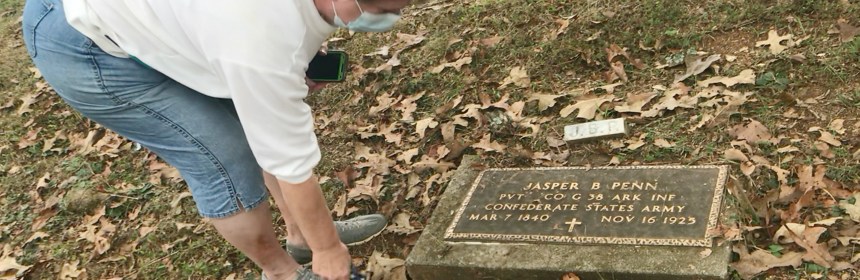
Five generations of Davidson’s family lay buried there, starting with her great-great-grandfather Jasper B. Penn, born in 1841, having died in 1925. Penn served during the Civil War in the Confederacy as a postmaster. She said the late Penn delivered mail on horseback and wagons.

Not too far from her great-great-grandfather, lay the tombstone of her great-grandfather Solomon Steven Mack and his wife, Barbara Mack.

Next to their grave, her grandfather and grandmother Aaron O. Mack and Ollie F. Mack, behind them, her grandfather’s brother John Adams Mack and his sister Carrie E. Milam.

Then her grandfather, Robert H. Milam and wife, Sara E. Milam, her father Alvin Andrew Milam and mother Eula Mack- Milam’s tombstone lay beside each other on one long black and grey marble stone a little distance away.

Her uncle and aunt lay behind her parents. Her late brother- in- law’s tombstone lay next to her sister’s, who is still alive. And many other family members.

“This cemetery is like home for me. When I’m here, I feel peace,” she said.

In 2015 after her brother-in-law died, Davidson bought a tombstone for herself. A mixture of pink and black marble the size of three soccer balls combined.  The marble rock, neatly cut on the engraved side and rough on the other side, bore her birthdate and engraved motto on the stone which read,

“Death is swallowed up in victory,1 Corinthians 15:54.”

At 75 years old, Davidson said she does not fear death.

“Death is not a lasting thing. We live on. For Christians, it’s a happy feeling,” she said.

Each generation of her family took care of the Brockett Cemetery. They would carry their lunch to work, take breaks to eat and go back to work until they completed the job.

“Sometimes people move the tombstones away to the road nearby, and these rocks are markers. We pick them up during cleaning and return them to their proper positions. We keep this place up to preserve our genealogy, for anyone interested in genealogy, this is a good way to preserve it,” she said, as she pushed out of the way into a stockpile cut weeds from a gravesite.

The weed is called “pork salad”, she pointed. It grows a lot here, and I like it; it’s edible. In the olden days, people used their black seeds as a dye for clothes and ink for writing.

The original name of the Brockett Cemetery was Knotts Cemetery, named after the late Joseph L. Knotts.

Knotts donated the piece of land for burial. Many of his family’s tombstones lie on the cemetery along a line, each bearing the name Knotts, young and old.

The name later changed to Brockett, the name of the community at the location of the cemetery.

Every year, they organize for clean-up in March and in October weather permitting. Volunteers show up from various states.

She said they also get donations from people and use the funds to hire for help in cutting grass and dry tree branches at the cemetery when they cannot find volunteers.

Davidson said they also sponsor community members not able to afford burial sites or tombstones.

“Anyone can be buried at the Brockett Cemetery,” she said.

Davidson says she believes at least three more fresh graves came in 2020. So far, 400 people call Brocket Cemetery their permanent home, even in death.

Davidson said the committee meets twice a year, and they have not come up with a new day to reschedule the clean-up after the rain sabotaged their plans.

She said people could find their contacts at the local funeral homes in Randolph County and neighboring towns.

Nurse practitioner fulfills dream with art gallery business

By Tristan Bennett
Delta Digital News Service

JONESBORO — Local artists have an avenue to profit from their craft thanks to one very busy business woman with a passion for art.

As a college freshman, Angela “Angie” Jones first declared her major as art before ultimately ending up in the healthcare field. Now a nurse practitioner, it is not surprising that her love of art stuck with her.

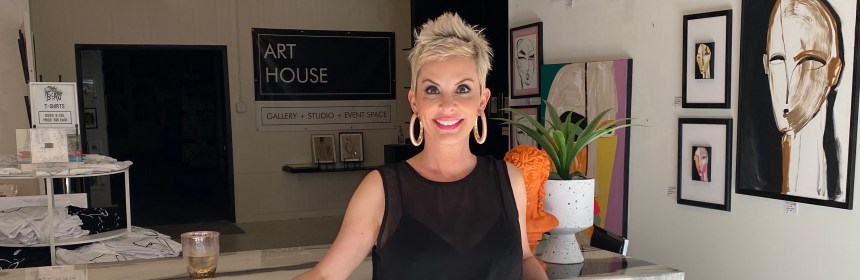
Artist Angela “Angie” Jones owns the Art House art gallery in downtown Jonesboro. Jones opened the gallery during the pandemic.

“I’ve always gone back to it,” Jones said. “Painting walls and furniture when my kids were growing up, always having a craft project.”

Now an empty-nester, Jones decided to dive back in to her love of art in the time she used to spend at ballgames, dance and choir performances. She began taking art lessons with Gussi Causey, a retired Jonesboro Public Schools art teacher, and a big problem gave her a big idea.

“She had mentioned one day that there was really nowhere for her students to exhibit their work,” Jones said. “We had just moved downtown, and we had a commercial space below us that was empty.”

In June 2019, she opened Art House, a gallery in downtown Jonesboro for local artists to showcase and sell their work.

“So what started out as being something that maybe 10 to 15 artists could use to have a random art show here and there turned into the Art House,” Jones said.

Today, Art House has hosted 11 art shows and represented over 50 local artists.

One of those artists, Braden Walls, considers himself to be a drawer. He bases his style on that of Picasso: cubism. He said his involvement with the Art House has been a great experience.

Walls said before Art House opened, other galleries operated in the area but were selective about whose art they showcased.

“Angie opened up Art House and was like, ‘Everybody come put your work in and display it,’” Walls said. “Which, nothing like that has ever happened in Jonesboro before.”

Jones gave all local artists a chance to profit from their passion, and for that, local artist Sheila Guinn is thankful.

“We’ve needed this. We have other art galleries in town, but this one seems to be targeted to everybody. Every age. Every walk of life. All kinds of art and all kinds of people” Guinn said.

When her Art House journey began, Jones was shocked at the number of artists in Jonesboro as well as the lack of opportunities those artists had to showcase their creations.

“We have a lot of resources, we just don’t have a lot of avenues for local artists to get their work out there,” Jones said. “I believe we created that avenue for people to display their work, sell it and get it in the public’s view, and for people to realize that there are talented artists.”

Even in the middle of a pandemic, Jones continued to serve Jonesboro’s artists. She shifted from hosting large public shows to online galleries and private viewings. Jones said she thinks that will expand in the future on top of the traditional shows.

Not only does Art House support local artists, but Jones used art to help her community as well. When the pandemic hit, many restaurants downtown went to curbside-only dining. This meant fewer people on the sidewalks and fewer people visiting other businesses. She assembled a team of five local artists to create murals downtown designed specifically for selfies. That team was dubbed “The Mural Squad.”

“Our goal was to get more traffic downtown, and it’s something fun for people to do when they come down here as well,” Jones said.

The murals’ success led to a contest for more artists to add their own selfie backdrop to the wall, and the Squad has more plans to paint downtown in the future.

The work Jones does for the community requires a delicate balance in her life, and she said she could not do it without her husband, Scotty.

“He will do anything I ask him to and take on any project I ask,” Jones said. “He has been there to hang the art, there to help me with all the other stuff and give support as well.”

Her efforts do not go unseen by the artists she represents.

“She’s doing what a lot of people have wanted to do but just didn’t,” Guinn said. “It takes a lot of effort to do what she does, and we all really admire her for doing this.”

Jones is in the midst of moving the Art House to a new space downtown and plans to continue to advocate for local artists as well as bring art into the Jonesboro community.

Note: Featured photo submitted.


Animal shelter seeks items for flea market fundraiser

By Courtney Edwards
Delta Digital News Service

PARAGOULD – The Greene County Animal Farm is asking for donations from the community as they gather items to sell for their semi-annual flea market.

“It’s to make money to pay for the dogs and cats at the shelter-for their food and their vet bills,” Sharon Vines, a volunteer for the shelter, said.

Located between Paragould and Jonesboro, the animal farm hosts flea markets every Saturday. But, in November, they will host a bigger sale, to bring more funds to the shelter. More items will be up for sale during this event.

Vines said donations for the flea market can include items such as furniture, pictures, clothes, shoes, or knickknacks.

The shelter houses animals of all kinds including dogs, cats, horses and pigs. Vines said they could also use donations of dog and cat food, treats, collars, paper towels, and cleaning supplies.

The shelter can’t take in any foster animals at this time because they are at capacity. The animals at the shelter have needs that are hard to meet without help from the community.

“We’re always full. We always have a full plate of animals. So many animals,” Vines said.

Because the animal farm is usually at full capacity, they want people from the community to make sure an animal is homeless before picking them up and taking them to a shelter. Many times, a loose animal is actually someone’s pet that is lost. If the animal looks to be starving, injured, or has parasites, it can be assumed that they are homeless and need help.

The same idea applies to wild animals. Finding a baby opossum or raccoon with no sign of the mother is no reason to worry. The mother is probably looking for food and will come back to its baby shortly. In this situation, it’s best to leave the animal alone and come back later to make sure the mother came back for it.

The Greene County Animal Farm is run only by volunteers. All of the supplies and money earned from donations, adoption fees, and the flea-markets go to the animal’s needs. The animal farm is a no-kill shelter, so every animal gets the best care possible.

The shelter hopes to provide forever homes to all of their animals, but the COVID-19 pandemic has strained their operations. The shelter has seen a decrease in adoptions and the number of volunteers that care for the animals.

“Not as many people go out there to volunteer or see the animals. They may not adopt or donate as much because they’re out of a job,” Vines said.

Individuals interested in helping the animal farm can volunteer or adopt, however,  if neither is possible, donate. Donating unwanted items for the flea markets helps the shelter pay for the animal’s necessities.

The semi-annual flea-market will be Nov. 7 from 9 a.m. to 5 p.m. and the shelter is open by appointment only. Call (870) 240 8117 to have volunteers pick up any donated items for the flea market or to ask about volunteering or adopting.


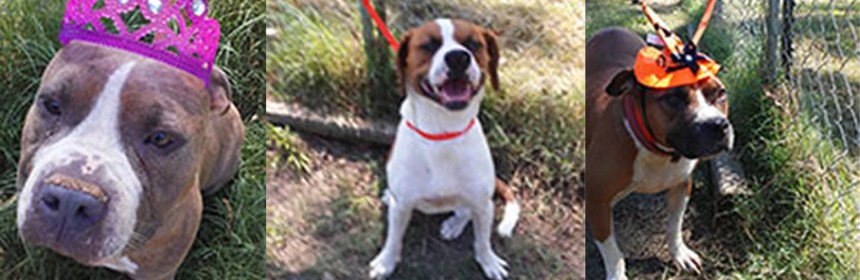
Note: Featured photos courtesy of Greene County Animal Farm.

Veterans’ Village nears completion

By Yu Bai
Delta Digital News Service

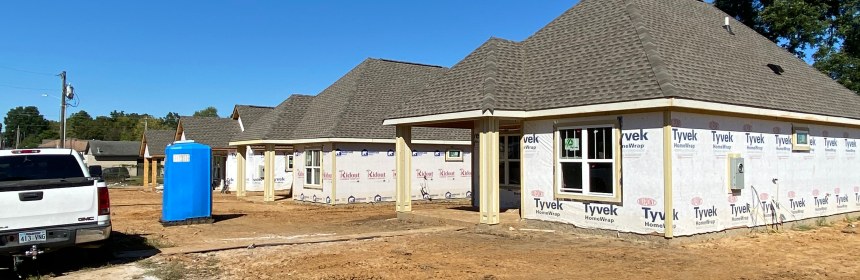
JONESBORO – Military veterans in Jonesboro will soon have a permanent place to call home. Construction of the first ever veterans’ village is in its last stages of completion.

“The village looks to be done on March in the next year,” said Guy Pardew, the vice president of Olympus Construction, “we are really proud of it.”

The construction plans started in 2019, and almost all the basic construction of houses has now been completed.

The village includes nine units which can hold up to 20 people. Two of these units include a two-bedroom floor plan which is designed for veterans with their families. The reaming seven units are one-bedroom apartment.

In addition to living houses, the village will also include a faculty building and a community building that can provide computers to veterans to do their works.

The out-door area will be a common place for veterans to cook together.

The veterans village is a partnership between the city of Jonesboro and Arkansas State University. The Beck Pride Center of A-State is willing to provide combat wounded veterans with first class educational programs and services.

“Our goal is to get these homeless veterans back into society. So with the programming, we’ll use students from different programs like social work, occupational therapy, and physical therapy to provide services to these veterans,” said Lynda Nash, director of the Beck Pride Center.

To better treat those veterans with PTSD and psychological trauma, the Beck Pride Center also provides free classes to them, such as anger management, stress management, and music classes. When veterans join these classes, they will explore to learn more appropriate coping mechanisms with their leaders.

“It’s a national project between us and the village, we’re lucky because Jonesboro is the only city in Arkansas selected to build the village,” Nash said.

The village is built on Aggie Road from Pepsi Beverage warehouses. The Cooper-Mixon Architect Firm is responsible for the construction of the entire village project.

John Mixon, an architect at the Cooper-Mixon Architect Firm, said the house’s actual size is smaller than expected, which is adjusted according to actual needs.

The village is close to the road, so the transportation for veterans is convenient. The  city will provide a complete transportation system that includes bus stops, bicycles, and the JET system.

Total cost of the village is $1.1 million dollars.