Author Archives: shelbyrussom

Paragould School District seeks bond restructure vote

Delta Digital News Service

Monday, April 29, 2024

By Shelby Russom | Contributor

PARAGOULD, ARK Paragould School District is seeking approval for a bond restructure to improve its existing facilities as well as new add ons. 

The bond restructure will be on the March 2024 ballot, and if approved, the district will use the funds to finance projects within the “Master Facility Plan.” This plan includes various projects such as building a new arena, HVAC projects, baseball/softball complex improvements, a potential renovation of the main high school campus, and parking lot improvements.

Jimmy C. Dodd, Jr. of the Paragould Rams Sports Network said he believes this is the most significant opportunity the district has had in a long time. He said this would benefit both the students and the community. Dodd said the district has this opportunity because of their excellent stewardship.

“It’s because of that that we have the opportunity to do this without a millage increase,” He said. “That’s a really big statement about accountability and using taxpayer money well.” 

In a public forum held by the Paragould School District on Feb. 9, the superintendent, Nick Jankoviak, said it is essential for the community to know the bond restructuring will not cause an increase in the tax rate. He said it is similar to getting a loan on a home. 

“We are extending our home loan, but by doing that, we can generate funds that can be used for construction projects,” Jankoviak said. 

Jankoviak said the construction projects involve building a new arena just east of the current arena, Doc Paynter Court, which the school has outgrown. 

“The reality is, it’s no longer adequate for the students, for the coaches,” he said. “The reality is that we can do something better.” 

Jankoviak said the plan does not involve tearing down Doc Paynter Court, seeing how the building is special to the district. 

Paragould School District media coordinator Danielle Honeycutt said she thinks building a new arena will help the students build new memories they will cherish the way her family, who graduated from PHS, do. 

“We’re like a family, and we’ve outgrown the house we’re living in.” She said. 

 Doc Paynter Court currently has a capacity of 851, but the new arena will hold 1,400. 

Voters can find Photos and a virtual tour of what the new arena will look like, a frequently asked questions section, a survey, and the official ballot question on the Paragould School District website. 

Jankoviak said the ballot question can be confusing because the district could not change all of the language on the question. The district was only able to change one sentence at the top of the ballot, which reads,

 “The total proposed school tax levy of 37.62 mills represents the same tax rate presently being collected.” 

The options listed are “for tax” and “against tax,” which Jankoviak said may be confusing, but the district is not asking for an increase in the tax rate. 

The community will vote on the bond restructure on March 5.

-30-


Paragould School District Approves Vehicle Purchase

Delta Digital News Service

Friday, March 15, 2024

By Shelby Russom | Contributor

PARAGOULD, ARK. — The Paragould School District voted to approve the purchase of a new vehicle.

A 2019 GMC Sierra will replace the superintendent’s current vehicle, a 2014 GMC Acadia. The district will then transfer the previous vehicle to a different department within the school district for professional development, and the vehicle currently used for that purpose will go to the maintenance department. 

“We’ve got to be able to get our people around the district,” Superintendent Nicholas Jankoviak said. “With multiple vehicles, we’re able to divide and conquer.” 

It is the district’s responsibility to provide a vehicle for the superintendent’s business and personal use according to the PSD superintendent’s contract. The district will also assume all expenses related to this vehicle’s use, including insurance, fuel, maintenance, etc. 

During the March 11 meeting, the school board voted to purchase the vehicle. The vehicle, with just over 28,000 miles, combined with a six-year or 120,000-mile warranty, will cost the district $48,828.

Michael McBryde, senior vice president of Stephens Inc., presented a plan to the board concerning the district’s plan to sell their bonds and the next steps the district should take now since the bond restructure passed March 5. 

Michael McBryde, senior vice president of Stephens Inc., presented the board with a plan to sell the district’s bonds.
Shelby Russom | Delta Digital News Service

McBryde said it is important to have one final meeting with the school board before selling the bonds to ensure everyone is on the same page. 

“It’s just kinda always one of those things,” he said. “Before you sell a couple million dollars worth of bonds, it’s always nice to have a little touch-in meeting.” 

McBryde said he believes if the district sells its bonds in the current market, it will have a better interest rate.

 “That means you’ll get your $17 million and actually reduce your total annual payment,” he said.

Josh Honeycutt, school board secretary, said the proposal is fantastic and will save the district $3 million over 30 years. 

The bond sale will begin with the state-required publishing of the sale in the local newspapers. Currently, the bond sale will take place April 9. 

PSD school board motioned to approve an alternate calendar based on hours, not days. A traditional academic calendar requires a minimum of 178 instructional days. The board-approved alternate calendar requires the district to have 1,068 instructional hours, allowing them to save additional time for days off, such as inclement weather. 

Currently, the district is banking 1,101.42 hours, meaning the district will have 33.42 hours to bank. 

“We can bank over five six-hour days,” Jankoviak said. “So, what will happen is if we get bad weather, we can allow the students to stay home five times without having them make up any days at the end of the school year.” 

The district will utilize the extra days for professional learning communities (PLC), which act as teacher collaboration days. Jankoviak said this year, the district really focused on incorporating PLC days and believes they will help improve the district. 

He said PSD currently employs two of the only high-impact teachers in northeast Arkansas, and he believes allowing them to collaborate with their colleagues will help improve the district. 

Oak Grove’s principal, Jamie Dial, stated the academic achievement of the students of Oak Grove Middle School (OGMS). The school’s current enrollment is 503, with 234 fifth and 269 sixth-grade students. The average attendance is 91%. The school employs 32 certified teachers, with 22 having over six years of teaching experience in the district. 

“Our staff is strong,” Dial said. “They’re doing a great job; we’re doing everything we can for the kids.” 

Dial said the teachers within OGMS have gone above and beyond in grasping PLCs with math, science and language arts. 

Within the OGMS math department, the PLC meets every week to discuss remediation pathways from previous testing data. Dial said both sixth-grade math teachers show growth as high as 17% with their students’ ACT Aspire test scores. 

OGMS began Imagine Math Small Group on Demand Tutoring. This year-long virtual program will help 56 high-risk students bridge the gap in their math skills. 

In other business:

  • The school board elected Jeremy Hancock as president and disbursing officer, Teresa Hill as vice president and Josh Honeycutt as secretary. The remaining board members were elected as secondary disbursing officers. 
  • Due to law changes, the board approved policy updates from the Arkansas School Board Association effective July 1, 2024. 
  • The board expelled a 10th-grade student for the remainder of the 2023-24 school year for actions that violated student policies 4.18, 4.20, 4.21 and 4.22 and student rule two in the Paragould High School Student Policies Handbook. 

-30-


NOTE: Feature photo of Paragould School District School Board meeting by Shelby Russom.

GCT participates in new testing program

Delta Digital News Service

Friday, February 16, 2024

By Shelby Russom | Contributor

PARAGOULD, ARK – The Greene County Technical School District decided to participate in a new type of optional interim testing for the 2023-2024 school year.

The new testing program, the Arkansas Teaching and Learning Assessment System (ATLAS), interim testing acts as a way to track how students are performing and how to help them improve. The system offers classroom, summative and end-of-the-year assessments for grades third through 10th.

“We opted into practicing with the interims, and I’m so glad we did because the kids will be better prepared for the summative,” said Assistant Superintendent Kodie Potter during the Feb. 15 meeting.

Caroline Schenk, district administrator of instructional programs, said this differs from any testing GCT has undergone because the testing is more difficult. Still, she said she is hopeful the students will succeed.

The science portion is the only ATLAS interim testing available since the program is still new. The tests will eventually cover multiple subjects including math, reading, writing, etc. Scheck said the district hopes to implement every interim testing as it becomes available next year. 

When given the science interim test, GCT’s students showcased skills from six points above the state average of 89 at the fifth-grade level to four points below the state average of 64 at the third-grade level. 

“We have work to do,” Schenk said. “We are not happy with being below the state average. We would like to excel, so we will keep working.”

Along with the testing, Greene County Tech will put together “gold documents.” These documents detail how well each student is doing in a particular area and include test scores and lists of teachers’ expectations for their grade level. Lead teachers can edit and refer to these forms as the year progresses to monitor each student’s performance and show other teachers what the district expects their students to understand by a certain point in their academic career.

“We are so proud of our staff, our teachers. They are working so hard, and they are knocking this out,” Schenk said. “We never dreamed we’d be as far as we are with all of this.”

Greene County Technical School District reported at the end of January 2024, its operating account had an ending cash balance of about $14.8 million, of which $868,000 remains in special projects. The district is restricting $500,000 for construction, and about $5.6 million remains in the July 22 bond proceeds fund. The current budget leaves about $7.8 million for operating.

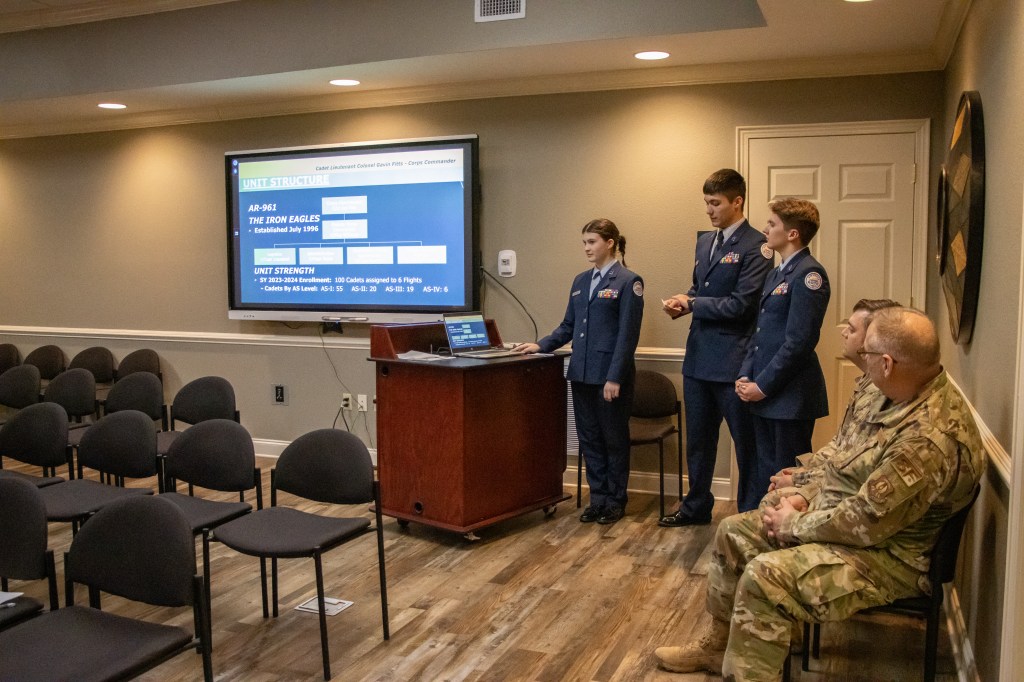
Three cadets from GCT’s Junior Reserve Officers’ Training Corps (JROTC) presented to the school board members detailing their organization’s 2023-2024 school year successes.

JROTC set school impact goals for the program over the next school year. The first goal was for 75% of cadets to receive at least a 2.0 GPA in regular education classes and a 3.0 GPA in the JROTC class. Deputy Corps Commander Cadet Bailee Williams said they are on track and expect to meet that goal by the end of the school year. The second goal of the program is to reach a 75% participation rate in non-mandatory activities for the 2023-2024 school year, of which they have passed with a participation rate of 97%. JROTC also wants to recruit at least 75 first-year students during their GCT Junior High School recruitment events while maintaining 70% of the corps.

Cadets from GCT give a presentation on their JROTC program on Feb. 15, 2024.

“Our unit is currently maintaining 87.5% of the corps for the upcoming spring semester,” Williams said. “We also have 80.6% of the corps expressing interest in reenrolling into JROTC next year.”

JROTC also set goals for the earning of community service hours. Currently, the unit earned 1,732 hours with an average of 17.32 hours per cadet.

Throughout the fall and spring semesters, JROTC raised $5,925 selling peanuts and bath bombs and $5,170 selling digital coupons and discount cards. JROTC will donate $700 to the family of a GCT student diagnosed with cancer and $500 to the family of an eighth grader who was involved in a car accident.

Superintendent Scott Gerrish said he appreciates the work Sgt. Scott Burlingame has put into JROTC and believes the program is worth all the effort. 

  • In the meeting, the board also:
  • Reviewed how teachers feel about the implementation of the alternate calendar and early start.
  • Approved a second read of classified and licensed personnel policies.
  • Approved incoming and outgoing student transfer petitions.
  • Approved a resolution authorizing the district to request a waiver.
  • Approved a special education data system.
  • and renewed the district’s ASBA Worker’s Compensation Trust.

– 30 –


Greene County Tech district switches to alternate calendar

Delta Digital News Service

Thursday, February 1, 2024

By Shelby Russom | Contributor

PARAGOULD, Ark. – Greene County Technical School Board approved a waiver to revise the 2023-2024 school year calendar in a special school board meeting yesterday.

            The Greene County Technical School administration recommended the school board approve a waiver from the state department allowing the district to change the school year calendar from a traditional to an alternate calendar to make up for school days lost to inclement weather.

            The waiver would allow the district to count the instructional minutes on the first day of school, Aug. 14, 2023, and count to the end of the calendar school year, May 24, 2024. The district has already been gathering extra instructional minutes throughout the school year but could not bank those minutes under a traditional calendar. Currently, the high school banks 365 instructional minutes daily, five minutes over the daily minimum. With the alternate calendar, the district can bank those extra five minutes a day and put them towards covering for inclement weather.

            “By approving this waiver, we’ve banked enough time that out of the three snow days we missed this year, we can take two off and only be needing to make up one snow day,” GCT’s Supt. Scott Gerrish said.

            The board voted to approve the waiver, which will remedy the school’s inability to use alternative methods of instruction, or AMI, days, due to the Arkansas Learns Act. The approval of this will mean the school now expects students to attend school Feb. 19, 2024, making up for instructional time lost during inclement weather. The school plans to announce the change through social media as early as Thursday, Feb. 1, 2024. Going forward, the state will expect the school board to revote on the alternate calendar each school year. President of the school board Tim Roswell said since there are no longer AMI days, banking extra instructional hours seems like the most logical way to make up for lost time and keep students from having to attend school in the last week of May 2024.

            After time spent in executive session, the school board voted to suspend the expulsion of a student for the remainder of the 2023-2024 school year for breaking rule 10 of the GCT Junior High Handbook. Rule 10 prohibits students from possessing, receiving, huffing/inhaling or dispensing a controlled substance.

            According to Tony Boyd, assistant principal of GCT Junior High School, he caught the student in question with a controlled substance Jan. 19. Once Boyd and the Student Resource Officer on duty confiscated the substance and had it tested, the substance came back positive for Tetrahydrocannabinol (THC). The Junior High School recommended the school board consider the student for suspended expulsion. Boyd said alternative school for one semester may be the best option for the student.

“I think that is going to be his best avenue. He deserves to at least have that shot,” Boyd said.

            Suspended expulsion allows the student to still attend school but in a location of the school board’s choice. This option will stand as long as both the student and guardian comply with the rules set for suspended expulsion, which may include but are not limited to receiving school-based mental health counseling services, referral to Narcotics Anonymous or Alcoholics Anonymous programs, drug testing, passing classes and so on.       

             Christi Sims, GCT administrative assistant, said, “Not all schools do the suspended expulsion. It’s just something we do to give our students another chance.”

            The guardian of the student initially intended to read an apology letter the student wrote to the school board but was unable to attend the meeting due to personal reasons.

           In other business:

  • The board read the first revisions of Licensed and Classified Personnel Policies, which did not require the board to take action.
  • The board also approved an annual trip to St. Louis, Missouri, for GCT’s gifted and talented program, PACE.
  • The board approved outgoing student transfer petitions and a personnel list.

-30-


NOTE: Feature Photo of Greene County Tech School Board meeting by Shelby Russom.

Coping with Seasonal Allergies

By Shelby Russom
Delta Digital News Service

JONESBORO, Ark. — Spring. Plants are blooming, and the weather is finally warming. For some, spring is wonderful time of year. For others, spring means coping with seasonal allergies.

   According to the Asthma and Allergy Foundation of America, allergies are reactions to allergens people come into contact with. Allergens, like pollen, cause seasonal allergies that affect approximately 81 million people in the United States and vary depending on location and time of year.

   Dr. Debra Schulte, a part-time nurse practitioner in Mountain Home and full-time assistant professor of nursing at Arkansas State University, said seasonal allergies are more common in the spring months but can affect people all year round.  

   “You see a lot more because you have your typical spring pollen,” Schulte said.

   A-State sophomore Sarah Purcell studying studio art said she does not believe her allergies are severe but does notice that the symptoms worsen during the warmer months of the year. Purcell said her allergies cause her to get mucus, but the symptoms of seasonal allergies can range from runny nose and sneezing to watery eyes and itchy throat.

   Dr. Audrey Folsom, A-State assistant professor of clinical laboratory, said preventing seasonal allergies is nearly impossible because people cannot avoid things like trees, flowers and pollen that release allergens into the air. However, people can manage their seasonal allergies through lifestyle and diet changes.

   To combat allergy symptoms, Schulte said people should change their surroundings by replacing carpet with hardwood in their homes, frequently washing their curtains and even putting plastic covers on their pillows and mattresses. Folsom said changing the foods people eat and adding vitamin D supplements to their daily routine can help the body fight against allergens.

   “It is ultimately tied to gut health,” Folsom said. “Because I would say, probably 80% of your immune system is around your gut. So the worse your gut health is, the more likely you are to have allergies.”

   Folsom herself battles with allergies. To combat her allergy symptoms, she cut out the big five foods that trigger allergies: wheat, gluten, dairy, soy and corn. Folsom said if people have very bad problems with allergies they should try to cut all five of those food groups out of their diet. Folsom said it is necessary to cut all five food groups out for at least a month and then reintroduce them back into the diet one at a time to properly find which is causing a spike in a person’s seasonal allergies.

Multiple medications
Because of the wide range of options, buying allergy medication can be a daunting task. People should do their research before deciding which medication is right for them. (Photo re-enactment by Shelby Russom)

   Several medications are available to combat seasonal allergies. These medications include over-the-counter antihistamines, prescription medications, as well as allergy shots.

   “If those classifications of medications are not good options, there’s definitely different families of medications that your provider can prescribe,” Schulte said.

   Schulte said all these medications are easy to access, but all require a few uses before a noticeable change will occur.

   In Northeast Arkansas, it is common for farmers to burn their fields to clearf any leftover crops to prepare for planting new crops. This practice releases copious amounts of smoke into the air that people will breathe in. Folsom said burning fields severely worsens everyone’s breathing and allergies.

   “It’s horrible and I wish they would stop it,” she said. “People think it’s normal, but there’s other places in the nation that do not do that.”

Headphones Affect Their Users

By Shelby Russom
Delta Digital News Service

JONESBORO, Ark. — Since their creation, headphones continue to grow in popularity. But these personal listening devices have their pros and cons.

   Invented in the early 1800s, headphones allow users to listen to their choice of audio privately. This allows those who love to listen to music in their cars and on personal radios to finally bike, walk and so much more while never having to put away their tunes. Timothy Hsu, of Phys.Org, headphones work through the turning of electrical audio signals into cycles of high and low pressures that the ear interprets as sound. This constant, close-contact vibration can be damaging if music is listened to for a long amount of time at a high volume.

   A headphone user and Arkansas State University junior from Jonesboro studying graphic design, Kennedy Crawford said she is aware of the potential dangers of headphones but values them too much to not use them.

   “I use them for a lot,” she said. “Like cleaning, working out, doing homework, so I pretty much always have them on me.”

   According to the Centers for Disease Control and Prevention, exposure to loud sounds may damage  structures and nerve fibers in the inner ear, resulting in noise-induced hearing loss. Causes of noise-induced hearing loss range from a single exposure to a very loud sound, to constant listening to loud sounds over an extended period.

   Crawford said she uses her headphones every day with her music at max volume but does not yet notice a change in her hearing.

   “If I have any change, I haven’t noticed it, but I wouldn’t be able to notice unless I got tested,” Crawford said.

   Dr. Lindsay White, doctor of audiology and assistant professor of communication disorders at Arkansas State University, said she pays attention to if her headphone’s audio level is safe for her ears.

   “You need your program to be loud enough that you can understand and get the full effect of your program or music you’re listening to but I think being an audiologist, I’m more aware of the harmful effects,” she said.

   White said the cause of noise-induced hearing loss results from damage to the extremely sensitive sensory-receptor cells found in the ear. These cells easily become damaged from loud sounds over time. The volume and duration of noise in a user’s headphones, can worsen the effects of noise-induced hearing loss.

   “I kind of think about it like sun exposure,” White said. “It’s accumulative over time. A little bit of listening today, plus a little bit of listening tomorrow over a duration of time can result in permanent damage to the ears.”

Chase Overholser, an Arkansas State University junior graphic design major from Wynne, uses headphones while completing a class assignment. Loud headphone use may damage the ears. (Photo by Shelby Russom)

   The louder a sound is, the shorter the amount of time a person can safely listen. White said Listening to sounds at 85 decibels for more than eight hours a day can damage the ear. The average pair of headphones can reach levels up to 110 decibels. According to the Harvard Health Blog, exposure to a volume of 105 to 110 decibels damages the ear in five minutes. White said that the louder the people listen to music, the shorter the amount of time they can safely listen.

   Dr. Matthew Taylor, a doctor of audiology at Taylor Hearing Centers in Mountain Home, said he recommends programming headphones to ensure they cannot go above certain audio levels. To alert their users they are listening to music at unsafe levels, phone companies implemented a warning system tasked with sending a notification to the users’ phone if audio levels are too high. White said listeners should not ignore those warnings.

   “You can actually get apps,” White said. “Like parents, for example, can put an app on their child’s phone that will limit the amount of volume that they have access to.”

LISTEN: Emotional Support Animals Improve Owners’ Lives

By Shelby Russom
Delta Digital News Service

Joshua VanDon sits with his ESA, Keena. (photo courtesy of Joshua VanDon)

JONESBORO, Ark. — People with diagnosed mental illnesses often benefit from emotional-support animals. These registered animals provide emotional support and love, alleviate stress and loneliness, and even ease the effects of mental illnesses to support their owners.

   Kellie Davison of Jonesboro, therapist, and co-founder of Courage Counseling said ESAs are wonderful and help people with mental illnesses like anxiety and post-traumatic stress disorder. She said she always recommends her clients who do not have an ESA look into getting one.

   As someone with PTSD and anxiety, Joshua VanDon of Paragould said people notice a change in him since getting his ESA, Keena, a four-year-old Belgian Malinois.

   “My wife’s seen first-hand like the difference in myself once I got Keena and you know, having her here,” he said.  

   Maya Saala, an Arkansas State University first-year student from Pocahontas studying elementary education, said she initially did not realize just how helpful having her ESA registered cat, Obi, would be. She said she knew being around him made it easier to deal with her anxiety, but did not realize the extent of the emotional help he provided. Saala said she recommends ESAs to anyone who struggles with mental illness.

Maya Saala and her ESA, Obi. (Photo courtesy of Maya Saala)

   “It’s just one of those things where it’s like, even if you don’t think you could benefit from one, you probably could,” she said.

   Legally recognized as support systems, ESAs can travel with their owners, attend events, go into stores and much more. Davison said this was helpful for her mother, Sarah Simmons, who suffered from anxiety and bipolar disorder.

   “She was able to travel with them and so it helped her get to do a lot of things she would have never been able to do,” Davison said.

   To register an animal as an ESA, an emotional support animal owner needs a letter from their mental health provider stating the owner requires the assistance of the animal. Traveling and entering certain places, as well as living on a college campus with an animal, requires an ESA letter.

   Davison said people should not abuse the ability to have an ESA. She, as well as other therapists, will not give the necessary documents to register an animal as an ESA to just anyone. She said she wants to ensure everyone who has an ESA is someone who truly needs it and will take care of the animal.

   “When I think of an emotional support animal, I think of it as if you’re going to maintain your own mental health, you also need to maintain your dog’s health as well or your cat or whatever animal you’re utilizing as your emotional support animal,” Davison said.