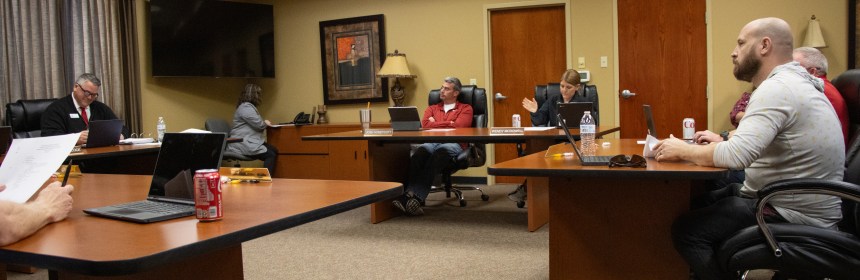
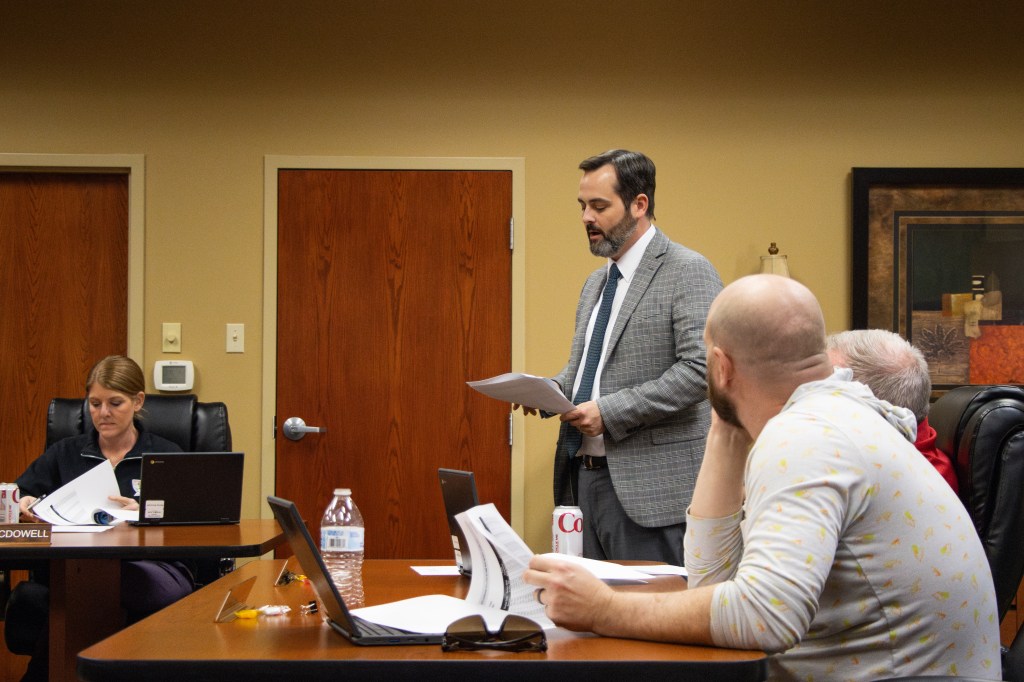
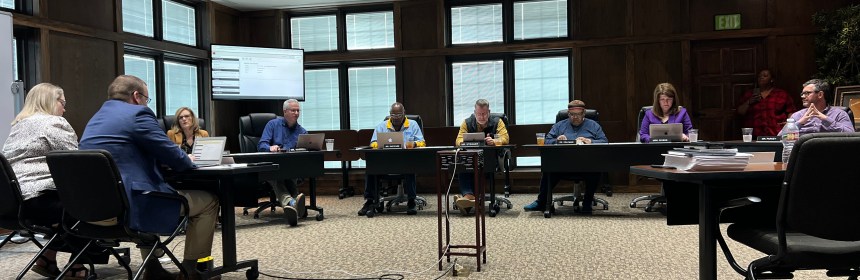
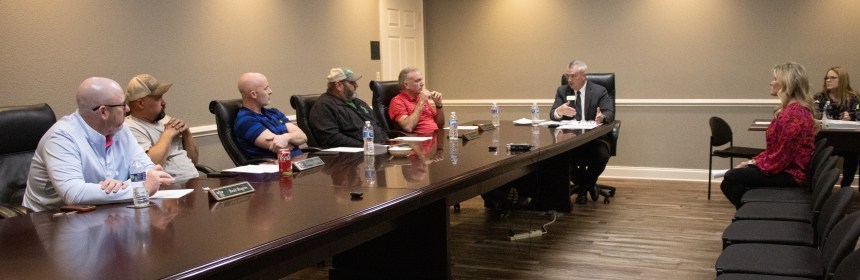
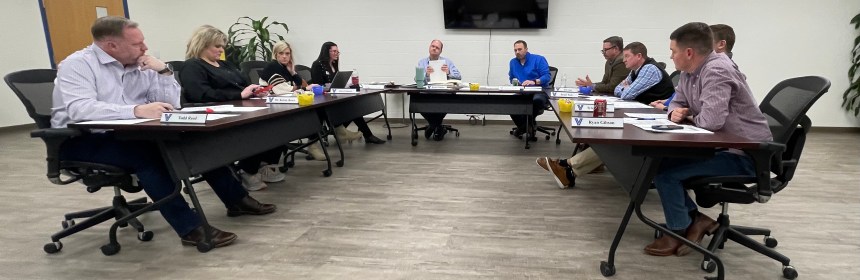
Members of the Valley View School Board, as well as Superintendent Roland Popejoy (second from right). Photo by Benjamin McDowell.
JONESBORO, Ark. — The Valley View School Board honored longtime member Richard Rogers, celebrated the success of the theater program, and approved major technology purchases during its recent meeting.
The board recognized the Valley View theater program, which took its one-act play Eurydice to competition in Russellville and earned a score of 97 out of 100. Judges selected the group as one of four schools in the state to showcase their one-act play at the State Thespian Festival in February.
Students later performed in Springdale, receiving a superior rating, along with awards for ensemble work and music design, and earned $100,000 in scholarships for theater education.
The board also heard updates on the Fine Arts Center lighting project, which improved stage and auditorium lighting for performances. The new lights allow different colors, enhancing plays, festivals, and shows.
Chromebook purchases and finances
The committee reviewed financial reports showing a $2.7 million deficit due to building project expenditures, though revenue collections are currently 51% ahead of budgeted expenses. Members approved the purchase of 750 Acer 514 Chromebooks for $373,525 and 250 Lenovo L16 Chromebooks for $223,223, citing cost-effectiveness and vendor reliability.
Superintendent Roland Popejoy discussed the Chromebook purchases and technology replacement plan.
“I have shared with you guys previously that we’ve been working on a replacement plan for laptops. That is an area where, whenever I came into this role, it was very important for me to make sure that we work toward getting a specific line item per year for technology replacement,” Popejoy said.
Popejoy emphasized that students should have access to the tools they need to succeed.
“Previously, we made really big purchases and then kind of saw how long they would last as part of our process. I really want to make sure that we have a solid replacement plan. And so that’s what we’ve been working on. We’re moving to one-to-one,” he said.
Honoring Richard Rogers
Board members recognized Richard Rogers for his 11 years of service, noting his role in overseeing several major school projects.
“He has served on our board since October of 2011, and so this will be his last meeting. Mr. Richard Rogers has played a pivotal role in multiple things in his time here. He oversaw the building of our high school while he was on the board, also the women’s field house, the additions here at the intermediate and the intermediate junior high, and now our high school addition,” Popejoy said.
He also praised Rogers’ contributions to athletic facilities.
“In addition, one thing that I think is really important is that he has played an integral role in the efforts to improve our athletic facilities, with our turf project for our football field, baseball field and softball field,” Popejoy said. “Anybody that knows this board over the years knows Richard is a voice that a lot of people reach out to. Richard is one that has a unique way of his advocacy.”
Special education and facility updates
Special education director Carol Brown provided an overview of services.
“As of December, there were 2,827 students enrolled in our district, and out of those, there are 448 receiving special education services, which is 15.85%,” Brown said.
Brown explained that the district serves students with a variety of disabilities, including specific learning disabilities and other health impairments such as ADHD, seizure disorders, and other medical conditions. She said the district provides multiple therapists and therapy options to support students academically, mentally, and medically.
Senior project manager Angie Berryhill gave an update on facility improvements.
“What I’d like to do is dwell on the path moving forward, and our message is still the same to this board and this community, that we’re going to move as expeditiously as possible. When we understand things, we will make that known, and we’re going to be here until the very end,” Berryhill said.
Berryhill added that the improvements will not cost taxpayers extra money.
“We have processes and procedures in place now that are going to prevent things like this from happening again,” she said.
Courtesy of Jonesboro Public Schools Facebook Page
JONESBORO, Ark. – Jonesboro Public Schools launched a new counselor website and approved additional compensation for teachers who teach more than 150 students per day and more during its monthly school board meeting on March 10.
Mandy Zipful, district school improvement specialist, presented the new counselor website, highlighting the new and improved course catalog for Jonesboro High School. The JPS School Counselors’ website provides a hub for connecting students with counselors, finding mental health resources, booking appointments, accessing grades and graduation requirements, and viewing a detailed course catalog. While the site is live, the district is working to connect the site to each school’s tab.
“This is a great tool for the students and parents,” Zipful said. “We’re super proud of this work.”
Zipful highlighted the new “Academics at Jonesboro High” course catalog, noting that the old version was just a Word document, while the new one lists every course offered and includes a detailed description. The new catalog also makes it easier to find graduation requirements, concurrent credit courses at both Arkansas State University and Black River Technical College, Success-Ready Pathways, and more.
“What would it look like to be more supported socially and emotionally?” Superintendent Misty Doyle asked students. Students said to be able to better get in touch with their counselor.
The website helps students easily book appointments with their counselor in 30-minute increments. Students can schedule an appointment by going to the JPS School Counselors website, clicking “Academics at JHS,” clicking the “Counselor Appointment” tab, selecting the counselor they wish to meet with and choosing a time that works best for them. Doyle even gave an example of how a student had an appointment scheduled for 9 a.m. and was surprised to actually be called out of class on time.
During the superintendent’s report, Doyle asked Von McDaniel, director of student health services to give an update on mental health.
“As of today, we’ve had 167 student contacts for this school year. Some of them we spend a lot of time with, and some of those we don’t,” McDaniel said.
Counselors meet with and contact students for a variety of behavioral and mental health concerns. Students can meet with counselors as many or as few times as needed. While some students have the resources needed to head in the right direction, others don’t and the district recognizes that.
Photo courtesy of JPS School Counselors website. (Left) Lene Pierce, Jonesboro High School Health and Human Services counselor, and Emily Aycock, Visual and Performing Arts Magnet school counselor.
The board passed the motion to approve additional compensation for teachers teaching more than 150 students per day for the first semester in the 2025-26 school year. The JPS finance office recommended six teachers, including two from JHS, two from Douglas MacArthur Junior High School and two from Annie Camp Junior High School, for the supplemental teacher contract pay.
“A teacher is not required to teach more than the maximum number of students permitted per day under the Standards for Accreditation of Arkansas Public Schools and School Districts, but a teacher may agree to teach more than the maximum number of students permitted per day,” according to Arkansas Code § 6-17-812 (2024).
The district will pay the teachers an additional amount in addition to their regular salary, proportionate to the additional number of students they taught.
The board also passed the motion to approve the purchase of a new $153,054 77-passenger school bus.
Photo and story courtesy of Arkansas State University.
JONESBORO – Arkansas State University is celebrating a record-breaking student body this fall with 11th-day enrollment surging to 17,926. Fueled by the largest freshman class ever and record credit hours, A-State’s growth marks another milestone in its rising trajectory as the destination for students across Arkansas and beyond.
The Class of 2029 includes 2,222 first-year students, a 12% increase compared to last year. Among them are 1,764 Arkansans, who make up 79% of the total class and represent a 30% increase from the previous year.
“This class is a clear sign that Arkansas families see A-State as their home for opportunity,” Chancellor Todd Shields said. “It means they believe in what we are building here and they trust this institution to shape their future and strengthen our home state.”
Total enrollment at A-State has increased by 28% since Dr. Shields arrived on campus in the summer of 2022.
This year’s Red Wolves are taking more classes as well, with total credit hours reaching 161,204, an 8% increase over last year and a university record.
A higher number of returning students is also driving enrollment growth, with nearly 750 more students resuming classes this fall, representing a 7% increase over the previous year.
“Our duty goes beyond recruitment. We must ensure that students persist, succeed and graduate ready to make a difference,” said Provost and Executive Vice Chancellor Calvin White Jr. “The historic number of credentials awarded last year and the improvement in returning students show that A-State is fulfilling its mission to advance student success at every level.”
During the 2024-25 academic year, A-State awarded more than 6,000 credentials, the highest total in its history.
This fall, more students are choosing the full A-State experience. On-campus enrollment grew by 7.8%, outpacing a 6.7% growth in online programs. The shift signals a rising demand for the traditional college environment, with students seeking the energy of campus life alongside strong academics. The trend also extends to A-State’s Campus Queretaro, which has seen enrollment grow to 1,053 students, up 10% from 2024.
Student life at A-State is thriving with residence halls filled to capacity. Currently, 3,242 Red Wolves and osteopathic medical students are living on campus, which accounts for 99.8% of the available beds. Meal plan selections rose 6.7% compared to last year, an additional sign of growing student engagement on campus.
“As someone new to A-State, I have been immediately impressed by the energy and excitement on campus,” said Vice Chancellor for Enrollment Management Amanda Nickerson. “It’s clear that students are drawn not only to our academic opportunities, but also to the sense of community here. That combination makes A-State an easy choice for families.”
Looking ahead, A-State is building on this year’s success with new opportunities for future students. The university has expanded its investment in merit scholarships, raising its top award to $18,000 per year and adding a new $10,000 A-State Trailblazer Scholarship for high-achieving students.
Innovative pathways are also fueling excitement, including the Freshman to Physician program that offers early admission to the NYIT College of Osteopathic Medicine at A-State. In addition, the new A-State College of Veterinary Medicine, anticipated to open in fall 2026, will provide Arkansans with the opportunity to pursue veterinary education closer to home while helping to meet the state’s critical need for veterinarians.
The Arkansas Dr. Martin Luther King Junior Commission partners with the Dr. Martin Luther King Junior Commission in Nevada. This partnership bridges the most active commission in the nation (Arkansas) and the world’s largest Dr. Martin Luther King Junior parade in Las Vegas. The parade in Las Vegas started in 1981 and has attracted commissions from across the nation to Las Vegas for the parade.
As part of the work done in Nevada around the celebration of the late Dr. Martin Luther King Junior, a technology summit is held annually to inform freshman through high school seniors about job opportunities. The technology summit was started seven years ago by Duana Malone, known as the Tech Queen.
“We wanted to serve by letting students know about the technology opportunities available,” says Malone. “This was especially important for outreach to go toward students who are in underserved and underrepresented communities. Back then, students did not know about high-tech opportunities, robotics, and other areas. We want to ensure that today’s students know about all available technological opportunities”.
Malone said that when the community started learning about the technology summit, it grew exponentially. One challenge was finding a space large enough to hold it. The Friday summit was held at Las Vegas City Hall in the city council chambers, which was large enough to hold a couple hundred students from area high schools to learn about technology and jobs.
The Arkansas Dr. Martin Luthe King Junior Commission is one of the most active commissions in the nation. Executive Director of the Commission Dushun Scarbrough has been excited about the partnership between Arkansas and Nevada.
“We have one of the largest days of service on Dr. Martin Luther King, Junior’s Day, and we participate in over 70 activities statewide through the year,” says Scarbrough. Scarbrough has been grateful for the partnership and says the Technology Summit coming to Arkansas will be a game changer. “Just as this did for Nevada, we are going to do the same thing in Arkansas and positively impact the children in Arkansas.”
Malone expects to be in Arkansas later this year to help with the establishment of a technology summit in Arkansas. More details on the technology summit in Arkansas will be released as soon as everything is finalized.
Construction has begun on a new high school in the Wynne School District, more than a year after an EF-3 tornado destroyed most of the campus. Faculty and staff are expected to transition to the new building in early 2027, assuming no delays.
Currently, site prep and dirt work for the area where the building will be constructed is complete. Dusty Meek, Wynne senior high school principal, said contractors will bid for the concrete and foundational construction soon. He said the rest of the bidding process will happen in January. Aaron Russell, Wynne school district communications officer, said he thinks the reopening of the high school will be a day of healing for the community.
“The high school is the heart and soul of a community, and losing one creates a huge missing piece,” Russell said. “We hope that by re-opening our high school campus, we can heal that scar and the new Wynne High School will serve as a new beginning and a lasting memorial to the old campus.”
Meek said the new building will feature several upgrades, including a modern cafeteria, media center, auditorium and internal courtyard. He said the building will also contain multiple stories, which will help most facilities stay clustered, instead of being spread out. Russell said the design will give students a more collegiate feel, with multiple indoor and outdoor learning spaces and bright, open interiors.
The high school principal said the reconstruction is based on current enrollment to meet eligibility requirements for insurance and state funds. Nevertheless, he said the new building was designed in mind for future additions, if needed.
Russell also said the school will have storm shelters and safe rooms to ensure the staff and students are protected from any future hazardous weather events.
The communications director said the school and architects met with faculty, staff and community members in multiple interest meetings to learn what they would like to see incorporated into the new building. He said there is a lot of excitement among the community associated with the construction.
“The modern look and the spaces included are something unique to our area and we feel we will be a huge draw for faculty, staff and future students,” Russell said. However, Meek said not every suggestion will be incorporated in the reconstruction. He said decisions will be made after the bids are finalized to see what will fit within the budget.
“Ultimately, like everything else, it comes down to affordability,” Meek said. “There are probably some things that people would love to see in it that we either didn’t have in the old buildings, so therefore it’s not going to be replaced, or it’s things that are not cost-effective.”
When designing the look of the new school, Russell said the district tried creating a campus that integrated the Wynne brand and identity. Renderings of the new building showcase a campus with highlights of the school’s blue and gold colors. The new building also incorporates Wynne’s mascot, the yellowjacket, in its design. Meek said they also wanted easily identifiable front entrances and the ability to section off parts of the school for different events.
The high school principal said insurance will help with part of the funding for reconstruction and the district is looking for further support from state partnerships and FEMA. Kenneth Moore, Wynne school district superintendent, said cost estimates cannot be released because insurance negotiations are still ongoing. Russell said weather is the biggest challenge the school has faced in the reconstruction process.
“The things we cannot control provide the most significant challenges,” Russell said. “We are in constant contact with our architect and contractor to limit delays.”
Meek said another challenge is monitoring the reconstruction project while also actively running the temporary campus, where the Wynne High School is operating following the tornado. Meek said the new high school building will be very exciting for the community and he hopes it raises morale. He said moving from the temporary campus to a 21st-century building with modern amenities will be very exciting.
“Just having indoor restrooms will be exciting for most of us, because everything we have now you have to travel outside to it,” Meek said. “It’ll be really exciting at the time but, just like anything else that you find, once you get into it, it just becomes your norm.”
Despite the excitement, Meek said the students who experienced the tornado and will graduate before the construction is complete must not be forgotten. He said these students will likely never set foot in the new building and bringing it up reminds them of bad memories, so they don’t discuss it often.
“One of the things that we’ve tried to do is provide as close to a real experience as we can on this campus and make this campus a home in itself and understand that this is their high school,” Meek said. “This is what they’re going to graduate from, let’s make memories here.” Moore said he wants students to enter the new building and see a fresh start that will lead to new memories.
Russell and Meek said they want to give their students the best opportunities possible, provide a positive culture on campus and want them excited about coming to school.
“The biggest hope is that we will return to normalcy and continue to grow as a school and community,” Russell said. “A disaster is a challenging time. You learn a lot about resilience and strength. Seeing how our faculty, staff, and students carried that burden and overcame it has been nothing short of inspirational.”
PARAGOULD, ARK – Paragould School District is seeking approval for a bond restructure to improve its existing facilities as well as new add ons.
The bond restructure will be on the March 2024 ballot, and if approved, the district will use the funds to finance projects within the “Master Facility Plan.” This plan includes various projects such as building a new arena, HVAC projects, baseball/softball complex improvements, a potential renovation of the main high school campus, and parking lot improvements.
Jimmy C. Dodd, Jr. of the Paragould Rams Sports Network said he believes this is the most significant opportunity the district has had in a long time. He said this would benefit both the students and the community. Dodd said the district has this opportunity because of their excellent stewardship.
“It’s because of that that we have the opportunity to do this without a millage increase,” He said. “That’s a really big statement about accountability and using taxpayer money well.”
In a public forum held by the Paragould School District on Feb. 9, the superintendent, Nick Jankoviak, said it is essential for the community to know the bond restructuring will not cause an increase in the tax rate. He said it is similar to getting a loan on a home.
“We are extending our home loan, but by doing that, we can generate funds that can be used for construction projects,” Jankoviak said.
Jankoviak said the construction projects involve building a new arena just east of the current arena, Doc Paynter Court, which the school has outgrown.
“The reality is, it’s no longer adequate for the students, for the coaches,” he said. “The reality is that we can do something better.”
Jankoviak said the plan does not involve tearing down Doc Paynter Court, seeing how the building is special to the district.
Paragould School District media coordinator Danielle Honeycutt said she thinks building a new arena will help the students build new memories they will cherish the way her family, who graduated from PHS, do.
“We’re like a family, and we’ve outgrown the house we’re living in.” She said.
Doc Paynter Court currently has a capacity of 851, but the new arena will hold 1,400.
Jankoviak said the ballot question can be confusing because the district could not change all of the language on the question. The district was only able to change one sentence at the top of the ballot, which reads,
“The total proposed school tax levy of 37.62 mills represents the same tax rate presently being collected.”
The options listed are “for tax” and “against tax,” which Jankoviak said may be confusing, but the district is not asking for an increase in the tax rate.
The community will vote on the bond restructure on March 5.
A 2019 GMC Sierra will replace the superintendent’s current vehicle, a 2014 GMC Acadia. The district will then transfer the previous vehicle to a different department within the school district for professional development, and the vehicle currently used for that purpose will go to the maintenance department.
“We’ve got to be able to get our people around the district,” Superintendent Nicholas Jankoviak said. “With multiple vehicles, we’re able to divide and conquer.”
“We’ve got to be able to get our people around the district, With multiple vehicles, we’re able to divide and conquer.”
Superintendent Nicholas Jankoviak
It is the district’s responsibility to provide a vehicle for the superintendent’s business and personal use according to the PSD superintendent’s contract. The district will also assume all expenses related to this vehicle’s use, including insurance, fuel, maintenance, etc.
During the March 11 meeting, the school board voted to purchase the vehicle. The vehicle, with just over 28,000 miles, combined with a six-year or 120,000-mile warranty, will cost the district $48,828.
Michael McBryde, senior vice president of Stephens Inc., presented a plan to the board concerning the district’s plan to sell their bonds and the next steps the district should take now since the bond restructure passed March 5.
Michael McBryde, senior vice president of Stephens Inc., presented the board with a plan to sell the district’s bonds. Shelby Russom | Delta Digital News Service
McBryde said it is important to have one final meeting with the school board before selling the bonds to ensure everyone is on the same page.
“It’s just kinda always one of those things,” he said. “Before you sell a couple million dollars worth of bonds, it’s always nice to have a little touch-in meeting.”
McBryde said he believes if the district sells its bonds in the current market, it will have a better interest rate.
“That means you’ll get your $17 million and actually reduce your total annual payment,” he said.
Josh Honeycutt, school board secretary, said the proposal is fantastic and will save the district $3 million over 30 years.
The bond sale will begin with the state-required publishing of the sale in the local newspapers. Currently, the bond sale will take place April 9.
PSD school board motioned to approve an alternate calendar based on hours, not days. A traditional academic calendar requires a minimum of 178 instructional days. The board-approved alternate calendar requires the district to have 1,068 instructional hours, allowing them to save additional time for days off, such as inclement weather.
Currently, the district is banking 1,101.42 hours, meaning the district will have 33.42 hours to bank.
“We can bank over five six-hour days,” Jankoviak said. “So, what will happen is if we get bad weather, we can allow the students to stay home five times without having them make up any days at the end of the school year.”
The district will utilize the extra days for professional learning communities (PLC), which act as teacher collaboration days. Jankoviak said this year, the district really focused on incorporating PLC days and believes they will help improve the district.
He said PSD currently employs two of the only high-impact teachers in northeast Arkansas, and he believes allowing them to collaborate with their colleagues will help improve the district.
Oak Grove’s principal, Jamie Dial, stated the academic achievement of the students of Oak Grove Middle School (OGMS). The school’s current enrollment is 503, with 234 fifth and 269 sixth-grade students. The average attendance is 91%. The school employs 32 certified teachers, with 22 having over six years of teaching experience in the district.
“Our staff is strong,” Dial said. “They’re doing a great job; we’re doing everything we can for the kids.”
Dial said the teachers within OGMS have gone above and beyond in grasping PLCs with math, science and language arts.
Within the OGMS math department, the PLC meets every week to discuss remediation pathways from previous testing data. Dial said both sixth-grade math teachers show growth as high as 17% with their students’ ACT Aspire test scores.
OGMS began Imagine Math Small Group on Demand Tutoring. This year-long virtual program will help 56 high-risk students bridge the gap in their math skills.
In other business:
The school board elected Jeremy Hancock as president and disbursing officer, Teresa Hill as vice president and Josh Honeycutt as secretary. The remaining board members were elected as secondary disbursing officers.
Due to law changes, the board approved policy updates from the Arkansas School Board Association effective July 1, 2024.
The board expelled a 10th-grade student for the remainder of the 2023-24 school year for actions that violated student policies 4.18, 4.20, 4.21 and 4.22 and student rule two in the Paragould High School Student Policies Handbook.
JONESBORO, Ark. – The Jonesboro Public School Board approved the purchase of tablet computers for food services and Apple iPads and MacBook Air laptop computers for staff and students Tuesday night.
The school board approved the purchase of 790 Apple MacBook Air laptop computers, 1,317 Apple iPads and 1,117 rugged iPad cases. The total cost is $1,151,607.15.
Students at The Academics at Jonesboro High School will use 560 of the Apple Air laptop computers, including a three-year AppleCare+ warranty. Staff members will use 230 of the computers, including a four-year AppleCare+ warranty. All 1,317 Apple iPads will be used at K-6 campuses. All purchases come from Title I funds, ESA funds and ARP ESSER funds. The 44 Dell Latitude 7230 food service tablets cost $117,106.22.
Jonesboro Public Schools Superintendent Kim Wilbanks shares details on the software needed for the tablets and computers.
“This is not a very high-end software that requires a lot of oomph to the computer. Even though the food service employee doesn’t include Aramark, they are responsible for the delivery of the meal. We hold responsibilities in terms of the service of the food or delivery of the food,” Wilbanks said.
Jonesboro Public Schools Superintendent Kim Wilbanks
The tablets and computers will be ready for use in Fall 2024. There is not a set date of when the tablets and computers will be delivered, but Jonesboro School District federal programs director Kris Williams said, “Apple is pretty quick on shipping. They will probably be in late April at the latest. That will give staff enough time to prepare for next school year.”
In other parts of the meeting, the school board approved moving the non-student day/non-contracted day from April 19 to April 8, which is Eclipse Day. The total solar eclipse will attract more than two million additional people in Arkansas and 750,000 additional automobiles, estimated by the Arkansas Department of Transportation.
The Academies at Jonesboro High School counselors presented the 2024 Pathway of Study. The pathways include health and human services (HHS), business, communication arts and law (BCAL) and science, technology, engineering and math (STEM).
HHS provides the medical science pathway, family and consumer science, navy national defense cadet corps, educational training, nursing and culinary arts.
BCAL provides the pre-law pathway, visual arts, journalism, banking, criminal justice, office administration, digital marketing, automobile collision repair, automobile service technology, digital cinema productions and advertising and graphic design.
STEM provides the advanced mathematics pathway, engineering, industrial technology, computer networking and cyber security, pre-professional sciences, construction-HVAC technology, advanced manufacturing, robotics/mechanical engineering, computer science and programming, welding technology and unmanned aerial systems.
Jonesboro high school counselor Charles Gabe shared information on the increase in STEM students over the past couple years and the impact the welding class has made on students.
“Many months ago we started the STEM academy capped at 200 students because we only had 200 computers to give to students. We’ve built on that, worked on that over the years and now we’re up to 450 students. Welding is probably our most popular class. We’re getting more females who want to be welders so that’s exciting as well,” Gabe said.
…Welding is probably our most popular class. We’re getting more females who want to be welders so that’s exciting as well,” Gabe said.
Charles Gabe, Jonesboro High School Counselor
With recognition at the beginning of the meeting, the school board recognized Terrance Brown for top scholar 7A athlete of the year and Trey Harding for 6A athletic director of the year. Brown played football and basketball for Jonesboro, finishing his high school career with a 4.25 grade point average.
Brayden Morse is a multimedia journalism major in the School of Media and Journalism at Arkansas State University in Jonesboro. He can be reached at brayden.morse@smail.astate.edu.
PARAGOULD, ARK – The Greene County Technical School District decided to participate in a new type of optional interim testing for the 2023-2024 school year.
The new testing program, the Arkansas Teaching and Learning Assessment System (ATLAS), interim testing acts as a way to track how students are performing and how to help them improve. The system offers classroom, summative and end-of-the-year assessments for grades third through 10th.
“We opted into practicing with the interims, and I’m so glad we did because the kids will be better prepared for the summative,” said Assistant Superintendent Kodie Potter during the Feb. 15 meeting.
“We opted into practicing with the interims, and I’m so glad we did because the kids will be better prepared for the summative,”
Assistant Superintendent Kodie Potter
Caroline Schenk, district administrator of instructional programs, said this differs from any testing GCT has undergone because the testing is more difficult. Still, she said she is hopeful the students will succeed.
The science portion is the only ATLAS interim testing available since the program is still new. The tests will eventually cover multiple subjects including math, reading, writing, etc. Scheck said the district hopes to implement every interim testing as it becomes available next year.
When given the science interim test, GCT’s students showcased skills from six points above the state average of 89 at the fifth-grade level to four points below the state average of 64 at the third-grade level.
“We have work to do,” Schenk said. “We are not happy with being below the state average. We would like to excel, so we will keep working.”
Along with the testing, Greene County Tech will put together “gold documents.” These documents detail how well each student is doing in a particular area and include test scores and lists of teachers’ expectations for their grade level. Lead teachers can edit and refer to these forms as the year progresses to monitor each student’s performance and show other teachers what the district expects their students to understand by a certain point in their academic career.
“We are so proud of our staff, our teachers. They are working so hard, and they are knocking this out,” Schenk said. “We never dreamed we’d be as far as we are with all of this.”
Greene County Technical School District reported at the end of January 2024, its operating account had an ending cash balance of about $14.8 million, of which $868,000 remains in special projects. The district is restricting $500,000 for construction, and about $5.6 million remains in the July 22 bond proceeds fund. The current budget leaves about $7.8 million for operating.
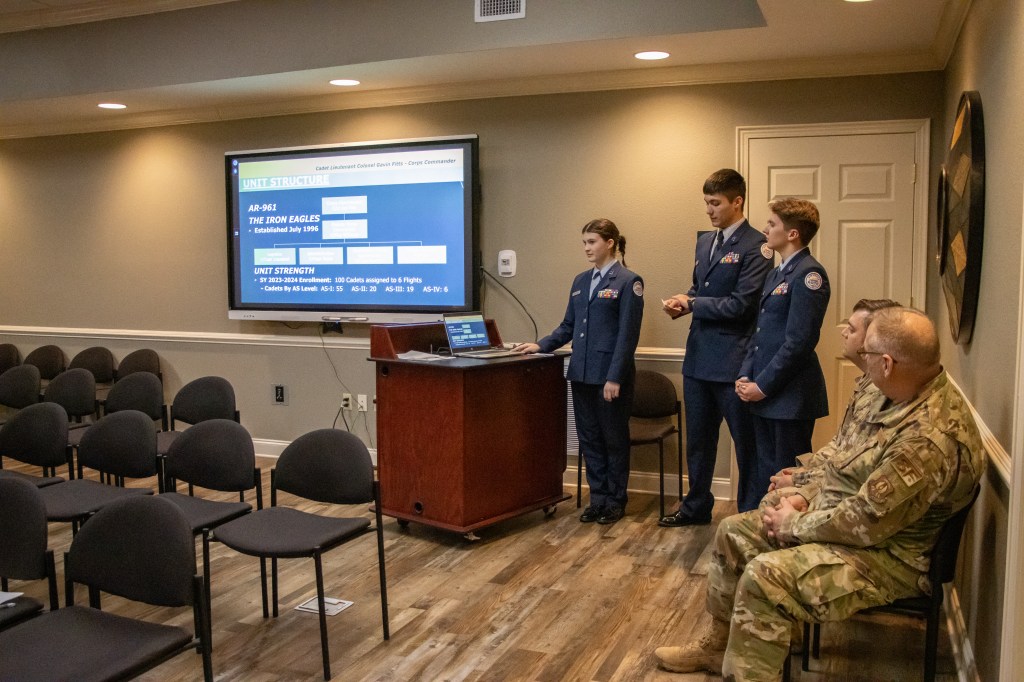
Three cadets from GCT’s Junior Reserve Officers’ Training Corps (JROTC) presented to the school board members detailing their organization’s 2023-2024 school year successes.
JROTC set school impact goals for the program over the next school year. The first goal was for 75% of cadets to receive at least a 2.0 GPA in regular education classes and a 3.0 GPA in the JROTC class. Deputy Corps Commander Cadet Bailee Williams said they are on track and expect to meet that goal by the end of the school year. The second goal of the program is to reach a 75% participation rate in non-mandatory activities for the 2023-2024 school year, of which they have passed with a participation rate of 97%. JROTC also wants to recruit at least 75 first-year students during their GCT Junior High School recruitment events while maintaining 70% of the corps.
Cadets from GCT give a presentation on their JROTC program on Feb. 15, 2024.
“Our unit is currently maintaining 87.5% of the corps for the upcoming spring semester,” Williams said. “We also have 80.6% of the corps expressing interest in reenrolling into JROTC next year.”
JROTC also set goals for the earning of community service hours. Currently, the unit earned 1,732 hours with an average of 17.32 hours per cadet.
Throughout the fall and spring semesters, JROTC raised $5,925 selling peanuts and bath bombs and $5,170 selling digital coupons and discount cards. JROTC will donate $700 to the family of a GCT student diagnosed with cancer and $500 to the family of an eighth grader who was involved in a car accident.
Superintendent Scott Gerrish said he appreciates the work Sgt. Scott Burlingame has put into JROTC and believes the program is worth all the effort.
In the meeting, the board also:
Reviewed how teachers feel about the implementation of the alternate calendar and early start.
Approved a second read of classified and licensed personnel policies.
Approved incoming and outgoing student transfer petitions.
Approved a resolution authorizing the district to request a waiver.
Approved a special education data system.
and renewed the district’s ASBA Worker’s Compensation Trust.
JONESBORO, Ark. — The Valley View Public School Board addressed progress on a 2-year construction project aimed at building new classrooms, a wing in the intermediate school building and a new cafeteria.
Valley View Public Schools District initiated the construction project two years ago with expectations to complete the initial phases at the same time. The newly constructed STEM wing in the administration building finished in mid-July, just before the academic year began and the developments of the intermediate school wing, new cafeteria and 15 additional classrooms remain ongoing.
“It’s definitely not in an area that everybody knows about,” Valley View Superintendent . Roland Popejoy said. “It’s south of an existing building and is a much-needed addition for our growth, for our intermediate building that serves students in grades three through six.”
“It’s definitely not in an area that everybody knows about,” Valley View Superintendent Roland Popejoy said. “It’s south of an existing building and is a much-needed addition for our growth, for our intermediate building that serves students in grades three through six.”
Supt. Roland Popejoy, Valley View School District
Justin Shrable, project manager, and Adam Seitor, executive vice-president of operations at Nabholz Construction, attended the school board meeting to update progress.
“We finally got things moving well over there (the intermediate wing),” Shrable said. “Right now, we are back filling, painting dry walls and we finished the last pouring of concrete for the courtyard.”
Shrable and Seitor addressed an issue regarding a connection between the new addition and the existing structure, which proved unfeasible due to different materials being used. They collaborated with architects, their construction company and engineers to devise a solution accommodating the existing structure.
Unexpected delays occurred due to issues with the geothermal heating, cooling and ventilation (HVAC) field and existing utilities, postponing construction by a year and a half. Completion estimates suggest that one part of the cafeteria/classroom will finish in April, while the other will be completed in August.
The board also sought approval for a lawn care and grounds maintenance contract, along with a project to replace the bus fuel station.
“Lawn care is an area that we have been discussing over the last year or so,” Popejoy said. “Potentially looking to outsource that as opposed to having grounds served by the staff of Valley View but by a contractor provider.”
The approved contract will ensure well-maintained grounds without ongoing overhead maintenance. However, the bus fuel station in the Valley View bus depot currently holds an older diesel tank which does not meet the code requirements, in regards to containment. The Jonesboro fire marshall spoke to the board about needing to replace it.
They identified solutions by various contract providers (in diesel and fuel) but tabled the proposal for a replacement project because they want to be “good stewards of the communities’ tax-paying money,” and are looking at all available options before making a final decision.
Upon returning from executive session, the board approved superintendent evaluations and the superintendent’s contract extension.
Laila Casiano is a junior in the multimedia journalism program in the School of Media and Journalism at Arkansas State University in Jonesboro. She can be reached at: laila.casiano@smail.astate.edu
NOTE: Featured photo shows from left, Valley View Public School Board members, Todd Reed, disbursing officer; Kristy Rowe, secretary; Sara Osment, assistant superintendent; Judy Clampit, chief financial officer; Roland Popejoy, superintendent; Richard Rogers, president; Lee Lane, vice president; Brant Tosh, Tyler Watkins and Ryan Gibson, alternate disbursing officer.
PARAGOULD, Ark. – Greene County Technical School Board approved a waiver to revise the 2023-2024 school year calendar in a special school board meeting yesterday.
The Greene County Technical School administration recommended the school board approve a waiver from the state department allowing the district to change the school year calendar from a traditional to an alternate calendar to make up for school days lost to inclement weather.
The waiver would allow the district to count the instructional minutes on the first day of school, Aug. 14, 2023, and count to the end of the calendar school year, May 24, 2024. The district has already been gathering extra instructional minutes throughout the school year but could not bank those minutes under a traditional calendar. Currently, the high school banks 365 instructional minutes daily, five minutes over the daily minimum. With the alternate calendar, the district can bank those extra five minutes a day and put them towards covering for inclement weather.
“By approving this waiver, we’ve banked enough time that out of the three snow days we missed this year, we can take two off and only be needing to make up one snow day,” GCT’s Supt. Scott Gerrish said.
“By approving this waiver, we’ve banked enough time that out of the three snow days we missed this year, we can take two off and only be needing to make up one snow day,”
GCT’s Supt. Scott Gerrish
The board voted to approve the waiver, which will remedy the school’s inability to use alternative methods of instruction, or AMI, days, due to the Arkansas Learns Act. The approval of this will mean the school now expects students to attend school Feb. 19, 2024, making up for instructional time lost during inclement weather. The school plans to announce the change through social media as early as Thursday, Feb. 1, 2024. Going forward, the state will expect the school board to revote on the alternate calendar each school year. President of the school board Tim Roswell said since there are no longer AMI days, banking extra instructional hours seems like the most logical way to make up for lost time and keep students from having to attend school in the last week of May 2024.
After time spent in executive session, the school board voted to suspend the expulsion of a student for the remainder of the 2023-2024 school year for breaking rule 10 of the GCT Junior High Handbook. Rule 10 prohibits students from possessing, receiving, huffing/inhaling or dispensing a controlled substance.
According to Tony Boyd, assistant principal of GCT Junior High School, he caught the student in question with a controlled substance Jan. 19. Once Boyd and the Student Resource Officer on duty confiscated the substance and had it tested, the substance came back positive for Tetrahydrocannabinol (THC). The Junior High School recommended the school board consider the student for suspended expulsion. Boyd said alternative school for one semester may be the best option for the student.
“I think that is going to be his best avenue. He deserves to at least have that shot,” Boyd said.
Suspended expulsion allows the student to still attend school but in a location of the school board’s choice. This option will stand as long as both the student and guardian comply with the rules set for suspended expulsion, which may include but are not limited to receiving school-based mental health counseling services, referral to Narcotics Anonymous or Alcoholics Anonymous programs, drug testing, passing classes and so on.
Christi Sims, GCT administrative assistant, said, “Not all schools do the suspended expulsion. It’s just something we do to give our students another chance.”
The guardian of the student initially intended to read an apology letter the student wrote to the school board but was unable to attend the meeting due to personal reasons.
In other business:
The board read the first revisions of Licensed and Classified Personnel Policies, which did not require the board to take action.
The board also approved an annual trip to St. Louis, Missouri, for GCT’s gifted and talented program, PACE.
The board approved outgoing student transfer petitions and a personnel list.
On Friday, November 10, the ASU mechanical engineering department hosted a robotics competition for local middle school students. The event took place at Centennial Hall in the Student Union from 9:30 AM to 1 PM.
The competition was mostly for eighth grade students that are participating in their schools’ EAST program. EAST (Environmental and Spatial Technology) is a national education model, first established in Arkansas, that fosters technology training, teamwork, problem solving, and service projects.
Nine teams from nearby schools were expected to show up, including Buffalo Island Central Junior High, Annie Camp Junior High, Jonesboro Visual and Performing Arts School, Highland Middle School, Marked Tree Elementary, and East Poinsett County High School.
The purpose of the event was to reach out to local schools, promote ASU, and foster a love of engineering, according to mechanical engineering student ambassador Morgan Diamond. It was completely arranged by mechanical engineering students and supported by the Kays Foundation.
“We want to reach out to the schools, tell them about Arkansas State University, but also foster hopefully a love for engineering and robotics, STEM careers,” Diamond said. “Getting them involved…in a design-oriented competition pretty early on is big for development…”
“So even if they don’t go here, they go somewhere else,” said Landon Perdue, another student ambassador. “We want to foster the next generation.”
Students Keagan Hicks, Cooper Hunt, and Kaleb Hirsch work on their robot.
The competition is usually held every year during fall. It was previously hosted at other local schools for several years, but they decided to have it on campus this year. They wanted for the event to be more accessible to other schools that are further away.
Every school attending is allowed two teams consisting of four students. Some chose to only bring one team. Altogether, they expected around thirty-five to forty students to show up. Teachers, family members, and friends were also allowed to attend for support.
Each of the teams is provided with a kit a couple of weeks before the competition that they can use to build a robot. At the competition, they have to use that robot to pick up blocks and navigate an obstacle course to drop the blocks in a basket.
“There are several schools that do not have a robotics program, they’re starting fresh, so we are most happy to help,” said Dr. Shivan Haran, the director and a professor of mechanical engineering overseeing the event. “We even told them…come by, we’ll even show your kids how to put this together…”
Whichever team deposits the most blocks wins the competition. Points are deducted if the robot breaks things. The blocks are strategically placed, some in areas that are difficult to reach and some that are easier.
“The goal of that was actually to maybe help develop critical thinking skills and time management and time management, like we don’t want to go for that block, that’s in a hard spot, instead we’re going to try and take a route to get all the easy ones,” Diamond said.
Additionally, because every team designs their robot in a different way, some blocks will be hard to get for one team while they will be easy for another, and vice-versa. The top three teams that get the most blocks each win a trophy.
“We don’t want them to think robotics is something stressful and hard. We want them to think of it as easy and fun, something accessible,” Diamond said.
“The goal here is to get a basic foundation of what robotics is like,” Perdue said.
For a student there from Buffalo Island Central named Henry Sills, it was his second time competing. He’s in eighth grade and learned about robotics in his EAST class, which he has been in for a year.
“Robotics has always been something I’ve been interested in, the actual building of it and the coding,” Sills said.
A group of students from East Poinsett–Christopher, Dalton, Bella, and Jumaro–was there for the first time. They’re also all in the eighth grade, and it’s their first year learning robotics in their EAST program.
Avery Jonesis a junior in the Department of English and Philosophy at Arkansas State University in Jonesboro. She can be reached at: avery.jones@smail.astate.edu
NOTE: Feature photo by Atsuki Ohbuchi of students Annie Shepherd and Vignesh Nair. Other photo in article also by Atsuki Ohbuchi.
Lauren McDaniel-Carter, founder of ACRES, with a student, Jonah Sharma.
Microschooling is a growing trend in education. According to The Reform Alliance, a nonprofit in Arkansas concerned with connecting families with education options, microschooling is comparable to the one-room schoolhouse concept. In a microschool, a small group of students meets for a certain amount of days a week to learn together.
It’s separate from a public or private school and falls under the category of homeschooling. Microschooling can either be a child’s main form of learning or a supplement to their homeschooling.
Laurie Lee from The Reform Alliance said that microschooling is becoming more popular because of the past closures of schools due to the recent pandemic; parents have also become more concerned with the state of education. Families want to have a stronger role in their children’s education.
“The great thing about a microschool is that you can’t put it in a box…It’s truly family, community-led,” Lee said.
There’s no definite beginning point for when microschools became a concept. There have been communities and homeschool families who have engaged in group learning before microschooling became popular. However, Lee states that a significant turning point in the microschool movement was the establishment of Prenda, an organization that helps to start microschools.
Prenda was inadvertently started by Kelly Smith in Arizona. He thought students needed a bigger emphasis on STEM in their education. His group grew, and now the organization helps other microschools by providing curricula and advice regarding the technicalities of microschooling.
“I think the verbiage, microschool, the name, might be more new than the concept,” Lee said.
According to Lauren McDaniel-Carter, founder of ACRES, a local microschool, there’s no strict definition of a microschool because the group gets to define it for themselves. There’s a lot of gray area.
“I’ve been calling mine somewhere between a homeschool co-op and a private school,” McDaniel-Carter said.
Her school opened this August. She planned to take no more than fifteen students from the age groups of kindergarteners to fourth graders.
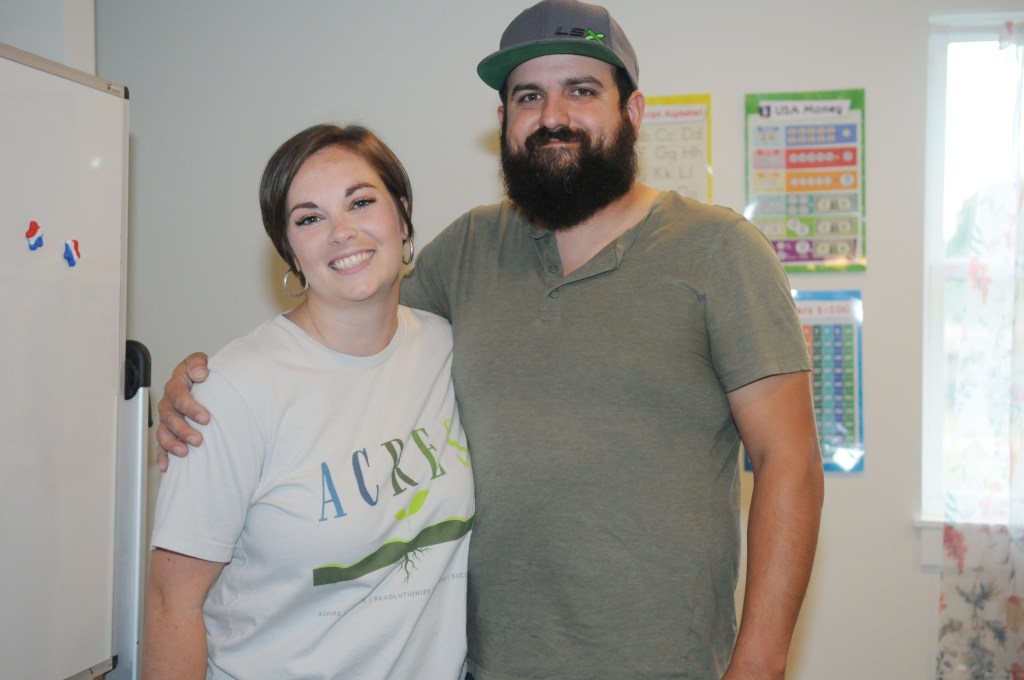
Lauren McDaniel-Carter and her husband, Nathan Carter.
According to Lee, microschools aren’t limited by age group. Some of the schools that The Reform Alliance has helped to set up only take students from kindergarten to third grade whereas others are K-12. The kids usually aren’t separated by age group or grade, either; they all learn together.
“I think the environment breeds a different day every day,” Lee said. “This model is set up to fit the needs of the people that are using it…We’ve seen extreme growth in students in these models over the last three or four years we’ve been actively working in them.”
McDaniel-Carter’s ACRES will focus on the core subjects of language arts and math. The students will use mainly online curricula and depending on the individual’s pace, it will probably take about two hours a day.
The programs used will be completely secular. McDaniel-Carter doesn’t plan to incorporate any religious teachings into the students’ work.
The students will work on computers, but they will be allowed to take breaks and go at their own pace. Additionally, the students don’t have to work on the same subject or curriculum at the same time.
“Rather than [having] these long, extended blocks where kids have to sit still in desks…they can be kind of where they want, they can take breaks…” McDaniel-Carter said. “They may be working on different programs, too. It’s not a one-size-fits-all curriculum…It’s just whatever the kids kind of need at that moment.”
For other subjects like science and social studies, she plans to use a projects-based and hands-on approach. She will also offer “enrichment” subjects like arts and language learning as well as time for unstructured socialization and play.
Her vision is to have the kids “take ownership of their learning.” She wants to have them determine what subject they want to master in a certain amount of time.
“This is the stuff that gets kids excited about school and learning, when they get to do stuff that they’re interested in, and a lot of the times in public school, you only see those opportunities being given to the kids who are excelling,” McDaniel-Carter said. “That kind of learning should not be just reserved for the ‘gifted’ kids. Anybody should have access to it. The fact that kids don’t like school is not a reflection of them, it’s a reflection of the school.”
Nathan Carter with students Skyler Armitage and Hazel Sharma.
McDaniel-Carter will guide the kids in the learning process. According to The Reform Alliance, it’s normal for microschools to have “learning guides,” but they don’t have to be certified teachers. McDaniel-Carter wants to eventually be able to hire a part-time learning guide to help.
Unlike public or private school, mastery will not be determined by a score on a standardized test. Students will move on when they’re ready instead of whenever the teacher determines they can move on.
In this way, the kids will not be compared to each other. They aren’t competing with grades, and since each student will be allowed to go at their own pace, they won’t be pulled out of the class for intervention or forced to move on before they’re ready.
Lee said that “Educators are starting to understand that student-focused and student-led days are more productive for kids to learn than a very rote, lecture-style classroom.”
She further stated that children should be taught like they’re going to be adults, which they will be eventually. Adults get to structure their own day and have to prioritize.
If they don’t complete their tasks for the day, those tasks have to roll over into the next day. Children need to learn these skills in environments which will teach them real-life consequences.
At ACRES, to measure her students’ progress, McDaniel-Carter will be able to see how they’re doing on their online programs and what they’re struggling with. She can share progress reports with the students’ families to keep them involved.
Additionally, everything the students do in their project-based learning time will be compiled in a portfolio. She also hopes to implement a badge system in which students will earn badges for certain achievements. Eventually, she wants to be able to host an end-of-the-year showcase to share the students’ accomplishments.
Measuring progress is usually up to the learning guide, according to Lee, but with the new LEARNS act, any school taking EFA funds will have to test students every year with a test set up at the national level. These tests will determine the sustainability of that program.
At ACRES, families will be able to determine how many days their children will attend. Some people might want to only come two days a week as a way to supplement their education at home, while others will want to come all five days as their main source of education.
Additionally, the tuition cost depends on how many days they want to attend. This makes it more accessible for even low-income families.
McDaniel-Carter has also invested much of her personal funds into the school. The school is located at her house in a room they built specifically to be multipurpose.
Lee at The Reform Alliance stated that microschools can be hosted virtually anywhere. She’s seen schools held in someone’s kitchen, repurposed buildings, and churches.
Before McDaniel-Carter decided to start a microschool, she worked as a public school teacher for eleven years. However, it wasn’t for her, and when her husband suggested that she start a “pod school,” she liked the concept of that.
“I can’t believe I lasted that long,” McDaniel-Carter said. “Honestly, I can remember doing my student teaching and thinking, I can’t do this for thirty years.”
She posted in a Facebook group to ask if anyone would be interested in a microschool, and in a couple of hours, she had around eighty responses. The process of starting a microschool has been “surprisingly smooth” for her. She said that she felt like she was following a path instead of trying to carve one.
The most difficult part was trying to get people to commit to the school. People are often reluctant to try something new. In June, she had eleven applications, but people are often prone to drop out or apply at the last minute.
Also, there’s not much clarity on the mandates regarding homeschooling, especially with the added confusion of the new Arkansas LEARNS act. The money provided by the act would be beneficial for her school.
“It would be nice, I feel like, if there was some clarity on what a microschool is and what governs it,” McDaniel-Carter said. “I would love to have access to that money. How that’s going to happen, I don’t know because there’s so little clarity in the act…if the financial barrier is removed, that opens us up to a lot more people.”
According to Lee, The Reform Alliance has set up and assisted in setting up several microschools. On July 22, they hosted a microschool conference in Little Rock where attendees learned about microschooling from the National Microschooling Center.
Avery Jonesis a junior in the Department of English and Philosophy at Arkansas State University in Jonesboro. She can be reached at: avery.jones@smail.astate.edu
NOTE: Feature photo of Lauren McDaniel-Carter and her students at ACRES by Atsuki Ohbuchi.All other photos in article also by Atsuki Ohbuchi.