JONESBORO, Ark. – The younger population of Arkansas appears to be leaving and even the agricultural business of Arkansas cannot persuade many to stay as the challenges ahead drive many new and younger generations of possible workers away.
According to the U.S. 2020 census results on PopulationU.com, Arkansas’ current population is around 3,042,231 people. The population is slowly rising over the year, however according to Arkansas Census Data: Age & Sex by County (a database created from the U.S. Census Bureau of 2000) stated only 9.4% of the total population of the 2000 census was 18-24. So, while the population is slowly rising, the number of younger residents and generations who stay is very low. This could be for a variety of reasons. Arkansas being ranked 13th place in agriculture, one may think the agriculture business would be able to keep younger generations interested in agriculture. That does not seem to be the case though as challenges and issues regarding agricultural business could be persuading them to look elsewhere for work in other states or even professions.
These ideas of challenges and problems are not all rumor as even those who have been working agriculture for years have seen some of them.
“There’s a lot of competition for land. Because it is a productive area, it’s real competitive and so people might be leaving this area because they’re just not finding opportunities here. It’s hard for someone who’s not established and it’s hard to find land to farm” said David Hodges, a retired Northeast Arkansas cattle and row crop farmer.
Hodges has been in the agricultural business for 40 years all the way back in the 1980s. Hodges developed a fascination for agriculture when he was young working on his parent’s farms and many others over the course of his life then he started his own after graduating from A-State and getting the loans needed to start his own farm.
Hodges said issues with loans when he was a student were different, as student debt today
is higher today than Hodge’s student debt when he was a student. Hodges said a challenge of newer farmers is finding land that can be used due to the competitive market agriculture has. Hodges mentions the market is competitive due to Arkansas’ good soil and agricultural status.
Hodges does not believe he was offered any advantage over anyone except a college degree in agriculture and being a local with expertise in farm work. Hodges said he believes that should be expected of any good agriculture worker looking to thrive.
Hodges does see the issues newer farmers face in such a competitive setting and that the financial challenges he faced are now far greater as the years have passed. Hodges is not alone in that thought process as other agricultural experts think the same about Arkansas farming loans.
“It’s very difficult for a young person to get started in agriculture it’s extremely expensive loans aren’t always available for them to fund an operation. You almost have to be an operation that’s owned by your family to work into a position” said Bill Shannon of Farmers National Co.
Shannon said loans and money just as much of a massive issue like Hodges said, but mentioned a loan can have up to $1,000,000 for most people just to get off the ground.
Shannon said all the money a newer agriculture worker would need to start a business would be hard to get for a newer worker. Most of them would need to have a form of collateral to even get the loan, which many would most likely not have, said Shannon.
Shannon said it’s easy to get a loan however, as many banks and operations like Arkansas Farm Services offer various loans to those in need of them. Shannon warned of loans and their ability to leave someone in debt, especially an agriculture college student who are the likely candidates for newer farmers in need of a loan.
It’s not just people like Shannon and Hodges who believe these problems exist. As even the Arkansas Department of Agriculture agreed with what they say.
“It’s a huge financial commitment. If they’re just getting started and don’t have the ability to borrow money or don’t want to borrow the huge sums, it’s just a lot” said Cynthia Edwards, deputy secretary of the Arkansas Department of Agriculture.
Edwards brought up a way to lessen the effects newer farmers could experience. Edwards said at the Arkansas Department of Agriculture has seen newer farmers start out in smaller operations that go away from the more competitive and abundant row crop business that many Arkansas farmers have. These operations include smaller livestock or specialty crop business like fruits and vegetables.
So, whether it be financial issues, a competitive environment, lack of land or even college debt that keeps newer and younger farmers from staying in Arkansas, hope remains in the Arkansas agriculture community. As the experts have said, they need to understand the challenges the will face and how to overcome them. Whether it be through family, experience or starting small and working their way up. People might be leaving, but perhaps in the future agriculture will be the reason they stay.
-30-
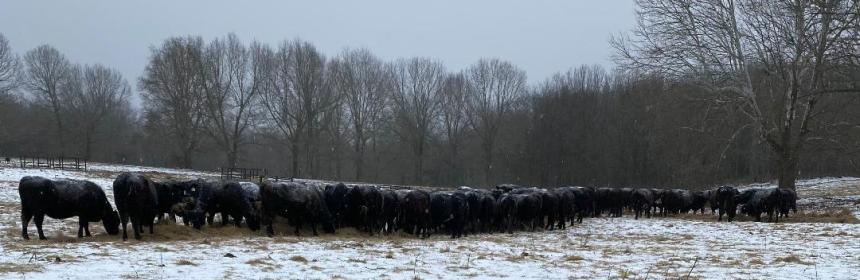
NOTE: Featured Photo | A herd of cattle at the Eric Eaves Cattle Farm. These cattle are the kinds of cattle agricultural experts like Bill Shannon and Cynthia Edwards say newer agriculture business should invest in. (Photo by Kenneth Lucas)
WALNUT RIDGE, Ark. – As winter weather pushes through Arkansas, city and state road crews are taking all precautions as they treat primary roads to keep transportation from freezing up.
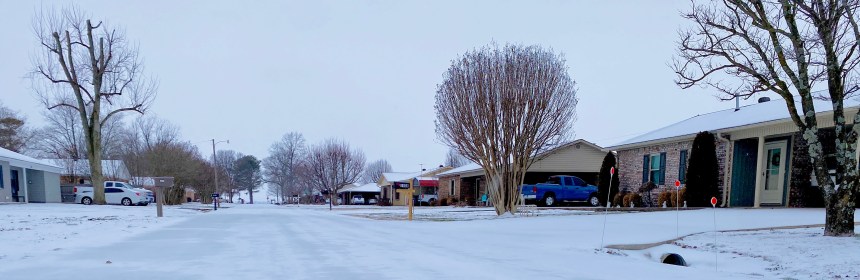
Arkansas sees its fair share of winter weather. The winter system that made its way into eastern Arkansas is no exception. The first round of sleet and snow began falling Monday night and continued with a second and third round Tuesday. When roads are in prime condition to freeze over, preparation by road crews keeps them from being unusable.
Lawrence County has many highly trafficked highways leading to bigger cities. During inclement weather, the Arkansas Department of Transportation sends out crews in District 10 to treat these roads. Brad Smithee, District 10 engineer for ARDOT, said crews try to treat roads 24 hours in advance to get the best results.
“We look at a lot of forecasting in order to keep up with the weather. We have close connections with National Weather Service, and we send out crews as soon as we get word of bad weather,” Smithee said. Treating roads when the weather has begun is not ideal, but weather is unpredictable, and crews will do whatever it takes to keep transportation running.
According to Smithee, the roads are pretreated with a brine. “The brine is a saltwater solution that forms a barrier between the pavement and the snow, making it easier to plow.” When the brine is put onto a road it forms a crust, and the crust forms best when the solution is dispersed when it is raining “low and slow.” ARDOT crews also use rock salt to treat roads, but it is not the best treatment when there are a lot of roads to cover.
While ARDOT focuses on main highways, city road departments take care of almost everything else. Walnut Ridge Mayor Charles Snapp said the city owns two salt trucks that are sent to treat roads when bad weather is coming. However, salt trucks release another useful ingredient when running their routes.
“We use beet juice as a pretreatment for our roads,” Snapp said. “Beet juice is a gooey substance and it sticks to the roads better. If it is windy, the wind will just blow the salt away.” Beet juice comes in handy when treating roads because it can be cheaper than salt at some times. Walnut Ridge received three shipments of salt in December, and they only have about one-fourth left to last the rest of winter.
According to Snapp, treating roads with beet juice first, then rock salt is proving to be the best way to clear the primary roads of the city. Road crews first clear roads leading to the hospital, then primary roads leading to Williams Baptist University, then the courthouse and lastly the sheriff’s office. Snapp said he plans to keep using this treatment as it works best for Walnut Ridge.
Once the road crews have treated the roads, they do routine maintenance to keep them clear. But even these treatments will not be completely effective. Drivers still need to be cautious while driving in winter weather. The smallest ice patches can cause an accident. Reece Archer, a dispatcher for the Walnut Ridge Police, said accident reports rise at least 30% during winter weather. Drivers need to know which roads are unsafe for travel during ice or snow. Checking IDrive Arkansas before traveling is a good way to see if there are any road closings or roads to avoid.
JONESBORO, Ark. – Local journalist and author George Jared is set to deliver a presentation on investigative journalism at Arkansas State University in the auditorium of the Rent Student Union Center on Tuesday, February 7. The public event is from 6 to 8 pm and coincides with the 50th anniversary of the U.S. Senate’s unanimous vote to create the select committee to investigate the Watergate break-in.
As a journalist, Jared has been covering topics like crime, business, politics, government, healthcare, entertainment, and agriculture for nearly 20 years.
Journalist and Author George Jared
He has won several awards for his writings, including first place awards from the Associated Press Media Editors. He has also written novels, hosted podcasts, and been interviewed by a variety of newspapers and podcasts. Jared has given two presentations at CrimeCon, an immersive, weekend-long true crime convention that brings together thousands of fans of the genre.
He has written most extensively about the Rebekah Gould murder case and the West Memphis Three. The Gould case was featured in two of his books, The Creek Side Bones and Whispers in the Willows, as well as news articles. Jared wrote 100 articles about the West Memphis Three and chronicled his experiences in another book, Witches in West Memphis.
Jared started his career as a journalist in 2004. He is a graduate of Lyon College with a major in history and a minor in political science. He originally thought he wanted to be a lawyer.
He won awards participating in moot court during college and enjoyed it. However, he stated that he met “some miserable lawyers” and became disillusioned with the career. He always knew, though, that he wanted to be a writer of some kind.
Born in Lubbock, Texas, Jared spent his childhood in Salem, Ore. as a kid, where he loved reading and writing. When he was a teenager, he lived in Salem, Ark., and wrote for the newspaper at his high school.
After he graduated college, he started writing for the newspaper in Salem, Arkansas, then soon got a job with Gannett, where he worked for a year. However, he missed his former boss, David Cox, so he decided to return to Salem.
Unfortunately, there were no writing jobs available, so he had to take a sales job, and he wrote on the side. He worked in sales for a couple years, then took a writing job with the Jonesboro Sun.
In 2004, while working at the newspaper in Salem, Arkansas, he began covering the Rebekah Gould murder case from Melbourne, Arkansas. This would be the first murder case he would cover.
When Gould’s murderer, William Miller, confessed in 2020, he said that he hated Jared. He confessed on November 7, Jared’s birthday, and was in Cottage Grove, Oregon, near where Jared grew up.
“That was very ironic for me,” Jared said.
Jared covered Miller’s trial in court. He was sitting with Dr. Gould, Rebekah Gould’s father, when Gould gave his victim impact statement. According to Jared, Miller didn’t look at Dr. Gould, but stared at Jared instead.
The case Jared has written about the most is the ‘West Memphis Three’. “That case has taken me all over the country and the world because of how insane it is,” he said.
He interviewed Damien Echols on Death Row in 2010 and is still keeps in contact with him today. The pair ate dinner together in Memphis in June of last year.
He also interviewed Terry Hobbs, the stepfather of one of the victims, who has been a suspect in the case. According to Jared, Hobbs rarely agrees to interviews. Jared recorded the interview over Zoom so that he could present the video at CrimeCon 2020, where it was analyzed by Jim Clemente, the executive producer of the TV show “Criminal Minds.”
While Jared’s investigative journalism has been a significant part of his career, he has reported on a variety of subjects. His areas of expertise are business, politics, entertainment, and even agriculture. He said that his favorite thing to write is feature stories.
Currently Jared writes for a company called Talk Business & Politics based in Little Rock, where he covers mostly business and politics in northeast Arkansas. A significant part of that is agriculture.
According to Jared, the Arkansas Farm Bureau told him that he’s the only reporter in the state who still covers subjects like soybeans, rice, and cotton. Jared can also sometimes be heard on early morning agriculture talk radio shows.
He has also interviewed several high profile politicians such as Sen. Tom Cotton (R) , former Gov. Asa Hutchinson, and has met a few presidents. He has done stories with celebrities like William Shatner, Barbara Eden, Johnny Depp, Eddie Vedder, and Natalie Maines.
Jared also interviewed Bob Dorough, famous jazz pianist and composer and performer of several Schoolhouse Rock! songs, a week before he died in 2018. Dorough was an Arkansas native, but had been all over the world. According to Jared, Dorough refused at first to do the interview with Jared, but called him not much later to take up the offer.
Jared wrote a series of articles about Holocaust survivors and included their stories in his book Whispers in the Willows. The Black River Technical College in Pocahontas, Arkansas, would host a Holocaust survivor for presentations once a year.
Jared covered Henry Greenbaum and Estelle Laughlin. He had visited some concentration camps during college and admired Greenbaum’s story.
“That story ripped my guts out,” Jared said.
Today, Jared rarely writes crime stories for work since the newspaper he currently writes for doesn’t cover that. However, he’s currently partnering with a criminology professor named Jennifer Bucholtz to cover crime on the side.
Bucholtz currently works for the American Military University. She was previously a counterintelligence officer in the U.S. Army. Bucholtz once heard Jared on a podcast discussing the Gould case and wanted to use it for a case study in her classroom.
She emailed him to talk, and the first time they called each other, they talked for over 3 hours, according to Jared. They decided to work together because their areas of expertise are different enough that they’re able to supplement each other’s work.
“Immediately I knew that she was a deadly serious human being,” Jared said. “She’s a wonderful writer…and very well-spoken.”
Together, they developed a criteria for deciding what cases to pursue. They also have a network of people to consult–for example, a knife expert and an arson expert. People send them cases, and they put them through their vetting process.
The criteria they use include solvability, family buy-in, and access to case files. According to Jared, if a case is’t solved, it’s usually because an investigator missed an important detail. If the case meets all the criteria, they’ll start investigating it.
They worked together on Gould’s case and made a Facebook page for discussion. A year before he was arrested, the killer had been posting theories about her death on the page and even direct messaging both Jared and Bucholtz. They presented the Gould case at CrimeCon 2021.
They’re currently working on two new cases: the murder of Judy Petty from West Virginia and the murder of Linda Malcom from Washington, both in 2008. They’ll host a podcast covering it, and Bucholtz is planning to write a series of articles about it for the American Military University magazine.
Jared has worked with a few other people in addition to Bucholtz who have furthered his career. He stated that his first boss, the editor of the newspaper in Salem, Arkansas, David Cox, taught him how to be a journalist.
“He kind of took me under his wing,” Jared said. “He taught me how to write. One thing I learned early on in journalism…is always tell a good story.”
“He kind of took me under his wing,” Jared said. “He taught me how to write. One thing I learned early on in journalism…is always tell a good story.”
– George Jared
He also admired two professors he knew at Lyon College, Dr. Scott Roulier and Dr. David Harrison. Roulier was his moot court coach and constitutional law professor, and Harrison taught him about writing and history.
Jared also finds inspiration in literature. James Michener and Sir Conan Doyle are among his favorite authors. The novels Raintree County by Ross Lockridge Jr. and Dracula by Bram Stoker are significant for him.
Jared’s education at Lyon College and brief interlude as a salesman were beneficial for his career as well. He finds that he’s able to use his skills in history and political science for his stories. He likes to do research on the background of a story and then incorporate that into his writing.
“I wrote a story about rice one time, and what I did to start the story is I went into the history of humans cultivating rice,” Jared said. “I would find some nuanced way to get into the story.”
He uses the skills he learned as a salesman when he’s interviewing and getting information out of sources. He found that the aggression used to get someone to buy something they don’t want is necessary when talking with people who don’t want to talk.
Jared stated that when he’s faced with difficult situations, he never hesitates to do what’s important. For instance, he’s not afraid to ask tough questions during interviews or take pictures of people mourning over their loved ones.
“People have asked me, ‘Don’t you feel callous in those moments?’” Jared said. “And I’m like, ‘No.’ I said, ‘We have to document that type of history…sometimes you gotta do the tough thing.’”
“People have asked me, ‘Don’t you feel callous in those moments?’” Jared said. “And I’m like, ‘No.’ I said, ‘We have to document that type of history…sometimes you gotta do the tough thing.’”
– George Jared
To aspiring journalists, Jared said to write for their reader and think about what the reader would find interesting. It’s important to open the story with a good hook or the “magic moment” that would pull the reader in.
Jared will be hosting a presentation at Arkansas State University on Tuesday February 7 for anyone who’s interested in his work. He plans to talk about his experiences as a journalist and his two most prominent cases, the Gould case and the West Memphis Three.
Two professors from the faculty are planning to attend. Mr. Terrence Armstard, a journalism instructor, will be introducing Jared and Dr. Angelo Brown, a criminology professor, will be doing the Q&A at the end.
“I think it’s great for Mr. Jared to come and share his experiences as a professional journalist with our students,” Armstard said. “His background as a true investigative journalist and author as well as having a podcast reveals to students the plethora of career possibilities available as a journalist.”
“Journalists like George Jared can greatly impact the criminal justice system in a positive way as it can help highlight errors in the system to push reform forward and highlight bad actors within the system,” Brown said. “As Jared’s work has highlighted the errors in the West Memphis case and the violation of the civil rights of the defendants, there are countless examples of justice being brought through the help of journalism.”
Avery Jones is a sophomore in The Department of English and Philosophy at Arkansas State University in Jonesboro, Arkansas. She can be reached at avery.jones@smail.astate.edu