Tag Archives: China

Year of the Dragon-NEA residents celebrate Chinese New Year

Delta Digital News Service

Friday, Feb. 9, 2024

By Avery Jones | Editor

JONESBORO, Ark. – Chinese New Year is a celebration based on the lunar calendar rather than the Gregorian calendar, which is the calendar used in the U.S. as well as many other parts of the world. 

The year begins with the first new moon of the year, which falls around the end of January and into February, and lasts for several days until the moon is full again. Each year is represented by a different animal of the Chinese zodiac; this year is the Year of the Dragon.

This year, the first day of Lunar New Year is on February 10. However, it’s not only celebrated in China, but in many East Asian communities around the world, including here in Jonesboro.

This year the Jonesboro Chinese Baptist Church will host a New Year’s party on February 10 at the Baptist Collegiate Ministry building on the ASU Jonesboro campus from 5 p.m. to 8:30 p.m. There is no entry fee and the event is open to anyone.

Greg Meeks is pastor of the church and helped to start the celebration. In Taiwan, he was the superintendent of an international Christian English-speaking school. Meeks worked in Taiwan for over 20 years as a missionary before moving back to Arkansas to teach at Arkansas State University.

At ASU, Meeks taught a classes with many international students, mostly Chinese. It was this class that gave birth to the Chinese Church.

“It just kind of morphed into a Chinese class, and as time [went] on, it grew larger and ended up starting services and just continued from there,” Meeks stated.

The celebration is adorned with food, traditional Chinese customs, a musical program, Bingo and gift card drawings. Children often perform songs or play musical instruments.

Members find out about the event through various venues such as the Chinese grocery store, Chinese restaurants, and Chinese university students.

Meeks describes the event as a “social ministry.” In the past, they have attempted to get contact information from attendees and encourage them to visit the church. However, it’s a very relaxed event for celebrating the New Year and not for evangelizing.

“One of our core purposes is to give Chinese a sense of family because there are expats here in the U.S…most of them still have family in China and other places,” he said. 

There are many traditional customs associated with Chinese New Year, and those who attend the church’s party usually adhere to a few of them. For instance, many of the attendees will wear more traditional Chinese dress, and many also wear red as well since red is considered a celebratory color.

In addition, fish is commonly served during Chinese New Year meals in accordance with the Chinese saying–literally translated–“Always have fish.” Fish is considered a blessing for prosperity. Another common custom is to gift their children red envelopes containing money.
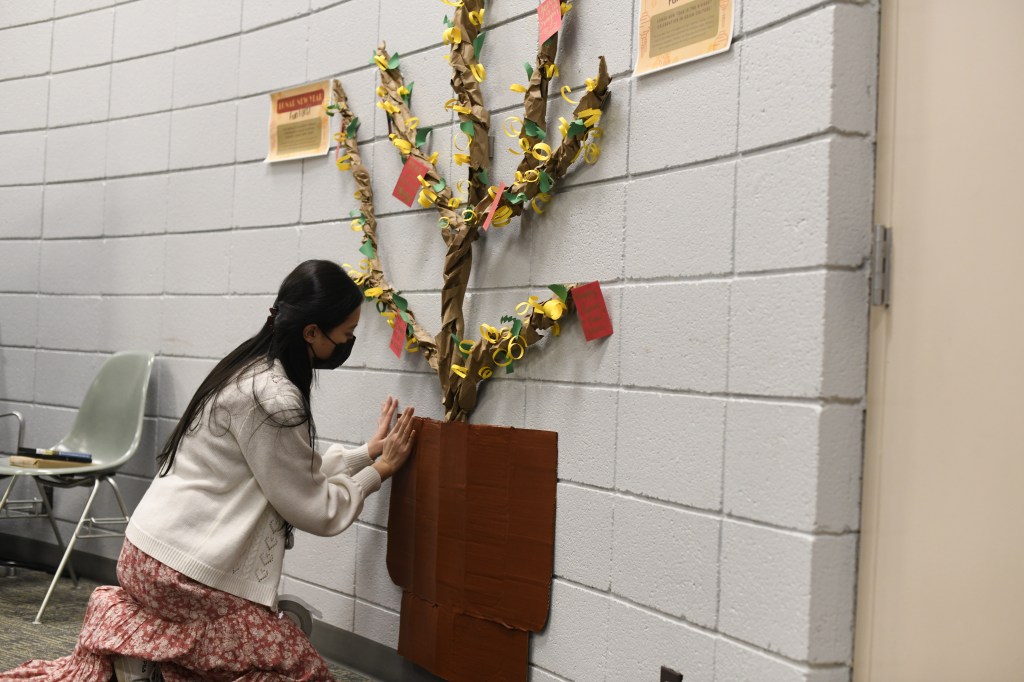
Ali Tran of Craighead County-Jonesboro Public Library prepares for the Chinese New Year celebration.

The Craighead County Jonesboro Public Library also hosted a celebration for Lunar New Year. Friday, February 9, starting at 4:30 p.m. in the Round Room. Festivities included two sessions of story time followed by crafts with light refreshments.

This was the first in-person version of the program that the library hosted. According to Ali Tran, adult services staff at the library, the library is trying to host more events that showcase the diversity of the local community.

“It’s a learning experience for parts of our community who may not know about this cultural celebration, but it also provides a safe space for our minority groups to come in and celebrate parts of their culture,” Tran said. “We want to try to reach out to more diverse groups in our community and uplift them, raise awareness about the different cultures we have even here in Jonesboro.”

-30-


NOTE: Feature photo by Ivan Aleksic on Unsplash

OPINION: Mulan – Learning from a Chinese feminist icon

By Yu Bai
Delta Digital News Service

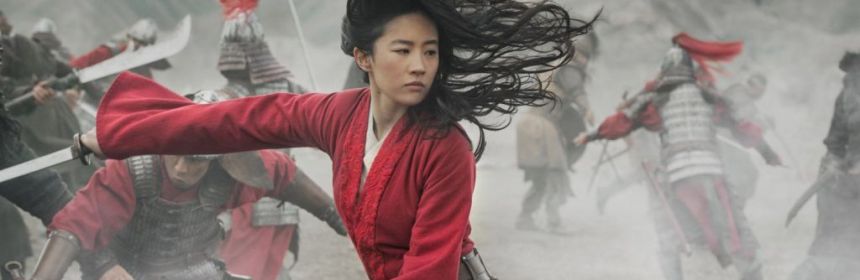
The origin of Mulan’s story can be traced back several centuries and before it became a much-loved cartoon image created by Disney in the 90s. This year, film director Niki Caro adapted the story into a live-action movie for the big screen.

Yu Bai/ DDNS Social Media Coordinator

Yifei Liu, the actress cast as Hua Mulan, is the first Chinese actress selected to star in a Disney movie. This historic casting is one of the reasons the movie has demanded a huge box office in China.  As such, Liu as Mulan represents the breaking of traditional societal constraints of Chinese women.

The story of a Mulan is that of a Chinese woman who disguised herself as a man in order to replace her elderly father in the army. As a solider, Mulan would inevitably engage in combat, eventually becoming a heroine on the battlefield.

Mulan is witty, brave, and self-conscious. She is the ordinary girl who became extraordinary – the ‘heroine’ that everyone hopes become. When her country needs her, she stepped forward and made the sacrifice. More importantly, her actions were not driven by the actions of men as were most Chinese women at that time. Mulan proved through her efforts that women also have the strength to protect and defend their families.

The boldness of her choice is evident, as hundreds of years ago, China was a feudal society where women were subordinate to men. Mulan reflects the hardworking, kind, and brave character found in traditional Chinese women which inspired future women to strive for self-improvement and challenge the status quo.

The story also teaches young women an important lesson  – the pursuit of a self-satisfying identity can only happen when you shed society’s “good girl” constraints to become who you were meant to be inside.

In addition, the legend of Mulan has created a new understanding of how traditional eastern women are defined in Western culture. Whether in fairy tales or in Disney animated films, the traditional European and American princesses are always gentle and innocent, waiting to be rescued by the prince. However, as a warrior Mulan subverts this tradition.

At the end of the story, when Mulan plucked up the courage to return home, her father accepts her as she is. It conveys the attitude of family tolerance — no matter what happens, your family will always welcome you home.

In the development of the Chinese film market, there are also many outstanding actresses representing the spirit of Mulan. Successfully breaking into the Hollywood film industry, Chinese-American actress such as, Lucy Liu, known for the “Charlie Girl” series, was nominated for an Oscar in 2013. In addition, Ziyi Zhang, known for the character of Yu Jiaolong in the 1999 martial arts film, “Crouching Tiger, Hidden Dragon,” won the American Independent Spirit Award for Best Supporting Actress. In 2005, Zhang was shortlisted for best actress during the 63rd American Film and Television Golden Globe Awards for her film, “Memoirs of a Geisha”.

More and more Chinese actresses appear in Hollywood films breaking Hollywood movie tradition by playing roles that have historically been dominated by European and American actors and actresses.

Li’s portrayal of Mulan in the film shows a young woman who becomes a legendary feminist icon by daring to challenge and break the mold of traditional gender roles.

Editor’s Note: (Feature Image credit: Disney)


Trade War Brings Struggles to Farmers

By Tristan Bennett
Delta Digital News Service

JONESBORO – Arkansas farmers continue a fight with a competitor halfway across the world. The trade war with China drags on with steady impact.

For the second harvest season, Arkansas farmers experienced lower prices for their crops as a result of a tariff war with China. Joe Christian, owner and operator of JOC Farms Partnership, sees first-hand the negative impact of the trade war.

“This summer, prices were down to $8.50 a bushel for soybeans and even less. That’s $2 below production costs,” he said.

The low prices stem from a decrease in demand for exporting agricultural commodities. Farmers across the nation struggle to make ends meet in the wake of harsh tariffs imposed by China to specifically hurt American agriculture.

Scott Stiles, an economist with the Cooperative Extension Service, said this all began when the Trump administration added tariffs to aluminum and steel imports in April 2018. In response, China imposed a 25% import tariff on U.S. soybeans, grain sorghum, cotton and several more agricultural commodities as well as several other industries.

“They chose to go after a segment of the U.S. population that would really get the president’s attention,” he said. “Hitting the ag (agriculture) sector could be something that could really be detrimental to the president’s political future,” Stiles reiterated.

As the top U.S. export market, China bought one-third of all U.S. soybeans before the trade war began. Arkansas grows around 3.4 million acres of soybeans each year and 610,000 acres of cotton, most specifically to be exported. Now, China buys hardly purchases any Arkansan crops.

“We can’t sell them commodities, but they want to sell us everything, and they don’t want tariffs,” Christian said. “So, in other words, they can put tariffs coming into our country but we can’t on ours.”

Because agriculture makes up a large part of the Arkansas economy, the effects can be felt in several more industries. Patrick Lenderman, Paragould Farm Credit Midsouth branch manager and vice president, works directly with Arkansas Delta farmers to finance their farms.

“This is kind of a trickle effect. When a farmer spends a dollar, it affects a lot of different people, whether it’s going to retail sales at the local Walmart or buying a new tractor or truck,” Lenderman said.

Stiles said the government cannot quantify the effects of the trade war beyond the growers because too many industries intertwine with the agriculture industry.

The federal government began providing trade aid to farmers in 2018 to help compensate for the low prices. According to the Congressional Research Service, the Market Facilitation Program offers farmers payments for “trade damaged” commodities. Arkansas farmers received $281 million in trade aid in 2018.

The U.S. Department of Agriculture increased funding to $14.5 billion and added many more crops to the list of those eligible for aid in 2019. Farmers may continue to sign up for these payments through Dec. 6.

“I think if every grower participated in that, then the amount of aid out of this 2019 round would be about $435 million,” Stiles said. “The payment rates are structured a little bit differently in 2019, and it covers more commodities, so there’s more aid available.”

Currently engaged in trade talks, the Trump administration and Chinese leaders began thawing their relationship, but export numbers remain lower than before the trade war.

Christian said other countries buy soybeans from the United States and then sell them to China to avoid the tariffs, so they still get the products. This could make it difficult to strike a deal between the countries.

He also said farmers in the area appreciate the actions of the Trump administration so far.

“We’ve been 20 plus years in the WTO (World Trade Organization) agreement, and we get rulings that are not far and against the United States all the time, and it’s time to do something different,” Christian said. “If we got to hurt a little bit to hopefully do some good, we’re willing to do it.”

Because many factors must be agreed upon by all countries involved for trade to resume, a solution to the trade war isn’t likely come soon.

“The solution will take time. There is no overnight solution to this,” Lenderman said.

The countries find themselves in a stalemate because the Trump administration interposed issues such as intellectual property disputes along with many others between the two countries over the past many years.

Negotiation talks were broken down into phases to address each issue, with agriculture as phase one.

Stiles said, “Ag is wrapped up in issues that are not ag-related, and it could be a casualty if we don’t ultimately get a complete, comprehensive trade deal.”

In the meantime, farmers continue the struggle to make ends meet. Arkansas growers, no matter how small the operation, cannot escape happenings halfway across the world and must fight through the current economic challenges.

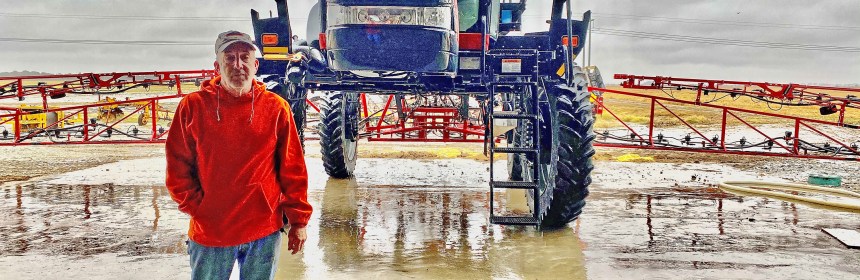
Editor’s Note/Feature Photo: Joe Christian, owner/operator of JOC Farms Partnership, is one of many local farmers affected by the U.S.-China trade war. Photo by Tristan Bennett.