Tag Archives: Craighead County

Taxes Fund Necessary Services and Programs

By Rachel Moore
Delta Digital News Service

JONESBORO – As tax season approaches, citizens should be concerned with more than income taxes. From Jan. 1 to May 31, all Craighead County residents must have their personal property manually assessed. This includes vehicles, boats, trailers, camping trailers, tractors and airplanes.

“There is also business personal property, which is all of the assets not affixed to the physical structure of the building that are used in the regular course of business. For example, a hair salon should turn in items such as salon chairs, mirrors, drying stations, scissors, waiting area furniture, mobile stations, office supplies, a computer,” said Hannah Towell, Craighead County’s tax assessor.

Towell’s duties include appraising and assessing all personal property. She determines a property’s assessment by taking 20 percent of the market value and then multiplying that number by that person’s school district millage.

“In 2016, the collector’s office collected $66,823,765.58,” said Wes Eddington, the Craighead County tax collector. His office works alongside Towell’s in order to sort and obtain local taxes.

While most citizens know they must pay their taxes every year, not all of them know what programs the taxes fund.

“I just know I need to pay them to avoid legal trouble. I don’t really know anything about what it funds,” said Brigitte Schwartz, a hairdresser currently residing in Jonesboro.

Local taxes fund governmental operations such as the county courthouse and public schools. According to CraigheadAssessor.com, nearly 75 percent of the money goes to schools in the area. Some of the money also goes to the quorum court, county judge, mayor and City Council.

“Also, improvements such as drainage districts, timber, fire districts, city liens, mineral rights and other interests can be legally added to the tax books for collection by this office and there may be a set fee or it may be calculated differently,” Eddington said.

Overall, taxes fund services crucial to the county. Without them, over 100,000 people in the area would not be able to live as they do. But legal punishments exist for those who fail to follow local tax guidelines. This can include monetary penalties that accumulate over time.

It’s important to note real estate taxes are handled differently than property taxes.

“Real Estate is appraised on a five-year cycle. Once every five years, we re-evaluate all of the real property — houses, farm land, commercial buildings — in Craighead County,” Towell said.

The county’s five-year cycle is ending, so officials are currently compiling data that they will use to determine the current fair-market value of everyone’s real property.

Tax assessment and collection can become complicated. So for more information about personal property and real estate taxes, visit the Craighead County courthouse in Lake City at 107 Cobean Blvd. in Lake City, Arkansas, or the Jonesboro courthouse at 511 S. Main Street.

 (NOTE: Cut money image courtesy of TaxCredits.net, [CC BY 2.5], via Creative Commons)

Voters Give Officials More Time

by Kirsten May
Courtesy of A-State Department of Media

Arkansas voters passed an amendment to the Arkansas Constitution that will lengthen term limits for elected county officials from two years to four years. As Kirsten May explains, people in those positions think this will help them be more effective.

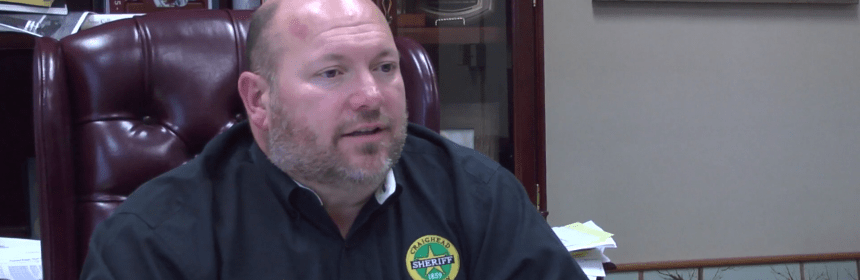
JONESBORO — Now even though the new term limits won’t go into effect until 2019, Craighead County Sheriff Marty Boyd said he is excited about what that means for the future of county officials.

“It’s going to be a great benefit to the operations of any department because you can set some long-term goals. Where in the past, just having a two-year office, it made it seem like you were always campaigning,” he said.

Boyd said he hopes the longer terms will let officials dig deeper to accomplish bigger goals, especially in a county that has a 2 percent annual growth rate. He said there are some things you just can’t get done in two years.

“Even though I know economically we can’t obtain maybe as many deputies as we want in the next 12 months, but I can look at the long-range plan and say in five years here is where we need to be,” Boyd said.

He said another benefit is being able to cut costs.

“Elections are expensive. I wish they weren’t, but in this day and time it takes a lot to run a successful campaign. Having to do that every two years, you get tired of the process and your supporters get tired of the process,” Boyd said.

There is also a better sense of job security for those in the department.

“It puts them in a better workplace knowing that they have at least four years to look at instead of two,” Boyd said.

Sheriff Boyd said there has been some concern about having an official in office that long. But he said as long as you research your candidates and know who you’re voting for before the election, that shouldn’t be a problem.

Issue 1 also states certain county officials cannot be appointed or elected to another civil office, and it allows unopposed candidates to be elected without their name appearing on the ballot.

UPDATE: Turnout for Cannabis Issues Doubtful

by Kirsten May
Courtesy of A-State Department of Media

JONESBORO — Arkansas voters will see five issues on their ballot this year, including two different proposals about medical marijuana. ASU TV’s Kirsten May reports on differences in the proposals and how they might affect the state election.

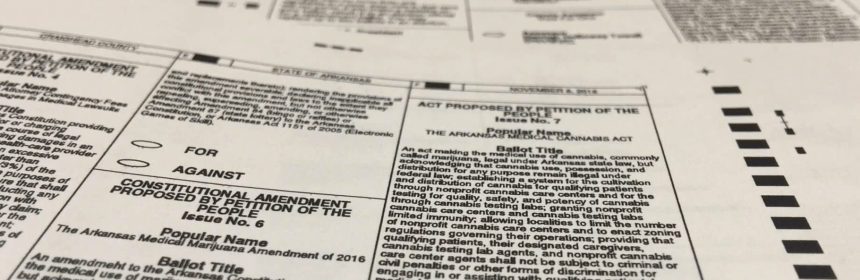
Issue 6 is the Medical Marijuana Amendment. Issue 7 is the Medical Cannabis Act. They would both make marijuana legal for medicinal purposes, but political science professor William McClean said there are important differences between the two.

“Issue 6 I think probably has the better chance of passing than Issue 7. (Issue 6 is) a little more restrictive,” he said.

The Medical Marijuana Amendment allows about 20 medical conditions to be treated with cannabis, whereas Issue 7 covers nearly 60 conditions. It would also be easier to add more diagnoses to that list on Issue 7.

“You can amend an act without going back to the voters, so without amending the Constitution again,” McClean said.

There is also a provision in Issue 7 to let anyone living further than 20 miles from a dispensary to grow their own marijuana.

“People become kind of wary about the ‘Not In My Back Yard’ syndrome, I don’t want my next-door neighbor growing marijuana around my children,” he said.

This is not the first time medical marijuana has been on the ballot. Arkansans nearly passed a similar proposal four years ago.

“That was a surprising outcome as a political scientist given the conservative nature of the state, that it came as close to passing as it did,” McClean said.

Craighead County Clerk Kade Holliday thinks more people know about the cannabis proposals on the ballot this time around.

“There’s a lot of debate about, you know, the two different ones, all the differences between them. They’re definitely the most talked about,” he said.

But Holliday and McClean both agree the people most likely to vote for the proposals — young people and college students — aren’t as likely to go cast a ballot.

“We had right at 6,270 people registered in that (18-24) demographic. Now of that demographic, only about 38 percent of that demographic turn out to vote,” Holliday said.

“I think it has a low chance of passing,” McClean said. “Most of the polls show about 80 percent of Arkansans are in favor of some form of medical marijuana. However, it’s probably going to be a low turnout election. Young voters are not very excited about either presidential candidate.”

Both men say what’s important is letting your voice be heard, whichever way you vote for these issues.

McClean said if both pass, the Constitution states the issue with the most votes will take effect. (UPDATE: The Arkansas Supreme Court disqualified Issue 7 from the ballot on Oct. 27, three days after early voting started.)

Recent Entries »