Category Archives: Politics

Hispanic Center Addresses Fear as Immigration Concerns Rise in Jonesboro

Story by DDNS Reporter Benjamin McDowell

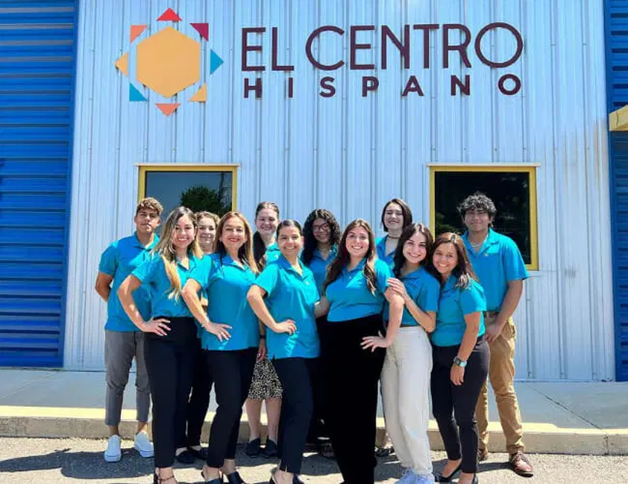
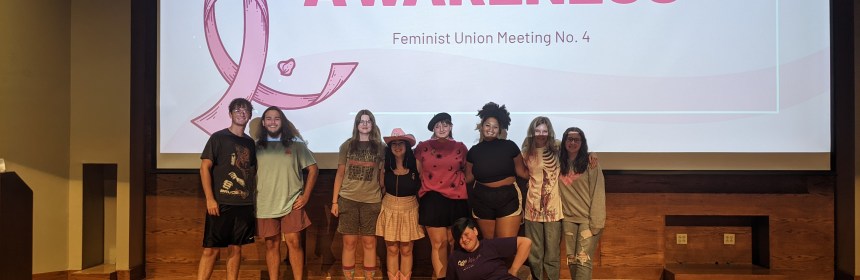
Staff members from the Hispanic Center pose outside their facility in Jonesboro, highlighting the organization’s role in supporting local families amid growing community concerns. Photo courtesy of The Hispanic Center via Facebook.

JONESBORO, Ark. — As immigration enforcement concerns grow in Jonesboro and across the country, leaders at the Hispanic Center say fear keeps some families from going to school, seeking medical care or accessing basic services. Immigration enforcement policies and increased activity by Immigration and Customs Enforcement have created uncertainty for many immigrant families, including those in northeast Arkansas.

The Hispanic Center is a nonprofit organization that serves the Hispanic community in Jonesboro, as well as others in need. The center offers services such as after-school programs, interpretation, translation, English classes, computer training and health fairs. The center also provides legal consultations, mental health sessions, and community events, while assisting families with food, transportation and housing support.

Carolina Elmore, assistant director at the Hispanic Center, said, “We serve the Hispanic community primarily, but we help anyone in need regardless of ethnicity, religion or race.”

Elmore said the Hispanic Center is a place she wants people to feel they could depend on anytime.

“We provide interpretation in hospitals, schools and legal settings so people who don’t speak English can still access essential services. Language is one of the biggest barriers, and we try to bridge that gap every day,” Elmore said.

Elmore said the Hispanic Center acts as a bridge between schools, the Hispanic community and local institutions. The center partners with local universities and organizations to provide students with educational support and expose them to career opportunities.

Elmore said one of the biggest challenges for the Hispanic Center has been increased activity by Immigration and Customs Enforcement.

“A lot of people are afraid to seek services because of immigration concerns. Some parents are even scared to send their kids to school or go to the doctor. We try to create a safe space where families feel supported despite those fears,” Elmore said.

Due to concerns about ICE, many community members are afraid to seek help or services at the Hispanic Center out of fear of being detained. That fear reflects what many immigrant communities are experiencing across the country, where enforcement actions can affect access to education, health care and other essential services. The center often works with churches and community partners to provide safe spaces and trusted environments for families.

“We help families with everything, from enrolling their kids in school to making doctor’s appointments. Sometimes it’s as simple as helping fill out a form, but that can change everything for a family,” Elmore said.

Elmore said she wants to continue serving her community during challenging times tied to immigration enforcement.

“Everything we do is about helping families feel supported, connected and valued in this community,” Elmore said.

Leo Hernández, program coordinator, helps facilitate the after-school program, which allows children to catch up on homework and receive tutoring.

“La Escuelita is here to support kids from kindergarten through ninth grade with their homework and academics. A lot of parents can’t help their kids with schoolwork, so we step in to guide them,” Hernández said.

La Escuelita runs Monday through Thursday during the school year and is divided into groups by age, allowing younger and older students to receive the support they need. Students work on subjects such as math, reading, writing, Spanish and public speaking, while also building communication and teamwork skills. The program also includes a summer component that helps students stay on track in a more engaging environment.

Hernández said the Hispanic Center also has a program called HELP, which gives high school students opportunities to explore life after high school. He said the program allows students to complete community service hours while visiting college campuses and local institutions.

“We’re not just helping with homework, we’re giving kids opportunities they might not have otherwise. It’s about building a foundation for their future,” Hernández said.

Hernández said education and guidance are some of the biggest needs in the Hispanic community, especially for students who struggle with English and need additional support.

Hernández said he wants the community to feel like a safe place where families can feel at home and that many people simply need direction.

“What’s happening with immigration affects families, especially the kids. We always encourage people to seek legal advice and handle things the right way. At the end of the day, we’re here to help people grow and succeed,” Hernández said.

Yesenia Dixon serves as a front desk receptionist, interpreter and after-school teacher at the Hispanic Center.

Dixon said many children struggle to express their emotions, and the center helps them build communication skills.

“It’s rewarding to see their faces light up when they realize they can do something,” Dixon said.

Dixon said she enjoys interpreting people but she also knows it is serious because she serves as the voice for others.

“I’m usually the first person people see, and they come in upset or needing help. I try to calm them down and let them know they’re in a safe place,” Dixon said.

Dixon said increased ICE activity has heightened fear in the Hispanic community, with some people choosing to handle everything virtually.

“During stressful times, we focus on giving people factual information so they don’t panic. There’s a lot of fear, so it’s important we don’t spread misinformation,” Dixon said.

Dixon said even if she does not have an immediate answer, she works to help people find one.

“We’re not just a place for handouts, we’re here to support people. We want to be known as a place where people can come without feeling judged,” Dixon said.

.

-30-

Second ‘No Kings’ protest to be held in Northeast Arkansas

Story by DDNS Reporter Jerry Don Burton

Demonstrators protest in Jonesboro at the June 14 No Kings protest, organized by the Coalition for Change of Northeast Arkansas (CCNEA). The second protest, also organized by the CCNEA, is scheduled from 10 a.m. to 1 p.m. Saturday, Oct. 18.
Photo Courtesy of the Democratic Party of Craighead County Facebook Page.

JONESBORO – The Coalition for Change of Northeast Arkansas (CCNEA) will hold a second No Kings protest from 10 a.m. to 1 p.m. Saturday, Oct. 18, in Jonesboro at the intersection of Highland and Red Wolf, next to the Turtle Creek Mall.


One of 13 others scheduled in Arkansas and more than 2,500 worldwide as of Oct. 10, the demonstrations aim to protest against policies and alleged authoritarian actions from President Donald Trump and his administration.
Carol Davis, CCNEA member, said those who attend the No Kings protests are rallying together over a variety of concerns and causes. She cited government overreach and concerns about community safety as reasons for her expected presence at the protest.


“If what it takes is large amounts of people continually coming out and saying and showing that they disapprove, that they’re concerned, that there are issues, then the hope is that they’ll listen,” Davis said. “And if they won’t listen, then the hope is that we can encourage people to vote with their conscience and with their interests.”


Jayne Schack, another member of the CCNEA, said Trump’s deployment of the National Guard in specific cities across the United States also highlights the need for another No Kings protest. Schack noted her participation in the first No Kings protest, held June 14, was a singular experience.


“The kind of ‘high’ that I had from attending the June 14 protest is like nothing else that ever happened,” Schack said. “There was such a bond of solidarity of ‘We are people who believe in our democracy, we are people who believe in our Constitution, and we are not going to let it change into something else.’ That’s what the No Kings is about.”


Nationally, the first No Kings protests saw a turnout between 4-6 million, according to data journalist G. Elliot Morris. Schack said more than 400 attended the rally in Jonesboro, far exceeding the CCNEA’s expectations.


Davis said while the CCNEA is comprised of people from a wide variety of beliefs, what binds the group together is a desire to see their community get involved and succeed. The CCNEA started in Paragould, Arkansas, in response to the 2024 presidential election results. Schack said she attended her first CCNEA meeting in December 2024.


“We are a grassroots organization. We are nonpartisan. We want to empower individuals to take action and make a difference in their communities,” Schack said.


The CCNEA is an offshoot of Indivisible, a progressive movement that started in 2016. According to their website, Indivisible is committed to nonviolence and rejects all forms of political violence and intimidation.


Schack and Davis said the CCNEA shares these values and has taken measures to ensure all attendees stay safe at the upcoming protest. Although it was not mentioned, any form of violence has been an issue in the past; therefore, it is strictly prohibited at the protest.


Davis said the CCNEA hosts training sessions for members, educating them on safety and their rights as protesters. The CCNEA will also designate trained safety marshals for use in the protest. Schack said safety marshals maintain peace, de-escalate conflicts, and help wherever needed.


Davis said those attending should take care of themselves by staying hydrated, wearing sunscreen, and taking breaks as needed. She says the CCNEA will be ready to help anyone who has any questions or concerns during the protest.


“It’s a serious subject and it’s an important thing, but ultimately, you should feel like you’re enjoying the company of the people around you,” Davis said. “It’s a fun thing to be able to have that opportunity, to have that right and to exercise it.”

Protesters present signs to passing vehicles at the Turtle Creek Mall during the first No Kings protest on June 14. Photo courtesy of the Craighead County Democratic Party Facebook page.

Schack said counter-protesters have as much of a right to assemble as the CCNEA. Still, she said they will not engage with any counter-protesters and all attendees should act in a non-confrontational manner.

“It takes work to keep a democracy, it takes understanding, it takes compassion. You have the right to say what you think. I have the right to think something different. It’s fine, that doesn’t mean we have to hate each other,” Schack said.

Despite disagreeing with the message of the No Kings protests, Arkansas Sen. Dan Sullivan said he wholeheartedly supports allowing diverse voices to challenge perceived power structures without fear of reprisal.

“I also recognize the irony of the protesters’ claims,” Sullivan said. “That if we truly lived in the authoritarian regime that they decry, their public demonstration of dissent would be swiftly suppressed. Thus, their very ability to rally is a testament to the freedoms they claim lost.”

Others voice stronger opposition.

House Speaker Mike Johnson said the No Kings protests are outrageous gatherings for outrageous purposes.
“This ‘Hate America’ rally that they have coming up for October 18th, the Antifa crowd and the pro-Hamas crowd and the Marxists, they’re all gonna gather at the (National) Mall,” Johnson said.

The No Kings coalition issued a response following Johnson’s statements, writing that Johnson is running out of excuses for keeping the government shut down and that the protesters are committed to nonviolence.

“Instead of reopening the government, preserving affordable healthcare, or lowering costs for working families, he’s attacking millions of Americans who are peacefully coming together to say that America belongs to its people, not to kings,” the statement read. “All No Kings events adhere to a shared commitment to nonviolent protest and community safety.

Schack said protesters are still people and should not be demonized, nor should their opposers.

“We’re all just people. Nothing special about us. We’re not demons. People who disagree with us are not demons,” Schack said. “Most of us are patriotic for our country and what it stands for. We differ in our views on what the future might be and how we see it. But there’s no reason why we can’t be respectful.”

Arkansas 1st District Rep. Rick Crawford did not respond to statement requests before publication.

Davis questions whether the rhetoric surrounding protests as inherently violent and ineffective, especially in the Arkansas Delta, will discourage people from attending. She said the CCNEA would love anyone interested to participate in it if they feel safe to do so, but understands that it’s not for everyone.

“I think the important thing about demonstrations, especially in this area, is first and foremost to encourage other people who are similarly concerned,” Davis said. “When I went to the first No Kings demonstration, I didn’t expect a tremendous amount of support. So to see so many people in my community motivated and concerned was really encouraging.”

Davis said she hopes those who attend the protest are encouraged to continue their activism. Whether through civil disobedience or running for office, Davis said she hopes the protest motivates people to continue demanding to be heard.

Schack said the CCNEA will host an event at an undetermined date after the protest to receive feedback from attendees and discuss improvements for future demonstrations.

“If you want to be involved in an organization that is going to foster your ability as an individual to engage and mobilize and promote social justice, this is it,” Schack said.

More information about the CCNEA, No Kings, and Indivisible can be found at ccnea.org, nokings.org, and indivisible.org.
-30-

Sullivan Talks Library Funding, DEI at Town Hall

Story by DDNS Reporter Shailey Wooldridge

State Senator Dan Sullivan (R) speaks during a town hall meeting in Jonesboro.
Photo courtesy of DDNS reporter Shailey Wooldridge.

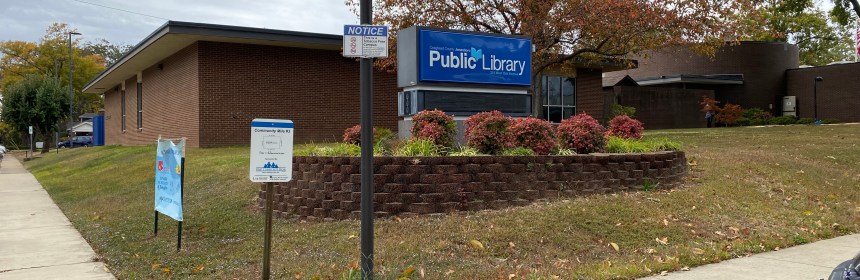
State Sen. Dan Sullivan hosted a town hall on May 3 at the Craighead County Jonesboro Public Library. The conversation centered on Diversity, Equity, and Inclusion, emergency funding for severe weather victims, and library funding.

Robert Steinbuch, professor of law at the William H. School of Law at the University of Arkansas Little Rock and columnist for the Arkansas Democrat-Gazette, co-hosted the event with Sullivan.

Some attendees expressed a disinterest in hearing Steinbuch’s answers to their questions, calling only for Sullivan to speak.

“We want to hear from Senator Sullivan,” Kimberly Warmth said to Steinbuch. “We didn’t vote for you. Your opinion doesn’t matter.”

The Jonesboro Police Department (JPD) was called early on into the meeting during a discussion about DEI, and officers stayed throughout the meeting.

“If it’s going to be this way, I want JPD here,” Sullivan said.

Sullivan asked for the removal of one attendee who left of their own volition.

Library funding

Kimberly Warmth, a NEA Regional Library Board chairperson, asked Sullivan about Senate Bill 184, which he had filed. The bill was unsuccessful and would have abolished the Arkansas Educational Television Commission and the State Library Board and placed them under the Arkansas Department of Education.

“I would like to know how you saw that as being something that was supportive of your district and what your thought process behind that was because I do not understand that,” Warmth said.

In response, Sullivan said PBS had a terrible audit, and the board refused to take action regarding the results. He asked the board to release a statement that it would protect children from sexually explicit content, and he said the board refused to do that.

DEI

A post made by Sullivan regarding free rides on Jonesboro buses for Social Justice  and Equality Day, as well as legislation sponsored by Sullivan to end DEI initiatives in local government were discussed in length at this event.

“Why is the city using your tax $$ honoring a divisive concept such as Social Justice & Equality Day?” Sullivan said in a Facebook post regarding the free rides.

Sullivan said he questioned multiple City of Jonesboro Officials, including Mayor Harold Copenhaver, four members of the city council and Jonesboro director of communications, Donna Malone, about the free rides and didn’t get a response.

Shamal Carter, President of the Craighead County Chapter of the National Association for the Advancement of Colored People (NAACP) and a guest speaker at the Social Justice and Equality Day event, attended the town hall. Sullivan said his remarks at the event were partisan.

Carter defended his comments during the town hall. He said the event was inclusive and had nothing to do with race, party or gender.

“As you (referring to Sullivan) went to social media, you made sure you pointed out it was more party-affiliated and had nothing to do with party,” Carter said. “I understand that it may not be comfortable, but we have to have uncomfortable conversations because you are, whether we elect you or not, and you represent us.”

John Thompson, a student at Arkansas State University, also attended this event. He asked Sullivan about his vote in support of Act 116, which ends DEI in public schools and higher education.

“I’m sure you know DEI stands for diversity, equity, and inclusion. I know that you and I may not ever agree on the equity part, but I just want to get some reassurance that you did not vote for that bill because you didn’t agree with diversity and inclusion on college campuses like Arkansas State,” Thompson said.

He also invited Sullivan to visit the A-State Black Student Association (BSA) and Multicultural Center, which Sullivan accepted and said he would.

Thompson voiced concern that organizations like the BSA might be banned from college campuses under Act 116. Sullivan said the bill states that universities cannot give preferential treatment, but students can form organizations as long as they are student-led.

Thompson then asked for assurance that the university wouldn’t face repercussions for allowing groups like the BSA if they were perceived as giving preferential treatment.

“You asked me to assure you that nobody will take action. I can’t do that,” Sullivan said.

Emergency funding for natural disaster relief

One attendee, Kimberly Roberts, asked Sullivan what his plan was regarding funding for those affected by severe weather as Gov. Sarah Huckabee-Sanders’s request for federal emergency aid (FEMA) from President Donald Trump was denied.

“How are you going to help? Since we’re moving back towards states’ rights and smaller government, what is your plan to help all these completely devastated people who now have no plan because nobody else is trying to help them,” Roberts said.

Sullivan said a caucus was scheduled for May 5, in which legislators would discuss using state emergency funds for disaster relief. He said there would be no vote on this issue, but he would provide an update on social media after the meeting.

Mental health experts highlight youth mental health concerns amid TikTok ban vote

Delta Digital News Service

April 4, 2024

Laila Casiano | Contributor

JONESBORO, Ark. – Amidst a unanimous decision by the U.S. House of Representatives to ban TikTok nationwide, mental health experts discuss concerns over social media’s negative impact on young people’s well-being.

     The use of TikTok created a point of contention in the United States, with national security concerns being the primary reason for its potential ban. Yet, additionally, state lawmakers raised concerns about the impact of social media, particularly TikTok, on the mental health of young people. This resulted in the implementation of age parental consent policies. However, the importance to question whether TikTok specifically is a genuine concern for young people’s mental health decline remains crucial.

     “Research shows that teens are spending upwards of five plus hours a day consuming social media (such as TikTok and YouTube), and one of the most relevant links has been girls’ social media use and loss of confidence,” Daniel Wysocki, a licensed psychological examiner for Wysocki Psychological Services, said.

     Wysocki identified social media as significantly shaping the mental health of young people outside of family dynamics. According to the 2023 Girl’s Index, 57% of girls reported social media influence on their desire to change their appearance and to plummet their self-confidence by falling under social pressures to “feel pretty.”

     However, this does not just affect young girls; Wysocki advises parents to be alert to teenage boys’ growing distress with their physical appearance. 

     “In my practice, I’ve observed an increase in distress and obsession with appearance among young men compared to earlier years of my practice,” Wysocki said. 

     Wysocki said as a provider, he offers Attention-Deficit Hyperactivity Disorder (ADHD) testing and experienced many people coming into his clinic based on TikTok recommended videos to identify ADHD tendencies or through ADHD “hack” videos. Wysocki notes an additional positive outlook as he is also seeing young people’s social media usage encouraging teens to seek help and to learn how they can lead a promising life, reducing the stigma of asking for support/help and talking with mental health professionals about their wellness.

     “TikTok has changed how children consume social media as it is now endless,” Wysocki said. “It is no longer a connection to friends and acquaintances; it has expanded into every aspect of daily life, and they can live vicariously alongside their favorite influencer. TikTok is (still) the leader in creating an endless loop of consumable snacks.”

   Wysocki said critics may not address the root causes of mental health issues among the youth and should at least offer alternatives. 

     “There are no simple answers to most of the issues we are facing when raising our children, but free and endless access to unrestricted social media is a big enough risk to developing minds that regulation should be considered. It would be no different than a license to drive a vehicle,” Wysocki said. 

     As Wysocki highlighted the transformative nature of TikTok on social media consumption, JoAnne Powell, a licensed professional counselor from Elysian Counseling Service, discussed the nuanced complexities surrounding TikTok’s impact, emphasizing both positive and negative attributes. 

     Powell claims that connection, support, access to information, expression and creativity highlight these positive attributes of the social media app. The negatives consist of young people comparing themselves or fearing missing out (FOMO). This often manifests itself in creating an “unrealistic portrayal of life” and leads to teens feeling inadequate, inhibiting low self-esteem and FOMO.  Other negatives Powell recites are cyberbullying, addiction, distraction (decreased senses of productivity, poor sleep quality, increased feelings of loneliness and isolation) and validation seeking (manifest in difficulties in creating boundaries).

     “Teaching youth ritual thinking skills and media literacy can help them navigate social media more responsibly and discern between accurate information and harmful content,” Powell said. “While social media has the potential to positively impact the mental health of youth, it is essential to address the negative consequences and implement strategies to promote responsible and healthy usage.”

     Powell said through her professional observations, she noticed an increase in young people’s anxiety, stress, their sense of negative self-perception, and an impact on social and interpersonal relationships, which affected other social skills like trust, conflict resolution and basic communication skills. 

     In therapy sessions, Powell said exploring these observations with clients help them develop better coping strategies, build resilience and cultivate a healthier relationship with social media.

     “This may involve psychoeducation on the impact of social media on mental health, teaching stress management techniques, fostering self-compassion and promoting a balance in online and offline activities,” Powell said.

     In line with Powell’s emphasis on compressive approaches to addressing social media’s effects, Jessica Richardson, licensed clinical social worker and therapist for The Best Of You, discussed the importance of maintaining open communication and setting boundaries with youth to ensure their safety and well-being in the social media world.

     “As a therapist and parent of a teen, I understand it’s difficult to navigate that area between respecting privacy while also trying to protect them. I think that modeling appropriate behavior and interactions could be a good start,” Richardson said. “So many people behave in ways that startle me a bit on social media. I’m not sure why we would expect kids to avoid things like bullying when many adults do it.”

     Richardson said it’s important to provide education related to safety and moderation rather than rely on government regulations on certain social media platforms. Additionally, she said social media may not be the singular cause of mental health concerns and banning a specific platform isn’t going to resolve the issue. 

     “For some, the concerns might be directly related to mental health, and for others, there could just be benefits to limiting the use of screens/technology in general,” Richardson said. “I think we can acknowledge the positive aspects of being connected through social media and the creative options that it provides while also being responsible with it and its use.”

     As Richardson highlights the nuanced perspectives on social media usage, the pending decision on the national TikTok ban emphasizes the ongoing battle of balancing social media’s benefits and potential risks, like TikTok, in modern society.

     The platform’s future remains unclear until the Senate votes for the national TikTok ban, but President Joe Biden announced he would sign the bill once it is sent to him. For now, the bill resides with the Senate Commerce Committee until the six-month deadline for TikTok CEO Shou Zi Chew to either sell the company from its Chinese parent company, ByteDance, or be banned nationwide. 

-30-


NOTE: Feature graphic courtesy of Ampfluence

ASU Feminist Union to host women’s rights rally

Delta Digital News Service

Friday, Mar. 29, 2024

By Avery Jones | Editor

JONESBORO, Ark. – The Feminist Union at Arkansas State University in Jonesboro will be hosting their first women’s rights rally this Saturday. It will be held from noon to 3 PM in the courtyard of the Craighead County Courthouse.

The event is open to the community, and those who attend can choose to sign for the Arkansas Abortion Amendment and Period Tax Petition. They will also hear from several female speakers who are important figures in the community. 

“Essentially, this rally is to…celebrate the advancement of women’s rights across the years but also to celebrate the women now who are making basically their mark on history, specifically women’s history,” said Christina Smith, the president of the Feminist Union and a student at ASU Jonesboro.

The Arkansas Right to Abortion Initiative–more popularly known as the Arkansas Abortion Amendment–is a movement that aims to get the amendment on the ballot for 2024 as a constitutional amendment in Arkansas. If instated, the amendment would allow abortion within 18 weeks of conception; in the cases of rape, incest, or fatal anomalies; or when the life of the mother is in danger.

The movement was started by Arkansans for Limited Government, a nonprofit organization that advocates for personal liberties and limiting government involvement, especially in regards to healthcare. They must collect at least 90,000 signatures by this July 5 in order for the amendment to be placed on the November 2024 ballot.

An Act to Exempt Feminine Hygiene Products and Diapers from Sales and Use Tax is being spearheaded by the Arkansas Period Poverty Project, which aims to increase access to feminine hygiene products in Arkansas, especially for those in poverty, by ending sales tax on feminine hygiene products and getting free menstrual products in public schools. They need 72,500 signatures by this July in order to make it on the November 2024 ballot.

Those are the two main movements that the Feminist Union is currently promoting, but Smith said there may be other causes represented at the rally. The speakers at the rally will be talking in general about women’s rights, but they also will most likely promote their own causes.

There will be four speakers: State Senate candidate Erika Askeland, who is running for District 20; Young Democrats of Arkansas president Allison Sweatman; Alison Guthrie, a community advocate from Little Rock; and another community advocate, Rebekah Pruitt, from Jonesboro.

Specifically, Askeland will probably speak about her campaign. Sweatman will most likely speak about the importance of voting, especially for women. Guthrie stated that she would be talking about disability rights. Pruitt, as a transgender woman, will most likely speak on transgender rights.

While it’s their first rally, Smith said that it wasn’t difficult to arrange. Since the courthouse’s courtyard is public property, she just had to call the courthouse to ask permission to use it and make sure no one else was using it at that time. Then she started promoting the event.

As for the speakers, Smith already had connections to them. She reached out to Guthrie and Pruitt and asked them specifically to speak. Meanwhile, Askeland and Sweatman volunteered when they heard about the event.

“I reached out to Alison Guthrie and Rebekah Pruitt because I’m a very big fan of their work within their own communities,” Smith said.

Smith works on Askeland’s campaign, so when Askeland heard of the rally, she offered to speak. Similarly, Smith is the president for the Jonesboro chapter of the Young Democrats of Arkansas, so when she mentioned the event to Sweatman, Sweatman also volunteered.

The ASU Feminist Union itself has only recently become active again. It was first established in 2018 but shut down due to the COVID-19 pandemic. Inactivity after the campus opened again caused the organization to die out. 

However, in fall 2023, Smith wanted to revive the Feminist Union. She had to register it again as a student organization and then recruit more members. Currently, the Union has around 60 to 70 members, but only about 10 to 15 members regularly attend meetings and activities.

“The hardest part was getting members…active members,” Smith said.

They have meetings every two weeks on Wednesdays and events every month. They have hosted panel events, in which they invite community advocates, elected officials, or female candidates for discussion; readings and movie nights about feminism; and tabling events where they hand out free condoms. Next semester, they’re also planning to start handing out emergency contraceptives.

-30-


Note: Featured image is from one of the Feminist Union’s previous events.

Library Patrons show support during Read-In

Voters will decide on Nov. 8 whether or not to reduce library funding

By Avery Jones | Editor

Delta Digital News Service

JONESBORO, Ark. – On the Nov. 8 ballot, during the general election, voters will decide whether or not the Craighead County Jonesboro Public Library’s tax millage should be cut in half. Recently, more than a hundred library patrons gathered to silently protest the potential tax cut at a community event called, ‘Support Our Library Read-In.’ The streets and parking spaces surrounding the library were crowded with vehicles as patrons gathered on the front lawn as well as along sidewalks during the early evening of Monday, Oct. 10, 2022. 

A petition was presented to the Craighead County Clerk on September 27 to advocate for reducing the mills of county property tax from 2 to 1, which would significantly cut the funding of the library. 

The petition was proposed by a local political group known as Citizens Taxed Enough, who are upset about the amount of funds that the library receives from taxes.

Since the proposal was presented, there has been much controversy over the validity and effectiveness of the potential tax cut. Those against the motion argue that the cut would force the library to reduce many of its programs and community outreach activities and that the average person wouldn’t save that much in taxes from the change.

“I think [the tax cut] would affect the library’s ability to do what it does now drastically…half the employees, half the programs, half the services, half the branches available to people,” said Rebecca Mixon, who sits on the Friends of the Library board.

Mixon went on to say that many people don’t realize just how many services the library provides.

 “It’s one of the only places in our community where you can go for the day and be in a heated and cooled environment and not spend anything,” Mixon said. “You could sit and make yourself better at the same time. That just doesn’t exist anywhere else in our community.”

“It’s one of the only places in our community where you can go for the day and be in a heated and cooled environment and not spend anything,” Mixon said. “You could sit and make yourself better at the same time. That just doesn’t exist anywhere else in our community.”

Rebecca Mixon, Friends of the Library Board Member

Some of the programs that the library offers are after-school activities for kids, free classes, summer activities, and outreach to public schools and nursing homes.

Dawn Morgan and Hope, frequent patrons of the library, said that they take advantage of many of the library’s programs and support everything the library does for the community. Morgan’s children enjoy the children’s library section of the library as well as the after-school crafts. 

Morgan herself has been attending the Jonesboro library since she was a teenager, when she also was in a young adult book discussion group. 

In addition, her grandmother, who is retired, enjoys the knitting classes and often comes to the library because she feels safe there. 

One library program that is especially vital to Morgan’s family is the craft fair. Morgan owns a small business, and one of the places she sells her products is at the fair.

“Without the craft fair, my small business would probably not exist. We honestly get the best turnout of anywhere here at the library,” Morgan said.

According to Chelsea Young, a 7th grade English teacher at Nettleton Junior High School, the literacy rates of children in Arkansas are currently at the lowest she has seen in her 10 years as a teacher. 

“The library means so much to the community in terms of increasing the ability to read,” Young said. “Nothing will increase student reading scores like independent reading.”

“The library means so much to the community in terms of increasing the ability to read,” Young said. “Nothing will increase student reading scores like independent reading.”

Chelsea Young, Nettleton Junior High School English Teacher

She believes that a variety of resources needs to be available to encourage students to read more and that reducing these resources by cutting the library’s funding would be a huge mistake. 

Not only does Young frequently use the library, she also takes advantage of the digital database and tells all of her students to sign for digital library cards as well. The library’s digital database provides resources for academic research, genealogy records, language learning, college and career preparation, and more. 

“A lot of my students live in poverty. There is a lot of poverty especially in rural districts. Even if the funding cut doesn’t affect this particular branch of the library, it will affect rural districts, which are most at risk for literacy issues,” Young said. “People in rural districts might not have access in terms of being able to walk into this library…so it’s absolutely vital and critical that people especially in rural districts have continued access to [the digital database] to increase literacy.”

According to Eric McGee, a candidate for state representative, the current funding that the library receives has allowed them to open satellite branches within the county such as in Brookland, Monette, Caraway, and Lake City. “The only reason those libraries are open is because of that funding,” McGee said.

He stated that the people that are for cutting funding to the library are misrepresenting that information.

McGee explained that the money the library receives is forward funded, which means it’s slated to be used the next year in case something happens to their current funds.

Right now, the library is operating out of last year’s budget, and the money they’re receiving now will be saved for next year, which is how they have a “surplus.”

He said that although cutting the millage would supposedly reduce taxes, the average person would only save about $1.78.

Since the actual amount saved would be so low for the average citizen, many supporters of the library value the library’s services far more than they do the money they would save in taxes.

Stinson Burton, who goes by ‘Lee’, and Katrina Baureis, both college students at Arkansas State University, said that the library is so important because it’s the only place where you can be educated for free.

“I spent a large part of my teenhood in a library,” Baureis said. “I wouldn’t be the person I am today if I didn’t have access to a library, and I think everyone deserves that same opportunity.”

“I spent a large part of my teenhood in a library,” Baureis said. “I wouldn’t be the person I am today if I didn’t have access to a library, and I think everyone deserves that same opportunity.”

Katrina Baureis, Arkansas State University Student

Burton plans to be a librarian while Baureis wants to work in a museum. Burton currently works at the Harrisburg library and explained that smaller libraries always need more funding.

“The smaller town libraries in the region will be negatively affected because a lot of them are run by a handful of people and their cities don’t have a lot of money [for] their libraries to begin with,” Burton said. “The Jonesboro Library supplements a lot of that and without that, that hurts the whole region, not just this library.”

Erika Askeland, who had set up a voter registration booth, said that the petition for the funding cuts was occurring because of the politicians who had taken issue with the LGBTQ+ pride display set up at the library more than a year before. 

Askeland attended several library board meetings, and said that Rep. Brandt Smith (R-Jonesboro) and Senator Dan Sullivan (R-Jonesboro) promised that if LGBTQ+ materials weren’t removed, they would bring the issue to a vote. 

“I feel like it’s just them following through with what they said, and at this point, they turned it into a funding issue,” Askeland stated. “They’re really, really hoping for the voters to stay misinformed in an effort to cut funding.”

The purpose of the event at the library was for locals to show their support for the library and their disapproval of the potential tax cuts as November voting approaches.

 Crowds of people of all ages were relaxed–reading, chatting, mingling, playing, and running around. One couple was even meditating and ringing Tibetan singing bowls. Most people were set up on blankets, lawn chairs, and under tents. Cotton candy was being handed out and a bubble machine was running; a blue inflatable tube man waved about, welcoming people to the event. The diverse group of attendees displayed the value of the library had to them.


Avery Jones is a sophomore in The Department of English and Philosophy at Arkansas State University in Jonesboro, Arkansas. She can be reached at avery.jones@smail.astate.edu


Huckabee Sanders’ Freedom Tour Rally Comes to Town

Gubernatorial candidate seeks support from northeast Arkansas voters

Delta Digital News Service

By Courtney Edwards | Aspiring Journalist

Sept. 9, 2021

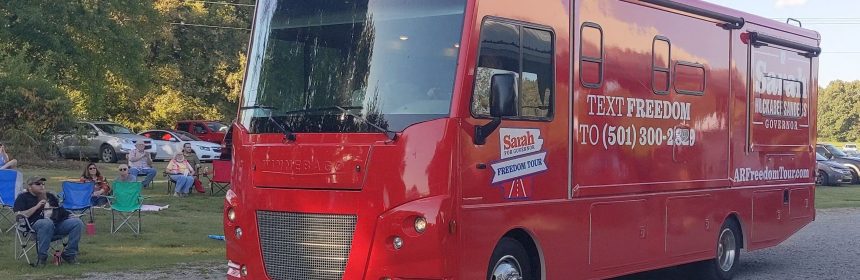
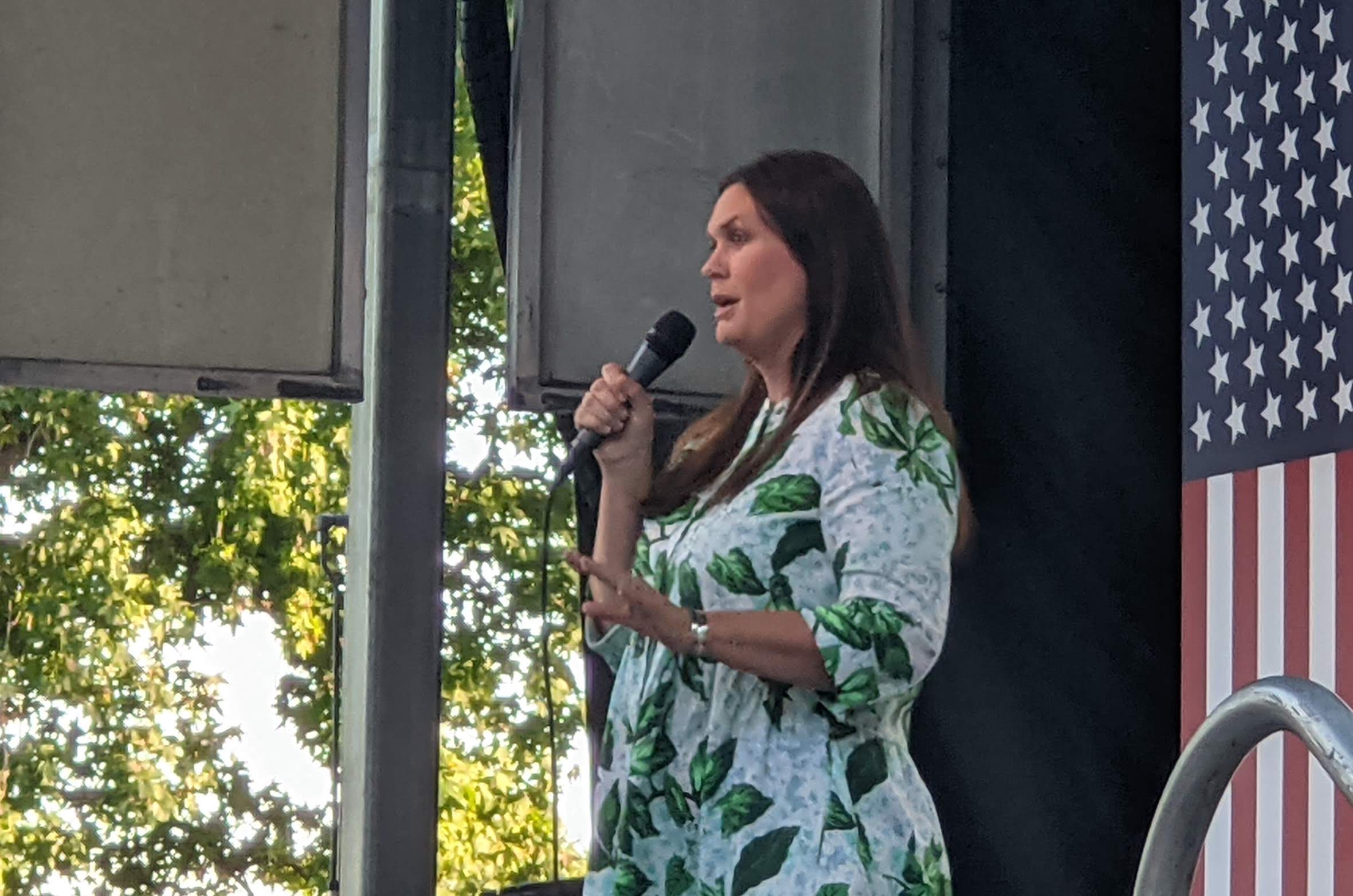
JONESBORO, Ark. – Arkansas gubernatorial candidate Sarah Huckabee Sanders arrived at the ASU Regional Farmers’ Market for her Freedom Tour rally Wednesday.

“I may just have to relocate permanently to Jonesboro with that kind of welcome,” Sanders said as she addressed the crowd.  Sanders mentioned the friendly faces looking back at her. “So many times, when I’ve come up and taken a microphone in front of a crowd, the faces aren’t so friendly,” she said.

Sanders, a republican, spoke of her position as former White House press secretary for President Donald Trump, as well as her familial tie to politics as  the daughter of former Arkansas Gov. Mike Huckabee who served as the states 44th governor.

“I was in college before I knew it wasn’t normal to spend your weekends and summers passing out brochures and asking people to vote for my parents,” Sanders said.

Sarah Sanders 2

Arkansas gubernatorial candidate Sarah Huckabee Sanders addresses the crowd during her Freedom Tour rally at the ASU Regional Famers’ Market in Jonesboro on Wednesday.

Bill Ennis of Jonesboro said he supported Sanders because she believes in the same things he believes – hard work and dedication.

“I like her dad,” Ennis said. “She did a great job when she worked for Donald Trump and she’s what Arkansas needs.”

She followed in her father’s footsteps by attending Ouachita Baptist University, where she served as a member of the student senate while pursuing a bachelor of arts in political science and a minor in mass communications. Sanders  graduated in 2004.

Sanders was the third woman to ever fill the position as White House press secretary. Now, she’s hoping to become Arkansas’s first female governor.

Sanders said being a mom helped her to keep her priorities in place for her role as press secretary. When she started, her kids were ages 5, 3 and 1.  

“One of the reasons I’m running for Governor of Arkansas is because I want to make sure the path in front of my kids, and the path in front of every kid growing up in this state, is free and clear so that they can run full speed towards whatever it is that they want,”

– Sarah Huckabee Sanders

Josh Hannah of Paragould said he attended the event to hear what Sanders had to say to decide whether he wanted to vote for her or not. He agreed with Sanders about protecting the Second Amendment.

“She hasn’t said anything that I disagree with, so I support her,” Hannah said. “It may change, but until then, it won’t.”

During her time as press secretary, Sanders had to defend Trump’s controversial or seemingly contradictory statements which led to her own credibility becoming questionable.

After her announcement to run for governor, NPR reported that in May 2017, Sanders told reporters Trump fired then FBI Director James Comey after White House officials “heard from countless members of the FBI” that rank-and-file members had lost confidence in Comey. Special Counsel Robert Mueller’s report said what Sanders said was not true.

Sanders, a republican, said she experienced some criticism on her tour around the state, saying she was “nationalizing the race.”

“And my answer to those people-you bet I am.… We have people in Washington in leadership, the radical left that are not OK just changing policy,” she said. “They want to fundamentally change who we are as a country. And we cannot sit back and do nothing and allow that to happen.”

A supporter of Sanders, Gary Harpole of Jonesboro attended the rally with his wife, Lisa. He said electing the right governor was very important, and he believed Sanders was the right choice.

“We believe in her vision for the state and her vision for the community,” Harpole said. “She has shown a tremendous effort to Northeast Arkansas and that’s just real important.”

Sanders said Arkansas needs a governor who is capable of leading the fight. She said not only would she wage that fight, but she would win it.

“Not only will I be a fighter,” Sanders said. “I will be the leader that our state needs to take us straight to the top.”

Gov. Asa Hutchinson is term-limited and cannot seek reelection. Sanders announced her run for Governor on Jan. 25, 2021. The election will be held on Nov. 8, 2022.

Voters flock to the polls for early voting

By Yu Bai
Delta Digital News Service

JONESBORO, Ark. – Early voting in Arkansas began on Monday, October 19.

As polls closed on Monday, November 2, over 17,000 people have turned out to vote early in Jonesboro.

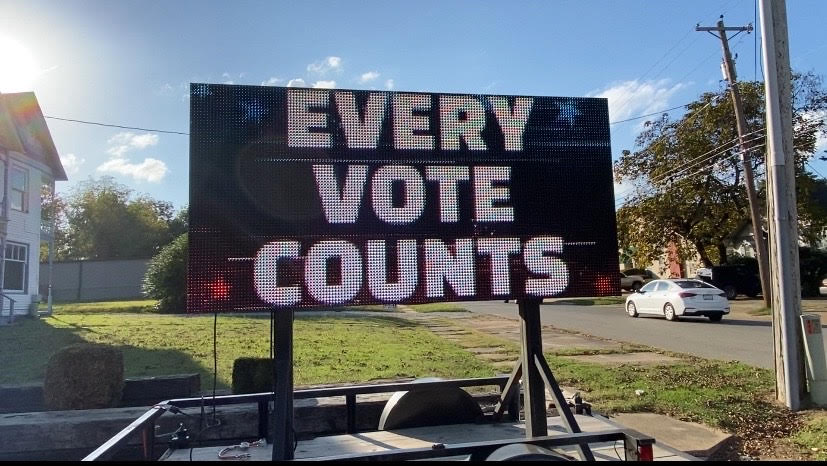
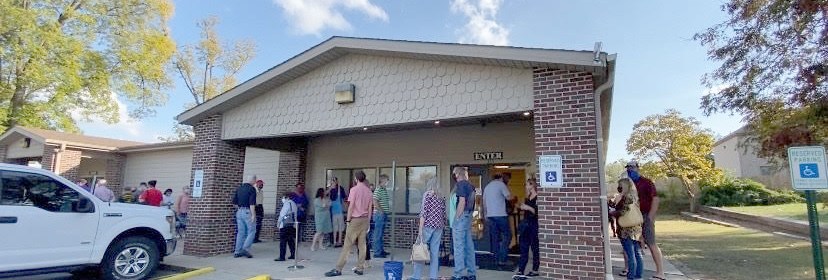
A sign displayed at the Jonesboro City Annex encourages everyone to vote. Photo by Yu Bai

“If you wait until the last day, and you could run into instance where there could be errors like machines done or power goes out,” said Nathan Coleman, of Jonesboro Police Department.

According to data from the Arkansas Secretary of State’s office, there are around 22,100 eligible residents that voted early in 2016. In contrast, the number of early voters this year is much lower.

Craighead County has more than 15 voting locations in the county, and because there are no locations assigned, voters can vote wherever they please.

In the city Jonesboro, the Craighead County Election Annex on Jefferson Street is the selected location for early voting.

New candidates and elected officials can also place their names on the ballot in the city of Jonesboro municipal election.

Issues such as term limits for certain positions are on the ballot.

“The term limits are important because I will only serve two terms, but my opponents are not for that. I also want the pay rise during the first year for the term, ” said incumbent Jonesboro Deputy Clerk Stan Mitchell.

President Donald Trump has already received the endorsement of the local Fraternal Order of the Police.

“He actually received all 50 states endorsements from FOP, and it’s obviously the first time in the history that one candidate received all of them,” Coleman said.

Voters have to bring a picture I.D. to cast their ballots. Once the voter’s information is verified, each voter will receive a card with a bar code and stylus. The card is used to upload the voter’s unique ballot to the screen.

Once the voters make a choice, they will receive a new code card. Voters will be instructed to put it in another machine when leaving the voting building.

In Jonesboro, there are total of 20 voting machines that include two machines for disabled people.

In order to ensure a safe social distance, only 20 people are allowed to enter the voting hall at the same time.

Monday, November 2, was the last day to return your absentee ballots.

Note: Featured photo by Yu Bai

Raising age limit may prevent adolescent addiction to e-cigarettes

By Colby Sigears

Delta Digital News Service

Watermelon Rancher flavored liquid for electronic cigarettes is pictured here. E-cigarettes come in a variety of flavors.

JONESBORO – If began at an early age, tobacco products may cause harm to individuals in their adolescent years. For some, raising the age limit for the purchase of tobacco products may be the solution to thwarting potential health risks.

Charlina Smith, a store manager at a local Jonesboro tobacco shop said electronic cigarette sales for young adults continue to grow at her store.

“More adults purchase the e-cigarettes for children…we turn parents away for picking up e-cigarette flavors for their children,” Smith said.

Arkansas House Bill 1519, introduced by Rep. Lee Johnson, R-Greenwood, would allow people only 21 and older to purchase tobacco, vapor, alternative nicotine or e-liquid products in Arkansas unless they have a military ID.

“They help with cardiac problems and not as bad as people think,” she said.

Sebastian Hanner, a cashier at Kum & Go said most people did not know of a recall on Juul e-cigarettes before they hit the market in Jonesboro.

“They were a piece of (expletive), originally killing people. They recalled flavors because they contained benzoic acid,” Hanner said.

Although awareness of the potential dangers of e-cigarettes has grown, the state may be unwilling to change its laws seeing as how sales from the product bring in more money to the state.

“Sales would be affected but it is necessary, it’s easy for a minor to purchase them,” Smith said. “We can card all day and they still could get them.”

Candace Cline, an employee at Vape Maven said, vaping helped her quit her smoking addiction.

“I have been vaping for six months and it helped me stop smoking when I got pregnant,” she said.

Two cities in the state have raised the minimum age to 21, Harrison and Helena-West Helena. Surgeon General, Gregory Bledsoe, said the age shift would positively impact collective health for decades to come.

“I did not have to spend as much money, got better sleep and was more relaxed when I switched to vaping,” Cline proclaimed.


Bill Clinton Speaks at A-State

President Bill Clinton

by Chase Gage
Delta Digital News Service

JONESBORO – Former President Bill Clinton spoke to a near-capacity crowd at the Fowler Center Monday night. The man from Hope delivered a speech about hope for the future.

At a time when America is arguably more politically divided than ever, Clinton urged listeners to love one another like human beings, not opposition. He drove home the message of treating people like people and getting rid of resentment and anger towards others.

Arkansas State University Chancellor Kelly Damphousse introduced the 42nd president to approximately 950 people.

“If you live in resentment and anger, it disempowers you. You want to be empowered,” Clinton said. “You have to open your heart and ears before you can open new doors. You’ll waste a lot of your life living in resentment and anger.”

Clinton, founder of the Clinton Foundation, said the current political discourse does not lay the foundation for citizens to have the types of conversations they need to be having. Instead of discussing economic inequality and how to fix it, or the emergence of artificial intelligence (an advancement that may kill more jobs than it creates), people are more worried about tearing each other down.

He proposed Americans should be more concerned about their grandchildren’s future instead of winning the next fight on a television talk show. People in disagreement are still people, and sometimes that is forgotten.

Bryant Moy, a graduate political science student at Washington University in St. Louis, said before the event that he hoped to hear the former president speak on civil discourse in the United States. He got his wish.

“He talked about trying to treat people as people. You can still have these deeply held, strong beliefs and resentment, but you have to cooperate with one another. I loved it. It was exactly what I wanted,” Moy said after the event.

Kaylee Bauman, a medical student at New York Institute of Technology from Michigan, said the speech was refreshing.

“(Clinton) talked about bringing everyone together, and then seeing all the different types of people in the room, it was great. I wasn’t sure what to expect, but I thought his overall message was something that could apply to everyone in the room. I found it fascinating,” Bauman said.

President Bill Clinton

President Bill Clinton spoke for about an hour Feb. 11 to more than 900 people in Riceland Hall at Arkansas State University as part of the “Riceland Distinguished Presentation Series.” The 42nd U.S. President previously spoke at A-State on three different occasions. (Photos by Ammar Taqi)

Monday night was not the first time Clinton spoke in Jonesboro. He recounted the story of when he spoke at the Arkansas State University Commencement ceremony in the late 1970s while he was Attorney General of the state. Due to rainy conditions, the ceremony was moved into the field house, where Clinton cut his speech off after only six minutes due to the hot, humid conditions. He most recently visited the university during the 2014 election cycle while campaigning on behalf of Mike Ross for the Arkansas gubernatorial election. He also dedicated the Dean B. Ellis Library in 1995 while in office as president.

Clinton told many stories that showcased examples of people treating others with love and respect. One such story involved fellow former president, George W. Bush and how the duo was able to put partisanship aside to work on creating a better world for the American people. Another story told of how Clinton’s grandfather would give food to those in need. The differences between the two examples demonstrated how respect for others can work on any level, in any situation.

“If you want America to lead the world to a better and more peaceful place, we have to think about empowering people, not putting them down,” Clinton said. “This is not a (partisan) issue. This is not a racial issue. This is a challenge.”

His message of a hopeful tomorrow rang throughout the hour-long speech. The future is up for grabs, for whoever wants to take it.

“We all have our resentments and regrets, but all we really have is tomorrow. You only become old when the weight of all your yesterdays outweigh your hope for tomorrow,” Clinton said. “There will never be a time free of problems. We have possibilities, but you have to face them and the problems they present not with resentment, but with an open hand, a listening ear and a loving heart.”

Listen to the full speech, courtesy of KASU’s Johnathan Reaves:

Candidates Debate at APA SuperConvention 

2018 Arkansas gubernatorial candidates

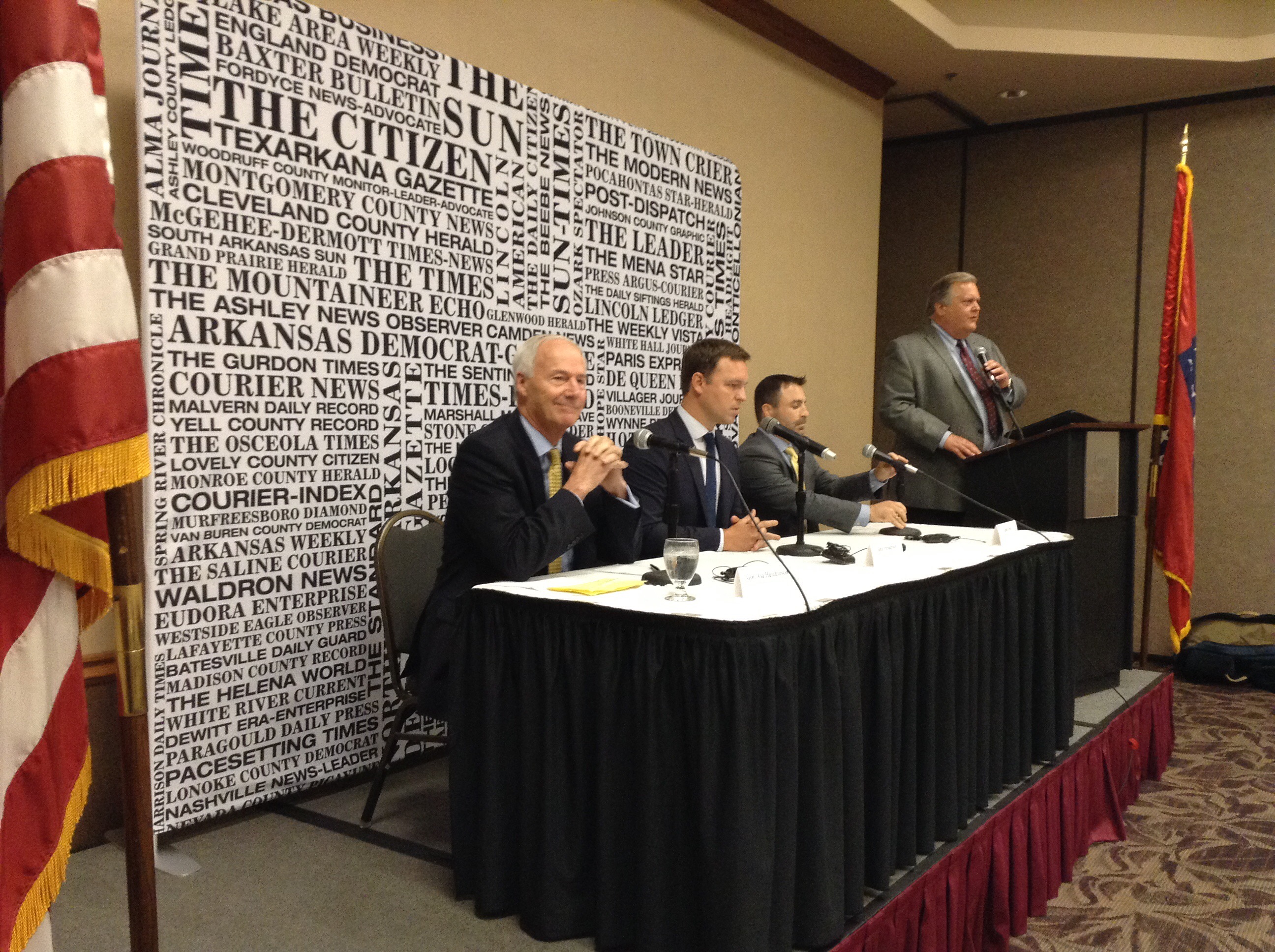
Gov. Asa Hutchinson (R), Democratic candidate Jared Henderson and Libertarian candidate Mark West prepare for the first gubernatorial debate of the year during the Arkansas Press Association’s 2018 SuperConvention. Moderator Rusty Turner provided questions about proposed work requirements for Medicaid recipients, reduced tax rates for affluent citizens, teacher pay, legislative scandals, highway funding and Sunshine Law support.

Immigration Ban Sparks Concern

By Kimberely Blackburn and Caitlin Janczys
Delta Digital News Service

JONESBORO – Although the 9th U.S. Circuit Court of Appeals ruling put a freeze on President Trump’s executive order limiting the entry of citizens from seven Muslim-majority countries, it still impacts thousands of people, including those currently in Arkansas.

Residing in the United States for four years, Aya* and her family will return to Libya in a few months. She said although it does not affect her now, she fears the executive order might alter her family’s future. Although Aya planned to return to the United States to work on her doctorate after visiting home, now she fears she will not be allowed.

The executive order not only affects Aya’s education, but also her children’s education. After learning of her 3-year-old son’s autism diagnosis, she feared for his future. In Libya, he would not be taught how to better express his emotions, which he now finds difficult. While in America, he learns to communicate by learning his alphabet, numbers and colors. If they cannot return, he will lose the benefits of a better educational program.

Jaden,* a graduate student from Yemen, came to the United States a year ago. He planned to return to Yemen in August for his wife and their 18-month-old child. But now he may have to stay here without them.

“There is now a need to stay here without them, without my soul,” he said.

img_1683

Protesters hold signs at the “NEA: We All Belong” rally in front of the Craighead County Courthouse. The rally started with a Facebook page. (Photo by Caitlin Janczys)

Voices like these got a group of people thinking. Cord Rapert and others decided to help make those voices heard by creating the “NEA: We all belong” rally on Friday, Feb. 3 in front of the Craighead County Courthouse. Word spread quickly.

“It’s all been word-of-mouth and Facebook,” Rapert said.

By noon Saturday, more than 60 participants showed up to hold signs and stand close to the edge of the sidewalk that faced Main Street for passing cars to see. The message they spread: “No bans. No walls. No mass deportations. We all belong.”

“We decided to show not only the community here that there are people here who support (immigrants) and have their back no matter what,” Rapert said, “we wanted to do something that showed our support and showed how we are against this issue. We’re going to fight it any way we can.”

Honking horns from passing cars signaled support for the rally and its participants. The encouragement lifted the crowd’s spirits, making them hold their signs higher and chant louder.

Yet with such a high tension-filled issue, the rally wasn’t just met with optimism. A few cars passed with their windows open so that they could yell negative comments in the faces of the participants. One male even stood up through his window, turned his phone on the rally so he could video them, the other free hand raised in a fist, screaming, “Build that wall.”

Aya said the prophet Muhammad teaches followers to treat others the way they would like to be treated. She understands how some equate Islam with terrorism, but said Islamic militants do no represent Muslims accurately.

“I hate them!” she said.

Aya said the majority wishes to work with the United States to rid Libya of the terrorists. When the Obama administration worked to kill known terrorists in the area, many Libyans assisted in the United States’ efforts. She said terrorists attack her country as well as others.

Jaden said he agrees that the group, which calls itself the Islamic State, affects those practicing Islam the wrong way. He said those truly practicing the Islamic faith hate the terrorists more than others. Islam will always be a personal faith, he said, noting it means something different to every Muslim.

Yet not everyone understands the divide between terrorists and Muslims. Jaden said he fears the executive order will increase the level of hate between U.S. citizens and Muslims.

img_1684

Many rally participants attended not only to raise concerns about the “ban,” but to promote hope, too. David Nunez, an organizer for Arkansas United Community Coalition, evoked the hopeful feeling at the rally.

“I thought it was a good idea … advocating for civil rights and social justice and civic integration,” he said. “Everybody has been so friendly and we’d like to keep it that way. It is a great rally. I’m very excited, I’m very, very proud to be here in solidarity.”

The outpouring of community support overwhelmed Aya, but it did not surprise her.

“I was sure the American people would not accept (the executive order),” she said. Many have tried to send her a message of support.

Aya said she has received many messages of support. After the president announced his executive order, Jaden said an American organization left flowers and prayer cards on the steps of the mosque expressing support. He said acts of kindness like this help him focus on peace and try to remain optimistic. Jaden said he believes this order goes against the human spirit and something will change. That could be the way his country and the United States views each other.

Jaden said he came to America with a negative view of the country due to the media attention it received in Yemen. But seeing the motivation of American citizens changed his view. Jaden said he hopes when he returns to Yemen, others will notice a difference in him and obtain a better view on Americans. He said he believes America remains a land of diversity and dreams, and that we can all learn from each other if we will just try.


*Editor’s Note: Names changed for privacy.

Delta Residents Join March for Women, Equality

by Caitlin Janczys
Delta Digital News Service

Participants march towards the capitol's steps in Little Rock. (Photo by Trisitin Janczys)

Participants march towards the capitol’s steps in Little Rock. (Photo by Trisitin Janczys)

LITTLE ROCK – People filled the intersection at Pulaski and Capitol streets, waiting behind a long purple marker. Police blockaded the surrounding streets, preparing for participants to walk. Thousands of citizens joined at the Capitol Saturday, Jan. 21, as part of the Women’s March.

Formally known as the Million Woman March, the Women’s March originated in Washington, D.C. What started as a simple rally turned into a historic movement as people in every state’s capital — and even countries around the world — marched in solidarity with the D.C. participants.

The Women’s March For Arkansas, designated due to its focus on women’s health and civic rights, was also an inclusive march. Its Facebook page stated, “This event is inclusive, and everyone who supports the rights of all is welcome. Our mission is to further the ideal of justice for all people who consider the United States home. Our vision is to educate and empower individuals to connect with like-minded allies to be the change they wish to see in the world.”

The mixture of genders, races, nationalities, religions and sexuality was hard to miss. Educators, lawyers, families and many more attended the event. Rebecca Spencer marched with her son, Jacob, a sophomore in college.

“We’re here just to march for social justice,” Spencer said. “It was an opportunity to share this with my son, to raise him to be a different white male in America.”

Jacob Spencer and his mother Rebecca Spencer hold signs for the march. Spencer runs the Allen House in Monticello. (Photo by Caitlin Janczys)

Jacob Spencer and his mother Rebecca Spencer hold signs for the march. Spencer runs the Allen House in Monticello. (Photo by Caitlin Janczys)

Quite a few educators marched in support as well, though some were reluctant to provide their full name in hopes of protecting their jobs. A self-identified professor from Arkadelphia said he marched for education as well as LGBTQIA rights.

“I believe education is very important,” Karr said. “I have a daughter, my friends are non-binary gender, and I also have gay/lesbian friends. It’s very important to represent for those people who are too afraid to come out and speak, and also to promote a positive attitude and emphasize how important education really is.”

Another educator named Shannon echoed similar feelings when it came to educational rights and being at the march for her child.

“I’m here because I have a 7-year-old daughter. I want her future to be bright and amazing, and I don’t want her to worry about any glass ceilings,” she said. “If I don’t stand up and make a difference, who’s gonna?”

As an inclusive march, many supported LGBTQIA rights.

“I’m here in representation of trans youth and women’s rights that are intersectional,” said Eliot, who supports equal representation for women from all walks of life. “We have to remember those in the margins who don’t get as much ‘air time’ as a privileged white woman might.”

Robert Polk moved to Little Rock a year ago from Dallas, Texas.

“The purpose of us being here is for promoting a better world,” Polk said. “The rights of equal opportunities, the respect of other women, LGBT, black, Afro-American, Latinos, you know all of us . . . just to make sure that the love is still there.”

(from left) Jaimee Jensen McDaniel and husband Ron of North Little Rock, stand with Gavin Stewart and his mother, Sherri, of Mountain View prior to the Women's March.

(from left) Jaimee Jensen McDaniel and husband Ron of North Little Rock, stand with Gavin Stewart and his mother, Sherri, of Mountain View prior to the Women’s March.

Cheers soon broke over the crowd in waves, signaling the 11 a.m. march to the directly facing Capitol building had begun. Marchers lifted decorative, bold signs high in the air and stepped over the purple marker.

“We Shall Over Comb!”

“Women’s Rights are Human Rights!”

“I’m with Her”

Many more signs would catch a person’s eye. Fists raised into the sky were also on prominent display. Chants could be heard over the roar of stomping feet:

“This is what Democracy looks like!”

“Love trumps hate!”

“We can change!”

Although the recent inauguration of the least popular president in modern times featured violent protests, the Women’s March in Little Rock was as peaceful as promised. The energy was high, and participants were kind and welcoming to each other.

The same feeling could be sensed across the country, including the main event in Washington, D.C. Breanna Francis from Marked Tree described the energy at the D.C. march.

“It was positive, and it was a true heartwarming experience for all,” she said. “The march on Washington gave me hope for the future of this country, and hope that things will get better.”

Rebecca Moore and Breanna Francis

Rebecca Moore and Breanna Francis marched in Washington, D.C. (photo courtesy of Breanna Francis)

Back in Little Rock, marchers surrounded the Capitol as the organizers and speakers greeted them. At noon, participants observed a moment of silence for solidarity with every person participating around the country. Then the speakers took the podium to address the crowd, calling for everyone to become politically savvy and contact their congressional leaders to demand fair rights for all.

Overall, hope provided the driving feeling of the whole event from start to end. One of the speakers, Vivian Flowers, told the crowd, “This march is not about one man, one election; it’s about unity and harnessing our power in the face of ignorance.”

For more information, photos and videos about the Women’s March, visit womensmarch.com or bethechange.org; search social media through the hashtags #taketheoath, #btc, #bethechange; or view the official Little Rock Women’s March Instagram.

« Older Entries