Tag Archives: Food insecurity

Food insecurity rises in northeast Arkansas as costs climb
Story by DDNS reporter Benjamin McDowell
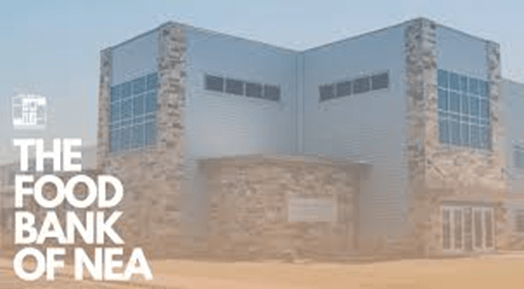
Photo courtesy of the Food Bank of Northeast Arkansas

As grocery prices climb and paychecks fall short, more Northeast Arkansas families are waiting in food bank lines to make ends meet.

Food insecurity is rising in northeast Arkansas as inflation drives up the cost of groceries, gas and housing, putting increased pressure on local food banks.

The Food Bank of Northeast Arkansas secures donations from food and grocery industries, government agencies, individuals and other organizations to provide for people in need. The food is stored in the organization’s 59,600-square-foot distribution facility in Jonesboro.

Terry Austin, a development officer focused on fundraising and communications, said demand for food assistance has increased over the past year due to inflation, rising gas prices and cuts to federal support programs such as the Supplemental Nutrition Assistance Program, or SNAP.

“Demand has risen already just from the cuts that we’ve taken so far from the economy being in rough shape,” Austin said.

Austin said donors are also feeling financial strain, forcing them to be more cautious with their contributions as they balance their own household expenses. He said the food bank has seen an increase in senior citizens and families seeking assistance.

“Everybody right now is watching gas prices go through the roof,” Austin said. “Everything is more expensive at the grocery store.”

According to Feeding America, about 240,000 people in Arkansas benefit from SNAP, including 113,000 children and 36,000 senior citizens. A University of Arkansas study estimates that 28.8% of Arkansans face food insecurity.
“The price of one pound of ground beef is now higher than the federal hourly minimum wage,” Austin said, describing the current conditions as a “perfect storm” of rising costs and reduced assistance.

Austin said he is concerned about the food bank’s ability to meet growing demand as grocery prices continue to rise and federal assistance programs face potential cuts.

“I’m honestly worried about making sure that we’re able to meet the needs that may be coming our way,” Austin said.
Feeding America estimates that cuts to SNAP benefits could result in a loss of up to 41 million meals for Arkansas families.

Laura Dunivan, who works on the programs team managing fundraising and grant efforts, said rising costs are bringing more first-time clients to food pantries.

“What used to be occasional support for some families is now something they rely on more heavily,” Dunivan said. “We’re consistently serving more households each month.”

Dunivan said many families use food assistance to fill gaps during financial hardship, allowing them to afford other essentials such as gas, rent or medication.

“Would you sit in a car line for an hour for a box of food if you could just go to Walmart and get it in 10 minutes?” Dunivan said.

She said transportation remains a major barrier in rural communities, where access to food pantries can be limited. To address this, the food bank operates the Nourish Mobile, which delivers fresh produce at no cost to underserved areas.
“Some of the people can’t come to the pantries, we have to go out to them,” Dunivan said.

Natalie Neal, the USDA coordinator for the food bank, said federal food programs play a critical role in addressing hunger across the state.

“With the rising price of food, it is more expensive to purchase food, and our neighbors can’t afford everything they need,” Neal said. “It really starts to feel like there’s a greater gap.”

Neal said the food bank has seen a decrease in USDA food shipments, limiting the amount of food available for distribution.

“We are seeing less come into the food bank, so we have less to go out to the community,” Neal said.

She said the organization works with mayors, churches and community partners to expand access and reach new households.

“USDA foods provide a pivotal source of food,” Neal said. “It helps keep food in the pantry to help us all get through difficult times.”

Bonnie Mamula, office manager at the food bank, said rising food costs combined with stagnant incomes are key drivers of food insecurity.

She said senior citizens are especially vulnerable because many live on fixed incomes while expenses continue to rise.
“Some counties only have a few pantries, and they’re only open a couple of times a month,” Mamula said. “People in more remote areas have fewer choices.”

Mamula said the food bank is also seeing more working individuals and recently unemployed residents seeking assistance.

“Even people with jobs can’t make ends meet,” Mamula said.

Jennifer Hannah, chief program officer, said inflation has affected not only how many people the organization serves but also the quality of food it can provide.

“If we look at our data over the last few years, what we’re seeing is consistently serving more people,” Hannah said. “Demand is always there; it’s just how urgent it is.”

Hannah said many families fall into a gap where they earn too much to qualify for assistance programs but not enough to consistently support their households.

“It’s not so much changing the services we deliver, it’s changing how much we’re able to deliver,” Hannah said. “When prices go up, the quality of people’s food is going to decrease.”

-30-

Food insecurity remains challenge for Food Bank of NEA

Story by DDNS Reporter Jerry Don Burton

JONESBORO – Following the government shutdown and with the holiday season approaching, food insecurity in Northeast Arkansas (NEA) remains a challenge for food banks.

Arkansas faces the highest rate of food insecurity in the nation, according to a since-discontinued annual report published in 2024 from the U.S. Department of Agriculture (USDA). The USDA defines food insecurity as a household-level economic and social condition of limited or uncertain access to adequate food.

Terry Austin, development officer at the Food Bank of NEA, said the rural nature of Northeast Arkansas contributes to the high rates of food insecurity. Many areas of Arkansas are also classified as food deserts.

Food deserts are areas where access to affordable, healthy food is restricted or nonexistent due to the absence of grocery stories within convenient distances, as defined by Food Empowerment Project.

“Statistically speaking, 21% of Northeast Arkansas citizens are in food insecure households,” Austin said. “Which is a staggering statistic to me.”

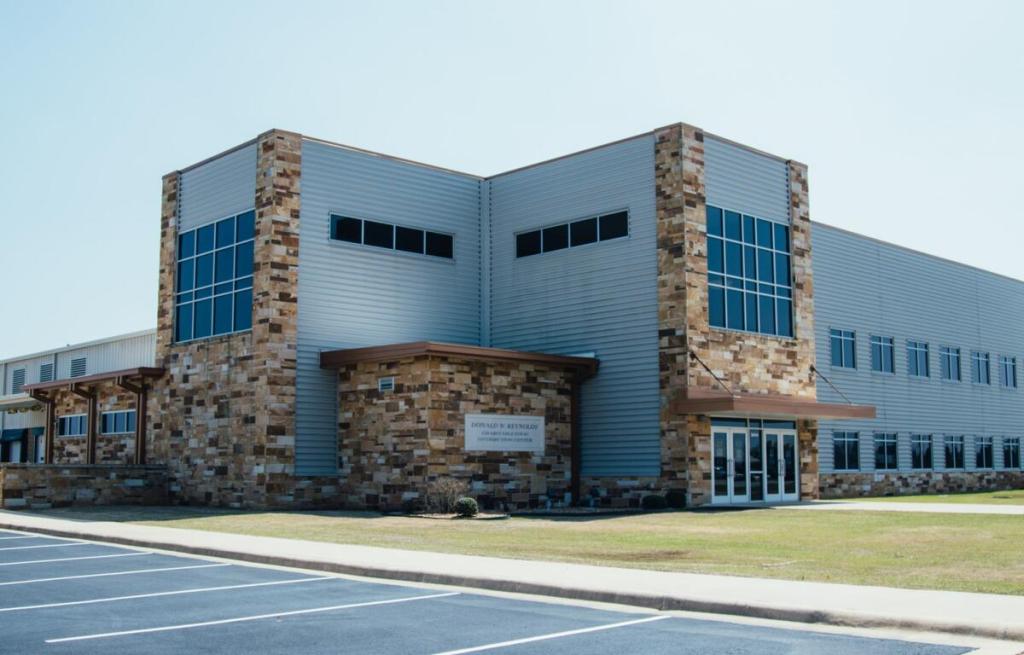
The Food Bank of NEA entrance, located at 3414 One Place in Jonesboro. Photo courtesy of Food Bank of NEA Facebook.

Food deserts are not the only elements worsening food security in NEA, though. National factors have further increased demand for food banks.

Lingering Impacts of Government Shutdown
Austin said the latest government shutdown, which lasted from Oct. 1 to Nov. 12 put a spotlight on food insecurity. He said those who depend on food assistance, such as the Supplemental Nutrition Assistance Program (SNAP) and federal employees, were particularly impacted.

The Food Bank of NEA saw a 16% increase in SNAP recipients who received food assistance during the shutdown compared to that same period in 2024. 8% of those served were new households that had never received assistance from the Food Bank of NEA before.

The One Big Beautiful Bill Act, signed into law by President Donald Trump on July 4, is also expected to impact food security nationwide.

President Donald Trump displays the One Big Beautiful Bill Act, after signing it. Photo Courtesy of Leah Millis, Reuters.

“[The act] is estimated to reduce the number of meals for SNAP beneficiaries in the nation by some six billion meals year to year over the next 10 years,” Austin said. “We’re gonna see that kind of cut in food assistance and that’s going to mean a very steady rise in demand.”

Another factor influencing the increased pressure on food banks is the approaching holiday season.

Holiday Season Challenges
“Regardless of what your family’s financial picture may be, you still want to have those holiday gatherings,” Austin said. “You want to have a table of food to share with your loved ones.”

The holiday season further contributes to an increase in demand because, since many children will be on break, they’ll miss out on school-provided meals. One in three children are at risk for hunger in NEA.

Austin said the Food Bank of NEA orders traditional seasonal food during this time of year to give families in need the food to make a holiday meal.
Food insecurity is not an issue limited to NEA, either.

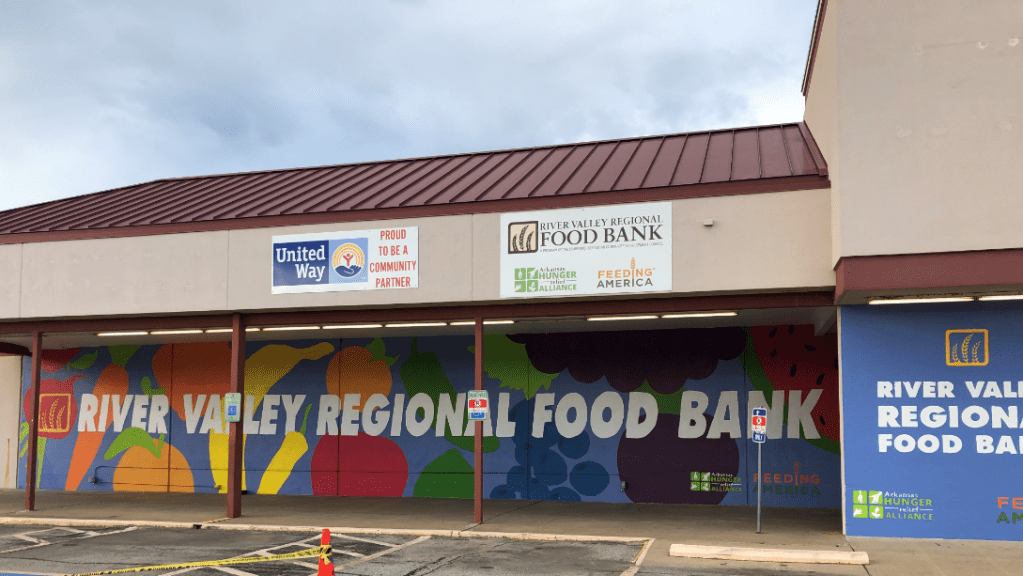
The River Valley Regional Food Bank entrance, located a 1617 Zero Street in Fort Smith.

Food Insecurity Affects Arkansans Everywhere
On the opposite side of the state, the River Valley Regional Food Bank in Fort Smith serves 140 pantries across eight counties in Western Arkansas.

Hattie Hamilton, interim food bank director and operations manager for the River Valley Regional Food Bank, said they have reached out to Feeding America for extra food. She said the additional product will help the food bank better supply the pantries as need increases.

Feeding America is a non-profit network of food banks nationwide that helps feed more than 46 million people.

“Our battle here to help fight against it is just to get the food in to help get to the neighbors in need,” Hamilton said.

State Funding Support
In an effort to combat SNAP cuts and relieve pressure on food banks, state funds have provided support to food banks across Arkansas.

On Oct. 31, Arkansas Governor Sarah Sanders directed $500,000 to be split among the six Feeding America partnered food banks in the state. On Nov. 9, with the shutdown still in effect, Sanders assigned $500,000 more to food banks.

“As the shutdown continues, my administration will stand with our partners in the legislature, at churches and in food banks to help Arkansans stay fed,” Sanders said.

Back in NEA, Austin said their food bank received about $83,000 from the state. He said the Food Bank of NEA priortized buying protein products with the funds.

“Protein is a critical part of a diet and it’s also part of a diet that’s hard for us to provide enough of in our distributions,” Austin said. “We get a lot of canned goods and a lot of dry goods. Protein can be tricky to fit into that parameter, so that’s why we focused using those dollars on protein purchases.”

Austin said he wants to stress that the food bank is grateful for the money, but more help is needed to meet the rising need.

Demand Rising in Northeast Arkansas
One of six food banks in Arkansas, the Food Bank of NEA serves a 12-county area in the northeast region of the state, serving about 8,000 square miles.

Austin said the Food Bank of NEA primarily raises money and food and then distributes products to 176 partner agencies. These agencies include churches, schools, food pantries and homeless shelters.

In 2024, the Food Bank of NEA distributed 8.2 million pounds of food to those facing food insecurity. 25% of that food was fresh products like meat, vegetables and fruit.

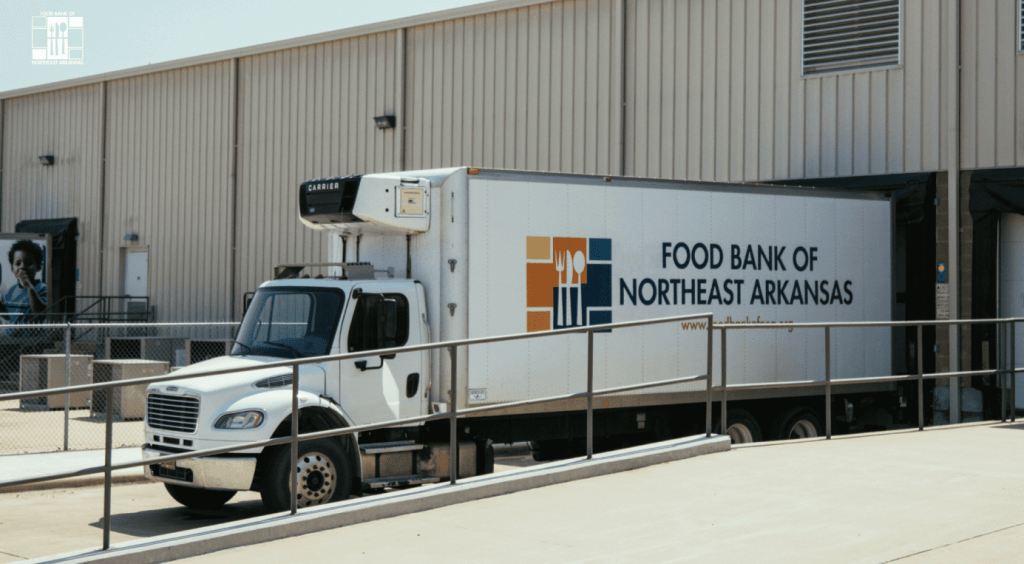
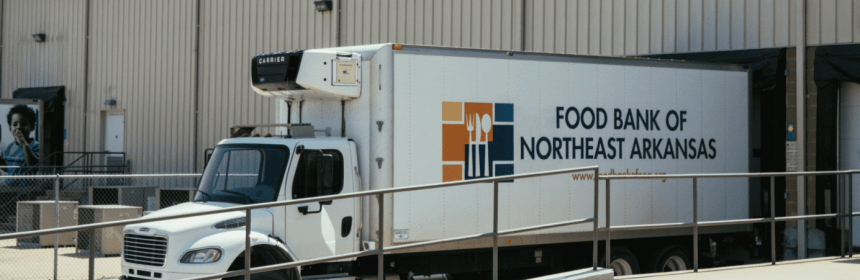
A Food Bank of NEA delivery truck, parked in the loading dock of the Food Bank of NEA. Photo Courtesy of the Food Bank of NEA website.

In addition to distributing food to partner agencies, Austin said the Food Bank of NEA travels to each of the 12 counties as least four times a year to hold a mobile distribution.

Through these distributions, Austin said the food bank arrives to a central location and hands out food themselves. He said the increased demand is felt even in these mobile distributions.

During a mobile distribution held in Craighead County in early October, Austin said the food bank brought 24 more boxes of food than normal and still had to turn away about 30 households because they ran out of food.
Similarly, during a distribution in Lawrence County, Austin said they brought 64 additional boxes of food and had to turn away 42 households.

“We simply ran out of food,” Austin said. “The demand has definitely spiked and it spiked in part because of the shutdown, but honestly, the demand was already beginning to climb.”

How to Receive Assistance and Offer Support
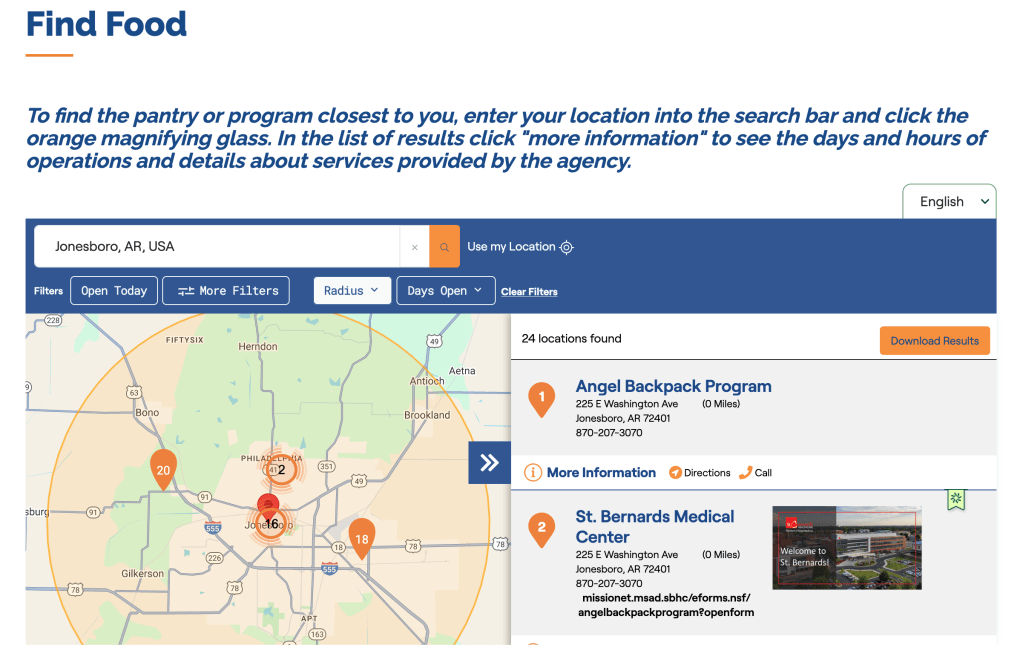
For those in need of food assistance, Austin said one of the best resources they offer is an interactive map on their website that allows users to find what food distributors in NEA are closest to them. Phone numbers, addresses and more information is included in the map to help guide users to help they need.

A screenshot of the Food Bank of NEA interactive map. The map allows users to search for food distributors in their location. Screenshot retrieved from the Food Bank of NEA website.


“We have done this a long time and we know all the ins and outs and the best way, the most efficient ways to get food to people who need it,” Austin said. “We stand ready to help if we need to.”

The Food Bank of NEA also has links under the “How to Help” section of their website for those interested in donating or volunteering. 1,157 volunteers donated 3,847 hours in 2024 to support the Food Bank of NEA.

Some of the most needed food items include peanut butter, canned soups, pasta, cereal, boxed meals, canned meats, and canned fruits and vegetables.

Austin said fresh food is always a challenge, so shelf-stable products are preferred. He also said popular foods that are flexible in meal prep are favored, such as spaghetti, corn, green beans and macaroni and cheese.

More than food, though, Austin said the Food Bank of NEA–and most food banks in general–actually prefer money donations.

Austin said donating money directly would serve the food bank more than canned goods, as the food bank buys product in bulk at reduced prices.
“We typically say that $1 donated can provide up to three meals,” Austin said. “We’re able to really stretch those dollars a long way.”

Austin said money donations can be used to pay for freight costs and other fees needed to keep the food bank running, too.

Still, Austin said any form of support–food donations, money donations, volunteer work or otherwise–is greatly appreciated.

The Food Bank of NEA is open from 8 a.m. to 5 p.m. weekdays and is located at 3414 One Place in Jonesboro. The food bank can also be reached by phone by calling 870-932-3663.
-30-