Tag Archives: healthcare

HEALTHCARE TO AGRICULTURE TOP ISSUES FOR A-STATE STUDENTS

Story by DDNS Reporter Gracie Lunceford

Image courtesy of Pixabay

JONESBORO, Ark. — At Arkansas State University, students are concerned about a myriad of issues during this year’s midterm elections. 

With the 2026 midterm elections coming this November, citizens are eager to vote on a range of issues. After interviewing three students at Arkansas State University, it was found that top concerns are healthcare, the rising cost of living, and protecting agriculture. Voters are seeking out candidates who are focused on protecting their community.

Evelyn Rogers, a wildlife biology major at Arkansas State, says her biggest concern is farming and agriculture. According to Rogers, the condition of the state’s agriculture is a crucial part of Arkansas’s economy and identity. 

“Supporting farmers in rural communities, while also protecting our water, land, and wildlife, is important to me because I want to see those resources available for future generations,” says Rogers. 

Although she identifies as a Democrat, Rogers agrees with the Republican Party’s support for agriculture in Arkansas.

“When it comes to supporting farmers in rural communities and protecting wildlife, I think it’s important to look at individual issues and candidates rather than automatically agreeing with everything one party represents.” 

Aspen Frank, a strategic communications major, says what is driving her to the polls is a concern about the high cost of living in Arkansas. 

“Coming from a state where every day I have to witness firsthand the suffering, [due to] the struggle that comes from high poverty rates, it’s important to me that the extra costs of living can be diminished rather than increased,” says Frank.

Along with the rising cost of living in rural areas, access to healthcare is also one of her biggest concerns, specifically as a type 1 diabetic herself. According to Frank, her firsthand experiences of receiving life-saving healthcare, but dealing with extremely high costs of medicine, have had a profound impact on her personally. 

“There are people in Arkansas that can’t even afford rent due to the overwhelming cost of medical care. Insulin is a necessity for survival, and we should not have to question whether you’ll be alive by the end of the week if your paychecks don’t come in on time,” according to Frank.

Many young people are excited to get to the polls and fulfill their civic duty as American citizens. Nathan Boone, a chemical engineering major and cadet in the Red Wolf Battalion, is passionate about voting in the midterms this year. Part of the reason for his passion comes from being in a migrant family. 

“We escaped communism,” says Boone. “I believe voting is half the luxury of being an American. You get to speak out about your government, participate; in Vietnam, if you spoke out, you were directly taken to a re-education camp.”  

This election season, many students are eager to have their voices heard on the issues that matter most to them: healthcare, agriculture, and the rising cost of living in Arkansas. 

Early voting in Arkansas begins October 19th through November 2nd, with the general election on November 3rd. In Craighead County, voters can cast ballots at the Election Annex, 315 W. Jefferson Avenue in Jonesboro, from 7:30 am to 7:30 pm. This is part of the national midterm elections.

#####

Local Hospital Navigates Rising Costs, Growing Demand

Stethoscope with dark blue tubing and metallic chest piece on a white background

Story by DDNS Reporter Benjamin McDowell

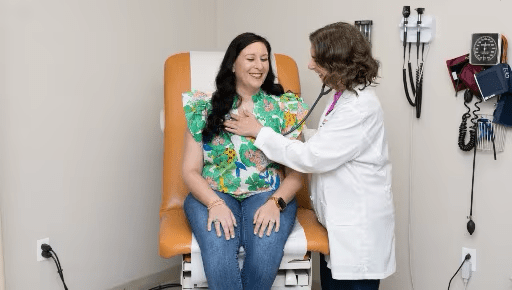
St. Bernard’s health care physician Dr. Christina Carl (right) performs a heart and lung auscultation for a patient during a routine wellness exam in Jonesboro, Arkansas. Photo courtesy of St. Bernard’s.

JONESBORO, Ark. — As St. Bernard’s Health Care approaches its 126th anniversary on July 5, leaders say the oganization is balancing a legacy of community care with the growing challenges of modern health care.

St. Bernard’s has been in medicine for 125 years, evolving alongside the social service industry rather than the city, economy, or technology. Kevin Hodges, senior vice president, said rising costs and increasing insurance requirements continue to strain providers in the post-COVID era.

“Every time they add requirements, it adds cost to us,” Hodges said. “Someone has to make sure those requirements are met just for us to get paid. Those are uncompensated burdens.”

Health care systems face high operational costs, including labor, transportation, utilities, and food insecurity. Hodges said balancing expenses while navigating reimbursement challenges has become increasingly difficult. Hodges also noted funding for social service programs has stagnated, often coming from federal and state sources, and emphasized the importance of volunteers from churches, students, and other community groups.

“To have high-level social services in communities, you have to have strong volunteer programs,” he said.

Michael Givens, administrator and chief operating officer, said the vision of the Sisters who founded St. Bernard’s 126 years ago continues to guide the hospital. Over his 25 years, Givens has seen growth in heart care, stroke care, robotic surgery, and technology, including artificial intelligence.

“We already use a system called Rapidan. It works with our CAT scanners to analyze brain scans and quickly identify strokes or aneurysms,” Givens said. “That kind of speed can save lives.”

Givens said St. Bernard’s aims to expand services further, recruit specialists, and become a top-10% hospital in the U.S.
Kevin Byron, assistant vice president for Behavioral Health Services, said the rise in mental health issues has driven growth in inpatient and outpatient care. The hospital has 108 beds serving patients with a wide range of needs, from severe psychosis to depression and suicidal thoughts.

Mental health remains central to St. Bernard’s mission, he said, inspired by the founding Sisters. Programs like the recuperative care program at the CSU allow patients to stay up to three months post-discharge, supporting those experiencing homelessness.

“I’ve been in health care for about 27 years, and Jonesboro has grown significantly. As the population grows, so does the need for infrastructure and services,” Byron said. He hopes to create a crisis response team that works with law enforcement and 911 and a psychiatric residency program to train new psychiatrists locally.

Mitchell Nail, media relations manager, said his role has shifted since the pandemic from health guidance to encouraging residents to address health issues early, including finding primary care providers and attending screenings.

Increased awareness of social services has led St. Bernard’s to provide prenatal and postpartum care regardless of a patient’s ability to pay. Nail said patient stories remain the hospital’s most effective way to connect with the community.

“I want people to see St. Bernard’s as their trusted source for health information and care,” he said. “I want them to feel confident they can find expert guidance and treatment right here in their community.”

-30

Freshman to Physician Partnership Formed

DDNS Story and Audio by reporter Mia Young

Young: Arkansas State University and the NYIT College of Osteopathic Medicine are working together to make the path to becoming a doctor a little bit smoother for Arkansas State students. The Freshman to Physician Pathway is a new partnership this year between A-State and NYITCOM that lets qualified students secure early admission to medical school while they are still undergraduates. Jennifer Wharton, media contact for the program, knows the ins and outs of the program and how it can help students. [0:31]

Wharton: Our goal is to help students who are interested in going into healthcare, specifically becoming a physician, become more confident and a more competitive applicant for medical school. We’re seeing a lot of need in the delta region for students who not just have an education, but have a quality education. And one of the things we know about medical education is that students who are from an area, who are able to stay in that area and go to school are going to be more likely to in turn, practice medicine in that area. [0:34]

Young: Students in the pathway will major in biological sciences with a pre-professional emphasis. If they maintain at least a 3.5 GPA, complete the required coursework, and pass an interview, they will earn a spot in NYITCOM after graduation. Program leaders say the collaboration between the two schools will give students extra mentoring, academic support, and confidence, along with peace of mind about their medical future. Jamie Howell is a prospective student for the Freshman to Physician pathway. [0:30]

Howell: I would like to do this program because it provides me with a quicker opportunity to pursue my dream of becoming a doctor. I also believe, if I understand the program correctly, that it can help you get into med school without taking the Mcat. This can be beneficial to me because I typically struggle with test anxiety and tend to not do as well as I should or as well as I believe my knowledge permits. [0:23]

For more information about the program go to AState.edu/FreshmanToPhysician. I’m Mia Young and you’re listening to KASU. [0:09]