JONESBORO, Ark. – The Feminist Union at Arkansas State University in Jonesboro will be hosting their first women’s rights rally this Saturday. It will be held from noon to 3 PM in the courtyard of the Craighead County Courthouse.
The event is open to the community, and those who attend can choose to sign for the Arkansas Abortion Amendment and Period Tax Petition. They will also hear from several female speakers who are important figures in the community.
“Essentially, this rally is to…celebrate the advancement of women’s rights across the years but also to celebrate the women now who are making basically their mark on history, specifically women’s history,” said Christina Smith, the president of the Feminist Union and a student at ASU Jonesboro.
The Arkansas Right to Abortion Initiative–more popularly known as the Arkansas Abortion Amendment–is a movement that aims to get the amendment on the ballot for 2024 as a constitutional amendment in Arkansas. If instated, the amendment would allow abortion within 18 weeks of conception; in the cases of rape, incest, or fatal anomalies; or when the life of the mother is in danger.
The movement was started by Arkansans for Limited Government, a nonprofit organization that advocates for personal liberties and limiting government involvement, especially in regards to healthcare. They must collect at least 90,000 signatures by this July 5 in order for the amendment to be placed on the November 2024 ballot.
An Act to Exempt Feminine Hygiene Products and Diapers from Sales and Use Tax is being spearheaded by the Arkansas Period Poverty Project, which aims to increase access to feminine hygiene products in Arkansas, especially for those in poverty, by ending sales tax on feminine hygiene products and getting free menstrual products in public schools. They need 72,500 signatures by this July in order to make it on the November 2024 ballot.
Those are the two main movements that the Feminist Union is currently promoting, but Smith said there may be other causes represented at the rally. The speakers at the rally will be talking in general about women’s rights, but they also will most likely promote their own causes.
There will be four speakers: State Senate candidate Erika Askeland, who is running for District 20; Young Democrats of Arkansas president Allison Sweatman; Alison Guthrie, a community advocate from Little Rock; and another community advocate, Rebekah Pruitt, from Jonesboro.
Specifically, Askeland will probably speak about her campaign. Sweatman will most likely speak about the importance of voting, especially for women. Guthrie stated that she would be talking about disability rights. Pruitt, as a transgender woman, will most likely speak on transgender rights.
While it’s their first rally, Smith said that it wasn’t difficult to arrange. Since the courthouse’s courtyard is public property, she just had to call the courthouse to ask permission to use it and make sure no one else was using it at that time. Then she started promoting the event.
As for the speakers, Smith already had connections to them. She reached out to Guthrie and Pruitt and asked them specifically to speak. Meanwhile, Askeland and Sweatman volunteered when they heard about the event.
“I reached out to Alison Guthrie and Rebekah Pruitt because I’m a very big fan of their work within their own communities,” Smith said.
Smith works on Askeland’s campaign, so when Askeland heard of the rally, she offered to speak. Similarly, Smith is the president for the Jonesboro chapter of the Young Democrats of Arkansas, so when she mentioned the event to Sweatman, Sweatman also volunteered.
The ASU Feminist Union itself has only recently become active again. It was first established in 2018 but shut down due to the COVID-19 pandemic. Inactivity after the campus opened again caused the organization to die out.
However, in fall 2023, Smith wanted to revive the Feminist Union. She had to register it again as a student organization and then recruit more members. Currently, the Union has around 60 to 70 members, but only about 10 to 15 members regularly attend meetings and activities.
“The hardest part was getting members…active members,” Smith said.
They have meetings every two weeks on Wednesdays and events every month. They have hosted panel events, in which they invite community advocates, elected officials, or female candidates for discussion; readings and movie nights about feminism; and tabling events where they hand out free condoms. Next semester, they’re also planning to start handing out emergency contraceptives.
Avery Jonesis a junior in The Department of English and Philosophy at Arkansas State University in Jonesboro, Arkansas. She can be reached at avery.jones@smail.astate.edu
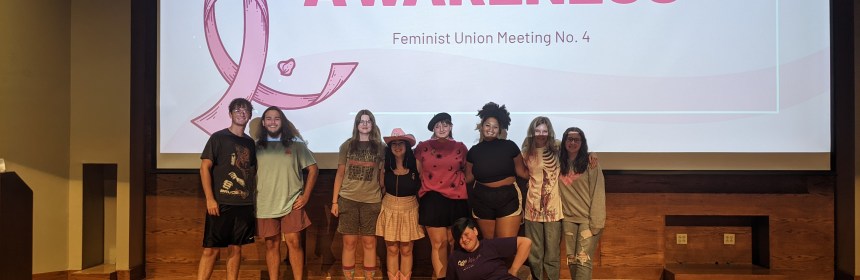
Note: Featured image is from one of the Feminist Union’s previous events.
JONESBORO, Ark. – On June 14, the Southern Baptist Convention voted against allowing female pastors in churches associated with the convention during their annual meeting in New Orleans, Louisiana, according to a press release from the Baptist Press. They have also voted to expel three churches that have female pastors from the convention.
While female spiritual leadership is becoming more and more prevalent in churches today across several denominations and sects, it’s still relatively uncommon in Northeast Arkansas.
According to the Pew Research Center, only certain denominations allow women to be ordained, the most relevant for this area being Methodists, Church of Christ, Episcopals, Lutherans, and Presbyterians. Southern Baptists generally do not allow female preachers.
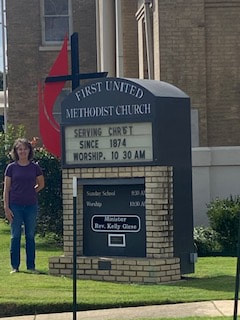
While it’s still relatively uncommon, there are a few female pastors in the area. Reverend Kelly Giese is the head pastor at the First United Methodist Church in Newport.
She’s been serving as a pastor for twenty-six years and at her current church for two years. She’s originally from Arkansas and currently living in Newport.
Reverend Kelly Giese
She was drawn to community service growing up. After she graduated from high school, she was very involved in vacation Bible school and Sunday school.
She also started working with disabled children from a group home. She worked in education for twelve years and has a master’s degree in education. A friend of the people from the group home died, and she was asked to preach at the funeral.
“I got a hold of my pastor at the time, and I said, here’s what’s going on,” Giese stated. “And that person said, you can preach this service better than I can. You know this person…From there, I just started exploring ministry.”
She described her decision to pursue ministry as a “calling.” She followed one of the usual pathways to ordination.
Her church held a conference to verify that she had been called and voted to receive her. She was assigned a mentor and decided what path she was interested in. She went through a process to become licensed which made her a local pastor.
“There’s a lot of other avenues out of there. I just happened to choose to go to seminary and then work through towards ordination after that, but there’s other pathways,” Giese said.
She attended the Duke Divinity School in North Carolina which was founded by the Methodist Church. By that point, she said, it had become fairly common for women to go to seminary and become pastors.
“I graduated from high school in 1978, and I had never met a female pastor at that point,” she said. “From that time forward…it became much more common…All of the women who went before me helped me.”
“I graduated from high school in 1978, and I had never met a female pastor at that point,” she said. “From that time forward…it became much more common…All of the women who went before me helped me.”
– Reverend Kelly Giese, Head pastor at the First United Methodist Church in Newport.
Her duties as a pastor vary from day to day. While she of course preaches and leads worship, she also has many other responsibilities.
She does a lot of community service, like visiting people in the hospital or nursing home, mentoring children, or helping with the food pantry. In the church, she helps with ordering curriculum for Sunday school, preparing for worship, and church maintenance as well as administration.
“I can’t say that that’s my job, but it’s what’s needed by the congregation…” Giese said. “I’ve caught three birds, there was a possum in the toilet, and we caught a raccoon.”
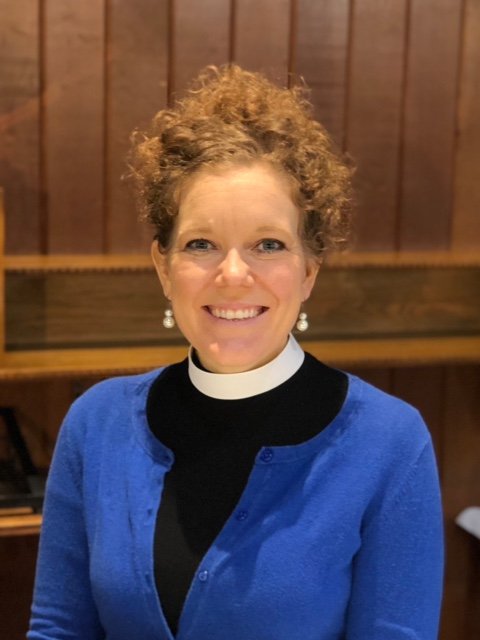
Another pastor, Reverend Annie Jones, is the rector of St. Paul’s Episcopal Church in Newport. She’s been serving there since 2021. She’s been a priest since 2020 and is originally from Iowa.
Rev. Annie Jones
Like Giese, she also experienced a “calling.” Before she was a priest, Jones was working as an elementary school teacher.
“Callings are very interesting and tricky things…I tried to ignore it, and that didn’t work out well for me,” Jones said.
She felt called to ministry since she was thirteen years old, but in college, she chose to go a different direction because, according to her, first-generation college students are generally expected to choose a “safe” path–a career that’s stable and provides a comfortable living. However, when Jones went on a trip to Eswatini, Africa (formerly Swaziland), she could no longer ignore the call.
In Eswatini, Jones was listening to several speakers, and one speaker was talking about callings. Jones felt like she couldn’t keep running from what she felt was the “internal voice of God” telling her to become a priest.
She had to do three years of seminary to become an Episcopal priest. She attended Church Divinity School of the Pacific in Berkeley, California. She also did clinical pastoral education, or CPE, which is 400 hours of hands-on chaplaincy work.
Most people do their CPE in hospital settings, but Jones had the opportunity to work with San Francisco Night Ministry where she walked the San Francisco streets from ten p.m. to two a.m. ministering to anyone who needed it.
Like Giese, Jones is expected to keep up with many duties as a priest. Jones said that because churches don’t usually have a large staff, pastors and priests are expected to be a jack of all trades.
It’s relatively common for women to be pastors in the Episcopal Church. According to Jones, they started ordaining women in the 1970s. In the diocese where she came from, the percentage of ordained women was well over fifty percent.
Here in this region, the percentage is much lower. However, Jones says that it’s changing.
Jones said that what she most loves about her job is the people.
“Being able to walk with people in the hardest and the happiest times, and being permitted to be in those spaces with them,” Jones stated. “And to help hold them and support them and pray with them and be an encouragement…we see the highest of highs and the lowest of lows in ways that many family members don’t actually even see of others, and that is a huge, huge responsibility, but also one of the amazing parts of the job.”
“Being able to walk with people in the hardest and the happiest times, and being permitted to be in those spaces with them,” …
– Rev. Annie Jones, St. Paul’s Episcopal Church in Newport
Captain Teri Smith is another local female pastor from the Salvation Army Church in Jonesboro. She’s part of a Protestant sect called the Salvationists, who have similar beliefs to Methodists.
Captain Teri Smith
She has been working with the Salvation Army since 2010 and has been an ordained minister since 2015. She was working as a youth pastor before she was ordained.
Smith and her husband, Captain Charles, decided to pursue ministry together. In the Salvation Army, both husband and wife have to become ordained together, not just one of them. Furthermore, if a single person is ordained, they can’t marry anyone unless the other person is also ordained or in the process of becoming ordained.
To become ordained, Smith attended the Salvation Army’s training center in Atlanta, Georgia, where she studied for two years. It’s similar to a seminary, but also teaches how to run a shelter and other practical aspects of working with the Salvation Army.
As a minister, Smith is also considered one of the commanding officers of the Salvation Army’s Jonesboro region. She and her husband direct eight counties. Her duties depend on how many volunteers and employees they have at the moment.
Currently, Smith’s duties include administration, like human resources and finances, and she and her husband share the duties of preaching. She also oversees Safe From Harm, which is a child protective training program that all of the volunteers and teachers in their church have to undergo.
In addition, Smith is the director of the women’s and youth ministry program. She teaches the lessons most of the time. She also is a part of the disaster services unit; whenever and wherever there’s a disaster, Smith is deployed with a team of other officers to assist.
“There are a lot of arms. As commanding officers, we are charged to ensure that things will run smoothly and sometimes, that means we are the ones that have to head it up,” Smith said. “Other times, we hope to train someone, or help encourage others to be a part of that, and then we just oversee it, but if there is no one to fill in that duty, as I’ve had to do right now with our finances…I’m having to fill that duty.”
“There are a lot of arms. As commanding officers, we are charged to ensure that things will run smoothly and sometimes, that means we are the ones that have to head it up,” Smith said.
– Capt. Teri Smith, Salvation Army Church in Jonesboro
Additionally, as officers, Captains Teri and Charles Smith can be deployed or moved at any time. They’re currently living in Jonesboro, but if they get called to move to another region, they will have to leave. Teri is originally from Ohio.
Similar to other denominations, women ministers are very common in the Salvationist Church. In their doctrine, they believe that it’s better for married couples to be ministers together. The couple is supposed to act as a unit.
“There’s no difference between male or female in that,” Smith said. “If you feel called, that is something that the Salvation Army will pursue.”
In the 1800s, when the Salvation Army was first established, Catherine Booth, the wife of the founder, felt the call to ministry. She wrote many articles, pamphlets, and books advocating for female ministers.
However, Smith still faces much prejudice as a female minister. According to her, it’s still not widely accepted in many circles for women to be ministers. For example, it’s difficult for her to be part of ministerial alliances where there are many ministers that don’t believe women should be ministers.
“My job isn’t to make anyone feel uncomfortable,” Smith said. “If that’s where I feel God has called me, then no matter if people agree or disagree, I don’t need that affirmation…”
Smith said many people believe that women shouldn’t be pastors because theological beliefs and certain interpretations of the Bible. However, Smith believes that because there were some women in the Bible who were in positions of authority, women are permitted to be ministers.
Additionally, some people even refuse to acknowledge her authority as a commanding officer of the Salvation Army. In her experience, sometimes people will ask for the captain, and when she says that she’s a captain, they’ll ask for “the man.”
However, at the end of the day, Smith said that “our heart is to be able to help people.” Because of the nature of her work, sometimes when people come to them, it’s because they’re having the worst day of their lives. What she truly wants is to help people, and the hardest things are the occasions when she’s unable to help.
-30-
Avery Jonesis a junior in the Department of English and Philosophy at Arkansas State University in Jonesboro. She can be reached at: avery.jones@smail.astate.edu
JONESBORO – March was Women’s History Month. It’s a recognition of women’s contributions to culture, history, and society. The annual celebration began in 1987. It first started as Women’s Day on Feb. 28, 1909.
In northeast Arkansas, many women serve in leadership positions and have started their own business. In Jonesboro, several small, independent businesses are owned and operated by women. They range from medical practices to art schools.
One such business is Hope Found of Northeast Arkansas, a nonprofit organization focused on raising awareness to fight against sex trafficking. It officially became a nonprofit in 2019. Megan Brown co-founded it with Audra King, Mary Sellers, and Miranda Ballard.
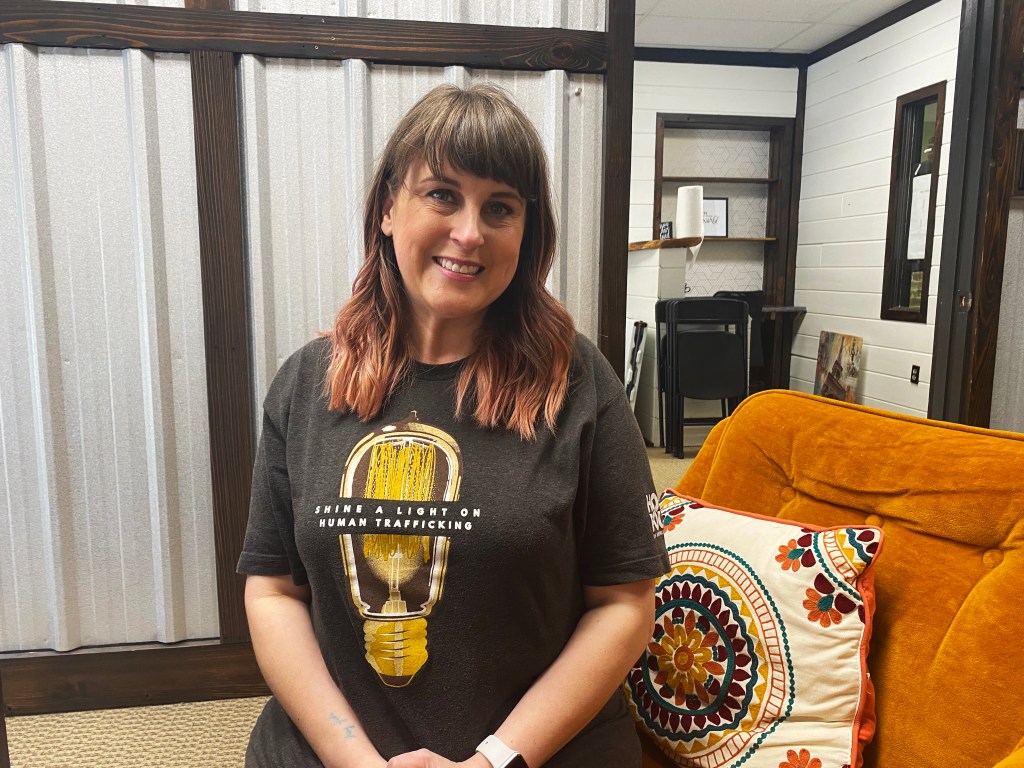
Megan Brown of Hope Found NEA.
Brown has been involved with anti-trafficking since 2009. She was living in Nashville and saw a documentary about trafficking, then felt called to help. She first worked with local organizations as an intern or volunteer.
Brown is originally from Jonesboro and decided to move back in 2011. Back then, there was only one anti-trafficking organization in the state, PATH (Partners Against Trafficking Humans) in Little Rock. She volunteered with them until 2015 and became a stay-at-home mom until 2018.
In 2018, Brown and the other co-founders first came together to discuss opening their organization. Brown and King had worked together before at PATH. Brown was always interested in starting her own nonprofit, but after three big trafficking cases around northeast Arkansas came to light, she became inspired to pursue it for the first time.
“We just really recognized there’s a need for an organization to serve these victims and also educate the community,” Brown said.
“We just really recognized there’s a need for an organization to serve these victims and also educate the community,” Brown said.
– Megan Brown
They struggled to find time to dedicate to the project because Brown was a stay-at-home mom, and the other co-founders had their own jobs and projects to deal with. However, because it was her dream, Brown continued pursuing it.
“When you’re walking in God’s calling, you’re going to constantly have the devil try to knock you down or try to create challenges or barriers,” Brown said. “Just kind of navigating that through it all is difficult as well.”
Brown graduated from Arkansas State University Jonesboro with a bachelor’s degree and was a licensed social worker. When she was living in Nashville, she worked at a restaurant and became a bartender as well as a corporate trainer and opened restaurants in New England.
Her best friend at the time ran a nonprofit in northwest Arkansas, and Brown asked her if she would’ve worked with a nonprofit consultant if she could do everything over again. The friend confirmed this, and Brown decided to pursue this path.
When she was starting to think about opening a nonprofit, Brown worked with a local company called KHARIS Group Consulting. She learned from a consultant named Shunquetta Cunningham about how to manage a nonprofit.
Today, Hope Found NEA has two employees, one of them being Brown. They give sex trafficking awareness presentations for professionals, and they have a curriculum for youth. The curriculum teaches the red flags to look for in someone who might have been trafficked, how to avoid being trafficked, and how to identify positive influences in one’s life. They also set up booths at various events.
Tanya Eddy, 53, owns and runs Jonesboro Art School, a small, independent school for children. She opened the school in 2009. Before the COVID-19 pandemic, she used to teach in-person classes for children, but now she teaches exclusively online.
She has been teaching for 20 years. She used to teach private lessons with the Foundation of Arts and decided at 40 years old that she wanted to open her own school.
She’s originally from Pocahontas and went to school at Arkansas State University. She started out pre-med, but decided later that she wanted to be a teacher. She got her teaching degree with a major in biology and a minor in art.
While in college, she worked at a bank for 10 years and had become a supervisor by the time she graduated. She left banking 25 years ago.
Within the first year of her art school opening, her class grew from 6 students to 50 students. About 3 years ago, they went completely online.
Eddy enjoys teaching online because she gets to teach students who live in other states and who have moved away. She also works with her daughter, Maya Eddy, 24, who teaches elementary art and creative writing at their school.
Eddy also does digital art and has a YouTube channel where she records demonstrations. Online lessons and digital art work much better for her than traditional art due to her arthritis.
“I love working with the kids,” Eddy said. “I love those moments when they’re learning to do something, and they get it. You can tell that they realize they understand how to do it.”
“I love working with the kids…I love those moments when they’re learning to do something, and they get it. You can tell that they realize they understand how to do it.”
– Tanya Eddy
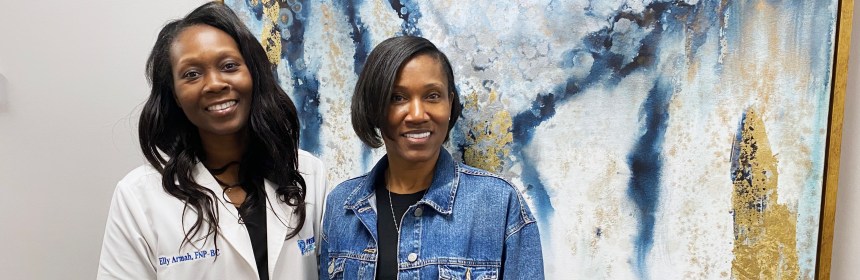
Premiere Family Practice is a small clinic run by Carolyn Coleman, 49, and Elly Armah, 41, nurse practitioners. Armah has been practicing for over 10 years, and Coleman has been practicing for over 20 years.
Elly Armah (left), Carolyn Coleman (right) of Premiere Family Practice.
Coleman is originally from Marked Tree while Armah is originally from Ghana. Armah lived there until she was 2, then moved with her family to Britain, then to the U.S. where she graduated high school. She’s been in Jonesboro since 1996.
Both attended Arkansas State University Jonesboro. Coleman earned her bachelor’s degree in nursing from ASU, then her master’s in nursing from University of Memphis. Armah earned both her bachelor’s and master’s degrees in nursing from ASU.
They both currently work as trauma hospitalist nurse practitioners as well as running their clinic. They first opened their clinic in April 2021. They wanted to have more autonomy and give back to the Jonesboro community.
“I enjoy building up those relationships with my patients,” Armah said. “We pride ourselves on allowing our patients to have access to us. Most physicians don’t give their patients access, and our patients can call the clinic and speak to us, they can call our cellphones and speak to us, so we pride ourselves on giving that personal touch when it comes to their care.”
Foundation – A Wellness Practice is a therapy center owned by Vicki White, 60, and Lauren Hannah, 37. They’re a mother and daughter duo who have been running their business for 5 years. They both worked previously as therapists in nonprofit community mental health centers.
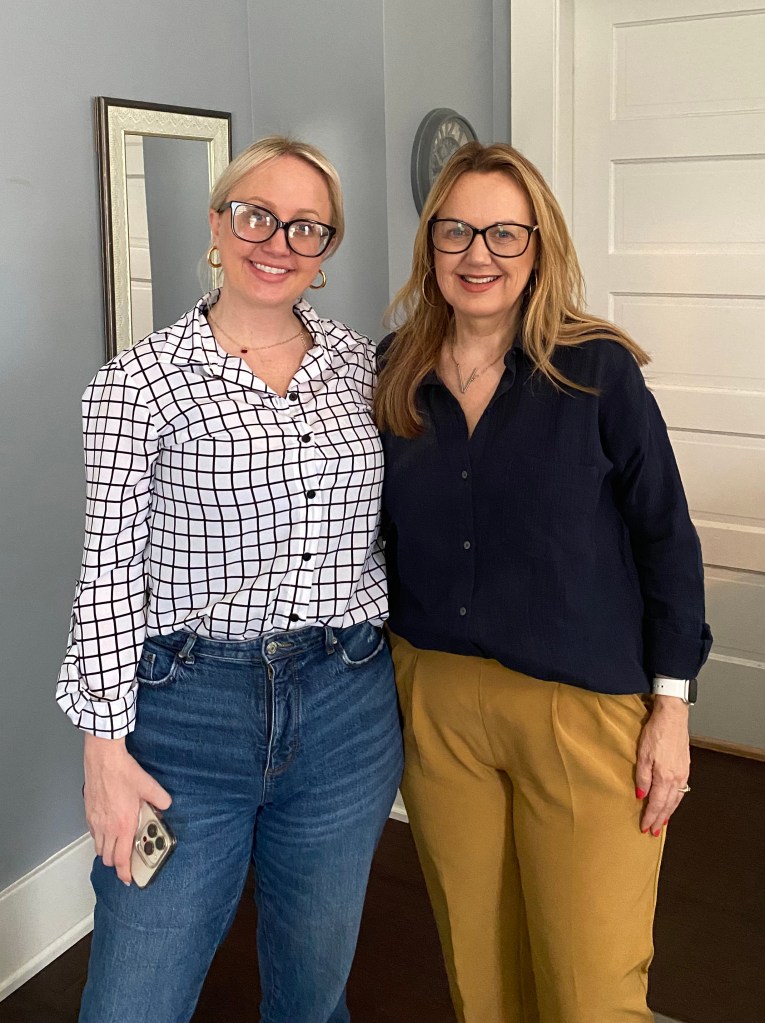
Lauren Hannah (left), Vicki White (right) of Foundation therapy center.
White is originally from Missouri, and Hannah is from Massachusetts. They’re both married, and Hannah currently has four children. When not at school, they stay upstairs in the Foundation building. Hannah’s husband also works for Foundation.
White is a licensed social worker with a bachelor’s degree from University of Tennessee and a master’s in social work from University of Missouri. Hannah is also a licensed social worker with a bachelor’s from Arkansas State University Jonesboro and a doctorate in social work from University of Tennessee.
They decided to open their business because they wanted to offer more specialized care to patients. Their focus is on holistic treatments that prioritize therapy and other natural methods over medication, although they do still offer medication.
They also recently bought the building across the street from theirs in order to open another business, associated with their therapy center, that will offer several wellness treatments: a wellness spa, cryotherapy, halotherapy, IV therapy, a sensory deprivation tank, proactive health treatments, a wellness boutique, and more.
Foundation currently has five full-time therapists and three part-time therapists, as well as a psychiatric nurse practitioner that handles medication. Each therapist has their own specialty. White specializes in couples therapy, while Hannah specializes in anxiety and women.
When asked what she likes about owning their own business, White said, “One thing I really like about it is we have the flexibility to meet people’s needs. If someone we’ve been working with for a while loses their insurance, we can say, Hey, we’ll still see you, we’ll figure it out together. Whereas if you’re working in a bigger business, sometimes you can’t make those types of decisions for yourself.”
Women in northeast Arkansas continue to own, open and operate many businesses which contribute significantly to their communities. The presence of female business ownership and leadership continues to grow, revealing the importance of their existence to society.
Avery Jones is a sophomore in the Department of English and Philosophy at Arkansas State University in Jonesboro. She can be reached at avery.jones@smail.astate.edu