Monthly Archives: October 2017

Public Transit Provides Cheapest Option
by Kayce Wilson
Delta Digital News Service

JONESBORO – With transportation apps like Uber and Lyft bringing services to the Delta, pre-existing businesses may feel the need to change their operations.

Jonesboro Economical Transit System transportation supervisor Keith Michael said the company does not feel threatened by the new services.

“The difference that JET has from other transportation options is that we are able to set our fares at lower rates than other services because we are federally funded,” Michael said. “It will cost you $10 and higher to ride a local cab, UBER or Lyft one way, in comparison to $1.25 one way for JET.”

JET of Jonesboro began operating in 2006. JET’s routes reach across the Central, East, North and West regions of Jonesboro, with a hub at 713 S. Caraway Road.

Since the city runs the public transit, its maintenance department and JET employees provide maintenance. The amount of riders per day varies. Many people use this service to get to work, the grocery store and various appointments.

“I don’t believe the newer forms of transportation will affect our JET ridership. Because we can offer lower fares, this alone will keep our ridership numbers steadily growing,” Michael said.

Craighead County Cab Company was unable to comment at this time.

Edward Harthorn, a graduate assistant in history at Arkansas State, said it is important for people to know about all of the forms of Jonesboro transportation.

“While there’s a lot that I don’t know about Uber or Lyft, I am optimistic that they will quickly play an important role in local transportation,” Harthorn said. “Single-car families, international students and many other constituencies may find that ride-sharing provides a convenient alternative when running errands, traveling across town or waiting for a vehicle to be serviced. It will be interesting to see how these companies and Jonesboro’s public transit co-exist.”

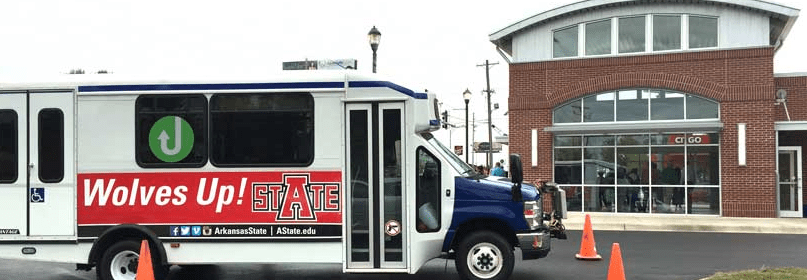
(Photo courtesy of A-State Media Relations)

A Plan for Downtrodden Properties

by Miranda Reynolds
Delta Digital News Service

JONESBORO — The Jonesboro City Council recently hosted the Little Rock Land Bank Commission to learn how it can positively impact the city.

Mayor Harold Perrin said he kept up with the Little Rock Land Bank Commission for two years and thinks that it could benefit the city.

“The biggest thing is that you are trying to clean up your entire area or neighborhood and concentrating on them. That’s the key,” Perrin said.

In 2008, the city of Little Rock started the Land Bank Commission in hopes of increasing home ownership, stabilizing property values, improving the health and safety of neighborhoods, and maintaining the architectural fabric of the community. The Commission sent Doug Tapp as a representative to inform Jonesboro’s City Council of its goals.

“The goal of the Land Bank in Little Rock is to take these properties that have issues, acquire those properties, have them cleaned up and get them back on the tax rolls,” Tapp said.

Tapp said the properties the Land Bank Commission prefers to have cleaned up include those with city liens, unsafe and vacant structures, vacant lots and properties that are being cleaned by the city.

Target areas in Little Rock include blocks with several properties or lots that need attention. Targeting specific areas allows for those communities to have a better selling point for potential buyers.

Neighboring houses to Land Bank Commission properties that are scheduled for demolition are offered to neighbors in the community for $500. Tapp said adding lots together can increase property values. If the property is between two neighbors, each neighbor can buy half of the property.

Selling these properties to neighboring citizens comes with regulations. Tapp said buyers must maintain the properties once they are bought to ensure that the properties do not fall into despair again.

“When we go in and do work on homes, we see neighbors see that and start doing the same thing,” Tapp said.

Crowley’s Ridge Development Council agreed to work with Jonesboro. Perrin said further research is needed and will then be presented to the council for further discussion.


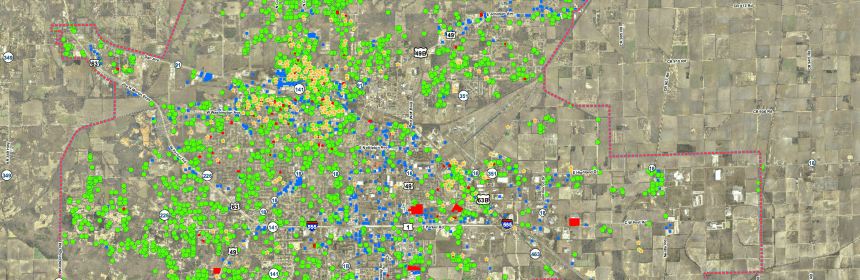
Editor’s Note: The featured photo depicts a representation of nearly 3,450 vacant commercial and residential properties in Jonesboro, based off records from Craighead County. (Courtesy of City of Jonesboro)