Monthly Archives: November 2017

New Overpasses Coming to Jonesboro
by Kayce Wilson
Delta Digital News Service

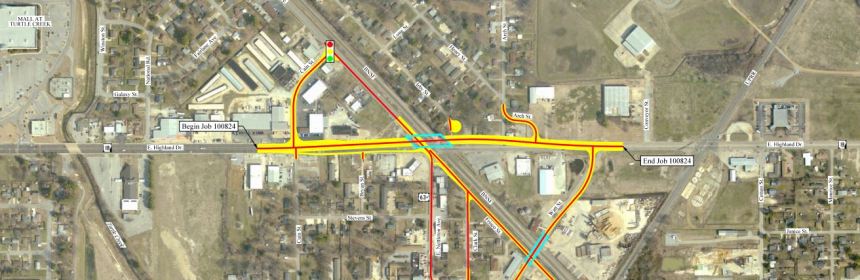
JONESBORO — The Jonesboro City Council-approved plans for new overpasses off Highland Drive and Nettleton Avenue will commence construction after July 2018.

Arkansas Department of Transportation Area 10 Engineer Brad Smithee said the financial aspect was the main reason for the wait.

“Discussion with Jonesboro, BNSF Railway, (Arkansas Department of Transportation) and other parties involved have been around for a number of years regarding this project,” Smithee said. “More direct project developments began when a funding mechanism was identified and the city of Jonesboro received a (Transportation Investment Generating Economic Recovery) grant for $1.2 million to perform environmental and design work on the project back in 2014.”

Smithee said the overpass will bring many changes to the community, many of which would affect safety.

“They would increase access to industry, increase safety for school-age children and increase the traffic flow that is currently congested by the railroad crossings,” Smithee said.

Aside from the businesses affected, the Nettleton School District could see some changes in the near future.

Nettleton graduate Jacquelyn Young said she believes construction could require more police supervision.

“I think that the overpasses will help after-school traffic and provide a new way to get around the school, but it also might make the traffic before school more hectic,” Young said.

Since the project is very complex and in a populated area of town, Smithee said there is not an exact time frame for completion. They must consider the cost of construction items and the number of possible construction days to figure up a bid. This is then paired with a building schedule figured up with a construction cost so that they can determine how many workers they will need.

The new overpasses will not only cut back on train and vehicular incidents, but will cut back on the traffic around the tracks.

Heritage Festival Honors Johnny Cash

By Kayce Wilson
Delta Digital News Service

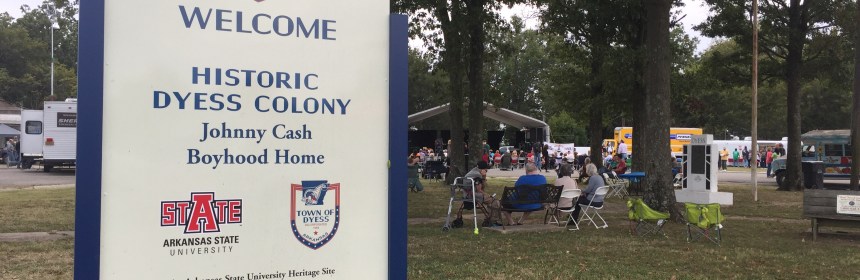
DYESS, Arkansas – The Arkansas State University Heritage Studies Center hosted the inaugural Johnny Cash Heritage Festival in the town center of Dyess.

During the three-day festival, people from all over the country came to celebrate the history of the Dyess Colony, where award-winning American musician Johnny Cash grew up.

In an excerpt from the program, Roseanne Cash said she was thrilled to present the festival, which “goes beyond regional and world-class music to include educational programs, exhibits, local crafts and an oral history project.”

Funds from this festival targeted the re-creation of the barn, smokehouse, chicken coop and privy that once were a part of the Cash farmstead.

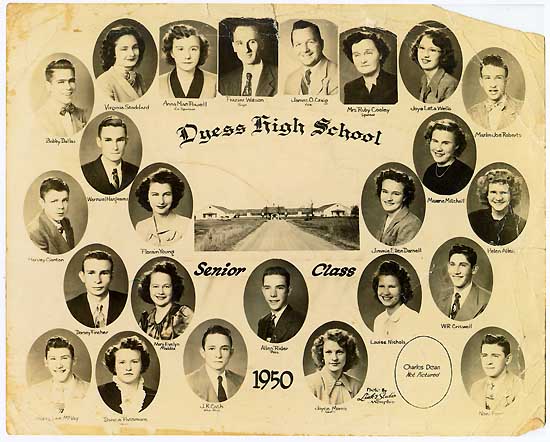
Dyess High School Senior Class of 1950

Dyess High School Senior Class. J.R. Cash can be seen to the left of the year, 1950. Photo courtesy of the family of Wanda Lawrence, sister of Warnuel Hargraves, pictured.

He Was Just Plain J.R.

“He Was Just Plain J.R.,” moderated by KASU’s Michael Doyle, featured a panel of alumni from the Dyess Class of 1950. A.J. Henson, a friend of Cash’s, told stories of their friend group – J.R., A.J. and J.E. – that ran around Dyess together in the 1940s.

“We went to school together since first grade and went to the same church,” Henson said. “We (Cash and Henson) were automatically friends. We went to Wilson or Lepanto for a midnight on Saturdays.”

The panel members said Cash always wrote poems and was an above-average student. Henson told a story about the time Cash wrote a poem for him, quoting it in its entirety. Classmate Louise Nichols echoed Henson’s recollection of Cash’s writing prowess.

“He would always think and talk about things up in the air compared to what we talked about. He liked being up front and being recognized,” Nichols said.

Delta Themes in the Music of Johnny Cash

Aaron Miller, Ivy Tech Community College associate professor of history, analyzed the motif of the Mississippi River plain in Cash’s songs in his presentation, “Cultivating the Fabulous Johnny Cash: The Environment and the American Artist.” Miller’s analysis of Cash’s Southern roots compared Cash’s writing to Mark Twain and B.B. King.

Area historian and Marion Evening Times newspaper reporter Mark Randall discussed “Jesus Was Our Savior and Cotton Was Our King,” based on the song by Cash. Throughout the presentation, Randall highlighted the mention of cotton in Cash’s songs and how his Southern upbringing formed Cash. He quoted Cash’s 1997 autobiography and said, “Back in Arkansas, a way of life produced a certain a certain kind of music.”

Randall then played a handful of Cash’s songs about cotton: “Busted,” “Pick a Bale O Cotton,” “Pickin Time” and “I Never Picked Cotton.”

Becoming Johnny Cash

Historian Colin Woodward looked at the father and son dynamic within the Cash family in his presentation titled “Ray and Johnny: How Cash’s Father Influenced His Life and Career.” Woodward said the dynamic in the 2005 movie, “Walk The Line,” may not have been an accurate portrayal as little information exists on Ray and Johnny’s relationship other than the movie.

Cash’s personal historian and friend, Mark Stielper, analyzed the turning times of Cash’s life in his presentation “Fifty Years After Folsom” from his early days in the spotlight until his awakening in the 1960s. Stielper spent time with Cash, and mentioned Cash’s autobiographies, “Man In Black” and “Man In White.”

“In 1967, Johnny had the No. 1 album after ‘Folsom Prison Blues’ but his life was in shambles,” Stielper said. “A man lost in the dark could see the light.”

Stielper spoke of Cash’s opioid abuse and how the lowest point of his life was when he wrecked his car in the rain and landed himself in jail. The sheriff of the station gave Cash a long speech about how he needed to turn his life around. Cash’s life then began to change for the better when he sang at the White House in 1968. From that moment, Stielper said Cash spent the next 50 years of his life making music as a better man.