Monthly Archives: August 2023

Arkansas Paws In Prison provides furry friends to inmates

Delta Digital News Service

August 8, 2023

By Avery Jones | Editor

JONESBORO, Ark. – Michelle Hill of Michelle Hill Dog Training Academy is a local certified professional dog trainer that has been volunteering for a program called Paws in Prison since 2021. Arkansas Paws in Prison is a nonprofit program started by the Arkansas Department of Corrections to rehabilitate inmates while also training dogs for adoption.

The program partners with dog shelters to bring in untrained dogs for the inmates to train with the mentorship of a professional trainer. The inmates get work experience, and the dogs have a better chance of getting adopted after they’re trained.

“We have a large overpopulation problem in Arkansas for unwanted dogs…what better to do than pair them up with people that have nothing but time?” said Victoria Schilden, the director of the program. “It saves the dogs’ lives, it gives the inmates a skill that they can walk out the door with and get a job right off the bat where typically it doesn’t matter if you check that box, ‘convicted felon.’”

Schilden also explained that the program provides them with a sense of normalcy, teaches compassion and unconditional love, helps them to maintain good behavior and gives them an incentive to be a different person than they had been.

Hill has been a dog trainer for 16 years. The director reached out to her personally and asked Hill if she would been interested in volunteering. Hill had done some research on the program and was eager to be involved.

“Not only are the dogs getting a second chance, but the inmate trainers are getting a second chance, too,” Hill said.

She works for the program 2 days per week. She’s at the McPherson Women’s Prison in Newport on Tuesdays and Tucker Unit for men and Maximum Security Unit on Thursdays.

Hill creates a lesson plan for each class. She sometimes brings her dog to demonstrate what she wants the inmates to do with the dogs and after they watch her, they copy the action. The dogs are typically in the units for 8 weeks of training; this can vary depending on the needs of the adopter or the shelter.

The dogs learn basic obedience like sitting, leash and crate training, as well as tricks such as rolling over, spinning and even flipping light switches and retrieving TV remotes.

At the end of the training, the dogs complete a final exam to show that they’re trained. The trainers use the American Kennel Club Canine Good Citizen Ready program which terminates in a test that evaluates whether the dog has learned all the skills the program teaches.

The trainers teach all the skills the dog would need to pass the test and then do a mock test. After the dog is adopted, the owners can contact the trainer to have the dog officially certified.

Not only does being trained increase the dogs’ chances of getting adopted, but it also helps them to stay in their homes. According to Schilden, untrained dogs are often returned to the shelter by their owners because of their behavior. Some dogs from this program even go on to be service dogs.

“They’re far less likely to be returned for behavioral issues because they’ve got that socialization and the basic obedience training,” Schilden said. “Sometimes the dogs end up right back where they came from after the family gets them home and they start chewing things up or they’re not potty-trained, so we try to mitigate that and make sure that it’s a successful adoption and that the dogs stay with the person who adopts them.”

According to Hill, almost every single dog has been adopted by graduation because of this program. Schilden said that more than 2,200 dogs have been adopted in this program’s duration. Additionally, many inmates have gone on to become dog trainers; one former inmate now works for the program as well.

Hill is a “positive reinforcement” trainer, which means she doesn’t believe in using pain or fear as a training method. She’s certified under the Certification Counsel of Professional Dog Trainers, so she has to take continuing education classes and build up to a certain amount of credits every three years.

However, not every dog trainer is certified, and nobody has to be certified to become a dog trainer, so the field isn’t regulated. As a result, it’s very common for dogs to be mistreated during training, according to Hill.

“Everything that I do is focused on building the physical, mental, social, and emotional aspect of the dog, so being able to impart those skills and that knowledge onto someone else that can later on build that same mindset and mentality in the dog training industry is a very important thing for me,” Hill said.

The Paws in Prison program was originally started by a group of women, some from the DOC and some interested in inmate rehabilitation. They were inspired by a similar program in Missouri called Puppies for Parole. They appealed to the governor and the director of the DOC to initiate it.

Schilden has been with the program for 7 years. She originally started as a volunteer for a capstone project while she was getting her master’s degree from the Clinton School of Public Service. She now works full-time as the director of the program and the program coordinator for the DOC.

The program currently operates in seven correctional facilities: McPherson Women’s Unit in Newport, Hawkins Women’s Unit in Wrightsville, Randall L. Williams in Pine Bluff, Ouachita River Unit in Malvern, North central Unit in Calico Rock, Tucker Unit and Maximum Security Unit.

They currently partner with five dog shelters: Care for Animals in Little Rock, Last Chance Arkansas in Little Rock, Adopt-A-Stray Rescue in Alexander, Stone County Humane Society in Mountain View, and Humane Society of Independence County in Batesville.

They also work with two other dog trainers besides Michelle Hill. Tracy Owen is a former inmate who went on to become a successful dog trainer due to the program and now works alongside them. Sandy Olivera is another volunteer who has been training dogs for over 20 years.

“It’s such a privilege to…see not only what it does for these animals and our rescue partners, but what it does for these inmates,” Schilden said. “I’ve seen this program truly change lives and change somebody from a hardened criminal into somebody who gets down on the floor and makes baby-talk with little puppies.”

–30–


Avery Jones is a sophomore in the Department of English and Philosophy at Arkansas State University in Jonesboro. She can be reached at: avery.jones@smail.astate.edu




Author Monica Potts Book holds book signing for first novel

Delta Digital News Service

By Avery Jones | Editor

July 1, 2023

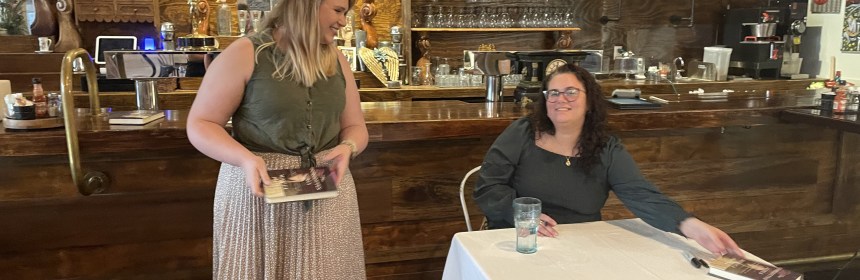
JONESBORO, Ark. – Monica Potts was recently hosted at The Parsonage restaurant in downtown Jonesboro for a discussion and signing of her new book, “The Forgotten Girls”. The event was put together by Verb Bookstore on Saturday, July 1 at 6:30-8 p.m.

Potts is a senior political reporter for the website FiveThirtyEight and has also been published in The New York Times and The Atlantic among others. The book was published in April of this year and is Potts’s first novel.

It’s a memoir about her childhood in Clinton, Arkansas that discusses the obstacles that women in rural communities face. Potts addresses poverty, religion, drug addiction, early motherhood, abuse, mental health, and lack of education.

Potts’s interest in the subject started when she heard of these studies that showed middle-aged white women in rural communities were starting to die earlier due to “deaths of despair”–deaths caused by drug addiction and suicide. 

Potts explores how these deaths are linked to the obstacles these women face in their communities, including the fact that many of these women only had high school degrees or less. It was shown in these studies that highly educated women generally live longer.

She saw these obstacles in her own community. Potts mainly writes about the life of her former best friend Darci, who unlike Potts, chose to stay in Clinton for all of her life and ended up struggling with drug addiction, early motherhood, poverty, and abuse.

When Sari Harlow, the owner of Verb and host of the event, asked the room who had cried while reading the book and how much of the issues in the book they had seen in their own lives and community, several hands went up. 

“Those first couple chapters were painful,” Harlow said. “I told Monica before I had to put it down and just process for a while and then come back to it because it really hits close to home.”

Potts herself had a similar experience writing the book. She said that she would often take a break to drive around in the mountains for a while to gather her thoughts. However, she also felt like it was a necessary process to endure.

She moved back to Clinton in 2018. She was working on her book by that point, and she stated that this was part of her reason for moving back, but she also had a lot of unresolved feelings about her hometown.

Despite the issues that are explored in her book, Clinton will always be home for Potts. However, it also sometimes feels like living in a fishbowl to her because everyone knows everyone. She misses city life sometimes.

“I actually felt in some ways more isolated than in the city,” Potts said.

When she moved away from Clinton to go to college, however, she sometimes felt guilty that she didn’t stay in touch with people from home, including Darci. She also felt like she had opportunities that many others couldn’t take advantage of.

Potts attended Bryn Mawr College in Pennsylvania and chose anthropology as her major even though she knew she didn’t want to be an anthropologist. However, she wanted the flexibility that comes with a liberal arts degree.

Additionally, as a first-generation college student, she believes that a liberal arts style education is more supportive than that of a state school, where it’s easier to get lost and feel adrift when one is trying to figure out the unfamiliar system.

Going into college, Potts didn’t realize the vast amount of career options that existed. For her, the importance of college was discovering what she was able to do and learning skills that would translate to several careers.

“I just can’t imagine a life without having had that,” Potts said. “It was just about having a different kind of life experience for myself…”

It’s difficult to name an ultimate solution for the kind of systemic and cyclical issues that people in rural communities face, but Potts believes that more opportunities for young people is vital to their growth.

“Figuring out who you are and who you’re going to be is a really hard job. It’s just an incredibly time-consuming endeavor, and I think teenagers have a really hard time…” Potts said. “…I think that the more grace and the more opportunities we can give young people to figure that out with as much support and kindness as we can, the better off they’re going to be.”

Potts said that the benefit of writing her book as a memoir was to connect Darci back to herself and encapsulate the whole life of someone. As for solutions to the issues that Darci and people like her face, Potts thinks that any solution couldn’t be finite or discrete; it’s a never-ending problem that can’t just be “fixed,” but instead must be addressed at a systemic level.

When asked about advice for adults that want to “escape” their small towns, Potts said that one probably has a bigger network than one believes. That person should reach out to anyone they’ve connected to in the past that might have resources or know about resources to help.

After the discussion, Potts signed books for those who had brought their own or those who were buying. Verb Bookstore had set up a table displaying copies of Potts’s book available for purchase, as well as books by other Arkansas authors and some currently popular picks.

“When we heard about her book and that she was an Arkansas author, we felt like we really needed to bring her viewpoint here to Jonesboro,” Harlow said. “It was definitely one that resonated with me personally…so I felt it was important to make those connections.”

–30–


Avery Jones is a sophomore in the Department of English and Philosophy at Arkansas State University in Jonesboro. She can be reached at: avery.jones@smail.astate.edu


Bikers show up for 3rd annual Ride Against Trafficking

Bikers show up to show support

Delta Digital News Service

June 3, 2023

By Avery Jones | Editor

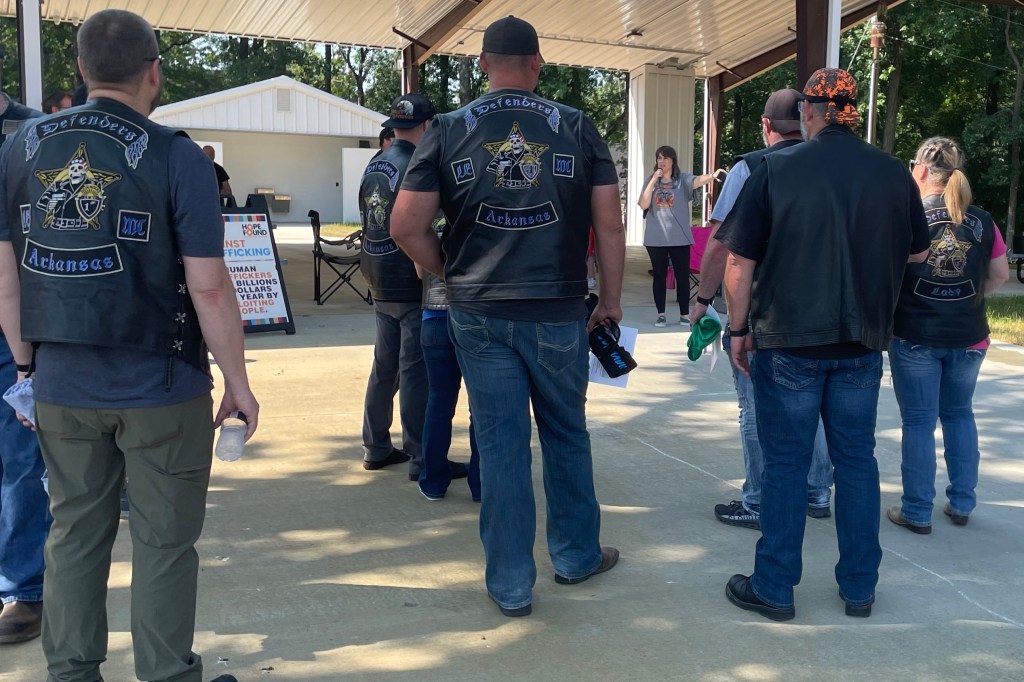
JONESBORO, Ark. – On Saturday, June 3, Hope Found NEA, a nonprofit organization located in Jonesboro fighting human trafficking, hosted the 3rd annual Ride Against Trafficking. Participants arrived at 9 a.m. to register at Central Baptist Church and rode out at around 10 a.m.

The event is a fundraiser in which cyclists complete a dice run and enjoy a free meal afterwards. For the run, each individual or group roll dice at each stop and adding up the results at the end to see who has the highest total. The group with the highest wins $100, while the lowest wins $50.

According to the organizer of the event and the founder of Hope Found, Megan Brown, the money will go toward programs to raise awareness in the community about human trafficking and services for victims. She thought a motorcycle ride would also be a good way to raise awareness.

“There wasn’t a lot of bike rides that I knew of in this area, but especially those that were focusing on this issue,” she said. “With bikers being on the road constantly, it was a good way to be able to get them educated on what signs and red flags of a trafficking situation may look like.”

Brown stated that she chose the church as a meeting place because it has a pavilion for shade, and it’s a central location that’s easy to get onto and off the route from. They have chosen a different place each year for the event so far.

There was a large crowd at the event. Along with several bikers, there were many volunteers and workers at the registration stand, selling t-shirts, and providing drinks. Brown stated that she expected a bigger crowd than last year’s event. 

Nearly 30 bikers participated last year; she expected about 50 to come this year. Twenty-two bikers pre-registered, with several more registering the day of the event. There were individuals, large groups, and even adults with kids.

A retired Pocahontas husband and wife duo that go by the road names Twisted and Hugs respectively were present representing their NEA chapter of Warriors Empowering Children, a nonprofit organization of bikers who support and protect children that have been through abuse. 

If the child is old enough, the group teaches them to ride, while also boosting their confidence. Members of the organization guard the children to make them feel safer, and escort them to school if need be. If the child has to go to court to testify against their abuser, the bikers will escort them to court. Each child receives a vest that proclaims, “I Am A Warrior” on the back.

“We’re all about bringing kids out of the darkness,” Twisted said.

Adam Farmer, an instructor with the Jonesboro Grappling Association, was there with Rachel Thieme. Thieme is a photographer and also works at St. Bernards.

“Megan reached out to us a while back last year to see if we would be interested in sponsoring [the event], and we discussed women’s self-defense, women’s safety, and we believe in the cause, so we decided to sponsor it,” Farmer said.

Both Farmer and Thieme are Jonesboro natives. Farmer has been riding for seventeen years.

There were a few people for whom it was their first time at the event. Jeff McDonald is a software engineer. He’s been riding for ten to fifteen years. 

He was there to “raise awareness,” and stated he’s also “learning more about [Hope Found] from the event.”

According to Brown, the ride was slated to last between 2 to 2 and half hours. Their first stop was Lorado Grocery and Grill. Afterwards, the bikers kept going north on Highway 141 into Lafe.

Their second stop was Jordan’s Quick Stop in Oak Grove before going to Paragould. Their third stop was another Jordan’s in Lake City before heading back to the church to finish the run.

Riders were provided with a free lunch, courtesy of Smokes Up BBQ. 

–30–


Avery Jones is a sophomore in the Department of English and Philosophy at Arkansas State University in Jonesboro. She can be reached at: avery.jones@smail.astate.edu