Monthly Archives: September 2024

LISTEN: Ridgefield Christian School basketball coach Morgan Colburn

Audio Story by Garrett Finnicum

Garrett: Hello everyone, I’m Garrett Finnicum, and today we have an exciting story about a local high school basketball team that has captured the community’s attention. Joining us today is the team’s head coach, who will share some insights. Coach, please go ahead and introduce yourself.

Coach Colburn: Hi, I’m Morgan Colburn, and I am the coach here at Ridgefield Christian School. This is my second-year coaching, and I feel so blessed to be here.

Garrett: Well, first off, I just want to ask, what are your expectations coming into this upcoming season?

Coach Colburn: Our expectations have a lot to do with character, so we want to be a humble and hungry team. We talk about that nearly every day: being a team first. I mean, being humble is being team-first and not really caring about our own accomplishments so much and being hungry and wanting to come out and give our best every game. That’s my expectation of the boys, and that’s their expectation of themselves as well.

Garrett: How would you say the school community impacts the team?

Coach Colburn: Man, that’s a good question. I will say that our boys love playing together; they seem to really enjoy one another. We have done retreats; they have also played other sports together, and they just enjoy playing together. And then the school community—I have only been here one year, but I know that as we started to do well last year, more people started to show up to the games, and it was very enthusiastic. So, it was just a great atmosphere here at the school last year, and I would like to make it better. I would like us to have more support, and I would like our guys to be more supportive of other things and other events at the school, so that is a hope of mine. But I would say that we have great families, just great family support. And then when we do well, I think we get even more school and community support.

Garrett: How has past coaching experience helped you prepare for this job going into year two?

Coach Colburn: Yeah, so I have coached high school basketball at different levels and different places, mostly in Washington for probably 15 years. I have coached some good teams over the years. I coached in Honduras for a few years, and we got second in the nation—and you would not really think of Honduras as a basketball hotbed. We would have won in any six-foot-and- under league; we were tough, we were just small. Then I coached at a high school where we played in the state championship three years. Unfortunately, every year we got second. Really sharp kids, talented. I would say, honestly, the years that prepared me the most to do well—not just here at Ridgefield—were the years that I struggled. Not because it’s a struggle here, but the years where you have to find a way to put guys in the right situations make you a better coach than when you can just throw out eight studs and just be good. So, the years that were a struggle —you learn how to adapt your defenses, you learn how to attack people with only a couple players on offense—and those years make you more creative, make you sleep less, and make it hard. There is good in that struggle. I would say my worst years have prepared me the best.

Garrett: Well, that is all the time that we have today. Coach Colburn, thank you so much for doing this and giving us some inside information on this up-and-coming basketball team. I am just as excited as you are for the upcoming season to see them play.

Coach Colburn: Thank you, Garrett!

LISTEN: Students have a new food delivery service option this semester: Kiwibots.

Audio and story by Jerry Don Burton

The cube-shaped robots on wheels autonomously deliver from Godfather’s Pizza, Einstein Bros Bagels and Freshens to over 60 locations on campus. The Kiwibots also deliver food from virtual dining services including Mr. Beast Burger and AQ BBQ.

Richard Matthews, Sodexo interim general manager, said Arkansas State University is the first college in Arkansas to use the Kiwibot service.

“This was the technology that Sodexo suggested that might benefit the campus,” Matthews said. “We want to make sure this is something that is not only utilized but something that you guys want here.”

Around 300 Kiwibot deliveries have been completed since the semester began. Matthews said A-State’s current fleet of 15 Kiwibots could comfortably handle 500 to 700 deliveries every day.

Luke Caldwell, a senior history major from Conway, Arkansas, used the Kiwibot service during the first week of school.

“I heard about it, I downloaded the app and I gave it a shot,” Caldwell said. “It was fairly user friendly.”

Orders are placed using the Everyday app. From the app, users can select a delivery location, arrange a time for pickup and choose a payment method. The Everyday app accepts payment via Flex dollars.

Caldwell said his order was cheaper than he anticipated. He said his order cost the same as it would if he had ordered in person because there was no delivery fee.

Justin Lewandowski, retail operations manager for Sodexo, said Sodexo uses Everyday as their food hub app. Kiwibots cannot deliver food from Chick-Fil-A and Starbucks because they partner with Grub Hub, a competitor food delivery app.

Caldwell said his experience ordering with Kiwibot was pleasant overall, but the wait time was slower than expected.

“I think the estimated time was 15 or 20 minutes. An hour and a half later, it had not even left the Union yet,” Caldwell said.

Matthews said Kiwibots may encounter issues in very cloudy conditions or when the network is busy or slow. He said they ordered network boosters to increase the effectiveness of Kiwibots in areas that may see disruptions.

Caldwell said he submitted a support ticket concerning his delayed order. He said a Kiwibot customer employee messaged him apologizing for the wait and offered free orders as compensation.

He said when he received his order, the Kiwibot stopped at a designated location outside his dorm at North Park Quads. Caldwell said he scanned a QR code on the Kiwibot to open the chassis and retrieve his food.

Caldwell said he will keep using the Kiwibot service, but would like to see more accurate wait times in the app.

According to Kiwibot’s website, the bots can detect people, cars, and other bots. Kiwibots utilize GPS, artificial intelligence, cameras and sensors to travel autonomously, plan routes and avoid obstructions.

Matthews said Kiwi Campus, the company that owns the Kiwibot service, sent an employee to A-State for two weeks over the summer to help create routes for the Kiwibots. He said they utilized geo-mapping to plot out optimal pickup locations and delivery routes.

Sodexo employees underwent training over the summer to learn how to use the Kiwibots. Matthews said there are also two Kiwi Campus employees stationed at A-State.

“Each employee has been trained on how to load it, how to accept the orders, how to open the bot and load the food in,” Matthews said.

Lewandowski said employees use a tablet to accept orders and open the Kiwibot. Employees then load the order, close the bot and the rest of the process is hands-off.

Matthews said Sodexo is looking to promote the Kiwibots across campus. He said he wants to raise awareness by having the Kiwibots participate in events like football games and hosting giveaways.

“We are going to make things fun with Kiwi. This October, coming up, you should start seeing more,” Matthews said. “We are going to have you guys name the robots so instead of them having a number they would have a name and they can respond to their name.”

Lewandowski said they run their ideas and plans through Kiwi Campus. He said the two Kiwi Campus employees at A-State also help with planning.

Lewandowski said he wants Kiwibot to become another member of the A-State community.

“We really want it to be a part of this campus where it is a reliable resource for the students,” Lewandowski said. “This is a partnership with Kiwi that we want to see grow and expand in the future.”

Dr. Brendan Kelly Begins Tenure as New President of Arkansas State University System

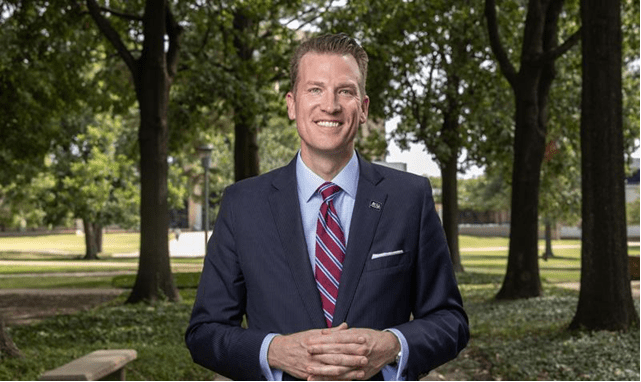
LITTLE ROCK – Dr. Brendan Kelly today officially began his appointment as only the third president of the Arkansas State University System. The ASU System Board of Trustees voted to hire Kelly, who had served as president of the University of West Georgia since 2020, on June 5. He succeeds interim president Dr. Robin Myers and the second system president, Dr. Chuck Welch, who left the system in January after nearly 13 years to become president and CEO of the American Association of State Colleges & Universities (AASCU) in Washington, D.C.

“The ASU System is open for business and will expand the state’s economy by improving lives and opportunities – starting with our students and their families,” Kelly said. “I believe strongly that if we do what’s right for a student, and then we make it work for the institution, we’ll never go wrong. The energy that exists in most communities emanates from institutions like the ones that we represent. I’m excited that the ASU System comprises not only seven outstanding campuses, but also some terrific communities in Arkansas.

“We have the opportunity to galvanize communities, look to the future to ensure the ASU System is ready to meet it and work to expand the impact of higher education within Arkansas and beyond,” he added. “From cutting-edge research initiatives to skilled workforce training, I’m confident the ASU System has the ability to meet the demands of our rapidly evolving economy.”

Kelly said the ASU System role appealed to him “because it represents one of a handful of roles in the United States in which one has the ability to influence and shape higher education throughout an entire state. I am grateful to each member of the ASU Board of Trustees for their faith in me to offer leadership to a university system that has the capacity to provide access to high quality, higher education to the vast majority of Arkansans and many more beyond the state borders. This is an opportunity to support the economic evolution of the state at large.”

Prior to joining UWG, Kelly was chancellor at the University of South Carolina Upstate in Spartanburg and Greenville from 2017-2020 and was appointed as interim president of the University of South Carolina in 2019. He was vice president of university advancement and president of the UWF Foundation, Inc., at the University of West Florida in Pensacola from 2013-2017, where he led a successful $50 million capital campaign. His teaching career spanned 13 years in Florida and Michigan in communication arts.

His focus at UWG has been innovative programming both inside and outside the classroom with an emphasis on creating valuable life and career outcomes for students, with a commitment to launch and advance student careers upon graduation. He served on the board of directors of multiple regional and state economic development entities, as well as the Atlanta Regional Higher Education Consortium.

While leading and implementing the “Becoming UWG” Institutional Strategic Plan, Kelly has led UWG to record-breaking fund-raising efforts, including the largest gift in institutional history, and oversaw an enrollment resurgence. The UWG campuses in Carrollton, Newnan and Douglasville have a combined 12,769 students and are expected to exceed 14,000 this fall.  Its spring enrollment was 11.4% higher than last year, while its graduate enrollment surged 41%. UWG recently completed a move in athletics from the NCAA Division II Gulf South Conference to the Division I Atlantic Sun Conference.

“We’re thrilled to have Dr. Kelly officially beginning his leadership of the ASU System,” Board Chair Christy Clark said. “I know he is eager to get busy, and our board is eager to support him and his vision for the System and our campuses. We look forward to a smooth transition as he leads our experienced System team and chancellors.”

Trustee Price Gardner, who chaired the search on behalf of the board, said: “We are excited to welcome Brendan Kelly as our new System president. We believe Dr. Kelly’s experience and outstanding record of achievement throughout his career will continue the growth and development of our System and lead us in addressing the ever-changing challenges facing higher education and our focus on student success. He has been described as a visionary, talented communicator and a person with the ability to elevate the reputation of the institution and further its mission. Our board looks forward to the opportunity to work with him.”

Kelly is a member of the AASCU board of directors and was named “One of the Most Influential Georgians” by Georgia Trend magazine and James Magazine. He was active with the National Forensic Association (NFA) and speech/debate competitions for many years and was honored as a NFA Hall of Fame inductee and with the NFA Eddie Myers Distinguished Service Award.

He received a Bachelor of Science degree in public relations and a Master of Arts degree in communication at Eastern Michigan University and his Doctor of Philosophy in rhetoric and political communication at Wayne State University.

Kelly and his wife, Dr. Tressa Kelly, have three children – Bree Luckey (married to Drew Luckey), Liam and Kieran.

A-State receives almost $2 million grant to conduct research into oral health

Courtesy of Arkansas State University

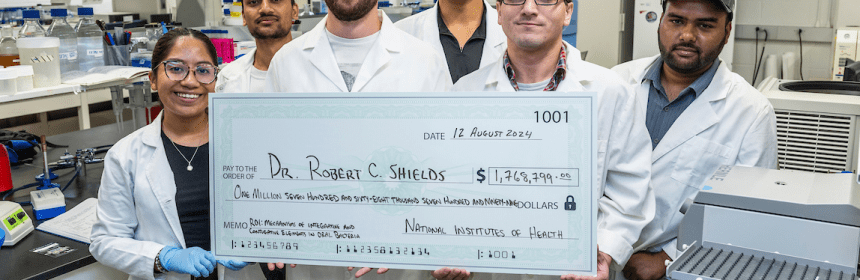
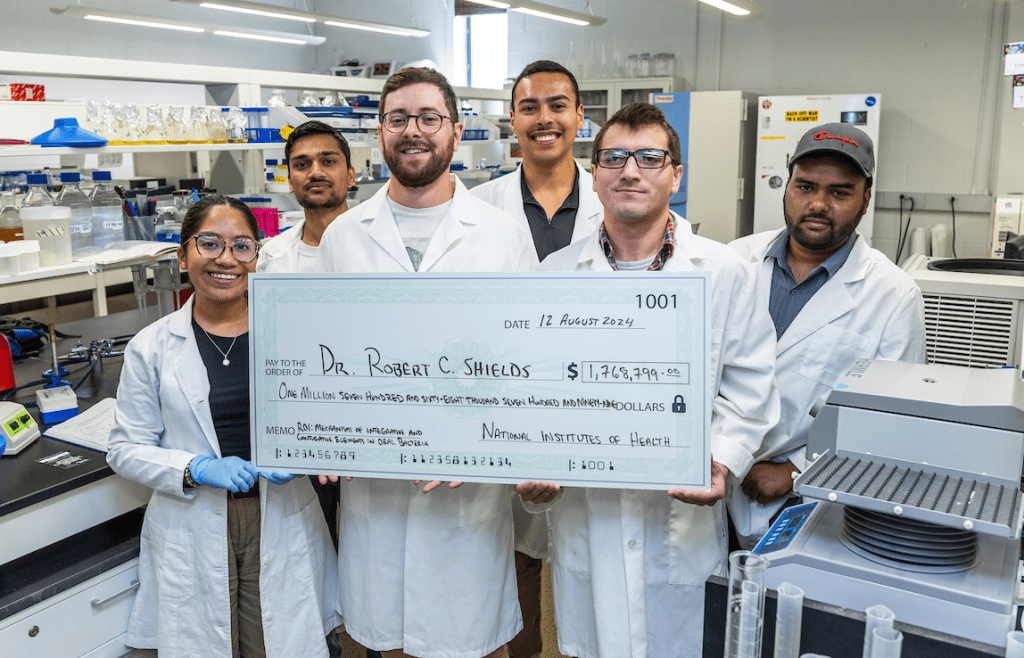
The team that will be leading the research includes (from left) Ana Karen Solano Morales, master’s student in biology; Sangam Chudal, biotechnology major; Dr. Robert Shields, principal investigator; Emanuel Cazano, biological sciences major, pre-professional program; Shawn King, lab manager; and Bikash Kumar Dwivedi, doctoral student in molecular biosciences. Image courtesy of Arkansas State University.

The team that will be leading the research includes (from left) Ana Karen Solano Morales, master’s student in biology; Sangam Chudal, biotechnology major; Dr. Robert Shields, principal investigator; Emanuel Cazano, biological sciences major, pre-professional program; Shawn King, lab manager; and Bikash Kumar Dwivedi, doctoral student in molecular biosciences. Image courtesy of Arkansas State University.

JONESBORO – While most people know that tooth decay can result in an unsightly smile, the impact of this disease has serious implications for one’s overall health.

A faculty member in Arkansas State University’s Beck College of Sciences and Mathematics has secured a federal grant to conduct extensive research into the problem with the goal of better understanding the causes and effects.

Dr. Robert Shields, assistant professor of microbiology in the Department of Biological Sciences and principal investigator for the grant, sought the funding through the National Institute of Dental and Craniofacial Research, a division of the National Institutes of Health (NIH).

“Tooth decay is one of the most common diseases affecting people,” he added. “It has a significant health and economic burden on the U.S. population.”

Shields will guide a team of faculty members, doctoral degree candidates, student researchers, and lab professionals who will delve into the intricate molecular mechanisms underlying tooth decay pathogens.

The research team also includes Dr. Lisa McLellan at Purdue University – Fort Wayne who is a molecular microbiology expert with her own research lab.

“In this study, we will investigate the movement of genetic information between bacteria, a process that spreads antibiotic resistance and fuels pathogen evolution,” Shields explained. “We will focus our studies on understanding this process in the oral cavity and determining the role it plays in assisting in the development of tooth decay.”

The $1.77 million grant over a five-year period will support the work of the research team and provide a supply of chemical reagents, travel expenses to present results at scholarly conferences, and other expenses associated with their work.“

Dr. Robert Shields’ grant is an exciting opportunity to enhance his research in oral health,” stated Dr. Jennifer Bouldin, dean of the Beck College of Sciences and Mathematics. “This highly competitive NIH R01 grant supports health-related research by an investigator in their area of expertise. The Beck College is excited to see Dr. Shields receive this prestigious award and further his research in this important topic.”

Dr. Travis Marsico, vice provost for research, innovation and discovery, and executive director of Arkansas Biosciences Institute at A-State, noted this grant, the NIH R01, is the premier funding mechanism for those researching human health. The NIH R01 is the gold standard because it supports important hypothesis-driven research that is backed by preliminary data; recent funding rates are just over 21% of applications received nationwide.

“I am thrilled that Dr. Rob Shields has secured an NIH R01 award for his work on dental decay bacteria,” he stated. “The discoveries that will result from his team’s work have important basic science and human health implications for the people of Arkansas.”

This new grant represents only the second R01 and only the eighth NIH award in A-State history. It is also the largest NIH grant in the university’s history, he said.

“With our recent emphasis on expanding research development, the goal of the Research and Technology Transfer team is to help make these kinds of awards a regularity on campus.”

A related development with A-State’s blossoming research enterprise will get underway early next year.“As part of our expansion of NIH-funded programs, A-State has been selected in a new program called Engagement and Access for Research-Active Institutions (EARA), which will assist campus researchers with identifying appropriate funding opportunities from NIH,” Marsico continued. “The program should begin in February 2025. Fourteen faculty members have expressed interest, and Dr. Shields has agreed to mentor faculty pursuing NIH funding. His efforts have been successful, and he has built a strong relationship with his NIH program director.”