Author Archives: krishnancollins

Bakeries across the region cope with COVID-19

By Krishnan Collins
Delta Digital News Service

Jonesboro, Ark. – When the pandemic started, locally owned bakeries around the region felt the blow of COVID-19 and those businesses in Northeast Arkansas have had to continually adapt to keep producing delicious sweets for the community.

Deep in the heart of downtown Paragould 

   Looking at cake decorating supplies at an overseas military base, Tracy Mothershed answered yes when a woman approached her and asked if she was a cake decorator. Although she did not have a shop at the time or much professional experience, Mothershed always had an artsy side and liked to decorate cakes for her children. 

   “I don’t know where that answer came from,” Mothershed said. “So she asked me to help her with her daughter’s birthday cake and it just started from there. I just started doing cakes for people and I feel in love with doing it. Gosh, that was almost 30 years ago.”

   Born and raised in Paragould, she swore she would never return home after she left. Mothershed did just that and eventually started her own bakery in 2011, Something Sweet, in downtown Paragould.

   “To me, downtown is the heart of your community,” Mothershed said. “You have to have a thriving downtown to create that community and I just always wanted to be a part of that.”

   When Mothershed returned from overseas with her husband, she made cakes for friends and family out of her home. Although she also worked full time, Mothershed’s cake production kept increasing. Eventually, her husband told her she had outgrown the house. 

   “I had cakes on the kitchen bar, had them on the kitchen table, had them on the dining room table,” Mothershed said. “He was like, ‘We can’t even sit down and have dinner because it’s everywhere.’ (I was) getting over the fear of opening your own place and just jumping in with both feet and (I) haven’t ever looked back.” 

   In the first year Something Sweet opened, sales were so good they shocked Mothershed’s accountant. The business grew every year since opening, but when the coronavirus hit in March, things got a little rough. 

   “Up until this year, it has grown every year since. I’m not going to lie, this year has been rough,” Mothershed said. “You know, we’re doing enough to keep the doors open and doing OK. I haven’t had the nerve to look at all my numbers. My accountant just sent me my quarterly reports and I haven’t even looked at them yet.” 

   Throughout the pandemic, Mothershed said she’s had plenty of low morale moments. Although she is someone that usually does not stress, the pandemic definitely produced some harrowing days. 

   “I was just telling my girls this morning I’m mentally and physically just exhausted,” Mothershed said. “In August my mom passed away. Not from COVID, she had a stroke and didn’t recover. Just all of this, I’m physically and mentally exhausted. So those low points, yeah I’ve had those.”

   Despite those low points, Mothershed said she’s too stubborn to throw in the towel and give it all up. Although the store folding crossed her mind, Something Sweet is her baby and her stubbornness persisted. 

   “My husband just says they’re going to have my funeral in here,” Mothershed said. “I’ve always been of the mindset as long as the bakery is paying for itself, I don’t have to pay myself. As long as everything is paid for and taken care of then no, I’m not shutting the doors. I’m not going to lie, there’s been a few times the past couple of months I’ve been like, ‘How much longer can we keep going?’ Right now, we seem to be at a good point.”

   Something Sweet misses the income that came from wedding cakes. With many weddings canceled and postponed due to the pandemic, one of the shop’s biggest income sources has not been as prolific as it was in a pre-pandemic world. 

   However, it’s not just weddings that the store lost potential income from during the pandemic. 

   “Life events are postponed,” Mothershed said. “Birthday parties have been canceled. Custom designed cakes are the biggest portion of our profit. That’s where our profit margin is. That side of it has taken a big hit.”

   The store also lost income from walk-in traffic. The store’s lobby remained closed throughout the pandemic but reopened in November. Before reopening, those non-regular customers who would have stopped by just for a look and happened to leave with a dozen cupcakes did not get the opportunity to do so from March through October. However, the store did allow curbside delivery and customers could call ahead to order.

   With walk-in customers not allowed into the store and the baking business being such a visual thing, Mothershed said advertising increased across social media, the store’s website, print and radio to keep the brand of the store going strong since the start of the pandemic.  

   The store made many preparations before reopening its lobby, including hand sanitizing stations, social distancing dots on the floor, multiple tongs, gloves and other measures to make sure the reopening is safe. 

   “I really wanted to be open for the holiday season,” Mothershed said. 

Right off campus in Jonesboro 

   Just a seconds drive away from Arkansas State University, right in the reach of students, Bliss Cupcake Cafe on Red Wolf Boulevard actually got its start in another part of the state. Bliss originally opened in Fayetteville in 2009, but Pocahontas native Breanna Walton wanted to bring something that gave her so much joy in college at the University of Arkansas back home with her. 

   “My roommate and I, we loved Bliss,” Walton said. “We would go there on a good day, go there on a bad day. It was like, ‘Hey we need a cupcake to feel better’ or ‘Let’s celebrate and eat a cupcake.’” 

   Walton, a nurse, ran down to the Fayetteville store before college graduation in hopes of winning a giveaway and the owner of Bliss happened to be there. Walton told him she was moving back home and that he should open a store in Jonesboro. He responded by telling Walton she should open it herself. 

   “It was just kind of a real nonchalant conversation that turned into a reality,” Walton said. 

   Bliss opened its doors in Jonesboro July 12, 2014.

   When the pandemic hit in March, Walton said the hardest thing initially was dealing with the uncertainty of the situation. In the beginning, Walton and her mother, who was also instrumental in bringing Bliss to Jonesboro, decided they would not take a paycheck from Bliss to ensure Bliss’ employees could continue to work and be paid. 

   In terms of social distancing, Bliss’ very wide cupcake case made social distancing almost automatic in the store between the person behind the counter and the customer. Bliss was already mostly a takeout business anyway, so the store was naturally acclimated to pandemic procedures.

   Despite the pandemic, Bliss found ways to maintain its brand and give the community fun options. 

   “For Easter this year one of the fun things we did was we delivered boxes from the Easter bunny to people’s doorsteps just so they didn’t have to get out,” Walton said. “So early Sunday Easter morning my mom and I got up at 3 a.m. and literally drove all over Jonesboro to deliver treats on people’s doorsteps. It was pouring rain that morning so that was interesting.”

   The store also made cookie decorating kits that people could use at home so they did not have to get out to have fun. 

   Walton said Bliss has always placed a pretty big importance on giving back to the community. The community reciprocates that energy. 

   Back in May, a customer ordered a large custom cake ahead of time but did not want to pay until she could pay with cash in person, Walton said. The customer never appeared to pick up the cake, but when Bliss posted the situation on social media many people reached out to the store saying they would purchase it despite its very custom nature. 

   “Without their support, we wouldn’t have made it through the last three months,” Walton said. “I think people realize that especially now more than ever, with the tornado and the timing of it all, that kind of all we have is each other. We’re local people owning local businesses. So if we don’t support each other, then our community doesn’t rise as a whole.”

   A-State alum Drew Roberson liked Bliss from the first time he tried their products.

   “I first went to Bliss Cupcake Cafe because I just wanted to visit my friend who worked there,” Roberson said. “I left with two cupcakes and a coke in my hands and loved every bit of it. After that, if I ever wanted to surprise a friend with something sweet, I would go to Bliss because I knew their cupcakes, and presentations of them, were always impressive. They’re really good and I don’t even like sweets.”

   The pandemic came at a terrible time for the store. Bliss saw a decline in sales initially, and the pandemic happened during what would usually be one of Bliss’ busiest seasons around Easter and Mother’s Day. Also, just like Something Sweet, Bliss lost a lot of income from canceled weddings. Despite those tough times, just like Something Sweet, the idea of going out of business never gained much traction. 

   “It was never a thought that was given any kind of fuel or action,” Walton said. “As soon as that crossed our minds, it’s not going to happen. We’re not going to let it happen.”

   The baking community 

   Mothershed said she knows she cannot bake enough cakes for everyone in Northeast Arkansas no matter how much she wants to, she has to sleep. 

   Even with a good amount of bakeries across the region, Mothershed said there is room for more bakeries in the region. 

   “Everybody loves sweets,” Mothershed said. “They make you happy. (Bakeries) just create part of your community, part of that family feeling.”

   Walton emphasized how Jonesboro is a hub for all the small surrounding towns in the area, so there are plenty of customers to go around for all the bakeries. 

   “My favorite thing to say is, ‘We’re a mouth full of happy,’” Walton said. “Just for the same reason I fell in love with Bliss, is what I want to provide for other people.”

Bubble tea shop opens amidst pandemic

By Krishnan Collins
Delta Digital News Service

JONESBORO- While some businesses struggle to survive during the coronavirus pandemic, a specialty shop serving bubble tea opened in August and business boomed from day one. 

   Tucked away in a suite of stores at 3800 S. Caraway Road over the I-555 bridge sits Bubblee, a shop started by owner Elna June, that serves bubble tea. Bubble tea is also sometimes referred to as boba. 

   Bubble tea’s name comes from the chewy tapioca balls that sit on the bottom of every cup of boba. The tea surrounding the tapioca comes in a variety of flavors ranging from the traditional just plain milk tea to even more exciting flavors like brown sugar milk tea, taro milk tea and many more.

   “I have been watching what has been missing in Jonesboro,” June said.

Instant success

   June moved to the United States around six to seven years ago from the Philippines. Although she has other businesses overseas in Asia, Bubblee marks her first business in the United States. 

   June’s friends in the Philippines opened bubble tea shops of their own and they flourished, so June conversed with them to see how to best start her bubble tea shop in the States. 

   “I did my research,” June said. “I did test market research here and the response was overwhelming. I didn’t expect it because I thought people from Jonesboro didn’t know what it is. But they do.”

   June started a website and tested out a delivery system at the end of August. Bubblee received so many orders the store had to move orders from one day to another just to be able to fulfill those requests. After the impressive test run with delivery, the shop opened its brick and mortar store Sept. 21. 

   Opening during a pandemic did not phase June. 

   “I don’t really consider it as the time of having the pandemic,” June said. “I always go by numbers. I’m a numbers girl. Numbers never lie. I watched my research, I saw how people reacted and I have data. So, I decided, ‘Hey, it is a good time. People are responding, so why not?’” 

Crafting the culture

   Social media played a big part in spreading Bubblee’s brand. June said without spending a single dollar, she sent out a post saying bubble tea is coming to Jonesboro and the post reached 24,000 people in Jonesboro alone. 

   June said one of the biggest challenges in opening the store came in the same form of challenges she faced in her businesses in the Philippines: That is finding the right people to work at the store with her. 

   “Finding people who are in the same culture,” June said. “We want fun, we want Bubblee. You know, that’s our name. It’s hard to find people who always want to come to work happy, enjoying life. That’s definitely the biggest challenge is finding the right people. Once you find the key people, your business can go on.”

   One of those key people June found, Chloe Barker, played an integral part in getting the store going. 

   One of the first to inquire about the job, Barker contacted June as soon as she saw a job offer. Barker worked in the food industry at Skinny J’s and at The Parsonage but decided she wanted to get out of the food industry and transition to the drink industry. 

   June wanted Barker to work for the store because of how tight knit the Jonesboro community is and Barker fits the bill perfectly: she was born and raised in Jonesboro. 

   “The first question I asked (Barker) was, ‘Are you local?’” June said. 

   Barker knew what bubble tea was before she worked at Bubblee and now she gets to experience the joy of watching new customers try boba for the first time. 

   “They never have experienced anything like that before,” Barker said. “My favorite is to interview the men. They’re like, ‘What’s a boba?’ I get to watch their reaction as they try it and they’re amazed and overwhelmed with what they expected to what they got. It’s just really happy, it makes me happy.”

Destination location

   June said sales have been great so far and called Bubblee a destination location. Since the store is tucked away on South Caraway, the store isn’t always easy to see. Customers come to the store because they know it’s there. 

   “Because we’re fairly new, we have about 70% new customers but about 30% returning all the time,” June said. “So 30% is a high number for returning customers for a new business.”

   One of those returning customers, Michaela Partridge, said she has been a bubble tea fan since the first time she tried it when she was 17. However, growing up in the small town of Sheridan made it hard for her to find bubble tea.

   Since coming to Jonesboro as a college student, Partridge found bubble tea easier and originally purchased her bubble tea from Chin Chin Express on East Johnson. Once she found out about Bubblee and its wide variety of options, she decided to try it.  

   “The people there are really nice and they make all of the drinks to order,” Partridge said. “You can customize however much boba you want, how sweet you want it, that kind of stuff, which I really like.”

   The first drink Partridge ever bought was the winter melon tea and said her first reaction to the tea was that it tasted exactly like Christmas. 

   Partridge goes to Bubblee about once a week, sometimes twice a week if it’s been a bad week and she needs a pick me up. 

   “I keep going because the prices really aren’t that bad,” Partridge said. “It’s really decent prices, there’s two different sizes and there’s all different kinds of flavors. They even have the popping boba, which I recently tried and I really love. It’s hard to find that at other boba places in town.” 

   Partridge said the only thing she thinks Bubblee could improve on is sometimes it takes a long time to get an order. However, she said she understands because they are new and really popular, it makes sense orders might take a little longer to be prepared. 

A sense of home

   Bubble tea represents a niche product and for June this resonates with a diverse group of people around Jonesboro. 

   “It provides a sense of being for some people that are implants, that have been implanted in Jonesboro,” June said. “Believe it or not, yes, Jonesboro is a small town, but it’s growing and not because people are having babies, but because people are being implanted into the community from different cultures, different backgrounds and different countries.”

   June said the Asian community has grown a lot in Jonesboro. When she moved to Jonesboro around six years ago, she said she only knew around 10 Filipino families and now she knows over 100. The owner also mentioned how Asian students in the community come to Bubblee and get a piece of home.

Expansion plans

   June holds plans to expand to a second location where the store will gain customers as people simply walk by the storefront. This changes Bubblee from a destination location to a location where casuals can buy bubble tea as well. 

   By December, June wants to have her location open on Main Street. 

   “Over here we’re a destination; over there we will not be a destination branch,” June said. “It will be a visible branch where people walk and say, ‘Hey, I want to stop there.’ In marketing they call the concept clustering. So I think I am clustered very well if we are on Main Street.”

The rich brown sugar milk tea

   Brown sugar milk tea reigns supreme on the menu as the most popular item. Brown sugar milk tea started in Taiwan and June found a way to bring that authentic Taiwanese taste to Jonesboro. 

   “In Taiwan people would line up all the way down the street, like hundreds of people, to have a brown sugar milk tea,” June said. “So I found a supplier who is from Taiwan and they’ve supplied us with all of our ingredients to make that very famous brown sugar milk tea.”

   Whether someone moved to Jonesboro from a bigger city around the world or someone came to Jonesboro from a small Arkansas town, Bubblee finds its way into the hearts of customers all around the tightly knit community of Jonesboro. 

   “I think it’s really cool because Jonesboro for me is a bigger town,” Partridge said. “The town I grew up in has like 500 people and I had to drive 30 minutes to go to school. It always felt weird there weren’t more options for bubble tea and then Bubblee opened and I fell in love with it. I really am happy we now have another option. It feels like it’s a little more inclusive.”

City council meets remotely due to COVID-19

By Krishnan Collins
Delta Digital News Service

JONESBORO The Jonesboro City Council met April 7 in remote fashion during a time of uncertainty due to COVID-19 and the city is still healing after a tornado swept through the center of Jonesboro March 28. 

   The meeting diverted from the original agenda right at the start as resolution 20:044 had to be approved for the meeting to officially be able to take place remotely. Since restrictions surrounding COVID-19 limits the number of people that can be in one place, the resolution was proposed and passed. 

   Among many stipulations in the resolution included that members on the council must conduct meetings in ways where the media can still view due to freedom of information laws, electronic means can be used for video call or chat that is recordable and audible to all parties watching and participating in the meeting, and the mayor, city clerk, city attorney and commission chair must be physically present at the meeting place where it is being held. 

  Jonesboro Mayor Harold Perrin started the meeting by complementing first responders, the community and city employees as wells as reminding citizens to follow social distancing and health guidelines.

   “We’ve been through a lot,” Perrin said. “Our employees in all of our departments deserve your appreciation. They have worked tirelessly and hours with a remarkable attitude. Jonesboro residents have been strong and came to one other’s rescue. We are definitely a loving people in Jonesboro. The coronavirus and tornado have created a new landscape. Our duty is to adjust. I ask for patience as we adjust with each other. This is not a new future, it is simply a temporary fix. So please be kind and be patient. We are doing the work of the city and we cannot stand still. Life doesn’t work that way. But we are not weak. COVID and the other obstacles that are ahead of us, we must be smart, and we will definitely work together.”

   Perrin stressed the importance of wearing a mask when out in public. 

   “This is no time to worry about appearances,” Perrin said. “You look better with a mask.”

One issue on the agenda caused significant debate on the night, Ordinance 20:011. 

   The ordinance, submitted by Ditta Enterprises, proposed the rezoning of an area at 400 E. Highland Dr. The Ditta family wants to build a hardware store in the area. The hardware store received public support, with only a single dissent.

   Janet Gehring said during a past meeting that an ordinance had been passed in 2007 that stated no business could ever be built on that plot of land except for a bank. The plot of land is in a neighborhood surrounded by residents. Gehring said she would not want to live next to a hardware store and asked what was the point of making an ordinance if it was just going to be changed later. 

   “And, I think, I might ask you all, would you like to live by a hardware store and call that your neighbor?” Gehring asked. “Mr. Rogers probably would. Mr. Rogers probably would say won’t you be my neighbor, but I would say, please don’t be my neighbor. Please don’t be my neighbor.”

   It was pointed out that the ordinance had been passed in 2007 to stop a 24/7 fast food restaurant or convenience store from opening at the time and was argued that such an establishment would cause disturbances to residents in the neighborhood being that it would be open at all times of the night as well as the day. 

   It was also argued at the time a convenience store on Highland Drive would mean children would have to cross a major road to go to the restaurant or store and therefore could easily be struck by traffic. 

   However, it was argued at the meeting that zoning ordinances are not meant to be frozen in time and can change with the times of the city. The original ordinance was not meant to stop a local, family-run hardware store from being installed in the area. 

   According to Jim Gramling of Gramling Law Firm who represents Ditta enterprises, the Ditta family hosted a couple of neighborhood meetings where it invited residents who lived within 400 feet of the planned site to come and voice their objections to the family. 

  According to Gramling, the Ditta family made many adjustments from feedback at the first meeting and hosted a second meeting. 

   The ordinance was passed to allow rezoning. 

   Technical difficulties during the meeting along with lag times in public comment through social media, phone lines and email provided some challenges for city officials. 

   “It’s not going to be perfect,” Perrin said. “Any change this drastic is going to have glitches.”

Editor’s Note: Photo by Katie Moum on Unsplash

Hispanic community works to complete census among challenges

By Krishnan Collins
Delta Digital News Service

JONESBORO – With the 2020 census on the horizon, the Hispanic community faces an ever present and mounting number of challenges while trying to get as many people to complete the census as possible. 

   Challenges like technological issues, misconceptions, the political climate and the coronavirus all represent a hurdle for the Hispanic community, said Gina Gomez, executive director of the Hispanic Center in Jonesboro. 

   Most of these challenges were expected, but the coronavirus situation presented new challenges and dampened plans that Gomez and others had been working on for a while. 

   “Even though we have been planning this work with the census for months now, we didn’t expect this was going to happen,” Gomez. “Every activity that we had planned, like door-to-door canvassing and going out to events where we were going to promote the census have been canceled. That’s a big challenge. Right now we are looking into ways we can continue promoting the census using online resources and social media.”

   Gomez emphasized in the current political climate there are many misconceptions on what will be done with the information given by families in the census. The community is working on educating families that information given will not be used against them or given to law enforcement agencies and informants. 

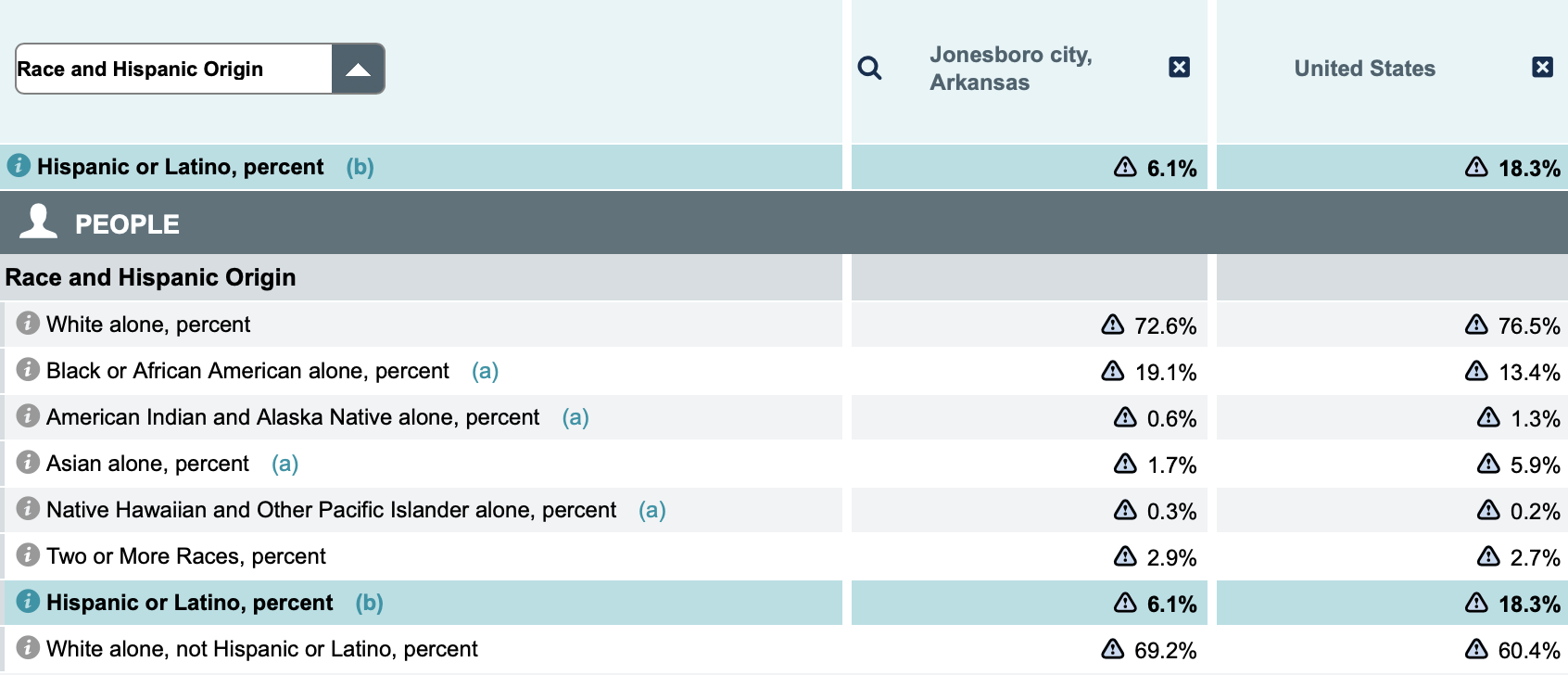
This graphic from Census.gov shows the percentages of various ethnic groups in Jonesboro and the United States.

   “Our people are afraid to provide information to the census,” Gomez said. “There’s been an educational phase where we have been trying to inform people about what the census is, how the census impacts them and also that there is not any risk by providing the information.”

   According to the census, counting children is a tough challenge for all families, no matter what ethnicity or race.

   “Children under 5 years old are among population groups historically undercounted in the census,” a Census Bureau press release said.

   Gomez said counting children in Hispanic families is a problem too. Gomez highlighted that many families completed a census in their home country, but once these families move to the United States they question whether they need to do the census or not.

   “Many families don’t understand what the impact the census has on your family or kids,” Gomez said. “If they don’t see the importance of bringing those funds to our city in order to have better schools, access to healthcare providers, improving our roads, it’s difficult to have people participating. A lot of this is education related. We need to educate our community.”

   This is the first year families can complete the census online. This makes it easier on some, but can also be a problem for others. 

   “For some of our families, they don’t have computer access, online access, they don’t have internet or they just don’t have the knowledge of how to do it,” Gomez said. “They can do it on a computer, an iPad or cellphone. It’s a little complicated for some of our people, especially for ones living in more rural areas. That’s one of the areas that we as the Hispanic Center were trying to work really hard on.”

   With the coronavirus dampening many ways to advertise the census, Gomez and the community have put a lot of emphasis on social media. Gomez noted just how important it is for Hispanic families to do the census as those families will see benefits moving forward. 

   “We hope by demonstrating the number of Hispanics we have in the area and in general the state, because we are part of the state coalition, we’ll be able to assure based on the percentage of Hispanics there are specific needs to target this minority in Arkansas by providing language services when it comes to healthcare or schools,” Gomez said. “But, if we are not able to demonstrate by how many people we have, the need will not be as evident even though we have the people here.”

   The coronavirus was not the only thing that affected the push towards the census. On March 28, an EF-3 tornado tore through Jonesboro. Homes and businesses were destroyed throughout the city. 

   “Now, more than ever, we need to bring funds to our city to help rebuild it,” a post on the Hispanic Center’s Facebook said. “You can help us with this, completing Census 2020.”

   Gomez worked with the Hispanic community in 2010 to complete the census but she said then the effort was not as widespread and did not have as many people involved. 

   “In 2010 Arkansas was really undercounted,” Gomez said. “We want to assure we are counting as many people as we can around the state this time so we are not letting those funds go.”

   According to the census, the Hispanic population makes up an estimated 6.1% of the total population in Jonesboro. The estimated total population in Jonesboro reads 76,990. 

   This time around the Hispanic Center created its own campaign with the city of Jonesboro and also created its own logo. There is also a state coalition called Arkansas Counts to spread the word about the census and efforts surrounding the census are more structured now.

   “When I moved here to this country, I didn’t understand why it was that important for me to fill out the census,” Gomez said. “But now that I have been educated on the topic I can educate others.”

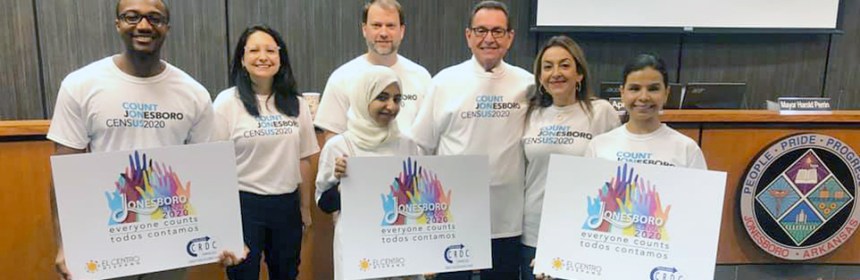
Editor’s Note: Feature photo courtesy of the Jonesboro Hispanic Center: Members of the Hispanic Center and Jonesboro community work together to spread the message about the 2020 census.

Jonesboro Public Schools welcome new nationally certified board teachers

By Krishnan Collins
Delta Digital News Service

JONESBORO –The Jonesboro Public Schools’ school board recognized eight new nationally certified board teachers at the JPS school board meeting Feb 11.

   The district now has 44 nationally certified board teachers and the process to become a nationally certified board teacher is a challenging process. 

    Christopher Taylor, a kindergarten teacher, described the challenges. 

   “Intense,” Taylor said. “It was very intense. It was probably one of the hardest professional things I’ve ever had to do. But I feel like it’s made me a better teacher. As I was going through the process I was actually able to see things that would help me improve as a teacher.”

   Teachers worked for months and sometimes even years producing videos, collaborating and typing reports all to be able to identify student needs inside and outside of the classroom. One teacher said there were 100 plus pages of typed material in the process. 

   Although a big goal of the process was identifying student needs, the ability to identify teacher needs was also gained. 

   The JPS board did not divert from the agenda on a very straight forward meeting night. The board did enter executive session, as the agenda said it would, to discuss employment, transfers, resignations and retirement for the 2020-21 school year. 

   Some discussion ensued over the issue of approving next school year’s academic calendar.    

   Board member Archie Ryan asked, “Is there anything unusual about the calendar?”

    It was said there was nothing unusual about the calendar but the school year would be starting on Aug. 13 which is the first day the district is allowed to have school and on a Thursday. The calendar also allows school to get out seemingly earlier than usual as school will end before Memorial Day. Memorial day in 2021 is May 31. 

   Students of Annie Camp Junior High School, Jimaria Jackson, Diamonique Reynolds, A’niah Graves, McKinna Robinson and Allannah Orsby were recognized at the board meeting after saving the life of a man who was going to attempt suicide. 

   According to KAIT8, Dec. 5, 2019, the members of the Annie Camp Junior High School basketball team were walking to Sonic. On the way there, they saw a man tying cords to a bridge and he put a cord around his neck. 

   The players called the police and continued to talk to the man. The man’s life was saved as officers arrived on the scene. 

   The JPS board’s next meeting is set for March 10 at 6 p.m. The meeting will be held in the JPS administration building.

Editors Note: Photo by Element5 Digital on Unsplash

Local coffee shops raise the bar

Delta Digital News Service

JONESBORO – In a time when craft and speciality coffee seems to be a major trend, a variety of passionately run local coffee shops conduct business in Jonesboro and beyond throughout the Delta. 

   As a consumer, one’s options prove numerous when deciding what coffee to pick up on a morning drive to work or on an afternoon study break. The consumer might choose a coffee giant like Starbucks, but the consumer might also know of a place in town that feels just like home. 

   Brian Nobles took over operations of the Edge Coffee House in August. The Edge sits right off the edge of Arkansas State University’s campus and the shop actually used to be a residential home. 

   “An experience,” Nobles said. “It’s really about the experience that you get from a mom and pop type shop. The charm and the quality and the characteristics of an old actual house turned into a coffee shop gives it all the unique characteristics.”

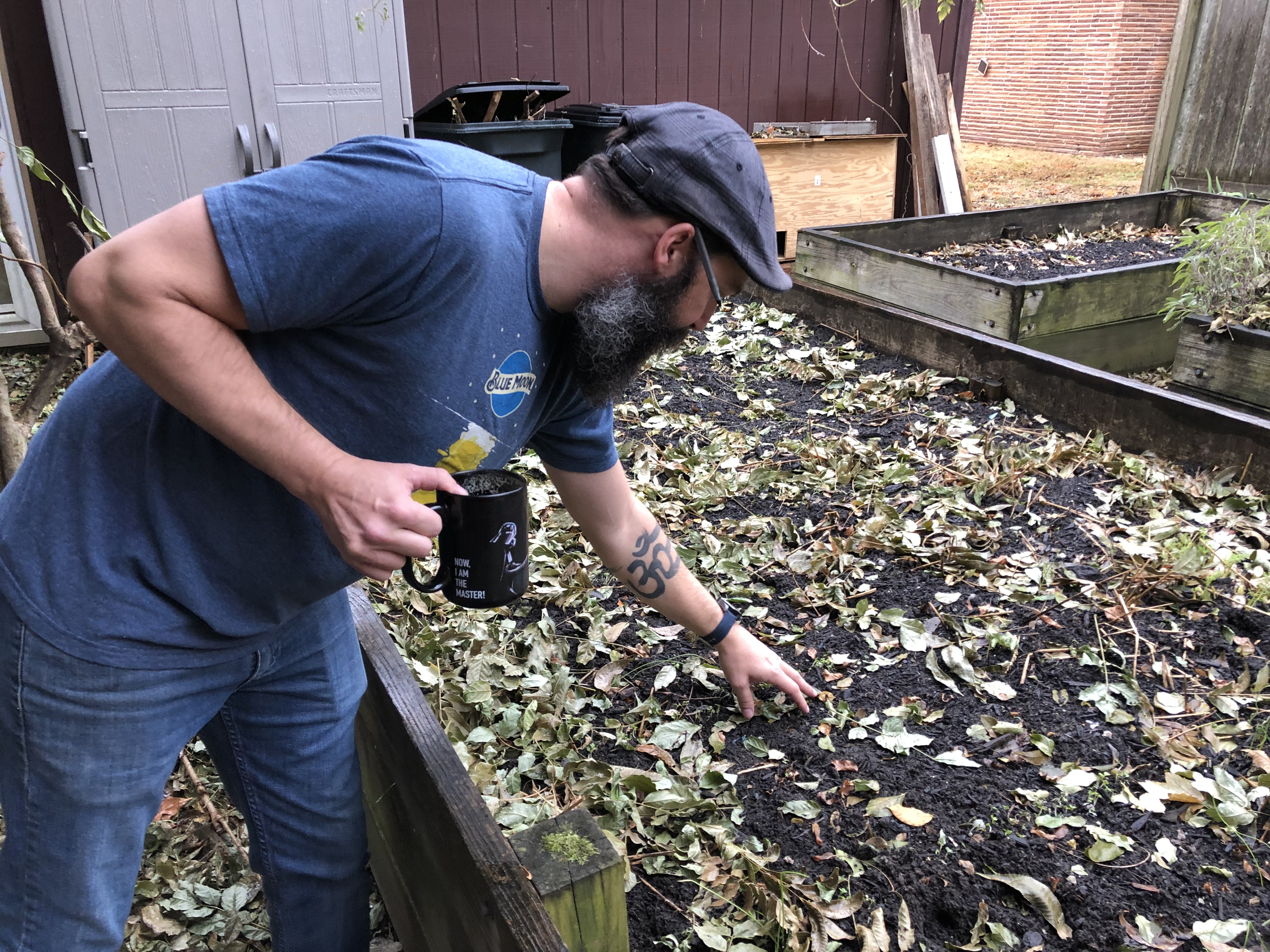
The Edge Coffee House owner Brian Nobles examines his shop’s gardens. Items grown in the gardens will be used for dishes at the Edge.

   The Recovery Room, in downtown Jonesboro, also boasts an atmosphere that is welcoming to people of all backgrounds. Since the Recovery Room is a small locally owned shop, employees do many different things to help out the shop. 

   Pat Warren, a woman of many trades at the shop (which includes making the pastries), said some customers first assume the Recovery Room is too fancy of an establishment for the everyday coffee drinker. But in reality, the shop opens its doors to anyone of any background.

   Warren describes the Recovery Room as a home for students and businessmen alike, and really anyone who enjoys a good cup of coffee or a great meal. 

   “Downtown Jonesboro has its own unique atmosphere,” Warren said. “You’ve got the old buildings. We get a lot of students that like to come in and study. We have the nice soft seating, the sofas and we have Wi-Fi. We’ll have students that come in first thing in the morning and maybe sit here most of the day and sit here and study while drinking coffee.”

   The culture and atmosphere represents one aspect of a local coffee shop, but the product has to be good too. A lot of local coffee shops also use locally roasted coffee;  the Edge is no exception. 

   “We use local, local as in Arkansas. We use an Arkansas based company out of Eureka Springs,” Nobles said. “They’re called Mountain Bird Coffee. They’re really great, nice people. They’re fair trade, they’ve got a great product and we’re proud to be able to use something from Arkansas.”

   The Recovery Room also fits the bill of a shop that uses local coffee. Warren said that just because coffee is locally roasted does not mean it automatically becomes good tasting coffee. The fact that locally roasted coffee can be great-which she said the Recovery Room’s coffee is excellent-truly makes the idea of locally roasted coffee so special. 

   Also based in Jonesboro, the Coffee Gallery prides its use of Westrock Coffee. The Coffee Gallery’s owner Nicole Townsend holds family ties to Westrock. Westrock’s owners use to own Alltel, which was based in Little Rock. Townsend’s dad worked for Alltel and a connection was born. 

   “We were really excited to partner with a local coffee roaster that also has ties with my family,” Townsend said. “We’ve known them since before I was born. We have a really close connection with the owners of Westrock. Their coffee is just wonderful. It’s roasted in west Little Rock. They bring it right up to us so everyone gets fresh roasted coffee.”

   While the main attraction of many local coffee shops might be the coffee itself, a lot of shops put a major emphasis on food. The quality food just adds another level to the overall offerings of a locally run coffee business. For the Edge, the food aspect came naturally. 

   “For my partner, my wife, that’s her realm,” Nobles said. “That’s her forte. That’s what she does and she does it really good. We want to ramp up the other areas of this restaurant that makes it more appealing to a broader audience. So we’ll have the coffee and we want to make the food something that makes it stand out by itself.”

   The Edge takes food to another level when it comes to the idea of local. The Edge boasts multiple gardens in the back, growing a wide array of foods including mushrooms and lettuce to use in dishes made in the kitchen. 

   The Edge also plans to put a bar in the upstairs section of the house. Nobles’ background comes from the restaurant and bar industry; adding a bar to the Edge just adds something else to attract a broader consumer spectrum.

    Mugs Cafe, a coffee shop based in the historic downtown area of North Little Rock known as Argenta, serves breakfast and lunch all day. Owner Michael Hickmon commented on just how important food is to Mugs. Hickmon said food stands as a way to differentiate coffee shops in the market and provide something else than just coffee. Mugs hosts an event every Saturday and only on Saturdays where customers can purchase all you can eat pancakes for $6. Most Saturdays, customers also find a special flavor of pancakes available like cinnamon roll pancakes or many others. 

   “We wanted something, especially on a Saturday, a special something that is unlimited,” Hickmon said. “(We wanted) something you can only get once a week and you can only get it here. It creates an excitement we feel like with customers.”

    The Recovery Room also puts an emphasis on food. 

   “We have an award winning chef,” Warren said. “At 5 p.m. we turn into fine dining. We have excellent food. It’s needed. We serve duck here. We have a great Sunday brunch here with crepes. You have to be skilled to call yourself a fine dining restaurant.”

   Involvement in the community represents another aspect that makes local shops stand out from national chains. 

   “We’re really involved in the community,” Townsend said. “For example, we have a Santa Claus coming to let the kids take free pictures. On top of that, we do a lot of donations. We donate to a lot of the charities, the marathons, the golf tournaments, the local schools, the football programs and everything like that.”

   Hickmon said just simply shopping local also supports the local community. 

   “In just kind of the movement of shopping local is (the fact) that you’re supporting your local community,” Hickmon said. “When you get a national chain, the coffee is not crafted locally. It’s crafted in some other state and shipped here. That was a big thing for us. From the actual coffee roasting side, we’re creating quite a few jobs here locally. There’s a huge difference between craft coffee and coffee you would get from a really large chain. We put a lot of tender, love, and care into all of our processes from coffee selection, from the bean selection to roasting it.”

   While many of the shops spoken to did not really see Starbucks or national chains as a major threat due to the different niches of a national grab-and-go chain compared to a local coffee house, many did acknowledge the power of advertising and reputation Starbucks boasts. Townsend said the Coffee Gallery makes coffee better than Starbucks, but the Coffee Gallery just cannot spend tons of money to make a commercial about its products. 

   Hickmon noted how Starbucks basically owns convenience in coffee, but how there are many other niches to be filled.

   “I wouldn’t call them a threat because they can’t compete with what we do as far as our relationships with customers,” Townsend said. “But, of course, whenever I drive by and see a big line around Starbucks, it makes me wonder why are they not trying us out.”

   Warren said people sometimes just do not realize what a local coffee shop has to offer. Starbucks boasts a worldwide reputation built over years and years, which makes people build habits of visiting chains. 

   “They don’t really try anything new,” Warren said. “But once people try our coffee and come in and catch our vibe here, they’re hooked.”

   While both local and national coffee shops have their advantages and disadvantages, Nobles said it’s all about the love when it comes to the local shop. 

   “I think with just like food and anything else that comes down to somebody hand making things with recipes and stuff like that, it comes down to love,” Nobles said. “You put a little love in it and you can taste all the difference.”

Editor’s Note: Photos by Krishnan Collins

Tuckerman organization takes students above and beyond

By Krishnan Collins
Delta Digital News Service

TUCKERMAN – Behind the guidance of an extremely hardworking and passionate woman, an organization brought Tuckerman schools’ report cards to an A grade and provides support for communities in the Delta. 

   Jan Paschal’s organization, Every Child is Ours, provides support for students in Tuckerman and also helps people in the community get the amount of food they need. 

Jan Paschal stands with Nelson Mandela. Paschal worked with leaders around the world like Mandela and President Bill Clinton to help students gain a better education worldwide.

   Paschal aims to help less fortunate students succeed in the classroom. Paschal said she believes every student can obtain an education; some students just do not have the same opportunities as others.

   “I think we have different expectations for poor children than we do for rich,” Paschal said. “I think that’s wrong on every level. I think rich and poor children can all succeed if they have equal footing. I think we as Americans need to look at education in that way.”

   Paschal worked with people like Bill Clinton and Nelson Mandela as she helped students gain an educational footing all around the world. Despite Paschal’s ability to reach different corners of the world, she moved back to Tuckerman and made an impact. 

   One of Paschal’s main points she emphasizes allows students to feel like they are loved and to feel like they are believed in. In Tuckerman, ECIO puts on multiple events for students of all ages to show they are loved and to let students get involved in the community. 

   Perhaps one of the most moving of those events is the bunny cake event. Students in fourth grade individually bake bunny shaped cakes after an important state mandated test every year. After they bake those cakes and decorate the cakes themselves, they write a letter to the person who has helped them the most in education. 

   “The letters are incredibile,” Paschal said. “Maybe you don’t even know that the grandma has come over and read to this child forever. We had one little boy who graduated and went to Lyon College. His grandmother helped him because his mom had a drug problem. He had to be outside under the steps. That’s where he was all the time, under the steps of his house. That little boy was an honor graduate of this school.”

   One annual event that truly represents what ECIO and Paschal are all about. Tuckerman High School principal Michael Holland noted many of the events ECIO puts on in Tuckerman, but he only called one the main event. 

   While a lot of schools may schedule a day off for Martin Luther King Jr. Day, Tuckerman schools do not schedule the holiday off. However, that day is seen as a day of service with ECIO as students prepare meals including soups, chili and sandwiches. Students deliver the meals to elderly residents in the community. 

   “When those kiddos, I drive the bus, those kids get off the bus and knock on the door,” Holland said. “Sometimes those kids will come back to the bus with a tear in their eye. I say ‘Hey is everything OK?’ and they say ‘Yes that was wonderful.’”

   Holland said the day of service stands as his favorite day of the school year and he is proud to be a part of the event. 

   Arkansas State University also participates in the day of service. Gina Hogue, an associate professor at A-State, said the impact of the day of service was so major on a student that the student told Hogue she still remembered her trip to Tuckerman and getting to work with Paschal from two years ago. 

   “I am so inspired by the work she’s doing and providing food and clothing and encouragement for students,” Hogue said. “When Jan walks into a classroom and introduces herself and looks in the eyes of every single student in the class, they know they’re special. She tells them that they’re special. She encourages them to become the very best student they can be.”

   With Paschal’s work in Tuckerman, an expectation of college or some form of higher education is placed on students. Paschal, of course, has a way to encourage that expectation. 

   ECIO brought A-State students to Tuckerman schools and had the students talk about what it was like to be in college. Athletes and student government members alike talked to Tuckerman students and Paschal pointed out the athletes did not talk about their ability on the field, they talked about what life was like in the classroom. 

   According to Paschal, the student government members from A-State received the same amount of love just as the athletes. Young Tuckerman students just wanted to know what it was like to be in college. 

   Hogue, a first-generation college student from the Delta herself, knew the importance of A-State students sharing their college experiences. 

   “I’m a first generation college student from Bay, Arkansas,” Hogue said. “My parents encouraged my sister and I to get a college education. But a lot of the students we grew up with, did not have that family support. They didn’t know they were really capable of going to college.” 

   After teaching and just being in the Delta, Hogue said she realized a lot of students had never thought of the idea of going to college. She called Pascal’s work of encouraging students to get a higher education “critical work.”

   Bringing multiple Tuckerman schools to an A rating took work from everyone in the community. Paschal noted ECIO worked like the glue of everything that was going on to increase students’ productivity. 

   “We have so many kids who have substance abuse problems,” Paschal said. “Not them but people in their homes. (We have) poverty and we don’t even have a grocery store here. What we’ve almost become is the glue. We’re what holds everybody together.”

   Holland acknowledged this glue effect and praised his own faculty and staff at Tuckerman High School. 

   “If a student is lacking in food at home and they have to come to school hungry, I just think it helps and works hand in hand,” Holland said referring to ECIO’s side. “If we can help provide them with food, it’s only going to help their learning.”

Holland talked about his faculty and staff next.

   “I really feel like it’s a one word answer: family,” Holland said about what makes his staff so successful. “I feel like this is the best overall staff I’ve had in place since I’ve been here.”

    Another aspect of Paschal’s work includes encouraging teamwork and kindness. With the help of Dillards at Tuckerman’s Middle School campus, Dillards built a boutique where students can buy clothes. The twist happens when students earn special currency that can be spent at the store by just being kind to one another and then informing the act of kindness to their teachers. Paschal said it is hard to open a door for yourself at the middle school because everyone is working so hard to be kind. 

   ECIO even provided McDonalds meals as a treat to every student in a class if everyone completed all the tasks given to them on a checklist in an event before Christmas break. This taught accountability and teamwork as students made sure everyone completed their tasks so they could receive a tasty treat. 

   From widening students’ worldviews by having them talk to students in overseas countries like Jordan, to encouraging high school students to help older people in the community by unloading food at the food pantry, it seems like Paschal never runs out of innovative ideas to transform a community. Her passion for education flows into the community and the people around her.

   “Children everywhere can learn if they have the right conditions and the right books and all the things that we try to give to ours,” Paschal said. “We need to make sure that in the USA every child is valued. I don’t care what that child’s problems are, what color their skin is or what their religion is. We should as Americans have the standard that every child matters. That’s the name of our organization, Every Child is Ours.” 

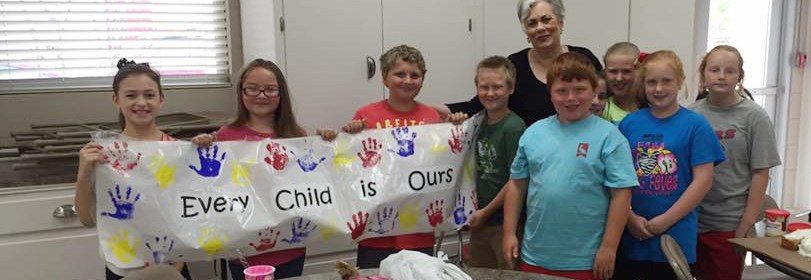
Editor’s Note: Feature photo courtesy of ECIO: Jan Paschal stands with the students after the annual Bunny Cake event. After the cakes are made, students write a letter to the person who helped them the most in their education.

Tablets provide JHS students with next level experiences

By Krishnan Collins
Delta Digital News Service

JONESBORO – The Foundation for Jonesboro Public Schools awarded a Jonesboro High School art teacher $1,000 so he could provide drawing tablets for his class and expand the abilities of his students. 

David Leggett used the money he received from a grant to purchase Huion 610pro tablets for his digital art media class. Although the tablets are a staple of the digital art media class, Leggett said other art classes should eventually be able to use them. 

After applying for a grant from the foundation, Leggett did not find out he won until foundation members visited his class during a school day. The awarding of the money surprised the art teacher. Members of the foundation walked through the halls of JHS ringing a cowbell as they approached his door. 

   “They don’t tell you you’re awarded,” Leggett said. “You submit your thing and then you wait. If you’re lucky enough to hear the cowbell come to your door, then you’re like OK. I didn’t realize it until they opened the door. It was right outside the door, I was like, that noise seems to be getting louder. Then it dawned on me, it clicked. I might’ve won. I can be excited now.”

   Leggett bought 17 tablets with the grant money and the tablets helped students achieve goals they might not have been able to achieve in the past. 

   “It helps a lot of the kids,” Leggett said. “A lot of kids feel like they can’t draw. So, they get into the computer side of it and know they can undo stuff and redo. They feel like they have a little bit more control over their media.”

   In classes like digital art media, students now approach projects with more confidence. 

   “In the digital classes, if I was to set a piece of paper in front of them and say we’re going to draw a face, a lot of the kids would say I can’t do that,” Leggett said. “So what we’re doing right now is practicing on using the tools and then we’re learning how to trace the face and the contours of the face.”

   Maddy Grubb, a junior at JHS, said she never really used a lot of technology in her art classes in the past and the tablets were her first experience with high-tech equipment when it comes to art. She noted how the tablets changed the game in her art classes recently. 

   “I feel like it definitely makes it easier for us,” Grubb said about the tablets. “When we have to use computers in our art class, it’s a little bit harder. It’s not as accessible as when you can use a tablet. The tablets definitely make it easier for us to draw and trace for our art projects.” 

   Grubb said she was nervous at first using technology to create art, but in the end, she realized how helpful the tablets were to use. 

   “I was a little nervous because I wasn’t really sure what it was going to be about,” Grubb said. “But it’s actually a lot easier than you think. You just plug it up to the computer and press a couple buttons. It’s very easy.”

  Another student, Brian Holmes, held more experience with high tech art equipment. The JHS sophomore used other tablets in the past and commented on why tablets are so important for art students. 

   “Being able to undo and redo and free transform objects is really helpful,” Holmes said. “So I don’t have to manually go back and erase it.”

   Holmes used a variety of tablets in the past and mentioned some of the advantages of the Huion tablets in Leggett’s art class.

  “The hot keys are really simple and the pressure sensitivity is pretty good too,” Holmes said. “Overall it’s just a really nice, simple tablet.”
  JHS offers a variety of different art classes and both Grubb and Holmes acknowledged the focus on technology at JHS. The technology helps improve the classroom. 

   “The classes do care about the quality of the classes and what they give out,” Holmes said. “They know that higher quality things can help students produce higher quality work.”

   The impact of the tablets on students shows in the classroom. Leggett noted how the tablets help create art in ways that just takes a lot of pressure away from his students. 

   “I do think it will actually help them in observation,” Leggett said. “(It will help them) in drawing something that they can always go back and undo a line and redo a line. They can do this much easier when they have a tablet in front of them by pushing a button. There are so many options they can do. Their anxiety is so much lower.”

  Even with the success of the tablets in the classroom so far, Leggett still looked into the future and saw more ways to improve his classroom. 

   “Anytime I can get money for my kids, I’m definitely going to try and do that,” Leggett said. “I was not able to provide a classroom set of tablets this year. We got 17 with the money we got. I would love to be able to have a class set of 30. I would love to go back and just keep getting tablets or really anything.”

   Leggett applied for a foundation grant for the first time when he applied for the tablet money. He noted how the foundation’s impact really matters.

   “I think it’s great,” Leggett said. “We’re given a budget. We have 1,500 kids. We try our best and buy everything we can. When we needed to get something like those tablets, I was able to write that grant. They were able to get me the grant money to do that. (It’s great) to see the kids working with these things and just my overall excitement for being able to provide these for the kids.”

   Leggett’s passion for teaching showed when he talked about the impact of the grant. It is clear JHS and the district as a whole has an organization on its side ready to chip in when needed most.

   “They’ve provided grant, after grant, after grant,” Leggett said. It’s been great, that’s what we’re here for, we’re here to provide for the students.”

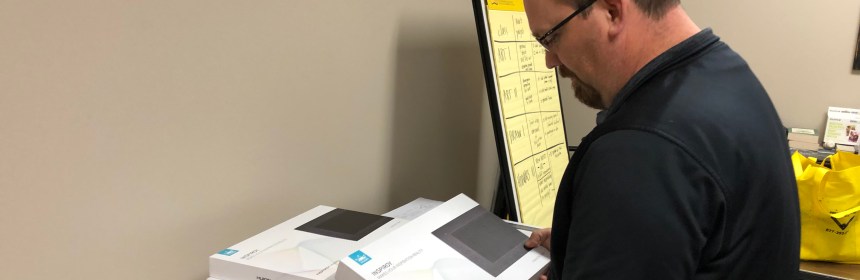
Editor’s Note: Art teacher David Leggett looks at a Huion 610Pro tablet. Leggett purchased the tablets for his class with money he received from a Foundation for Jonesboro Public Schools grant.  

A Stormy Night comes to Jonesboro

By Krishnan Collins
Delta Digital News Service

JONESBORO – The Foundation for Jonesboro Public Schools hosted the inaugural A Stormy Night event Oct. 3 to raise funds for grants for students attending the Jonesboro Public School District.

   Other events like this one existed in the past, but this was the first fundraiser of its kind in terms of the format and set up for the foundation. The foundation sold tickets at $50 each and a silent auction took place at the event. Sponsors also donated money to the cause. 

Slade Mitchell, president of the Foundation for Jonesboro Public Schools, commented on the initial ticket sales. 

 “These are going to be estimates because I haven’t seen any final numbers, but I believe we have sold somewhere around 200 tickets,” Mitchell said. “But with sponsorships and everything involved, I expect this event will raise somewhere around $30,000 for our cause.”

   The foundation hosts fundraisers like A Stormy Night because teachers in the district tend to put forward ideas of how they can educate their students in fun and creative ways. However, these teachers do not always have the means necessary to carry these plans out. 

   “We have great teachers,” Mitchell said. “They have great ideas for things they would like to do in their class: creative ways to educate their students. A lot of times with the ideas they have there’s a disconnect between the idea and the funding needed to pull that off. So what we do as a foundation is we award grants to those teachers in that situation. These types of events sustain that program.”

   Joshua Miller, a math teacher at the Success Achievement Academy in Jonesboro, benefitted from multiple separate foundation grants. Miller is a testament to the success of the fundraisers the foundation hosts. 

   Miller’s students built roller coasters, rockets and bridges all thanks to grants from the Foundation for Jonesboro Public Schools. These projects made math engaging for the students and illustrated different ways math applies in the world outside of the classroom.

   “If it weren’t for you all, the ideas and the dreams that we want to experience in our classroom would not become a reality,” Miller said in a speech to A Stormy Night attendees. “This dream of mine that I sit at home planning every once in awhile would not become a reality.”

   A Stormy Night marks the first fundraiser the foundation created as a dinner during the middle of the week. Mitchell commented on how this could change the game for foundation fundraisers. 

   “We’ve always wanted to have an event like this,” Mitchell said. “We have board members now that have experience with doing this. While we’ve wanted to do it in the past, we’ve got the team that can do it now. We’re so excited to have something like this come together. In the past, rather than an evening banquet, we have done a brunch the Saturday following homecoming.”

   The Foundation for Jonesboro Public Schools hosted the brunch for a few years, but an annual dinner has a chance to bring even more people to a fundraiser. 

   “We’ve always talked about doing an evening and doing something where we could maybe allow for more people to come,” Mitchell said. “Saturday mornings were tough because people were out of town or various things. We never really had the courage to try. This year, again, with the right board members in place, with the right team in place, we were able to pull it off.”

   Many different people attended at A Stormy Night, including faculty from the Jonesboro Public School District along with various members of the community and sponsors. 

   Felicia Johnson represented New Door Real Estate Brokerage at the event, a local real estate company. Johnson’s daughter graduated from Jonesboro Public Schools. 

   “I think Jonesboro Public Schools are amazing and I would take any opportunity to support the schools,” Johnson said. “That’s why our company is here tonight. It’s wonderful to get here tonight and be with all these people that share the same goals.”

   Johnson did four years of schooling herself with Jonesboro Public Schools and has been in Jonesboro for 32 years. She highlighted the importance a fundraiser like A Stormy Night plays in the lives of students. 

   “Oh my goodness, the funds that are raised here, can you imagine? Can you imagine the robotics team having what they need? The band having what they need? The cheerleaders? (For them) not to have to do tons and tons of fundraisers. This is amazing. We’re going to raise a lot of money to help our children.”

Editor’s Note: Feature photo shows Joshua Miller addressing attendees at A Stormy Night event. 

High School Bands perform during A-State Band Day

By Krishnan Collins
Delta Digital News Service

JONESBORO – High schools from across the Delta traveled to Arkansas State University on Sept. 21 for A-State Band Day. 

 The event provided an opportunity for high school bands to get a taste of what the next level of band is truly like. For some band members, the experience transcended their everyday high school routine. 

 “I think it’s a wonderful experience,” Margaret Teeling, band director of St. Joseph School in Conway, said. “We don’t have a football team. So, we just do basketball. That means my students get to come out here and experience what it’s like to play with a huge band.”

Since Band St. Joseph Band members do not have the opportunity to participate in a marching band, participating in A-State Band Day presents a new challenges the students.

   “Well, our high school band is a lot smaller than the college band,” Teeling said. “This is a different experience for them. College band has a lot more freedom than high school band does and I think it’s great for them to have that experience.”

   That opportunity to march means everything to St. Joseph students. Sid Davenport, a ninth grade percussion student from St. Joseph, attended his second Band Day at A-State. He last came to Jonesboro for the event as a seventh grader.

   “I look forward to the opportunity to march,” Davenport said. “Our school is so small that we don’t really get a chance to march. My first time was difficult.”

   A-State Band Day’s annual event brings students into a fast-paced afternoon of rehearsing, playing and enjoying a college game day.  

   Members of The Sound of the Natural State, the university’s band, coached the high school students and gave pointers on how to perform on a football field. The intense rehearsal prepped everyone in attendance for the halftime show. 

   Steven Riley, director of athletic bands and assistant director of bands at A-State, explained the importance of the fast-paced rehearsal. 

   “At halftime, they will all be on the field with us,” Riley said. “That’s why we got to get this rehearsal in beforehand. It’s a lot of extra people.” 

   Riley noted this was not everyone’s first band day appearance. Whether returning A-State band members or returning high school band students, some people knew ahead of time what the day entailed. 

   Dalton Austin, band director at Osceola High School, returned to his alma mater in a different role. Austin experienced band day as a member of the A-State band; now the 22-year-old teacher decided to give his students a valuable experience in his first year of teaching.

   “I’d love for my students to get involved in band after high school,” Austin said. “I want them to know they do have a place in music after high school. I think this is a great event for that.”

   Austin knows he cannot teach his students everything there is to know about band. 

   “I hope they learn that they can perform after high school,” he said. “I hope they learn things that they might not have learned from me. In high school you’re usually competing against area bands. In college it is more of an entertainment thing. I think it’s a lot more fun.” 

   Gregory Brown, one of Austin’s students, attended his second band day. Brown liked the social aspect of the event. Brown plans to be in band wherever he attends college. 

   “Band day could help me know what it’s like to march on the field in front of everybody and calm my nerves,” Brown said. “I would fight for band.”

   The Osceola student specializes in trombone but also plays some other instruments on the side. Band day gave students an opportunity to meet new people from all over the state. 

   “I look forward to meeting new people,” Brown said. “Last year was really fun and collaborative.”

   After rehearsal, both The Sound and high school students took a well deserved break. Visiting schools received black Band Day themed shirts to match the color pattern planned for Centennial Bank Stadium at the A-State Red Wolves’ football game.

   The high school band members watched The Sound perform pregame before watching the football game itself. The halftime performance wrapped up the visiting bands’ performance for Band Day and brought the event to a close.

   “There’s nothing like a college game day,” Riley said. “Especially from the perspective of a marching band member. Getting to be on the field performing for thousands and thousands of people is unlike anything else. The camaraderie and the spirit is unparalleled. Giving high school bands that opportunity is something we cherish.”