New DHS Program Cuts Hours for Disabled Citizens
by Kimberely Blackburn
Delta Digital News Service
JONESBORO – A new program implemented by Arkansas Department of Human Services resulted in cuts of home health care hours for many in the disabled community of the state.
Legal Aid of Arkansas won a temporary restraining order on behalf of many who suffered a cut in hours in February. DHS appealed and won a postponement of the original court date of July 2017. The suit is expected to go to court in 2018.
The suit states Arkansas DHS did not notify those enrolled in the ARChoices waiver program of upcoming changes. This lawsuit came after winning a suit filed in federal court against DHS.
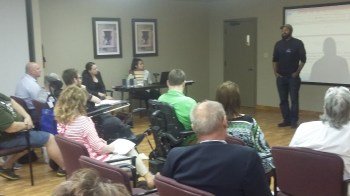
James Dukes speaks about a video he directed that highlights the impact of the 4,000 cuts. Legal Aid of Arkansas is traveling the state meeting citizens to help explain the cut in hours imposed by Arkansas DHS. (Photo by Kimberely Blackburn)
Kevin De Liban, attorney with Legal Aid of Arkansas, said the lawsuit came after several clients contacted him after DHS drastically cut their hours. These cuts resulted from a new program called ARPath. The program uses an algorithm developed at the University of Michigan to determine a category each patient would fall into. DHS assigned each category a pre-determined number of hours assigned that cannot be changed by a health care professional.
Brandi Hinkle, deputy director of communication for Arkansas DHS, said, “ARPath was implemented to provide a more objective review of client needs to ensure that all beneficiaries receive a consistent, medically appropriate level of care.”
She said DHS developed the categories after studying a large number of individuals with similar diagnoses. DHS used this study to best determine home health care hours. Hinkle said DHS commits itself with helping individuals maintain a high quality of life.
De Liban said the lawsuit was filed due to the violation of the Administration Procedures Act, which governs state agencies. According to the Act, state agencies must publish any proposed changes and allow for public comment. After the period for public comment closes, they must consider comments and re-evaluate the proposed change.
Hinkle said DHS follows an extensive procedure for changes to all programs and clients have the right to appeal after their assessment. De Liban said DHS did not adequately inform the public of the change. He said DHS published a notice of rulemaking online and in newspapers of record, but included no mention of the algorithm. The notice did include a link to the entire 242-page document, but De Liban said the notice mentioned the algorithm only six times and did not include it on the page that listed the major changes.
The Effects
Dan Watson acts as the primary caregiver of his 32-year-old son Andrew. He said they learned of the new program with they asked for a re-assessment. Watson said his son’s condition worsened, but the new program resulted in a reduction of hours. He said the nurse ran the program with all the worst answers and it still resulted in the same number of hours. He said his concern lies in what will happen to Andrew in the future.
Dorothy Vaughn suffered a spinal stroke, which involved a blood vessel bleeding out into her spinal cord. She said paralyzation occurred within a matter of hours. DHS cut Vaughn’s hours by 21 hours per week. She said her family works and her son cannot turn her due to his back surgery. She said she suffered a stage-four pressure sore due to her lying on her back each night, a result of the reduction of hours.
Vaughan said she remained in a nursing home for three weeks after having part of her tailbone removed in treatment for the pressure sore. She said she needs the additional home health care hours to help her get on top of the pressure sore and become productive again. As it stands, Vaughan said her end result will be a nursing home.
Shannon Brumley suffered a spinal-cord injury 16 years ago as a result of a motorcycle accident. His mother remains his primary caregiver.
Brumley said emotional health plays a big part in one’s physical health. He said being in a nursing home would affect his emotional state greatly directly. He said he wishes DHS could live his life for a week. If possible, he said it would change its mind.
Tammy Dobbs of Cherokee Village explain how the cuts in her home health care affects her life in a video directed by James Dukes. Legal Aid of Arkansas produced this video to show the impact of the cuts caused by the new program implemented by Arkansas DHS. (Video courtesy of Legal Aid of Arkansas)
The Future
Arkansas DHS appealed the state lawsuit and De Liban said it could take until 2018 for the case to go to court. In the meantime, those enrolled in this program can protect themselves. Hinkle said all enrollees have 30 days to appeal their assessment. She added anyone who appeals within 10 days has the right to keep all their hours until the hearing.
De Liban said anyone who loses at the hearing will be required to pay the state for the cost of the extra hours. However, he said DHS cannot garnish any Social Security or Medicaid benefits. He said he also suggests each one logs all hours in which care received, what they do, and what they cannot do for themself.
De Liban said his main concern involves the lack of thought DHS made on how its actions would affect many enrolled in their program. He said anytime you make a decision that will greatly affect those vulnerable, great thought must be made.
“You definitely should get the opinions of the people who are going to be affected by the program,” he said.
Vaughn said although her concern remains her future, others’ futures concern her more. Before her recent health decline, she volunteered at schools with special-needs children.
“My heart breaks for the possibility of this affecting children,” Vaughan said.


