Author Archives: Kimberely A. Blackburn

DeltaYou: A Public Radio Leader Retires

by Kimberely Blackburn
Delta Digital News Service

JONESBORO – A changing of the guard will soon occur at KASU, Jonesboro’s public radio station as its current station manager retires after 32 years of service and a decade of leadership.

KASU staff members reflected on their time with Station Manager Michael Doyle positivity. Mark Smith, development director, said Doyle served as his mentor for many years. He said he hopes the community joins him in celebrating Doyle and his work throughout the region.

“He has been a good leader for KASU and his natural charm has endeared him to so many in his public appearances for the station throughout the region,” Smith said.

Doyle and Brandon Tabor

Michael Doyle (left) shares a laugh with KASU Morning Edition host Brandon Tabor. Doyle recently announced his retirement as KASU station manager. Photo by Kimberely Blackburn

Reflecting back on Doyle’s leadership in community involvement, June Taylor, KASU’s broadcast production specialist, said he understood the importance of connecting with the community. Doyle served the community in taking up the banner of both entertaining and educating the Jonesboro community. Concerts showcasing local acts include “Bluegrass Monday” in Paragould, “Bluesday Tuesday” in Newport and the Johnny Cash Heritage Festival in Dyess.

Helping local acts perform at the Johnny Cash Heritage Festival proved to be a source of pride for the station. Doyle said these acts performed on the concrete slab where the old commissary stood in Dyess. Cash’s childhood home — recently restored by Arkansas State University’s Heritage Sites — served as the backdrop during the concert.

Although local acts did not perform with headliners Rosanne Cash and Kris Kristofferson, Doyle said performing on that stage served as a source of inspiration and pride for these artists. Helping Arkansans find a sense of pride in the state proved to be important to Doyle. When Arkansas native Glen Campbell died, a social media post composed by Doyle noted while others portray Arkansans as ignorant hillbillies, the state’s rich musical heritage should be a source of pride.

Hear Doyle’s entire social media post and his thoughts on Arkansas music

Arkansas Roots

Doyle first considered a classical music program to fill the noon hour. But after brainstorming with KASU staff members, “Arkansas Roots” debuted. Program director Marty Scarbrough said Doyle shares his own personal knowledge of Arkansas musicians, resulting in the program greatly benefitting its listeners. He said those who tune into the program learn of pioneers who inspired not only Arkansans but many others.

“Without people like them, we wouldn’t have people like Bonnie Raitt or Sheryl Crow,” Scarbrough said. “There wouldn’t be a James Brown or a Ray Charles without people like Rosetta Tharpe or Louis Jordan.”

Not only does the show broadcast the state’s extensive musical history, it also plays current acts who make music for the love of making music. Taylor said the program quickly resonated with KASU’s listeners. Because the program focuses on the roots of Arkansas, people discover upcoming musical events and learn about their community. That, she said, fulfills the purpose of public radio.

Legacy

Doyle said he hopes he leaves KASU better because of his influence. He said 10 years ago, the station gave him an opportunity to do something other than teach four classes a day. This opportunity gave him a chance to make a difference.

KASU staff members said that change will be felt. Since Doyle established such a clear vision for KASU leadership, Scarbrough said he doesn’t foresee any large changes. Taylor agreed and said his leadership kept staff on the right track, continuing on to the goal. Smith said he plans to hold Doyle to his promise of continuing on working at the station as a volunteer.

Doyle told a story of a man he met while doing doctorate work at the University of Tennessee in Knoxville. After deciding to do something different for lunch one day, Doyle said he stopped in at the Wesleyan Center, a Methodist center for UTK students on campus. He said he found himself drawn to a man wearing a white shirt and tie and engaged him in conversation. After some time, Doyle learned the man served as the director of the center. Before the man’s tenure, very few students attended and the center appeared desolate and run-down.

The man worked to build the center up, performing repairs and engaging students in hopes they would visit. In doing so, the man’s doctorate work — the reason he first came to campus — fell by the wayside. Looking around, the man proclaimed the center became his doctorate. Doyle said he feels similarly about his work at KASU.

“I feel like I’ve left it better than I’ve found it,” he said. “So, this is my doctorate. I’ve never finished it, but I’m glad to have done something worthwhile. And I think this is it and I’m very appreciative of that.”

Kimberely Blackburn interviews Michael Doyle on NEA Expose’

Organizations Seek to Help Area Homeless

By Kimberely Blackburn
Delta Digital News Service

JONESBORO – With many of the Delta’s residents living without a home, area organizations assist in putting lives back together.

After being homeless for seven years, Travis Howard said he doesn’t like living on the streets. He said his parents raised him to live better than he currently does.

“My momma told me one time: ‘Before I die, I want to see you get better,'” Howard said. “(She said) I know it’s in you.”

The grandfather of three boys began coming to Jonesboro’s Helping Underserved Belong after its opening. The HUB assisted Howard in getting his birth certificate and insurance to help him find his way back from living on the streets.

Howard’s journey to homelessness began after he worked for many years in various jobs, including an assistant manager position. He said he attended two years of college and still likes to try and keep his mind sharp. He goes to the public library every day, reading newspapers.

Untreated physical and mental problems caused his downward spiral. He said he began drinking alcohol at the age of 13, but no one tried to get him into an alcohol-treatment program until he came to the HUB. Howard said he doesn’t blame others for his situation, he knows he can do better … but he needs help. Many, he said, don’t want to help, they just want to lock him up.

Providing Help

Kimberly Bartee, director of the HUB, said she hears stories similar to Howard’s too often. Many need help after a single event caused their lives to spiral out of control. She said after the HUB volunteers grow to know their guests as people, they begin to understand what needs to be done to truly help.

“They may have gone through drug rehab, but that was yesterday,” she said. “Who is that person today? Who do we want that person to be? Who does that person want to be?”

After being concerned with the homeless situation in Jonesboro, Mayor Harold Perrin created a task force in 2016 to determine how best to help. He said they created Jonesboro’s HUB after visiting a similar facility in Memphis. Perrin said while he plans to take the program further and build a shelter, more can be done now.

Hoping to help area panhandlers, Perrin said he authorized city employees to assist the homeless in finding work within the city organization. Finding a way to put them back into society will help them to help themselves, he said.

Director of Community Involvement Tiffny Calloway said Jonesboro receives Community Development Block Grant Funding from the U.S. Department of Housing and Urban Development. This grant provides funding to aid in issues low-to-moderate income families face in their daily lives. She said the city allocated part of the funding to help Jonesboro’s homeless. These funds help fund the HUB and provide transportation and other basic services.

Jonesboro also received the Continuum of Care grant to provide housing and utility assistance to eight individuals for a year. Calloway said the grant will pay 100 percent of the utilities for the first few months, 75 percent for the next few months and gradually decrease to help the recipients get on their feet and save money.

A Place to Stay

The HUB works with Mission Outreach in Paragould to provide emergency shelter for Jonesboro’s homeless. Program director Cheri Peters said they assist Northeast Arkansas and parts of Missouri in providing shelter for those who need it. The facility holds 58 individuals and they house men, women and families in separate dorms.

The philosophy of Mission Outreach seems similar to the HUB’s as they both seek to determine what each individual needs, and works with those in the community to provide services. Mission Outreach works with Families Inc. to provide counseling services and local government offices to find needed identification documents.

Peters said after an individual obtains an identification card, they must find employment within two weeks. Mission Outreach provides transportation to and from their work and each one must save 75 percent of their wages.

While not an emergency shelter, Jacob’s Place in Searcy assists area women and families needing help getting back on their feet. Melanie Kiihnl, program director, said Searcy Ministerial Alliance established the shelter after a Searcy High School student did a study on the homeless situation in the area. The 2007 study found 80 homeless families in White County.

Jacob’s Place houses up to 15 individuals and those seeking shelter must submit to a criminal background check and drug screen. Kiihnl said they try to work with other area programs to assist when an individual fails either test. She said they often work with Wilbur D. Mills drug-treatment facility when one fails a drug screen.

Those staying in Jacob’s Place must obtain a job and save 40 percent of their wages.

Both Mission Outreach and Jacob’s Place enforce strict rules and regulations upon those staying at their shelters. All must do chores and be inside the facility by curfew. Mission Outreach’s doors lock at 9 p.m., and Jacob’s Place residents must be back by 10 p.m. Peters said the rules help to maintain order and maintain relationships with other families living near the facility.

While Jonesboro officials currently search for a place to establish a homeless shelter, Perrin said he believes the citizens of Jonesboro will take care of the needs of their own.

Howard said he wished a shelter existed in Jonesboro. He said it’s difficult to get and keep employment when one cannot keep up with personal hygiene. He often attempts to clean up in area hospital bathrooms, but can only take what he calls “bird baths.”

Until the city completes a shelter, Bartee said HUB volunteers will continue to help those in need, whatever their situation.

“To the druggie on the street who has a habit that they cannot beat, we’ve got resources for you,” she said. “To the person who just lost their house in a fire, we’ve got resources for you. To the grandparent who needs custody of their grandchildren or whatever they should need, we’ve got resources for you.”

Listen to Howard’s full interview

***

Editor’s Note: Featured photo by Jason Snyder [CC BY-SA 2.0]

New Weapons’ Policy Evokes Anger, Fear

by Kimberely Blackburn
Delta Digital News Service

MONTICELLO, Ark. – Arkansas’ new weapons’ policy brings up memories of the past for one faculty member.[1]

An assistant professor at the University of Arkansas at Monticello said gaining a tenure-track job excited her. However, after she moved, she learned of the new weapons’ policy.

“I want to teach certain books, I want to teach certain things and I’m having to censor myself,” she said. “I’m having to pull back on what I would do in the classroom normally because I’m scared.”

The new weapons’ policy triggers memories of a previous shooting at Virginia Tech. While doing post-graduate work at a nearby university, she learned a former classmate, Seung-Hui Cho, killed 32 people and wounded another 17 in two separate attacks before turning the gun on himself.

Blaming the tragedy partially on herself, she said the attack changed the way she conducts her classes. Remembering behavior she said she will not allow in her classes, she said classmates and professors teased Cho mercilessly. She said the teasing came from his struggle with the English language.

Dr. Richard Wang

Dr. Richard Wang, associate professor of political science (photo by Christopher Lee)

Richard Wang, Arkansas State University associate professor of political science, said the new law changes the climate of his campus. His immediate concerns include the safety of the staff, his students and the faculty, many of whom he counts as friends.

“The law, now in effect, denies me the right to control my work environment,” he said. “I’m not allowed to prevent, to get in the way, to ban concealed weapons carry from my classrooms or my office or anywhere else.”

The assistant professor agreed and said learning by its very nature makes people uncomfortable. Some people display violence when uncomfortable. She said she believes no one truly addressed the reason behind campus gun violence.

Although legislation passed by Arkansas lawmakers took effect Sept. 1, 2017, instructors just received the necessary training to teach the needed classes. The law still prohibits the carrying of weapons in campus childcare centers, athletic events and disciplinary meetings.

Brad Phelps, A-State’s general counsel, said each campus will need to designate a specific area for disciplinary meetings. The area must be cordoned off and there must be 9-hour notice given. He said the new signage, once fully installed, will answer all questions on where guns can and cannot be carried.

The legal offices in Arkansas university system offices worked together to interpret the new legislation. Phelps said they did so in order to ensure all campuses applied the law consistently. Interested parties can read the frequently asked questions on how the new legislation impacts ASU campuses.

Mark Rushing, University of Arkansas’s assistant vice chancellor for university relations, said they held four public forums asking for feedback from the campus community. He said the U of A System considers the law fully implemented on its campuses. Read more on U of A’s frequently asked questions here.

Both Wang and the assistant professor said they considered forms of protest. She said she thought about wearing a bulletproof vest to class. Wang said he considered wearing a helmet or flak jacket. He said he might use humor in his protest because of the absurdity of this law.

The assistant professor said universities spend a lot of time creating emotional support for students. They also need to spend time giving educators the right frame of mind, so they can teach. She said this situation impacts her essence of ethics.

“Do you jeopardize your own standards, do you jeopardize your own morals to keep employment?” she asked. “Do you lower your standards for your students to stay alive?”


1. The UAM faculty member requested anonymity due to concerns about the interview’s effects on potential tenure status.


Featured photo made by adapting wiz72’s “Gun Support” [CC BY-SA 2.0]

DeltaYou: Couple’s Impact Still Resonates

By Kimberely Blackburn
Delta Digital News Service

JONESBORO – Many Northeast Arkansans feel the influence of two educators long after they retired.

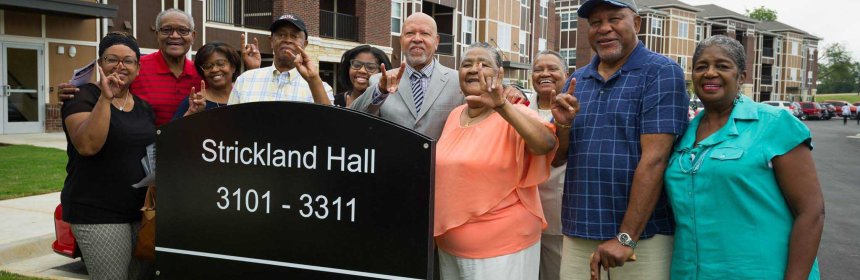
The Stricklands

Herman and Maxine Strickland display “The Circle.” A-State dedicated apartment buildings to its first four black facility members, known as “The Circle.” Photo by Kimberely Blackburn

Herman Strickland Sr. taught elementary school in Blytheville and moved up to principal. He considered teaching at Arkansas State University to allow his wife to return to school.

The university made the decision easier with a simple addition to the offer: a house. Until then, the Stricklands lived in an apartment. The house and the low tuition for his wife helped prompt the move.

As A-State’s second black faculty member, Strickland said his family did not face many racial issues. History professor C. Calvin Smith faced difficulties when he came the year before. But Strickland said he believed the university worked out all the issues before he arrived. Showing his love of sports, he compared his and Smith’s journeys to those of baseball players.

“Jackie Robinson had all the problems, but they worked them out before (Roy) Campanella and Don Newcombe came,” Strickland said. “It was sort of that way before me, I think.”

Maxcine Strickland planned to study social work, but said the university did not offer that discipline at the time. She said she believed divine intervention caused her to choose elementary education. The decision, she said, remains one of the best she made in her life.

Herman served A-State as associate professor of teacher education and dean of University College. He said he never thought he would stay in higher education. After Maxcine earned her degree, they planned to return to Blytheville. He said he thought he would return to primary education.

But his students made him change his mind. Herman fell in love with higher education and decided to stay. He worked to mentor students, both in the department and in his fraternity, Alpha Phi Alpha.

Their Impact

Rickey Greer, principal of Jonesboro’s Math & Science Magnet School, said Herman and Maxcine greatly impacted his life. He still strives to pattern his life after them.

Greer learned professionalism from Herman. Greer said Herman always looks at everyone as if they had potential. Greer said Herman’s positivity struck him as well. Although Greer knew the Stricklands faced obstacles due to their race, Herman did not dwell on them.

Greer said he does not know many men like Herman.

Maxcine taught first grade in Jonesboro. Retiring after 26 years, she said her “children” still visit, bringing “grandchildren” along.

In her first year of teaching, Maxcine said she thought every child would pass — she would make sure if it. Maxcine said a wise mentor told her she could not make them learn. Instead, she could provide the information to the children and encourage them.

Although most turned out fine, the students who struggled broke her heart. She said she still wonders what she could have done differently.

Greer worked as a student teacher under Maxcine. He said her dedication to her job and her children greatly affected him.

“She felt like or treated every kid as if they were queens and kings, or they were the best, or they were (gifted and talented) kids,” Greer said. “No matter what level they were on, she treated them that way.”

Maxcine tried to treat every child the same. She set a high bar and encouraged each child to reach it. She told them to never underestimate their abilities. She said if she expected it, they did it.

The Circle

Although the Stricklands moved four houses down from the Smiths in the neighborhood now known as “The Circle,” both families left Jonesboro every weekend. They started going to each other’s homes with the university’s hire of Wilbert Gaines, emeritus associate professor of physical education. The Circle became a family following the arrival of Mossie Richmond, who became A-State interim president, vice president for student affairs and dean of University College.

Maxcine said she never expected what came from The Circle. She said they came to Jonesboro to do a job, but instead, gained nephews, nieces and friends they will love until the day they die.

Herman said he never thought A-State would dedicate buildings to them. The thought overwhelms him. He said he hopes it inspires black students to know if they work hard and find mentors, they can do anything.

Greer said he wished his students could understand how the Stricklands affected their lives. He said he hopes his students spread the positive impact forward.

Herman said he still looks ahead.

“I hope in the future it won’t make any difference about race. I’ll see you as a sister and you’ll tell me about your parent. I’ll feel your parent did a really great job with you and I’ll know you want to leave a legacy for your parent,” he said. “My parent did a great job with me, didn’t have many means, and I want to be a legacy for them.”

(Featured photo courtesy of A-State Media Relations)

Undocumented Women Fear to Report Abuse

by Kimberely Blackburn
Delta Digital News Service

JONESBORO – Immigration and Customs Enforcement detained a woman inside a courthouse to obtain a protective order against her allegedly abusive boyfriend earlier this year in Texas.

This, along with reports of increased immigration investigations, results in many undocumented women being afraid to report abuse. In trying to remedy the situation, many organizations strive to help those undocumented victims of domestic violence.

“It’s complicated because there aren’t any specific solutions,” said Marium Durrani, public policy attorney for the National Network to End Domestic Violence. “There is a bill in the House and the Senate that protects them in community locations like courthouses, rape crisis centers and medical service providers, from immigration forces.”

Current Fears

This year, seven national abuse advocacy organizations performed a survey to help better understand how current immigration policies affect such immigrants.

Sixty-two percent of respondents reported an increase to the question, “Is your agency observing a change in the number of immigration-related questions from survivors?” Feedback sent with the survey reported many abuse survivors simply question how to plan under the new immigration policies. Some question if they should apply to immigration under the Violence Against Women Act.

When asked, “Are immigrant survivors sharing with your agency that they have concerns about contacting police?” 78 percent responded yes.

One respondent said: “Clients are afraid of calling the police because they believe that they will be deported if they do, especially if their abuser is a U.S. citizen. They think law enforcement will listen to someone who is a citizen of this country more than an undocumented person.”

When asked, “Are survivors reporting to your agency that they have concerns about going to court for a matter related to the abuser/offended?” three out of four answered yes.  Some respondents said that after media outlets reported a woman’s deportation while filing for an order of protection, many clients feared the same.

Forty-three percent responded yes when asked, “Are you or your organization working with immigrant survivors in your community who have decided to drop civil or criminal cases because they are fearful to continue with their cases?”

Durrani said some women find themselves in this situation after being brought to the country under false pretenses. Some come under a fiancée visa with the promise they will have help in obtaining citizenship. She said many abusers then withhold vital documentation and the women find themselves stuck after their visa expires.

Durrani said these undocumented victims often need special protection. A woman may look for work to escape her abuser but cannot work legally. Some employers, Durrani said, will take advantage of her status and pay a much lower wage. Other abusers will file other charges against their victim.

For these reasons, in addition to reports of victims being arrested after reporting their abuser, many stay silent.

Help Available

Rebekah Stewart, program communications associate with Tahirih Justice Center, said organizations exist to help those suffering from abuse to apply for protections under the law, including:

  • Gender-based asylum for those who suffer or may suffer violence in their home countries.
  • Violence Against Women’s Act Petitions for spouses, parents or children enduring abuse.
  • T Visas for those surviving being brought to the United States for human trafficking.
  • U Visas for those surviving crimes involving mental and physical abuse in the United States.
  • Special Immigrant Juvenile Status for abused, abandoned or neglected children.

Protecting yourself when asking for help

Durrani said she believes the protections came from Congress understanding the control abusers have over their victims.

“Congress has understood that sometimes people are not brought here under their own  volition and that doesn’t mean they should be disregarded under the protections of the law,” Durrani said.

However, obtaining these documented statuses often proves difficult.  Stewart said Tarihi Justice Center provides legal assistance for those seeking these protections, as well as social services assistance.

Working with legal assistance continues to be very important. Durrani said obtaining these statuses remains complicated. She said women can be declined from these protections for a variety of reasons.

The U Visa, for example, require women to work with police. Thus putting themselves at risk, especially if immigration enforcement considers them to be a priority.

Durrani said this fear often impacts the community as well. If a victim fears to work with law enforcement, more crimes affecting others often go unreported.

Assistance in NEA

Many victim assistance programs exist in Northeast Arkansas. Nanette Heard, executive director of The United Way of Northeast Arkansas, said such programs include everything from shelters to support groups. Organizations exist that provide monetary assistance as well.

David McDaniel, public information officer for the Jonesboro Police Department, said helping the victim remains the priority for JPD. After 20 years of service, he said he cannot remember a single time immigration investigated a victim in a domestic violence case.

McDaniel said protecting the victim, no matter their immigration status, continues to be JPD’s concern.

“If you’re here illegally, if you’re here on a visa, that makes no difference to us,” McDaniel said. “You’re not supposed to live that way. No one deserves to live that way.”

Editor’s Note: Featured photo by Jeffrey [CC BY-SA 2.0]

Damphousse Seeks Community Ties

By Kimberely Blackburn
Delta Digital News Service

Damphousse Window Art

Window art featuring Kelly, Beth and Maple Leif Damphousse decorated the window of the Chancellor’s office. Damphousse became A-State’s chancellor on July 1. Photo by Kimberely Blackburn

JONESBORO – A native Canadian and Montréal Canadians fan, Arkansas State University’s new chancellor aspired to become either a goaltender for the NHL or a Mountie before coming to Northeast Arkansas by way of Oklahoma.

Chancellor Kelly Damphousse said he planned to stay at his last position as dean of the College of Arts and Sciences at the University of Oklahoma until retirement, but an email sent by A-State President Chuck Welch prompted him to apply. When he first visited the campus, Damphousse saw the challenges but viewed A-State as a diamond in the rough. He said he can impact a community as a chancellor in a much different way than he could as a dean.

“It’s important for us to have a relationship with the people on our campus. Sometimes it’s easy for someone who in administration to get removed from the reality of the world that they’re serving,” Damphousse said.

Damphousse explained why he creates relationships:

Campus and Community

Damphousse said his main concern will always be the students, faculty and staff. He said he understands he can only see a few students per day due to his position. Yet faculty and staff members interact with hundreds.

Damphousse said he wants to use his position to help bridge the gap between campus and community. He said there seems to be a strain between the two due to past events. He said he believes strains occur due to a lack of communication, meaning people do not truly know each other.

To remedy this, Damphousse said he speaks to any community club that extends an invitation, as well as local merchants and companies to see how A-State can help their business. Jonesboro Mayor Harold Perrin said he and Damphousse agreed to work together on several projects.

Perrin said he hopes to help get the word out of what A-State offers the community. He said A-State remains a driving force in the Craighead County community.

Perrin said A-State can help employers by providing both new employees and education for existing workers. Perrin said he believes A-State and the Jonesboro community can achieve this by fine-tuning programs already on campus.

“I’ve always learned in business, you build and become strong on what you have. If you’ll continue to build and to redefine what you’ve got, you’ll be highly successful,” Perrin said.

Damphousse explained his plans to keep A-State movng forward:

United Way

Damphousse recently announced on his Facebook account that The United Way of Northeast Arkansas named him and his wife, Beth, as co-chairs of Arkansas State University’s United Way Campaign.

Nanette Heard, executive director of United Way of Northeast Arkansas, said the Damphousses will encourage the A-State community to designate part of their salary to help fund projects throughout the eight-county region.

UWNEA covers residents of Clay, Craighead, Cross, Greene, Jackson, Lawrence, Poinsett and Randolph counties. Heard said the projects include shelters, after-school programs and programs that help feed the hungry.

Damphousse said the community matters to him and to A-State. Because the campus and community will always be tied together, he said if one rises, they both rise. Damphousse said he and Beth plan to be around for the long run.

He mentioned an analogy about planting trees you never get to sit under. But Damphousse said he wants to sit under the trees he plants. He said he wants to see the efforts that come from the changes he implements.

This is why, Damphousse said, the motto “Every Red Wolf Counts” truly encompasses everyone.

“Every Red Wolf Counts. That means every student, every faculty member, every staff member, every alumnus, every member of the Jonesboro community,” Damphousse said. “I see them all as Red Wolves because we’re all tied together.”

He even let students name the family dog:

Listen to the entire interview:

Trump Puts DACA in Doubt

Canizales at protest

Daniela Canizales, a dreamer, attends a pro-DACA protest on the A-State campus. She remembers nothing of her birth country after coming to the United States as an infant. Photo by Kimberely Blackburn

By Kimberely Blackburn
Delta Digital News Service

JONESBORO – President Donald Trump announced his decision to discontinue the Deferred Action for Childhood Arrivals program, a decision placing those brought to the United States as children by undocumented immigrant parents, often known as “dreamers,” at risk for deportation.

Trump’s decision comes after lawmakers from 10 states demanded he take action against the program, which they called “unlawful and unconstitutional.” Texas Attorney General Ken Paxton sent a letter penned by himself and other officials, including Arkansas Attorney General Leslie Rutledge, giving the Trump administration until Sept. 5 to make a decision on DACA. After this date, the group would proceed to federal court.

In a prepared statement, Rutledge said, “While we are a compassionate country, the United States is a country of laws, and President Trump recognized that President Obama’s DACA program went far beyond the executive branch’s legal authority. Congress has always been the proper place for this debate, and I am pleased that the President is granting Congress an additional six months to legislatively address this issue.”

The Impact

One dreamer, Bryan Hernandez, said his parents decided to leave Mexico City after someone robbed his father at gunpoint. After coming to the United States at the age of 6, Hernandez said he does not remember much of his birth country.

Hernandez said his parents brought him and his sister to the United States for a better education and more work opportunities. He said his parents work as a roofer and a maid, having previously worked for low wages as migrant workers.

Edica Tamez, a friend of Hernandez, said she remembers when Hernandez’s 4-year-old brother worked as a migrant worker alongside his family. Tamez said the child knew his family needed money and wanted to help.

Tamez said she often saw a similar work ethic in the Hernandez family, remembering Hernandez’s now 16-year-old sister reacting to being approved for DACA, after being denied twice.

“She was so relieved she could finally work. She could finally help her family and go to school,” Tamez said.

Brought from Monterrey, Mexico, 18 years ago, now 19-year-old Daniela Canizales said she remembers nothing of her birth country. Canizales said she fears how the end of DACA affects her educational opportunities. While currently not in school, she said she wants to study social work.

Canizales said her parents brought her and her older brother to the United States for a better education. She says DACA also provided opportunities for her brother and sister-in-law to provide for their 6-year-old daughter.

Hernandez and Tamez at protest

Edica Tamez and dreamer Bryan Hernandez protest the end of DACA. The A-State Young Democrats protested in the Humanities and Social Sciences Building. Photo by Kimberely Blackburn

The Aftermath

The Young Democrats of Arkansas State University staged a protest on the A-State campus. Those in attendance included Kayleigh Schalk of Poplar Bluff, Missouri. Schalk said she attended the protest because of her belief that it is unfair for children to be sent away from their home.

Schalk said she attended class with dreamers in a small Missouri university, finding them to be kind and hardworking. One, Schalk said, worked odd jobs and swept up the trash after all the events and ball games.

Special Sanders, outreach director of Arkansas Coalition for DREAM, said Arkansas requires dreamers to pay out-of-state tuition. This is often close to double what Arkansas residents pay. Sanders said when DACA ends, dreamers will most likely not be able to keep their identification or their jobs.

Sanders said she does not think Congress will pass legislation to help dreamers. She said if something does not change, she will return to the streets in protest.

Dylan Herekamp, also in attendance for the protest, said he did not know any dreamers personally. However, he said, that did not matter to him. Herekamp said his goal will always be to stand up and support dreamers, and he encourages everyone to write or fax their lawmakers and make their voices heard.

A Deal in Progress

Late Wednesday night, Senate Minority Leader Chuck Schumer and House Minority Leader Nancy Pelosi issued a joint statement after meeting with Trump which said “We agreed to enshrine the protections of DACA into law quickly, and to work out a package of border security, excluding the wall, that’s acceptable to both sides.”

Sarah Sanders, press secretary for the Trump Administration issued a Tweet which said, “While DACA and border security were both discussed, excluding the wall was certainly not agreed to.”

Uncertain Future

In response to DACA critics, Canizales said she wishes everyone would become fully informed on the issue. Canizales said everyone should do research and learn of the issue before making snap judgments.

Hernandez said the future of his family remains uncertain and his education remains a concern.

“(This decision) takes away the opportunity, the change for an education that we always wished for,” Hernandez said.

Women’s Hall of Fame Inducts 2017 Class

Hawkins award

Holly Fish, chair of the Arkansas Women’s Hall of Fame board (left), presents Ruth Hawkins, executive director of A-State Heritage Sites (center), with the 2017 induction award. Also pictured is Shelby Worsham, a girl of distinction. Photo by Kimberely Blackburn

By Kimberely Blackburn
Delta Digital News Service

LITTLE ROCK – The Arkansas Women’s Hall of Fame inducted nine women and one convent into its 2017 class Thursday evening in the third-annual award ceremony held at the State Convention Hall.

Immediately preceding the event, the board of directors unveiled a permanent installation celebrating all the women inducted into the hall of fame. Located downstairs in the Convention Hall, the interactive installation shares the stories of these inspirational women and their accomplishments.

John Owens, president of the North Little Rock Chamber of Commerce, said although his organization involves itself in several community events, this is his favorite due to the impact these women have on Arkansas.

“These women have a positive impact on social change and make it easier for the next generation (to invoke change),” Owens said.

This year’s inductees include:

  • Olivetan Benedictine Sisters, for ministry and medicine
  • Maya Angelou, writer and activist
  • June B. Freeman, advocate for the arts
  • Ruth Hawkins, for honoring history and heritage
  • Brinda J. Jackson, groundbreaking architect
  • Bernice Jones, philanthropic leader
  • Pat Lile, community champion
  • Judge Elsijane Trimble Roy, legal trailblazer
  • Dr. Joanna Seibert, healthcare pioneer
  • Dorothy Stuck, force for equality

Still Making a Difference From the Past

Accepting the award on behalf Maya Angelou, Patricia McCraw said she finds honor in accepting any award for her friend.

Perhaps best known for her writing, Angelou found inspiration in Malcolm X and Martin Luther King Jr. and moved to Egypt to join the anti-apartheid activists. After returning the United States, Angelou joined the civil rights effort.

McGraw said when Angelou saw evil upon any person, she would try to help and Angelou strived to inspire others to love and respect all.

In 1993, Angelou achieved history by becoming the first woman and the first African-American to read a presidential inaugural poem.

McGraw said she composed a poem calling Angelou a “shero of the ages,” due to her desire for peace within the human race. Angelou herself composed a poem where she says, “We are more alike, my friends, than we are unalike.”

Bernice Jones and her husband Harvey committed themselves to contributing a large amount of their fortune to the betterment of Arkansas families. Founded in 1933 by Harvey, The Jones Truck Lines eventually turned into an $80 million-per-year business. After being unable to start a family, Jones and her husband began a philanthropic endeavor to better the state for other families.

Jones paid the salaries of Springdale’s teachers during The Great Depression and helped fix the public school facilities in order to better the education of the children. Although they created a charitable foundation in the 1950s, they chose to make most of their contributions anonymously. In 1995 the Jones Center for Families opened, offering educational opportunities as well as recreation for the community.

Ed Clifford, CEO of the Jones Center of Springdale, accepted the award in Jones’ honor and said her spirit lived on through her contributions, but also through the Jones Center.

Jones’ nephew, Jeff Curtis, also accepted the award in her honor. Curtis said Jones believed the three ways to be successful in were to “follow God, treat everyone the way you would like to be treated, and to follow your passion.”

Judge Elsijane Trimble Roy’s long list of accomplishments includes being the first female judge on the Arkansas Supreme Court.

Roy grew up saying she wanted to follow in her father’s footsteps by becoming a lawyer, but that plan changed when she learned of Amelia Earhart. However, after Roy’s uncle took her on a ride on his crop duster, her mother quickly ended her daughter’s aviation dreams.

After being appointed as a federal judge in 1977, Roy served in the same courtroom as her father for many years. Roy’s son, Jimmy, said his mother often looked at her father’s photo, displayed in the courtroom, for inspiration and guidance when making difficult decisions.

Accepting the award in her honor, Jimmy Roy said his mother loved what she did and she wanted to serve the people.

Serving the Community Together

Inducted into the group category, the Olivetan Benedictine Sisters of the Holy Angels Convent serve the citizens of Jonesboro through various ministries. Established in Pocahontas, the convent moved to Jonesboro in 1889. The original six sisters from Switzerland opened St. Bernard’s Medical Center in 1900. Currently, the sisters try to visit every patient admitted to the Medical Center daily.

Sister Mary Claire of the convent said the sisters believe tending to a patient’s spiritual needs greatly impact their physical condition. Sister Claire said she felt as if her predecessors in the convent felt compelled by God to achieve their mission against all odds. Although not trained in medicine, the sisters rely on their faith and sense of community to fulfill their mission.

“Praying together, eating together is an important part of our lives. We’re kind of scattered with our ministries, but we still want that community feeling, that family feeling and those real bonds you get from living together,” said Prioress Johanna Marie Melnyk in a prepared statement provided by Arkansas Business Publishing Group.

In addition to their ministry at St. Bernard’s Medical Center, the sisters also visit prisoners and work at the Hispanic Center of Jonesboro. Accepting the award for the convent, Sister Teresa Marie said they only want to love their neighbors, as Jesus commanded.

Making a Difference in the State Today

jackson

A senior picture of Brinda Jackson was featured at the 2017 Arkansas Women’s Hall of Fame Induction ceremony. Jackson served as the first black valedictorian of Lake Village High School. Photo by Kimberely Blackburn

As the final group of women inducted, the contemporary category held six women currently striving to serve.

Brinda Jackson, the first black women registered in Arkansas to practice architecture said she received inspiration in a surprising way.

The tube of drawings Mike Brady of “The Brady Bunch” brought home appealed to her, inspiring her to speak with her high school counselor about architecture. Even after having to explain the craft to her counselor, Jackson said she did not let it deter her.

As the first black valedictorian of Lake Village High School, Jackson said she expected to receive the same college scholarship awarded to past students in the past situation. However, after the school decided to make a change, they awarded the scholarship to the salutatorian instead.

After crying for some time, her father comforted her by saying he would still ensure she went to college. Jackson became only the second black woman to complete the architecture program at the University of Arkansas.

Many tried and failed to deter her from the profession, leading Jackson to begin work with the Army Corps of Engineers in 1990. After being sent to Iraq at the beginning of Operation Iraqi Freedom, she faced her fears when her truck broke down while traveling from Kuwait to Iraq.

Refusing to accept the same fate as Jessica Lynch, a soldier captured a few weeks earlier, Jackson said she flagged down a passing convoy and asked if they could head north. By finding a way out of the situation, she earned the 555 Combat Engineer Group Commander’s Award and the honor of being named battlefield hero of the day.

The award surprised Jackson as she said she did not know how many she inspired, but she accepted the award in honor of her parents. She said her parents deserve the credit for her success. Her father would come home from working on the farm and do his children’s chores so they could concentrate on their homework.

Jackson said to never give up because there will always be someone who does not value you as you should be valued.

“Don’t let anyone deter you. Other people cannot determine your success,” Jackson said.

Dorothy Stuck said she came to Arkansas to teach history. She said the thought of being part of Arkansas history makes her very proud. Stuck began her philanthropy career after helping to further the cause of desegregation inspired her. She said she believed segregation to be inconsistent with the nation’s ideals, and one should be judged by their abilities, not the color of their skin.

Owning three newspapers with her husband, Howard, Stuck wrote the news, sports and lifestyle sections, as well as writing editorials and selling advertisements. The Arkansas Gazette published her editorials against segregation, and in 1964 and 1969, she was named Press Woman of the Year. Stuck worked with the 1969-1970 Constitution Committee to repeal the poll tax.

In 1970, the U.S. Office for Civil Rights named Stuck regional director for the Department of Health, Education and Welfare. Over the five-state region of Arkansas, Texas, Oklahoma, Louisiana and New Mexico, Stuck continued her desegregation efforts. While regional director, she worked to integrate public schools, schools of higher education and public-health facilities.

According to a prepared statement provided by ABPG, Stuck chaired Southern Bancorp’s nonprofit, called Southern Bancorp Community Partners. Their mission remains to address poverty in the Delta by providing low-interest mortgages and education with loans to small businesses in the area.

Stuck said she never dreamed she would be considered for such an award. She advises others to never give up, to never give in, and above all, to be stubborn.

stuck

A photo of Dorothy Stuck accepting her award is projected onto the big screen. Also pictured are Fish and Savana Melton, a girl of distinction. Photo by Kimberely Blackburn

“Courage is just being stubborn when you’re scared,” she said.

Dr. Joanna Seibert began to consider medicine as a career late in college. Becoming the first trained pediatric radiologist in the state, she decided to work with children because she always loved them.

She moved to Arkansas with her family in 1976 as the nation celebrated its bicentennial, saying that Arkansas welcomed them with fireworks.

She and her husband, Dr. Robert Seibert, worked to develop Arkansas Children’s Hospital. Siebert said she would often play the harp for the parents, with her favorite area being the neonatal intensive care unit.

Siebert remembers playing the harp as a child suffered a cardiac arrest. She thought she should stop playing, but the doctor working with the baby told her to keep playing. The music seemed to help the medical team as they worked with the patient.

Siebert often kept contact with her patients. She still speaks to a now elementary-aged child who, when born, weighed only 500 grams.

Seibert began training to be a deacon in her church over 20 years ago and is now ordained in her Episcopal faith. Serving at St. Mark’s Episcopal Church, she said she never feels a conflict between her faith and medicine. She said medicine taught her to be curious, but not to fear illness or death.

Siebert said she hopes to live up to the honor of this award.

Committed to making Arkansas better through the arts, June Freeman’s father told her at a young age she would not make a living being an artist. Moving to Arkansas after earning her bachelor’s degree at the University of Chicago, Freeman missed the museum. She began the Little Firehouse Community Arts Center in Pine Bluff, which housed not only an art gallery, but community art classes as well.

After the art center became the Southeast Arkansas Arts and Science Center, Freeman kept the exhibits circulating through the state so Arkansans could enjoy them in their hometowns. She served the state as a cultural entrepreneur.

Freeman also helped to establish Pine Bluff Sister Cities, which encourages trade and friendship with cities in foreign lands. Through Freeman’s efforts, Pine Bluff became the first Arkansas city with a sister city in Iwai City, Japan.

Freeman said one’s life can take many roads, but the key is to never ask permission.

Pat Lile became a full-time community volunteer after being privileged to have full-time help in her home.

After attending a national conference in child advocacy, Lile said the problems the children face in Arkansas overwhelmed her. She then realized something could be done about it, and as long as she could bring something to the table, she would.

In her career, Lile served on several nonprofit boards. In 1999, President Bill Clinton appointed her as the lone Arkansan to attend the White House Conference on Philanthropy.

Serving from 1996-2007 as the president and CEO of the Arkansas Community Foundation, Lile said a sign on Little Rock’s Broadway Bridge inspired her to move forward.

The sign said, “Who will build Arkansas if our own people do not?”

Lile said although she did not know everyone in attendance, she viewed them as a beautiful crowd of Arkansas builders.

Being the second oldest of 12 children, Ruth Hawkins said her parents never questioned that they would all go to college. After beginning her professional career as a journalist, she developed a love of the stories of the state’s Delta region.

As director of Arkansas State University Heritage Sites, Hawkins worked to restore historical sites, such as the childhood home of Johnny Cash and the barn studio in Piggott where Ernest Hemingway wrote “A Farewell to Arms.”

In 2012, she authored a book titled, “Unbelievable Happiness and Final Sorrow: The Hemingway-Pfeiffer Marriage” after 12 years of research. She said the book sets the record straight about Hemingway’s marriage to his second wife, Pauline Pfeiffer.

Hawkins said her interest lies not in the buildings themselves, but in the stories that could be told through them.

“We have a very rich heritage here. There are so many stories out there beginning to disappear because the material things associated with them are beginning to disappear,” Hawkins said.

Hawkins is currently working on the 2017 Johnny Cash Heritage Festival being held in Dyess on Oct. 19-21. Performers include Roseanne Cash and Kris Kristofferson. Hawkins said Cash’s family wanted the restoration of his childhood home for many years.

Attendees of the event will be able to view the house behind the performers.

Arkansas Women’s Hall of Fame

Past inductees include Hillary Rodham Clinton, civil rights crusader Daisy Gatson Bates, Alice Walton and the first woman ever elected to the Senate, Hattie Caraway.

Alex Howland with ABPG said the North Little Rock Chamber of Commerce began the event and a partnership with ABPG to help elevate the status and impact of women.

Arkansas’ First Lady Susan Hutchinson serves on the board of directors. She said the hall of fame serves to bring together and honor those women who make a difference in the state.

A selection committee decides who will be honored based on established criteria. Such criteria include the nominee’s positive impact on women and girls, and her impact on the state.

The board uses three separate categories for inductees. Hutchinson said the board decided on a posthumous category to help preserve the past from the “shadows of time.” The contemporary category highlights women still making a difference for today’s society. The group category showcases groups of women making a difference together.

Girls of Distinction

Howland said they chose five area high school girls to escort the honorees to the stage. Those chosen for this honor serve in student government positions, maintain high academic standards and strive to make their communities a better place.

This year, they chose Jennifer Bond, Zharia Harris, Savana Melton, Stephanie Verdaris and Shelby Worsham to serve as “Girls of Distinction.”

Verdaris serves as student body president at Mount St. Mary’s Academy in Little Rock, as well as a student ambassador for the school and member of both the National Honor Society and Beta Club.

Verdaris said her inclusion in the ceremony humbles and honors her, and being around such women makes her nervous but excited. She escorted Pat Like and the Olivetti Benedictine Sisters.

Harris, a Little Rock native, started “Socks for the Rock,” a nonprofit that provides socks for Little Rock’s homeless population. Other than their basic uses, Harris said that socks can block the passage of certain bacteria to help ward off infection.

Harris said being included in this ceremony makes her want to do more to improve society.

For more information on nominations, visit The Arkansas Women’s Hall of Fame website.

A-State Dedicates ‘The Circle’

University officials unveiled a placard explaining “The Circle” during the dedication. The university named the apartment buildings for its first four black faculty. Photo by Kimberely Blackburn

by Kimberely Blackburn
Delta Digital News Service

JONESBORO — Arkansas State University honored its pioneering black faculty Aug. 7 at the dedication of “The Circle,” a group of apartment buildings.

Chancellor Kelly Damphousse said such an honor sends a statement and begins many projects intended to make the campus a more welcoming place.

“We’ve come a long way in recognizing the important role that African-Americans play in our community, but we have a lot further to go,” he said.

A-State named the buildings — which will house A-State faculty, graduate students and New York Institute of Technology College of Osteopathic Medicine students — for the four men who taught at a time when many did not accept integration:

  • C. Calvin Smith, emeritus professor of history and A-State’s first black faculty member
  • Mossie Richmond, A-State interim president, vice president for student affairs and dean of University College
  • Herman Strickland Sr., emeritus associate professor of teacher education and dean of University College, and
  • Wilbert Gaines, emeritus associate professor of physical education.

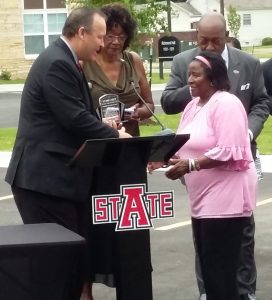
Chancellor Kelly Damphousse presents Earline Smith with a crystal award in honor of her late husband C. Calvin Smith. Each family received an award. Photo by Kimberely Blackburn

Smith lived in campus housing after being unable to find someone in Jonesboro willing to rent to his family. As the other families arrived, they became neighbors and formed “The Circle.”

Rick Stripling, vice chancellor for student affairs, said the dedication sends the statement that Arkansas State embraces diversity. He emphasized the importance of honoring the contributions of these men in the public eye.

Smith’s widow, Earline, said the families’ shared experience formed an extended family who truly loved each other. She said never in her wildest dreams did she expect so many people would attend the dedication. Richmond’s widow, Velmar, said the dedication honored and dumbfounded her.

Strickland said he came to A-State and found friends immediately. He said he gained acceptance as a teacher because of his friendship with Smith, who had done it first. He said he became a dean because Moss mentored him.

Gaines claimed the dedication shows A-State as, “a beacon of light to which other institutions can come for divine wisdom and insight.”

Richard Hartness Sr. authored a book illustrating the families’ lives called “The Circle: Coping With Integrated Life at AState, 1970-1978.” A former student of Smith’s, Hartness said he learned of the story at the celebration of Smith’s life after his death. Hartness said Smith brought important aspects of American and black history to his students that sometimes corrected the history books. Hartness said he now teaches these ideas to his students at East Arkansas Community College.

Richmond’s family member, Sandra Smith, works as principal of the BCH2 Academy at Wynne public schools. She said the dedication provided an opportunity for her to bring ideas to her students and teachers. Smith said she often quotes Frederick Douglass — who said, “Education can be an equalizer” — to show the importance of education to her students.

“In 2017 when we find there is still racial tension at times, this (dedication) establishes the fact hard work does pay off, and there is a facet of America that recognizes hard work,” she said. “As (Arkansas State) honored these founders and pioneers, they have honored themselves. As we lift others up, we lift ourselves up and if we understand that, we will be a greater America.”

New DHS Program Cuts Hours for Disabled Citizens

by Kimberely Blackburn
Delta Digital News Service

JONESBORO – A new program implemented by Arkansas Department of Human Services resulted in cuts of home health care hours for many in the disabled community of the state.

Legal Aid of Arkansas won a temporary restraining order on behalf of many who suffered a cut in hours in February. DHS appealed and won a postponement of the original court date of July 2017. The suit is expected to go to court in 2018.

The suit states Arkansas DHS did not notify those enrolled in the ARChoices waiver program of upcoming changes. This lawsuit came after winning a suit filed in federal court against DHS.

James Dukes speaks about a video he directed that highlights the impact of the 4,000 cuts. Legal Aid of Arkansas is traveling the state meeting citizens to help explain the cut in hours imposed by Arkansas DHS. (Photo by Kimberely Blackburn)

Kevin De Liban, attorney with Legal Aid of Arkansas, said the lawsuit came after several clients contacted him after DHS drastically cut their hours. These cuts resulted from a new program called ARPath. The program uses an algorithm developed at the University of Michigan to determine a category each patient would fall into. DHS assigned each category a pre-determined number of hours assigned that cannot be changed by a health care professional.

Brandi Hinkle, deputy director of communication for Arkansas DHS, said, “ARPath was implemented to provide a more objective review of client needs to ensure that all beneficiaries receive a consistent, medically appropriate level of care.”

She said DHS developed the categories after studying a large number of individuals with similar diagnoses. DHS used this study to best determine home health care hours. Hinkle said DHS commits itself with helping individuals maintain a high quality of life.

De Liban said the lawsuit was filed due to the violation of the Administration Procedures Act, which governs state agencies. According to the Act, state agencies must publish any proposed changes and allow for public comment. After the period for public comment closes, they must consider comments and re-evaluate the proposed change.

Hinkle said DHS follows an extensive procedure for changes to all programs and clients have the right to appeal after their assessment. De Liban said DHS did not adequately inform the public of the change. He said DHS published a notice of rulemaking online and in newspapers of record, but included no mention of the algorithm. The notice did include a link to the entire 242-page document, but De Liban said the notice mentioned the algorithm only six times and did not include it on the page that listed the major changes.

The Effects

Dan Watson acts as the primary caregiver of his 32-year-old son Andrew. He said they learned of the new program with they asked for a re-assessment. Watson said his son’s condition worsened, but the new program resulted in a reduction of hours. He said the nurse ran the program with all the worst answers and it still resulted in the same number of hours. He said his concern lies in what will happen to Andrew in the future.

Dorothy Vaughn suffered a spinal stroke, which involved a blood vessel bleeding out into her spinal cord. She said paralyzation occurred within a matter of hours. DHS cut Vaughn’s hours by 21 hours per week. She said her family works and her son cannot turn her due to his back surgery. She said she suffered a stage-four pressure sore due to her lying on her back each night, a result of the reduction of hours.

Vaughan said she remained in a nursing home for three weeks after having part of her tailbone removed in treatment for the pressure sore. She said she needs the additional home health care hours to help her get on top of the pressure sore and become productive again. As it stands, Vaughan said her end result will be a nursing home.

Shannon Brumley suffered a spinal-cord injury 16 years ago as a result of a motorcycle accident. His mother remains his primary caregiver.

Brumley said emotional health plays a big part in one’s physical health. He said being in a nursing home would affect his emotional state greatly directly. He said he wishes DHS could live his life for a week. If possible, he said it would change its mind.


Tammy Dobbs of Cherokee Village explain how the cuts in her home health care affects her life in a video directed by James Dukes. Legal Aid of Arkansas produced this video to show the impact of the cuts caused by the new program implemented by Arkansas DHS. (Video courtesy of Legal Aid of Arkansas)

The Future

Arkansas DHS appealed the state lawsuit and De Liban said it could take until 2018 for the case to go to court. In the meantime, those enrolled in this program can protect themselves. Hinkle said all enrollees have 30 days to appeal their assessment. She added anyone who appeals within 10 days has the right to keep all their hours until the hearing.

De Liban said anyone who loses at the hearing will be required to pay the state for the cost of the extra hours. However, he said DHS cannot garnish any Social Security or Medicaid benefits. He said he also suggests each one logs all hours in which care received, what they do, and what they cannot do for themself.

De Liban said his main concern involves the lack of thought DHS made on how its actions would affect many enrolled in their program. He said anytime you make a decision that will greatly affect those vulnerable, great thought must be made.

“You definitely should get the opinions of the people who are going to be affected by the program,” he said.

Vaughn said although her concern remains her future, others’ futures concern her more. Before her recent health decline, she volunteered at schools with special-needs children.

“My heart breaks for the possibility of this affecting children,” Vaughan said.

Pocahontas Relief Efforts Continue

POCAHONTAS, Arkansas — Clean-up efforts continue after flooding caused severe damage.

Randolph County Judge David Jansen said three major and several minor breaches occurred in the levee designed by the Arkansas Corps of Engineers. Flood waters flowed over the levee at a span of 3-4 miles for 4-5 hours, he said. It caused the levee to “churn” and eventually resulted in the breaches.

Although the property damage proved to be extensive, Jansen said the county’s first priority remained resident’s lives.

“Our No. 1 goal when this event started was no loss of life, and we’ve achieved that,” Jansen said.

Jeff Harris looks at flood damage in his Pocahontas home. Pocahontas suffered extensive flood damage after breaches in levee breech. (Photo by Kimberely Blackburn)

The Aftermath

Pocahontas resident Jeff Harris lost almost everything in the flood. After the call to evacuate came, his family prepared as best they could. He and his 10-year-old son Colton put the kitchen appliances on cinder blocks to help shield them from the water. This task proved difficult as Harris experiences health problems that cause difficulty with his daily movements.

Harris is no stranger to struggle. He said he’s lived through a brain tumor, being electrocuted and watching his father suffer the effects of being hit by a drunk driver. Most recently, his 7-year-old daughter Lorraine underwent open-heart surgery at Arkansas Children’s Hospital to correct a heart murmur.

Harris, wife Stephanie and their family currently live with his grandmother in a small home outside the flood zone. He said they will rebuild.

Neighbor Laura Williford said her house took 7 inches of water; her enclosed patio held 18 inches. She said her family put their possessions high enough by stacking them on the deep freeze. But the water flipped the freezer, which was on the patio. She said she will rebuild.

“Where else can you go? We don’t have any houses around here,” she said.

While staying at the American Red Cross shelter until she can move back into her house, someone gave her a small travel trailer.

A Community Unites

In his 13th year as judge, Jansen said he has served through many natural disasters, but this one hit him hard. Yet the influx of help from within and outside the community encourages him. As of May 22, Jansen said 33 residents resided at the Red Cross shelter.

Red Cross volunteer Stan Rosenzweig said those displaced receive everything from shelter and food to just a warm hug and blanket. Volunteers arrived from all over the country to help with the relief efforts; he came from Salt Lake City, Utah. Other volunteers in the relief effort hail from Minnesota, Massachusetts, and California.

Rosenzweig said volunteers do 91 percent of work done by the Red Cross. He said currently over 70,000 volunteers nationwide assist with disaster relief.

A member of the Arkansas Baptist State Convention Disaster Relief team helps remove water from flood-damaged homes. Other team members brought supplies to assist with the flood relief. (Photo by Darryl J. Kelley, courtesy of ABSC Disaster Relief)

Arkansas Baptist State Convention Disaster Relief unit commander Jack Chandler said the team works closely with the Red Cross to feed residents, and provide hot showers and laundry services at the shelter. Several ABSC Disaster Relief teams helped remove damaged housing materials after the flood. Chandler said after the homes dry, the teams return to spray mold killer to help protect the homeowner.

ABSC Disaster Relief team member Steve Thomas said all team leaders train in specialized areas to help assist with the efforts. Other volunteers train in various areas, e.g. food safety, to best help the community hit by a natural disaster.

Harris said he received help from a variety of places. Cody Walker arrived with Reach out Worldwide, an organization started by his deceased brother, actor Paul Walker. Harris said the organization provided $18,000 in removal assistance. He said many others came to help him remove damaged furniture and housing materials.

“Everyone who has come to my house and helped me have been angels,” Harris said.

Jansen said Pocahontas officials, concerned with possible scammers taking advantage of residents, required all contractors to register with the city. The city compliance officer and Pocahontas police patrolled the area to ensure compliance.

Jansen said the city and county opted to not handle monetary donations. Instead, the Pocahontas Ministerial Alliance works with the Salvation Army to take donations. He said they placed a series of checks and balances to ensure residents receive all donations.

“I want to thank everyone who has helped from the bottom of my heart,” Jansen said.

Future Planning

The Corps of Engineers hired an engineer to study possible solutions to the Black River water problem. Jansen said all the water goes under the Black River Bridge, but the bridge cannot adequately handle the influx of water from floods of this type.

The engineer will present the findings of the study to the levee board, which will then determine the best course of action. No date has been set for the study completion.

Jansen said possible solutions include flood relief gates and restructuring the Black River Bridge. For flood relief gates to work properly, a dam would need to be constructed, continue through Lawrence County and cross three state highways. Jansen said such a project would require the acquisition of land and several overpasses to work properly, which is a large undertaking for a small county.

Jansen said his concern lies in funding such a project. He estimates the cost to be a minimum of $6 million and Randolph County does not possess the funds to cover such a project. He said he has contacted the county’s Congressional leadership for help.

***

(Editor’s Note: The featured image at the top of the page shows soldiers from the Arkansas National Guard’s 87th Troop Command assisting Randolph County authorities with evacuation assistance in Pocahontas Tuesday, May 2, 2017. The soldiers were activated in response to flooding in the area from multiple rivers. (Courtesy of the Arkansas National Guard) [CC BY 2.0 (http://creativecommons.org/licenses/by/2.0)], via Wikimedia Commons)

Controversy Surrounds Death Penalty Drug

By Kimberely Blackburn
Delta Digital News Service

Kenneth Williams (photo courtesy of Arkansas Department of Corrections)

VARNER, Ark. — The last man Arkansas plans to execute in April is not a saint.

Sentenced to life for the 1998 death of University of Arkansas at Pine Bluff cheerleader Dominique Hurd, Kenneth Williams escaped in 1999 after 19 days in prison.

Williams robbed and killed Cecil Boren of Grady, who lived not far outside of the prison. A high-speed chase while evading police in Boren’s stolen truck led to an accident and death of delivery driver Michael Greenwood of Culligan, Missouri. Williams later confessed to killing Jerrell Jenkins on the same day as Hurd.

The state sentenced Williams to die by lethal injection April 27. But his and four other inmates’ fates remain uncertain following the United States Supreme Court refusal late Monday night to vacate the Arkansas Supreme Court’s stay of execution for Don Davis.

STATE MOVING FORWARD

Arkansas Gov. Asa Hutchinson said in a statement following the SCOTUS decision that the state would proceed in carrying out the sentences of the other inmates. The SCOTUS decision came just hours after a temporary restraining order barring the state from carrying out a controversial seven executions in 11 days was overturned by the 8th U.S. Circuit Court of Appeals.

That decision prompted McKesson Corp., which manufactures one of three drugs — vecuronium bromide — used in Arkansas’ lethal injections, to pursue further legal action Tuesday.

“McKesson has filed a new action in Pulaski County Circuit Court for review by the new judge who has now been assigned to these matters and again seeks a restraining order to prevent the use of our product for something other than a legitimate medical purpose. McKesson is committed to ensuring that its property is only used in a manner consistent with our supplier agreement,” said Kristin Hunter, director of Corporate Public Relations for McKesson.

DRUG COCKTAIL CONTROVERSY

The drug cocktail slated for use in the lethal injections contains a drug encompassed in a political firestorm.

The ACLU claims one of the drugs used in Arkansas’ lethal injections may violate the ban on cruel and unusual punishment by causing a long and painful death. An Alabama inmate given the drug experienced painful, burning sensations before death.

The McKesson Corp. claimed the state misled the drug manufacturer to obtain vecuronium bromide. A prepared statement said McKesson believed its drug would be used for medicinal purposes in the Department of Correction’s in-house medical facility. After learning of the drug’s true intention, McKesson asked for the product’s return.

“Upon learning that ADC was potentially holding the product for lethal injection purposes, McKesson immediately requested and was assured by ADC that the product would be returned. McKesson issued a full refund to ADC and made several additional requests for the product, but the product was never returned,” Hunter said.

Requests for comments from the Department of Corrections remain unanswered.

Brandon White, a Paragould pharmacist with Arkansas Methodist Medical Center said vecuronium bromide is used in long-term paralysis cases such as a patient being placed on a respirator. He said usually, healthcare professionals administer the drug with a strong pain reliever due to the potential of an internal burning sensation.

If McKesson’s vecuronium bromide is used for lethal injection, it could result in legal action against the state. Joseph Rukus, assistant professor of Criminology at Arkansas State University, said McKesson could sue Arkansas for damages to its reputation and as an example to other states considering using their drug for lethal injections.

“Bottom line,” he said, “this could cost the state some money.”

Ruckus said the state’s lack of transparency in such cases concerns him. He said when it comes to a penalty as final as death, all parts of due process must be transparent.

By not being truthful to obtain this drug for lethal injections, he said the state’s behavior resembles one as an addict.

“If an individual wants to get oxycodone, but can’t get them through legal means, the state would put someone in prison for getting them through illegal means. The state is doing the same thing,” Rukus said.

DEATH PENALTY SUPPORT

National public support for the death penalty has waned in the past five-to-10 years partially due to the Innocence Project, an organization that attempts to exonerate those wrongly convicted through DNA testing. Rukus said the project resulted in those who believe in the death penalty in principle but are wary of innocents being put to death.

Ruckus said the appeals process takes 10-15 years and results in the death penalty being more costly than an inmate being incarcerated for life without the possibility of parole. Proponents of the death penalty support a shorter appeals process as a result, he said.

Considering convictions overturned after 10-15 years, Ruckus said the state is not always getting death penalty convictions right. However, a recent Talk Business & Politics-Hendrix College poll shows 61 percent of Arkansans support the death penalty, while only 29 percent support life without parole.

Sen. Tom Cotton praised the death penalty at a Town Hall and condemned the pharmaceutical companies “trying to interfere with the justice system n the state of Arkansas.” Sen. John Boozman did not wish to comment. Arkansas Attorney General Leslie Rutledge issued a tweet.

Meanwhile, Williams awaits his fate. In a “Life Inside” series article penned earlier this month, he wrote of his mindset, apologized to the victim’s families, claimed to be transformed by religion, and discussed the drugs to be used to kill him. As far as the upcoming date?

“Death, one step closer. Tick, tick.”


Photo of Varner Unit Supermax by Richard Apple (Own work) [CC BY-SA 3.0], via Wikimedia Commons

EDITOR’s NOTE: A previous version of this story used 2016 poll data; the article has been updated to include more recent poll data from Talk Business & Politics – Hendrix College poll.

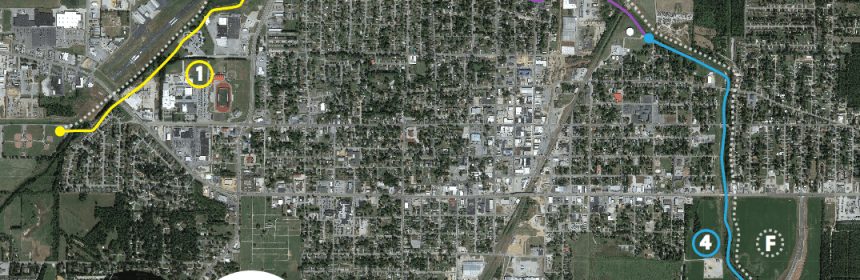
Paragould Plans New Greenway

The proposed greenway that would run through Paragould. (Photo courtesy of the Green County Future Fund)

The proposed greenway that would run through Paragould. (Photo courtesy of the Green County Future Fund)

by Kimberely Blackburn
Delta Digital News Service

PARAGOULD – The Arkansas Highway Transportation Department recently approved a grant to partially fund the first leg of an urban greenway for the city of Paragould.

AHTD’s grant provides 80 percent of the approximately $580,000 project. Mayor Mike Gaskill and the City Council’s approval provides the remainder from the city’s reserve funds.

Greene County Future Fund‘s Kimberly Dale said the trail will begin at Rotary Softball Park, near the Sundale subdivision, and follow 8-mile Creek to Highway 49. Noting how the trail will connect the community, she said the project excites her.

“People my age and younger will move to a place for the quality-of-life amenities,” Dale said.

Conservation Tools‘ guide lists many of the economic benefits hiking trails bring to a city. Benefits not only include attracting homebuyers, but also attracting businesses looking for top-quality employees.

After AHTD and the Army Corps of Engineers approve the design of the hiking trail, Gaskill said the city will bid the job out. He expects the construction to provide a boost to the local economy.

Plans from the Past

Gaskill first wanted a trail 19 years ago, when he became mayor of Paragould. When the city widened 8-mile Creek for drainage issues, leaders considered a walking path, but thought it impossible due to the bridges it must cross. Later they discovered a path could be built under the bridges to alleviate any safety concerns.

Members of the Future Fund originally targeted private donors to raise the remaining funds, but Gaskill said he wanted every citizen to be involved. He said providing the money from the city’s reserve fund will not alter the city’s budget, and no other department or project will lose funds due to this project.

Gaskill said officials annually strive to improve community safety for citizens to exercise. For example, officials began sidewalk improvements in downtown Paragould in 2015.

Future Green Spaces

Greene County Judge Rusty McMillon said he first thought of a green space behind the courthouse when houses still stood on the proposed site. Although an annex to the courthouse was suggested after the county tore those houses down, McMillon said he believes Greene County needed more green spaces.

Working through “Healthy, Active Arkansas,” an initiative started by Gov. Asa Hutchinson in October 2015, McMillon said he hopes to not only educate county employees about living a healthy lifestyle, but provide a space for them to stay active. McMillon said he believes such a green space will help lower insurance premiums as well.

McMillon said he hopes to build green spaces throughout Greene County. He said he encourages all those throughout the county with ideas to contact him.

Dale said the Future Fund remains open to any ideas about future green spaces in Paragould. She said they would love the opportunity to purchase the land for a space downtown. Yet, Bolen said right now there isn’t a space in downtown Paragould where the community can gather outside during events.

Dale said with Paragould being such a pretty city, she hopes this trail will attract many to the community. Future Fund member Ashley Bolen said Paragould’s founding fathers planned for the growth when planning the city. She said Paragould’s citizens enjoy a great quality of life.

“Paragould is a well-kept secret,” Bolen said.

You can find more information on becoming a member of the Greene County Future Fund here.

« Older Entries