Category Archives: Environment

Earth Day: A great time to review the natural state’s environmental practices, policies

Story by DDNS Reporter Jerry Don Burton

April 16, 2026

From city-wide cleanups to research demonstrations, several organizations are gearing up to host events for Earth Day in Arkansas.

Earth Day, held on April 22 every year since 1970, is a global event observed to spread awareness and support for environmental issues and practices.  

Melissa Dooley, director of the Arkansas State University environmental, health and safety office, said Earth Day assigns a specific day in which people can sit down and talk about what they are doing or could be doing to help the environment.

“Earth Day is a kind of celebration and a recognition and awareness of things that we can do to help maintain and improve our environment,” Dooley said. “But it’s also a celebration of the Earth as a whole and that we all are here sharing this big rock floating in space together and it’s all our home.”

EARTHDAY.ORG, the global coordinator for Earth Day events, announces a unique theme for Earth Day every year. This year, they chose “Our Power, Our Planet.”

Dooley said centering Earth Day around a theme keeps everyone on their toes and prevents the same events from happening each year. 

Upcoming events

Over 10,000 Earth Day events are scheduled worldwide. More than 60 official EARTHDAY.ORG events are registered in Arkansas alone. 

EARTHDAY.ORG offers an interactive map on its website with the locations and dates of all registered events.
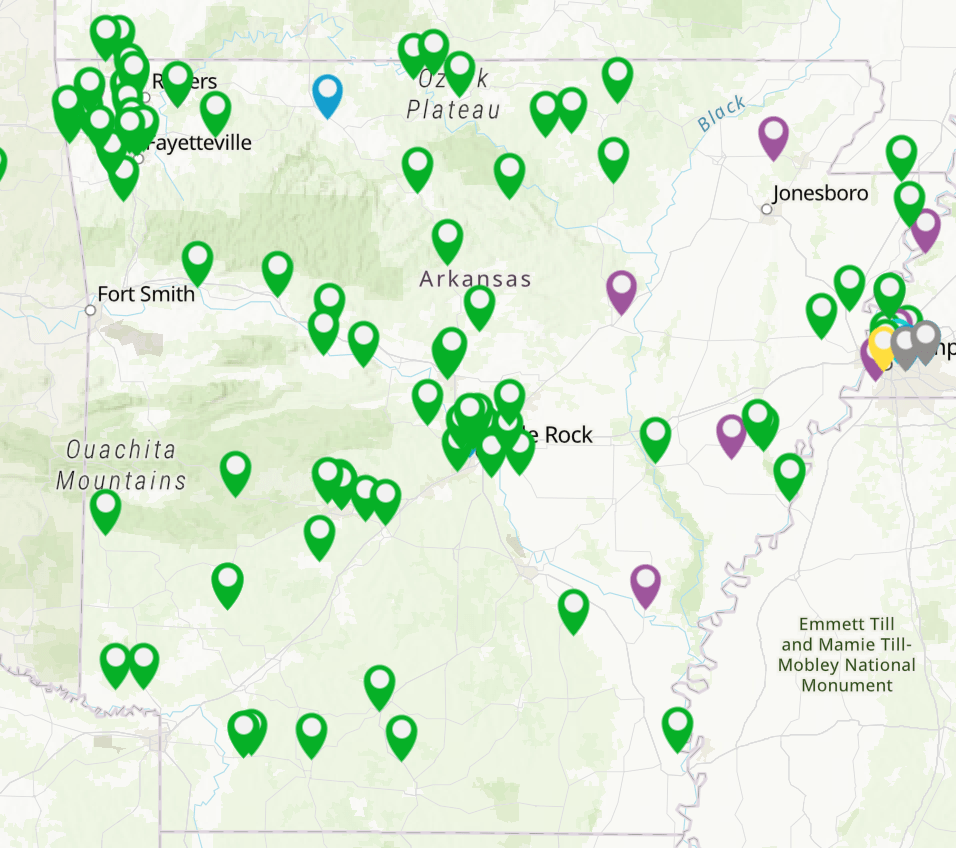
A map of Arkansas with pins denote Earth Day events registered through EARTHDAY.ORG. Organizers registered over 60 events in Arkansas as of April 16, 2026. MAP GRAPHIC COURTESY OF EARTHDAY.ORG.

Keep Arkansas Beautiful lists seven pages of environmentally focused events across Arkansas on its website, though not all are organized specifically for Earth Day. 

Keep Arkansas Beautiful is a division of the Arkansas Department of Parks, Heritage and Tourism and a certified affiliate of Keep America Beautiful Inc.

In Jonesboro, an Earth Day event is scheduled from 10 a.m. to 2 p.m., April 22, at the Heritage Plaza Lawn on the A-State campus. 

Several clubs and organizations will table at the annual event to spread awareness on several topics related to Earth Day. Dooley said some participants will even present their research. 

“We also invite a lot of local vendors who might be interested in setting up a table and talking about what they’re doing for environmental progress, sustainability and whether they have a focus on that this year,” Dooley said. 

An art contest is also scheduled, which will feature works made from recycled materials by local primary school students.

Dooley said the main goal of the event is to reach out to the younger generation and open their eyes to their impact on the world and the importance of sustainability. 

“It’s making them knowledgeable, so as they grow up, and they see mom and dad throw something out the window, they’re like, ‘you shouldn’t litter, mom and dad,’” Dooley said. “If we get everybody as they’re young, they grow up with these good responsibilities of being a steward for this planet and that also gives an opportunity to start thinking of things outside the box that this generation didn’t think of.”

Beverly Parker, Keep Jonesboro Beautiful commission chair, said giving children early experience with practices like litter removal and proper trash maintenance will establish more eco-friendly habits in the future.

Dooley said while the event is generally geared toward elementary and middle school students, anyone can come out and learn something.

The event is funded entirely by donations and volunteering. The EHS director said her department sponsors the event alongside Jennifer Bouldin, dean of the science and mathematics department and director of the ecotoxicology research facility. Dooley said this event represents a significant collaboration between several campus organizations. 

One town over and three days later, Paragould will host a city-wide cleanup from 8 a.m. to noon. The event is led by volunteers and designed to bring together residents and local businesses to improve public areas.

More Earth Day events across the Arkansas Delta are listed below:

  • Marianna/Lee County cleanup
    • When: April 18, 2026, from 8:30 a.m. to 12:30 p.m.
    • Where: No. 1 Court Square, Marianna, Arkansas
    • What: Volunteers will clean up litter in downtown Marianna
    • Coordinator: Pat Audirsch, 870-821-1403, pataud@sbcglobal.net 
  • Lake Chicot cleanup
    • When: April 18, 2026, at 9 a.m.
    • Where: Lake Chicot State Park
    • What: Volunteers will clean up areas across Lake Chicot State Park 
    • Coordinator: Brandi Hanson, 870-265-5480, brandi.hanson@arkansas.gov 
  • Helen-West Helena cleanup
    • When: April 25, 2026, from 9 a.m. to 1 p.m.
    • Where: 319 Philips St., Helena-West Helena, Arkansas
    • What: Volunteers will engage in a city-wide cleanup across Helena-West Helena
    • Coordinator: Chris Schaffhauser, 501-410-5562, schaffhauserchris@gmail.com 

More important than ever

Cherie O’Mary, executive director of the Arkansas Recycling Coalition, said Earth Day excels at highlighting advancements in environmental policies, practices and issues. 

Dooley said one of the biggest environmental issues facing Arkansas now is the amount of trash on the interstates, highways and parking lots.

“You can go anywhere, there’s just trash everywhere,” Dooley said. “All of that trash eventually makes it ways into our stormwater systems and our rivers, our streams, our lakes, where it clogs up the heavy, dense areas in the woods where animals are, and it affects their habitats as well.”

Parker said areas with poor litter or debris management give off an unsafe feeling. 

Arkansas Department of Transportation assistance chief engineer for maintenance, Steve Frisbee, said litter is a problem, from the largest interstate to the smallest back road.

Emma Goad, a writer for ARDOT, said the department spent about $8 million on cleanup efforts. She said the cost comes from several programs, contracts and other services intended to keep Arkansas highways litter-free.

Frisbee said organizations like Keep Arkansas Beautiful help engage the community in cleanup efforts and reduce the environmental damage litter causes.

A litter report form may be filed on the IDrive Arkansas website here.

Recent environmental policy also highlights the significance of Earth Day. 

On July 25, 2025, Arkansas Republican Representative Bruce Westerman introduced the Standardizing Permitting and Expediting Economic Development Act

The SPEED Act limits the scope of the National Environmental Policy Act and changes the environmental review of major federal actions under NEPA to restrict the number of federal actions that trigger NEPA review and expedite the review process. 

According to House Majority Whip Tom Emmer, more than 300 stakeholders support the bill. Organizations like the Aluminum Association, Steel Manufacturers Association, Data Center Coalition and even Google state they support the SPEED Act because it will accelerate projects and lower costs.

Despite this support, the bill remains controversial legislation.

David Watkins, director of government affairs for the climate and energy program at the Union of Concerned Scientists, said this bill means bad news for the environment.

“It includes goodies like shielding fossil fuel projects from meaningful review or public input before they are permitted, then shielding them from legal recourse after they are approved,” Watkins wrote in a UCS article. “Circumventing science and denying reality will only lead to greater harm to our environment and worse outcomes for communities.”

The SPEED Act is pending approval from the Senate after the House of Representatives voted to pass the SPEED Act on Dec. 18, 2025.

Despite the controversy surrounding this bill and others, Dooley said she thinks, generally, Arkansas does its fair share for the environment.

“We have beautiful parks, beautiful places to go and visit, enjoy and we have some rules in place,” Dooley said. “Could we do better? Yeah, I mean, there’s always room for improvement. But I think we’re headed in a good direction.”

Dooley said stormwater permit requirements are an example of good policy in Arkansas.

The Arkansas Division of Environmental Quality requires any construction project over one acre to apply for a stormwater permit under the National Pollutant Discharge Elimination System program. 
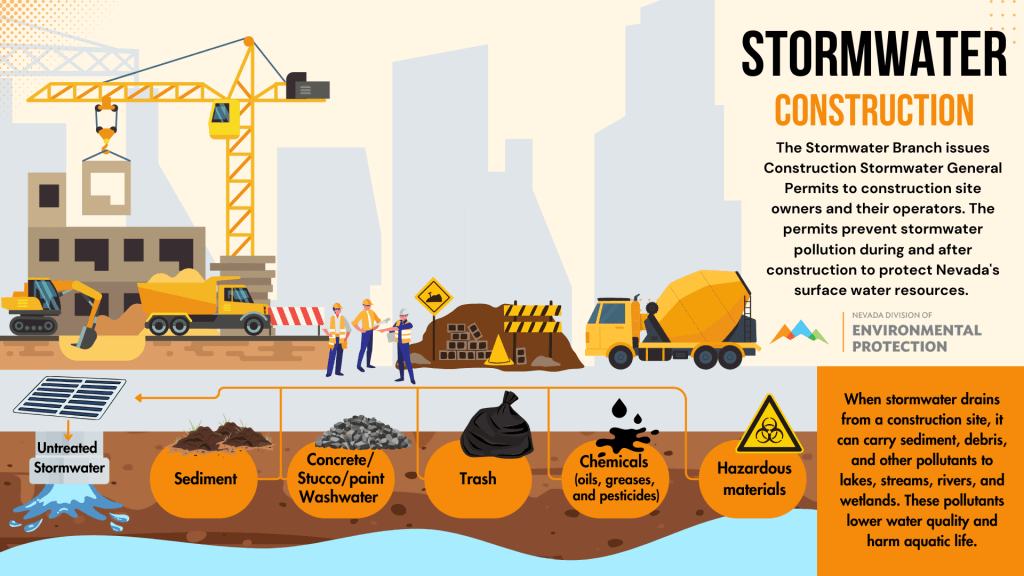
An infographic illustrates how rain or melted snow carries construction waste like concrete, oils and pesticides, into stormwater drains. These construction pollutants cause ecological damage when they drain into bodies of water. INFOGRAPHIC COURTESY OF NEVADA DIVISION OF ENVIRONMENTAL PROTECTION.

According to the ADEQ website, stormwater carries dirt, chemicals and other pollutants that could harm water quality. Stormwater permits regulate this runoff and prevent pollutants from entering streams, creeks, ditches and other waterways.

While Dooley said the laws in place and penalties for breaking them are effective, she knows there will always be bad actors. She said this is why speaking up is important.

The ADEQ pollution complaint form may be found here.

O’Mary said Arkansas’ glass recycling programs are another example of how Arkansas is leading the charge in certain areas of sustainability.

The ARC executive director said the real impact of Earth Day may only be felt in the future. Still, O’Mary said now is always the best time to get involved.

Keep the conversation going

Although Earth Day is only celebrated on a single day, Dooley said awareness should continue year-round. She said people are constantly interacting with the environment, making Earth Day an everyday conversation. 

O’Mary, who has served the recycling industry for 15 years, said she feels Earth Day is more prevalent now than in previous years. 

In her five years as the EHS director, Dooley said she noticed younger people becoming more interested in sustainability. Dooley, who also sits on the Keep Jonesboro Beautiful commission, said the community has expressed interest in Earth Day events like city cleanups.

“I was relatively surprised with the amount of people that really want those types of things,” Dooley said.

O’Mary and Dooley said one does not have to wait until Earth Day to start taking care of the planet. 

Dooley said many people do not realize all the different ways they can participate in Earth Day.

O’Mary said calling the local solid waste district and asking how to offer support is a good first step for those interested in recycling but unsure how to start.

The ARC executive director said she is constantly on the phone, helping direct people to where they can recycle unwanted items.

“That’s the ultimate goal, keep it out of the landfill,” O’Mary said. “Reuse, reuse, reuse.”

The ARC may be contacted by calling 866-290-1429 or emailing mail@recycleark.org.

Dooley said events like clothing swaps and practices like electronic recycling are things people don’t think about often, but still help the environment.

The EHS director said, even if Earth Day did not exist, people would still raise awareness for environmental issues and engage in eco-friendly practices. 

“I think we, as a race, as a human race, all recognize that something should be done,” Dooley said.

More information about Earth Day, local events and environmental issues may be found linked below:

Pollution Control and Ecology Commission adopts new business plan for Used Tire Program

Story by DDNS Reporter Jerry Don Burton

March 1, 2026

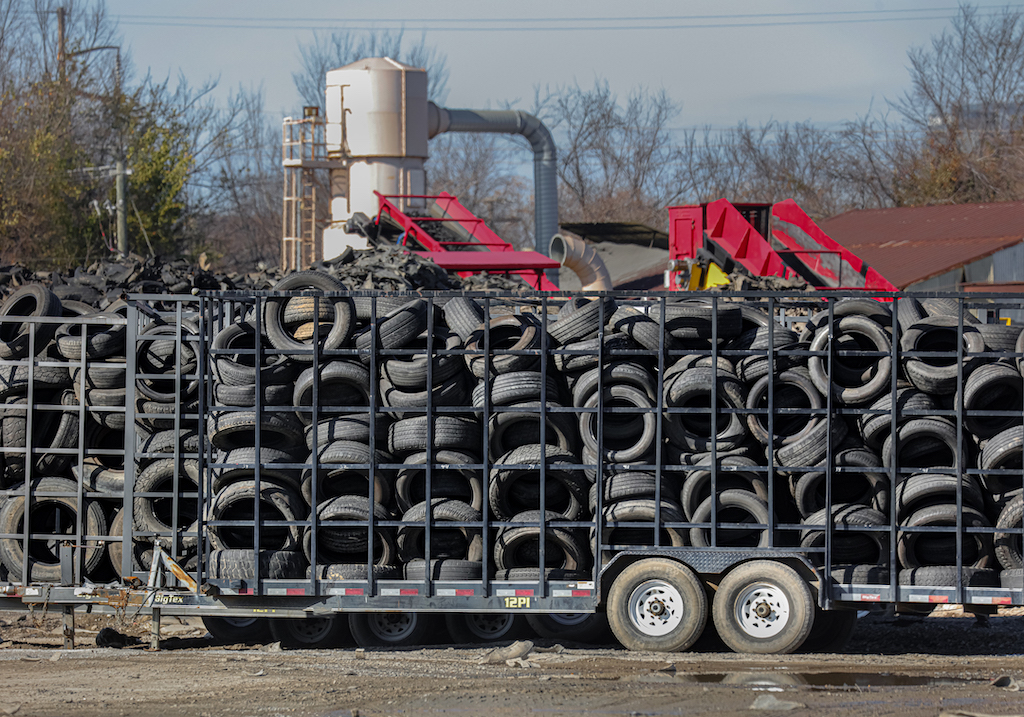
Loads of tires sit on trailers at the Davis Rubber Company facility in east Little Rock in December 2022.

The Arkansas Pollution Control and Ecology Commission (PC&EC) adopted a new business plan for the District 4 Used Tire Program (UTP-4), increasing reimbursement rates to $4.84 per tire in Southeast Arkansas.

Bailey Taylor, chief environment administrator for the Arkansas Division of Environmental Quality, presented the UTP-4 business plan at the Friday, Feb. 27, PC&EC meeting.

Taylor said the plan is structured to address the backlog in Southeast Arkansas tire processing and resulting health and environmental concerns.

“For human health and the environment, we’re looking at getting these tires off the ground,” Taylor said. “There’s been almost two full quarters that tires have not been picked up. We’re getting lots of calls that tires are stacking up all over the district.”

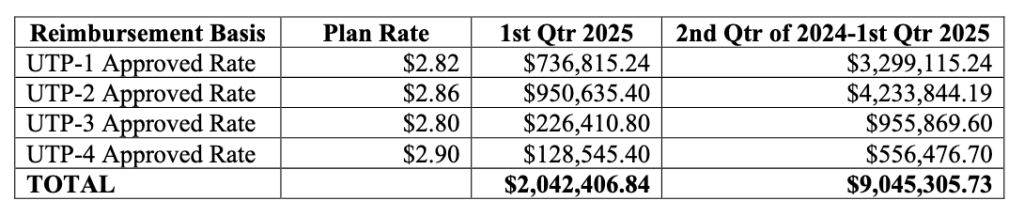
The plan proposes increasing the reimbursement rate per tire from $2.90 to $4.84 in District 4, which encompasses Southeast Arkansas. Taylor said this increase is based on administrative, processing and transportation costs, including costs for an out-of-state contracted processor.

Courtesy of the Arkansas Pollution Control and Ecology Commission.

Taylor said she recommended the plan only be approved temporarily for one or two quarters to establish a collector, transporter and processor to manage the tires in Southeast Arkansas. Then, she said, they would evaluate how to save costs and return with a revised plan.

“We’re hopeful that with just a quarter that they can pick up the backlog and also what is produced this quarter,” Taylor said. “And then go out for bid at a much more reasonable rate.”

However, Justin Sparrow, director of the West River Valley Solid Waste District in Clarksville, Arkansas, said this plan may do more harm than good.

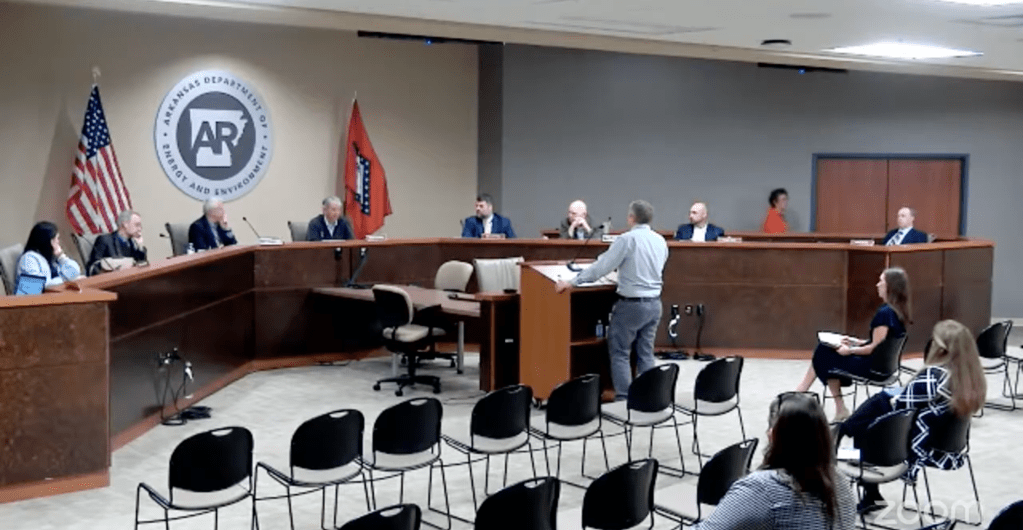
Justin Sparrow, director of the West River Valley Solid Waste District in Clarksville, Arkansas, presents his concerns regarding the new business plan to the PC&EC.

“My major concern with the proposed reimbursement rate for UTP-4 being $4.84 is that this will quickly deplete a fund that is already in the red,” Sparrow said. “By statute, once that money runs out, DEQ has to prorate what they send out to all four districts.”

Prorate is a verb, meaning to allocate or distribute funds pro rata, or proportionally. Taylor said she wants to avoid prorating if possible.

Sparrow said if the fund runs out, the other three districts will feel the effect. 

Sparrow operates in District 1, Northwest Arkansas, where the reimbursement rate is $2.82 per tire. He said his district collects and processes 360,000 tires annually from 11 counties.

“I think UTP-4 should probably reopen the bid process and take another look at this before this commission approves a rate of $4.84,” Sparrow said.

Following Sparrow’s comments, PC&EC Chair Al Eckert III asked Taylor if the new reimbursement rate would result in a quicker shortfall, or deficit.

Taylor said they already see a shortfall between $300,000 and $400,000 every quarter with the current rates. She said any reimbursement rate over $2.31 per tire will result in a shortfall and the new rate would contribute to an extra $150,000 deficit for two quarters. 

Charlie Spakes, district 4 commission member, said the out-of-state contractor might be taking advantage of the situation. 

“It just seems like the cost is way higher, they have us kind of over a barrel where we have to get these tires picked up and they kind of have us hostage at this $4.90, compared to everyone else,” Spakes said.

Taylor said while the processing cost per tire is higher than other districts, the extra transportation cost inflates the rate much more.

Once the discussion concluded, the PC&EC passed a minute order adopting the business plan.

In other business, Angela Russell, mayor of Tontitown, Arkansas, continued asking the commission for help with her city.

Aerial view of the Eco-Vista Landfill in Tontitown, Arkansas. Many Tontitown residents claim the landfill produces dangerous fumes.

Tontitown citizens and government officials, including Russell, have attended several PC&EC meetings to seek help regarding declining air quality from the nearby Eco-Vista Landfill.

Russell said she will keep voicing her concerns and asking for stricter rules or regulations. She said if something catastrophic does happen, someone will be held accountable. 

“I want it recorded that citizens have come here to ask for help,” Russell said. “Nothing has been done to alleviate the problem.”

She said her grandson has made multiple hospital visits as a result of the dangerous fumes emitted from the landfill. 

“I myself have had to go to the hospital in the middle of the night because I woke up and the fumes were so strong in my bedroom I couldn’t breathe,” Russell said.

After the mayor’s comments, Eckert asked Taylor to address Russell’s concerns and prepare an update for the next meeting.

The PC&EC will meet again at 10 a.m. March 27, in the Arkansas Department of Energy and Environment’s Commission Room. Meetings are also livestreamed on YouTube.

Severe weather preparedness vital as Arkansas tornado season reaches peak

Story by DDNS Reporter Jerry Don Burton.

April 6, 2026

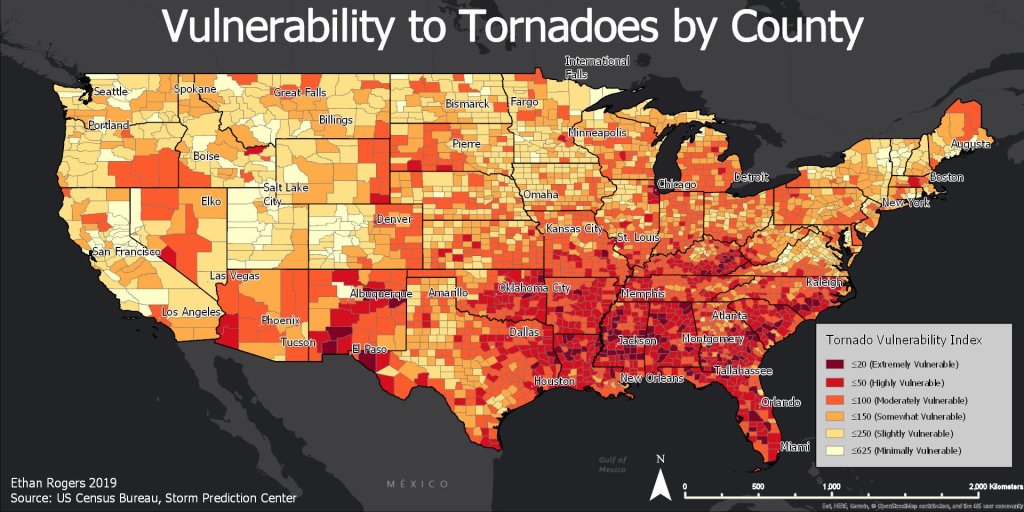
A graphic depicts the vulnerability of tornadoes in each county in the United States. Areas of greater vulnerability largely concentrate in the southeastern portion of the U.S. GRAPHIC COURTESY OF ETHAN ROGERS

 Severe weather preparedness remains vital as Arkansas enters the peak of tornado season.

Kory Ward, fire chief for Wynne, Arkansas, said those who don’t take severe weather seriously are making a bad move.

“There’s people that think, ‘oh it’ll never hit here,’ and it’s been very true to hit here within the last two years,” Ward said. “I say it all the time, stay weather aware. Pay attention to the news. Pay attention to your local radio station. Don’t be surprised by it.”

How can I stay safe during tornado season?

Anthony Coy, director of the Craighead County Office of Emergency Management (OEM), said always knowing the location of a nearby safe spot is vital for tornado season preparedness. 

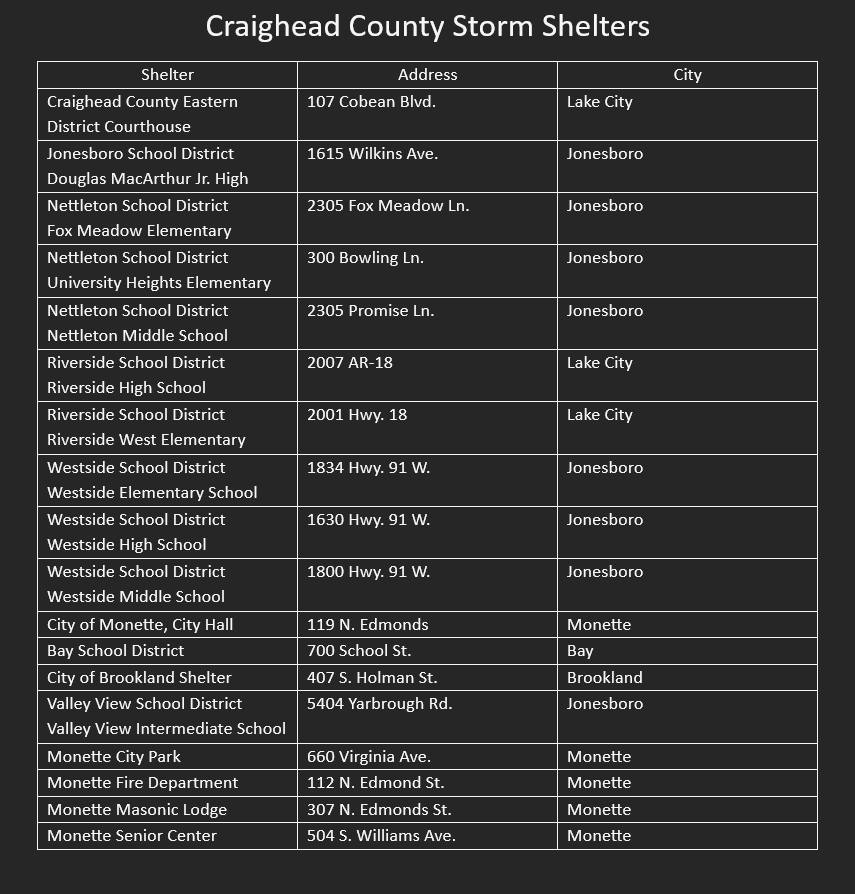
A list of public storm shelters across Arkansas may be found at https://arkansasstormshelterlist.phonesites.com/. This list was last updated March 2025.

Coy said those living in manufactured homes or mobile homes, also called trailers, should especially take advantage of these community safe rooms. 

Manufactured homes are particularly susceptible to tornado damage because they are usually constructed with lighter, less durable materials. 

In a 2018 research article published by the American Meteorological Society’s Weather, Climate, and Society journal, Stephen Strader and Walker Ashley found that 72% of all tornado fatalities occur in homes and 54% of these deaths occur in mobile or manufactured homes. 

Amber Schlessiger, a National Weather Service (NWS) meteorologist, said overnight tornadoes are another distinct threat because they strike when most people are asleep. She said those who find themselves in the path of an overnight storm should set up multiple methods to receive warnings and be ready to wake up if a threat approaches.

Ward echoed this sentiment and said having some form of early warning system, such as phone notifications or a crank radio, is indispensable. 

Coy said keeping up-to-date with the weather is always good advice.

“There are a hundred different ways you can get those weather warnings on your phone,” Coy said. “But almost every county has some sort of information platform. In Craighead County, we use CodeRED.”

CodeRED, a community emergency notification system, allows individuals to sign up for alerts on Jonesboro’s website. The CodeRED mobile app may also be downloaded on the Apple App Store and Google Play Store.

Coy also said to exercise caution when determining trusted sources. He said some severe weather information, especially on social media, may be misleading or originate from questionable sources. 

The OEM director said creating and maintaining a preparedness kit is another step in staying safe. 

A well-prepared kit may include the following items: Several days’ worth of food and water, a flashlight, batteries, first-aid, a change of clothes, a whistle, maps, hygiene items, prescription medicines and pet food, if applicable.

Ultimately, Coy said, even the most seasoned preppers will overlook something. Still, even small acts of preparation will make a lasting impact, he said.

“Each time you chip away at that, you’ll become more prepared than you were before,” Coy said. “Don’t ever let it become a back-burner item.”

What are the impacts of tornado season?

Tornadoes are one of the deadliest and most costly natural disasters in the United States.

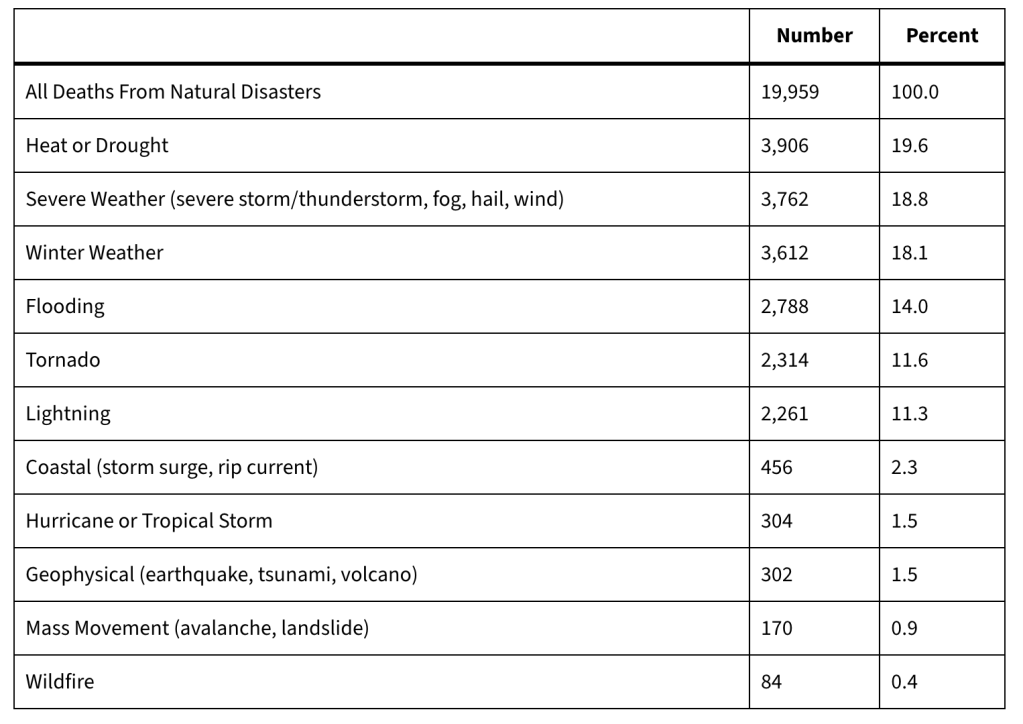
In a 2008 research article concerning patterns among natural disasters and mortality, Kevin Borden and Susan Cutter found, of 11 disasters researched, tornadoes accounted for the fifth-highest deaths in the U.S. between 1970 and 2004.

A list of natural disaster-related deaths recorded in the United States between 1970 and 2004. Tornadoes accounted for the fifth-most deaths in this list. LIST COURTESY OF KEVIN BORDEN AND SUSAN CUTTER

The article, published in the International Journal of Health Geographics, reported deaths caused by tornadoes constituted almost 12% of all natural disaster-related deaths in the U.S. during the same time.

Arkansas, in particular, shares a lengthy history with tornadoes.

From 1950 to 2024, 2,478 tornadoes hit Arkansas, killing 412 people, according to the NWS Little Rock office.

A study conducted by the National Oceanic and Atmospheric Administration (NOAA) found, from 1950 to 2025, tornadoes in Arkansas caused 5,567 direct injuries, $3.5 billion in property damage and $4 million in crop damage.

Northeast Arkansas is no stranger to lethal tornadoes either.

On March 31, 2023, an EF3 tornado tore through Wynne, Arkansas, killing 4 and causing over $150 million in property damage, according to the NWS Memphis office. The Wynne High School, which found itself directly in the center of the tornado’s path, was razed.

Three years prior, on March 28, 2020, another EF3 tornado damaged about 300 buildings, caused an estimated $300 million in damages and injured 200 people in Craighead County. 

However, despite the destruction they cause, Coy said, blessings exist in every disaster.

For example, Coy said the COVID-19 pandemic actually saved lives during the aforementioned 2020 tornado. He said the pandemic kept people at home rather than in commercial buildings, like The Mall at Turtle Creek in Jonesboro, which the tornado almost completely destroyed.

View of The Mall at Turtle Creek in Jonesboro after a tornado nearly destroyed the entire 73-acre plot. The tornado hit Craighead County on March 28, 2020. PHOTO COURTESY OF JONESBORO POLICE DEPARTMENT FACEBOOK

He said the tornado also taught him to have plans in place before disaster strikes.

“I was very new in the position at that time, I didn’t have my volunteer teams gathered yet, didn’t have changes to our emergency operations plan, none of that,” Coy said. “And here I am sitting at home on a Saturday and I watch a tornado drop down in the middle of Jonesboro. That’ll get your attention.”

An aerial view shows ongoing construction at the site of the new Wynne High School. A tornado that struck Wynne, Arkansas on March 31, 2023, destroyed the previous high school. Nabholz Construction Corporation was contracted to lead construction on the high school. PHOTO COURTESY OF NABHOLZ CORPORATION FACEBOOK

As for Wynne, the company contracted to build a new campus for the high school, Nabholz Construction Corporation, stated in a Jan. 13 Facebook post that progress is moving steadily. 

“It’s exciting to see this project transition from structure to the spaces that will soon support learning, creativity, and community,” Nabholz Corporation wrote.

Why is there a tornado season, anyway?

According to the NWS, the months of peak tornado occurrence, also known as tornado season, last from March to May in Arkansas.

As temperatures transition from colder to warmer in the spring, atmospheric instability creates conditions favorable for the formation of tornadoes. Since this transition happens at slightly different times throughout the country, tornado season varies depending on the state.

Other climate factors also play a role in creating a tornado season.

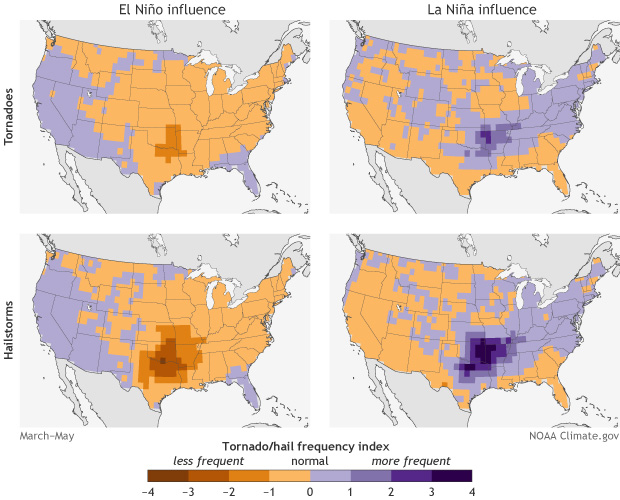
In a 2015 feature published by the NOAA, Michon Scott reported a relationship between tornado frequency and the natural weather patterns El Niño and La Niña.

Graphic depicts maps of the United States, representing the influence La Niña and El Niño have on the frequency of tornadoes and hailstorms in March and May, the peak months of tornado occurrences in Arkansas. The maps suggest La Niña increases the frequency of such severe weather in the southern U.S. GRAPHIC COURTESY OF NOAA

“Specifics vary, but in general, springtime tornadoes and hailstorms are less frequent in the southern central United States during El Niño and more frequent during La Niña,” Scott wrote.

El Niño is a natural weather pattern, usually lasting about a year, that occurs when warm water accumulates in the central and eastern Pacific Ocean. La Niña is the opposite and happens when cool water develops in the Pacific Ocean.

Coy, however, said Arkansas experiences severe weather regardless.

“The meteorologist will explain it has to do with whether you are in a El Niño or a La Nina and, I’ll be honest, they’ve explained it to me and I don’t always understand it,” Coy said. “It seems like we get severe weather regardless of which one we’re in.”

According to the NOAA’s National Severe Storms Laboratory, while tornado season denotes the period in which tornadoes are more frequent, a twister can form at any time of the year and in any location. Tornadoes occurred during all 12 months and in all 50 states.

According to a 2025 article published in the research database EBSCO, Mark Dziak wrote that “Tornado Alley” can be a misleading term because those living outside of its poorly-defined boundaries may believe they are less vulnerable to tornadoes.

Tornado Alley is a common geographic term used to define areas in the central U.S. where tornadoes are more frequent.

“Despite the focus on Tornado Alley, experts note that tornadoes can and do occur in every state, highlighting a phenomenon known as Dixie Alley in the southeastern U.S., where tornadoes may even be more frequent and damaging than in Tornado Alley,” Dziak wrote. 

Is tornado season getting worse?

As of April 3, 2026, the NWS confirmed nine tornadoes in Arkansas, near the average for that time of year.

Coy said, in his time working in emergency management, he experienced increasingly frequent and deadly weather. Coy, who is also the treasurer of the Arkansas Emergency Management Association, has worked in the industry since 2006. 

Research supports Coy’s experience. 

The Arkansas Tornado Database, using data from all NWS offices serving Arkansas, found that between 1970 and 1999, Arkansas averaged 25 tornadoes per year. 

Between 1991 and 2020, that number rose to an average of 37 tornadoes a year.

In a 2018 journal article published in the npj Climate and Atmospheric Science journal, Vittorio Gensini and Harold Brooks found while the national annual frequencies of tornado reports remained relatively constant, they documented positive trends in the Midwest and Southeast U.S. 

While no definite reason exists for this increase in tornado sightings, several theories offer possible hints.

Hazards geographer and meteorologist Stephen Strader, in a 2024 interview with NPR, told host Ari Shapiro that advancements in detection technology contribute to the apparent increase in tornadoes. Strader said tornadoes – especially weaker, short-lived ones – posted on social media are sometimes added to severe weather databases, which also increases the statistics.

Strader said population growth and urban development may also be partly responsible for the increasing severity of tornadoes. Many areas once forested or used for farmland developed into dense population centers, thus increasing the likelihood of a tornado causing significant damage.

“There’s just more things to hit, which means more potential disasters,” Strader said.

A 2021 journal article published in Scientific Reports found population density and the installation of Doppler Radar systems contribute to the increasing trend of damaging tornadoes.

Another possible culprit, climate change, may offer more complex impacts on tornado season.

Climate change, a hotly politicized and controversial weather phenomenon, refers to long-term changes to Earth’s average weather patterns, according to NASA.

Strader said, while the connection between climate change and tornadoes is not fully understood, many researchers suspect tornado sightings will increase as the impacts of climate change create environments conducive to severe weather.

Data from the NOAA reports a greater risk of off-season tornadoes in a future warmer climate. However, the various intricate weather conditions at play during the formation of tornadoes make it difficult for scientists to determine the impact climate change is having or will have on tornado season.

A report from the Center for Climate and Energy Solutions (C2ES) also states factors such as limited data collection methods, high variability and the relatively small geographic size of tornadoes as challenges for attributing climate change to a worsening tornado season.

“As scientists improve their physical understanding of the processes that cause tornadoes, and as climate models are run at higher spatial resolutions, our understanding of the climate change influence on tornadoes will improve,” the C2ES report stated. “Likewise, as the observational record increases over time, trends will likely become more obvious.”

Coy said while some people debate whether climate change is to blame, he focuses more on preparation.

“Whatever reason that is, I don’t know and I don’t have to know,” Coy said. “I just need to know when’s the next one and how strong do we think it might be.”

Coy said Craighead County is due for a break from severe weather. He said every year he hopes the weather is better than the year before.

However, the OEM director said he will never suggest any particular tornado season might be less severe because that might encourage people to let their guard down.

“I don’t want to cry wolf, I’d rather people be prepared and then not need to use that preparedness as the other way around,” Coy said.

Where can I find more tornado season resources?

The Craighead County Office of Emergency Management may be called at (870) 933-4575, found online at craigheadcountyar.gov/oem, or visited in person at the Craighead County Courthouse Annex. 

More local information about tornado preparedness from Craighead County may be found here.

Arkansas Weather Watchers, a digital media platform offering real-time coverage and community-driven reports from across the state, may be found here.

Lake Frierson State Park hosts ‘Women In The Woods’ workshops

Program teaches camping and outdoor skills

Delta Digital News Service

Friday, Mar. 13, 2024

By Avery Jones | Editor

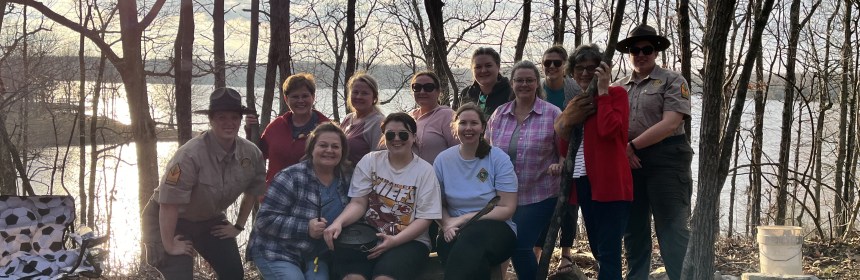
JONESBORO, Ark. – Women in the Woods, a new outdoors program hosted by Lake Frierson State Park, recently started in February. They will meet every first Sunday of the month (except for April due to the eclipse). Their most recent meeting was held on March 3 from 2 p.m. to 6 p.m. at Lake Frierson State Park. 

Cathy Combs

Each meeting focuses on a different outdoors skill. The first meeting, originally planned for February 4 but postponed, was about backpacking. This most recent meeting taught Dutch oven cooking. Future events will teach foraging, fishing, kayaking, canning, geocaching, horseback riding, and camping.

According to Cathy Combs, the park superintendent at Lake Frierson State Park who arranged the event, the purpose of Women in the Woods is for women to “grow their roots” at the park. 

“The entire series aims to grow closer to the park, grow friendships with friends new and old, and grow outwards towards adventures that can be found in other parks in our area,” Combs stated.

She and other employees at the park wanted to start programs that are geared towards certain groups. They typically host several programs that are open to everyone in the Jonesboro and Paragould communities. 

The wide variety of their activities is meant to be an example of the diversity available at not only Lake Frierson, but also other parks across the state. They also hope to foster community connections.

The events are free to attend, and there’s no limit on attendance, unless supplies are being provided in which case there’s a small fee and a limit on the number of attendees. The Dutch oven class had a limit of fifteen people and cost $15 due to the Dutch ovens and food being provided.

The series is planned to end in November, but it will return next year. They might change some activities depending on which were the most popular, but the essential concept will remain the same.

According to Combs, this event is specific to women because there’s a large network in Northeast Arkansas of women who enjoy outdoor activities and are looking for activities to do and to make new friends. 

“This is really just the park opening up its doors and saying, hey, our backyard is your backyard,” Combs said. “Come hang out, have fun, try something new, and then make new friends.”

However, Combs emphasized that women are welcome at all events held at the park, and there are also several events for other demographics. In addition, if someone has an idea for an event, they can call the park, and it will be taken into consideration.

When determining what activities should be included in this event, the park sent out a survey to the community asking what outdoor activities women would be most interested in learning. From the results, they chose the activities that had the most votes for Women in the Woods.

“It was really important that everything that we chose not only fit in with the resources that we had here and in our area, but also what people were wanting to explore for themselves,” Combs said.

At the Dutch oven cooking class, the women made chili, broccoli cheddar soup, soda bread, cornbread, and dump cakes. The class was full with at least fifteen attendees. None of the women who came were familiar with Dutch oven cooking, which is partially why they wanted to participate.

Ali Smith, who was there with her mother-in-law, had never been to Lake Frierson before and only heard of it because she was invited to the Dutch oven class. However, she and her mother-in-law love doing outdoor activities, and Smith was excited to visit a park she had never been to before.

“I’m not much of a cook, but I was down to come along to see basically the lake because I’ve never been out here before,” Smith said.

Kim Quinn and Tammy Stevens are also both outdoor enthusiasts and enjoy activities like hiking, kayaking, camping, and biking. They’re familiar with Lake Frierson, as well as many other state and national parks. They attended because they were interested in learning about Dutch oven cooking.

Laura Newberry, another attendee, is also an outdoorsy person and goes to Crowley’s Ridge State Park every day since it’s near her house. She wanted to come to the Dutch oven class because she wants to be more prepared.

“I was planning on doing more camping, so I was like, this’ll be great,” Newberry said. “And I might be by myself sometimes, so it’d be good to know.”

Martha Bunch isn’t usually an outdoorsy person, but she wants to be. She’s also always thought that food cooked directly over a fire looks very appetizing, so she wants to find out and be able to do it herself.

“I’ll be booked camping most of the time completely by myself, and I’d like to have the confidence to do what I need to do,” Bunch said.

“I think it’s great that they’re doing it for women only because it’s not as intimidating to come to something if you know that it’s just going to be women,” Stevens said. 

“We’re a community, too,” Newberry added.

-30-


Emergency services, nonprofits provide NEA with much needed care during emergencies

Prepping for severe weather has become standard amongst service providers

Delta Digital News Service

UPADATED August 29, 2023

By Avery Jones | Editor

JONESBORO, Ark. – A nearly two weeks after Hurricane Hilary brought torrential rain and gusty winds to Baja Mexico and Southern California, Floridians take shelter as they brace for Hurricane Idalia to hit the state. This year National Oceanic and Atmospheric Administration (NOAA) forecasters with the Climate Prediction Center, a division of the National Weather Service, predict near-normal hurricane activity in the Atlantic. The hurricane season runs from June 1 to November 30.

Although hurricanes form in the Oceans and primarily the Atlantic, thunderstorms and tornadoes are often spun into neighboring states. Earlier this year, two tornadoes, both EF3s, hit the Little Rock area and later the city of Wynne on March 31, causing extensive damage.  

Although there wasn’t much severe damage from the storms in northeast Arkansas region, the area received plenty of weather alerts. However, a late season outbreak of tornadoes on December 10, 2021 caused extensive damage to the city of Monette. Along with the previous year’s EF3 tornado on March 28, 2020 which hit the city of Jonesboro and including the Mall at Turtle Creek in Jonesboro, severe weather preparation is more pertinent than ever.

There are multiple ways to prepare for severe weather, and finding the proper shelter as well as insurance in case of damage to personal property are among the most important.  

Craighead County Judge, Marvin Day, stated that when the county is under a severe weather warning, especially for tornadoes, they activate the Emergency Operations Center. During severe weather, the center monitors weather conditions so they’ll be able to alert proper officials or departments that need to take action.

Officials regularly make sure that highway and road departments is prepared so that they can clear roadways of debris and fallen trees if needed. They also keep the general public informed of weather conditions and significant damage.

Another significant aspect of severe storm preparation is insurance. Depending on the individual policy, insurance could possibly help a person to get back on their feet if their personal property is damaged by a severe storm.

INSURANCE

According to local insurance agent Randy Smith, insurance rates and claims generally increase after a natural disaster. However, factors of rates and claims vary significantly across agencies and policies, and one important factor is based on losses and how much the company has to pay out.

Additionally, severe storms can cause claims to still come in years after the fact. For instance, Smith’s office is still seeing claims from a hailstorm on April 15, 2022. This is usually due to the recent high winds which can blow off roof shingles, and when roofers repair the damage, they may find additional hail damage that hadn’t been seen before.

“Make sure that your company but even more so that your agent that you have, that they are preparing you to make sure that you at least have the opportunity to have the coverages that you are going to need when this event occurs.” Smith said in order to prepare for a severe weather event.

– Randy Smith, Insurance Agent

He explained that his office uses “the doctor’s approach.” They begin by asking a series of questions, the customer explains their situation, and the agent gives their professional opinion about what they believe the customer needs. 

The price is never discussed as the agent is often focused on customer needs for a particular situation. It’s entirely up to the customer whether or not the price is worth what the agent offers them.

According to Smith, most customers are only concerned with getting the best product for the least money, but it’s also important for the person to consider what kind of situation they’ll be in with whatever they bought if they suffer a disaster. The agent’s intention should be to educate the customer about that situation and prepare them.

After a disaster, the customer can go through the claims process. If a house is uninhabitable due to severe weather, and if it’s offered in the policy, the person can be given some money to live in a hotel or apartment: this is called additional living expenses. Also, if a car is damaged and the person has rental car coverage, they can get a rental car for the amount that the specific policy offers. 

In his office, Smith says that customers can call the agent to have them involved in the process by filing the claim for the customer and then the agent can continue to check up on the customer after the fact. However, the office doesn’t have the authority to make determinations on claims or pay out money. That happens from the company; the agent acts as a liaison between the company and the customer.

FOOD NEEDS

However, insurance isn’t the only way to recover after a disaster. There are many charity and nonprofit organizations that offer relief to victims of severe weather in the Northeast Arkansas area.  

According to chief executive director Christie Jordan, the Food Bank of Northeast Arkansas makes sure that affected families have food after disasters. They reach out to the community to supply water and snacks to victims and volunteers helping clean up. During the recovery period, they provide families that are rebuilding their lives with food.

Their response changes based on what the community in question needs. They often work through their network of partner agencies and local churches to distribute food. They currently have a distribution center set up in Wynne to receive and donate food to victims of the recent tornado. They work with city officials to ensure that resources get to the right places.

The Food Bank of NEA works closely with other Feeding America food banks in Arkansas and other states and are part of a disaster preparation cohort to work together and plan in advance. They make sure that supplies are already staged in various locations so they can respond quickly as they did in Wynne.

Another organization that helps after disasters in the general area is the Arkansas Southern Baptist Convention Disaster Relief. They’re based in Little Rock, but they have units situated all over the state, including several in the Northeast Arkansas area.

According to Randy Garrett, the disaster relief director for the Arkansas Baptist State Convention, their main job is to supply resources to the public after a disaster. Primarily, they do feeding as well as chainsaw work and flood recovery. They also have incident command to provide leadership and guidance after a disaster.

Randy Garrett

The organization is part of the North American Mission Board Send Relief. They can reach out to other organizations across the state or in other states for help if needed. There are several thousand of these organizations. The Arkansas Baptist Disaster Relief has traveled to help other states as well, such as during Hurricane Sandy.

They also have chaplains, and they provide the training for the chaplains themselves. The chaplains talk to the public during a crisis to listen to the survivors and help them work through it.

They have a new program called the Box Ministry where they help victims sort through the wreckage of their home after a disaster to find keepsakes and other important belongings. They bring boxes to contain the findings. While they’re helping, they spread the message of Christ.

Sometimes this process can take several days. They help to put the box in a safe place until the victims can start to rebuild their lives.

Arkansas Baptist Disaster Relief usually comes in right after the first responders. They stay in that community for as long as it takes to get people taken care of. Currently, they’re still sending teams into Central Arkansas and Wynne to help after the tornadoes.

Each worker has to get trained. Arkansas Baptist Disaster Relief hosts training events across the state. They also provide all the necessary personal protective equipment. They currently have over 2,500 volunteers. They also work alongside other churches in the local area of the disaster that want to help.

“There’s other avenues to help people in times of crisis, but I think the main thing is faith is very important. I’ve seen it move mountains,” Garrett said.

“There’s other avenues to help people in times of crisis, but I think the main thing is faith is very important. I’ve seen it move mountains,” Garrett said.

– Randy Garrett, Director of Disaster Relief

“People of Arkansas are very resilient. You think…how will they ever recover? And you go back maybe six months later and you see the rebuild process…they really bounced back and they’ve got their lives back. It’s just a tribute to the guys and ladies of Arkansas…when something happens, we’re down, but we’re not out.”

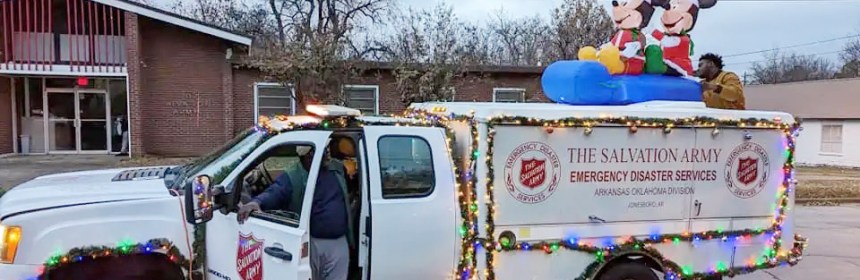
The Salvation Army in Jonesboro is another organization that offers disaster relief. They serve eight surrounding counties with a staff of three, and usually about fifty to sixty volunteers during the holiday season and fifteen to twenty-five the rest of the year.

Captain Charles Smith and his wife Captain Teri Smith are the commanding officers. According to Charles Smith, his team goes on on-site as soon as a natural disaster happens. They offer food to both victims and first-responders. Their Disaster Mobile Canteens also provide things like water and coffee.

They also offer emotional and spiritual care. They go out and talk to people to encourage them and listen to them. 

After an initial hit, they help do long-term recovery work. For instance, the divisional disaster director Laurie Fried and her team based in Oklahoma City have been traveling several times a year to visit those affected by the tornadoes in the Trumann area a couple of years ago.

“What they offer is solutions to help people get back on their feet,” Smith said. “Whether it’s through monetary donations or gift cards or other ways to help meet their needs. We work alongside…other agencies…to help get people back on their feet and get them established again, getting them into homes, getting them relief, whether it’s through food, financial assistance with rent or utilities, things of that nature.”

The agencies that Salvation Army works alongside include Samaritan’s Purse, Red Cross, and the Baptist Foundation.

Although natural disasters are undoubtedly devastating, there are many organizations willing to help those affected and also ways to help oneself be prepared before a storm. 

-30-


Avery Jones is a sophomore in the Department of English and Philosophy at Arkansas State University in Jonesboro. She can be reached at: avery.jones@smail.astate.edu


World Falconry Day

Falconry flies high in the Arkansas Delta

More than hunting, falconry encourages environmentalism and conservation

November 16, 2022

By Avery Jones | Editor

Delta Digital News Service

JONESBORO, Ark. – World Falconry Day, the day when falconry is recognized by UNESCO as an Intangible Cultural Heritage of Mankind, is recognized on Nov. 16. According to the North American Falconers Association, “Falconry can be defined as the taking of wild quarry in its natural state and habitat by means of a trained raptor.” In short, falconry is the practice of using birds of prey to hunt wild game. 

Heath Garner and José Martinez are two falconers located in Jonesboro. Garner has been a falconer for 34 years while Martinez has been one for three years. Garner was Martinez’s sponsor and guided him during his education as a falconer.

The two first met when Martinez was put in touch with Garner through the Arkansas Hawking Association. He was 26 years old when he spent a year shadowing Garner during hunting and got his permit afterwards at 27.

“It was just something I’ve always wanted to do,” Martinez said.

“It was just something I’ve always wanted to do.”

José Martinez, General Falconer

He said that he enjoys the outdoors. He also read the novel, “My Side of the Mountain” by Jean Craighead George as a child, which is about a young boy who raises a peregrine falcon to hunt.

Martinez is a designated as a general falconer with three years of experience. Garner is a master falconer with 34 years of experience. 

Garner first started falconry when he was 17. According to Garner at that time there were only five licensed falconers in the entire state. Garner was unaware that falconry even existed, especially since this was back in 1988, pre-Internet. 

However, Garner saw massive numbers of red-tailed hawks that migrated through town when he was young. Between Browns Lane and Windover Road, there was existed an area where he liked to play as a child. 

General Falconer José Martinez

“The blackbirds would roost there…thousands and thousands of blackbirds,” Garner said. “And that attracted the red-tailed hawks and you could go out there at any given day and see 30 to 50 red-tailed hawks in that area.” A fan of the outdoors, he said as a child that it was fascinating to watch the raptors hunt. 

While squirrel-hunting with a friend, the pair came across an injured great horned owl. Garner decided to take it home and nurse it back to health. It was during this event he discovered falconry. 

Regulations on falconry in the U.S. as well as in Arkansas are very thorough. Since it’s a cultural heritage art, regulations specify that an aspiring falconer must learn from a sponsor. After they pass a written exam, the aspiring falconer must then find someone to sponsor them for two years.  

“You can read as many books as you want and try to do it on your own, but it would probably be three times as long to try to start practicing it and have results,” Martinez said. “So, a good sponsor is very important and it’s…integral to the sport of falconry.”

“Anybody can catch and/or find a hawk and keep it alive, but it takes a lot of experience and mentorship to learn how to train one to actually hunt with you,” Garner said.

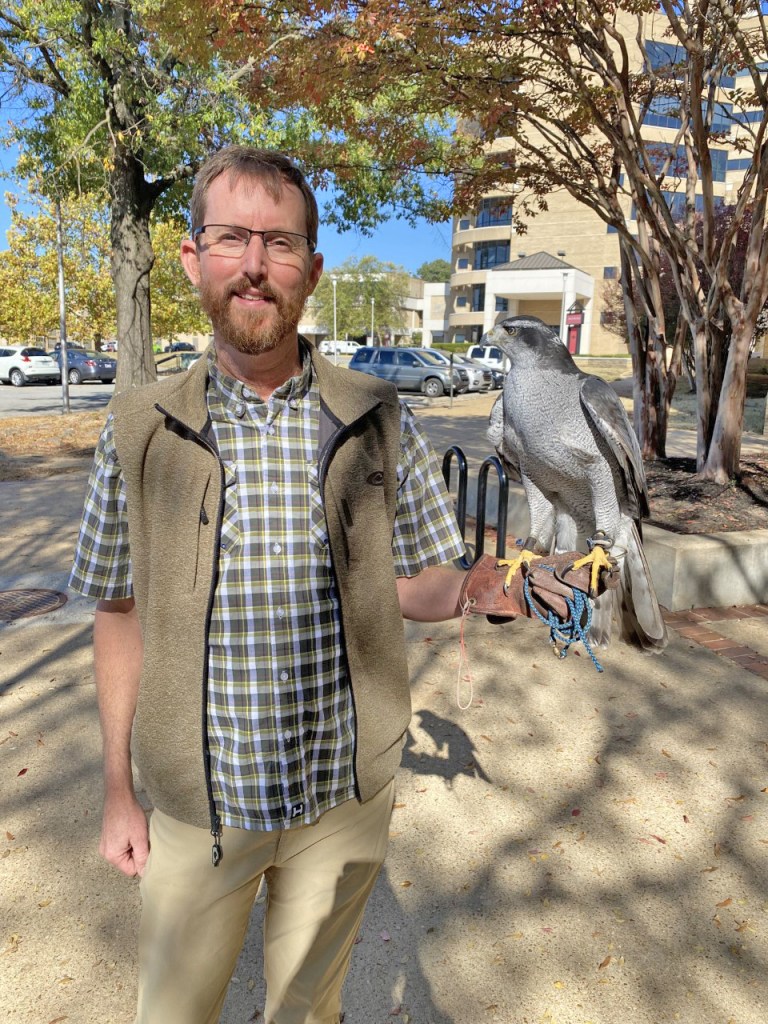
Master Falconer Heath Garner displays a peregrine falcon.

However, studying is also very important when learning falconry. The required exam provided through the Arkansas Game and Fish Commission is 100 questions and covers biology of raptors, training techniques, terminology, and raptor health and medicine. An aspiring falconer must pass with at least 80%.

Aspiring falconers also have to have a regular hunting license, as well as an indoor facility in which to keep their bird that has to pass an inspection. Finally, a sponsor must sign off an agreement to train the apprentice for two years. The entire process can take from 6-18 months before training begins.

Furthermore, the equipment needed for a bird as well as the fees for getting a license can be pretty expensive. Garner said that it’s unlikely for an apprentice to get into falconry without spending at least $2,500.

“It’s probably the most regulated form of hunting in North America,” Garner said. “Because you’re using another public natural resource to pursue game, so you have to make sure that whoever gets those licenses are qualified…”.

An apprentice has to have two years of experience before they can become a general falconer, and then they must be a general falconer for five years before they can become a master falconer.

To get their first bird, an apprentice is legally required to only trap a bird on its first passage south. They’re limited to a few specific breeds and only one bird at a time. 

After they become a general, they can buy birds from a breeder and can have up to two birds. Master falconers can have up to five birds of any species that’s legal to acquire, although it’s rare to have five birds at one time.

The birds are trained using rewards. Every time the bird kills game, the falconer will teach it to “transfer off” by giving it a smaller piece of meat to eat so it will let go of the game. 

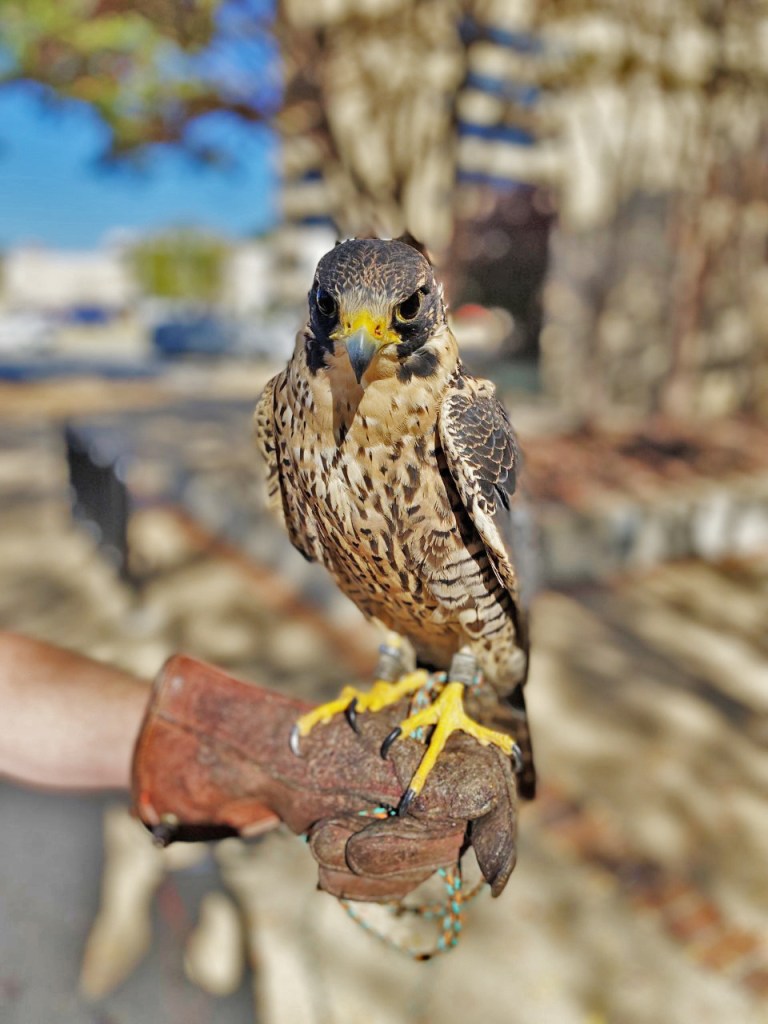
A red-tailed hawk perches on a falconer’s glove.

The bird also gets to eat the parts of the game that the falconer doesn’t want. This encourages a partnership.

The bird learns that the falconer will provide food, and that’s the sole reason it comes back. The bird isn’t a pet and doesn’t have an emotional attachment to the falconer.

However, there are many instances in which the bird won’t return. Sometimes there will be an accident where the bird gets killed, or the bird will fly off and the falconer can’t find it again.

“There is no way to avoid loss in falconry,” Garner said.

Fortunately, falconers are able to use devices to keep track of their birds. Bells are attached to their ankles so they can be heard, and GPS transmitters are attached as well that have an audible beep and will communicate to a phone.

Falconers don’t keep their birds forever, though. According to Martinez, he’s generally ready to release his current bird after two or three years.

“It’s a wild bird,” Martinez said. “I feel like it deserves to be free again.”

Martinez currently has one bird named Negrita, while Garner has two birds named Gretel and Chance. Garner said he tried to have three birds at once.

“That just about kills you,” Garner said.

He went on to say that everything a falconer does revolves around their bird. Garner has to plan work and family activities around hunting. 

“It’s not a hobby or lifestyle for people who work 8 to 5,” Garner said.

“It’s not a hobby or lifestyle for people who work eight to five.”

Heath Garner, Master Falconer

He said that many falconers quit their day jobs and work second- or third-shift jobs. Garner currently works as a senior project manager for SWCA Environmental Consultants. He said it’s not hard to write reports after dark. 

In college, while he was earning his bachelor’s degree in wildlife management and later a master’s degree in biology, he was able to find time to hunt around his classes. 

Martinez is currently a student at Arkansas State University studying wildlife conservation. He also works in hospital administration and as a part-time field tech for Garner. He often finds himself going straight from work to hunt without even changing his clothes.

According to Garner, some falconers are able to make a living with their practice. They’re often hired by airports, industrial hygiene facilities, vineyards, berry farms, and more for their birds to scare quarry away rather than hunt it.

Garner said that it’s difficult to juggle work, family, and falconry, so he’ll sometimes drop responsibilities for a day to go hunting. During any available time between Nov. 1 and March 15, he’s usually flying birds or working.  

The difficulty of the practice is worth it, though, according to Garner and Martinez. Garner stated that falconry creates an “intimacy” with the environment that other types of hunting don’t. 

Both Garner and Martinez said that falconry is a learning tool and helps them to become better conservationists and biologists. They engage with the environment because they’re able to observe their bird interacting with their natural habitat.

“It’s like interactive bird-watching,” Garner said.

In addition, Garner stated that the primary reason some bird species aren’t endangered anymore is falconry.

Wild birds have a very high mortality rate. Capturing and training a wild bird is actually beneficial to it because they enhance their hunting and survival skills. They have an increased chance of survival once they’re released again.

“It’s a way to expose the public to conservation and natural resources,” Garner said. 

Falconry also brings people together. It’s a cultural heritage practice reaching back 4,000 years and today, people all over the world still engage in it.

“It’s really interesting to see falconry bridge those cultural gaps,” Garner said.

Garner is vice president of the North American Falconers Association, as well as the creator of the Arkansas Hawking Association. There are about 4,500 falconers in North America. There’s also an international association of falconers that meets every six years with falconers from 70 other countries.

The Arkansas Hawking Association currently has about 35 members. Back in 1991, when Garner started it, there were only seven. It meets once a year, and they have a summer picnic. They also have a raffle to raise money for their student grant as well as an apprentice workshop.

Falconry, while enjoyable, takes a lot of commitment. According to Garner, most people quit within the first three years because they can’t maintain it with their lifestyle. Those that do it for five or more years usually do it their entire lives.


Avery Jones is a sophomore in the Department of English and Philosophy at Arkansas State University in Jonesboro. She can be reached at: avery.jones@smail.astate.edu


Winter weather provides challenges for Arkansas agriculture

Extreme weather provides little help, many challenges

By Garrett Hatcher | Delta Digital News Service

As cold winter temperatures and storms continue to hinder Arkansans, some cannot help but wonder how Arkansas’ agricultural workers and organizations have been braving the extreme climates.

While some people face problems like power outages, icy roads and a lack of winterization, livestock ranchers appear to be having the most immediate problems as they try to keep their livestock warm and feed while keeping up with the industry demands.

“As a livestock producer, this is hard on the animals that are out there in this weather. The rate of gain on the cattle is going to be definitely less. They’re gonna have to have a lot more feed just to generate body heat just to maintain themselves, much less gain any weight,” said David Hodges, a northeast Arkansas beef cattle farmer.

“….They’re gonna have to have a lot more feed just to generate body heat just to maintain themselves, much less gain any weight.”

– Beef Cattle Farmer David Hodges

Hodges said that despite the problems winter brings for farmers and ranchers, it does have one upside – the extermination of insects that would normally affect crops. Due to the very cold temperatures and storms, they keep off and away from farmer’s crops. This leads to cold temperatures being especially helpful to row crop farmers who have little trouble during the winter months.

Branon Thiesse, County Extension Agent – Staff Chair
UADA | CES | Craighead County

Hodges also mentioned how many farmers have taken up growing less nitrogen-dependent crops during the winter and overall during the seasons as prices for nitrogen and other farming chemicals rise. He said winter could cause financial issues to a farmer if a high maintenance and expensive upkeep crop were to die due to ice or snow.   

Branon Thiesse, a county extension agent – staff chair at Craighead County Cooperative Extension Service said ice could cause farmers issues. 

Craighead County Cooperative Extension Service is an organization that provides research-based information through non-formal education to help Arkansans with their economics and well-being in consumer science, community development and agriculture.

Bill Shannon of Farmers National Co.

“As far as an ice storm is concerned, loss of electricity, damage to buildings and farm shops and things like that can cause problems, broken pipes in the farm shops and different things like that because they don’t have an alternative heating method, as most of them use gas,” Thiesse said. He said that while some farmers may have kerosene heaters to heat their shops, many farmers have electric fans that when stopped could stop heat from circulating in their shops. This can damage equipment that hasn’t yet been winterized or protected and halts any future progress toward preparing for the next proper farming season.

“We don’t get dry soil that we can get out and farm. This is pretty much a dead time of the year; field work will typically begin in March unless we just happen to have an unusual dry period during the winter,” Bill Shannon of Farmers National Co. said. “Anytime they’re not able work in their fields, they work in their shops winterizing equipment, making repairs for the upcoming season and just getting ready to start another crop.”

“Anytime they’re not able work in their fields, they work in their shops winterizing equipment, making repairs for the upcoming season and just getting ready to start another crop.”

– Bill Shannon of Farmers National Co.

Farmers National Co. is an organization that manages land for absentee landowners, bank trust departments and charitable foundations, while also leasing farmland to operators so it can be farmed.

As winter drags on, many workers and organizations are planning out and maintaining their equipment as they prepare for the next season of growing rather than worrying about the cold and the troubles it tends to bring. 


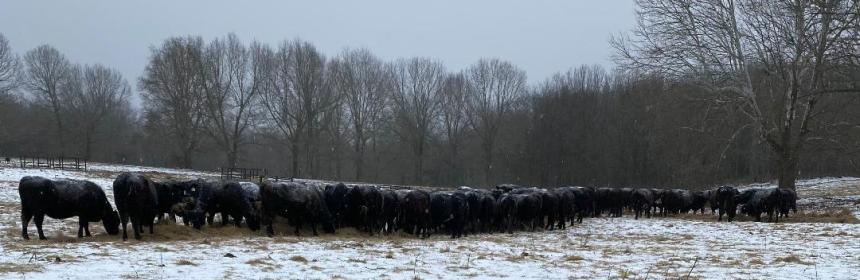
NOTE: Feature photo: A herd of cattle at the Eric Eaves Cattle Farm stand in an ice covered field Friday. During extreme weather cattle need to be feed more to gain weight for protection against cold temperatures. Submitted Photo

Students turn out for Global Climate Strike

By Melissa  Palumbo
Delta Digital News Service

Memphis, Tenn. – Millions of people from over 150 countries took to the streets Sept. 20 to demand action for climate change.

Protests and strikes led by young activists and students around the world will run through until Sept. 27 in a movement known as Global Climate Strike. There were local protests in Memphis and West Plains, Missouri, and a strike is scheduled at the Arkansas State University campus in Jonesboro Friday.

This new wave of environmental awareness began with 16-year-old Greta Thunberg, who walked out of her Friday classes each week to bring awareness to crises affecting the planet. 

“We will do everything in our power to stop this crisis,” the Swedish activist said Sept. 20 at City Hall in New York City.

One Memphis local brought the global climate strike closer to the Delta. Jojo Sigala, president of the Progressive Student Alliance University of Memphis chapter, led an afternoon protest in front of City Hall in Memphis. 

“Our kids will learn about the Great Barrier Reef like we learned about the dinosaurs,” she said during her speech.

While the global climate movement this week is led by the younger generations, those who have been protesting climate change for decades made appearances, as well as organizations that stand on behalf of the earth. 

For over 65 years, The Nature Conservancy has been working to combat the climate crisis in all 50 states and 72 different countries. 

Two representatives for The Nature Conservancy attended the Memphis Strike, where they were fundraising and helping to raise awareness of issues impacting the environment. 

“We focus on water shortages and pollution, and we replant trees for a more sustainable tomorrow,” Nathan Murray, a Memphis representative, said. “We’re here for the cause.”

The estimated 4 million participants from around the world this week will make this the largest climate protest in history. 

Citizens are demanding people in power to take action, as they chanted in the streets “No more coal, no more oil, keep your carbon in the soil,” with signs that read “Don’t defund the EPA.”

Jillian Johnson, an Interdisciplinary Studies student at Memphis University and environmental activist, participated in the protest at Memphis. 

“I’m here because the wrong Amazon is burning and the wrong ice is dissolving, so I think change needs to happen. The only way it’s going to happen is for us to do something about it, because, obviously, the people in power haven’t done anything and don’t want to do anything.”

Nature Center Promotes Outdoor Education

by Chase Gage
Delta Digital News Service

JONESBORO — Summer is coming and children across the nation need activities to fill their time other than cellphones and tablets. The Crowley’s Ridge Nature Center offers several educational programs for children and adults alike over the break.

In a world of technological overload, screens dominate while nature sits on the backburner. The Forrest L. Wood Crowley’s Ridge Nature center is combating this issue through various educational programs in hunting, fishing, trapping and more.

Lifelong outdoor enthusiast and Education Program Specialist Cody Walker said he hopes to spread his passion for the outdoors through programs at the nature center.

32724966407_03b063bcf5_k

One of the many animals on display at the Crowley’s Ridge Nature Center is a coyote, a canine species found in Northeast Arkansas. This display, along with several others, functions as a learning mechanism for visitors at the center. (Photo by Chase Gage)

“I didn’t have a cellphone until college. I went outside to play. My parents wouldn’t allow me to stay inside and I see that trend declining. It’s important to get kids and adults outside doing these activities not because it’s my job, but because it’s a passion for me. I like passing that (passion) on to other folks,” Walker said.

The nature center provides programs across the outdoor spectrum, from Hunter and Boating Education courses to simple fish feedings. Two programs available during the spring were the “Crankin’ Good Time” introduction to fishing course, where participants learned the basics of fishing and get to create a unique fishing lure to take home, and a “Turkey Fan Seminar” that taught hunters how to mount their trophy gobblers.  

Watching screens can be addictive. Studies conducted by Dr. Piush Mandane, associate professor of pediatrics at the University of Alberta, conclude that screen time in children can be directly linked to ADHD.

“Children should develop a healthy relationship with screens as young as 3-to-5 years of age,” Mandhane said in an interview with ABC News. “Our data suggests that between zero and 30 minutes per day is the optimal amount of screen time.”

With screens dominating American society, it can be hard to escape them. Televisions, tablets, cellphones and more have made their way into nearly every aspect of life. 

Some local parents are facing this issue head-on, using the nature center as an outlet for education and an escape from the digital world. Kalob Welch, a history teacher at Blytheville High School, took his 4-year-old daughter, Arden, to the center as a Saturday getaway.

“She loves being outside, she loves animals. I think it’s important for kids to get outside. We need a healthy balance (of outdoors and technology). It’s definitely nice to bring her out here to exert some of her energy,” Welch said.

The nature center provides several classes every Saturday and Sunday year-round.

This summer, residents of Northeast Arkansas have the opportunity to go outside and experience the beauty of the natural world around them, or to stay inside and strengthen addictions to screens.

Watch the full interview with Walker here.

Save Pets From Frigid Temps

By Chase Gage
Delta Digital News Service

JONESBORO – Frigid temperatures may be inconvenient for humans but pets have a tougher time combating the weather.

When temperatures plummet into the teens and single digits, commuters don extra layers of warm clothing such as scarves and mittens to stay warm. But pets do not have the same options.

The Humane Society changes much of its routine when temperatures get so harsh.

“It’s definitely an issue,” said Kelly Pickering, kennel manager at the NEA Humane Society. “On Jan. 31, it was 18 degrees with a windchill of 8, so we couldn’t even take out two rows of animals at a time. We would only take out about two dogs apiece, clean two kennels, get them dry and bring those two back in. They weren’t outside more than 15 minutes.”

Weather permitting, these animals typically stay outside from breakfast to lunch (around 1:30 p.m.) while their kennels get cleaned. The cold weather forces the process to speed up and keeps the animals caged longer than normal.

Some dogs have the luxury of taking human-like precautions, but they need a bit of assistance.

cagedPups

Caged puppies wanting attention during the polar vortex. Too young to be put with the general population, they got a cage all to themselves. (Photo by Chase Gage)

“With some of our smaller or malnutrition dogs, we put sweaters and jackets on them. I’ve never had a crew that likes to dress dogs up as much as our current crew. It’s not a chore to them. They thoroughly enjoy it,” Pickering said.

Homeless pets may be regulated during these conditions, but pets with homes face similar dangers. Depending on the breed of the dog, warm and cool temperatures will affect them differently.

“Any time the weather gets below freezing, there should be some serious consideration on bringing your dogs inside,” said Ancel Jines, a local dog trainer. “It varies based on what breed of dog you have and how acclimated it is to the weather.”

Jines said some breeds, such as huskies and German shepherds, have multi-layered coats that keep them warm during harsh conditions. However, dogs such as beagles and dachshunds have single-layered coats that aren’t much longer than a human eyelash. These animals struggle to stay warm in the cold, especially when it gets below freezing.

The weather itself is of great concern to pets, but diseases during cold weather may be more dangerous. The polar vortex itself may not cause direct harm to animals in the region, but its effects very well could.

“The key to animal health is cleanliness,”” Pickering said. “We have to be really cautious about overcrowding. When we have a large population and they’re not getting out and just being confined, that’s when you’re set up for an outbreak of disease. We just have to watch out for abnormal behavior. At the first sign of anything unusual we get them to our medical team.”

Melissa Grigsby, a veterinary kinesiologist at Hilltop Veterinary Hospital, said there have been no reported cases cold-related injury but claims the weather is still very much a concern.

“We haven’t had any specific cases recently (directly attributed to the cold weather). However, due to the rain and the cold, we have had a lot of parvo cases come up,” Grigsby said. “Just because we haven’t seen any cases yet doesn’t mean they’re not out there. We would worry about shelter, water being frozen, stuff like that if they’re outside.”

During harsh weather, make sure to take care of loved ones, especially the four-pawed kind that cannot care for themselves.

Honey Bees Impact Arkansas

Honey Bees in Arkansas from Miranda Reynolds on Vimeo.

***

by Miranda Reynolds
Delta Digital News Service

JONESBORO – Honey bees in Arkansas create endless benefits for agriculture and give economic opportunities for businesses.

The bee industry involves many different avenues for businesses to take advantage of:

  • Cultivating honey
  • Provide pollination services for farms
  • Raising bees to sell
  • Raising queen bees for people wanting to start their own beehives

David Coy with Coy’s Honey Farm grew up around honey bees from the age of 2.

“All of my life I’ve been around honey bees. A lot of people think of beekeeping as a hobby, but it’s a business for us,” Coy said.

Coy’s business revolves around family. His dad introduced him and his brother to beekeeping and they have created a business from it. The family owns 10,000 hives at their farm north of Jonesboro.

Providing pollination services allows the family business to assist farmers. They pollinate close to 1,000 acres of watermelons in portions of Northeast Arkansas.

The honey farm produces anywhere from 500,000 to 700,000 pounds of honey in Arkansas. However, the production of honey per hive continues to decrease and Coy sees the trend continuing.

According to Steve Culp with Northeast Arkansas Beekeepers Association, 4,000-5,000 commercial beekeepers reside in Craighead County.

The loss of bee habitat in the Delta region impacts the honey bees. Farm chemicals spreading to areas of wildlife impact the honey bees. Coy says only one type of crop in a single area also impacts bees.

“Bees need a variety of plants to gather nectar and pollen from to maintain their health,” Coy said.

Kim Pittcock, associate professor of horticulture at Arkansas State University, said there must be a preservation of bees.

“We need to preserve the diversity that we’ve got in all of the plants that we have to help the bees. It’s a mutual hand-in-hand relationship with it. We need to maintain part of their habitat to use them to continue to help us work and to continue their populations,” she said.

Pittcock noted certain crops must have pollinators to remain yielding.

“Some crops could not be pollinated at all without some insect of some sort, and bees are the biggest and most natural pollinator due to the structure and the type pollen that needs to be transported,” she said.

The Coy’s business tries to adjust to supply and demand. In California, the almond industry drives the beekeeping industry on a commercial level. Coy’s Honey Farm sends bees to California in February to provide pollination services for almond orchards.

“We try to have income from several different areas that the bees can give us income from so that we’re not totally reliant on bee production,” Coy said.

With the changing of the bees’ environment, Coy hopes to remain in the beekeeping industry for many years to come.

“I hope to continue to be a beekeeper. I hope to maintain the opportunity for my children, too, if that’s what they want to do,” he said.

A honey bee pollinates plants that makeup of one-third of humanity’s everyday diet. The reality is, without bees, humans will not have food.

Delta Not Directly Affected by Dakota Access Pipeline

By Madison Gomez
Delta Digital News Service

JONESBORO — The Dakota Access Pipeline has grabbed headlines for months with concerns on environmental and cultural impact.

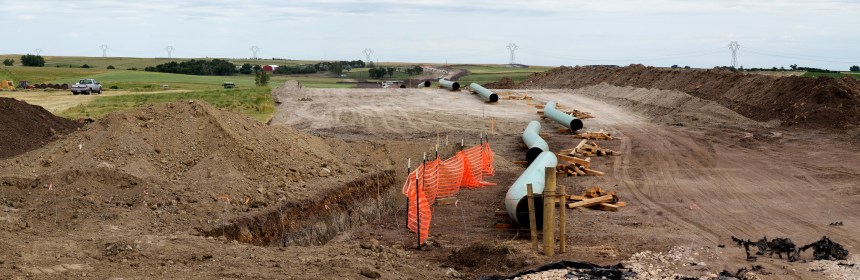
Energy Transfer Partners received an easement that will push along the completion of the Dakota Access Pipeline. The 1,172-mile long, underground pipeline starts in North Dakota and runs through three other states. The pipeline will be the only fully functioning pipeline among eight other underground pipelines that run under Lake Oahe in South Dakota.

The Dakota Access Pipeline will transport crude oil to different refining markets. President Trump issued a memo to push forward the pipeline’s progress, which is subject to terms negotiated by the United States. While the pipeline will help create jobs and bring money into investments, potential problems could arise. The pipeline has brought a lot of controversy with protests from the Standing Rock Sioux Tribe over the desecration of burial sites and potential water contamination.

Another problem arises from potential contamination due to a spill or leak. That experience occurred in Mayflower, Arkansas in 2013, when an oil spill pushed people out of homes and got into waterways. Such an effect to the Delta seems unlikely.

“I do not foresee any direct problems from a Dakota Access pipeline unless it gets into the Mississippi River,” said Richard Grippo, professor of environmental biology at Arkansas State University. “This may cause transportation problems that could possibly affect the Delta Region.”

Joseph Richmond, an instructor of disaster preparedness at A-State, agreed.

“I don’t really see this being an issue that could affect this part of Arkansas,” Richmond said.

The underground pipeline does seem to have some effect on this issue, according to Jerry Farris, a distinguished professor of environmental biology.

“Pipelines below ground would certainly impact the ways in which product would be mobilized or contained in the event of a spill,” Farris said. “That is also largely impacted by proximity to vulnerable resources, geology and climate conditions at the time of and following the spill.”

Though the Delta region might not see any effects, other issues are at play with the pipeline.

“It seems that the environmental and cultural impacts of the pipeline have not been fully evaluated and taken into consideration when planning the routing of the pipeline,” Grippo said. “They definitely need to reroute around Native American lands.”

Protesters from both the Standing Rock Sioux Tribe and other concerned people evacuated the area Feb. 23.

(NOTE: Featured image courtesy of Lars Plougmann, [CC BY 2.5], via Creative Commons)

Paragould Plans New Greenway

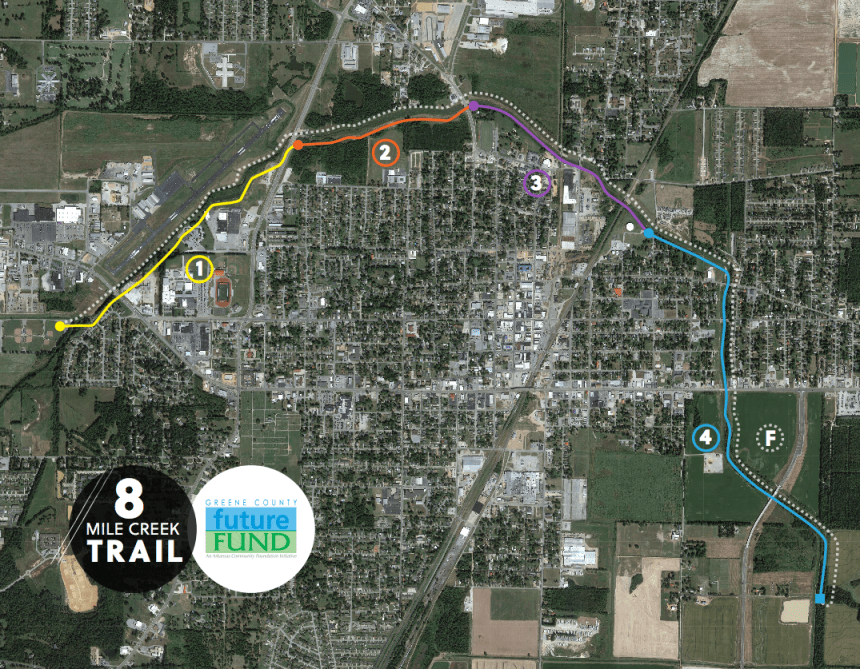
The proposed greenway that would run through Paragould. (Photo courtesy of the Green County Future Fund)

The proposed greenway that would run through Paragould. (Photo courtesy of the Green County Future Fund)

by Kimberely Blackburn
Delta Digital News Service

PARAGOULD – The Arkansas Highway Transportation Department recently approved a grant to partially fund the first leg of an urban greenway for the city of Paragould.

AHTD’s grant provides 80 percent of the approximately $580,000 project. Mayor Mike Gaskill and the City Council’s approval provides the remainder from the city’s reserve funds.

Greene County Future Fund‘s Kimberly Dale said the trail will begin at Rotary Softball Park, near the Sundale subdivision, and follow 8-mile Creek to Highway 49. Noting how the trail will connect the community, she said the project excites her.

“People my age and younger will move to a place for the quality-of-life amenities,” Dale said.

Conservation Tools‘ guide lists many of the economic benefits hiking trails bring to a city. Benefits not only include attracting homebuyers, but also attracting businesses looking for top-quality employees.

After AHTD and the Army Corps of Engineers approve the design of the hiking trail, Gaskill said the city will bid the job out. He expects the construction to provide a boost to the local economy.

Plans from the Past

Gaskill first wanted a trail 19 years ago, when he became mayor of Paragould. When the city widened 8-mile Creek for drainage issues, leaders considered a walking path, but thought it impossible due to the bridges it must cross. Later they discovered a path could be built under the bridges to alleviate any safety concerns.

Members of the Future Fund originally targeted private donors to raise the remaining funds, but Gaskill said he wanted every citizen to be involved. He said providing the money from the city’s reserve fund will not alter the city’s budget, and no other department or project will lose funds due to this project.

Gaskill said officials annually strive to improve community safety for citizens to exercise. For example, officials began sidewalk improvements in downtown Paragould in 2015.

Future Green Spaces

Greene County Judge Rusty McMillon said he first thought of a green space behind the courthouse when houses still stood on the proposed site. Although an annex to the courthouse was suggested after the county tore those houses down, McMillon said he believes Greene County needed more green spaces.

Working through “Healthy, Active Arkansas,” an initiative started by Gov. Asa Hutchinson in October 2015, McMillon said he hopes to not only educate county employees about living a healthy lifestyle, but provide a space for them to stay active. McMillon said he believes such a green space will help lower insurance premiums as well.

McMillon said he hopes to build green spaces throughout Greene County. He said he encourages all those throughout the county with ideas to contact him.

Dale said the Future Fund remains open to any ideas about future green spaces in Paragould. She said they would love the opportunity to purchase the land for a space downtown. Yet, Bolen said right now there isn’t a space in downtown Paragould where the community can gather outside during events.

Dale said with Paragould being such a pretty city, she hopes this trail will attract many to the community. Future Fund member Ashley Bolen said Paragould’s founding fathers planned for the growth when planning the city. She said Paragould’s citizens enjoy a great quality of life.

“Paragould is a well-kept secret,” Bolen said.

You can find more information on becoming a member of the Greene County Future Fund here.

« Older Entries