Tag Archives: Gina Hogue

Partnership Engages Jr. High Students

by Mia Young
Delta Digital News Service
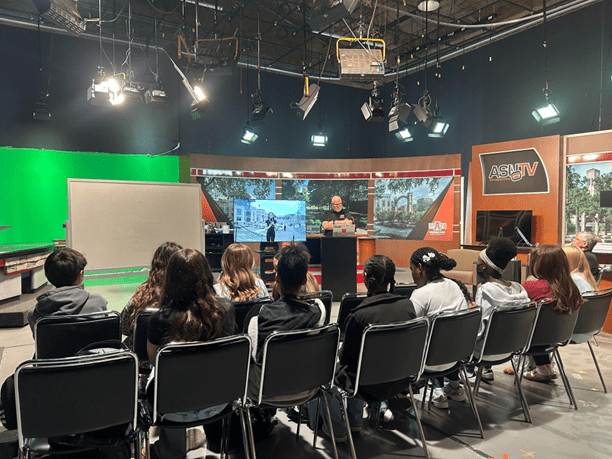
Nettleton BRIDGE program students presenting and watching their final video projects about Nelson Mandela and Zodwa Dlamini. Photo by Mia Young.

JONESBORO, Ark.- The Nettleton BRIDGE program introduces middle school students at Nettleton Junior High to the learning environment of a college student by teaching them about multimedia journalism in the School of Media & Journalism.

The Nettleton BRIDGE program began as a way to help Nettleton Junior High students experience what it is like on a university campus, so they can imagine themselves as a student at Arkansas State University or any other university. Many first-generation college students struggle to imagine college life.

Chris Moss, principal of Nettleton Junior High, contacted Gina Houge, associate dean for the College of Liberal Arts and Communication, because he wanted to target his eighth-grade students young enough to benefit from an experience that could encourage them to become college students. Last year, the program began by bringing in a small group of Nettleton students who were interested in multimedia journalism, especially the media aspect.

“I mean, that’s what students know, right? They have their phones, and they’re engaged in media constantly,” Hogue said. “But to get an experience within an academic field was what Mr. Moss wanted them to experience.”

Hogue and Moss also wanted to add a historical component to the program, as they are both passionate about history. But last year’s pilot program focused on building the students’ multimedia journalism skills, and they were unable to build out any historical component. Jonathan Reaves, instructor in the school of media and journalism, played a critical role in working with the students and developing their multimedia journalism skills.

“The first year of the program (last year) was a challenge in that we were developing a program from scratch,” Reaves said. “In the first year, we had to decide which media we wanted to use.  We primarily focused on video packages, and I have been working on audio podcasts separately.  I expect we will incorporate more audio podcasting next year.”

The program changed significantly from the first year to the second. Last year, the group of students interested in media activities merged with the group who were interested in STEM activities. This meant some Mondays, the group would work on multimedia projects and other Mondays, they would work on STEM projects.

This year, the two groups remained separate, and they focused on adding a historical component along with learning the elements of writing, audio and video.

“So we wanted to continue with street talks, and we wanted to expand and add the audio component in so they could do more audio editing. Then Alina and Jonathan wanted them this semester to do an actual video report that encompassed all of these elements of interview, audio and also video,” Hogue said. “To build in the historical component, we wanted students to be able to meet people from many places around the world and learn about the culture in other places and to interview people, so that they’re doing their research, ’cause when you research like a journalist, you’re researching like a historian.”

Throughout the last year, students completed several multimedia projects based on what they learned about different historical topics in the Nettleton BRIDGE program class.

One of the first things Alina Sakayeva taught the students about was her hometown of Kazan, Russia. Sakayeva talked about her family traditions, the food they eat and the relationship between her and her family. She showed them some of the historic buildings and contemporary athletic facilities where they host global soccer matches, and taught the students about the ancient culture and the traditions there.

“The students sat on the edge of their seats, listening and looking at the images, and watching the videos of the cultural dancers in Kazan, conveying the history of that region of the world to these young people, these eighth graders, from Nettleton Jr. High School,” Hogue said.

At the end of the nine weeks, the students created their video story about Kazan and something from Sakayeva’s culture they were interested in, and then presented it to the class.

“The Kazan video (was my favorite), it gave us a lot of freedom to do whatever with the video, and it was super fun to learn about,” Brylin Smallman, eighth grader in the Nettleton BRIDGE program, said.

During the second nine weeks, the students learned about the Pine Ridge Indian Reservation in South Dakota. They also individually created videos on the topic using interviews with Alice Phelps, a former educator on the reservation, and their own research.

During the third nine weeks, they read “The Story of Nelson Mandela” by Floyd Stokes and learned about him, and Zodwa Dlamini, who was in his administration in South Africa and who brought several school districts together there. The students also interviewed Dlamini over Zoom.

For their final projects in the fourth nine weeks, the students spent time in the K-labs learning about audio production and editing their videos about what they learned from their reading, their research and the interview with Dlamini.

Not only are the students learning audio, video, storytelling and a little bit about history but they are also learning life lessons they will carry with them throughout their lives.

“(I learned) to be open-minded. I wasn’t very open-minded at the beginning, and now I’m just like ‘OK, this is what’s going to happen, and that’s OK,’” Fielder Franks, an eighth grader in the Nettleton BRIDGE program, said. “Sometimes life happens, and it doesn’t go your way, and sometimes that’s just how it works, and so, you’ve just gotta be OK with that and move on.”

Every Monday, the group of 12 students would meet in the TV studio in the A-State College of Media and Journalism for two hours. This means these students would be missing three class periods and would be responsible for making up the classwork they missed. To be in the BRIDGE program, the students have to meet certain requirements, like having good grades (because they miss a lot of work) and not having any behavioral issues at school.

Karley Barnes incorporates multimedia elements into her EAST class, which each of the students attends. Barnes, an A-State alum, also travels with the students to and from the A-State campus and gives students a participation grade based on whether or not they came out and did their best.

“I think it benefits them because they get out of the classroom, they get to be challenged. It might be kind of taboo to say, but public school education is very watered down, and it’s not watered down out here,” Barnes said. 

Click to View!

Next year, the program will see a new group of eighth graders with many of the same and many different projects. Each year the students move up in school, the program continues to support them, but they have less time to visit campus. Reaves and Hogue are still excited for what next year will bring, even though the current eighth graders may not be on campus as much next year as they are now.

“I would tell these students to stay curious, keep working on their editing skills and be proud of what they have done,” Reaves said.

The Nettleton BRIDGE program does not just give students a chance to learn and improve their media skills, but “to help them, to inspire their learning, and to find their pathway in life. That’s the goal,” Hogue said.

Tuckerman organization takes students above and beyond

By Krishnan Collins
Delta Digital News Service

TUCKERMAN – Behind the guidance of an extremely hardworking and passionate woman, an organization brought Tuckerman schools’ report cards to an A grade and provides support for communities in the Delta. 

   Jan Paschal’s organization, Every Child is Ours, provides support for students in Tuckerman and also helps people in the community get the amount of food they need. 

Jan Paschal stands with Nelson Mandela. Paschal worked with leaders around the world like Mandela and President Bill Clinton to help students gain a better education worldwide.

   Paschal aims to help less fortunate students succeed in the classroom. Paschal said she believes every student can obtain an education; some students just do not have the same opportunities as others.

   “I think we have different expectations for poor children than we do for rich,” Paschal said. “I think that’s wrong on every level. I think rich and poor children can all succeed if they have equal footing. I think we as Americans need to look at education in that way.”

   Paschal worked with people like Bill Clinton and Nelson Mandela as she helped students gain an educational footing all around the world. Despite Paschal’s ability to reach different corners of the world, she moved back to Tuckerman and made an impact. 

   One of Paschal’s main points she emphasizes allows students to feel like they are loved and to feel like they are believed in. In Tuckerman, ECIO puts on multiple events for students of all ages to show they are loved and to let students get involved in the community. 

   Perhaps one of the most moving of those events is the bunny cake event. Students in fourth grade individually bake bunny shaped cakes after an important state mandated test every year. After they bake those cakes and decorate the cakes themselves, they write a letter to the person who has helped them the most in education. 

   “The letters are incredibile,” Paschal said. “Maybe you don’t even know that the grandma has come over and read to this child forever. We had one little boy who graduated and went to Lyon College. His grandmother helped him because his mom had a drug problem. He had to be outside under the steps. That’s where he was all the time, under the steps of his house. That little boy was an honor graduate of this school.”

   One annual event that truly represents what ECIO and Paschal are all about. Tuckerman High School principal Michael Holland noted many of the events ECIO puts on in Tuckerman, but he only called one the main event. 

   While a lot of schools may schedule a day off for Martin Luther King Jr. Day, Tuckerman schools do not schedule the holiday off. However, that day is seen as a day of service with ECIO as students prepare meals including soups, chili and sandwiches. Students deliver the meals to elderly residents in the community. 

   “When those kiddos, I drive the bus, those kids get off the bus and knock on the door,” Holland said. “Sometimes those kids will come back to the bus with a tear in their eye. I say ‘Hey is everything OK?’ and they say ‘Yes that was wonderful.’”

   Holland said the day of service stands as his favorite day of the school year and he is proud to be a part of the event. 

   Arkansas State University also participates in the day of service. Gina Hogue, an associate professor at A-State, said the impact of the day of service was so major on a student that the student told Hogue she still remembered her trip to Tuckerman and getting to work with Paschal from two years ago. 

   “I am so inspired by the work she’s doing and providing food and clothing and encouragement for students,” Hogue said. “When Jan walks into a classroom and introduces herself and looks in the eyes of every single student in the class, they know they’re special. She tells them that they’re special. She encourages them to become the very best student they can be.”

   With Paschal’s work in Tuckerman, an expectation of college or some form of higher education is placed on students. Paschal, of course, has a way to encourage that expectation. 

   ECIO brought A-State students to Tuckerman schools and had the students talk about what it was like to be in college. Athletes and student government members alike talked to Tuckerman students and Paschal pointed out the athletes did not talk about their ability on the field, they talked about what life was like in the classroom. 

   According to Paschal, the student government members from A-State received the same amount of love just as the athletes. Young Tuckerman students just wanted to know what it was like to be in college. 

   Hogue, a first-generation college student from the Delta herself, knew the importance of A-State students sharing their college experiences. 

   “I’m a first generation college student from Bay, Arkansas,” Hogue said. “My parents encouraged my sister and I to get a college education. But a lot of the students we grew up with, did not have that family support. They didn’t know they were really capable of going to college.” 

   After teaching and just being in the Delta, Hogue said she realized a lot of students had never thought of the idea of going to college. She called Pascal’s work of encouraging students to get a higher education “critical work.”

   Bringing multiple Tuckerman schools to an A rating took work from everyone in the community. Paschal noted ECIO worked like the glue of everything that was going on to increase students’ productivity. 

   “We have so many kids who have substance abuse problems,” Paschal said. “Not them but people in their homes. (We have) poverty and we don’t even have a grocery store here. What we’ve almost become is the glue. We’re what holds everybody together.”

   Holland acknowledged this glue effect and praised his own faculty and staff at Tuckerman High School. 

   “If a student is lacking in food at home and they have to come to school hungry, I just think it helps and works hand in hand,” Holland said referring to ECIO’s side. “If we can help provide them with food, it’s only going to help their learning.”

Holland talked about his faculty and staff next.

   “I really feel like it’s a one word answer: family,” Holland said about what makes his staff so successful. “I feel like this is the best overall staff I’ve had in place since I’ve been here.”

    Another aspect of Paschal’s work includes encouraging teamwork and kindness. With the help of Dillards at Tuckerman’s Middle School campus, Dillards built a boutique where students can buy clothes. The twist happens when students earn special currency that can be spent at the store by just being kind to one another and then informing the act of kindness to their teachers. Paschal said it is hard to open a door for yourself at the middle school because everyone is working so hard to be kind. 

   ECIO even provided McDonalds meals as a treat to every student in a class if everyone completed all the tasks given to them on a checklist in an event before Christmas break. This taught accountability and teamwork as students made sure everyone completed their tasks so they could receive a tasty treat. 

   From widening students’ worldviews by having them talk to students in overseas countries like Jordan, to encouraging high school students to help older people in the community by unloading food at the food pantry, it seems like Paschal never runs out of innovative ideas to transform a community. Her passion for education flows into the community and the people around her.

   “Children everywhere can learn if they have the right conditions and the right books and all the things that we try to give to ours,” Paschal said. “We need to make sure that in the USA every child is valued. I don’t care what that child’s problems are, what color their skin is or what their religion is. We should as Americans have the standard that every child matters. That’s the name of our organization, Every Child is Ours.” 

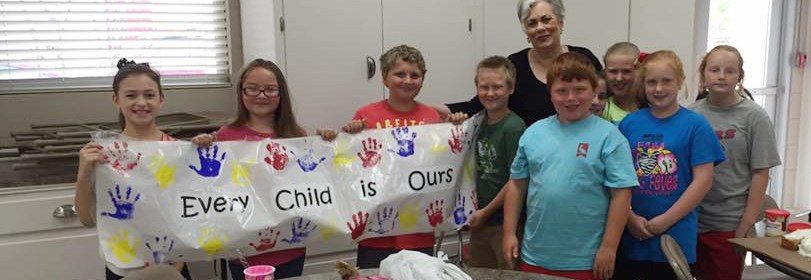
Editor’s Note: Feature photo courtesy of ECIO: Jan Paschal stands with the students after the annual Bunny Cake event. After the cakes are made, students write a letter to the person who helped them the most in their education.