Poet challenges social prejudices and misconceptions
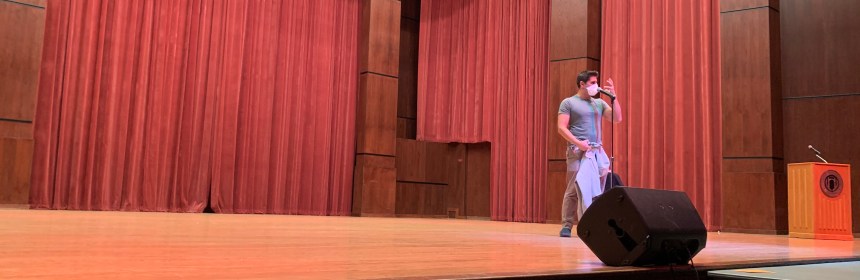
Gomez delivers encouragement through engagement.
By Emma Allen | Delta Digital News Service
JONESBORO, Ark. – Cold weather bearing 30-degree temperatures were no match for the itching ears of a crowd wanting to hear the words of Poet Carlos Andrés Gómez on Thursday, January 25th at Arkansas State University.
The event, which was free to the public, was slated to be held in the Drama Theatre with a seating capacity of 344, but was changed to Riceland Hall, a 970-seat auditorium in the Fowler Center, due to social distancing guidelines for COVID-19.
Gómez, a Colombian American poet, actor, and educator from New York City, stars in HBO’s “Def Poetry Jam” and has acted in films such as Spike Lee’s award-winning movie, “Inside Man”, with Denzel Washington.
Gómez was invited to campus by the A-State Department of Theatre and its Office of Diversity and Community Engagement.
“The faculty met with the theatre students last year and one of the things that we talked about was diversity issues,” said Associate Professor of Theatre Jeff Mclaughlin.
Mclaughlin said, “It became clear in that conversation that our students were interested in having more tools in their tool kit to deal with microaggression and social injustices that they didn’t really know how to deal with.”
According to Mclaughlin, the department spent time this summer looking for someone they could bring in to discuss those issues. He said Gomez was recommended by another group they had contacted during the search. The group was told they should “bring in Carlos.”
Gómez has conducted workshops in the past that cover “Antiracism as Action”, “Diversity, Equity, and Inclusion”, “Healthy Masculinity and Gender Equity”, and “Tools for Self-Care: Mental Wellness & Emotional Resilience.” He covers some of the topics in his poems during his performance.
Sharon Lee, director of the Office of Diversity and Community Engagement really liked the idea of bringing in Gomez.
“We thought it was great,” Lee said. “We wanted to be a part of it too.”
Although colleges and universities are part of Gomez’s circuit, this was his first time performing at A-State and visiting Jonesboro.
“I mean, I think for me, the thing that I love most about visiting colleges and universities is, I feel like it’s a rare time that you encounter a human being when they are in this moment of tremendous change instead of flux and figuring out who they are,” he said.
Gomez said that he was very honored and humbled to have been invited to perform. “The city has been great and I’m really excited to be here,” he said.
Gomez’s poems included such titles as, “Above The Speed Limit”, “Gifted”, and “Where Are You Really From?”
Although the event was attended by people within the community, the venue was packed with students.
Madison Stewart, a senior from Trumann appreciated Gomez’s attempt to connect with the audience during his performance.
“I think that Carlos was such a kind and genuine person. Having a conversation with his audience and turning us into a part of the performance was very important to him, and you could tell throughout,” Stewart said.
“I think that Carlos was such a kind and genuine person. Having a conversation with his audience and turning us into a part of the performance was very important to him, and you could tell throughout”.
Madison Stewart, A-State theatre major
“In between all of his poems, he took the time to talk to the audience about their personal life experiences and was genuinely interested in what we all had to say. I have never seen a poet as engaging as him, ”she explained.
Gómez said that human moments is what inspired him to write. “I don’t know if you have ever experienced a moment that feels really profound, but you’re the only person that seems to either see it, or appreciate it? So, I think creating snapshots of really profound moments of being a human being, and also bringing some of those things that we don’t talk about to the surface, so we can deal with them,” he said.
“I don’t know of another moment, and definitely another moment in adulthood, when I think people are as open and receptive to considering perspective so different from their own,” he elaborated.
Gómez said that he really relishes going into places and often being in spaces with people who may come from a different life experience, or have different ideas about the world.
Freshman Norah Wilborn of Jonesboro attended the event. Wilburn said she often encounters situations where her ethnicity and her behavior don’t match other’s expectations.
“I’m constantly told that I sound ‘white’….I’m not exactly sure what that means,” Wilborn said. She said that Gomez’s poems helped her to understand about stereotypes people often encounter.
Juanita Acosta, Community Navigator with El Centro Hispano, a community-based nonprofit organization serving the Latino community within the city also attended the event.
“I think it was a really good opportunity to see that not everyone is there to judge you for who you are,” Acosta said. “It was also special because he is of Colombian decent, and I am actually from Colombia as well.”
Acosta attended the event with friends and family members. “There were a few of us that went because we saw that he was going to be there. We were happy about that. It was nice because you don’t normally see that in such a small town in Arkansas, especially for such a famous poet like himself,” she said.
After his performance, Goméz mentioned on Instagram, “Last night in Jonesboro, Arkansas at A-State was one of the most generous and vulnerable audience I’ve ever had. The electricity of that experience was beyond words.”
Gomez met with attendees while signing several copies of his award-winning book, “Fractures” after his performance. Gomez was treated with an afterparty by event organizers before continuing on his tour to share.