JONESBORO, Ark. — The College of Education & Behavioral Sciences’ interconnection with the Northeast Arkansas community benefits education majors, NEA school districts and Arkansas State University.
Makenzi Davis graduated in December with a bachelor’s degree in physical education. A-State awarded her the Chancellor’s Scholar at the College of Education & Behavioral Sciences Convocation of Scholars Ceremony.
She was also one of the first students at the college to be accepted into the new Aspiring Teacher Program. The program allows students who make a high enough score on their exam to waive their year of residency and become full-time teachers immediately.
“Before, I was just a college kid who stuck to their inner circle and this really stretched me as a person. It’s made me a lot more connections than what I had before I got here,” Davis said.
Davis now teaches physical education at the Nettleton Intermediate School and serves as the junior high girls’ head basketball coach. She said this position has made her feel a lot closer to the NEA community.
Lacy Baker, the Nettleton School District Assistant Superintendent of Curriculum and Assessment, has been involved in the district’s hiring process for many years. She said at least half of the Nettleton School District teaching staff working there currently has some sort of certification degree from A-State.
The school district also takes in as many A-State residency placements as possible. For the 2026 fall semester, the district had 27 placement requests and she predicts they’ll be able to take in all of them.
“Anything we can do here at Nettleton to reinforce what A-State is doing there and, of course, keep up our numbers of teachers,” Baker said.
Baker said she’s a big fan of the Aspiring Teacher Program because it’s good for the students. It gives college students early access to teacher benefits and salary. She said A-State graduates come to the workplace very well prepared.
“Arkansas State is doing beautifully by preparing their students. I think it’s such a wonderful opportunity for student that are already ready to go ahead and go on into that third year,” Baker said.
Baker said student-athlete visits, professor presentations and staff meetings are some other ways A-State stays involved in the Nettleton School District.
Valarie Hilson, an assistant professor and program coordinator of Physical Education Teacher Education at A-State, said the Aspiring Teacher Program strengthens collaboration with the NEA school districts.
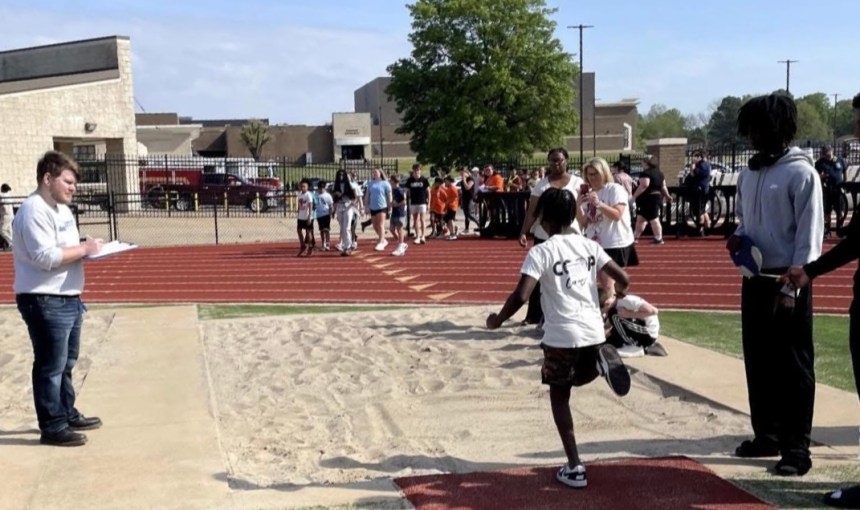
Faculty from Community Care & Miracle Kids volunteer at the Area Seven Special Olympics Track Meet, held April 10 at Jonesboro High School. Photo courtesy of Special Olympics Arkansas Area Seven
Click to View!
Hilson, who coaches the Special Olympics of Arkansas and serves as the Area Seven training director, has served as a Special Olympics coach for over 20 years. An A-State colleague introduced her to the nonprofit organization. The organization hosts regular sporting events across the state.
Jonesboro High School hosted the last event April 10, which included 565 athletes ranging in ages from 2 to 60 participating. The Nettleton High School track team, local businesses and A-State faculty and students were all involved in the event.
The commitment to helping one another succeed is vital in maintaining the relationship between the education majors, NEA school districts and A-State.
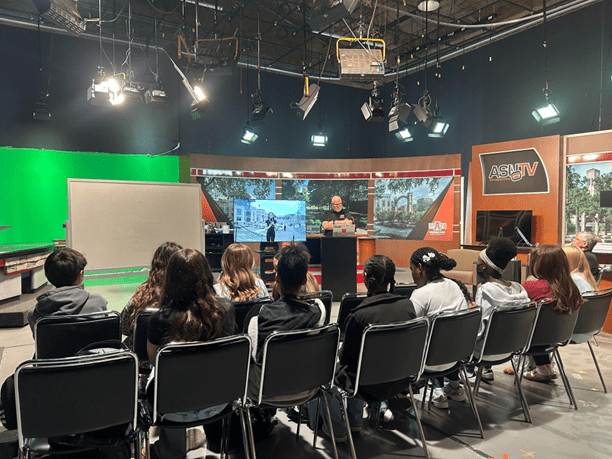
Nettleton BRIDGE program students presenting and watching their final video projects about Nelson Mandela and Zodwa Dlamini. Photo by Mia Young.
JONESBORO, Ark.- The Nettleton BRIDGE program introduces middle school students at Nettleton Junior High to the learning environment of a college student by teaching them about multimedia journalism in the School of Media & Journalism.
The Nettleton BRIDGE program began as a way to help Nettleton Junior High students experience what it is like on a university campus, so they can imagine themselves as a student at Arkansas State University or any other university. Many first-generation college students struggle to imagine college life.
Chris Moss, principal of Nettleton Junior High, contacted Gina Houge, associate dean for the College of Liberal Arts and Communication, because he wanted to target his eighth-grade students young enough to benefit from an experience that could encourage them to become college students. Last year, the program began by bringing in a small group of Nettleton students who were interested in multimedia journalism, especially the media aspect.
“I mean, that’s what students know, right? They have their phones, and they’re engaged in media constantly,” Hogue said. “But to get an experience within an academic field was what Mr. Moss wanted them to experience.”
Hogue and Moss also wanted to add a historical component to the program, as they are both passionate about history. But last year’s pilot program focused on building the students’ multimedia journalism skills, and they were unable to build out any historical component. Jonathan Reaves, instructor in the school of media and journalism, played a critical role in working with the students and developing their multimedia journalism skills.
“The first year of the program (last year) was a challenge in that we were developing a program from scratch,” Reaves said. “In the first year, we had to decide which media we wanted to use. We primarily focused on video packages, and I have been working on audio podcasts separately. I expect we will incorporate more audio podcasting next year.”
The program changed significantly from the first year to the second. Last year, the group of students interested in media activities merged with the group who were interested in STEM activities. This meant some Mondays, the group would work on multimedia projects and other Mondays, they would work on STEM projects.
This year, the two groups remained separate, and they focused on adding a historical component along with learning the elements of writing, audio and video.
“So we wanted to continue with street talks, and we wanted to expand and add the audio component in so they could do more audio editing. Then Alina and Jonathan wanted them this semester to do an actual video report that encompassed all of these elements of interview, audio and also video,” Hogue said. “To build in the historical component, we wanted students to be able to meet people from many places around the world and learn about the culture in other places and to interview people, so that they’re doing their research, ’cause when you research like a journalist, you’re researching like a historian.”
Throughout the last year, students completed several multimedia projects based on what they learned about different historical topics in the Nettleton BRIDGE program class.
One of the first things Alina Sakayeva taught the students about was her hometown of Kazan, Russia. Sakayeva talked about her family traditions, the food they eat and the relationship between her and her family. She showed them some of the historic buildings and contemporary athletic facilities where they host global soccer matches, and taught the students about the ancient culture and the traditions there.
“The students sat on the edge of their seats, listening and looking at the images, and watching the videos of the cultural dancers in Kazan, conveying the history of that region of the world to these young people, these eighth graders, from Nettleton Jr. High School,” Hogue said.
At the end of the nine weeks, the students created their video story about Kazan and something from Sakayeva’s culture they were interested in, and then presented it to the class.
“The Kazan video (was my favorite), it gave us a lot of freedom to do whatever with the video, and it was super fun to learn about,” Brylin Smallman, eighth grader in the Nettleton BRIDGE program, said.
During the second nine weeks, the students learned about the Pine Ridge Indian Reservation in South Dakota. They also individually created videos on the topic using interviews with Alice Phelps, a former educator on the reservation, and their own research.
During the third nine weeks, they read “The Story of Nelson Mandela” by Floyd Stokes and learned about him, and Zodwa Dlamini, who was in his administration in South Africa and who brought several school districts together there. The students also interviewed Dlamini over Zoom.
For their final projects in the fourth nine weeks, the students spent time in the K-labs learning about audio production and editing their videos about what they learned from their reading, their research and the interview with Dlamini.
Not only are the students learning audio, video, storytelling and a little bit about history but they are also learning life lessons they will carry with them throughout their lives.
“(I learned) to be open-minded. I wasn’t very open-minded at the beginning, and now I’m just like ‘OK, this is what’s going to happen, and that’s OK,’” Fielder Franks, an eighth grader in the Nettleton BRIDGE program, said. “Sometimes life happens, and it doesn’t go your way, and sometimes that’s just how it works, and so, you’ve just gotta be OK with that and move on.”
Every Monday, the group of 12 students would meet in the TV studio in the A-State College of Media and Journalism for two hours. This means these students would be missing three class periods and would be responsible for making up the classwork they missed. To be in the BRIDGE program, the students have to meet certain requirements, like having good grades (because they miss a lot of work) and not having any behavioral issues at school.
Karley Barnes incorporates multimedia elements into her EAST class, which each of the students attends. Barnes, an A-State alum, also travels with the students to and from the A-State campus and gives students a participation grade based on whether or not they came out and did their best.
“I think it benefits them because they get out of the classroom, they get to be challenged. It might be kind of taboo to say, but public school education is very watered down, and it’s not watered down out here,” Barnes said.
Click to View!
Next year, the program will see a new group of eighth graders with many of the same and many different projects. Each year the students move up in school, the program continues to support them, but they have less time to visit campus. Reaves and Hogue are still excited for what next year will bring, even though the current eighth graders may not be on campus as much next year as they are now.
“I would tell these students to stay curious, keep working on their editing skills and be proud of what they have done,” Reaves said.
The Nettleton BRIDGE program does not just give students a chance to learn and improve their media skills, but “to help them, to inspire their learning, and to find their pathway in life. That’s the goal,” Hogue said.
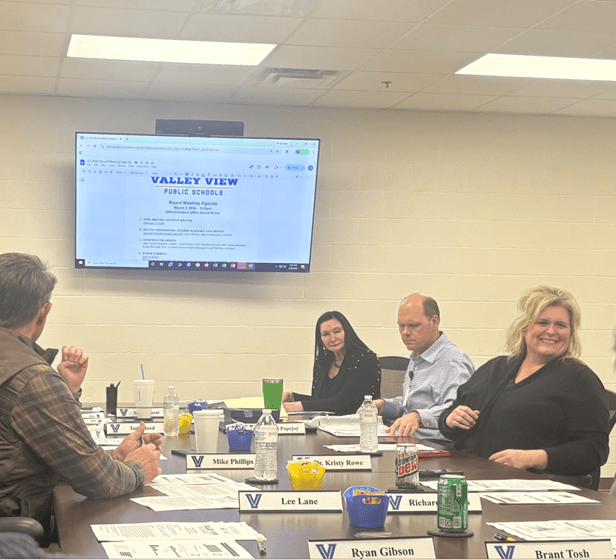
Members of the Valley View School Board, as well as Superintendent Roland Popejoy (second from right). Photo by Benjamin McDowell.
JONESBORO, Ark. — The Valley View School Board honored longtime member Richard Rogers, celebrated the success of the theater program, and approved major technology purchases during its recent meeting.
The board recognized the Valley View theater program, which took its one-act play Eurydice to competition in Russellville and earned a score of 97 out of 100. Judges selected the group as one of four schools in the state to showcase their one-act play at the State Thespian Festival in February.
Students later performed in Springdale, receiving a superior rating, along with awards for ensemble work and music design, and earned $100,000 in scholarships for theater education.
The board also heard updates on the Fine Arts Center lighting project, which improved stage and auditorium lighting for performances. The new lights allow different colors, enhancing plays, festivals, and shows.
Chromebook purchases and finances
The committee reviewed financial reports showing a $2.7 million deficit due to building project expenditures, though revenue collections are currently 51% ahead of budgeted expenses. Members approved the purchase of 750 Acer 514 Chromebooks for $373,525 and 250 Lenovo L16 Chromebooks for $223,223, citing cost-effectiveness and vendor reliability.
Superintendent Roland Popejoy discussed the Chromebook purchases and technology replacement plan.
“I have shared with you guys previously that we’ve been working on a replacement plan for laptops. That is an area where, whenever I came into this role, it was very important for me to make sure that we work toward getting a specific line item per year for technology replacement,” Popejoy said.
Popejoy emphasized that students should have access to the tools they need to succeed.
“Previously, we made really big purchases and then kind of saw how long they would last as part of our process. I really want to make sure that we have a solid replacement plan. And so that’s what we’ve been working on. We’re moving to one-to-one,” he said.
Honoring Richard Rogers
Board members recognized Richard Rogers for his 11 years of service, noting his role in overseeing several major school projects.
“He has served on our board since October of 2011, and so this will be his last meeting. Mr. Richard Rogers has played a pivotal role in multiple things in his time here. He oversaw the building of our high school while he was on the board, also the women’s field house, the additions here at the intermediate and the intermediate junior high, and now our high school addition,” Popejoy said.
He also praised Rogers’ contributions to athletic facilities.
“In addition, one thing that I think is really important is that he has played an integral role in the efforts to improve our athletic facilities, with our turf project for our football field, baseball field and softball field,” Popejoy said. “Anybody that knows this board over the years knows Richard is a voice that a lot of people reach out to. Richard is one that has a unique way of his advocacy.”
Special education and facility updates
Special education director Carol Brown provided an overview of services.
“As of December, there were 2,827 students enrolled in our district, and out of those, there are 448 receiving special education services, which is 15.85%,” Brown said.
Brown explained that the district serves students with a variety of disabilities, including specific learning disabilities and other health impairments such as ADHD, seizure disorders, and other medical conditions. She said the district provides multiple therapists and therapy options to support students academically, mentally, and medically.
Senior project manager Angie Berryhill gave an update on facility improvements.
“What I’d like to do is dwell on the path moving forward, and our message is still the same to this board and this community, that we’re going to move as expeditiously as possible. When we understand things, we will make that known, and we’re going to be here until the very end,” Berryhill said.
Berryhill added that the improvements will not cost taxpayers extra money.
“We have processes and procedures in place now that are going to prevent things like this from happening again,” she said.
Courtesy of Jonesboro Public Schools Facebook Page
JONESBORO, Ark. – Jonesboro Public Schools launched a new counselor website and approved additional compensation for teachers who teach more than 150 students per day and more during its monthly school board meeting on March 10.
Mandy Zipful, district school improvement specialist, presented the new counselor website, highlighting the new and improved course catalog for Jonesboro High School. The JPS School Counselors’ website provides a hub for connecting students with counselors, finding mental health resources, booking appointments, accessing grades and graduation requirements, and viewing a detailed course catalog. While the site is live, the district is working to connect the site to each school’s tab.
“This is a great tool for the students and parents,” Zipful said. “We’re super proud of this work.”
Zipful highlighted the new “Academics at Jonesboro High” course catalog, noting that the old version was just a Word document, while the new one lists every course offered and includes a detailed description. The new catalog also makes it easier to find graduation requirements, concurrent credit courses at both Arkansas State University and Black River Technical College, Success-Ready Pathways, and more.
“What would it look like to be more supported socially and emotionally?” Superintendent Misty Doyle asked students. Students said to be able to better get in touch with their counselor.
The website helps students easily book appointments with their counselor in 30-minute increments. Students can schedule an appointment by going to the JPS School Counselors website, clicking “Academics at JHS,” clicking the “Counselor Appointment” tab, selecting the counselor they wish to meet with and choosing a time that works best for them. Doyle even gave an example of how a student had an appointment scheduled for 9 a.m. and was surprised to actually be called out of class on time.
During the superintendent’s report, Doyle asked Von McDaniel, director of student health services to give an update on mental health.
“As of today, we’ve had 167 student contacts for this school year. Some of them we spend a lot of time with, and some of those we don’t,” McDaniel said.
Counselors meet with and contact students for a variety of behavioral and mental health concerns. Students can meet with counselors as many or as few times as needed. While some students have the resources needed to head in the right direction, others don’t and the district recognizes that.
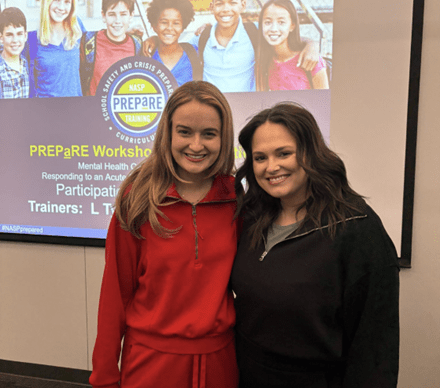
Photo courtesy of JPS School Counselors website. (Left) Lene Pierce, Jonesboro High School Health and Human Services counselor, and Emily Aycock, Visual and Performing Arts Magnet school counselor.
The board passed the motion to approve additional compensation for teachers teaching more than 150 students per day for the first semester in the 2025-26 school year. The JPS finance office recommended six teachers, including two from JHS, two from Douglas MacArthur Junior High School and two from Annie Camp Junior High School, for the supplemental teacher contract pay.
“A teacher is not required to teach more than the maximum number of students permitted per day under the Standards for Accreditation of Arkansas Public Schools and School Districts, but a teacher may agree to teach more than the maximum number of students permitted per day,” according to Arkansas Code § 6-17-812 (2024).
The district will pay the teachers an additional amount in addition to their regular salary, proportionate to the additional number of students they taught.
The board also passed the motion to approve the purchase of a new $153,054 77-passenger school bus.