Campus Concealed Carry Remains Contentious
by Christopher Lee
Delta Digital News Service
JONESBORO — New interests in school safety have emerged with the mass shooting at Parkland, Florida, and the Westside Shooting’s 20th anniversary fresh on everyone’s mind.
In light of the Parkland shooting, President Donald Trump advocated for arming teachers in the hopes of preventing more mass shootings in a tweet.
Armed Educators (and trusted people who work within a school) love our students and will protect them. Very smart people. Must be firearms adept & have annual training. Should get yearly bonus. Shootings will not happen again – a big & very inexpensive deterrent. Up to States.
— Donald J. Trump (@realDonaldTrump) February 24, 2018
The debate of having firearms on campus is not isolated to public schools; it provides a point of contention for colleges and universities as well.
According to the National Conference of State Legislatures, 10 states including Arkansas currently have provisions allowing concealed carry on postsecondary campuses. Provided a person has passed the required courses — including the standard concealed-carry courses and the specialty enhanced-carry courses — gun owners may legally carry their weapon on college grounds.
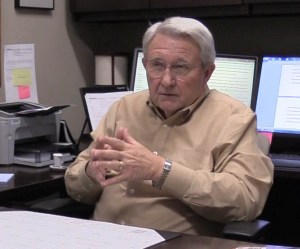
Dr. Michael McDaniel, A-State Faculty Senate chair (photo by Christopher Lee)
Arkansas State University Faculty Senate chair Michael McDaniel explained how A-State’s Faculty Senate reacted to the new law.
“It’s hard to speak for the entire faculty. About the only thing I feel comfortable saying is that I believe that the faculty were reasonably comfortable with the situation we had prior to this new law,” McDaniel said.
Prior to House Bill 1249, now Act 562, colleges could opt out of allowing concealed carry on their premises, but with the passing of Act 562 this is no longer an option.
“With the new law we lost that option, so now we can’t opt out. It is the rule and it is the law,” McDaniel continued.
Bill Smith, A-State’s associate vice chancellor for marketing and communications, echoed the idea in a short but strong statement.
“The law is the law and we can’t change that,” Smith said.
Even though the law has officially gone in effect, understanding faculty and student opinions about the new conceal carry law is important for gaining insight into how the law and its implementation are perceived.
Some faculty members like associate professor of political science Richard Wang said they feel they were ignored.
“As you know, the university said, ‘No, we’ll opt not to have concealed carry on our campus.’ Joining with A-State are all the other universities in this state, plus junior colleges, plus the campus police forces, plus the local police, the county police and county sheriff offices all around the state, joining … It’s a coalition, and they all said, ‘No, we want to keep the local option, the option here,” Wang said.
Wang has taught at Arkansas State University for 31 years. He said he was surprised to hear the law passed. You can hear more of Wang’s opinions about the concealed carry law by watching the video below:

Dr. Brandon Kemp, interim Dean of associate engineering programs (photo by Christopher Lee)
Brandon Kemp, A-State’s interim associate dean of engineering programs, echoed this sentiment when he heard the new concealed carry law had gone into effect.
“My first opinion was that it was ridiculous. As a faculty we have voiced our opinions over and over again that we don’t want guns on campus,” Kemp said.
A Jonesboro native who has worked at Arkansas State University for over seven years, Kemp said allowing guns on campus added unnecessary risk to the campus. He said it also adds confusion to first responders during an active-shooter threat.
“If we have an active-shooter situation and we have people on campus — whether it be faculty or students — who are pulling out their firearms to combat the situation, then the first responders — the police and SWAT — now they have a much more difficult situation,” Kemp said.

Dr. Erik Gilbert, professor of history (photo courtesy of Arkansas State)
While concerns about increased gun violence with more guns on campus is rational, Erik Gilbert, professor of history at A-State, has already written two articles about the topic of concealed carry on college campuses.
Gilbert cited his articles as his opinion of the new concealed carry law.
In the first article, “Stop Worrying About Guns in the Classroom. They’re Already Here,” published in The Chronicle of Higher Education in March 2016, Gilbert spoke to college faculty in Texas about their concerns with the concealed carry law.
In the article, Gilbert encouraged faculty to relax about the idea of guns being on campus.
I can almost guarantee that if you have a few semesters of teaching under your belt, at some point there have been students with guns in your classroom. If those illegally armed students were not moved to violence by the content of your course or the statements of their fellow students, it seems highly improbable that a new group of legally armed students will prove to be more volatile or violence-prone than their scofflaw peers.
Gilbert ended the article by stating, “Don’t worry about the presence of legally carried guns in your classrooms. If you are going to worry, worry about someone illegally bringing a gun on campus with the intention of causing mayhem, not someone who legally carries a gun in the hope of protecting himself from harm.”
In his second article, “Campus Carry Is Not About Preventing Mass Shootings,” Gilbert argued the choice to allow concealed carry on campus is less about the ability to stop mass shootings and more about letting individuals choose how they wish to defend themselves.
Gilbert wrote, “If you happen to be locked down in a classroom during a mass shooting, wouldn’t you rather be able to shoot back if the shooter comes through the door? If you would rather resort to throwing coffee cups or iPads, as some campus police might advise, that’s a valid choice and I would not try to dissuade you.”
The article, published by Inside Higher Ed in 2017, cites many sources to show how concealed carry has affected mass shootings in states where it is allowed, and how concealed carry benefits students.

College Republicans Rep. Chandler Jones (photo by Christopher Lee)
Members of both the College Republicans of A-State and the Young Democrats discussed their opinions on the topic of concealed carry on campus.
“I’m thankful for the state of Arkansas legislature to pass this because it shows that they think of us as humans, they think of us so that we’re allowed to protect ourselves,” College Republicans Rep. Chandler Jones, a pre-professional biology major, said. “I’m thankful and I do think it will be more of a preventative measure; someone who is mentally ill would know that they’re also going to be met with force.”
Jones said he sees the new law as an opportunity, ensuring students have the right to defend themselves if necessary during a mass shooting. You can listen to more of his points below.
Dominique Phillips and Anthony Sumlin of A-State’s Young Democrats discussed the organization’s opinion of the law.

Young Democrats Rep. Dominique Phillips (photo by Christopher Lee)
Phillips also serves as president of student diversity and recruitment.
“I feel like I speak not only for myself but for my party when I say that I feel like the new laws might cause a bit of a problem,” she said. “In general, you can’t fight violence with violence, you can’t fight fire with fire. You’re allowing guns to be on campus now, even going throughout the so many courses that you have. That doesn’t change when a person has a mental breakdown or a mental issue.
“As far as someone acting as a guardian, it’s a little tricky because I see that and I can see the positive side of how they will be able to fight back,” Phillips said. “But at the same time, is it guaranteed that someone will be able to muster up enough courage to go out and shoot someone back?”
While the College Republicans and Young Democrats sit on opposite sides of the concealed carry on campus debate, both parties agreed mental health reform is necessary to prevent mass shootings like Westside and Parkland.
“I feel that not only in public schools — in high schools and elementary, middle schools — but also in colleges there needs to be a more open discussion about mental health awareness,” Phillips said.
A-State’s Young Democrats Anthony Sumlin, a biology and chemistry major, echoed Phillips’ opinion.
“I think the response should not be, ‘Oh well, let’s give more people guns to hide on themselves.’ Personally I feel like we should do more with educating teachers on how to spot mental health issues and really getting rid of that stigma that mental health is something to be ashamed of,” Sumlin said.
You can listen to more of Sumlin’s statements below.
Jones also said he believes mental health reform provides the key to stopping mass shootings.
“Restricting buying guns now really isn’t going to slow down someone who wants to get a weapon from getting it cause they’re on the streets, they’re sold illegally. So I think it needs to be more mental health,” he said. “Screening these people, getting more help for these people, more … maybe facilities. More money distributed there, I think that’s what needs to be our first step.”
The new conceal carry law has clearly struck a nerve with faculty and students alike, but it is unclear how it will affect the educational climate of colleges and universities. Even with the division the new law has caused, what is clear is the law will continue to create debates about campus safety.
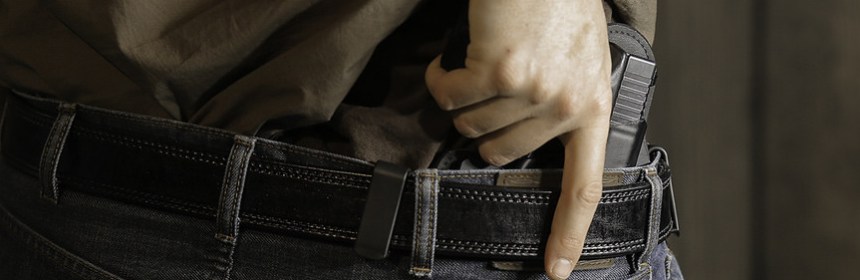
Featured image made by adapting Ibro Palic’s “Gun Holster” [CC BY-SA 2.0]