Author Archives: christopherjameslee

Buy or Bye? ‘Star Wars Battlefront 2’
by Christopher Lee
Delta Digital News Service

JONESBORO – DICE and Electronic Arts recently updated its newest entry in the fan-favorite “Star Wars” franchise.

“Star Wars Battlefront 2” marks a rather controversial entry in the long-running first and third-person shooter franchise. Players fight in single-player and multiplayer, whether on the ground or in space in some of the best battles from the “Star Wars” films.

With an underwhelming predecessor and negative press connected to it, the game started off shaky. Over the months leading up to the game’s release, critics and fans alike flamed the game for the potential “pay to win” elements found in the game during the open multiplayer beta back in October.

The game went through many changes since then, with the game developers addressing many of the problems. This comprehensive review of the single-player and multiplayer campaigns determines whether the game lives up to its ancestors.

Single-Player Campaign

The “Battlefront” franchise provides an interesting history with single-player campaigns. The first “Star Wars Battlefront” in 2004 did not have a cohesive campaign.

The sequel, 2005’s “Star Wars Battlefront 2,” offered a great, dedicated campaign following the exploits of a clone trooper in various battles from the films.

The single-player campaign for 2017’s “Star Wars Battlefront 2” bears similarity to the 2005 “Star Wars Battlefront 2.” Players control a soldier taking part in important battles between “Star Wars Episode VI: Return of the Jedi” and “Star Wars Episode VII: The Force Awakens.”

The story revolves around Iden Versio, an Imperial special forces commander, as she leads her unit, the “Inferno Squad.” The campaign follows her exploits after the destruction of the second Death Star, during the Emperor’s mysterious “Operation Cinder.”

The “Star Wars Battlefront” of 2015 lacked a single-player campaign, earning points in the sequel’s favor. The campaign pleasantly surprised me with high quality, but some flaws stuck out.

The Good

The creators designed one of the most beautiful games I ever played. From the characters to the environment, everything looks amazing and creates the feeling of actually being in a “Star Wars” film. The visuals, combined with the excellent sound design, create a truly immersive experience.
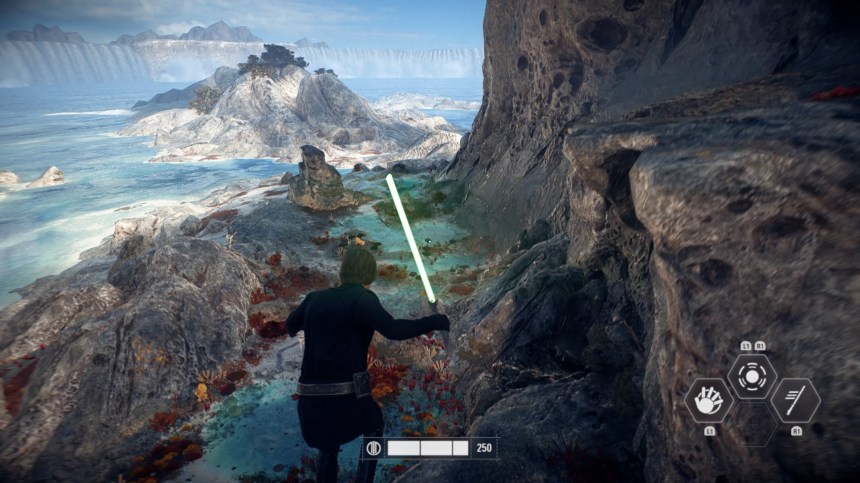
Luke Skywalker leaps into combat on a mysterious Imperial outpost. Photo by Christopher Lee


Along with Iden, players have the opportunity to play as and alongside famous “Star Wars” characters.

To avoid spoilers, this review will not go into much detail about the campaign’s story, instead focusing on the impressive campaign features.

As players travel through the campaign, they will see moments pulled straight from the “Star Wars” universe, both from films and other media like Marvel’s “Star Wars: Shattered Empire” comic series. These moments come to life from the perspective of Iden as she fights her way through memorable battles.

This brings me to one of the most impressive visual elements: character designs.

Many of the characters in this game look just like their real-world actors and actresses. Iden, portrayed by Janina Gavankar, provides one of the best examples. The motion-capture work and facial animations made her performance come to life.

Overall, the solid performances and great character chemistry round out the single-player.  Misty Lee, one of my favorites, does a wonderful job filling in for the late Carrie Fisher as Princess Leia.

Great story and characters, however, do not make a game. Gameplay remains the most important part of a game, and “Star Wars Battlefront 2” does not disappoint.
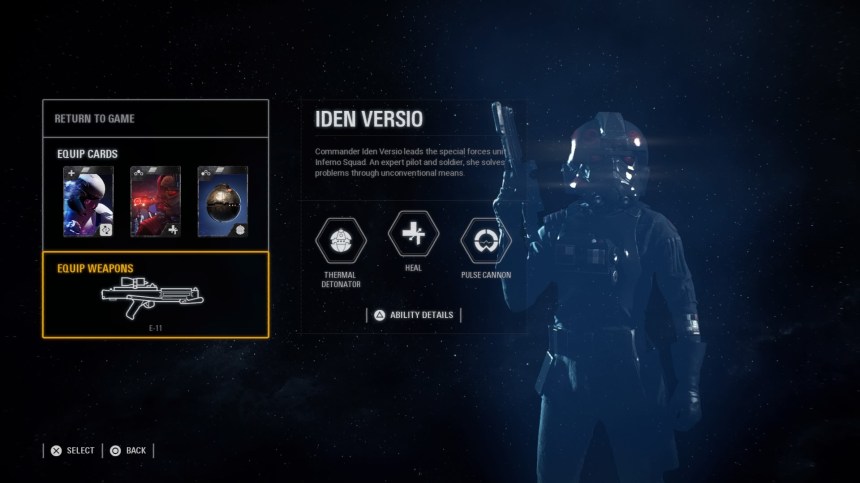
A small number of Iden’s many abilities. Photo by Christopher Lee

Iden utilizes several abilities available to her as she fights her way through the smooth and fast-paced combat.

DICE uses the single-player as an opportunity to introduce players to all the sides of combat they will face in the multiplayer game option.

The single-player section involves ground and space combat connected with vehicle sections and action. All this comes together to make the gameplay both fun and cinematic.

Very few game developers can make the gameplay feel like a movie like DICE can. Players really feel the seamless gameplay as they sprint, shoot and roll to victory.

I enjoyed the single-player campaign more than I thought I would. From the characters to the settings, it all came together to form a well-structured narrative. Unfortunately, the campaign possesses noticeable, unavoidable faults.

The Bad

Almost every bad thing about the campaign comes from its length. While I enjoyed every moment of the campaign, I must mention its disappointing length.

Clocking in anywhere from four-to-six hours (depending on the difficulty setting), the campaign comes across as too short. This short length brings one of the biggest problems of the campaign to the forefront: the pacing.

This game goes way too fast. The game seems to move at breakneck speed from one location to another, and this only hurts the story overall.

Important decisions, clashing loyalties and huge game-changing events seem to fly by. Spending more time developing the characters and their motivations would have been better.

Single-player Conclusion

DICE did a fantastic job with the campaign. Even with a short length and overly-fast pace, The story’s pros outweigh the cons. The way DICE integrated Iden’s story into the established “Star Wars” canon makes it a “Star Wars” experience.

The following video showcases “Star Wars Battlefront 2” at its finest. Watch Iden fend off the rebel attack on Fondor Station.

Multiplayer

The Good

Most of the good about the multiplayer gameplay comes across as “second verse same as the first.” The fluid, fast-paced combat shines in the multiplayer, rewarding skilled players without punishing newer players.

The multiplayer shines in the maps and the game modes, an area where its 2015 predecessor failed. It appears DICE listened to the complaints.

The game came out with 11 maps and five game modes. DICE planned to add more maps later through free downloadable content and updates – a major step forward after the rather disappointing 2015 release.

The addition of free content proved to be a step in the right direction, but it resulted in one the worst criticisms towards the multiplayer.

Overall, I found myself being fully immersed in the beautiful maps as I fought in some of the most iconic locations in the films. The maps and modes vary in terms of gameplay and should keep a player invested for many hours.

This review quickly lists and describes the different game modes. It also includes gameplay for the two largest game modes: galactic assault and starfighter assault.

  • Galactic Assault

The bread and butter of “Star Wars Battlefront 2,” — galactic assault — offers large-scale 40-player combat. The player fights across well-known battlefields piloting different vehicles and fighting as iconic heroes or villains. Focusing on multiple-objective gameplay, this game mode allows players to truly utilize all the game offers.

See an example of galactic assault gameplay. Watch the defense and attacking phase of the planet Jakku from “Star Wars Episode VII: The Force Awakens.”

  • Starfighter Assault

Similar to galactic assault, players accomplish multiple objectives while piloting powerful and iconic vehicles like X-Wings and TIE Fighters.

Watch the video below to see just what Starfighter Assault offers.

  • Heroes vs. Villains

Finally, players can find out who would win in a fight between Yoda and Darth Vader. The game mode proved to be pretty self-explanatory.

  • Hero Showdown

A small-scale take on the established heroes-versus-villains format. Find a friend and fight the forces of good or evil in two-vs-two combat. P.S. Don’t split up.

  • Strike

This mode boils down to a smaller-scale galactic assault match. Its fast-paced combat usually revolves around capturing an objective and getting it to a location for extraction.

  • Blast

Standard team deathmatch: score 100 eliminations before the enemy team to win.

  • Ewok Hunt

They may be fuzzy but they prove to be ruthless. Join a group of stormtroopers as they try and survive, or hunt them down as one of the cute little murderers. This mode will only be available for a limited time.The multiple maps and game modes come together to form a fun, exciting experience. This may be the most fun I experienced with a shooter in some time. But, even the best experiences have flaws.

The Bad

One of the biggest problems with the game tends to be balancing. While the game designers mostly balanced the weapons and vehicles, the maps provided the main problem.

More than a few maps seem to lean heavily to one side or the other. Winning on these maps can feel far more difficult than needed. Of course, this can vary greatly depending on the map, enemy team skill level and team composition.

Consistent updates alleviate annoying balancing problems, but “Star Wars Battlefront 2” lacked in new content.

Updates to “Battlefront 2” felt slow with many content updates being separated by months of waiting. Long wait times are ok if the final product lives up to it, but updates tend to fall flat.

The first large-scale update coincided with the release of “Star Wars Episode VIII: The Last Jedi.” Since then the majority of the patches have focused on balancing heroes, rebuilding the progression system and quality of life changes. All necessary and appreciated, but content felt lacking since December. Though it appears the waiting might be over.

As of the writing of this review, the two most recent updates from April and May have included the addition of a new temporary game mode, Ewok Hunt, and a new content update to coincide with “Solo: A Star Wars Story.”

With the inclusion of new monetization options after the removal of loot boxes maybe updates like these will become the norm. That brings me to the most important part of the review.

The Ugly, or What Used to Be

The character progression system brings the biggest problem. This sentence meant something entirely different with the game’s original release. Now it summarizes many the problems “Battlefront 2” currently face.

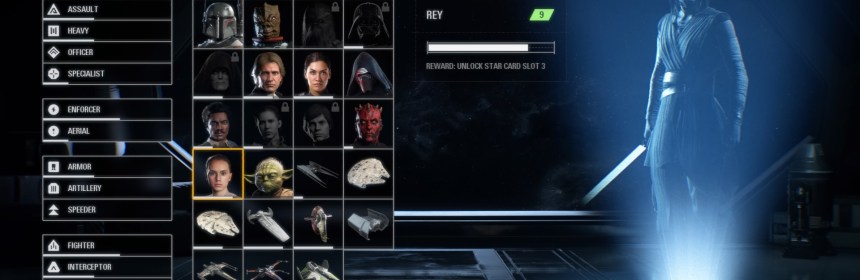
Originally, players could equip upgrades to their favorite classes, vehicles and heroes to fit their favorite play style. These upgrades, called “star cards,” could offer anything from a few seconds off an ability timer to completely changing how the character plays. While still true today, game creators changed how players unlock these upgrades.
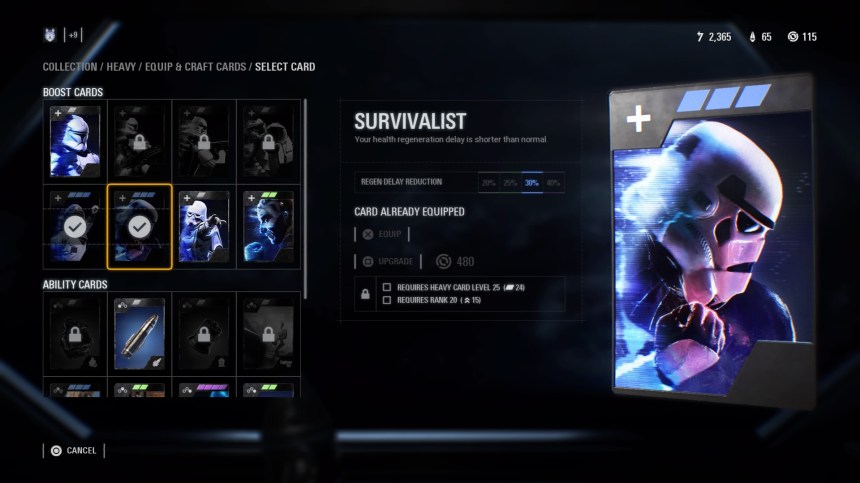
Example of the old progression system. Photo by Christopher Lee


The Controversy

Players unlocked star cards in one of two ways, but both ways relied on the same system.

Players earned three forms of in-game currency: credits, crystals and crafting parts. All of it revolved around the “supply crate” system.

Supply crates describe items earned in the game that gave players random in-game items. These items included emotes, victory poses, star cards and crafting parts. The last two being of most importance.

Players could earn star cards from supply crates. Each crate gave the player the possibility of earning any star card up to a certain rarity. The real problem came from how players acquire supply crates.

Players earned credits just by playing the game. Credits purchased supply crates, which carried star cards and crafting parts. Crafting parts could craft and upgrade star cards, and the best star cards could only be gained through crafting.

While confusing to newer players, it also came with another, bigger problem.

When the game first released Nov. 17, players could purchase supply crates using real-world money. This created backlash from the fans.

Fans called this a “pay-to-win” system, where players could spend real-world money for in-game advantages. DICE answered by removing the option to purchase “supply crates” with money.

“Star Wars Battlefront 2” made up only one part of a much larger controversy involving several different games. To considerably shorten this review, check out this article breaking down the history of the controversy.

After several months DICE changed the progression system entirely to focus more on linear progression. Now players earn experience points to level up their account and classes unlocking new star cards in the process.

As players level up classes they earn skill points which are spent leveling up star cards. This new system stream-lined the progression and rewarded players for playing their favorite classes.

This change brought new life into the game and turned the ugliest mechanic into the simplest.

Multiplayer Conclusion

Despite its flaws, this game provides one of the best shooters I have played in a while. The fun and immersive game play makes me feel like my skill matters during fights, as my many deaths playing as a sniper showed me.

Overall, the multiplayer left a positive impression. I think DICE fixed many of the games biggest problems and could easily fix the rest.

The legacy the unrewarding progression system left behind leaves me more emotionally conflicted than Luke Skywalker after Darth Vader said, “Luke, I am your father.” On the one hand, DICE and EA acknowledged their mistakes and took action to change them, but on the other hand, they tried implementing a clear pay-to-win system in the first place.

Newer players should enjoy the multiplayer just fine, but I wonder how many of the original playerbase like myself left because of how bad it used to be.

Final Thoughts

My time with “Star Wars Battlefront 2” proved to be pleasant and immersive. Short-but-fun single-player combined with fast-paced multiplayer creates a delightful experience.

The game shows several good ideas, but, even with the potential of the progression system, things still need some ironing out.

With the recent changes to the game and the new reduced price, I don’t see any reason to not pick it up.

Even with all of its problems, I still consider it to be one of the best “Star Wars” games I’ve ever played. I just hope DICE and Electronic Arts learned from its mistakes.

Overall score: 7/10

(See how to progress here)

How to Progress in ‘Star Wars Battlefront 2’

by Christopher Lee
Delta Digital News Service

JONESBORO – “Star Wars Battlefront 2’s” new progression system breathes new life into the multiplayer experience for new and returning players.

Designed to help new players, this comprehensive guide breaks down how the progression system works and offers a few effective play style choices to get players started.

Progression

Let us start with the basics: how players progress through the game.

At launch, player progression came from three parts: player level, a class’ card level and items called “supply crates.”

Supply crates offered random in-game items including emotes, victory poses, star cards and crafting parts. Only the last two proved to be important for player progression.

This style of progression proved confusing and dissatisfying with upgrades being given out at random or through hours of grinding to earn enough crafting parts.

After backlash from fans DICE changed the progression system to focus on linear progression. Now upgrades must be earned them the old fashion way, through gameplay. This brings us to star cards, or upgrades equipped to soldier classes, vehicles and heroes.

Star cards offer players the ability to customize their classes to fit their specific play style. Whether running and gunning through enemies or taking a more passive, long-range approach.

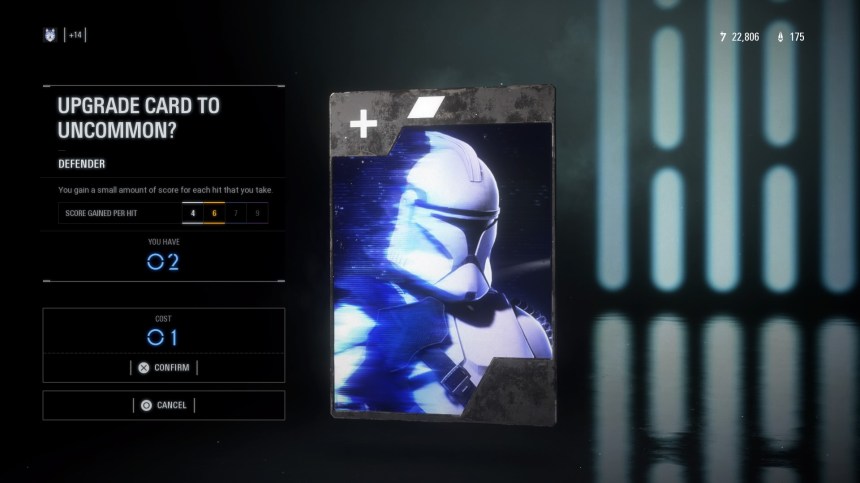
An example of how players upgrade star cards. Note the increased values from upgrading. Photo by Christopher Lee

Upgrading star cards provide better stats including reduced ability cooldown timers and new abilities or resistances.

With the changes to the progression systems, acquiring and upgrading star cards proves to be easier than ever. Now players earn experience points which level up both their account and the individual classes, vehicles and heroes.

Level up a class or hero gains a skill point. Players use skill points to unlock and level up star cards.

Unlocking and upgrading star cards also require a certain account level. This prevents individuals from acquiring powerful star cards at lower levels. However, players gain plenty of experience playing the game earning credits.

Along with gathering star cards, players acquire iconic “Star Wars” weaponry.

Weapons tie into to class progression. Earning them comes from getting kills in a specific class. Getting kills with specific weapons also unlocks attachments for them.

DICE designed the class progression is straightforward. Any needed supplies can be earned through gameplay. Players will find their progress in the “Career” tab on the main menu.

Star Cards and Weaponry

The play styles mentioned in this section offer interesting or strong options for new players, but I encourage new players to experiment with different star cards as they become familiar with the game.

First, let us start with the most straightforward class: assault.

I have two loadouts for assault. I call them “ol’ run-and-gun” and “the mid-range monster.”

“Ol’ run-and-gun” packs the CR-2 as its primary weapon. With its high rate of fire and devastatingly quick time-to-kill, this weapon will win any close-up fight.

For star cards, I went with “Recharge Vanguard” for extra close range damage. This card brings abilities back after the player gets a kill, which goes well with the other two cards.

The last two cards, “Resourceful” and “Toughen Up,” proved to be useful. “Resourceful” brings a player’s abilities up more often, and “Toughen Up” heals damage suffered by the player. I suggest unlocking “Resourceful” for every class. These cards do the most damage at close range. To deal damage at long range, I suggest my next loadout, “the mid-range monster.”

With the right weaponry, assault deals with mid-range opponents surprisingly well – the A-280 fills this niche. With a three-round burst fire mode and balanced weapons stats, it packs quite a punch close-up or far away. For cards, I suggest “Survivalist,” “Bounty Hunter” and “Resourceful.”:

  • “Survivalist” reduces the time required before a player’s class heals from damage taken. This means a player can get back to fighting faster after getting shot, blown up or burned.
  • With “Bounty Hunter” equipped, more “battle points” can be earned. With battle points, powerful reinforcements can be purchased during a multiplayer match to help in team play. If a player wishes to play as a powerful Jedi or Sith, battle points will be needed.

This loadout focuses more on team-play, making it more passive but just as lethal. I suggest this loadout on large, open maps with multiple objectives.

Next up: heavy, big guns and dealing plenty of damage.

Heavy offers two styles of weapons: high rate-of-fire with low damage and low rate-of-fire with high damage. In my time playing, I found all of the heavy guns to be rather consistent. I suggest using the most comfortable gun. For cards I suggest these:

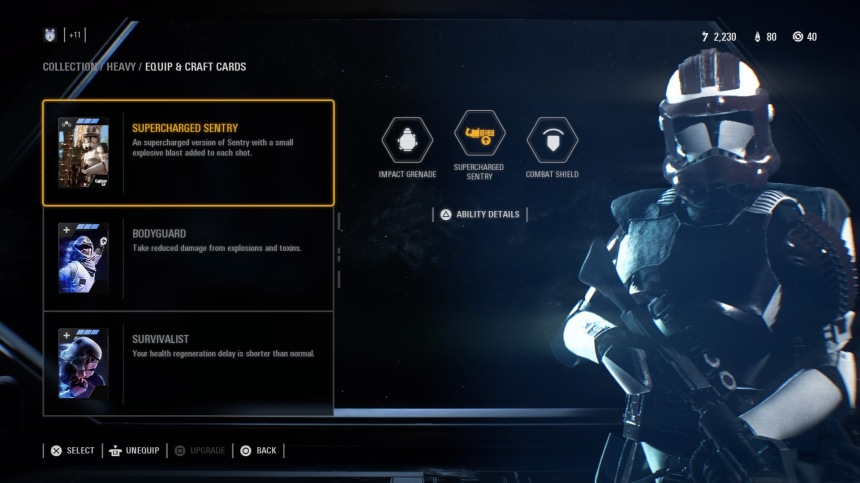
Star cards for the “heavy tank” loadout. Player preference determines the best weapon. Photo by Christopher Lee

Introducing the “heavy tank” loadout. With all the provided resistance, a player will never be blown up. I designed this loadout to solve the heavy class’s biggest weakness: getting blown up.

The heavy possesses an ability called the sentry gun, a mini-gun that does huge amounts of damage, but it makes the heavy move slowly. Because of the slow-moving play style, enemies will throw grenades. Players will need to take a few explosions to do the job, and this loadout helps with that.

“Supercharged Sentry” proves to be the bread, butter and whole kitchen; doing ridiculous damage and healing while in use. The sentry ability offers another fun feature by reducing damage from explosions. Combine this with “Bodyguard,” which does the same thing, and a player can basically “tank” a rocket at their feet.

“Survivalist” provides healing from damage quickly. I recommend this loadout for attacking or aggressive roaming. My next loadout (for defense) proved to be just as fun.

Big guns and bigger explosive guns define this play style, and it will have players yelling “fire in the hole!”

The “artillery inbound” heavy basically works around explosions and nothing else. It consists of a grenade launcher, the “Barrage” star card for general explosion needs, and an explosive sentry for when an area needs to be locked down.

Beware using the explosive sentry offensively, as it cannot move while in use and it fires slowly.

Instead of using small, rapid-fire explosive shots like the supercharged sentry, the explosive sentry sends out massive, highly-explosive rounds capable of killing an enemy with one shot. It works for locking down a hallway or small room for several seconds.

The last star card remains optional. I like “Resourceful” because it gives the sentry back faster.

Sometimes in “Star Wars Battlefront 2,” players need to lead by example and be the guiding light for teams. I have two officer loadouts just for that.

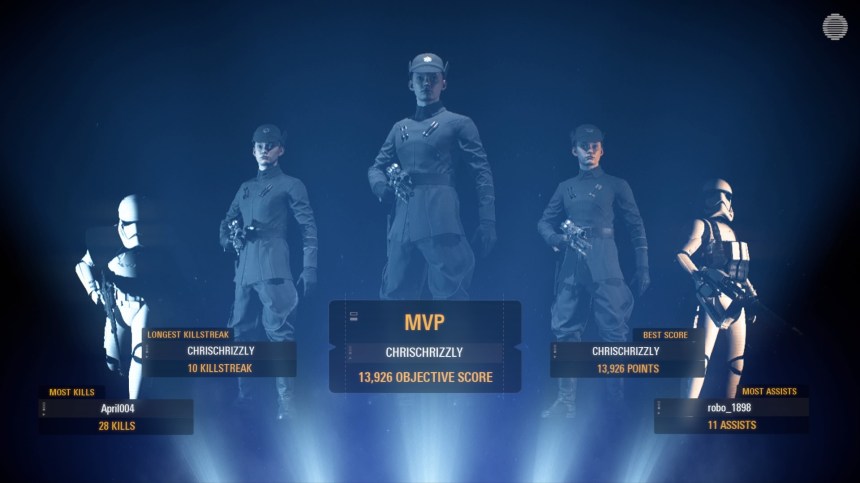
Nothing can get a player to the top of a scoreboard like an officer.

Example of officer’s ability to score big. Photo by Christopher Lee

Like the heavy, I have a hard time justifying one officer weapon over the others. Use them all and figure out which one works. But, I offer some fun cards.

I offer two powerful play styles. One leads the team from the background and the other leads by example from the front lines.

Always use “Resourceful.” Officers need their abilities at all times to defend themselves and their squads. The other two cards differ depending on the situation and play style.

For those interested in helping their team more than helping themselves, I suggest the “guiding light” loadout.

Besides “Resourceful,” players equip star cards revolving around passively supporting their team before using their improved battle command to make a push into enemy lines. The improved battle command gives a team shields and damage mitigation for a short duration, which proves to be crucial for taking objectives.

“Officer’s Presence,” allows allies to heal faster from their injuries, similar to the “Survivalist” star card. This loadout makes one a team player and gets higher scores.

On more close-quarters maps I suggest players “lead by example” with this loadout: “Resourceful,” “Bounty Hunter” and “Disruption.”

As discussed previously, “Bounty Hunter” gains more battle points, and “Resourceful” lowers cool down. “Disruption” makes a fun twist by momentarily preventing all enemies from firing their weapons. This extremely powerful ability can save lives when one “lead by example.”

Last, the specialist class offers sniper gameplay and comes with one loadout useful for every job.

The specialist possesses the lowest health of all the classes. Because of this, survival must be placed at top priority to successfully help the team.

Start with the “Survivalist” card. The specialist’s low health means they will heal the fastest with this card. It proved to be useful when dueling other snipers on the battlefield.

Next, the “Marksmen” star card restores a small amount of ammo after killing an enemy with a headshot.

The “Personal Shield” allows survival from almost any bad situation. It provides shields to absorb a large amount of damage, allowing players to scout ahead or retreat without dying instantly. It also helps when peaking over ridges to look for enemy snipers.

These loadouts should help any newer player start their games off on a strong foot. Best of luck to everyone in all their multiplayer endeavors, and may the force be with you.

Campus Concealed Carry Remains Contentious

by Christopher Lee
Delta Digital News Service

JONESBORO — New interests in school safety have emerged with the mass shooting at Parkland, Florida, and the Westside Shooting’s 20th anniversary fresh on everyone’s mind.

In light of the Parkland shooting, President Donald Trump advocated for arming teachers in the hopes of preventing more mass shootings in a tweet.

The debate of having firearms on campus is not isolated to public schools; it provides a point of contention for colleges and universities as well.

According to the National Conference of State Legislatures, 10 states including Arkansas currently have provisions allowing concealed carry on postsecondary campuses. Provided a person has passed the required courses — including the standard concealed-carry courses and the specialty enhanced-carry courses — gun owners may legally carry their weapon on college grounds.

Dr. Michael McDaniel

Dr. Michael McDaniel, A-State Faculty Senate chair (photo by Christopher Lee)

Arkansas State University Faculty Senate chair Michael McDaniel explained how A-State’s Faculty Senate reacted to the new law.

“It’s hard to speak for the entire faculty. About the only thing I feel comfortable saying is that I believe that the faculty were reasonably comfortable with the situation we had prior to this new law,” McDaniel said.

Prior to House Bill 1249, now Act 562, colleges could opt out of allowing concealed carry on their premises, but with the passing of Act 562 this is no longer an option.

“With the new law we lost that option, so now we can’t opt out. It is the rule and it is the law,” McDaniel continued.

Bill Smith, A-State’s associate vice chancellor for marketing and communications, echoed the idea in a short but strong statement.

“The law is the law and we can’t change that,” Smith said.

Even though the law has officially gone in effect, understanding faculty and student opinions about the new conceal carry law is important for gaining insight into how the law and its implementation are perceived.

Some faculty members like associate professor of political science Richard Wang said they feel they were ignored.

“As you know, the university said, ‘No, we’ll opt not to have concealed carry on our campus.’ Joining with A-State are all the other universities in this state, plus junior colleges, plus the campus police forces, plus the local police, the county police and county sheriff offices all around the state, joining … It’s a coalition, and they all said, ‘No, we want to keep the local option, the option here,” Wang said.

Wang has taught at Arkansas State University for 31 years. He said he was surprised to hear the law  passed. You can hear more of Wang’s opinions about the concealed carry law by watching the video below:

Dr. Brandon Kemp, interim Dean of associate engineering programs

Dr. Brandon Kemp, interim Dean of associate engineering programs (photo by Christopher Lee)

Brandon Kemp, A-State’s interim associate dean of engineering programs, echoed this sentiment when he heard the new concealed carry law had gone into effect.

“My first opinion was that it was ridiculous. As a faculty we have voiced our opinions over and over again that we don’t want guns on campus,” Kemp said.

A Jonesboro native who has worked at Arkansas State University for over seven years, Kemp said allowing guns on campus added unnecessary risk to the campus. He said it also adds confusion to first responders during an active-shooter threat.

“If we have an active-shooter situation and we have people on campus — whether it be faculty or students — who are pulling out their firearms to combat the situation, then the first responders — the police and SWAT — now they have a much more difficult situation,” Kemp said.

Dr. Erik Gilbert

Dr. Erik Gilbert, professor of history (photo courtesy of Arkansas State)

While concerns about increased gun violence with more guns on campus is rational, Erik Gilbert, professor of history at A-State, has already written two articles about the topic of concealed carry on college campuses.

Gilbert cited his articles as his opinion of the new concealed carry law.

In the first article, “Stop Worrying About Guns in the Classroom. They’re Already Here,” published in The Chronicle of Higher Education in March 2016, Gilbert spoke to college faculty in Texas about their concerns with the concealed carry law.

In the article, Gilbert encouraged faculty to relax about the idea of guns being on campus.

I can almost guarantee that if you have a few semesters of teaching under your belt, at some point there have been students with guns in your classroom. If those illegally armed students were not moved to violence by the content of your course or the statements of their fellow students, it seems highly improbable that a new group of legally armed students will prove to be more volatile or violence-prone than their scofflaw peers.

Gilbert ended the article by stating, “Don’t worry about the presence of legally carried guns in your classrooms. If you are going to worry, worry about someone illegally bringing a gun on campus with the intention of causing mayhem, not someone who legally carries a gun in the hope of protecting himself from harm.”

In his second article, “Campus Carry Is Not About Preventing Mass Shootings,” Gilbert argued the choice to allow concealed carry on campus is less about the ability to stop mass shootings and more about letting individuals choose how they wish to defend themselves.

Gilbert wrote, “If you happen to be locked down in a classroom during a mass shooting, wouldn’t you rather be able to shoot back if the shooter comes through the door? If you would rather resort to throwing coffee cups or iPads, as some campus police might advise, that’s a valid choice and I would not try to dissuade you.”

The article, published by Inside Higher Ed in 2017, cites many sources to show how concealed carry has affected mass shootings in states where it is allowed, and how concealed carry benefits students.

College Republicans Rep. Chandler Jones

College Republicans Rep. Chandler Jones (photo by Christopher Lee)

Members of both the College Republicans of A-State and the Young Democrats discussed their opinions on the topic of concealed carry on campus.

“I’m thankful for the state of Arkansas legislature to pass this because it shows that they think of us as humans, they think of us so that we’re allowed to protect ourselves,” College Republicans Rep. Chandler Jones, a pre-professional biology major, said. “I’m thankful and I do think it will be more of a preventative measure; someone who is mentally ill would know that they’re also going to be met with force.”

Jones said he sees the new law as an opportunity, ensuring students have the right to defend themselves if necessary during a mass shooting. You can listen to more of his points below.

Dominique Phillips and Anthony Sumlin of A-State’s Young Democrats discussed the organization’s opinion of the law.

Young Democrats Rep. Dominique Phillips

Young Democrats Rep. Dominique Phillips (photo by Christopher Lee)

Phillips also serves as president of student diversity and recruitment.

“I feel like I speak not only for myself but for my party when I say that I feel like the new laws might cause a bit of a problem,” she said. “In general, you can’t fight violence with violence, you can’t fight fire with fire. You’re allowing guns to be on campus now, even going throughout the so many courses that you have. That doesn’t change when a person has a mental breakdown or a mental issue.

“As far as someone acting as a guardian, it’s a little tricky because I see that and I can see the positive side of how they will be able to fight back,” Phillips said. “But at the same time, is it guaranteed that someone will be able to muster up enough courage to go out and shoot someone back?”

While the College Republicans and Young Democrats sit on opposite sides of the concealed carry on campus debate, both parties agreed mental health reform is necessary to prevent mass shootings like Westside and Parkland.

“I feel that not only in public schools — in high schools and elementary, middle schools — but also in colleges there needs to be a more open discussion about mental health awareness,” Phillips said.

A-State’s Young Democrats Anthony Sumlin, a biology and chemistry major, echoed Phillips’ opinion.

“I think the response should not be, ‘Oh well, let’s give more people guns to hide on themselves.’ Personally I feel like we should do more with educating teachers on how to spot mental health issues and really getting rid of that stigma that mental health is something to be ashamed of,” Sumlin said.

You can listen to more of Sumlin’s statements below.

Jones also said he believes mental health reform provides the key to stopping mass shootings.

“Restricting buying guns now really isn’t going to slow down someone who wants to get a weapon from getting it cause they’re on the streets, they’re sold illegally. So I think it needs to be more mental health,” he said. “Screening these people, getting more help for these people, more … maybe facilities. More money distributed there, I think that’s what needs to be our first step.”

The new conceal carry law has clearly struck a nerve with faculty and students alike, but it is unclear how it will affect the educational climate of colleges and universities. Even with the division the new law has caused, what is clear is the law will continue to create debates about campus safety.


Featured image made by adapting Ibro Palic’s “Gun Holster” [CC BY-SA 2.0]

7 Tips for Improving ‘Battlefield 1’ Multiplayer

by Christopher Lee
Delta Digital News Service

JONESBORO – The multiplayer mode in “Battlefield 1” supplies a perfect jumping-on point for newcomers to the series, but it is a harsh and unforgiving place.

If you’re not careful, it will punish your every mistake. To help new players who may struggle in their first days, I’ve compiled a list of seven tips to improve your time in “Battlefield 1.” Following these helpful tips will help you begin your first games knowing what to do.

1. Have Fun

This may seem obvious to many, so this is less of a tip and more of a reminder.  Games are meant to be fun and as you play, it is important to remember this. Strive to maximize the fun everyone is having.

2. Play the Objective

As you play “Battlefield 1” multiplayer, you will hear players telling each other to PTFO. I can’t break down the acronym and keep this list child-friendly, but I can tell you it means play the objective.

From a game-play perspective, this tip will help you the most. “Playing the objective” means doing what is necessary to win. This varies from mode to mode but playing the objective benefits you and your team. You will gain experience and help lead your team to victory.

So capture flags, sectors or even pigeons and you will see the experience pour in.

3. Learn Your Class and When to Switch

Knowing the ins and outs of all the classes is important for successful teamwork in a class-based shooter like “Battlefield 1.” Learning how each class works, when they are needed and how to be effective with each takes time. So pick one class to start and play the class till it reaches level three.

At level three, the class is basically complete minus one item gained at level 10. After reaching level three, move to a new class and repeat the cycle. As stated before, know when a class is needed, e.g. if your team is constantly dying, it would benefit from another medic more than a sniper.

4. Communicate

Communication provides the key to victory, both in history and in “Battlefield” multiplayer.

It is easy to communicate even if you don’t have access to a microphone. “Battlefield 1” contains a built-in text chat used to give information and commands. Keep your team informed about important events happening at your location.

5. Map Awareness

Pay attention to the map and you will never be surprised by any developments again. The map contains an assortment of information: enemy locations, objective statuses and useful equipment.

Keeping an eye on the map allows the team to quickly react to changes in the flow of battle. The faster you react, the faster you can win.

6. Vehicles and When to Use Them

Vehicles can be powerful assets. They can easily sway the battle in your favor, but don’t be too eager to get behind the wheel of history’s first tanks. While they are powerful, vehicles only allow you to level up the special vehicle classes.

I advise you wait to play vehicles until you’ve reached at least level three with all your classes. That said: if you believe a vehicle could possibly save your team and no one else will take the responsibility, then do it.

7. Don’t Quit

This is the last tip I have and it’s pretty simple. Don’t quit unless you absolutely must.

No matter how bad things are going, always stick it out to the very end. Not only does quitting hurt your team (causing teams to be unbalanced until someone takes your place), but it hurts you as well.

At the end of each round, a score multiplier provides large sums of experience you will need to level up. Leveling up gains you “war bonds,” which you use to unlock new weapons and equipment.

Quitting also prevents you from acquiring Battlepacks, which are randomly awarded to players at the end of each round. They contain weapon skins that act as cosmetic enhancements to individual weapons. Weapon skins allow players to stand out in the multiplayer.

Quitting for something important is understandable. No penalty exists for quitting, so go right ahead; but don’t quit just because your team is losing.

Theses tips come from years of “Battlefield” game experience. I can assure you these tips have secured many victories and will never let you down. To see all these tips in action, watch the playlist below where I go through one of the operation matches in “Battlefield 1.”

‘Battlefield 1’ Packs Action, History Lesson

by Christopher Lee
Delta Digital News Service

JONESBORO – A new entry in the long-running shooter franchise, “Battlefield 1” drops players into the boots of soldiers in the Great War.

People cower in fear as titans take to the field to decide who will be victorious by Christmas. The conflict will be bloody but only one can be the winner. But enough about the holiday game release schedule; let’s talk about its most recent recruit, “Battlefield 1.”

Released Oct. 21, “Battlefield 1” represents the newest entry in the first-person shooter franchise of the same name. In “Battlefield 1,” players take the role of soldiers in one of the bloodiest conflicts in history: World War I.

World War I provides rarely tread territory in the gaming world. Factors for this could include a lack of a clear bad guy or the relatively static combat. DICE and Electronic Arts took it upon themselves to try it anyway.

This comprehensive review of the single-player and multiplayer campaigns tells you whether or not they succeeded.

Single-player Campaign

Battlefield™ 1_20161023183643

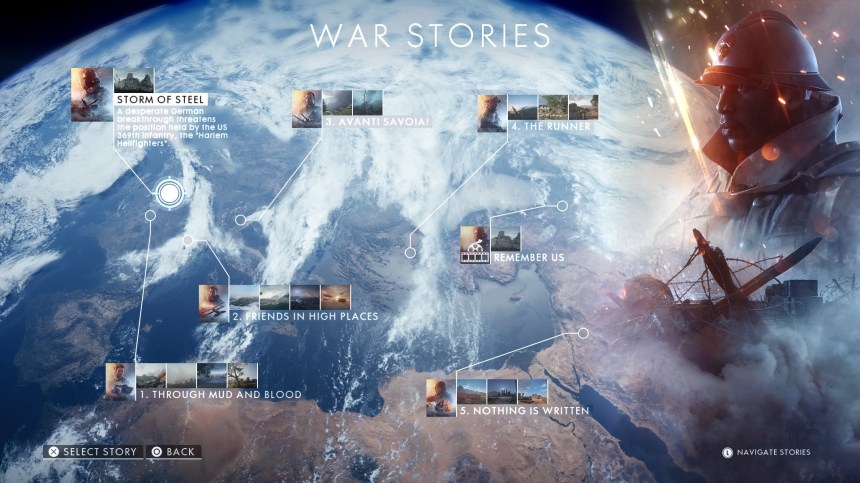
Battlefield 1 single-player menu, “War Stories.” Each story consists of multiple chapters. (Photo by Christopher Lee)

Single-player and Battlefield haven’t always had the best relationship.The lackluster Battlefield 3 and 4 campaigns to the relatively good Bad Company 1 and 2 show a hit-and-miss cycle.

For “Battlefield 1,” it seems developers at DICE focused extensively on the single-player for this entry in the franchise. “War Stories” covers the exploits of five soldiers of varying nationalities as they take part in the “war to end all wars.” From the mud of the Western Front trenches to the sun-scorched deserts of the Ottoman Empire, the campaigns provide a lot to experience.

While battlefield 1’s single-player is definitely a step in the right direction, it is not without its problems.

The Good

The good for “Battlefield 1” can be basically be determined from the writing. Each chapter is a self-contained story with it own characters and narrative. This allows each story to fully flesh out the characters.

Characters interactions are believable and their motivations are genuine. This leads players to form a connection with the characters and their efforts. Many good moments occur throughout the main campaign, but two stories stand out: Chapter 2 “Friends in High Places” and Chapter 4 “The Runner.” While I can’t go too far without spoiling them, I can say the endings will stick with you long after they’re over.

But with the good comes the bad, and Battlefield 1’s single-player is no exception.

The Bad

The majority of campaign problems can be boiled down to one fact: time.

Clocking in at anywhere between eight to 10 hours depending on difficulty and play style, Battlefield 1’s campaign is noticeably short. While this doesn’t subtract from the quality, it does leave the player wanting more.

Luckily the format DICE used for the campaign — having stories be self-contained segments — does allow for the possibility for new chapters in the form of downloadable content.

Single-player Conclusion

As a whole, the single-player gives an enjoyable and enriching experience no “Battlefield” player should go without playing. The following video provides the first 13 minutes of the single-player mode:

Multiplayer

But for many players, the most important questions lie in the multiplayer mode.

Battlefield™ 1_20161024123430

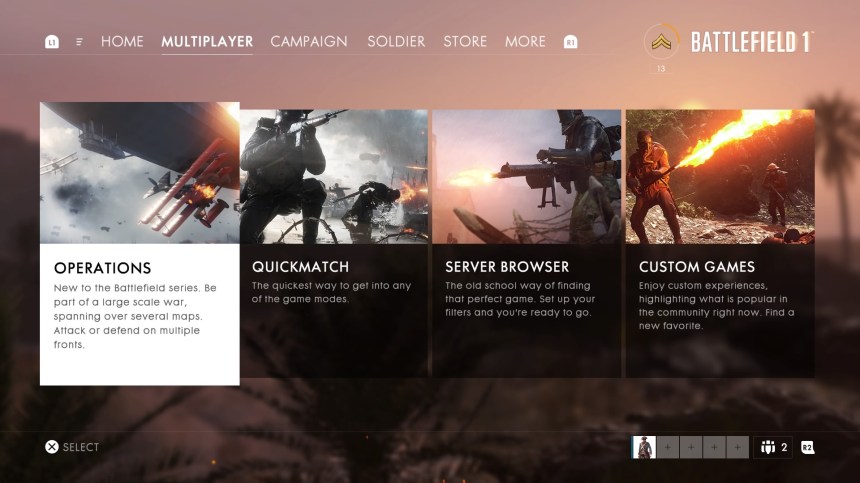
Multiplayer selection screen. Custom games are currently unavailable. (Photo by Christopher Lee)

Multiplayer provided the main selling point for the “Battlefield” franchise for years and with “Battlefield 1,” this is no different. While single-player made major advances to improve, multiplayer provides the majority of the playtime found in “Battlefield 1.”

The Good

The multiplayer mode provides the most refined of all the “Battlefield” multiplayers so far.

Players can quickly grasp the controls and the objectives of each mode as they battle in many of World War I’s greatest battlefields. Achieving rank provides access to period-appropriate weapons and gear to increase your lethality in the field.

New game mechanics and modes increase the re-playability and make each match a fast-paced arena of chaos. But it’s good chaos.

Unfortunately, the multiplayer features its fair share of problems.

The Bad

The biggest problem comes from the game balance. Some weapons and vehicles will cause players many headaches as they die repeatedly until they unlock the weapons they need to fight back.

This problem is worsened by the matchmaker. I found myself fighting players from a variety of levels sometimes having gaps as big as plus-or-minus 30 levels. This led to several unbalanced games.

Multiplayer Conclusion

While it has its problems, multiplayer produced the most fun I’ve had within a “Battlefield” in quite some time. The following video examines “Operations” from “Battlefield 1” multiplayer mode.

Final Thoughts

The romp through World War I left me in awe several times as I saw things I never expected to see brought to life in a video game. Whether a fan of the fighting or the history, “Battlefield 1” supplies plenty of enjoyable moments. I cannot wait to see what DICE and Electronic Arts has in store for the upcoming downloadable content.

Overall score: 8.5/10

Phi Beta Lambda Helps The Helping Neighbors

Christopher Lee
Delta Digital News Service

JONESBORO, Ark.-  Every year, Arkansas State University’s Phi Beta Lambda chapter takes part in their annual Community Service Project, and for the last two years PB…

Source: Phi Beta Lambda Helps The Helping Neighbors