Monthly Archives: August 2017

Rockabilly Legend Dies

Albert Austin “Sonny” Burgess, a 2002 Rockabilly Hall of Fame inductee, died Aug. 18. He lived 88 years.

Born May 28, 1929 to Albert and Esta Burgess in Anderson, Arkansas, Sonny learned to play guitar at an early age and started playing rhythm guitar with his uncles. A lifelong Newport resident, he graduated from Newport High School in 1948. Following a three-year enlistment in the U.S. Army, Burgess joined Johnny Ray Hubbard, Gerald Jackson and Kern Kennedy and formed the Moonlighters. The band opened for Elvis Presley during an October 1955 show at Newport’s Silver Moon Club.

Presley recommended the band record with Sam Phillips at Sun Records in Memphis. The band added Joe Lewis and Jack Nance, then changed its name to Sonny Burgess and the Pacers. Their hits included the Burgess-penned classics “We Wanna Boogie” and “Red Headed Woman,” which sold more than 90,000 copies. Razorback Records released his 1965 hit, “The Short Squashed Texan.” AVI Records released “Hitting That Jug: The Best of Sonny Burgess” in 1995.

Although contemporaries of Elvis, Johnny Cash and Roy Orbison, the band never received the same recognition. Yet a “frantic” stage act led to a degree of notoriety. The group disbanded in 1971, but gained a European following. He later toured with the Sun Rhythm Section before reforming his final band, Sonny Burgess & the Legendary Pacers.

The Rock and Roll Hall of Fame of Europe inducted Sonny in 1999. A year later, the Legendary Pacers released “Still Rockin’ and Rollin’,” voted as the best new album in the country and roots field in Europe. A 2016 documentary short entitled, “The Arkansas Wild Man,” chronicled Burgess’ trip to England to play for his fanbase.

The Arkansas Entertainers Hall of Fame inducted the band in 2007. Memphis’ Rock and Soul Museum devotes an entire wall to the Pacers. Arkansas State University bestowed an honorary doctorate of music on Burgess in 2011. Burgess co-hosted the weekly radio program “We Wanna Boogie” with June Taylor on KASU, 91.9FM in Jonesboro until his death.

Preceded in death by his son, Peyton, survivors include a son, John, and former spouse, Joann Adams.

For more information, see the Encyclopedia of Arkansas entry, the MusicianGuide biography and articles posted to the Rockabilly Hall of Fame. Sun Records promotional photograph courtesy of Sonny Burgess.

*****

(Editor’s note: Burgess was born in 1929, not 1931; this made him 88 years old.)

NEARK Schools Prepare for Solar Eclipse

by Tucker Crain
Delta Digital News Service

JONESBORO – Northeast Arkansas high schools are taking the necessary precautions in preparation for viewing the solar eclipse on Monday, Aug. 21.

The eclipse, which is predicted to take place around 1 p.m., will be visible in the United States from coast-to-coast for the first time since 1918. This brings a new challenge to the school districts, which have not faced the prospect of viewing a potentially hazardous eclipse in recent memory.

The Valley View School District opted out of allowing the students to view the eclipse altogether. Select schools in the Jonesboro, Nettleton, Westside and Ridgefield Christian districts are allowing students to view the eclipse.

“No one will be outside watching the eclipse. Our district made the decision to stay inside and watch a livestream instead,” said David Goodin, Valley View High School principal. “We were worried about the glasses. They’re supposed to be one-size-fits-all, but maybe they don’t fit some students. Younger students may not use the glasses properly, or someone might take their glasses off and get hurt.”

Valley View decided to stream the eclipse instead of going outside to watch even after consent forms were sent home with students. Glasses purchased for the event will go unused.

“Our older students may be checked out by their parents to watch the eclipse with their own approved glasses, and that’s fine. This decision is really just for the general welfare of our student body,” Goodin said.

At Jonesboro Public Schools, all students will be supplied with glasses and allowed to watch the eclipse with an approved consent form.

“We purchased approved solar eclipse glasses for all the students and faculty in the Jonesboro Public Schools district, except for our kindergarten and pre-K students,” Carol Neves, Jonesboro Public School District’s Science, Technology, Engineering and Math specialist. “Every student has a permission slip to get signed by a parent or guardian to be able to watch it. If they don’t get it signed, we’ll still be streaming the event inside our buildings.”

Jonesboro Public Schools is the only district allowing all of its students to watch the solar eclipse. Nettleton, Westside and Ridgefield Christian are only allowing older students to watch, though “older” is different at every district.

“Our eighth-grade through 12th-grade students can view the eclipse. We have contacted local eye doctors and developed a safety plan for what type of glasses to use,” said Michael Graham, Westside High School principal. “We’re conducting a safety briefing before the event. We’ve had some concerns, but our consultations with the local specialists made us feel like students will be safe to watch.”

Ridgefield Christian will also allow seventh-grade students to watch.

“Our secondary students will be invited to view the event. Our glasses will be provided free of charge, but the students must have their consent form approved by a parent or guardian. All our younger students will watch a stream online,” said academic adviser Veronica Reeves.

While other schools secured enough glasses for all students to view the eclipse, the Nettleton School District only secured enough for certain classes.

“All of our science classes will be viewing the eclipse, and we’re trying to find enough glasses to get the entire school out there,” said Brian Carter, Nettleton High School principal. “The ninth through 12th-grade students who are in a science class during the eclipse will be able to go outside and watch it if they have their consent form signed by a parent or guardian.”

The path of the solar eclipse will show between 75-90 percent totality in Jonesboro and the surrounding areas. The totality in each area lasts around 2 minutes and should not be looked at without using approved glasses.

A-State Dedicates ‘The Circle’

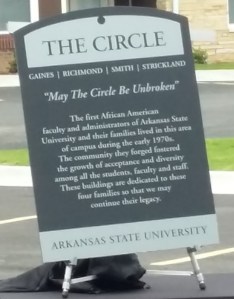
University officials unveiled a placard explaining “The Circle” during the dedication. The university named the apartment buildings for its first four black faculty. Photo by Kimberely Blackburn

by Kimberely Blackburn
Delta Digital News Service

JONESBORO — Arkansas State University honored its pioneering black faculty Aug. 7 at the dedication of “The Circle,” a group of apartment buildings.

Chancellor Kelly Damphousse said such an honor sends a statement and begins many projects intended to make the campus a more welcoming place.

“We’ve come a long way in recognizing the important role that African-Americans play in our community, but we have a lot further to go,” he said.

A-State named the buildings — which will house A-State faculty, graduate students and New York Institute of Technology College of Osteopathic Medicine students — for the four men who taught at a time when many did not accept integration:

  • C. Calvin Smith, emeritus professor of history and A-State’s first black faculty member
  • Mossie Richmond, A-State interim president, vice president for student affairs and dean of University College
  • Herman Strickland Sr., emeritus associate professor of teacher education and dean of University College, and
  • Wilbert Gaines, emeritus associate professor of physical education.

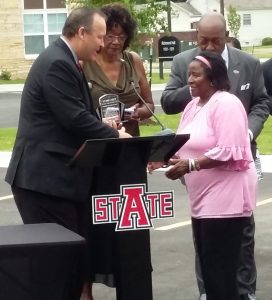
Chancellor Kelly Damphousse presents Earline Smith with a crystal award in honor of her late husband C. Calvin Smith. Each family received an award. Photo by Kimberely Blackburn

Smith lived in campus housing after being unable to find someone in Jonesboro willing to rent to his family. As the other families arrived, they became neighbors and formed “The Circle.”

Rick Stripling, vice chancellor for student affairs, said the dedication sends the statement that Arkansas State embraces diversity. He emphasized the importance of honoring the contributions of these men in the public eye.

Smith’s widow, Earline, said the families’ shared experience formed an extended family who truly loved each other. She said never in her wildest dreams did she expect so many people would attend the dedication. Richmond’s widow, Velmar, said the dedication honored and dumbfounded her.

Strickland said he came to A-State and found friends immediately. He said he gained acceptance as a teacher because of his friendship with Smith, who had done it first. He said he became a dean because Moss mentored him.

Gaines claimed the dedication shows A-State as, “a beacon of light to which other institutions can come for divine wisdom and insight.”

Richard Hartness Sr. authored a book illustrating the families’ lives called “The Circle: Coping With Integrated Life at AState, 1970-1978.” A former student of Smith’s, Hartness said he learned of the story at the celebration of Smith’s life after his death. Hartness said Smith brought important aspects of American and black history to his students that sometimes corrected the history books. Hartness said he now teaches these ideas to his students at East Arkansas Community College.

Richmond’s family member, Sandra Smith, works as principal of the BCH2 Academy at Wynne public schools. She said the dedication provided an opportunity for her to bring ideas to her students and teachers. Smith said she often quotes Frederick Douglass — who said, “Education can be an equalizer” — to show the importance of education to her students.

“In 2017 when we find there is still racial tension at times, this (dedication) establishes the fact hard work does pay off, and there is a facet of America that recognizes hard work,” she said. “As (Arkansas State) honored these founders and pioneers, they have honored themselves. As we lift others up, we lift ourselves up and if we understand that, we will be a greater America.”