A-State African Students Association gives a hand to the homeless
By Christine Miyawa
Delta Digital News Service
PARAGOULD – The A-State African Student Association visited the Mission Outreach of Northeast Arkansas, a homeless shelter based in Paragould, to donate consumables, which included; disinfectant wipes, detergent, tissue paper and paper towels.
In 2018, the first time when the AASA students visited the same shelter, they prepared African dishes and brought to feed the homeless people at the Shelter.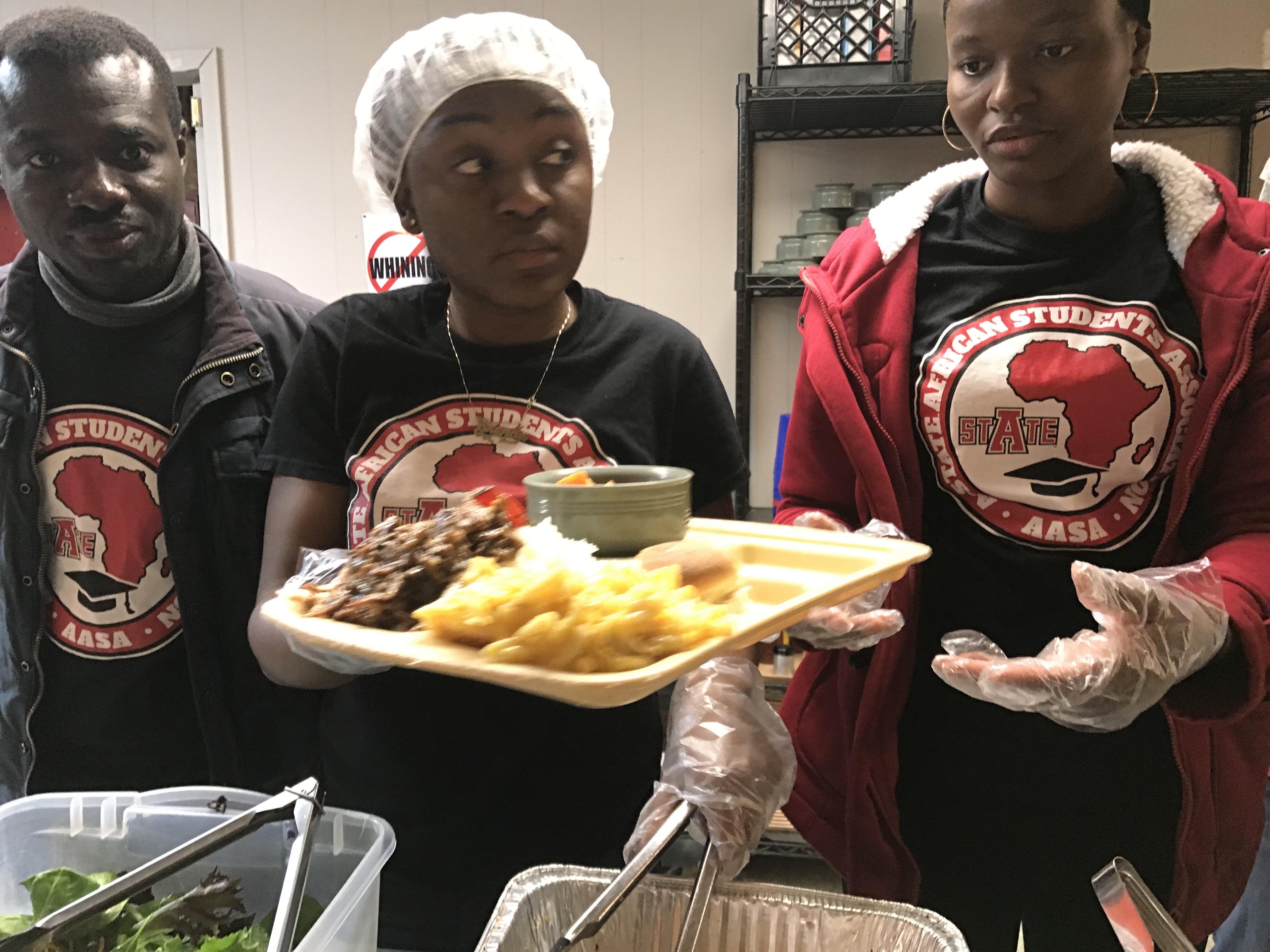
The outgoing president of AASA Samuel Noi said the purpose of the visit was part of AASA’s community outreach program.
“Coming here today is about giving back to society. It’s not only about being students but, being compassionate, fulfilling the needs of others who are less privileged. We called before coming and they told us what they needed and that’s what we brought,” Noi said.
About the Shelter.
Cheri Peters, the executive director of MONEA, said the shelter is the largest homeless shelter in Northeast Arkansas. She said it holds 58 beds and houses men, women, children and families.
The shelter contains three family dorms. Currently, 11 children are at home.
Peters said helping homeless people get back on their feet is the purpose of the shelter.
They assist homeless people with employment, transportation and health insurance.
Management requires residents at the shelter who have jobs to save 75% of their earnings once they start working. Teaching them how to save and budget so they can stand on their own once they leave the shelter.
Peters said the shelter offers benevolent services.
She said they have a food pantry open to the public and a soup kitchen that serves three meals every day.
People come from all over Arkansas for the shelter’s services.
Peters said Jonesboro has the Salvation Army which only has 14 beds. Because the shelter is located in the ‘boot heel’ of Missouri, they get a lot of people from the state of Missouri, too.
She said most of the people are referred; few are walk-ins.
“We have a website and get phone calls every day for placements. Many people who come to the shelter are experiencing drug addiction, meth and mental illness. We have a therapist here at the shelter and recommend that anyone who comes to the shelter receives counseling services,” Peters said.
She said those who come to the shelter seeking help could live at the shelter for up to two years.
“When someone is homeless, and all they have is clothes on their back, you can’t get them to be where they need to be in life in 90 days. They have to get a job, get a vehicle and decided to move out and those things take time,” Peters said.
She said if the residents at the shelter follow the rules and goals set, they can stay for up two years.
“We have repeated, but we don’t want to enable people,” Peters said.
The management carries out random alcohol and drug tests on residents. Once someone has come and stayed at the shelter three times, they must pass a drug test to come back in.
The program doesn’t work for some people. They must be ready to change their lives for it to work.
Peters said 60% of their support comes from residents of Greene County in the form of donations and 40% is from grants.
“Providing paper towels for over 50 people gets very expensive. And so, we rely on donations like what the AASA students gave,” Peters said.
The majority of the volunteers lived at the shelter at some point. They want to come back to give back.
This year marks the sixth year since Peters’ started working at the shelter. She says it’s a blessing but a challenging job.
“It’s not a job you can leave at work when you go home. You take it home with you. When you see people struggling with addiction or mental illness and when you see children in need, it doesn’t leave your mind when you go home,” Peters said.
Peters comes from Mississippi. She worked for a hospice and nursing home before moving to work at the homeless shelter.
“I like working with people and helping people. It’s a rewarding job,” Peters said.
She said the mission outreach is 37 years old and she hopes that they can add more dorms to enable them to accommodate more people.
Peters said the shelter received a grant of $200,000 from the Arkansas Developmental Council to carry out renovations in the toilets, bathrooms and dormitories.
“Every day is a challenge when you work here. We are not just here for the people who live in the shelter, but we are for people on the street too. We have people walking in and say, ‘can you help me get on rehab.’ We have molested children and victims of domestic violence,” Peters said.
She said they take them to doctor’s appointments.
Peters said all the local churches in Greene County are so involved in helping the shelter. The majority come to serve and people will be coming to serve during Thanksgiving and Christmas.
“Some of our children here, this will be the best Christmas they ever have,” Peters said.
Peters said her dream is there would be so many mission outreaches out there because it works. She said if it didn’t, the shelter wouldn’t be here for 37 years. She wished there was an outreach like this in all the communities that needed it.
‘If there was an outreach like this in every community that needed it, we could solve this problem,” Peters said.
Meet Ashley Smith- A resident at the shelter.
Ashley Smith, one of the residents at the shelter, came from Kennett, Missouri. She lost custody of her children while in Missouri. Smith said the state of Missouri took the children when a neighbor called in to alert them of children left at home alone. Smith said she left the children at home without adult supervision whenever she went to work.
She said she initially moved to Missouri from Memphis to get away from people using drugs around her and to be somewhere no one knew her who would want to give her drugs.
Smith said she started experimenting with marijuana when she was 11 years old. She said she was adopted, grew up in foster care and lost her foster mom when she was 20. She said she did not have anybody and turned to the streets to cope with the pain she was experiencing.
“I just wanted to fill an empty spot in my heart, so I started popping pills, doing cocaine and drinking and it just got awful and that’s how I ended up in Missouri,” Smith said.
She said while in Missouri, she did not have any support with the children. Smith has four children.
She said she was off drugs for a year while in Missouri before the state took her children, after which she relapsed.
“So, during summertime, I left my children at home as I go to work. I felt I would check on them. That’s how the state took them,” She said.
Smith said the father of two of her children is deceased, another’s father is not a part of her life and another’s father was convicted for sex trafficking and is serving 55 years in prison.
Smith said Peters and Jana Burnett, the resident case manager, went with her to her court date scheduled approximately three weeks at the time she arrived at the shelter. She said the two helped her get back custody of her children and they currently live with her in the dormitory at the shelter.
“I feel like the shelter has terrific people. They are not doing it just for doing it. If I didn’t come to this shelter, I would still be living in hotels mixing with the wrong people, drinking heavily and doing cocaine because it was within my reach, right in my fingertips,” Smith said. “I was lost without my children. I become delusional. I just thought everyone was out to get me. I was crazy and paranoid. I was under depression. If you had met me then, you would say, ‘ is this girl crazy? What’s wrong with her?’ My mind was not right,” Smith said.
Smith said the shelter helped her find a good job. She said she thought of going to settle for a job at a fast-food restaurant like McDonald’s, but she works at the American Railcar Industries making $14 an hour. She said she is saving her money and plans to get a house for her and her children when she gets out of the program.
She said she stayed in a shelter before and did not get much help but, the shelter at Mission Outreach is in touch with what the residents are doing and try to lead them in the right way.
When she is not at her regular job working, she volunteers at the soup kitchen in the shelter.
Burnett said she does the intake of new arrivals. She assesses the need, set goals for them. If they need identification cards, birth certificates, or if they are disabled. She meets with the residents regularly and follows upon them to ensure they are doing what they need to be doing.
She said the shelter does not take people in a wheelchair because the accommodation has two flights of stairs and no ramp. She said they do not accept sex offenders either or violent felons because of the presence of the children and the safety of the children is their priority.
She said the soup kitchen is open three times a week and anybody can come in and eat. She said the shelter is part of Feed America and gets their food supply from Walmart and Kum and Go.
Cassie Grant’s Story
Cassie Grant, 32, of Marked Tree, Arkansas, also received help from the shelter. Following her release from a hospital admission in Jonesboro after a short illness, she went to the Salvation Army to find shelter. Because the shelter did not take her in, a man brought her to Mission Outreach. Grant was on the streets for a while before she went seeking help. She was doing drugs. Grant was 25 when she started using drugs.
She moved to New York, where she met a friend who influenced her into drinking and using drugs. For her, it was peer pressure. She got sick a lot and got tired. She said she used to “pin handle,” which is standing at a gas station and request to pump a customer’s gas for change. She would then spend the money on drugs.
“I just felt like the black sheep of the family. I didn’t care about life; I didn’t know which way to turn, so I turned to drink and using drugs. I felt like the family disowned me. I felt like nothing; I felt like I was all alone with no one to turn. I felt loved in the drinking and dragging, yet after I drunk, everything went wrong,” she said.
Grant said she grew up in the church.
“I’m a Christian. I want better things in life. So even deep after drinking, I got tired of doing it, it got old,” she said.
Grant said she looks at other families and other people not on drugs, dressed up and looking good and she said she wants. She said because they are dressed-up does not mean they have no problems, but when drinking and drugging everything goes wrong, nothing good comes of it.
She said some family members understood her and did not judge her while others laughed at her and disowned her. She said even when she tried to get help, it did not matter.
“The people who helped me prayed for me, spoke positive words, they gave me money and support,” Grant said.
She said she loves the Lord. And the Lord brought her through the darkest moments.
Grant said there are plenty of times she just wanted to give up in life. She said some people showed up and gave her hope. They told her, regardless of what she is doing in the streets, they were there for her if she wanted someone with whom to talk.
Grants say when she gets out of the program, she plans to get herself an apartment, come back to the shelter to volunteer. She wants to join a missionary church, go to Africa and other countries and volunteer, help feed the hungry and build churches. She said she wants to help people.
She said she doesn’t hold any grudges towards her family members. Now she knows she doesn’t have to prove a point to anybody; her heavenly father is her best friend.
Grant said she is in a place where she gets the needed help and has faith; she is going to do better. She said she would love her family from a distance.
Grant goes to True Life Church in Paragould. She was 7 years old when she got baptized at St. Johns Baptist Church in Marked Tree, Arkansas.
She said she is taking a day at a time. She plans to leave the shelter in a month.
She would like to advise people out there dealing with drug addiction not to give up.
“If you’re running from your problems, know there is someone out there who loves you and when you feel like you are alone, there is your heavenly father by your side. Stand on your own two feet as a woman and a man and take one day at a time. Keep faith, hope and believe and know that anything is possible if you keep your mind to it,” she said.
Joseph Cox’s story
It’s four years since Joseph Cox become homeless. He said he battles paranoia and schizophrenia’.
He thought people were out to get him.
He said he is tired of living in the street and would like to start a different life.
At the age of 3, Cox joined the foster care system and when he was 6 years old, he got adopted. When he turned 17 years old, he wanted to visit his biological mother, but the court terminated his mother’s rights to see him. His adoptive parents took him to Searcy, where his mother worked at a restaurant. He stayed with his mother for three months until he turned 18 years old.
Cox said he found out that his family has relations with outlaws and gangsters and he did not want to be part of it and because of schizophrenia so, he left home and started hitchhiking to Texarkana, Texas, where he lived in the street.
His mother came for him in Texarkana and brought him and his adopted brother to their adopted dads’ home in Jonesboro.
He said at his adopted dad’s home, his other adopted brother and adopted dad did not like them, so he and his adopted brother moved to live in a friend’s house but his friend offered them an insulated doghouse to live in instead. At that point, they met a man who brought them to the Mission outreach.
He said he hopes the shelter will help him obtain documents like social security numbers to enable him to find work. He said someone pickpocketed him and stole his social security card.
He said the shelter promised to enroll him in medical insurance to enable him access treatment for Schizophrenia and Paranoia.
Cox said he found Jesus hitchhiking through the desert. He was so tired and almost passing out when he saw Jesus and said, “bring water my way,” two Hispanics appeared from nowhere with two bottles of water. He remembers when hitchhiking to Texarkana, he was tired and almost giving up when he picked a rubber band on the side of the road written “press on” and after just three miles someone came along and offered him a ride to Texarkana
Cox said no matter what someone is going through; God is always going to be by their side.
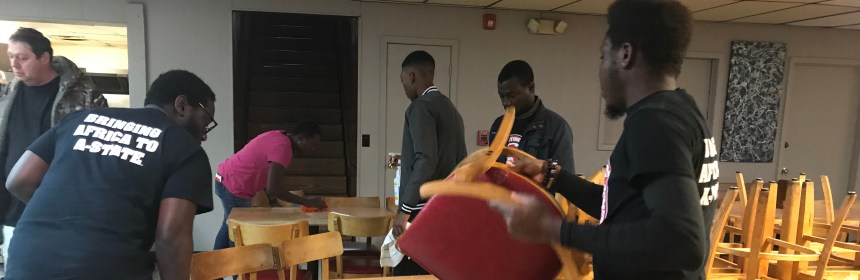
Victor Omowonuola, the incoming president of the association, joined other female members of the association in serving food. When dinner was over, the male members of the association cleaned up the cafeteria.
Peters and Burnett thank the AASA for their kind gesture.
Lawrence Yawson, the vice-president and events co-ordinator of AASA, said the shelter is welcoming and he looks forward to the association coming more often to Mission Outreach to help the homeless people.

 “The main thing that we do is we sit down with our guests and we talk to them about what is going on in their life,” Zugarek said.