Category Archives: Society

Applications Open for Hemingway-Pfeiffer Writer-In-Residence Program

PIGGOTT – The Hemingway-Pfeiffer Museum and Educational Center in Piggott is announcing its 2025 writer-in-residence position.

The residency will be for June 1-30, 2025, and includes lodging at a loft apartment over the City Market coffee shop on the downtown square in Piggott.

The writer-in-residence will be able to work in the studio where Ernest Hemingway worked on “A Farewell to Arms” during an extended stay with his wife’s family in 1928. The residency includes a $1,000 stipend to help cover food and transportation.

“The writer-in-residence will be expected to serve as a mentor for a week-long retreat for writers at the educational center,” stated Dr. Adam Long, executive director of the A-State heritage sites.

This retreat will be open to eight to 10 writers from the region. The recipient may be asked to hold one or two readings of his/her work. The remainder of the month will be free to the writer-in-residence to work on his/her work.

Candidates with a Master of Arts or Master of Fine Arts in a relevant field are preferred.

Applicants should send a cover letter, curriculum vitae (CV), and writing sample of roughly 20 pages, in any genre, to Long at adamlong@AState.edu by Feb. 28, 2025.

Questions about the program can be directed to Long. For more information about the museum or lodging (the Inn at Piggott), one may visit Hemingway.AState.edu.

Incomplete applications cannot be accepted. Due to the expected high volume of applications, confirmation of receipt of applications cannot be guaranteed.

The writer-in-residence program is made possible through underwriting sponsorship by Piggott State Bank.

The Hemingway-Pfeiffer Museum and Educational Center, an Arkansas State University Heritage Site, contributes to the understanding of the regional, national and global history of the 1920s and 1930s eras by focusing on the internationally connected Pfeiffer family of Piggott and their son-in-law and regular guest Ernest Hemingway.

This includes drawing on Hemingway’s influence as a noted American author to foster interest in literature and the arts and promote excellence in both.

Walmart donates to food pantry on ASU campus

The ASU food pantry and Walmart team up to provide more to campus community

Delta Digital News Service

Friday, Dec. 1, 2023

By Avery Jones | Editor

Recently, the Jonesboro Walmart on Highland has been donating to the food pantry on the Arkansas State University Jonesboro campus. The partnership was arranged by Every Child Is Ours, a nonprofit organization headquartered in Tuckerman.

Use of the food pantry is available to anyone with an ASU ID–student, faculty, or otherwise. With the large number of people in need, it can be difficult to keep up with demand, according to Jameson Archer, an ASU student and the president of the volunteer council.

Every year, the food pantry serves 3,000 to 4,000 students and employees. In July of last year, they served 700 people. Usually during summer break, that number would be around 200 since most students are off-campus at that time, so the demand has seemingly increased.

“There are a lot of times where they’re really having to strap to get people food,” said Dean MacDonald, a graduate student at ASU who also works with Every Child Is Ours.

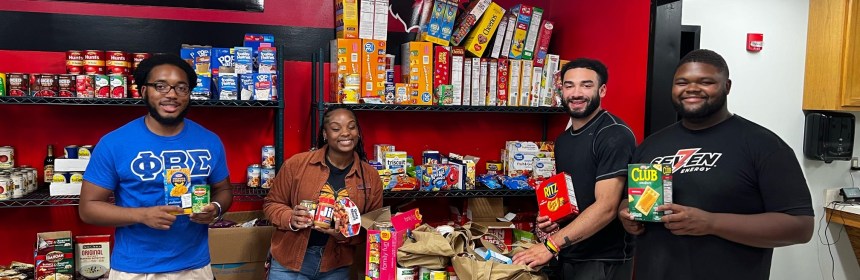
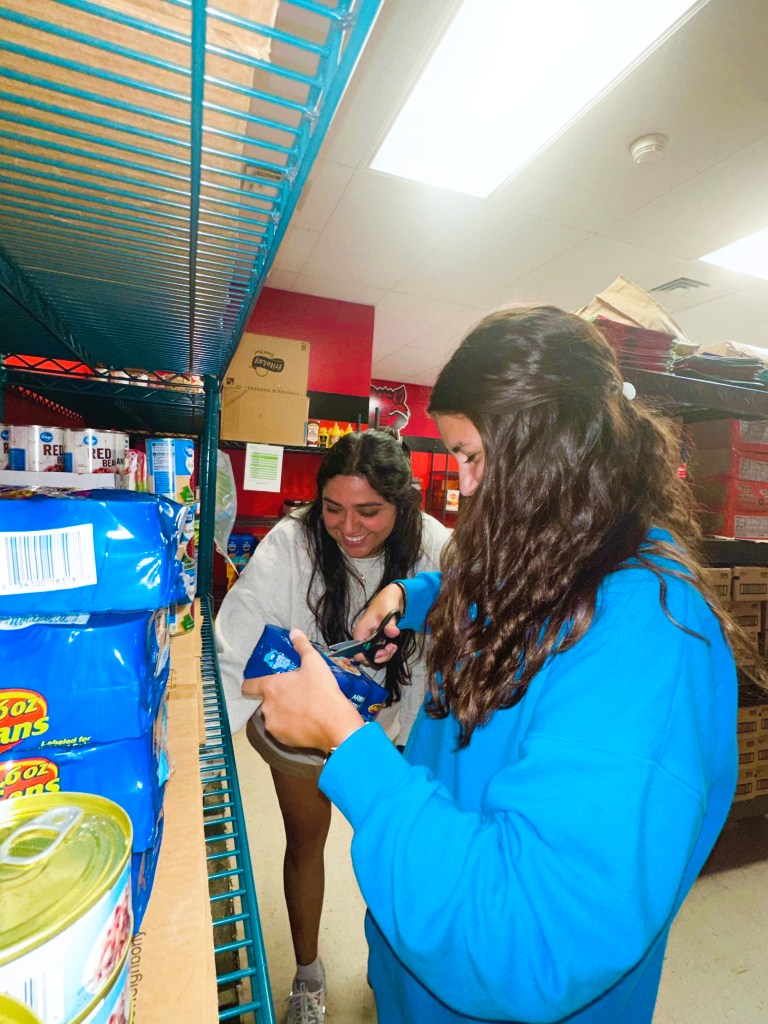
Volunteers Kennadie Hobson and Ericka Hernandez at the food pantry.

Over the summer of this year, they started developing the idea of Walmart donating to the food pantry. The pantry was in need of volunteers since most students had left for the summer. Raven Person, who works in Student Affairs, started volunteering there.

According to Person, she and Bekah Herring, the assistant director of Career Development who also manages the food pantry, started discussing the need for donations. Herring said that almost all of the pantry’s resources come from individual donations.

Both MacDonald and Person personally know Jan Paschal, the owner of Every Child Is Ours. Along with another student, a history major named Alandria Maddox, they set up a meeting with her on June 2 at the ECIO food pantry to discuss what they could do for the community.

Maddox works as an ambassador for Every Child Is Ours. She brings awareness to the cause and helps Paschal whenever she’s needed. She’s been working with them since May when she was introduced to Paschal by Person.

According to Maddox, Person came up with the idea that Walmart might donate to the food pantry on campus. Paschal had collaborated with Walmart before on other projects, and Walmart also often donates to similar causes.

“A lot of hard work was done by Dr. Hogue, Dean, Raven, and Mrs. Jan,” Maddox said.

Paschal said at the meeting that Walmart wanted to donate to ECIO, but it would be better if the donations went to ASU instead. Paschal contacted an executive at Walmart, Carolyn Hembrey, to set it up. 

Hembrey said that she has worked with Paschal many times. She approved the new project and helped to coordinate times for when the volunteers come to pick up the donations.

“I just did not realize that there was a need. I guess we just assume if they’re going to college, they must have the funds to eat, and I was just like floored at the need that there was…” Hembrey said. “I’ve really been encouraged by the participation from the volunteers and just the excitement that they’ve had about the project also.”

The donations occur once weekly. They consist of canned items and other preserved food but also fresh food, such as vegetables, fruit, meat, and dairy. These donations offer a bigger variety than what the food pantry is usually able to provide.

“It’s widened our variety,” said Archer. “It’s always nice because we’re serving so many people, it just gives us something else that we don’t have to personally buy.”

-30-


Note: Feature photo shows volunteers at the food pantry.

VIDEO: National Loving Day

Delta Digital News Service

June 12, 2021

By Rangsiya Faihin | Staff Photographer

JONESBORO, Ark. – Every June 12th is the anniversary of national ‘Loving Day’. The day recognizes the interracial relationship of Mildred, a woman of black and Native American ancestry and Richard Loving, a white man who were arrested due to violating the Racial Integrity Act of 1924. However, in 1967, the U.S. Supreme Court ruled that it is unconstitutional to ban interracial marriages.

Every June 12th is the anniversary of national ‘Loving Day’. The day recognizes the interracial relationship of Mildred, a woman of black and Native American ancestry and Richard Loving, a white man who were arrested due to violating the Racial Integrity Act of 1924. However, in 1967, the U.S. Supreme Court ruled that it is unconstitutional to ban interracial marriages.

-30-


Rangsiya Faihin

Rangsiya Faihin is an engineering senior at Arkansas State University in Jonesboro. She can be reached at: rangsiya.faihin@smail.astate.edu


NOTE: Featured photo by Lareised Leneseur on Unsplash

Veterans’ Village nears completion

By Yu Bai
Delta Digital News Service

JONESBORO – Military veterans in Jonesboro will soon have a permanent place to call home. Construction of the first ever veterans’ village is in its last stages of completion.

“The village looks to be done on March in the next year,” said Guy Pardew, the vice president of Olympus Construction, “we are really proud of it.”

The construction plans started in 2019, and almost all the basic construction of houses has now been completed.

The village includes nine units which can hold up to 20 people. Two of these units include a two-bedroom floor plan which is designed for veterans with their families. The reaming seven units are one-bedroom apartment.

In addition to living houses, the village will also include a faculty building and a community building that can provide computers to veterans to do their works.

The out-door area will be a common place for veterans to cook together.

The veterans village is a partnership between the city of Jonesboro and Arkansas State University. The Beck Pride Center of A-State is willing to provide combat wounded veterans with first class educational programs and services.

“Our goal is to get these homeless veterans back into society. So with the programming, we’ll use students from different programs like social work, occupational therapy, and physical therapy to provide services to these veterans,” said Lynda Nash, director of the Beck Pride Center.

To better treat those veterans with PTSD and psychological trauma, the Beck Pride Center also provides free classes to them, such as anger management, stress management, and music classes. When veterans join these classes, they will explore to learn more appropriate coping mechanisms with their leaders.

“It’s a national project between us and the village, we’re lucky because Jonesboro is the only city in Arkansas selected to build the village,” Nash said.

The village is built on Aggie Road from Pepsi Beverage warehouses. The Cooper-Mixon Architect Firm is responsible for the construction of the entire village project.

John Mixon, an architect at the Cooper-Mixon Architect Firm, said the house’s actual size is smaller than expected, which is adjusted according to actual needs.

The village is close to the road, so the transportation for veterans is convenient. The  city will provide a complete transportation system that includes bus stops, bicycles, and the JET system.

Total cost of the village is $1.1 million dollars.

Veterans Village Plans for the Future

By Chloe Short
Delta Digital News Service

JONESBORO — The Veterans Village coming to Jonesboro features major plans.

More than 5,000 veterans live in Craighead County and around 200 of those veterans are reported as living below poverty level. The Veterans Village plans to help homeless veterans get back on their feet.

The Beck Pride Center will be active in the Veterans Village by making sure the right services and paperwork are provided to the homeless veterans. Interested students with majors in social work, counseling, physical therapy and other degrees from Arkansas State University will work with The Beck Pride Center through volunteering or internships to assist in the Veterans Village. Individuals from the Veterans Village will be able to receive those services after they have left.

Beck Pride Center director Lynda Nash (photo by Chloe Short)

“Veterans have been a productive member of society in the past. Something’s happened, so at that point we want to put them back in that role again. They’ve given to society, they continue to give and they should be honored for that,” said Lynda Nash, director of Beck Pride Center.

Other organizations waiting to get involved are the Disabled American Veterans Group, Veterans of Modern Warfare and the PTSD Foundation. The village will find residents through word of mouth but also through law enforcement expressing concern, veteran’s service groups, contacts through other veterans, and by contacting those who show up at the HUB downtown.

Nash said she’s pleased the Veterans Village is set for Jonesboro, since she will now have local options for them and their families if needed. Sending veterans needing housing assistance to Memphis, Tennessee or Poplar Bluff, Missouri are currently the only options available.

“Once accepted, they’re willing to work a program, so it can lead to a more permanent setting for them,” Nash said.

The village’s development on Aggie Road will be built down from Pepsi Beverage warehouse. The Cooper-Mixon Architect Firm originated all of the design aspects and created housing to meet the needs of each individual. Hillary Starnes, Jonesboro’s community services manager, said the homes should be completed by late 2020.

John Mixon, architect at the Cooper-Mixon Architect Firm, said nine homes will be built: two homes are made for families and the other seven are designed for single occupants. Each house features a different exterior. The village includes a community building and a community pavilion.

47694366402_f5dabc4290_k

Sign on site of the future home of the Veterans Village. (photo by Chloe Short)

“The Veterans’ Village is a fully accessible community with different scales of experiences and a continuum of public to private life,” Mixon said.

Arkansas Development Finance Authority granted $1 million to cover funding needs for the Veterans Village. The Arkansas Development Finance Authority released a Notice of Funds Available and received three applications. Cheryl Schluterman, president of the Arkansas Development Finance Authority, said each application must meet application completeness, fulfill requirements and be financially feasible. Of the three applicants, Jonesboro met the criteria.

“There is still funding available for other projects. So far, Jonesboro is the only recipient of National Housing Trust Funds in Arkansas,” Schluterman said.

Bill Campbell, director of communication for Jonesboro and spokesperson for the mayor, said the mayor is going forth with the challenge to end veterans’ homelessness.

The city will be providing transportation at the village. There will be a bus stop, bicycles and a bike rack. The JET system will be an option. The village accommodates veteran’s dogs as well.

Nonprofits play pivotal role in helping homeless

By Brooke Buckner
Delta Digital News Service

JONESBORO — Nonprofits provide resources for the increasing homeless community.

The Salvation Army is the only homeless shelter in Jonesboro, but there are many other resources for the homeless.

United Way of Northeast Arkansas and The Hub help the homeless community, but don’t house them.

33855969068_5ecd1bb8ef_k

Nanette Heard and Shaila Creekmore at United Way of NEA. (photo by Brooke Buckner)

United Way helps the working people and serves eight counties. They provide a backpack program for kids in need of food with the Food Bank of Northeast Arkansas and fund a program called Homeless to Self-Sufficient with Mission Outreach of Northeast Arkansas.

Nanette Heard, executive director of United Way, said, “A lot of what we do is raise funds for programs. Unfortunately, there aren’t a lot of shelters in our area.”

UWNA helps people get back to work by providing work clothing, boots, childcare and transportation. Most of their programs are geared toward kids.

Gwendolyn Zugarek, executive director of The Hub, said the 2-year-old resource center provides a 90-day program for the homeless. The first step to helping people is tracking down their birth certificate or getting them an ID so that they can move forward from there.

HUB“The main thing that we do is we sit down with our guests and we talk to them about what is going on in their life,” Zugarek said.

The Hub offers a bike program allowing guests who don’t have transportation to ride a bike to their job. The guest’s responsibility is to buy the bike lock.

Currently, the Hub is a community-funded organization. They usually see an estimated 40 new homeless individuals every month and they helped 532 individuals in their first year of being open. Their mail center helps the less fortunate receive benefits.

Shelters Outside of Jonesboro

Shelters in Blytheville and Paragould provide help year-round for the homeless.

Blytheville’s Mississippi Union County Mission helps women, children and men. Most of the children who come in are 17 to 18 years of age. The majority of residents are single.

There’s no time restraint for living at the Mission, but the average time is three to four months.

Mission Outreach of Northeast Arkansas in Paragould takes all ages and people can live there for up to two years. Director Cheri Peters said she sees more single people coming into the shelter. In 2018, Mission Outreach of NEA provided shelter for 452 people.

The Mission houses 55 and Mission Outreach houses 58 people. Both of these shelters house increasing numbers during the winter and summer.

In addition to housing and feeding residents, Mission Outreach helps residents with birth certificates, employment and insurance.

Lisa Willard, executive director of The Mission, said they offer a work program consisting of yard work or odd jobs. The charge for the community is $10 per hour and the workers get paid $8.50 per hour.

Similarly, Mission Outreach offers jobs and provides transportation for their working residents like United Way does.

Both of these shelters feed the less fortunate by serving food boxes. The Mission serves 100 food boxes per week.

Mission Outreach’s food pantry feeds low-to-moderate income families. These families can come once a month to get food boxes. They also have a soup kitchen that prepares three meals per day.

“For the food box, you have to be a Greene County resident,” Peters said.

Willard and Peters said they enjoy working at these shelters because they watch lives transform.

The community can help each of these organizations by volunteering or donating toiletry items, canned goods, blankets and furniture.

Couple Makes Best of Tough Situation

By Jessica Ladd
Delta Digital News Service

JONESBORO — In America, 553,000 people experienced homelessness in 2018. Of those, 2,712 lived in Arkansas.

The homelessness issue in America continues to rise due to a lack of housing options for those with a low income. Without housing options, people face eviction, instability and homelessness. Low-income households don’t make enough money to pay for food, clothes or a home.

In recent years, Jonesboro took steps to reduce its homeless population. Mayor Harold Perrin enacted a task force to end homelessness. The HUB, a homeless resource center, opened in 2017 and the city has multiple food pantries available to help those in need. These services help, but people are still falling through the cracks.

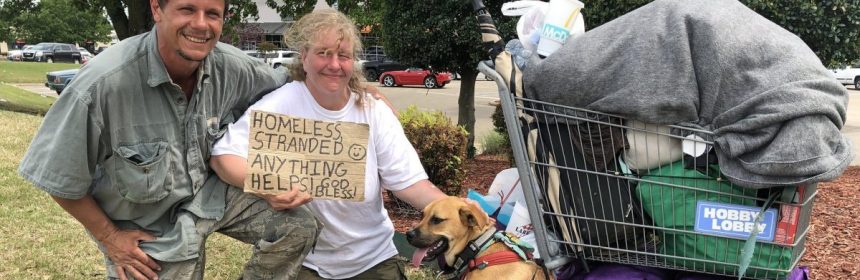
Patricia Eggers and Allen Wheelis married 15 years ago. The two fight and argue like most couples, but they love each other more than anything. They own a registered service dog named Prints. A devoted Christian, Eggers carries a Bible with her everywhere. Wheelis enjoys playing the guitar and singing. The pair also suffer from homelessness.

32790971757_2f96d25cb7_k

Eggers’ service dog, Prints (photo by Jessica Ladd)

“I don’t wish it on anybody,” Wheelis said. “Once we get back to square one, we get knocked down again.”

The couple came through Jonesboro in the spring and said they’ve been homeless for over a year and a half. Eggers worked at a Save-A-Lot but lost her job. A few months later, Wheelis lost his job, too. They didn’t know what to do. Wheelis’ sister lives in Missouri. She told them they could stay with her. She called them to cancel while they were driving through Louisiana. They didn’t know where to go or what to do.

Their car broke down in Louisiana. The two couldn’t afford to have it towed, so they left it behind. Now, they hitchhike or travel on foot. The pair have been all over Louisiana, Texas, Missouri and Arkansas.

Hurricane Harvey flooded the woods they were sleeping in. They lost most of their stuff.  Another time, a levee broke and flooded their campsite. Eggers said she later went back and waded through knee-deep water for her Bible.

Through all the hardships, Eggers kept her faith. She served five months at Phelps County Jail in Missouri. During that time, she was all alone. She said it was the hardest thing she’s ever gone through. She turned to God for support. Eggers said God is watching over them and everything happens for a reason.

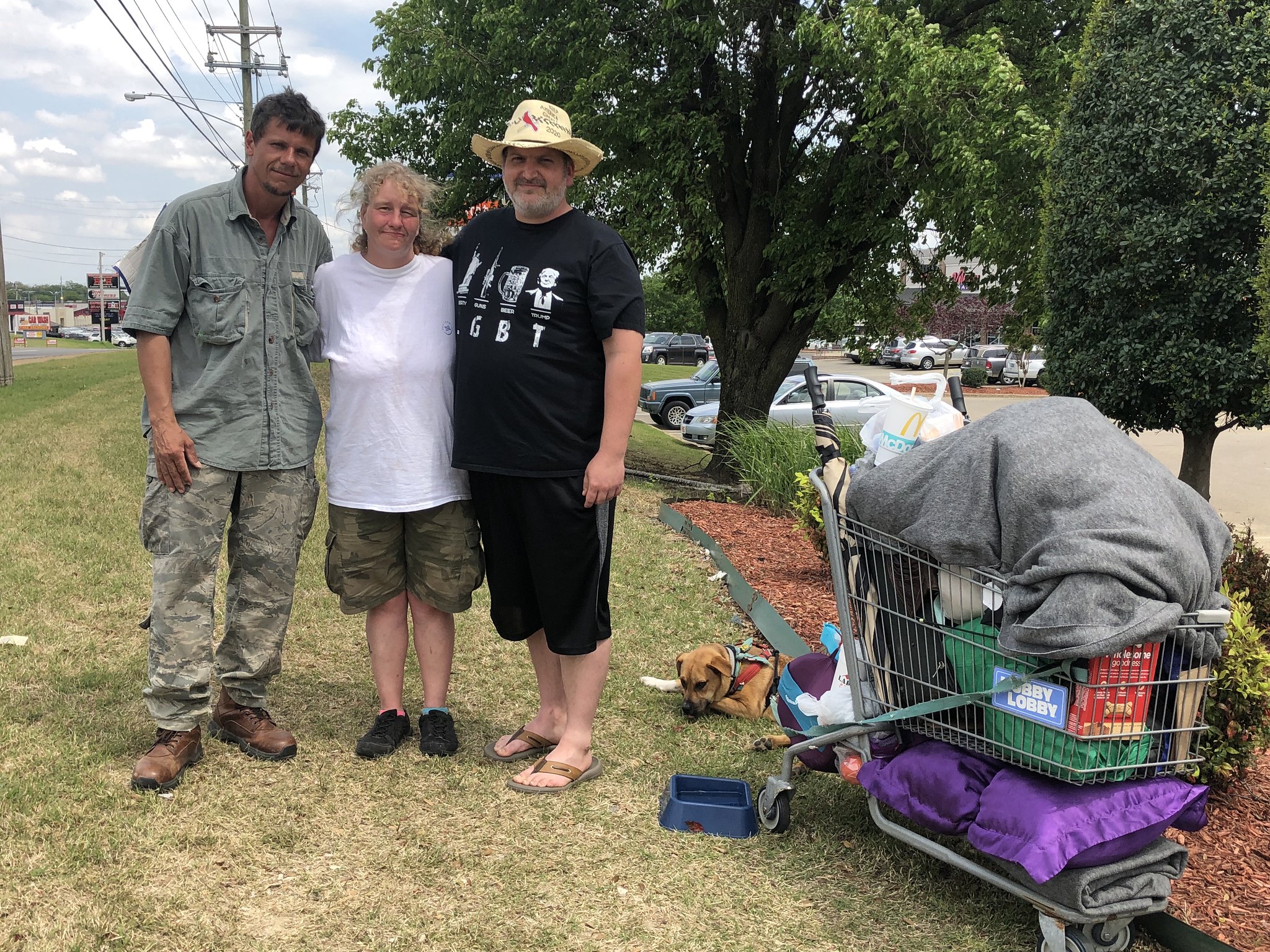
They carry all their belongings in a Hobby Lobby shopping cart. The pair came to Jonesboro in April. During the day, they tried to panhandle money. Wheelis said he didn’t want to panhandle, but they need money for food and shelter. He couldn’t find a job. Employers want an address, driver’s license or birth certificate. Neither one of them possesses a valid form of identification.

Eggers said her identification was stolen. She was walking along a road late at night in Lafayette, Louisiana. A man offered her a ride. She accepted. Eggers asked him to stop so she could use the bathroom. Once she got out of the car, he drove off, taking her purse with him. She lost the little money she had, her ID and important family photos she can never replace.

The couple said people treat them differently because they’re homeless. Eggers has been embarrassed more times than she can count.

“I had one guy tell me to go out and sell my body,” she said. “For you to sit there and say that to me— I’d rather sit here holding a sign than sell my body.”

They’ve been kicked out of gas stations, restaurants and even Walmart. One McDonald’s told them they were taking up space and needed to leave. They are constantly refused service. Once, they were arrested for sitting on church property.

Wheelis said most people assume they’re hooked on drugs or alcohol. When people hand him money, they’ll tell him not to spend it on the substances. Eggers said people don’t trust others nowadays. Eggers blames individuals who panhandle and don’t need the extra help. She said it hurts the people who actually need it and makes people less likely to help.
47734384711_116cfaea4c_k

Allen Wheelis, Patricia Eggers and Nick Bennett stand outside the Walmart Super Center on Highland Drive. (photo by Jessica Ladd)

However, good people still exist who will lend a helping hand. Nick Bennett, a Jonesboro resident, saw Eggers and Wheelis sitting outside the Walmart Super Center on Highland Drive. Instead of giving them money, he gave them time and compassion. Bennett stopped and spoke with the couple for about 45 minutes. He said sometimes people just want someone to speak with.

“I’m here because I care. They’ve told me about the harassment they’ve gone through. It’s a disgrace — having water thrown on them. There’s no call for that,” Bennett said.

Bennett returned later with some clothes for Wheelis. He said he knows they’re just down on their luck. He called them genuine, down-to-earth people.

Eggers has a 23-year-old son from a previous marriage. She maintained contact with him but he isn’t financially stable enough to help them. The rest of her family and friends, she said, didn’t bother to check up on her. To her, that’s what hurts the most. Wheelis has a daughter from a previous relationship and they don’t talk much. None of his family offered to help either.

Wheelis said their situation is only temporary. He wants to get both of them valid forms of ID. Then he wants to get a job. Eggers suffers from PTSD and she has very bad anxiety. She said that’s why they could never stay at homeless shelters. The shelters always wanted to split them up. Wheelis agreed. He said he wasn’t going to sleep without his wife. They hope to get Eggers started on disability soon.

Both managed to keep a positive outlook on life. These two endured so much. They still try to smile at people and thank them for the help. Wheelis said he’s had people give him as little as 20 cents. He said it doesn’t matter the contribution, just as long as it from the heart. They said the key is staying humble and not letting pride get in the way.

Free Food Transfer Hub for the Homeless

by Yu Bai
Delta Digital News Service

JONESBORO — About 48,000 homeless people live in Arkansas: 8.5% of them are veterans and 20% of them have a serious mental illness. People who suffer homelessness are also struggling with a serious problem: hunger.

Many factors are contributing to this problem. Homeless people in the age group of 60 to 65 in Arkansas are mostly African-American or Hispanic and they lack transportation to the food vendors, so they are more susceptible to food deprivation.

“I don’t think there is anything that directly contributes to homelessness other than the circle of poverty. People cannot buy food without money. The most difficult problem I have to face is about getting fresh food,” said Vonte Benjamin, who has been homeless since 2018.

Food Bank of Northeast Arkansas

The Food Bank of Northeast Arkansas started in Jonesboro in November 2012. This organization distributes food to people in need through nonprofit agencies and networks.

“We are a member of Feeding America. We have served more than 30 million pounds of food to homeless and the poor since we established,” Corporate Partnerships coordinator Amber Horton said.

Living in an agricultural state, FBNA makes every effort to ensure it provides the freshest and safest food. Local and national manufacturers, retailers and growers supply the food sources. Otherwise, people who work in the Department of Food Security will destroy other unidentified food.

Benjamin said the place he has been living has no kitchen to cook in so he went to the food bank to find fresh food.

The organization runs its work with a mature industrial chain. It distributes four-to-five kinds of food to 20 locations in 12 different counties each year. People must check a schedule list before they go to the designated location to get food.

Homeless people have a chance to get an emergency box that includes sufficient food once a year. It is the only special program requiring them to show their identification.

“In recent years, we provided about 2.5 million pounds of fresh produce through the support from grower partners; it’s equivalent to 62 tractor-trailers’ load capacity,” said Jennifer Hannah, FBNA outreach coordinator.

Competition and Cooperation with Arkansas Foodbank

As the distribution center, FBNA works with more than 100 organizations, including the Arkansas Foodbank, which located in Little Rock.

The Arkansas Foodbank started in January 1984, and it is the foundation in the fight against hunger. It forms an important food hub with FBNA for providing fresh food supplies to nearly 34,000 people in 12 counties.

These organizations feature the same programs, such as food pantries, soup kitchens and shelters for homeless people.

Compared with FBNA, the Arkansas Foodbank can access other partner organizations in big cities such as Houston, Texas because of its central location.

“Both of our food banks play a special role as warehousing and distribution facility, and it is more in the sense of complements rather than competes,” FBNA Compliance and Facilities manager Jeff Fielder said.

However, there is a program unique to the Arkansas Foodbank — it has a partnership with the Arkansas Rice Depot.

Rice farmers in Arkansas realized they had a surplus crop and many hungry neighbors in 1982. They tried to improve the lives of hungry Arkansans with the establishment of Arkansas Rice Depot.

Arkansas Foodbank depends on the food source of Rice Depot, and the Rice Depot needs the food bank as a shipment center to help it transport food to other places.

The food bank constantly is looking for better and more efficient ways to deliver much-needed food to people. It is a vital organization to help solve the food shortage and security problems of the homeless.