Author Archives: Jorge Quiquivix

Vigorous Training Benefits K-9s, Handlers, Community
By Jorge Quiquivix
Delta Digital News Service

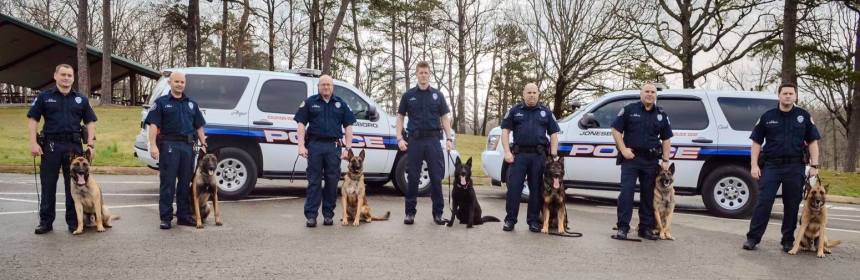
JONESBORO, Ark.- K-9s are part of several law enforcement agencies in the Delta. These animals even have a presence in smaller police departments.

Jonesboro Police Sgt. Cassandra Brandon spent five years as a canine handler and says these dogs help them sniff out drugs.

Her K-9’s name was Mick and she quickly found out this assignment was going to be different than being a patrol officer. Unlike patrol officers, canine handlers go home but they are technically still working.

“I had to pay not only attention to what was going on out there, but I had to pay attention to him too and make sure he was okay. That he was comfortable. That he didn’t need to go potty or anything like that. It’s just a lot of extra responsibility as a K-9 handler,” Brandon said.

She also had to train constantly as required by Case Law, which is what the police world operates by. Among the requirements is 16 hours of training a month.

“If there was not a whole lot going on, me and him would go out and we’d just train on our own,” she said. “Mainly that was for him to keep him fresh. Especially for the drugs. I know where they are. I just need to see where they could find him.”

Blake Bristow owns BlueStreak K9, a business where he trains and sells dogs to Delta police departments. He helps set up some of the training required by Case Law.

“Some of these agencies don’t have the time and manpower to be able to train all the time,” Bristow said. “They don’t have the people there that can help them so they come to us.”

One of the handlers struggled during the training, which he says happens when the K-9 and officer are not used to each other yet.

“They’re new. The dog’s good. The handler is figuring things out but we got to get them working together. So that’s what this is for. It’s a team deal,” Bristow said.

He also stressed how crucial the training is and what it means for hard-working citizens if these K-9 handlers don’t do what they are supposed to.

“When they go to court, it’s going to be hard to win that case,” he said. “The more they practice, the better they’re going to deploy in the streets and in a real-lifetime situation. So you know it could save the officer’s life.”
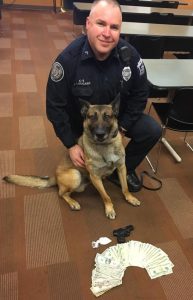
Officer Heath Loggains and his K-9 partner, Cash, pose with bounty from an arrest. (photo courtesy of Jonesboro PD)

The Jonesboro Police Department understands the importance of these dogs. Most of their K-9s sniff out drugs only, but they also have a bomb sniffing K-9. Brandon says she cannot overstate what the K-9s mean to the officers.

“They can go to a house we don’t want to send an officer into, or a building, or in the woods, or wherever they can go in and try to find a person. If we didn’t have the dogs, we would have to send a person and put that person in harm’s way,” she said.

Bristow said he agrees with Brandon.

Despite knowing they’re a tool for the department, these officers have developed a relationship with their canines.

“Of all the jobs I’ve done, this is one of the most rewarding to be able to see your dog come out and perform when it’s supposed to,” Bristow said.

“We know that’s what they are doing for us. That alone makes having the canine program worth having,” Brandon said.

BlueStreak K9 can be found on Facebook for anyone interested in purchasing a K-9.

Police Department Offers Transparency Despite Tensions

By Jorge Quiquivix
Delta Digital News Service

TRUMANN, Ark. — The tensions between police and Americans have escalated in the last couple of years and it’s something that even smaller towns in the South are having to deal with.

Sgt. Chad Mason works as a detective with the Trumann Police Department. He doesn’t like the way police officers are portrayed in the media recently.

“We don’t put the badge and the gun on every day just to come to work and do bad and do harm against the community and the citizens,” he said. “It’s a constant negative about law enforcement doesn’t care, they’re just there to arrest you and take you to jail, so on and so forth.”

Deadly Shootings Impact Views

A factor that plays into this negative view is the number of deadly shootings by police in the United States.

According to The Washington Post’s Fatal Force database, officers killed 963 people in 2016. The database collects data from news reports, law enforcement websites and even social media reports. The number barely decreased from 2015, when there were about 2015 killings reported. So far, there have been 284 deaths in 2017.

In Arkansas, the database reports five people died in 2015, 15 in 2016, and four by April 2017. Mason realizes where the concerns come from, but he has an issue with those concerns.

“It’s a long line of bad stuff, so that the good stuff doesn’t get seen,” he said.

Stepping Out for Change

Mason and other members of the police department have taken steps to change that perspective, at least in his community.

“Every negative thing that society may see that a police officer does, I try to turn that into a positive,” he said.

To do that, the Trumann Police Department has started community-oriented policing. That means officers take time during patrols to stop and talk to people, to find out what problems they have and try to help them out.

Trumann police officers interact with children as part of community policing. It provides an opportunity for residents to see police in a positive light. (photo courtesy of Sgt. Chad Mason)

One main audience for this approach: children.

“Kids that are growing up, they need to see that positive role model. They need to see that positive side of law enforcement in the community so that whenever they’re in need and they need help, they’ll be secure and they’ll feel like they’re secure,” Mason said.

He said he feels those kids need to see the officers as people behind the badge. During a citizen ride-along across town, Mason explained there isn’t a lot of recreational activities for children to do in Trumann.

“Some of that may or may not contribute to kids running out of stuff to do and getting in trouble,” he said.

He said he hopes their officers can show them there are better ways to spend their time.

“We try to be that mentor; we try to be that positive figure in their life,” Mason said. “Me and many officers are on a first-name basis with a lot of the kids and they see us driving around and they’re like, ‘Hey, hey Officer Mason or hey Officer Cook.'”

Another way they do it is being there for those in need. Mason said a girl once reported a bike stolen, so he and a couple of other officers pitched in to help her.

“I saw that she did everything right. She locked it down and someone still managed to get away with it,” he said.

Doubt Remains Among Residents

People in Trumann have noticed that police are taking their time to build those relationships, including 21-year-old Dee Crockett.

“I see them if kids are out playing basketball they will get out of the trucks and play a couple games or something,” Crockett said. “It makes me feel like they actually care about it.”

However, he still doesn’t trust the police and he wouldn’t give a specific reason.

“They’re kinda crooked,” Crockett said. “I mean … it’s just, I know people and I’ve seen things. And you know, once you see it, you know.”

Mason doesn’t let that critique get to him. In fact, he welcomes critiques and is willing to talk to anyone who doubts what they’re doing.

“If you don’t understand something or if you want to see kinda what we do, come up here and fill out a form for a ride-along,” he said. “I’ll be more than happy to take you for a ride-along and you can see what deal with on a day-to-day basis.”

Sheriff: Offenders Treat Prison As ‘Revolving Door’

By Jorge Quiquivix
Delta Digital News Service

MOUNTAIN HOME, Ark. – One of the main problems in Arkansas’ judicial system is prison overcrowding. While many work to fix the issue, an Arkansas sheriff explained who is reaping the benefits of this situation.

Baxter County Sheriff John Montgomery said repeat offenders take advantage of the efforts to decrease the prison population. As a mid-sized county, Montgomery said the number of repeat offenders is drastic.

“We’ve had people paroled from prison who have already been to prison three, five, eight, 11, 15 times. I believe that it’s almost just like a revolving door,” he said. “They’re letting them out so fast that there’s no deterrent. They’re out hurting society and committing new crimes against the citizens of this state.”

According to findings from a 2012 release cohort by the Arkansas Department of Correction, 53 percent of the inmates released in 2012 returned to jail in three years.

He said when the prison fills, some of the inmates get housed in county jails. It puts a strain on county jails across Arkansas including those in the Delta, which has him begging for help.

“Please! You got to get them out of there because I got them sleeping on the floor or whatever the case may be,” he said. “So the prisons are under a lot of pressure to create bed space. How they are creating it is by kicking folks out early.”

Solomon Graves, public information officer and legislative liaison for the Arkansas Department of Corrections, released a statewide population report that states Arkansas has 1,340 inmates backed up in county jails.

“We also have 336 inmates housed in a Texas facility,” Graves said.

The population report states even the ADC facilities have more inmates than the capacity listed.

Following the Council of State Governments report in April 2015, a bipartisan Legislative Criminal Justice Oversight Task Force was formed to combat the overcrowding. Montgomery said he feels the task force did a lot of great work, but none of it reflected what he suggested when he testified before them in Little Rock.

“When I cornered them and asked if their recommendations were done, would they still need more prison beds and they said yes. Yet, none of that was a part of the recommendations,” he said. “The department requested funding for 576 beds. As of now, we have not received any indication that we will receive the necessary funding.”

Graves said prison overcrowding could be lessened with the passage of Senate Bill 136, which has been proposed in this year’s legislative session.

“The department is supportive of the reforms in SB136,” he said. “The reforms within that bill will help to divert low-level offenders to Community Correction Centers, thereby freeing up prison beds while maintaining the public’s safety.”

That could also set up a way for repeat offenders to not cheat the system. However, Montgomery said Arkansas should look at how Missouri is fighting its ever-growing population system.

According to the Missouri General Assembly, if an offender has already been in prison once then the offender must now serve 40 percent of their sentence. Those who have been in prison twice before would have to serve 50 percent of their sentence. Those who have three or more previous prison sentences must serve at least 80 percent of their sentence.

State Sen. Bryan King filed Senate Bill 177 in this year’s session. It would require someone who’s been sentenced three or more times to serve at least 80 percent of their sentence in Arkansas.

Montgomery said King’s bill may not pass because it should be staggered more like Missouri’s law.

“But I very much agree with his thinking,” he said. “He is like us. He is sick and tired of the repeat offenders that continue to get in and out of prison over and over again.”

Operation D.E.T.E.R. Causes Mixed Reaction

By Jorge Quiquivix
Delta Digital News Service

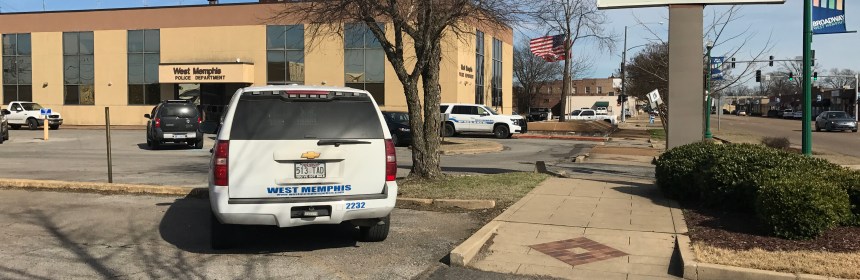
WEST MEMPHIS — Even though this city has more than 25,000 residents, a police captain said it experiences violent crimes more than any other small town. That is something police hope to change.

Maisha Spears has lived in the Delta community for seven years and has seen crime get worse each year, especially when it comes to murders. West Memphis Police reported 11 murders in 2016.

“It’s actually scary because I have children of my own growing up in this neighborhood,” Spears said.

As a mother of three, Spears is one of many in the city who welcome the newly enacted crime crackdown by the West Memphis Police Department. Both the patrol and investigate units restructured so they could enact Operation Data Enhanced Targeted Enforcement and Restoration at the start of February.

Capt. Joe Baker said after being a member of the Violence Reduction Network for just more than a year, the police department visited Los Angeles to see LAPD’s Operation LASER in effect.

“We liked the elements of the program. So, we replicated the program to bring it back to West Memphis,” Baker said.

The department looked at the last three years of reporting data and searched for an area with a large concentration of violent crimes like homicides, battery, aggravated assault and terroristic acts. After an analysis, police focused on the southwest part of the city for the operation.

“It’s a really targeted effort,” Baker said. “It’s targeted based on the people committing these crimes. It’s not a suppression effort. It’s not a corner jump street effort.”

Spears agreed that particular side of the community was known for violent crimes.

“Hopefully, they’ll straighten it up because there have been a lot of killings going on in the last couple of months,” she said.

However, not everyone agrees with the crackdown. A man, who did not want to be named, was standing across the street from Maddux Elementary School. He said there’s no crackdown on crime because there is no crime.

“They’re harassing people,” he said. “The police say they are cracking down and they are setting up speed traps right in front of the school just to catch innocent parents who have nothing to do with anything.”

He said he feels violent crime in the southwest part of town is all lies because people can drive through the neighborhood without coming across gangs.

“In big cities, gangs huddle up. You see them everywhere; that’s not the case here,” the man said.

Nevertheless, Baker said the data speaks for itself. The department set a goal after the program has been in place for nine to 12 months.

“I know in a city like L.A. where we copied this from, a 3 to 5 percent decrease in their violent crime and a 10 percent decrease in their homicides is a big deal,” he said.

With more than 10 homicides last year, Baker said the odds look well for the small town.

“Ten percent, that’s one person’s life that is being saved,” he said.

The West Memphis Police Department is a pilot test for small-town adaptions of Operation LASER. If their version works, not only would the program expand to other parts of the city, Baker said his colleagues would teach other Delta communities how to incorporate it in their municipality.