Author Archives: Keith Turner

Faith, family help man battle cancer
By Keith Turner
Delta Digital News Service

JONESBORO — When doctors told an Arbyrd, Missouri man that he had cancer in his lower-right lung, he laughed in disbelief.

The diagnosis came last June after doctors discovered a spot on Michael March’s lung during a checkup after he had issues with blood flow.

It shocked him; he didn’t feel anything was wrong.

“I didn’t even feel sick,” he said.

But before long, he was whisked away into a series of tests, scans and doctors appointments.

“We weren’t leaving one appointment before they were calling us for the next one,” said his wife, Yuronda March.

Everything lined up and moved very quickly, the couple explained. March’s treatment consisted of six weeks of radiation and two rounds of chemo.

“When we walked into the chemo lab for the first time, I realized, ‘Mike, you’ve got cancer,'” he said. “But when I walked in there and saw the faces on them, there was so much hopelessness.”

March cried when he realized what the patients around him were going through, and then made a vow to always have a smile on his face in the radiation lab.

“There were so many in there that were going through far worse than what I was going through,” he said.
Keith-Cancer01

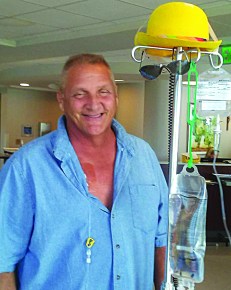
Michael March poses with “George,” his well-dressed IV tower. (Courtesy of Yuronda March)

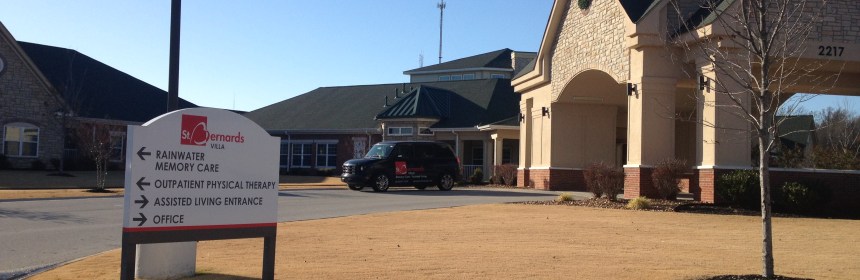
He realized firsthand the impact that positivity can have on cancer patients and committed himself to providing that positivity. While undergoing chemotherapy through St. Bernards Healthcare, the couple stayed at St. Bernards Villa.

“It was a blessing, it was such a blessing,” Yuronda said.

They utilized their time at the Villa to minister to others, even holding church in the Villa’s chapel. The family was stunned by the kind treatment they received at the Villa.

“The workers there didn’t treat us like we were cancer patients; they treated us like we were family,” March said.

The care and treatment they received at St. Bernards boosted their hope and morale. Committed to remaining hopeful, March stayed strong emotionally and in his faith.

March has been ministering to others for 18 years, and said his faith played a major role in giving him the strength to get through his journey. The children at his church, New Life Christian Center of Rector, wanted to do something in support of him. So, they gathered and prayed over a prayer cloth to give to him.

“That spoke to my heart and spoke to my wife’s heart,” March said.
Keith-Cancer02

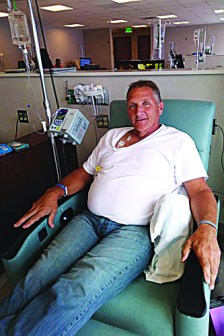
Michael has a smile on his face, even during chemotherapy.(Courtesy of Yuronda March)

March saw the battle with cancer as an opportunity to minister with others, and now hands out prayer cloths that his church has prayed over to other patients.

“Had it not been for God allowing us to go through this journey, I would have never stepped in a chemo lab, I would have never stepped in a radiation lab. I would have never seen it,” March said.

For many years, March worked hard and provided for his family. It was how he was raised to be, he said. When he received the diagnosis, he worried about how he would take care of his wife.

So he was beyond thankful when his daughters, sons-in-law, friends and family all stepped up to offer as much help as they could.

“Out of the woodwork, just blessings,” Yuronda said.

During treatment, March got a craving for a classic treat, Banana Flips. After telling his cousin and his wife about the craving, the family members realized the product is no longer sold in the state, or anywhere nearby. So, the two drove all the way from Doniphan, Missouri to Jonesboro to deliver a special, homemade Banana Flip cake, which March shared with the other patients.

The experience has given March and his family a new outlook on life.

March is healed by the Lord, he said, and has decided to no longer receive chemotherapy. He will soon begin receiving a form of immunotherapy.

“We take advantage of what’s in front of us and we take for granted what we have,” he said.

March still experiences pain, cramps and coughs caused by the radiation. But whenever the doctors tell him how much he’s improved, he tells them the same thing:

“It’s only because of God.”

NEARK Hepatitis A outbreak continues

by Keith Turner
Delta Digital News Service

Hep_A_Map_10.26.18_update

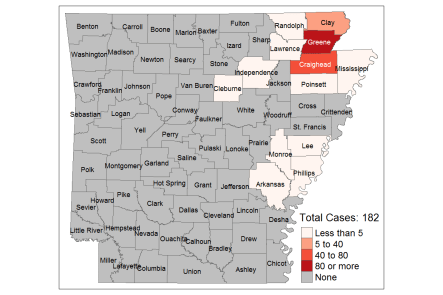
This map displays the reported cases of hepatitis A by county, showing a high concentration of cases in Northeast Arkansas. (Courtesy of Arkansas Department of Health)

JONESBORO — Health officials in Northeast Arkansas report as many as 182 cases of hepatitis A since February as part of an outbreak throughout the area. 

Students at Arkansas State University experienced a scare when a food-service worker employed through A-State’s food service provider, Sodexo, was reported to have a potential case of hepatitis A. A-State no longer employs the worker. 

A-State Chancellor Kelly Damphousse sent an Oct. 25 email to students, faculty and staff detailing the situation, and assuring the public all appropriate food-safety procedures were in place to limit exposure.

“I want to assure you that it is safe to eat in the Acansa Dining Hall. I ate breakfast there this morning, and I will be eating lunch there today,” Damphousse wrote in the email.

The Arkansas Department of Health held vaccination clinics at the Craighead County Health Department and on A-State campus for anyone concerned about potential exposure. However, officials reassured the public that the virus was restricted to the single employee, and not found in the food or any other sources.

“There is not an outbreak of hepatitis A at Arkansas State University, and there is no documented foodborne case,” A-State officials said in a statement.

A-State officials reviewed Sodexo’s various food handling procedures, including the continuous wearing of gloves, appropriate hand-washing technique and regular sanitization of the food-preparation area. Michael Wonderly, Sodexo’s director of campus operations for A-State, said employees are trained in these procedures according to Hazard Analysis Critical Control Points policy standards to ensure the safety of the food.

A highly contagious liver infection, symptoms of hepatitis A can include fever, fatigue, loss of appetite, nausea, vomiting, abdominal pain, dark urine, diarrhea, clay-colored stool, joint pain and jaundice (yellow of the skin and eyes). Wonderly said Sodexo policy tells employees to stay home if they have fever, vomiting or diarrhea, and employees are sent home if they present any symptoms at work.

hepatitis A vaccination

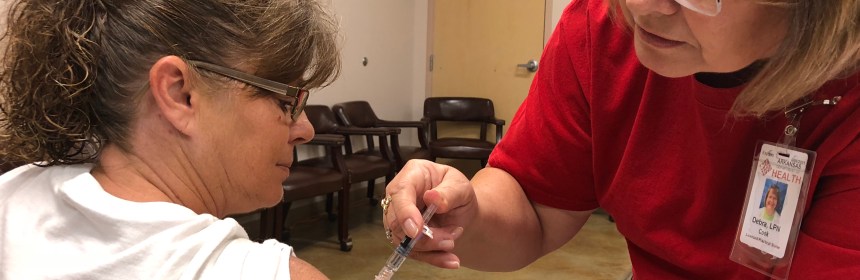
Sandra Holland receives her hepatitis A vaccine from Debra Cook, LPN, during a clinic at the Craighead County Health Unit. (Photo by Keith Turner)

“This particular employee also showed no symptoms that would have had us send them away for medical attention before being allowed to return to work, so when the employee notified us we took the proper measures and informed the university which was also informed by the Health Department,” Wonderly said. All Sodexo employees also received vaccinations.

ADH spokesperson Meg Mirivel advised the risk of getting hepatitis A through a food service setting is low, and hepatitis A is being spread primarily through close contact in the community.

Several groups are at higher risk for contracting hepatitis A, according to the ADH, including people who have direct contact with someone who has hepatitis A, travelers to countries where hepatitis A is common, men who have sexual contact with men, people who use both injection and non-injection drugs and household members or caregivers of a recent adoptee where hepatitis A is common. Health officials advise these groups to receive a hepatitis A vaccine.

The ADH said besides the vaccination, the best way to prevent hepatitis A is practicing good hand hygiene and thoroughly washing hands after using the bathroom and before preparing or eating food.

Volunteers Participate in Great Arkansas Cleanup

by Keith Turner
Delta Digital News Service

JACKSONPORT — All across Arkansas, volunteers are cleaning trash from state parks, roads and other public areas as part of the Great Arkansas Cleanup.

mulching

Members of Trail Life USA prepare to mulch. Volunteers spent their weekend cleaning up the park. (Photo by Tyler Yeager)

Kaleb Young, a member of Trail Life USA Batesville, spent his Saturday off from school mulching trees in his local state park.

“It’s good to serve the community and get to have some physical activity in there … learn about the outdoors and camp, stuff like that,” Young said.

Young’s activities in the park were part of the Great Arkansas Cleanup, a statewide volunteer event dedicated to removing litter and cleaning up the state’s roadways, parks and public areas sponsored by the Keep Arkansas Beautiful commission.

At Jacksonport State Park, nearly 20 volunteers assisted park staff in various clean-up projects, from mulching to trash cleanup. Mark Ballard, superintendent at the park, has worked at the park since 1990. Ballard said he estimates the park has participated in the cleanup for 25 years.

“The service work that we get out of it … they clean the community up. We all want to live in a clean community,” Ballard said.

According to the Keep Arkansas Beautiful website, over 7,000 volunteers worked across the state in the 2016 Great Arkansas Cleanup. In 2016, volunteers collected 210,582 pounds of litter. The economic value to the state was over $1.6 million.

“We get some work done that our maintenance staff doesn’t have to do,” Ballard said.

Volunteers in the cleanup receive a T-shirt, and Ballard and his staff prepared lunch for the volunteers.

Multiple groups volunteered at Jacksonport, including Trail Life, a Christian scouting program for boys in grades K-12. Chris Middleton is the Troopmaster for the Batesville group. Middleton said he brings the group out to help the park and for additional bonuses.

“They feed us hot dogs. Anytime someone feeds us, we come out,” Middleton said.

Cleanup days will continue throughout the state until Oct. 31. To find a cleanup at a park near you, visit http://keeparkansasbeautiful.com/full-event-calendar/.

A-State Board Considers Weapons Policy

by Keith Turner
Delta Digital News Service

JONESBORO — The Arkansas State University System board of trustees considered an updated weapons policy, helping transfer students and disaster preparation during its first fall meeting.

ASU System President Chuck Welch described the new weapons policy as a “reaction” to a bill passed by Arkansas legislature. The bill allows, to a degree, concealed carry on college campuses.

Welch said the Arkansas State Police have not yet completed its enhanced training program, meaning no one can legally carry a handgun on campus yet.

“We anticipate that it will be sometime in 2018 – January, February, March – sometime in that time frame before an individual will be able to legally carry a weapon on our campuses,” Welch said.

Helping Transfers

Welch and A-State Chancellor Kelly Damphousse announced a study of transfer students beginning in October or November. The goal of the study is to analyze the relationship between ASU campuses and students who transfer or wish to transfer from two-year schools.

“We have a large number of students in community colleges in the state of Arkansas. Unfortunately, we don’t have a large percentage transferring to a university,” Welch said.

Damphousse said he is passionate about transfer students.

“The next step is to make sure we get more transfer students from our sister schools to come here,” Damphousse said.

Disaster Preparedness

The board approved long-term lease agreements for ASU disaster preparedness training facilities in Walnut Ridge and Imboden. The school will seek grants and private funding for the project, which will train participants to respond to a variety of natural disasters. Fewer than 10 similar facilities exist nationwide.

Representatives of ASU and the cities of Walnut Ridge and Imboden signed 50-year leases for the facilities the following week.

In Walnut Ridge, ASU will pay $12,500 a year to rent 100 acres of land, with a 3 percent increase every five years. Walnut Ridge will pay the rent on behalf of ASU for the first two years. The Walnut Ridge site will have training zones specific to certain disasters, such as tornadoes and floods.

ASU will pay $10,000 a year to rent 183 acres in Imboden. The Imboden site will allow for “wilderness scenarios.”

Susan Hanrahan, dean of ASU-Jonesboro’s College of Nursing and Health Professions, assisted in the push for the training facilities.

“With the opportunity to have land in two different spaces, we can start working on getting funding to help build those things and bring people to our region for that type of education,” Hanrahan said.

Walnut Ridge Mayor Charles Snapp told the Jonesboro Sun this “might be the biggest economic boom” in the history of his city and Lawrence County.

System Review

Welch announced plans to hire a firm for reviewing the ASU System and campuses. The review will analyze staffing, programming and resources to determine the overall efficiency of the office.

The review should take around 12 weeks, but it could be up to six months before the results are known.

Other items considered included:

  • Celebrating the anniversaries of two ASU System campuses: ASU Beebe, now in its 90th year, and ASU Mid-South, now in its 25th year.
  • Accepting a resolution to rename the ASU-Newport criminal justice department in honor of the late Lt. Patrick Weatherford, who was killed in the line of duty in June. Weatherford worked for the Newport Police Department, and was a graduate of ASU-Newport and ASU-Jonesboro. His wife, Kristen, attended the meeting.
  • Approving restructuring amendments to the faculty handbook.
  • Approving new policies on internal controls and investments.
  • Approving a resolution to change the name of the lounge area on the third floor of the Reng Student Union to the Vaughn Student Lounge.
  • Approving a request by ASU-Newport to offer additional automotive-mechanical certificates (automotive mechanical systems, automotive transmissions and axles, engine performance, and heating and air conditioning).
  • The efficiency of the employee health care plan.

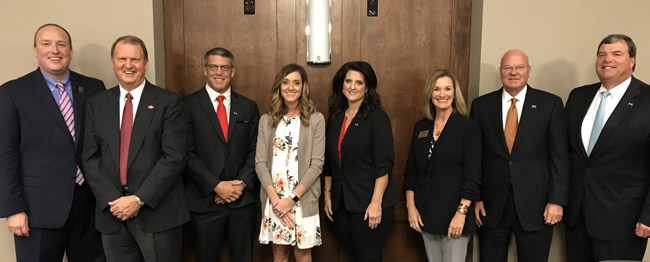
(Board of Trustees photo courtesy of A-State Media Relations)