Author Archives: Seth Cleveland

Westside Survivors Gather Journals
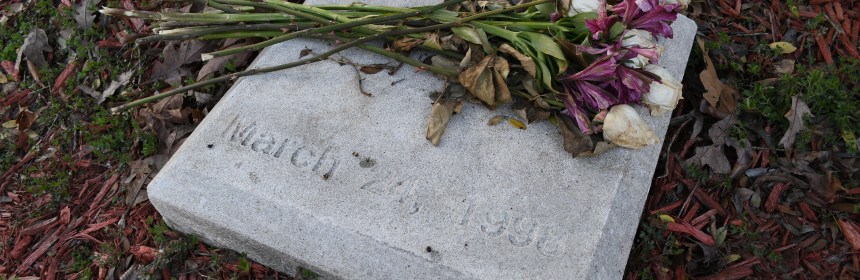
Flowers on marker at Westside Middle School Memorial Garden

by Seth Cleveland
Delta Digital News Service

JONESBORO — For one group of people in Jonesboro, the past 20 years remains a time of healing from wounds that never seem to close.
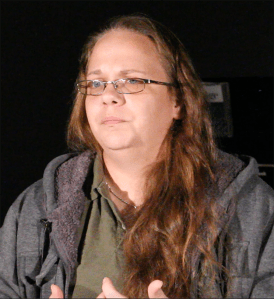
Valerie Grass

Valerie Grass (photo by Seth Cleveland)

By all accounts, March 24, 1998 began as a pretty average day. The students of Westside Middle School started fifth period. The teachers began the lesson. Then two middle-school students pulled the fire alarm, went up on a hill and began shooting, killing four students and a teacher, and wounding 10 more.

“No time for questions. It was just run and take cover,” said Valerie Grass, a student at Westside at the time of the shooting.

Brandy Myatt said she remembers hearing, “Don’t walk, run!” on that day.

“We just took off helter-skelter, and right as soon as we got to the gym, I noticed my friend holding her arm,” she said.
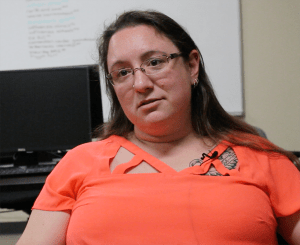
Brandy Myatt

Brandy Myatt (photo by Seth Cleveland)

Myatt started piecing together what happened. And, she said, things began to change. From there began a long and arduous healing process.

That’s the truth for many people who have experienced similar events. Those who have experienced these atrocities must learn to move on.

The Westside survivors want to aid in the healing process of other survivors.

“We usually try to offer something to say, ‘You’re not alone in this,'” Myatt said.

After every school shooting since 1998, the Westside survivors have gotten together and figured out a way to help. After the Sandy Hook Elementary School shootings in Newtown, Connecticut, the Westside survivors sent the children stuffed animals like they received. In other cases, the Westside survivors have gone to school to talk to the students.

For many of the Westside shooting survivors, Parkland felt different. The similarities between the shootings, the approaching 20-year anniversary and the helplessness — it all opened the wounds of the past.

“This most recent shooting has just flooded so many memories back,” Grass said.

Others in the group agreed.

“As soon as we heard about Parkland, we all got on our Facebook group … and the first thing that I asked is ‘What are we going to do?'” Myatt said.
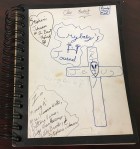
Brandy Myatt's journal

Myatt’s journal (click photo to enlarge)

Their idea stemmed from something the survivors did after the shooting.

Ferncliff, a camp in Little Rock, offered the survivors a getaway from the media coverage the summer after the shooting. The survivors learned journaling as a way to cope.

“From that came a lot of healing,” Grass said. “When we got there they had a starter backpack with a flashlight, a journal and a teddy bear.”

Jennifer Roshto, a Westside survivor, appreciated the journals.
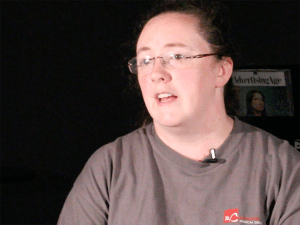
Jennifer Roshto

Jennifer Roshto (photo by Seth Cleveland)

“It gave me a place to say all these things and put all these things down, without having somebody tell me, ‘Well, you need to get over it,'” she said.

The Westside survivors want to gather 3,400 journals to send to Parkland survivors so that every high school student can have one.

“We’ve had several donations already, but I still feel that we’re very shy of what we need,” Roshto said.

Northeast Arkansas residents can donate until April 1 at several Journal Donation Locations around Jonesboro.

They also offer up their advice. “Take it day by day,” Myatt said.

Journal Donation Locations
Target Monday – Friday, 8 a.m.- 4 p.m. Brandy Myatt
VA Clinic Monday – Friday, 8 a.m.- 4:30 p.m. Lindsay Kifer
Hytrol Monday – Friday, 8 a.m.- 4 p.m. Jessica Odom
Westside Middle School
Pocahontas Schools
Highland Schools
Bono City Hall
Lost Pizza Company

Pharmacists Provide, Monitor Opiates

by Seth Cleveland
Delta Digital News Service

Opioid Crisis

Click the picture to view special topic index.

JONESBORO — For the local medical community, the opioid crisis continues to be an uphill battle.

Recently highlighted by President Trump’s combative statements against the epidemic, awareness continues to grow.

A Growing Epidemic

According to the Department of Health and Human Services, Arkansas has one of the worst dependency rates and treatment capacities in the nation. With this crisis comes a new motivation for the medical community to combat the issue.

Natalie Hinton, a fourth-year pharmacy student at A-State, was not optimistic about medical advancements or research being done to decrease the severity of the issue. She said the way the body works, opioids are really the only current advancement that can sufficiently block pain receptors. Searcy pharmacist Nancy Showalter said she agreed.

There are other treatments, however. “NSAIDs, something like ibuprofen — there are other drugs in that class that works a little better than ibuprofen and they provide a longer time frame for their pain relief — I think drugs like that could be used, but in some situations, patients can’t use those drugs,” she said.

Who’s to Blame?

Sen. John Boozman highlighted steps the state is taking to provide some relief to the opioid epidemic: DEA policy reform, proposed legislation, increased area spending and pharmaceutical sanctions. Yet some local pharmacists seem to think that cracking down on the amount of pills they’re allowed to give out is antithetical to the treatment of the issue at hand.

“I think that pharmacies are already trying to fight it. I think that physicians really need to be held accountable. I think they write way too many opioid prescriptions,” Hinton said. “If the doctors were not writing so many prescriptions, it would not be nearly as big of an issue.”

Hinton said she does not place all the blame on physicians, but she was not alone in her discomfort.

“I hate that (opiates) would not be there for those that really need them,” Showalter said. “But I also understand that this is a crisis and something has got to be done.”

Several procedures in place allow Arkansas’ pharmacies to monitor the activities of prescription purchasers.

“You can look up a person by their name and it shows where they’ve gotten controlled substances, the date they got them,” Showalter said.

Arkansas is one of six states that have “refusal clauses.” These effectively allow a pharmacy to completely refuse service to a suspicious customer without fear of being sued.

“We would just simply refuse their prescription,” Showalter said.

As pharmacies already closely monitor the amount of drugs they administer, perhaps the solution lies in the hands of the doctors prescribing them. Thomas Day, an orthopedic surgeon, said he actually agreed with Hinton and Showalter.

“I blame physicians for the free prescribing of addictive medications,” he said.

Day said he could see the progression of over-prescribing from the mid-’90s to the early 2000s.

“More and more practitioners for whatever reason became more comfortable prescribing pain medication just because (patients) said they hurt,” Day said. “We created a whole generation of Americans that if they have any kind of pain, they think they need a pill for it.”

As a result of this, Day said there has been an uptick in “pain contracts.”

“I see anywhere between 70 to 80 patients a week and in that time, I see as few as five or as many as 10 patients that are on a pain contract,” he said.

Pain clinics are clinics that specialize in treating pain. They deal in a lot of opiates. When on contract at a pain clinic, a patient is supposed to be highly monitored through random urine tests. But in a lot of cases, Day sees something different.

“What happens is these pain clinics become a place where people go once a month, pay their money, and get their prescription and keep going back,” he said.

Future Hope

While there do seem to be many sides to this complex crisis, things can seem a bit forlorn. Hinton, Showalter and Day all expressed feelings of what appeared to be a hopeless desperation, i.e. desperate to discover a solution and hopeless to the discovery of the solution.

But with more understanding and more awareness, there comes progress. Software is being designed, legislation is being enacted and awareness is being raised, all in the name of this cause.

Piano Competition Allows College Entrants

By Seth D. Cleveland
Delta Digital News Service

JONESBORO — Arkansas State University hosts the J.D. Kelly Piano Competition every year, but until this year, the competition never allowed students to participate.

Lauren Schack Clark, professor of Music at A-State and organizer of the competition, said the competition has evolved over the years. The competition’s roots started in a former summer music festival. Clark said the festival began as “really a camp for pre-college students.  We started the competition as part of that festival around 2007, and the last year of the camp was 2014.”

But the time came for a change and the camp, which proved “very successful” according to Clark, drew to a close. Clark did not want the competition to end. So she retained the competition, but held it during the school year to make it more accessible for students who participate in other summer camps and family travel.

Starting last yea, Clark decided to incorporate an undergraduate division into the competition. According to Instructor of Music and annual judge Brian Henkelman, “It adds another level.”

With the addition of a new division with a larger cash prize, talented students from A-State and the entire surrounding area have the chance to win. According to the website, the competition offers cash prizes ranging from $25 to $200 for first and second place in every division.

No collegiate participants outside of Jonesboro participated this year, but Clark said she hopes that will change. The goal is to increase participation in all of the divisions by next year.

“The cash prizes are an incentive that not every competition can offer,” she said.

Those cash prizes do not come so easily. As a judge, Henkleman said, “The difference is perhaps in level of expectation.”

With the addition of the collegiate division comes a higher level of “maturity and professionalism.” Henkleman said while “the collegiate level usually offers more difficult literature … the judges are still listening for accuracy, musicality, appropriate interpretation and all of the elements of music that the students in the earliest levels are beginning to explore.”

Clark said the addition of the division serves as somewhat of a recruiting tactic.

“The competitions are designed to encourage excellence in musicianship and to give the students a goal to work toward.  They are also a recruiting tool.  Allowing college students to participate brings potential graduate students onto campus,” she said.

Henkleman and Clark said they agree that the incorporation of the undergraduate division is a great way to expose other students and colleges to the caliber of the music program. In addition to the college division, the competition also began to accept video entries.

The winners of this year’s undergraduate competition were Samantha Holt and Xin Ying Kong.