Category Archives: Agriculture

State fish hatchery prepares for upcoming fishing derby

By Tristan Bennett
DELTA DIGITAL NEWS SERVICE

CORNING, Ark. — A local fish hatchery prepares to celebrate as National Hunting and Fishing Day approaches.

For the first time, Donham State Fish Hatchery, along with the other five state hatcheries, will host a fishing derby to celebrate National Hunting and Fishing Day.

The holiday began as a day of thanks for sportsmen who contributed to conservation and sustainable use of fish and game, according to the National Fishing and Hunting Day website. President Richard Nixon first proclaimed the holiday in 1972 as a day to enjoy the outdoors and encourage proper management of natural resources.

This year, National Hunting and Fishing Day falls on Sept. 28.

The employees at Donham hatchery work year-round to ensure derbies such as this one go off without a hitch. They must plan ahead each year to ensure each derby site gets the proper amount of fish.

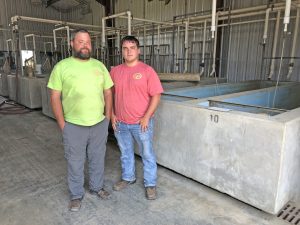
Robert Zimmer, left, and Erik Jordan pose by fish vats. Photo by Tristan Bennett

Mark Harness, hatchery manager, said, “In January or February, I’ll know how many fish I’ve got to produce for the whole year.”

Preparing these fish is no small task. The technicians keep themselves busy taking care of the fish and helping maintain the hatchery itself.

Robert Zimmer, senior technician, said, “We do everything from mowing to cleaning the bathrooms and everything in between.”

In the fall, the employees rework the ponds by draining them and mowing the grass in them down as well as work on their second round of fish harvesting for the year. In the spring, they put fish in spawning nests and usually begin harvesting by June or July.

“Checking all the oxygen levels is the first thing we have to do every morning,” said Erik Jordan, a technician at the hatchery.

The technicians keep a close eye on oxygen levels to ensure the fish are in a healthy environment. Fish must also be fed and checked on regularly to confirm proper growth.

When the time comes to send those fish out into the community, the hatchery employees harvest the ponds using a method called dragging.

“We have a seine that reaches across one of our 1 1/2-acre ponds, and we’ll drag the whole pond to a corner and slowly pull it in,” Harness said.

From there, they take a sample to get an approximate weight of the fish.

“Let’s say these fish are one pound,” Harness said, “that means one fish weighs one pound, so if we’ve got to have 500 fish, we know we’ve got to have 500 pounds.”

Then, technicians load the fish onto trucks and take them to their new homes for communities to enjoy.

Harness’s hatchery stocks catchable catfish, one pound or over, in many of the Family and Community Fishing Ponds in Northeast Arkansas. Several of these ponds will hold derbies throughout the summer and fall.

Family and Community Fishing Ponds get stocked with catfish in April, May, June, September and October. Trout come to the ponds in November through February. Lakes and ponds get stocked according to what the biologist wants, so it varies from year to year.

Zimmer said, “We may stock Lake Charles this year, but we may not stock it next year.”

The biologist is in charge of deciding how many fish and of what species a lake needs.

The hatchery’s job does not always stop there. Donham holds its own derby at the hatchery every year as well as the National Hunting and Fishing Day derby, which will take place on the Arkansas State University campus.

“We are not doing it here (at the hatchery) because we reach the local people with our derby in June. So, we are going to move to Jonesboro with this one to see about getting a different group of people,” Harness said.

Hatchery employees will be there working educational booths and a casting contest to teach people how to cast correctly. The A-State American Fisheries Society will also be there with information on endangered species. In the past, Donham hatchery has also done a BB gun range, a knot-tying station and kayaking at their derbies, Jordan said.

Admission to the derby is free, and anyone is welcome to fish from 8 a.m. to noon at the Pavilion Pond on the A-State campus. Family and Community Fishing Program rules apply, so someone could even go by themselves to the derby. There is a three fish limit per person.

“It’s designed to get families back to fishing or even get the young kids interested in fishing,” said Harness.

National Hunt and Fishing Day is all about enjoying the outdoors, and Harness hopes this derby will provide Northeast Arkansas with a chance to do so as well as learn about conservation and wildlife.

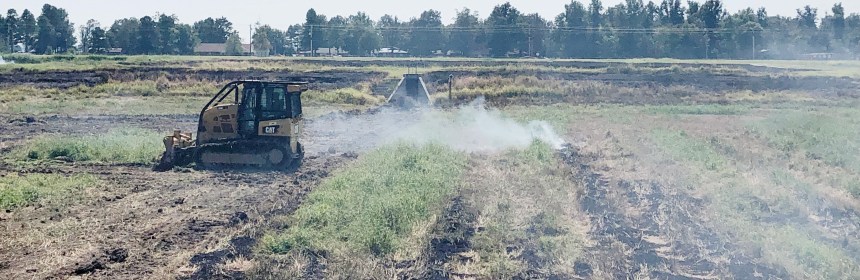
Editor’s Note: Featured photo shows hatchery staff reworking ponds in preparation of spawning season. Photo by Tristan Bennett
CORRECTION: In-crop Dicamba applications end May 25

By Camden Metheny
Delta Digital News Service

JONESBORO — Arkansas farmers must stop in-crop applications of dicamba pesticide no later than Saturday, May 25 or potentially face fines up to $25,0000.

The rule applies to all dicamba products registered for in-crop use in the state, which includes Engenia, Fexapan, Tavium Plus Vaporgrip, and Xtendimax. While the cutoff affects the vast majority of state farmers, farmers within the Mississippi River levee areas can apply for a special permit as they typically plant later due to high river levels in the spring, according to the Arkansas State Plant Board. The board changed usage rules in March, including:

  • A half-mile buffer zone required around all non-dicamba crops when dicamba is applied.
  • A one-mile buffer zone for university and USDA research stations, certified organic crops and commercially grown specialty crops between April 16 and May 25.
  • Prohibiting the mixing of dicamba with glyphosate between April 16 and May 25.
  • Requiring applicators to provide proof of training to pesticide dealers prior to purchasing dicamba in-crop products.

Controversy surrounds the use of dicamba due to the pesticide damaging non-resistant crops. An estimated 3.8 million acres of soybeans have shown symptoms of dicamba damage. Because of this, many farmers have complaints.

Dan Hosman, a farmer from Craighead County, is one of many in Arkansas who are opposed to using dicamba.

“As a steward of the land, after a good deal of research, it’s just too volatile to use,” Hosman said. “There’s different alternatives that we should employ before hurting someone else’s crops.”

The reason dicamba is so dangerous is due to its volatility, meaning it can vaporize instantly. This causes it to spread to more crops and without the genetic resistance it can cause serious harm to those plants.

However, dicamba isn’t just dangerous to plants.

Richard Coy, a bee farmer in Arkansas, is also affected by the use of dicamba. In 2017, he noticed a significant drop in honey production due to the use of the pesticide in fields where Coy’s hives are located. With the loosening of restrictions on the cutoff date for use of the pesticide, this puts several Arkansas beekeepers in jeopardy as the season moves forward. In an interview with KASU, Coy said dicamba wasn’t killing the bees but the plants they needed in order to pollinate.

“The plants that produce the honey that we were selling to the retail market are the plants that have been severely damaged and the honey that are our bees collect off of other vegetation is not as desirable and I did not want to put a product that is undesirable on the shelf,” he said

The use of dicamba has been a contentious topic in Arkansas to the point where one farmer was shot and killed over the use of dicamba. Mike Wallace, a farmer in Monette, died in a 2016 altercation with a farmhand due to the pesticide drifting into Wallace’s fields. He had always been a vocal opponent of dicamba, appearing in a Wall Street Journal describing how the chemical killed 40 percent of his soybeans.

EDITOR’s NOTE: A previous version of this article incorrectly stated that dicamba pesticide could be applied between May 26-Oct. 31 if a half-mile buffer was maintained between non-treated plants. Although DDNS does not knowingly publish inaccuracies, errors are corrected as soon as possible regardless of the source of the error.   

Honey Bees Impact Arkansas

Honey Bees in Arkansas from Miranda Reynolds on Vimeo.

***

by Miranda Reynolds
Delta Digital News Service

JONESBORO – Honey bees in Arkansas create endless benefits for agriculture and give economic opportunities for businesses.

The bee industry involves many different avenues for businesses to take advantage of:

  • Cultivating honey
  • Provide pollination services for farms
  • Raising bees to sell
  • Raising queen bees for people wanting to start their own beehives

David Coy with Coy’s Honey Farm grew up around honey bees from the age of 2.

“All of my life I’ve been around honey bees. A lot of people think of beekeeping as a hobby, but it’s a business for us,” Coy said.

Coy’s business revolves around family. His dad introduced him and his brother to beekeeping and they have created a business from it. The family owns 10,000 hives at their farm north of Jonesboro.

Providing pollination services allows the family business to assist farmers. They pollinate close to 1,000 acres of watermelons in portions of Northeast Arkansas.

The honey farm produces anywhere from 500,000 to 700,000 pounds of honey in Arkansas. However, the production of honey per hive continues to decrease and Coy sees the trend continuing.

According to Steve Culp with Northeast Arkansas Beekeepers Association, 4,000-5,000 commercial beekeepers reside in Craighead County.

The loss of bee habitat in the Delta region impacts the honey bees. Farm chemicals spreading to areas of wildlife impact the honey bees. Coy says only one type of crop in a single area also impacts bees.

“Bees need a variety of plants to gather nectar and pollen from to maintain their health,” Coy said.

Kim Pittcock, associate professor of horticulture at Arkansas State University, said there must be a preservation of bees.

“We need to preserve the diversity that we’ve got in all of the plants that we have to help the bees. It’s a mutual hand-in-hand relationship with it. We need to maintain part of their habitat to use them to continue to help us work and to continue their populations,” she said.

Pittcock noted certain crops must have pollinators to remain yielding.

“Some crops could not be pollinated at all without some insect of some sort, and bees are the biggest and most natural pollinator due to the structure and the type pollen that needs to be transported,” she said.

The Coy’s business tries to adjust to supply and demand. In California, the almond industry drives the beekeeping industry on a commercial level. Coy’s Honey Farm sends bees to California in February to provide pollination services for almond orchards.

“We try to have income from several different areas that the bees can give us income from so that we’re not totally reliant on bee production,” Coy said.

With the changing of the bees’ environment, Coy hopes to remain in the beekeeping industry for many years to come.

“I hope to continue to be a beekeeper. I hope to maintain the opportunity for my children, too, if that’s what they want to do,” he said.

A honey bee pollinates plants that makeup of one-third of humanity’s everyday diet. The reality is, without bees, humans will not have food.

Harvest Affects Asthmatics

by Miranda Reynolds
Delta Digital News Service

Eli Norton (photo courtesy of the Norton family)

MCCRORY, Arkansas – Harvest season in the Delta creates turmoil for residents who annually suffer from asthma and allergies.

Eli Norton, age 7 of McCrory, has severe allergies requiring shots every other week. Aside from the shot, he uses nose spray and allergy medication in the mornings and at night. Lesley Norton, Eli’s mother, said she notices a change in Eli’s condition during harvest season.

“He gets more headaches and he has a more stuffy, runny nose,” she said. “Sneezing, coughing, just the typical symptoms you would have with allergies. When it’s not harvest season, we can do the shot once a month. With harvest season, we sometimes have to do it once a week depending on how severe his symptoms are.”

The farmers of rural communities in Arkansas cultivate their yields and feed its country’s residents during the fall season.

Billy Holmes, a farmer in Woodruff County, harvests about 1,600 acres of rice and soybeans. Holmes said soil types, residue, weather and the location of the fields determine whether to burn the rice stubble.

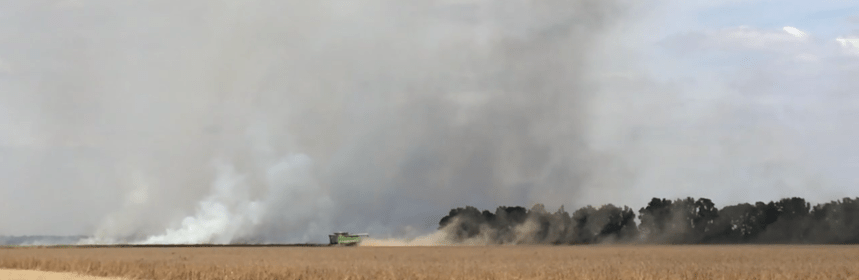
Safety is a concern for Holmes’s employees. Holmes said the employees keep themselves out of smoke as much as possible while doing the same for the neighboring farms. Laborers work mostly in tractors with cabs equipped with filtered air conditioning to protect them from dust.

Melissa Alumbaugh, advanced practiced registered nurse with ARcare, sees most of her patients suffering from allergies in the spring and fall. Alumbaugh said harvest season absolutely affects those with asthma.

Alumbaugh said preventative measures that asthma suffers can take include:

  • Avoid irritants. Use prescribed allergy medications, including antihistamines and nasal steroids.
  • Use dust mite covers on beds.
  • Use humidifiers at night.

The dust and smoke that harvest season produced may affect children, adults and the elderly.

Knowing personal conditions regarding dust and smoke can help with better preparation for this time of year. A health care provider can assist with a plan of action when harvest season occurs in Arkansas.

Cotton Acreage Experiencing All-Time Low in Arkansas

by Melissa Martin
Delta Digital News Service
JONESBORO, Ark. — Arkansas cotton acreage is experiencing an all-time low in Arkansas’ history of growing cotton. It’s estimated the latest planted acrea…

Source: Cotton Acreage Experiencing All-Time Low in Arkansas

The Price of Cotton Drops

gabrieltait's avatarPhotojournalism @ stAte

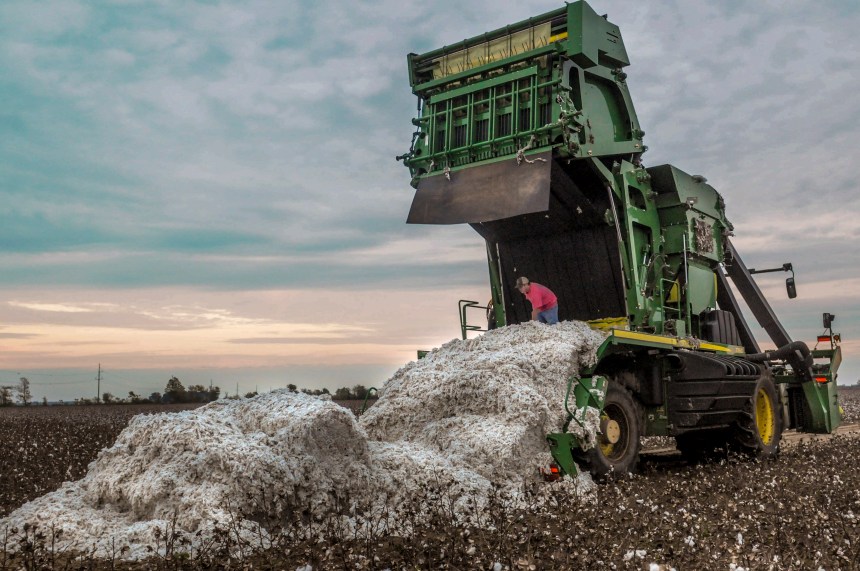
ArkansasStateUniversity_Holder_Emily_news1 With cotton production at a 38 year low, Logan Dewitt and his father Allen (not pictured) experience technical difficulties with their picking machine in the cotton field on Nov. 5, 2015. The cotton picking machine fails to wrap the cotton, causing it to fall out unpackaged. This creates an unwanted delay for the farmers, as they were hoping to continue picking one of their last fields at a steady pace. The malfunction forces the farmers to stop picking and manually push the cotton out of the machine into a pile on the ground before they could continue working in the field. The farmers experience a setback like this once every season with their picking machines, hindering their work time in the field.  Photo by: Emily Holder

View original post

Recent Entries »