JONESBORO, Ark. — At Arkansas State University, students are concerned about a myriad of issues during this year’s midterm elections.
With the 2026 midterm elections coming this November, citizens are eager to vote on a range of issues. After interviewing three students at Arkansas State University, it was found that top concerns are healthcare, the rising cost of living, and protecting agriculture. Voters are seeking out candidates who are focused on protecting their community.
Evelyn Rogers, a wildlife biology major at Arkansas State, says her biggest concern is farming and agriculture. According to Rogers, the condition of the state’s agriculture is a crucial part of Arkansas’s economy and identity.
“Supporting farmers in rural communities, while also protecting our water, land, and wildlife, is important to me because I want to see those resources available for future generations,” says Rogers.
Although she identifies as a Democrat, Rogers agrees with the Republican Party’s support for agriculture in Arkansas.
“When it comes to supporting farmers in rural communities and protecting wildlife, I think it’s important to look at individual issues and candidates rather than automatically agreeing with everything one party represents.”
Aspen Frank, a strategic communications major, says what is driving her to the polls is a concern about the high cost of living in Arkansas.
“Coming from a state where every day I have to witness firsthand the suffering, [due to] the struggle that comes from high poverty rates, it’s important to me that the extra costs of living can be diminished rather than increased,” says Frank.
Along with the rising cost of living in rural areas, access to healthcare is also one of her biggest concerns, specifically as a type 1 diabetic herself. According to Frank, her firsthand experiences of receiving life-saving healthcare, but dealing with extremely high costs of medicine, have had a profound impact on her personally.
“There are people in Arkansas that can’t even afford rent due to the overwhelming cost of medical care. Insulin is a necessity for survival, and we should not have to question whether you’ll be alive by the end of the week if your paychecks don’t come in on time,” according to Frank.
Many young people are excited to get to the polls and fulfill their civic duty as American citizens. Nathan Boone, a chemical engineering major and cadet in the Red Wolf Battalion, is passionate about voting in the midterms this year. Part of the reason for his passion comes from being in a migrant family.
“We escaped communism,” says Boone. “I believe voting is half the luxury of being an American. You get to speak out about your government, participate; in Vietnam, if you spoke out, you were directly taken to a re-education camp.”
This election season, many students are eager to have their voices heard on the issues that matter most to them: healthcare, agriculture, and the rising cost of living in Arkansas.
Early voting in Arkansas begins October 19th through November 2nd, with the general election on November 3rd. In Craighead County, voters can cast ballots at the Election Annex, 315 W. Jefferson Avenue in Jonesboro, from 7:30 am to 7:30 pm. This is part of the national midterm elections.
JONESBORO – Arkansas State University’s ASU-TV will host three political debates in October for candidates vying for office.
The debates will begin at 6 p.m. Thursday, Oct. 1; Thursday, Oct. 8; and Thursday, Oct. 22.
The Oct. 1 debate will focus on the Arkansas House District 36 race between Republican Rep. Johnny Rye and Democratic challenger Shamal Carter. Rye was invited, but they have not confirmed if they will attend. Carter has confirmed that he will be present at the debate.
The Oct. 8 debate will highlight the U.S. House District 1 race between Republican incumbent Rick Crawford, Democratic candidate Dr. Terri Yarbrough Green, and Libertarian candidate Dr. Steve Parsons. Crawford will not attend, but Green and Parsons will be present.
The Oct. 22 debate will focus on the U.S. Senate race between Republican incumbent Sen. Tom Cotton, Democratic challenger Hallie Shoffner, and Libertarian candidate Jeff Wadlin. Cotton will not be present, but Shoffner and Wadlin will attend.
“We are excited to air these three political debates because they help connect voters with the candidates seeking to represent them. Meaningful debates are essential, as they allow the public to compare ideas, hear differing perspectives and make informed decisions at the ballot box,” said Johnathan Reaves, instructor of mass communication, who will also serve as producer.
Panelists for the debates include Allie Carson, editor-in-chief of The Herald; Lexie Burns, KASU reporter; LaGanzie Kale, KLEK general manager; Samantha Mitchell, KASU news director; and Levi Seward, A-State Pre-Law Club president.
Marty Scarbrough, KASU program director, will serve as moderator for the Oct. 1 and Oct. 22 debates. Reaves will moderate the Oct. 8 debate. Students in instructor Galen Perkins’ Video Production Two class will organize the programs.
“I am excited to see our students play such a vital role in bringing these debates to the viewers. Not only is this an invaluable learning opportunity, but it also gives them valuable real-world experience in live television production while contributing to an important civic event. There is no better classroom than working on a broadcast that directly serves the community and helps inform voters,” Reaves added.
The debates will air on ASU-TV, KASU Public Radio at A-State, Red Wolf Radio, and KLEK-FM. They will also be available on ASU-TV’s YouTube channel and social media channels.
JONESBORO, Ark. — At Arkansas State University, theater productions like “Leading Ladies” depend greatly on the presence of a live audience, many of whom come from the surrounding Jonesboro community.
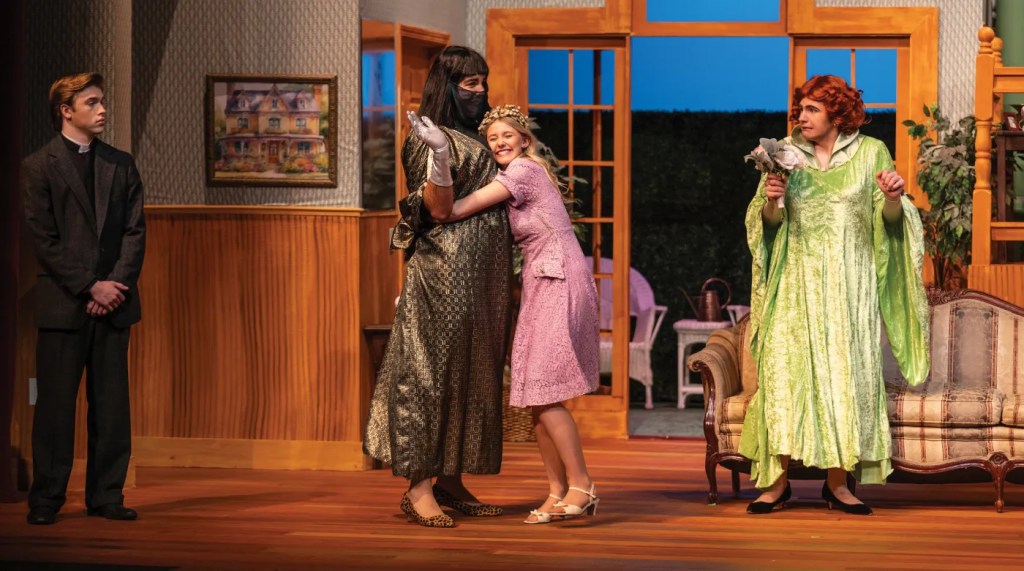
(Left) Garrett Veal, Zane Brewer, Zoey Newcomb and Donovan Walters playing Duncan, Leo, Meg and Jack, respectively, in A-State Theater’s production of “Leading Ladies.” Photo courtesy of Arkansas State University
While the Department of Theatre produces the show, students alone cannot complete the experience without a live audience. Performing in front of live audiences night after night gives the students the most authentic acting experience possible.
Assistant stage manager and A-State student Emalee Gillean said the difference is noticeable.
“When audiences are reactive, laughing and engaged, our actors can feed off of that energy and put it into our show. Without a real audience, the feel of the show is very different,” Gillean said.
Because theater is performed live, each audience brings something new to the experience.
“Each audience has their own personality,” Gillean said. “Each day, our audiences are entirely different because of the energy they bring to the performance.”
For students who are involved in the production, that interaction is part of what makes theater different from regular classroom experiences. Director DayDay Robinson said students gain valuable insights through productions like this.
“Students gain real, hands-on experience that you just can’t replicate in a classroom,” Robinson said.
That experience is not only about rehearsals, but also performing in front of others and responding to audience reactions in real time. Gillean said audiences include more than just students.
“We see a wide variety of students, professors, family members and Jonesboro community members in our audiences,” Gillean said.
That mix of audience members shows how productions bring the Jonesboro community onto campus while also giving the students a chance to perform for a wider audience. In addition to performance, visual elements also contribute to the audience’s experience. Costume designer Claire Abernathy said actors bring those elements to life on stage.
“The two actors wear the costumes with such confidence and really embrace the fun, absurd playfulness of the moment,” Abernathy said.
For many students, the opportunity to perform in front of a live audience is one of the most important parts of the process.
“We spend months building a show and creating a special experience. Getting to showcase it is the highlight of the process for many,” Gillean said.
Click to View!
For performers, that connection between the stage and the audience is what makes live theater special. Donovan Walters, a student actor who performed in the A-State Theater production, “Leading Ladies,” said theater is a communal experience.
“Theater is a shared experience that connects a tie between all the people on stage and everybody in every seat,” Walters said.
For a city like Jonesboro, this connection between community and school is valuable.
The university’s theater program depends on community members to attend performances, while those same community members benefit from access to live theater and creative work produced by the students. Both sides have an important role in the success of the school and the community.
JONESBORO — The Arkansas State University Aggie Market is doing more than selling locally processed meat. The market to many students and community members provides a visible connection between A-State and the larger city.
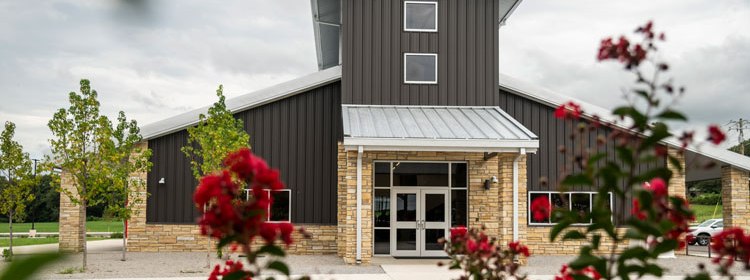
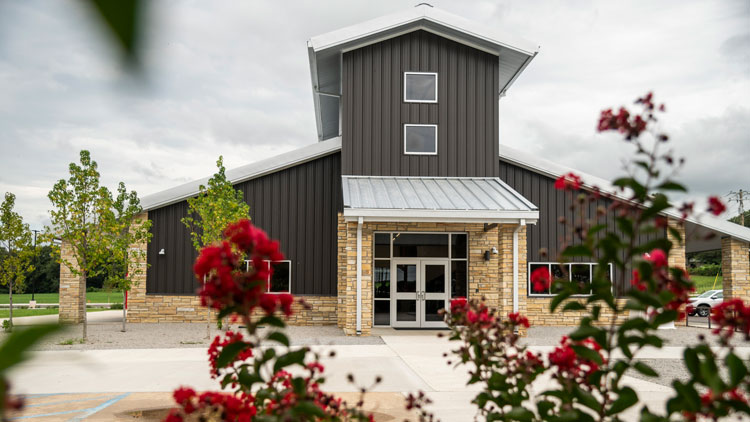
View of the front of the Arkansas State University Aggie Market. Photo courtesy of Arkansas State University
Part of the College of Agriculture, the Aggie Market serves as both a student learning facility and a public retail space. Students help process, market and sell products while interacting directly with Jonesboro residents during weekly retail hours and community events.
Richard Readnour, meat laboratory manager, said the market’s role extends beyond education by creating direct interaction between students and the Jonesboro community.
“The Aggie Market’s target audience is anyone within the Jonesboro community, or surrounding areas. We seek to build relationships with students, staff, faculty, and strengthen our community ties,” Readnour said.
The Aggie Market first opened in 1971 as the ASU Meat Lab under the leadership of Raymond Hostetler. The meat lab originally focused primarily on teaching and USDA-inspected processing.
In 2021, the College of Agriculture received grant funding from the Arkansas Department of Agriculture that allowed the facility to undergo major renovations. The market reopened in 2023 under the new name A-State Aggie Market as the first state-inspected facility in Arkansas.
The renovation also expanded opportunities for students beyond meat processing. Students can now participate in nearly every step of production, from raising livestock at the university farm to developing and marketing retail products sold to the public. Students working inside the market are often the face of those interactions.
Hannah Johns, a student employee at the Aggie Market, said they provide hands-on learning opportunities and even employment for students.
“We are committed to producing products handmade by students and being engaged with the community,” Johns said.
The market opens weekly to the public, allowing residents to purchase products directly from students working in the facility. Readnour said those face-to-face interactions help students gain experience while also giving customers a better understanding of agriculture and food production.
According to Readnour, the market isn’t a one-time stop.
“We have several repeat customers who come back often to pick up their favorite products. We use this as an opportunity to tell them about the importance of agriculture, and our students who help us through every stage of production,” Readnour said.
Still, awareness of the Aggie Market itself may not be widespread throughout Jonesboro.
Craig Rickert of the Jonesboro Advertising and Promotion Commission said he was more familiar with the broader Judd Hill Farmers’ Market than the Aggie Market specifically. Rickert said community-centered agriculture events hosted through A-State play an important role in connecting the university with Jonesboro residents.
“The great appeal of the Judd Hill Farmers’ Market is that it brings people to campus,” Rickert said. “Those Saturday morning and Tuesday afternoon trips can be as much about being social as shopping. You can get great local products in a lot of places. But the farmers’ market gives you community on top of that.”
Click to View!
Rickert said the Aggie Market should be viewed as a community resource and not exclusive to the university.
“When you see the full parking lot, the families, the kids running around snagging a free taste of something, that’s special,” Rickert said. This most definitely strengthens the connection between the city and the university. A-State is the heart of our city.”
While the Aggie Market operates on a relatively small scale compared to other university outreach efforts, it continues to provide one of the few spaces where students and Jonesboro residents regularly interact through a shared local experience.
“We need to drop the sentiment that something is only A-State or only Jonesboro. The city and the university live together hand-in-hand,” Rickert said.
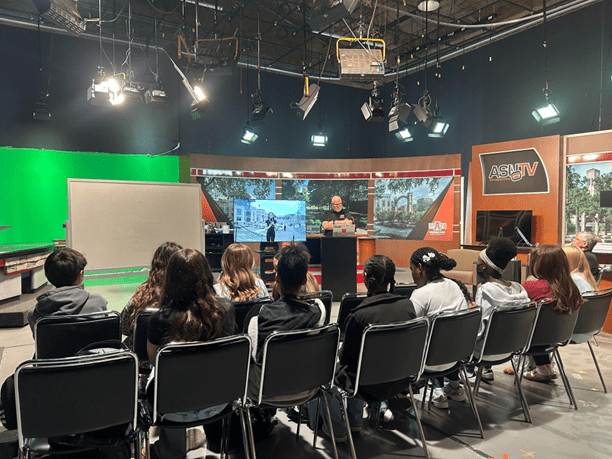
Nettleton BRIDGE program students presenting and watching their final video projects about Nelson Mandela and Zodwa Dlamini. Photo by Mia Young.
JONESBORO, Ark.- The Nettleton BRIDGE program introduces middle school students at Nettleton Junior High to the learning environment of a college student by teaching them about multimedia journalism in the School of Media & Journalism.
The Nettleton BRIDGE program began as a way to help Nettleton Junior High students experience what it is like on a university campus, so they can imagine themselves as a student at Arkansas State University or any other university. Many first-generation college students struggle to imagine college life.
Chris Moss, principal of Nettleton Junior High, contacted Gina Houge, associate dean for the College of Liberal Arts and Communication, because he wanted to target his eighth-grade students young enough to benefit from an experience that could encourage them to become college students. Last year, the program began by bringing in a small group of Nettleton students who were interested in multimedia journalism, especially the media aspect.
“I mean, that’s what students know, right? They have their phones, and they’re engaged in media constantly,” Hogue said. “But to get an experience within an academic field was what Mr. Moss wanted them to experience.”
Hogue and Moss also wanted to add a historical component to the program, as they are both passionate about history. But last year’s pilot program focused on building the students’ multimedia journalism skills, and they were unable to build out any historical component. Jonathan Reaves, instructor in the school of media and journalism, played a critical role in working with the students and developing their multimedia journalism skills.
“The first year of the program (last year) was a challenge in that we were developing a program from scratch,” Reaves said. “In the first year, we had to decide which media we wanted to use. We primarily focused on video packages, and I have been working on audio podcasts separately. I expect we will incorporate more audio podcasting next year.”
The program changed significantly from the first year to the second. Last year, the group of students interested in media activities merged with the group who were interested in STEM activities. This meant some Mondays, the group would work on multimedia projects and other Mondays, they would work on STEM projects.
This year, the two groups remained separate, and they focused on adding a historical component along with learning the elements of writing, audio and video.
“So we wanted to continue with street talks, and we wanted to expand and add the audio component in so they could do more audio editing. Then Alina and Jonathan wanted them this semester to do an actual video report that encompassed all of these elements of interview, audio and also video,” Hogue said. “To build in the historical component, we wanted students to be able to meet people from many places around the world and learn about the culture in other places and to interview people, so that they’re doing their research, ’cause when you research like a journalist, you’re researching like a historian.”
Throughout the last year, students completed several multimedia projects based on what they learned about different historical topics in the Nettleton BRIDGE program class.
One of the first things Alina Sakayeva taught the students about was her hometown of Kazan, Russia. Sakayeva talked about her family traditions, the food they eat and the relationship between her and her family. She showed them some of the historic buildings and contemporary athletic facilities where they host global soccer matches, and taught the students about the ancient culture and the traditions there.
“The students sat on the edge of their seats, listening and looking at the images, and watching the videos of the cultural dancers in Kazan, conveying the history of that region of the world to these young people, these eighth graders, from Nettleton Jr. High School,” Hogue said.
At the end of the nine weeks, the students created their video story about Kazan and something from Sakayeva’s culture they were interested in, and then presented it to the class.
“The Kazan video (was my favorite), it gave us a lot of freedom to do whatever with the video, and it was super fun to learn about,” Brylin Smallman, eighth grader in the Nettleton BRIDGE program, said.
During the second nine weeks, the students learned about the Pine Ridge Indian Reservation in South Dakota. They also individually created videos on the topic using interviews with Alice Phelps, a former educator on the reservation, and their own research.
During the third nine weeks, they read “The Story of Nelson Mandela” by Floyd Stokes and learned about him, and Zodwa Dlamini, who was in his administration in South Africa and who brought several school districts together there. The students also interviewed Dlamini over Zoom.
For their final projects in the fourth nine weeks, the students spent time in the K-labs learning about audio production and editing their videos about what they learned from their reading, their research and the interview with Dlamini.
Not only are the students learning audio, video, storytelling and a little bit about history but they are also learning life lessons they will carry with them throughout their lives.
“(I learned) to be open-minded. I wasn’t very open-minded at the beginning, and now I’m just like ‘OK, this is what’s going to happen, and that’s OK,’” Fielder Franks, an eighth grader in the Nettleton BRIDGE program, said. “Sometimes life happens, and it doesn’t go your way, and sometimes that’s just how it works, and so, you’ve just gotta be OK with that and move on.”
Every Monday, the group of 12 students would meet in the TV studio in the A-State College of Media and Journalism for two hours. This means these students would be missing three class periods and would be responsible for making up the classwork they missed. To be in the BRIDGE program, the students have to meet certain requirements, like having good grades (because they miss a lot of work) and not having any behavioral issues at school.
Karley Barnes incorporates multimedia elements into her EAST class, which each of the students attends. Barnes, an A-State alum, also travels with the students to and from the A-State campus and gives students a participation grade based on whether or not they came out and did their best.
“I think it benefits them because they get out of the classroom, they get to be challenged. It might be kind of taboo to say, but public school education is very watered down, and it’s not watered down out here,” Barnes said.
Click to View!
Next year, the program will see a new group of eighth graders with many of the same and many different projects. Each year the students move up in school, the program continues to support them, but they have less time to visit campus. Reaves and Hogue are still excited for what next year will bring, even though the current eighth graders may not be on campus as much next year as they are now.
“I would tell these students to stay curious, keep working on their editing skills and be proud of what they have done,” Reaves said.
The Nettleton BRIDGE program does not just give students a chance to learn and improve their media skills, but “to help them, to inspire their learning, and to find their pathway in life. That’s the goal,” Hogue said.
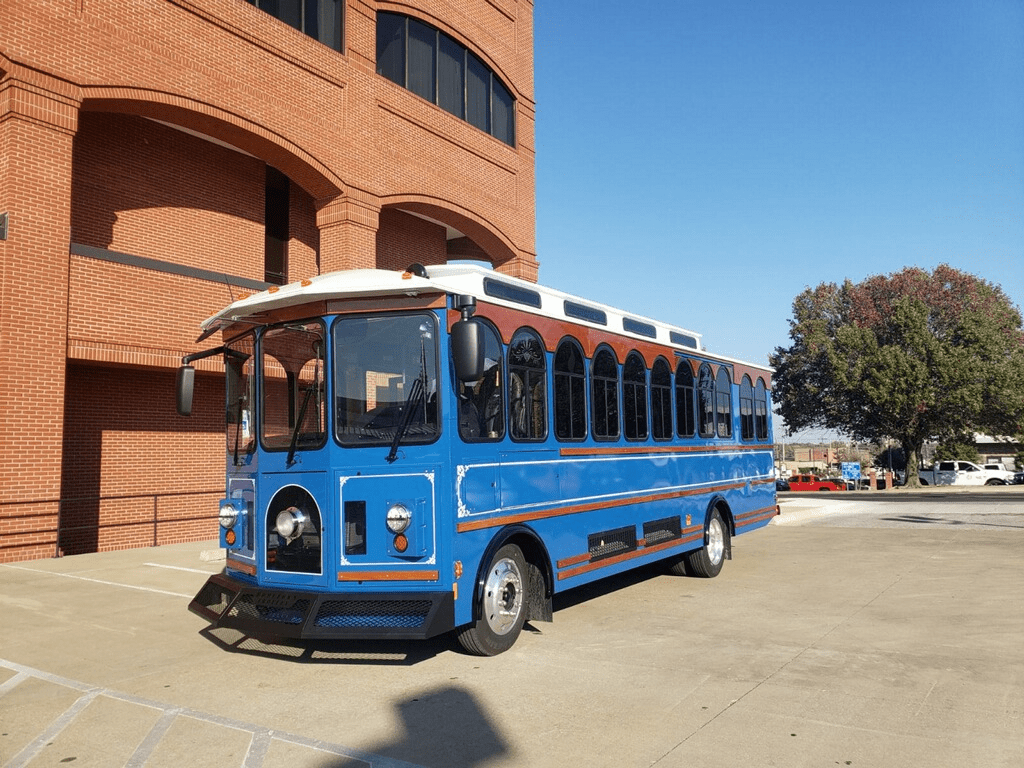
A blue trolley-style bus parked at the Jonesboro City Hall building. These buses offer transportation services using the GoJo Transportation System. Photo courtesy of the City of Jonesboro website.
JONESBORO, Ark. — The City of Jonesboro’s new GoJo Transportation System provides a convenient service to Arkansas State University students, offering free, campus-wide transportation. However, limited outreach to students has kept many from using the service.
The new GoJo system, previously JET, provides service to A-State and the surrounding Jonesboro area. It features six routes, ranging from on-campus hotspots to countless places in the city. The new Let’s GOJO! The app and website provide a map of all stops and routes to help users locate the nearest available transportation, as well as live tracking of all buses and trolleys.
The service is free to students with a valid student ID, providing an accessible alternative to driving or walking.
One of the most notable features of the system is the new Trolley-style buses. These vehicles provide classic aesthetics with modern functionality, which gives students a comfortable ride that is also more visually appealing than traditional transportation options.
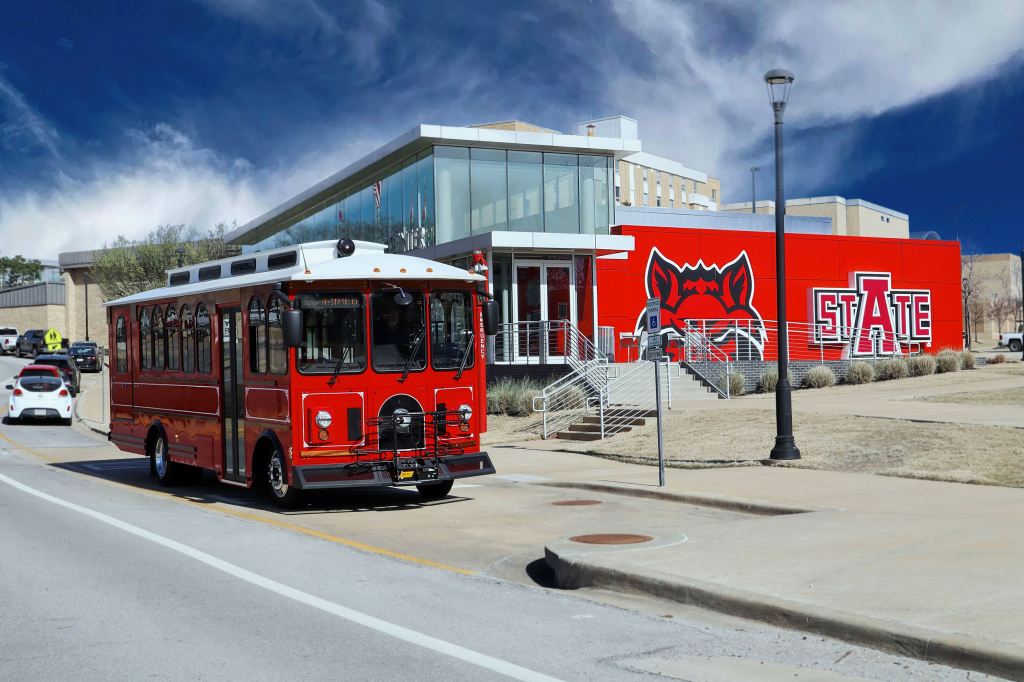
A red trolley-style bus parked in front of the Arkansas State University Welcome Center. Photo courtesy of the City of Jonesboro website.
City officials and transportation coordinators said GoJo is meant to connect residents, visitors and students to the city of Jonesboro through expanded connections throughout the city, including A-State.
Despite the advantages to students, GoJo is relatively unknown amongst them. International student Boaz Muteba said she followed the news surrounding the new system.
“In the fall of 2024, when public transportation options were expected to increase, I was one of the individuals who participated in the meeting to get more buses,” Muteba said. “Recently, when the idea took shape, I spotted the bus on campus and even saw it featured on Instagram. Unfortunately, I never got the chance to utilize it.”
The system’s impact goes beyond convenience. By encouraging students to use public transit, Gojo supports sustainable efforts and accessibility for those without personal vehicles and eases parking demand that comes with a growing campus.
As Jonesboro and student enrollment at A-State continue to grow, GoJo presents an opportunity to strengthen connections between the city and it’s academia scene. However, its success will depend on public awareness of this new system.
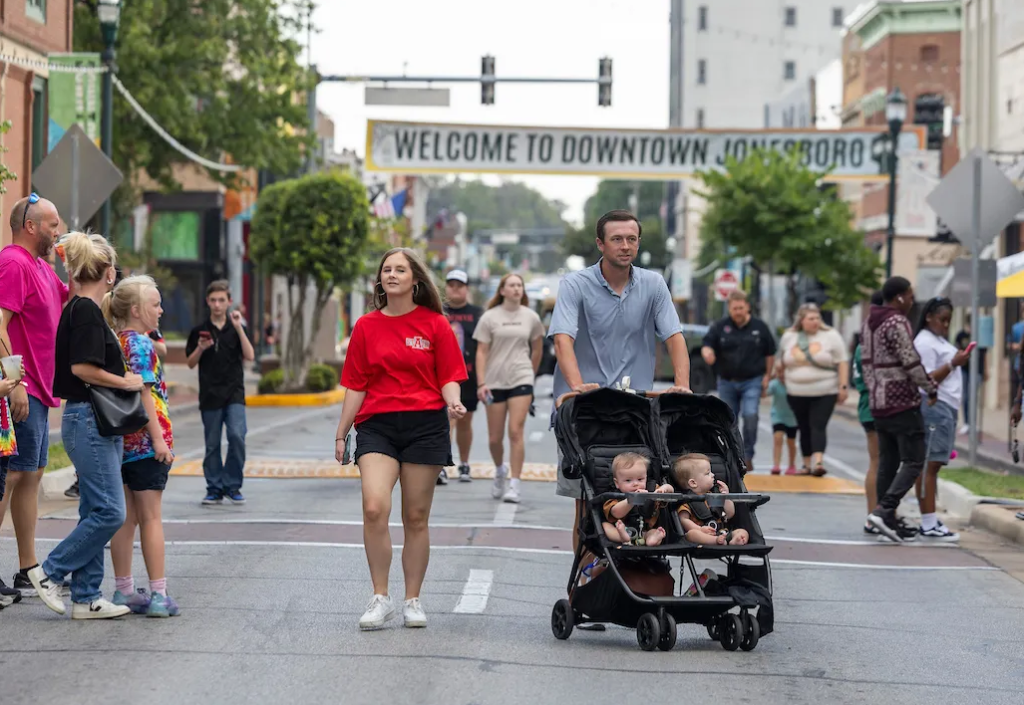
Pedestrians walk through downtown Jonesboro beneath a “Welcome to Downtown Jonesboro” banner, highlighting the connection between Arkansas State University and the local community. Photo courtesy of Arkansas State University.
JONESBORO, Ark. — As Arkansas State University continues to grow alongside the city of Jonesboro, students and community leaders say the relationship between campus and community is evolving, but not without challenges.
From economic inequality to shifting social values, both groups are working to better understand their roles in a shared space. While students often focus on academics, identity and campus life, many Jonesboro residents are more concerned with jobs, healthcare and the rising cost of living, highlighting a need for stronger collaboration.
Local organizations say collaboration is critical as community needs continue to grow.
At the Jonesboro Human Development Center, officials say demand for services has increased in recent years, creating new challenges for staffing and care.
“We are struggling to hire people to provide hands-on care for adults with disabilities,” said Diane Keith, a nursing home administrator at the facility. “We need employees with a CNA license.”
Keith said the center also maintains a waiting list for services, reflecting a broader need for support across Northeast Arkansas. She said A-State students help fill some of those gaps through internships in nursing, dietetics and speech therapy.
“We receive several A-State students for internships,” Keith said.
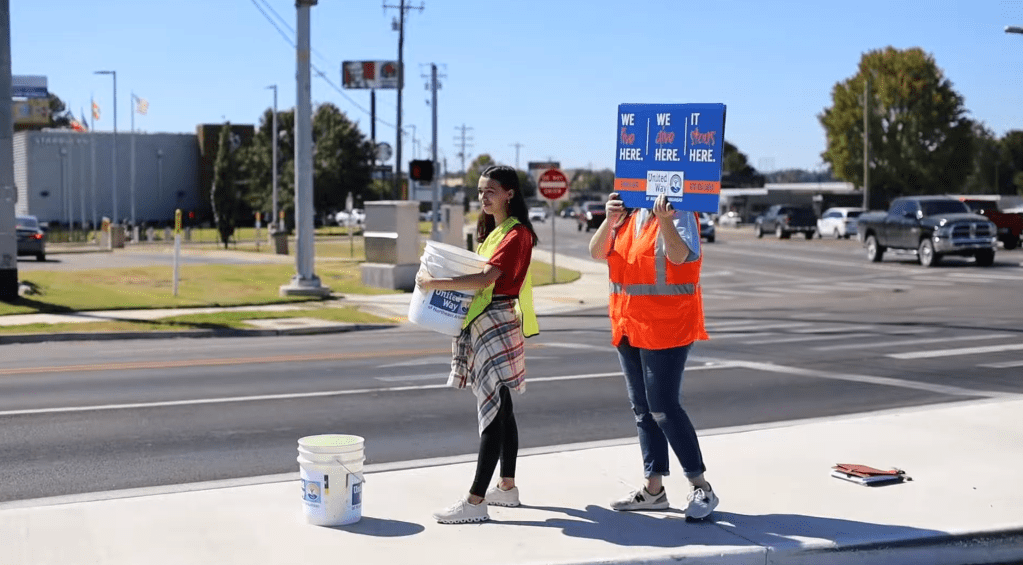
Volunteers request roadside donations for the 2022 United Way Day of Caring. More than 500 volunteers attended the event in 2022. Photo courtesy of UWNEA Jonesboro YouTube Channel.
Community leaders say those partnerships are key, but there is still room to grow.
Heather Coats, executive director of United Way, said A-State has already made strong efforts to connect students with the community.
“I think what’s important, and A-State already does a great job of this, is letting students, especially young adults, know what resources are available,” Coats said.
However, she believes the responsibility does not fall solely on the university.
“I think the community could do a better job of being present on campus when it’s not just for sporting events,” Coats said. “We need to have more of a presence that isn’t just about our own entertainment.”
Coats said increased engagement from Jonesboro residents could help integrate students into the community and encourage long-term involvement.
Erin Calhoon, development director for United Way, said improving awareness is essential to strengthening that connection.
“I would say finding ways for people on A-State’s campus to be more aware of what’s available in the community,” Calhoon said.
Student leaders agree that awareness remains one of the biggest barriers.
Jaycee Davis, president of Volunteer A-State, said her organization has made it a priority to connect students with local opportunities.
“Our mission last year was to connect campus to the community,” Davis said. “We had organizations from Jonesboro come to campus, and we introduced ourselves and shared how we could help each other.’
“Our goal this year is to have students make a bigger impact in the Jonesboro community by making them more aware of volunteer opportunities,” Davis said. “So many students don’t know what’s available in Jonesboro.”
Davis said students can get involved through activities like packing food boxes, participating in community events and supporting organizations like Hope Found, which raises awareness about human trafficking.
“Right now, the community gives a lot to the campus, which is great,” Davis said. “But I think our mission moving forward is to give that same energy back.”
Lavonda Evans, an instructor of sociology and criminology at Arkansas State, said differences in age and life experience often shape priorities.
“Students are in that space between being supported by their families and stepping into the real world,” Evans said.
Evans said campus conversations often focus on identity and diversity, while broader community concerns center on economic stability and infrastructure. She said there is a growing shift toward individualism.
“Everything is more individualized and specialized, which creates less collective support,” Evans said. “People tend to focus on their immediate circles rather than the community as a whole.”
Despite those differences, Evans said collaboration is both possible and necessary.
Click to View!
“Jonesboro is already making efforts to connect the campus with the city,” Evans said.
She said projects like walking trails and plans to better link the university to downtown are some examples of this effort.
Evans said expanding paid internships or job-shadowing opportunities could help students gain early experience while strengthening ties to the community.
“Overall, both city and university leaders are making strong efforts to connect students and the community, but there is always room for improvement,” Evans said.
As both sides continue to grow, leaders agree that bridging the gap will require greater awareness, stronger partnerships and a shared commitment to engagement on campus and in the community they will eventually call their own.
JONESBORO, Ark. – The Arkansas State University Museum is not only a place where people can see parts of history, but also an educational resource for teachers, professors and students.
Many students spend four or more years at A-State without visiting the museum, missing a valuable interactive educational experience that could help them better understand what they learn in history classes. The museum focuses not only on Arkansas history, but also on preserving and showcasing the history of northeast Arkansas and the Delta region.
The museum serves as an informal learning environment, according to Elisabeth Engel, director of the A-State Museum.
“You don’t have to be here. It’s not like class,” Engel said. “So, you know, we value the people that come through because they’ve made an effort to come see us. We hope that they walk away feeling like that effort to brave campus, find a parking spot, and all of those kinds of things, in our particular environment, was well worth it.”
Students, faculty, staff and Jonesboro residents can visit the museum on their own or book a tour with Jill Kary, curator of education at the museum. For teachers and professors, the experience can be especially valuable.
Lillie Fears, professor and interim director in the School of Media and Journalism, brings her classes to the museum every semester to help students understand historical events in ways a textbook cannot.
“My favorite part about taking students to the museum is seeing their reactions when they see something old that we’ve talked about in class, or that is mentioned in our book or in a documentary. These types of experiences can allow them to step out of present-mindedness and to realize how the tools and technology they use in modern times evolved at different eras in U.S. and world history,” Fears said.
Many groups, Engel said, visit the museum with a specific purpose. For some groups, Engel pulls artifacts from storage and creates a “mini exhibit” tailored to their interests.
Fears prefers tours focused on communication history and artifacts, so Engel often brings out old newspapers, cameras and photographs for her students.
“I really appreciate how the director, Elisabeth Engel, is always willing to bring out old artifacts that pertain to mass communications and provide us with special lectures on the history of these media tools. A textbook or video could never do what she and Jill Kary, education coordinator, do for my classes,”
For some students, a focused tour helps them better understand what they have been learning in class.
“It made a lot of the concepts feel more real. In class, we talk about the history of media, but actually seeing the artifacts and examples in person helped me connect everything more clearly, especially how media has evolved and impacted society,” Kaysen Lomax, a junior creative media production major from Jonesboro, said.
For other students, seeing everything the museum offers gives them a perspective they otherwise might not have considered.
“Yes, I did thoroughly enjoy the tour Dr. Fears took us on. Seeing how passionate Jill Kary was about the black business district was inspirational. I enjoyed looking at all the old pictures of old businesses and equipment/technology, and find it crazy to see how much those things have changed,” Alexander Riggs, a junior creative media major from Forrest City, Arkansas, said.
While the museum serves as a tool for professors on campus, teachers in surrounding school districts also can use it as a resource.
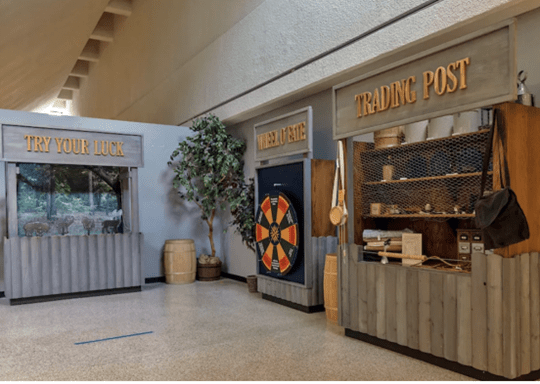
Photo courtesy of Arkansas State University.
Traveling suitcase exhibits are smaller exhibits teachers can check out for two weeks at a time. They offer hands-on materials, visual aids and lesson plans for each exhibit. Teachers can choose from five options, including Pioneer Living, Portals of the Soul: Native American Culture, World War II on the Arkansas Homefront and more.
“All of them are linked to the educational standards that are dictated by the state,” Kary said.
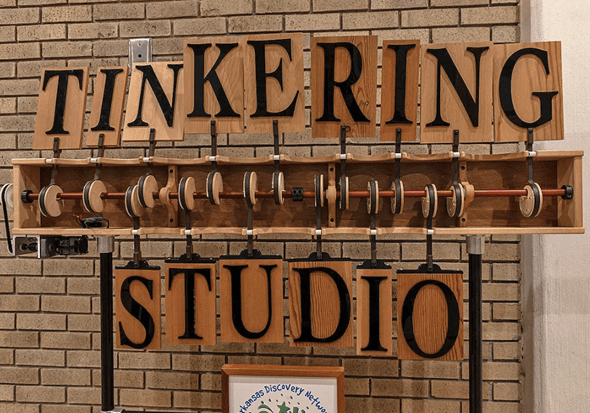
Visitors can also explore the tinkering studio to test whether they have the same innovation skills as people on the Arkansas frontier.
“If the kids have been paying attention, in every gallery they’re seeing innovation happen,” Kary said. “So they are told to invent things, make something, and if it doesn’t work, tweak it, fix it.”
Learning does not just happen in the classroom; it can happen in many places, including the museum. And learning is not just for students. Anyone who visits the museum is welcome, whether for a specific purpose or simply for fun.
From city-wide cleanups to research demonstrations, several organizations are gearing up to host events for Earth Day in Arkansas.
Earth Day, held on April 22 every year since 1970, is a global event observed to spread awareness and support for environmental issues and practices.
Melissa Dooley, director of the Arkansas State University environmental, health and safety office, said Earth Day assigns a specific day in which people can sit down and talk about what they are doing or could be doing to help the environment.
“Earth Day is a kind of celebration and a recognition and awareness of things that we can do to help maintain and improve our environment,” Dooley said. “But it’s also a celebration of the Earth as a whole and that we all are here sharing this big rock floating in space together and it’s all our home.”
EARTHDAY.ORG, the global coordinator for Earth Day events, announces a unique theme for Earth Day every year. This year, they chose “Our Power, Our Planet.”
Dooley said centering Earth Day around a theme keeps everyone on their toes and prevents the same events from happening each year.
Upcoming events
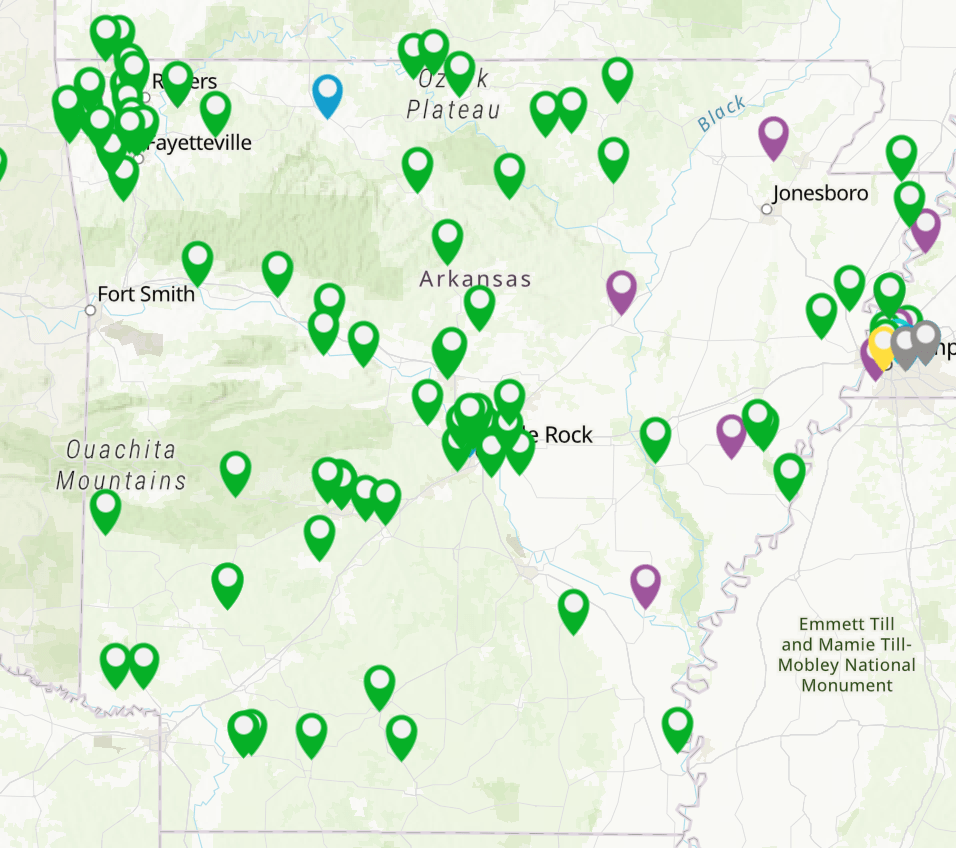
Over 10,000 Earth Day events are scheduled worldwide. More than 60 official EARTHDAY.ORG events are registered in Arkansas alone.
EARTHDAY.ORG offers an interactive map on its website with the locations and dates of all registered events.
A map of Arkansas with pins denote Earth Day events registered through EARTHDAY.ORG. Organizers registered over 60 events in Arkansas as of April 16, 2026. MAP GRAPHIC COURTESY OF EARTHDAY.ORG.
Keep Arkansas Beautiful lists seven pages of environmentally focused events across Arkansas on its website, though not all are organized specifically for Earth Day.
Keep Arkansas Beautiful is a division of the Arkansas Department of Parks, Heritage and Tourism and a certified affiliate of Keep America Beautiful Inc.
In Jonesboro, an Earth Day event is scheduled from 10 a.m. to 2 p.m., April 22, at the Heritage Plaza Lawn on the A-State campus.
Several clubs and organizations will table at the annual event to spread awareness on several topics related to Earth Day. Dooley said some participants will even present their research.
“We also invite a lot of local vendors who might be interested in setting up a table and talking about what they’re doing for environmental progress, sustainability and whether they have a focus on that this year,” Dooley said.
An art contest is also scheduled, which will feature works made from recycled materials by local primary school students.
Dooley said the main goal of the event is to reach out to the younger generation and open their eyes to their impact on the world and the importance of sustainability.
“It’s making them knowledgeable, so as they grow up, and they see mom and dad throw something out the window, they’re like, ‘you shouldn’t litter, mom and dad,’” Dooley said. “If we get everybody as they’re young, they grow up with these good responsibilities of being a steward for this planet and that also gives an opportunity to start thinking of things outside the box that this generation didn’t think of.”
Beverly Parker, Keep Jonesboro Beautiful commission chair, said giving children early experience with practices like litter removal and proper trash maintenance will establish more eco-friendly habits in the future.
Dooley said while the event is generally geared toward elementary and middle school students, anyone can come out and learn something.
The event is funded entirely by donations and volunteering. The EHS director said her department sponsors the event alongside Jennifer Bouldin, dean of the science and mathematics department and director of the ecotoxicology research facility. Dooley said this event represents a significant collaboration between several campus organizations.
One town over and three days later, Paragould will host a city-wide cleanup from 8 a.m. to noon. The event is led by volunteers and designed to bring together residents and local businesses to improve public areas.
More Earth Day events across the Arkansas Delta are listed below:
Cherie O’Mary, executive director of the Arkansas Recycling Coalition, said Earth Day excels at highlighting advancements in environmental policies, practices and issues.
Dooley said one of the biggest environmental issues facing Arkansas now is the amount of trash on the interstates, highways and parking lots.
“You can go anywhere, there’s just trash everywhere,” Dooley said. “All of that trash eventually makes it ways into our stormwater systems and our rivers, our streams, our lakes, where it clogs up the heavy, dense areas in the woods where animals are, and it affects their habitats as well.”
Parker said areas with poor litter or debris management give off an unsafe feeling.
Arkansas Department of Transportation assistance chief engineer for maintenance, Steve Frisbee, said litter is a problem, from the largest interstate to the smallest back road.
Emma Goad, a writer for ARDOT, said the department spent about $8 million on cleanup efforts. She said the cost comes from several programs, contracts and other services intended to keep Arkansas highways litter-free.
Frisbee said organizations like Keep Arkansas Beautiful help engage the community in cleanup efforts and reduce the environmental damage litter causes.
A litter report form may be filed on the IDrive Arkansas website here.
Recent environmental policy also highlights the significance of Earth Day.
The SPEED Act limits the scope of the National Environmental Policy Act and changes the environmental review of major federal actions under NEPA to restrict the number of federal actions that trigger NEPA review and expedite the review process.
According to House Majority Whip Tom Emmer, more than 300 stakeholders support the bill. Organizations like the Aluminum Association, Steel Manufacturers Association, Data Center Coalition and even Google state they support the SPEED Act because it will accelerate projects and lower costs.
Despite this support, the bill remains controversial legislation.
David Watkins, director of government affairs for the climate and energy program at the Union of Concerned Scientists, said this bill means bad news for the environment.
“It includes goodies like shielding fossil fuel projects from meaningful review or public input before they are permitted, then shielding them from legal recourse after they are approved,” Watkins wrote in a UCS article. “Circumventing science and denying reality will only lead to greater harm to our environment and worse outcomes for communities.”
The SPEED Act is pending approval from the Senate after the House of Representatives voted to pass the SPEED Act on Dec. 18, 2025.
Despite the controversy surrounding this bill and others, Dooley said she thinks, generally, Arkansas does its fair share for the environment.
“We have beautiful parks, beautiful places to go and visit, enjoy and we have some rules in place,” Dooley said. “Could we do better? Yeah, I mean, there’s always room for improvement. But I think we’re headed in a good direction.”
Dooley said stormwater permit requirements are an example of good policy in Arkansas.
The Arkansas Division of Environmental Quality requires any construction project over one acre to apply for a stormwater permit under the National Pollutant Discharge Elimination System program.
An infographic illustrates how rain or melted snow carries construction waste like concrete, oils and pesticides, into stormwater drains. These construction pollutants cause ecological damage when they drain into bodies of water. INFOGRAPHIC COURTESY OF NEVADA DIVISION OF ENVIRONMENTAL PROTECTION.
According to the ADEQ website, stormwater carries dirt, chemicals and other pollutants that could harm water quality. Stormwater permits regulate this runoff and prevent pollutants from entering streams, creeks, ditches and other waterways.
While Dooley said the laws in place and penalties for breaking them are effective, she knows there will always be bad actors. She said this is why speaking up is important.
The ADEQ pollution complaint form may be found here.
O’Mary said Arkansas’ glass recycling programs are another example of how Arkansas is leading the charge in certain areas of sustainability.
The ARC executive director said the real impact of Earth Day may only be felt in the future. Still, O’Mary said now is always the best time to get involved.
Keep the conversation going
Although Earth Day is only celebrated on a single day, Dooley said awareness should continue year-round. She said people are constantly interacting with the environment, making Earth Day an everyday conversation.
O’Mary, who has served the recycling industry for 15 years, said she feels Earth Day is more prevalent now than in previous years.
In her five years as the EHS director, Dooley said she noticed younger people becoming more interested in sustainability. Dooley, who also sits on the Keep Jonesboro Beautiful commission, said the community has expressed interest in Earth Day events like city cleanups.
“I was relatively surprised with the amount of people that really want those types of things,” Dooley said.
O’Mary and Dooley said one does not have to wait until Earth Day to start taking care of the planet.
Dooley said many people do not realize all the different ways they can participate in Earth Day.
O’Mary said calling the local solid waste district and asking how to offer support is a good first step for those interested in recycling but unsure how to start.
The ARC executive director said she is constantly on the phone, helping direct people to where they can recycle unwanted items.
“That’s the ultimate goal, keep it out of the landfill,” O’Mary said. “Reuse, reuse, reuse.”
The ARC may be contacted by calling 866-290-1429 or emailing mail@recycleark.org.
Dooley said events like clothing swaps and practices like electronic recycling are things people don’t think about often, but still help the environment.
The EHS director said, even if Earth Day did not exist, people would still raise awareness for environmental issues and engage in eco-friendly practices.
“I think we, as a race, as a human race, all recognize that something should be done,” Dooley said.
More information about Earth Day, local events and environmental issues may be found linked below:
The Arkansas State University (ASU) System Board of Trustees named Robin Myers to return as interim president.
Myers, who previously served as ASU system interim president in 2024, was again named to the position on Dec. 12, 2025, following the previous president’s resignation. He said he was honored to return.
Jeff Hankins, ASU system vice president for strategic communications and economic development, said the chancellors and system staff were relieved by Myers’ second appointment. He said they are confident he was the best individual to step back into the interim president role.
“Dr. Myers is a calm, steady force who’s very experienced,” Hankins said.
In his role, Myers said he is responsible for enacting board policies and overseeing the operation of the system office as it interacts with each campus under the ASU system.
Regardless which campus they belong to, Myers said, students should know the ASU system works on their behalf to support and assist them.
“There is a group of people working on their behalf and I think that’s important to understand for students,” Myers said. “Unfortunately, because we are remote from the campuses, it is hard to have that interaction with students.”
Despite this limited contact, Myers said over 30 years of interactions with students in various educational positions gave him the experience needed to succeed as interim president.
Myers served as chancellor of ASU-Mountain Home for 11 years from 2012 to 2023, where he said he learned how students integrate and work together with campus operations.
“I think those are the things, just having that exposure and experience over the years, that provide me with a good background to understand what our campuses are going through on a day-to-day basis and the kinds of support and conversations that they need from me,” Myers said.
As a child, Myers said he worked closely with his dad’s business, gaining experiences and opportunities that shaped his current skill set.
The interim president said his greatest strength is his ability to listen to people and understand their perspective. He said he is not quick to judge or make decisions, but instead exhausts all information on a topic before moving forward.
However, Myers said his methodical nature is sometimes a weakness.
“I try to maybe do too much or get too involved sometimes, just because I want to help and assist,” Myers said. “Maybe I should take a step back occasionally.”
Jerry Morgan, ASU system board of trustees chair, said the board named Myers because of his previous experience as interim president and comprehension of system priorities.
Hankins said the board of trustees turning to Myers again is a significant compliment. He said he does not recall any particular challenges from Myers’ first appointment as interim president.
“If anything, we came away disappointed that he couldn’t have stayed on as president,” Hankins said.
The interim president said it’s too soon to tell if his current appointment will be different or similar to his first, although the circumstances are similar.
Myers was first named interim president in 2023, following the resignation of the second system president, Chuck Welch.
In 2024, Myers stepped down after the board completed its search for a permanent system president, naming Brendan Kelly to fill the position. However, Kelly resigned in early December 2025 upon being offered to serve as president of Eastern Michigan University, his alma mater.
Myers said he enjoyed his time working with Kelly through both transitions.
“Just an exceptional person, incredible skills and ability,” Myers said. “To be able to go back to his hometown and the school in which he graduated and be the president of that, no one can blame him.”
Hankins said the board of trustees held a special meeting to accept Kelly’s resignation. Soon after, at the next scheduled meeting, the board named Myers to be interim president.
Myers said the timing of the transition required him to pivot quickly.
“In addition to trying to transition and get an apartment and get moved to Little Rock, I had to also try to celebrate the holidays with my family,” Myers said. “It was a challenge, but it was also exciting and it worked out perfectly.”
In a statement published after Kelly’s resignation, A-State Chancellor Todd Shields said continuity of purpose is vital during system president transitions.
“As the trustees identify a new system president, our job is to stay the course and stick to the vital mission of educating tomorrow’s leaders and bridging our four-year and two-year colleges, industry and workforce needs for the ultimate good of Northeast Arkansas and the entire state,” Shields said.
Myers said he wants to be remembered as someone who cared about people, supported students and worked on behalf of everyone to find the best solutions for every issue presented to him.
“In the end, everything we do is focused on providing the best educational experience and opportunities we can for our students,” Myers said. “It is both an honor and a privilege to get to work with these folks.”
Myers will serve as interim president until the board of trustees completes its search for someone to fill the position in a long-term capacity. The board will meet again Feb. 13 to outline next steps in the search for an ASU system president.
JONESBORO, Ark.- Mayor Harold Copenhaver gave his sixth State of the City address to the Jonesboro City Council on Tuesday evening, featuring major growth in the economy, finances and infrastructure, lower crime rates, and a bright future for the city.
Amid the city’s acquisition of CityStars’ finances, Copenhaver highlighted the 15 consecutive audits. He said Jonesboro is thriving and, at the end of 2025, had $28.1 million in reserves and $15 million in capital improvements.
He mentioned the growth in nearly every aspect of the city, including the 150 businesses that opened last year, 10% more calls firefighters responded to, and numerous projects ready to start. Not only projects “built for wheels,” but for pedestrians. Funds awarded to Jonesboro through the Transportation Alternatives Program will go toward new pedestrian infrastructure on the Marion Berry overpass. This will not only make the overpass safer and more walkable but will also help connect Arkansas State to the rest of Jonesboro.
“Jonesboro’s future is bright, but we’d better prepare for it now,” Copenhaver said.
He highlighted that even with the large population growth over the last decade, statistics recently released by the FBI show that violent crime is the lowest it has been in at least a decade.
More than 100,000calls were answered by dispatchers through the city’s emergency medical dispatch program. Seven calls helped guide people through CPR, and one even helped deliver a baby. Copenhaver also noted that 63% of firefighters’ and 52% of police officers’ salaries have increased.
The city also won three Trendsetter awards for Jonesboro connecting efforts, emergency medical dispatch, and the city park ranger program, and was also named Volunteer City of the Year. Copenhaver knew the council was not the only one responsible for helping win these awards; the public was a big help. He called upon citizens to make an effort to get involved and help craft a blueprint for a better city.
“But all those numbers can add up to an overall total of one. One goal, one responsibility to make Jonesboro the best city,” Copenhaver said to close his address.
After the State of the City address, business continued as usual. A few Council members raised additional concerns regarding the handling of CityStars. Questions were raised regarding Freedom of Information Act (FOIA) requests, missing paperwork and invoices for individuals working the tournaments, and making sure all aspects of taking over CityStars’ finances were done legally.
Efforts are underway to move toward partial- or fully cashless events in youth sports. IT is making strides to handle this issue. The first phase of this process is to assess the cost of the required infrastructure and ensure that locations have the Wi-Fi capabilities needed to run the program.
Matt Daniel, former executive director of the Arkansas Revolution Soccer Club, spoke during public comment. He stated during the Feb. 3 City Council meeting, Copenhaver directly named him and incorrectly quoted both his CityStars resignation letter, which did not mention anyone by name, and his proposal. Daniel went on to correct Copenhaver and state what he actually said in his letter. He stated the city has maintained that CityStars operated independently, but contracts, payroll involvement, event insurance filings, and more “show a far more entangled relationship,” and people deserve to know the truth.
“Mayor Copenhaver, I have lost all confidence in your leadership for our city,” Daniel said, after stating the aforementioned documents were not any type of confidential record but documents he was a part of.
Daniel closed his public comment, giving a call to action to the council, saying, “If you have confidence in this administration, say so. If you do not, say so. Jonesboro deserves clarity.”
(From left) Jeff Rosenzweig and Paul Ford listen as Dan Stidham speaks during the West Memphis Three panel discussion. All three men were attorneys involved in the defense of the West Memphis Three and were invited by the Arkansas State University Sociology and Criminology Association to attend the panel. Photo by Jerry Don Burton.
JONESBORO – Attorneys who defended three freed men convicted as teenagers, known as the West Memphis Three, spoke in a panel discussion at Arkansas State University to share insight, advice, and theories regarding the case.
The highly publicized and controversial case originated from the murders of three boys in West Memphis, Arkansas, in 1993. Damien Echols, Jessie Miskelley Jr., and Jason Baldwin were convicted of the murders, despite questionable evidence.
The A-State Sociology and Criminology Association (SCA) hosted the public panel on Thursday, Nov. 6, in the Reng Student Union Auditorium.
Stacy Dewald, faculty co-adviser for the SCA, said she wanted the event to bring attention that the criminal justice system is flawed, show wrongful convictions exist and offer new perspectives for those who still think the West Memphis Three are guilty. She said she believes the panel discussion achieved this goal.
The three attorneys who participated in the panel, Jeff Rosenzweig, Paul Ford, and Dan Stidham, began the discussion by detailing their connection to the case. Rosenzweig was on the team responsible for releasing the West Memphis Three in 2011, Ford was on the original defense team for Baldwin, and Stidham represented Miskelley as an attorney. Ford said this case highlights the power of confirmation bias.
“Once you have this notion, all new information is going to be sorted to reaffirm whatever that notion is. If your first notion is ‘they’re guilty,’ you’re going to hold on to that,” Ford said. “So when you meet people who are less than 40 years of age and their first involvement in this proceeding was to watch the HBO documentaries, they can’t believe they were convicted. Because that was the first story that they heard, but that was not the first story that people heard in 1993.”
Ford said the citizens of West Memphis needed somebody to blame so they could feel their community was safe. The existence of multiple potential suspects other than the West Memphis Three contributes to the controversial nature of the case and is the topic of many ongoing debates.
The three panelists said they are confident the West Memphis Three are innocent and have their own theories as to who committed the murders.
Rosenzweig said one valid suspect is “Mr.Bojangles,” referring to a bleeding man who was seen entering the nearby Bojangles restaurant about two hours after the boys were reported missing. Witnesses said the man was mentally disoriented and entered the women’s restroom. The next day, police took blood samples from the restroom that were later lost.
Ford said he has always been suspicious of Chris Morgan, a teenager who unexpectedly traveled to California with Brian Holland, another teenager, four days after the bodies were found. During questioning, Morgan said he had a history of drug and alcohol use and experienced blackouts and memory lapses. He said he might have killed the victims, but recanted this statement. This recanted statement was debated in the trial, but was found inadmissible as evidence.
Stidham said he has a suspect, a serial killer, whom he can place in the vicinity of the murders. He said he will explore the lead further and hopefully have more information to present before he retires.
Prevalent media coverage represents another element that generated controversy for the case.
Ford said national attention in the case, specifically from the media, was a double-edged sword.
“To have a CNN truck pull up outside of the courthouse in Corning, Arkansas, that’s like finding Bigfoot,” Ford said. “It was a big deal. Everywhere you went, there were reporters, cameras, people wanting interviews, producers from talk shows.”
Ford said if he could do anything differently in the trial, he would trust the media less. However, without a relationship with the media, he said, there would never have been a documentary and the West Memphis Three would still be in prison.
Dewald said the 1996 HBO documentary, “Paradise Lost: The Child Murders at Robin Hood Hills,” saved Echol’s life. Echols was the only teenager sentenced to death in the trial.
The case is also associated with the Satanic panic, due to the prosecution’s assertion that the children were murdered as part of a Satanic ritual. The Satanic panic was a social panic that began in the 1980s and continued throughout the late 1990s, involving widespread cases and accusations of Satanic ritual abuse.
Rosenzweig said some still believe the West Memphis Three are guilty for a number of reasons, ranging from having personal connections to being ill-informed.
“You’re never going to convince everyone, no matter what,” Rosenzweig said. “You just have to move on and go to the next person.”
Stidham said the use of the Alford Plea in the case is a common source of confusion that many people struggle to understand.
In 2011, the West Memphis Three entered an Alford Plea, meaning they pleaded guilty while maintaining their innocence. Judge David Laser accepted the plea, which simultaneously freed the men after serving 18 years in prison and put the case to rest.
Rosenzweig said he agrees with Stidham that the Alford Plea is a confusing part of the case and is controversial in its own right. Rosenzweig said if the state really thought the West Memphis Three killed the boys, they would still be in prison.
Ford said if the prosecution felt the teenagers actually killed the three eight-year-old boys, they should feel ashamed for letting them go free.
“Why would you ever agree to let people you think killed eight-year-olds walk free?” Ford said. “That, to me, is the greatest evidence that they really didn’t believe it.”
Scott Ellington, the prosecuting attorney at the time, said he recognized the compromise was not ideal. Still, he said, it gave the state the guilty plea it wanted and the defendants the ability to continue asserting their innocence.
“It certainly was not a perfect resolution to the case for the state, but it was much better than having three trials, trying to convince 36 jurors of the defendants’ guilt using old evidence, failed memories, changed minds, dead witnesses and the parents of two of the victims who now say they believe the defendants are innocent of the crimes,” Ellington said in a 2011 article from the Thomas Jefferson School of Law.
Rosenzweig said procedural mechanisms, which are rules designed to secure a fair and consistent application of due process, have not improved in Arkansas since the original West Memphis Three trial. He said forensic advancements make scientific evidence much more precise, but misunderstandings still persist and proliferate on social media.
Stidham said documenting is important, and interrogations should be recorded in their entirety. Ford said what he found egregious about the case was that adolescents were questioned by law enforcement without a parent present or knowledge.
The discussion ended after the panelists advised the audience on what to do if they are ever falsely accused of a crime. Stidham and Ford said to stay quiet and get a good lawyer, and Rosenzweig said to recognize that the exoneration process takes time.
Dewald, who is also an assistant professor of criminology, said planning for the event began in August, when A-State students Lesleigh Sullivan and Anna Hartley expressed an interest in the West Memphis Three for their honors project. Dewald said she feels a connection to the West Memphis Three because she grew up around the same time and shared similar interests in music and books.
“I kind of felt connected to them, but what was different is they grew up in the South, I grew up in the North,” Dewald said. “So it wasn’t so frowned upon in the North to like Metallica and Stephen King.”
The assistant professor of criminology said the case remains nationally relevant because DNA evidence remains to be tested and many questions remain unanswered. She said community interest endures because many people feel a local connection to the case.
Stidham said interest in the case will persist for many years.
“People are going to be talking about this case in 300 years, like we talked about the Salem witch trials,” Stidham said. “It’s essentially the same thing.”
Dewald said she didn’t think the panel would draw as many attendees as it did. Nevertheless, she said she appreciates the interest and hopes the event raises awareness and helps dispel some myths surrounding the West Memphis Three and the criminal justice system.
On Aug. 1, 2025, new DNA testing for evidence from the original crime scene was ordered by Crittenden County Circuit Court Judge Tonya Alexander. At the time of writing, however, no other updates have been announced.
Arkansas State’s football season started strong with a 42-24 win over SEMO at home to start the season at 1-0, then the Red Wolves went on a 4-game losing streak as they lost 56-14 to Arkansas in Little Rock, then lost 3 close games to Iowa State 24-16, Kennesaw State 28-21, and ULM 28-16.
The Red Wolves were tied with Texas State in the fourth quarter. Both teams traded touchdowns to make it 24-24 after it was 10-10 to start the fourth quarter. After the Red Wolves scored 24-24, Texas State got a big run play to set up 1st and goal, and then scored on the next play to make it 30-24 with the extra point coming up.
Looking at the score, the Red Wolves thought they were going to start the season 1-5, but the Texas State kicker missed an extra point, giving A-State a chance to win and save their season. Following the kickoff, the Red Wolves needed just 53 seconds to score what could have been the game-winning touchdown. Clune van Andel kicked the extra point and made the score 31-30 in favor of the red wolves. Following the kickoff, Texas State tried a series of laterals. But the rally came short, and A-State would go on to win the game 31-30. The win would give A-State momentum leading into their bye week.
Following the bye week, A-State would go on to win its next 3 games. A 15-14 win at South Alabama, a 34-24 homecoming win against Georgia Southern, and a 23-10 win at Troy. The Red Wolves have a chance to lead the Sun Belt West if they beat Southern Miss.
But the Red Wolves rally came a play short as Southern Miss intercepted Raynor’s pass in the endzone as time expired to give the Red Wolves their first loss in conference play and their first loss since the ULM game.
While the shot at winning the division and going to the Sun Belt championship is out of reach, the chance of going bowling in the postseason is still alive as A-State just needs one more win to become bowl eligible, as the Red Wolves have 2 games left with a home mid-week game against Louisiana and a road trip to App State. Since ASU has five wins, websites that post bowl projections have included A-State. The following are the websites that have A-State projected to go bowling after the loss to Southern Miss.
ESPN (Schlabach): Boca Raton bowl vs Miami (Ohio)
Athlon Sports: 68 Ventures bowl vs Western Michigan
Pro Football Network: 68 Ventures Bowl vs Central Michigan
Sports Illustrated: Myrtle Beach Bowl vs Utah State
On3 Sports: Cure Bowl vs Western Kentucky College football news: IS4S Salute to Veterans Bowl vs Jacksonville State