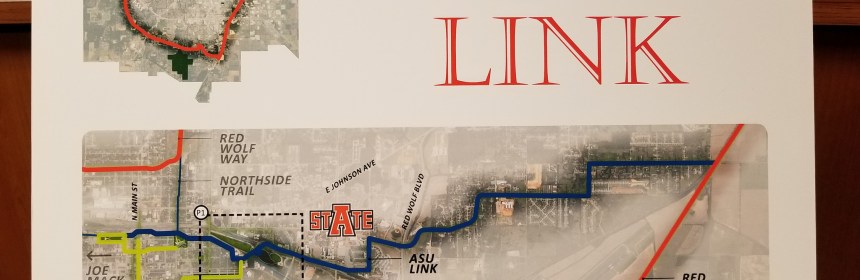
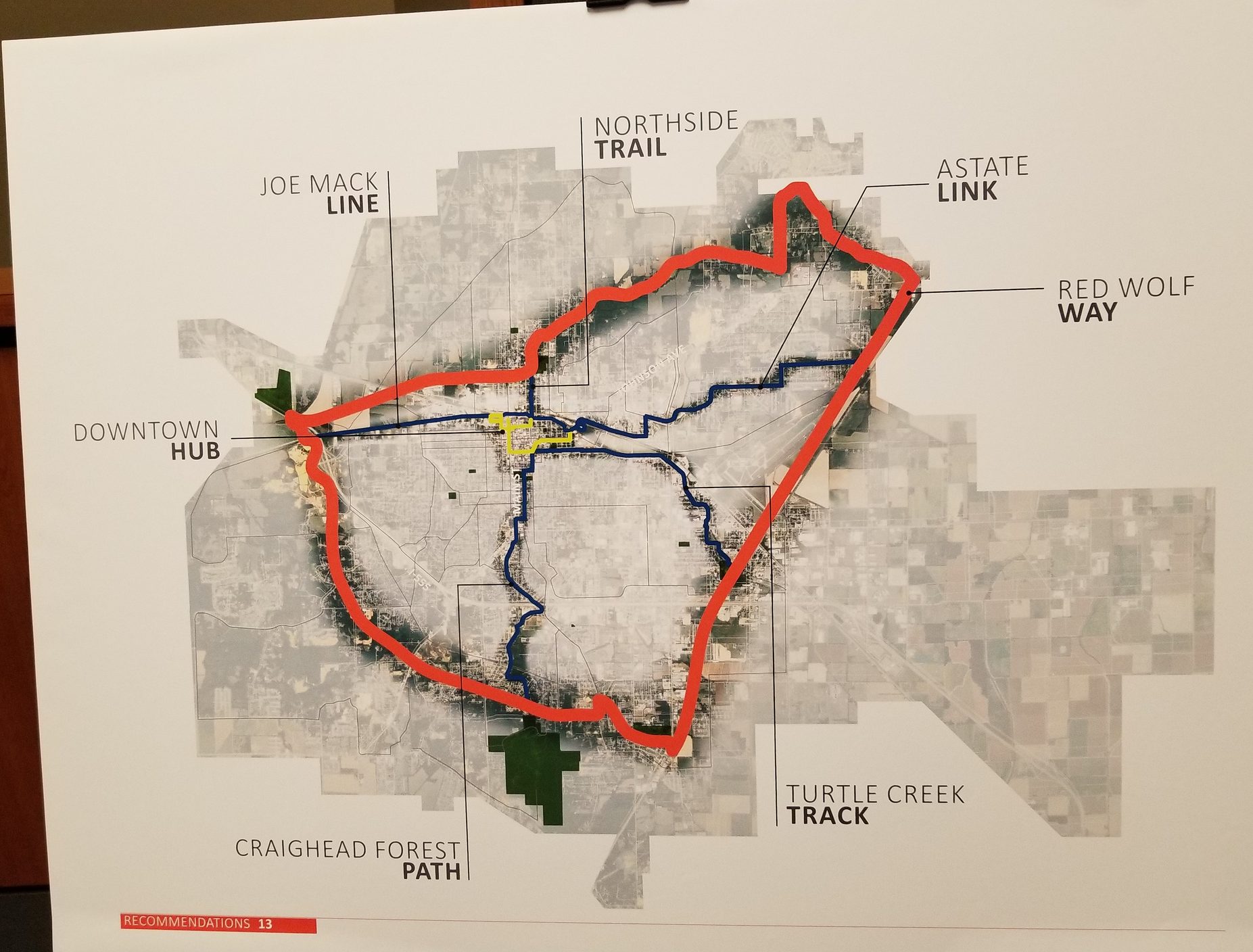
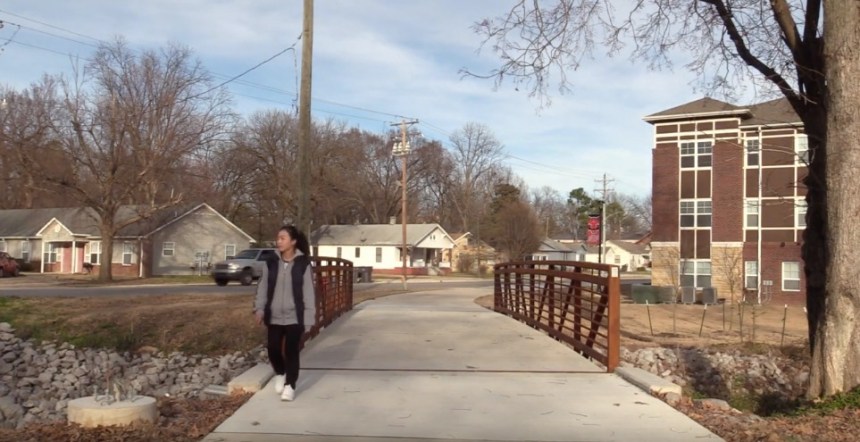
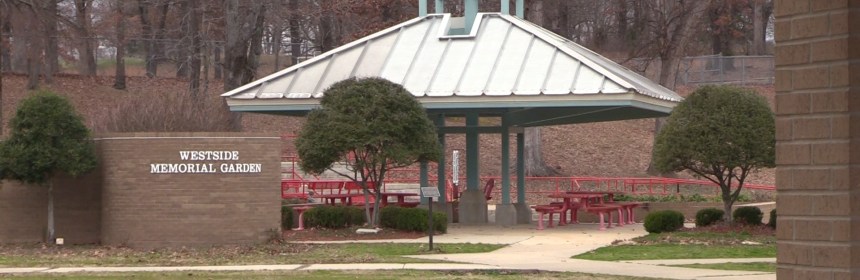
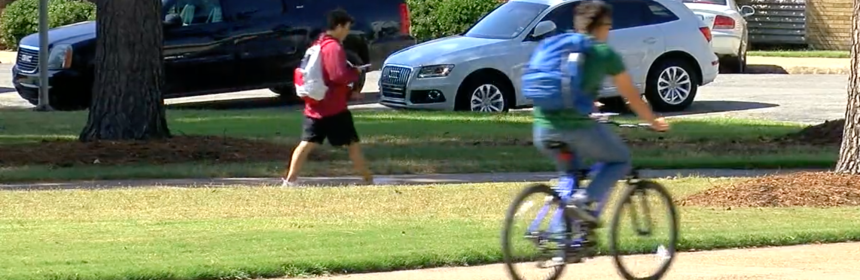
A proposed bike trail would circle the city. (Photo by Denton Postlewait)
JONESBORO — Citizens and cyclist will soon be able to access the city easier and get safe exercise for the whole family with the Jonesboro Quality of Life and Connectivity Master Plan bike and pedestrian plan.
The A-State link is part of the greater biking and walking trail plan proposed by the city with funding coming from grant money. If approved, the grants would be an 80-20% match for a total of $500,000 from the Arkansas Department of Transportation and the Transportation Alternatives Program. The grants would provide $400,000 or 80%, while the city would provide the additional $100,000 or 20%.
Arkansas State Vice Chancellor for Marketing and Communications Bill Smith said the proposed plan will strengthen the bond between the university and the Jonesboro community.
“With Arkansas State, you have a lot of park space. There are trails on campus, there are places for families to come and visit and the A-State Museum,” Smith said. “Having a way for people to come into campus from the east is extremely impactful.”
Not only would the A-State link be helpful for students and employees of the university, but it would also give residents with children a safe and fun place to get exercise on the east side of the city. With the proposed link, citizens would pass through the A-State campus on a path to downtown Jonesboro.
Smith said the northeast corner of the city happens to be the only place in Jonesboro without access to a park. The University Heights phase would give citizens and students the opportunity to use active modes of transportation to travel to work or school.
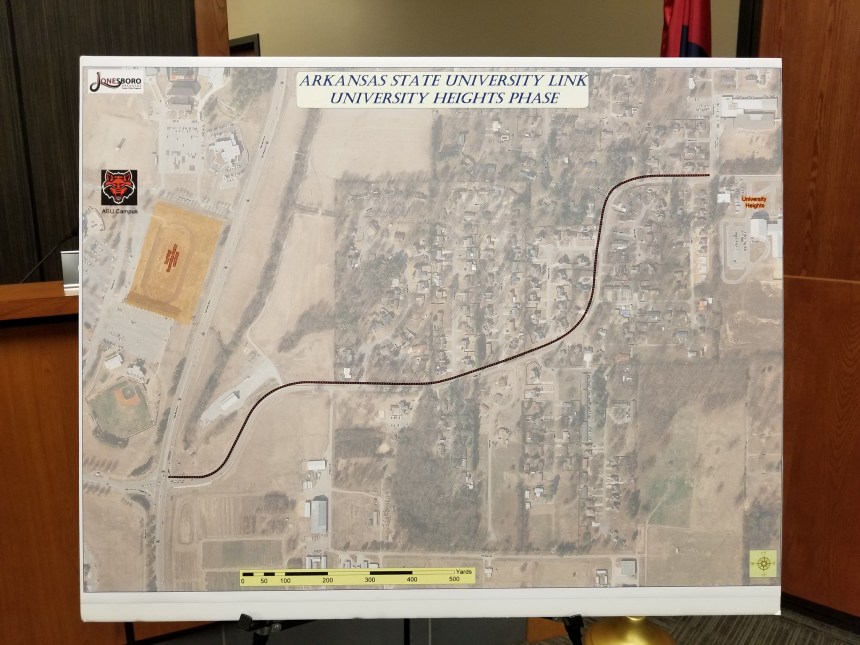
Jonesboro Parks and Recreation Director Danny Kapalas said the city would start construction on the University Heights link in late 2020. It will be the first phase of a 68-page master street plan that passed a city council vote. From there, the community selected which phase would be completed first.
“We went to the public about which section needed to be the first phase,” Kapalas said. “This phase was unanimously picked.”
The impact of the plan will not provide road cyclists much in the way of safe riding. The plan’s design caters to modes of active transportation to citizens. Brent Walker, a local cycling instructor, said it will give people who walk or ride their bike a safe route to travel on.
“It will provide a safe environment for families, especially young children to ride,” he said. “Not everyone drives, so I think it will be good.”
The plan for the University Heights phase will be designed to give citizens safe access along Aggie Road, a notoriously dangerous road with many blind turns and narrow lanes. If approved, Smith said the path would open the entire east side of Jonesboro. The one benefit for road cyclists would be access to gravel and farm riding outside the city limits.
The University Heights phase as planned. (Photo by Denton Postlewait)
Click here to find out more about the proposed link or to read the entire 68-page master road plan proposal.
JONESBORO— A new bike and pedestrian pathway will be built on Arkansas State University’s campus. The pathway will improve safety and connectivity across campus.
This new pathway comes as a breath of fresh air to some university students.
A-State student Christina Huynh said, “It is a good thing since we did have that accident recently here. I think anything we do to help make things safer, will make things safer.”
She also said she won’t feel completely safe on campus until drivers start obeying the university’s traffic laws.
The latest pathway project consists of two phases. According to Bill Smith, the associate vice chancellor for marketing and communication at A-State, the university received a $450,000 grant from the Arkansas Department of Transportation for the first phase. ARDOT will provide an additional $370,000, possibly $390,000, for the second phase of the project.
Bill Smith, the associate vice chancellor for marketing and communication (photo by Jessica Ladd)
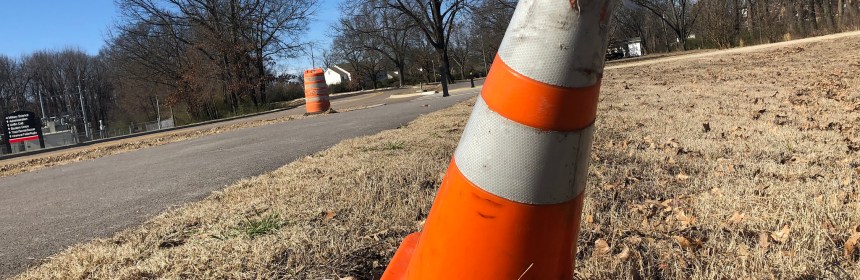
Phase one will create a multi-use path for pedestrians and bicycle riders along Aggie Road on the western side of campus. The path will also continue under Marion Berry Parkway along University Loop West. Construction on phase one began in February 2018 and finished in July 2018.
Phase two will extend the path from behind the library and continue east. It will then turn north to circle back to Aggie Road. Once completed, students will be able to make a loop around campus. The second phase is approaching the design and bid. The university hopes to start on phase two in the late spring and summer of this year. However, bid results and weather could cause delays.
Smith said these pathways are part of a master plan to link campus together. It will be easier for pedestrians and cyclist to get around. Eventually, the university wants to add more trails to connect the east side of campus to the farming area located on the other side of Red Wolf Boulevard. Smith said he hopes Jonesboro will connect its pedestrian pathways with A-State’s in the future. This will multiply the pathways for the city.
These grants come from the Transportation Alternatives Program. The money goes directly into the project and is used for engineering, materials and construction. These grants work as matching 80/20 grants: ARDOT will provide 80 percent of the funds and ASU will cover the other 20 percent. On the $450,000 dollar grant, ASU paid $120,000. The same arrangement will be applied to the grant for the second phase.
Aggie Road Bridge — An Arkansas State University student uses the new portion of the pathway along Aggie Road. (photo by Jessica Ladd)
Aaron Vowell, a resident engineer for ARDOT, said his job is to oversee construction, bids to contractors and the building plans in Jonesboro. Every couple of weeks, he receives a payment request from the University. He then reviews it to ensure the work listed has been completed. Once he has inspected the request, he sends it on to the corporate office in Little Rock, where the grant process is handled.
Although the pathway isn’t completed, many students still enjoy it.
A-State student Latoya Taylor said, “I think it is a good project because you don’t want to be in the road so close to traffic,” she said.
The University is installing lights on the dark western side of campus along the completed portion of the path. Smith predicted the path will have more foot traffic then, especially at night. Smith said he knows what it is like to maneuver around campus without with pathway.
“I’ve lived west of campus and I ride to work almost every day,” he said. “Having that new path has allowed me to step off of the road and have fewer incidents with traffic.”
He said in the past, drivers have not been willing to give him 3 feet of the road. Smith said safety must be a top priority. Drivers must stop at crosswalks. Drivers should also pay attention to the speed limit. He urged pedestrians to make sure the driver sees them before crossing at a crosswalk; they should never assume a driver will see them and stop. Smith said the new pathway will be designed to give pedestrians the right of way with the streets it intersects.
JONESBORO — New interests in school safety have emerged with the mass shooting at Parkland, Florida, and the Westside Shooting’s 20th anniversary fresh on everyone’s mind.
In light of the Parkland shooting, President Donald Trump advocated for arming teachers in the hopes of preventing more mass shootings in a tweet.
Armed Educators (and trusted people who work within a school) love our students and will protect them. Very smart people. Must be firearms adept & have annual training. Should get yearly bonus. Shootings will not happen again – a big & very inexpensive deterrent. Up to States.
The debate of having firearms on campus is not isolated to public schools; it provides a point of contention for colleges and universities as well.
According to the National Conference of State Legislatures, 10 states including Arkansas currently have provisions allowing concealed carry on postsecondary campuses. Provided a person has passed the required courses — including the standard concealed-carry courses and the specialty enhanced-carry courses — gun owners may legally carry their weapon on college grounds.
Dr. Michael McDaniel, A-State Faculty Senate chair (photo by Christopher Lee)
Arkansas State University Faculty Senate chair Michael McDaniel explained how A-State’s Faculty Senate reacted to the new law.
“It’s hard to speak for the entire faculty. About the only thing I feel comfortable saying is that I believe that the faculty were reasonably comfortable with the situation we had prior to this new law,” McDaniel said.
Prior to House Bill 1249, now Act 562, colleges could opt out of allowing concealed carry on their premises, but with the passing of Act 562 this is no longer an option.
“With the new law we lost that option, so now we can’t opt out. It is the rule and it is the law,” McDaniel continued.
Bill Smith, A-State’s associate vice chancellor for marketing and communications, echoed the idea in a short but strong statement.
“The law is the law and we can’t change that,” Smith said.
Even though the law has officially gone in effect, understanding faculty and student opinions about the new conceal carry law is important for gaining insight into how the law and its implementation are perceived.
Some faculty members like associate professor of political science Richard Wang said they feel they were ignored.
“As you know, the university said, ‘No, we’ll opt not to have concealed carry on our campus.’ Joining with A-State are all the other universities in this state, plus junior colleges, plus the campus police forces, plus the local police, the county police and county sheriff offices all around the state, joining … It’s a coalition, and they all said, ‘No, we want to keep the local option, the option here,” Wang said.
Wang has taught at Arkansas State University for 31 years. He said he was surprised to hear the law passed. You can hear more of Wang’s opinions about the concealed carry law by watching the video below:
Dr. Brandon Kemp, interim Dean of associate engineering programs (photo by Christopher Lee)
Brandon Kemp, A-State’s interim associate dean of engineering programs, echoed this sentiment when he heard the new concealed carry law had gone into effect.
“My first opinion was that it was ridiculous. As a faculty we have voiced our opinions over and over again that we don’t want guns on campus,” Kemp said.
A Jonesboro native who has worked at Arkansas State University for over seven years, Kemp said allowing guns on campus added unnecessary risk to the campus. He said it also adds confusion to first responders during an active-shooter threat.
“If we have an active-shooter situation and we have people on campus — whether it be faculty or students — who are pulling out their firearms to combat the situation, then the first responders — the police and SWAT — now they have a much more difficult situation,” Kemp said.
Dr. Erik Gilbert, professor of history (photo courtesy of Arkansas State)
While concerns about increased gun violence with more guns on campus is rational, Erik Gilbert, professor of history at A-State, has already written two articles about the topic of concealed carry on college campuses.
Gilbert cited his articles as his opinion of the new concealed carry law.
In the article, Gilbert encouraged faculty to relax about the idea of guns being on campus.
I can almost guarantee that if you have a few semesters of teaching under your belt, at some point there have been students with guns in your classroom. If those illegally armed students were not moved to violence by the content of your course or the statements of their fellow students, it seems highly improbable that a new group of legally armed students will prove to be more volatile or violence-prone than their scofflaw peers.
Gilbert ended the article by stating, “Don’t worry about the presence of legally carried guns in your classrooms. If you are going to worry, worry about someone illegally bringing a gun on campus with the intention of causing mayhem, not someone who legally carries a gun in the hope of protecting himself from harm.”
In his second article, “Campus Carry Is Not About Preventing Mass Shootings,” Gilbert argued the choice to allow concealed carry on campus is less about the ability to stop mass shootings and more about letting individuals choose how they wish to defend themselves.
Gilbert wrote, “If you happen to be locked down in a classroom during a mass shooting, wouldn’t you rather be able to shoot back if the shooter comes through the door? If you would rather resort to throwing coffee cups or iPads, as some campus police might advise, that’s a valid choice and I would not try to dissuade you.”
The article, published by Inside Higher Ed in 2017, cites many sources to show how concealed carry has affected mass shootings in states where it is allowed, and how concealed carry benefits students.
College Republicans Rep. Chandler Jones (photo by Christopher Lee)
Members of both the College Republicans of A-State and the Young Democrats discussed their opinions on the topic of concealed carry on campus.
“I’m thankful for the state of Arkansas legislature to pass this because it shows that they think of us as humans, they think of us so that we’re allowed to protect ourselves,” College Republicans Rep. Chandler Jones, a pre-professional biology major, said. “I’m thankful and I do think it will be more of a preventative measure; someone who is mentally ill would know that they’re also going to be met with force.”
Jones said he sees the new law as an opportunity, ensuring students have the right to defend themselves if necessary during a mass shooting. You can listen to more of his points below.
Dominique Phillips and Anthony Sumlin of A-State’s Young Democrats discussed the organization’s opinion of the law.
Young Democrats Rep. Dominique Phillips (photo by Christopher Lee)
Phillips also serves as president of student diversity and recruitment.
“I feel like I speak not only for myself but for my party when I say that I feel like the new laws might cause a bit of a problem,” she said. “In general, you can’t fight violence with violence, you can’t fight fire with fire. You’re allowing guns to be on campus now, even going throughout the so many courses that you have. That doesn’t change when a person has a mental breakdown or a mental issue.
“As far as someone acting as a guardian, it’s a little tricky because I see that and I can see the positive side of how they will be able to fight back,” Phillips said. “But at the same time, is it guaranteed that someone will be able to muster up enough courage to go out and shoot someone back?”
While the College Republicans and Young Democrats sit on opposite sides of the concealed carry on campus debate, both parties agreed mental health reform is necessary to prevent mass shootings like Westside and Parkland.
“I feel that not only in public schools — in high schools and elementary, middle schools — but also in colleges there needs to be a more open discussion about mental health awareness,” Phillips said.
A-State’s Young Democrats Anthony Sumlin, a biology and chemistry major, echoed Phillips’ opinion.
“I think the response should not be, ‘Oh well, let’s give more people guns to hide on themselves.’ Personally I feel like we should do more with educating teachers on how to spot mental health issues and really getting rid of that stigma that mental health is something to be ashamed of,” Sumlin said.
You can listen to more of Sumlin’s statements below.
Jones also said he believes mental health reform provides the key to stopping mass shootings.
“Restricting buying guns now really isn’t going to slow down someone who wants to get a weapon from getting it cause they’re on the streets, they’re sold illegally. So I think it needs to be more mental health,” he said. “Screening these people, getting more help for these people, more … maybe facilities. More money distributed there, I think that’s what needs to be our first step.”
The new conceal carry law has clearly struck a nerve with faculty and students alike, but it is unclear how it will affect the educational climate of colleges and universities. Even with the division the new law has caused, what is clear is the law will continue to create debates about campus safety.
JONESBORO – Twenty years have passed since the shooting that changed the lives of so many in Northeast Arkansas.
On March 24, 1988, two middle school students shot and killed four classmates and one teacher. It still haunts the people of Jonesboro. Westside Superintendent Scott Gaunt said the threat of violence serves as a worry for superintendents everywhere.
“Any superintendent will tell you that’s a nightmare that all of us have. Bad people have bad intentions; they’re going to do bad things,” Gaunt said. You know, we can only hope that we can put protocols in place that can stop it.”
One thing that can be taken from tragedies like Westside’s involves how law enforcement handles active-shooter situations. Sgt. Lyle Waterworth, Jonesboro Police Department’s community outreach and recruiting coordinator, said 20 years ago police officials waited for special forces, a policy that changed after the Columbine school shooting. The Columbine shooting happened a year after the Westside shooting, and also involved two minors shooting and killing their classmates and one teacher.
In the last 20 years, officials placed active-threat procedures in place in schools all over the nation. Many schools put in place precautions like student resource officers and civilian response courses.
“It’s important for people to know that they can defend themselves,” Waterworth said.
Whether it’s a course like the one taught to incoming freshman at Arkansas State University or the training Jonesboro Police go through with local schools, current training procedures include the same basic concepts.
“Different programs use different names, but they all kind of break down to this: run, hide or fight,” said Bill Smith, A-State’s associate vice chancellor for marketing and communications.
Something Smith said improved over last 20 years include the willingness to create training programs and talk openly about what people need to do in active-shooter situations.
“I think one of the things that over time we’ve seen as a change in the response to active threats is more of a response toward the aggression,” Smith said.
The anniversary of the Westside shooting arrives with painful memories for Jonesboro residents, but it also brings with it valuable lessons and advances in procedures to prevent active threats in the future.
by Kirsten May
Courtesy of A-State Department of Media
There are a growing number of cyclists in Jonesboro, but there are still no roads with designated bike lanes in the city and some cyclists feel there are not many safe places to ride. ASU TV’s Kirsten May looked into what is being done in Jonesboro to make it more bike-friendly.
JONESBORO, Ark. — “We need to wrap our heads as a community around the concept of a bicycle being part of our transportation mix.”
Bill Smith is the marketing and communications director for Arkansas State University and he is a cyclist.
Many people in Jonesboro are students or work in town who are now using a bicycle as their main form of transportation, and he said he thinks the city needs to focus on helping them ride safer.
“Certainly I think that we could see a greater commitment to bicycle infrastructure in our town, a greater commitment to a plan for how that will be moved around town, and not just in a parks and (recreation) mode,” Smith said. “I think that’s the future and I think that’s what millennials want.”
Jonesboro Parks and Recreation director Wixon Huffstetler said bike safety is a priority for the city and they are working to improve it.
“You know, the new trail obviously at Craighead Forrest that we are building that’ll connect eventually to the greenway that’s in town and we’re definitely looking at bike lanes on the outskirts of Jonesboro and on the bigger roads that we can fit them on,” he said.
Huffstetler understands cyclists want more done on the roads and said the city is looking at how to make that work.
“It’s just that Jonesboro is so grown together on the inside of the city, inner city, that it’s hard to figure out how to put bike lanes in without having to buy property or acquire ride away and stuff like that, which is a long process,” he said.
He said the city is constantly looking for grants to help improve infrastructure for bicyclists.
Both Huffstetler and Smith agree the best thing is for both riders and drivers to be aware of their surroundings and obey all traffic laws.
***
Smith said cyclists fare best when they act like drivers and are predictable.
Smith is teaching a vehicular riding course that teaches experienced cyclists how to be safer when riding in traffic. He said to message the Arkansas State University Facebook page or email him if you are interested in taking the class.