JONESBORO, Ark. — At Arkansas State University, students are concerned about a myriad of issues during this year’s midterm elections.
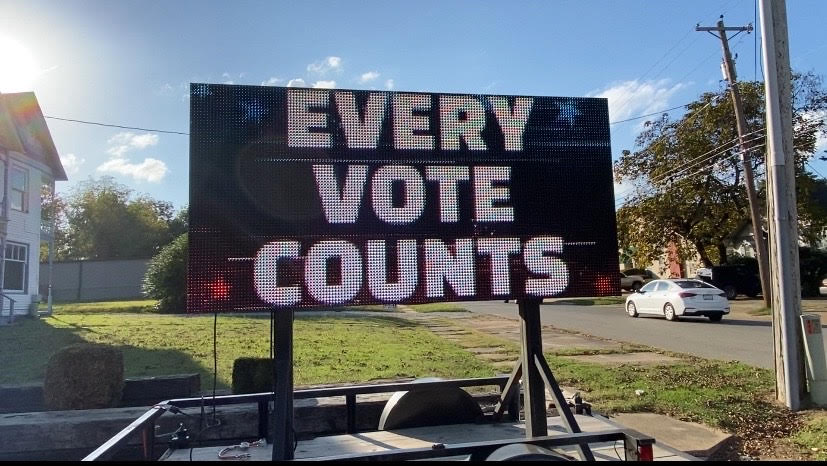
With the 2026 midterm elections coming this November, citizens are eager to vote on a range of issues. After interviewing three students at Arkansas State University, it was found that top concerns are healthcare, the rising cost of living, and protecting agriculture. Voters are seeking out candidates who are focused on protecting their community.
Evelyn Rogers, a wildlife biology major at Arkansas State, says her biggest concern is farming and agriculture. According to Rogers, the condition of the state’s agriculture is a crucial part of Arkansas’s economy and identity.
“Supporting farmers in rural communities, while also protecting our water, land, and wildlife, is important to me because I want to see those resources available for future generations,” says Rogers.
Although she identifies as a Democrat, Rogers agrees with the Republican Party’s support for agriculture in Arkansas.
“When it comes to supporting farmers in rural communities and protecting wildlife, I think it’s important to look at individual issues and candidates rather than automatically agreeing with everything one party represents.”
Aspen Frank, a strategic communications major, says what is driving her to the polls is a concern about the high cost of living in Arkansas.
“Coming from a state where every day I have to witness firsthand the suffering, [due to] the struggle that comes from high poverty rates, it’s important to me that the extra costs of living can be diminished rather than increased,” says Frank.
Along with the rising cost of living in rural areas, access to healthcare is also one of her biggest concerns, specifically as a type 1 diabetic herself. According to Frank, her firsthand experiences of receiving life-saving healthcare, but dealing with extremely high costs of medicine, have had a profound impact on her personally.
“There are people in Arkansas that can’t even afford rent due to the overwhelming cost of medical care. Insulin is a necessity for survival, and we should not have to question whether you’ll be alive by the end of the week if your paychecks don’t come in on time,” according to Frank.
Many young people are excited to get to the polls and fulfill their civic duty as American citizens. Nathan Boone, a chemical engineering major and cadet in the Red Wolf Battalion, is passionate about voting in the midterms this year. Part of the reason for his passion comes from being in a migrant family.
“We escaped communism,” says Boone. “I believe voting is half the luxury of being an American. You get to speak out about your government, participate; in Vietnam, if you spoke out, you were directly taken to a re-education camp.”
This election season, many students are eager to have their voices heard on the issues that matter most to them: healthcare, agriculture, and the rising cost of living in Arkansas.
Early voting in Arkansas begins October 19th through November 2nd, with the general election on November 3rd. In Craighead County, voters can cast ballots at the Election Annex, 315 W. Jefferson Avenue in Jonesboro, from 7:30 am to 7:30 pm. This is part of the national midterm elections.
JONESBORO – Arkansas State University’s ASU-TV will host three political debates in October for candidates vying for office.
The debates will begin at 6 p.m. Thursday, Oct. 1; Thursday, Oct. 8; and Thursday, Oct. 22.
The Oct. 1 debate will focus on the Arkansas House District 36 race between Republican Rep. Johnny Rye and Democratic challenger Shamal Carter. Rye was invited, but they have not confirmed if they will attend. Carter has confirmed that he will be present at the debate.
The Oct. 8 debate will highlight the U.S. House District 1 race between Republican incumbent Rick Crawford, Democratic candidate Dr. Terri Yarbrough Green, and Libertarian candidate Dr. Steve Parsons. Crawford will not attend, but Green and Parsons will be present.
The Oct. 22 debate will focus on the U.S. Senate race between Republican incumbent Sen. Tom Cotton, Democratic challenger Hallie Shoffner, and Libertarian candidate Jeff Wadlin. Cotton will not be present, but Shoffner and Wadlin will attend.
“We are excited to air these three political debates because they help connect voters with the candidates seeking to represent them. Meaningful debates are essential, as they allow the public to compare ideas, hear differing perspectives and make informed decisions at the ballot box,” said Johnathan Reaves, instructor of mass communication, who will also serve as producer.
Panelists for the debates include Allie Carson, editor-in-chief of The Herald; Lexie Burns, KASU reporter; LaGanzie Kale, KLEK general manager; Samantha Mitchell, KASU news director; and Levi Seward, A-State Pre-Law Club president.
Marty Scarbrough, KASU program director, will serve as moderator for the Oct. 1 and Oct. 22 debates. Reaves will moderate the Oct. 8 debate. Students in instructor Galen Perkins’ Video Production Two class will organize the programs.
“I am excited to see our students play such a vital role in bringing these debates to the viewers. Not only is this an invaluable learning opportunity, but it also gives them valuable real-world experience in live television production while contributing to an important civic event. There is no better classroom than working on a broadcast that directly serves the community and helps inform voters,” Reaves added.
The debates will air on ASU-TV, KASU Public Radio at A-State, Red Wolf Radio, and KLEK-FM. They will also be available on ASU-TV’s YouTube channel and social media channels.
Nettleton BRIDGE program students presenting and watching their final video projects about Nelson Mandela and Zodwa Dlamini. Photo by Mia Young.
JONESBORO, Ark.- The Nettleton BRIDGE program introduces middle school students at Nettleton Junior High to the learning environment of a college student by teaching them about multimedia journalism in the School of Media & Journalism.
The Nettleton BRIDGE program began as a way to help Nettleton Junior High students experience what it is like on a university campus, so they can imagine themselves as a student at Arkansas State University or any other university. Many first-generation college students struggle to imagine college life.
Chris Moss, principal of Nettleton Junior High, contacted Gina Houge, associate dean for the College of Liberal Arts and Communication, because he wanted to target his eighth-grade students young enough to benefit from an experience that could encourage them to become college students. Last year, the program began by bringing in a small group of Nettleton students who were interested in multimedia journalism, especially the media aspect.
“I mean, that’s what students know, right? They have their phones, and they’re engaged in media constantly,” Hogue said. “But to get an experience within an academic field was what Mr. Moss wanted them to experience.”
Hogue and Moss also wanted to add a historical component to the program, as they are both passionate about history. But last year’s pilot program focused on building the students’ multimedia journalism skills, and they were unable to build out any historical component. Jonathan Reaves, instructor in the school of media and journalism, played a critical role in working with the students and developing their multimedia journalism skills.
“The first year of the program (last year) was a challenge in that we were developing a program from scratch,” Reaves said. “In the first year, we had to decide which media we wanted to use. We primarily focused on video packages, and I have been working on audio podcasts separately. I expect we will incorporate more audio podcasting next year.”
The program changed significantly from the first year to the second. Last year, the group of students interested in media activities merged with the group who were interested in STEM activities. This meant some Mondays, the group would work on multimedia projects and other Mondays, they would work on STEM projects.
This year, the two groups remained separate, and they focused on adding a historical component along with learning the elements of writing, audio and video.
“So we wanted to continue with street talks, and we wanted to expand and add the audio component in so they could do more audio editing. Then Alina and Jonathan wanted them this semester to do an actual video report that encompassed all of these elements of interview, audio and also video,” Hogue said. “To build in the historical component, we wanted students to be able to meet people from many places around the world and learn about the culture in other places and to interview people, so that they’re doing their research, ’cause when you research like a journalist, you’re researching like a historian.”
Throughout the last year, students completed several multimedia projects based on what they learned about different historical topics in the Nettleton BRIDGE program class.
One of the first things Alina Sakayeva taught the students about was her hometown of Kazan, Russia. Sakayeva talked about her family traditions, the food they eat and the relationship between her and her family. She showed them some of the historic buildings and contemporary athletic facilities where they host global soccer matches, and taught the students about the ancient culture and the traditions there.
“The students sat on the edge of their seats, listening and looking at the images, and watching the videos of the cultural dancers in Kazan, conveying the history of that region of the world to these young people, these eighth graders, from Nettleton Jr. High School,” Hogue said.
At the end of the nine weeks, the students created their video story about Kazan and something from Sakayeva’s culture they were interested in, and then presented it to the class.
“The Kazan video (was my favorite), it gave us a lot of freedom to do whatever with the video, and it was super fun to learn about,” Brylin Smallman, eighth grader in the Nettleton BRIDGE program, said.
During the second nine weeks, the students learned about the Pine Ridge Indian Reservation in South Dakota. They also individually created videos on the topic using interviews with Alice Phelps, a former educator on the reservation, and their own research.
During the third nine weeks, they read “The Story of Nelson Mandela” by Floyd Stokes and learned about him, and Zodwa Dlamini, who was in his administration in South Africa and who brought several school districts together there. The students also interviewed Dlamini over Zoom.
For their final projects in the fourth nine weeks, the students spent time in the K-labs learning about audio production and editing their videos about what they learned from their reading, their research and the interview with Dlamini.
Not only are the students learning audio, video, storytelling and a little bit about history but they are also learning life lessons they will carry with them throughout their lives.
“(I learned) to be open-minded. I wasn’t very open-minded at the beginning, and now I’m just like ‘OK, this is what’s going to happen, and that’s OK,’” Fielder Franks, an eighth grader in the Nettleton BRIDGE program, said. “Sometimes life happens, and it doesn’t go your way, and sometimes that’s just how it works, and so, you’ve just gotta be OK with that and move on.”
Every Monday, the group of 12 students would meet in the TV studio in the A-State College of Media and Journalism for two hours. This means these students would be missing three class periods and would be responsible for making up the classwork they missed. To be in the BRIDGE program, the students have to meet certain requirements, like having good grades (because they miss a lot of work) and not having any behavioral issues at school.
Karley Barnes incorporates multimedia elements into her EAST class, which each of the students attends. Barnes, an A-State alum, also travels with the students to and from the A-State campus and gives students a participation grade based on whether or not they came out and did their best.
“I think it benefits them because they get out of the classroom, they get to be challenged. It might be kind of taboo to say, but public school education is very watered down, and it’s not watered down out here,” Barnes said.
Click to View!
Next year, the program will see a new group of eighth graders with many of the same and many different projects. Each year the students move up in school, the program continues to support them, but they have less time to visit campus. Reaves and Hogue are still excited for what next year will bring, even though the current eighth graders may not be on campus as much next year as they are now.
“I would tell these students to stay curious, keep working on their editing skills and be proud of what they have done,” Reaves said.
The Nettleton BRIDGE program does not just give students a chance to learn and improve their media skills, but “to help them, to inspire their learning, and to find their pathway in life. That’s the goal,” Hogue said.
Pedestrians walk through downtown Jonesboro beneath a “Welcome to Downtown Jonesboro” banner, highlighting the connection between Arkansas State University and the local community. Photo courtesy of Arkansas State University.
JONESBORO, Ark. — As Arkansas State University continues to grow alongside the city of Jonesboro, students and community leaders say the relationship between campus and community is evolving, but not without challenges.
From economic inequality to shifting social values, both groups are working to better understand their roles in a shared space. While students often focus on academics, identity and campus life, many Jonesboro residents are more concerned with jobs, healthcare and the rising cost of living, highlighting a need for stronger collaboration.
Local organizations say collaboration is critical as community needs continue to grow.
At the Jonesboro Human Development Center, officials say demand for services has increased in recent years, creating new challenges for staffing and care.
“We are struggling to hire people to provide hands-on care for adults with disabilities,” said Diane Keith, a nursing home administrator at the facility. “We need employees with a CNA license.”
Keith said the center also maintains a waiting list for services, reflecting a broader need for support across Northeast Arkansas. She said A-State students help fill some of those gaps through internships in nursing, dietetics and speech therapy.
“We receive several A-State students for internships,” Keith said.
Volunteers request roadside donations for the 2022 United Way Day of Caring. More than 500 volunteers attended the event in 2022. Photo courtesy of UWNEA Jonesboro YouTube Channel.
Community leaders say those partnerships are key, but there is still room to grow.
Heather Coats, executive director of United Way, said A-State has already made strong efforts to connect students with the community.
“I think what’s important, and A-State already does a great job of this, is letting students, especially young adults, know what resources are available,” Coats said.
However, she believes the responsibility does not fall solely on the university.
“I think the community could do a better job of being present on campus when it’s not just for sporting events,” Coats said. “We need to have more of a presence that isn’t just about our own entertainment.”
Coats said increased engagement from Jonesboro residents could help integrate students into the community and encourage long-term involvement.
Erin Calhoon, development director for United Way, said improving awareness is essential to strengthening that connection.
“I would say finding ways for people on A-State’s campus to be more aware of what’s available in the community,” Calhoon said.
Student leaders agree that awareness remains one of the biggest barriers.
Jaycee Davis, president of Volunteer A-State, said her organization has made it a priority to connect students with local opportunities.
“Our mission last year was to connect campus to the community,” Davis said. “We had organizations from Jonesboro come to campus, and we introduced ourselves and shared how we could help each other.’
“Our goal this year is to have students make a bigger impact in the Jonesboro community by making them more aware of volunteer opportunities,” Davis said. “So many students don’t know what’s available in Jonesboro.”
Davis said students can get involved through activities like packing food boxes, participating in community events and supporting organizations like Hope Found, which raises awareness about human trafficking.
“Right now, the community gives a lot to the campus, which is great,” Davis said. “But I think our mission moving forward is to give that same energy back.”
Lavonda Evans, an instructor of sociology and criminology at Arkansas State, said differences in age and life experience often shape priorities.
“Students are in that space between being supported by their families and stepping into the real world,” Evans said.
Evans said campus conversations often focus on identity and diversity, while broader community concerns center on economic stability and infrastructure. She said there is a growing shift toward individualism.
“Everything is more individualized and specialized, which creates less collective support,” Evans said. “People tend to focus on their immediate circles rather than the community as a whole.”
Despite those differences, Evans said collaboration is both possible and necessary.
Click to View!
“Jonesboro is already making efforts to connect the campus with the city,” Evans said.
She said projects like walking trails and plans to better link the university to downtown are some examples of this effort.
Evans said expanding paid internships or job-shadowing opportunities could help students gain early experience while strengthening ties to the community.
“Overall, both city and university leaders are making strong efforts to connect students and the community, but there is always room for improvement,” Evans said.
As both sides continue to grow, leaders agree that bridging the gap will require greater awareness, stronger partnerships and a shared commitment to engagement on campus and in the community they will eventually call their own.
St. Bernard’s health care physician Dr. Christina Carl (right) performs a heart and lung auscultation for a patient during a routine wellness exam in Jonesboro, Arkansas. Photo courtesy of St. Bernard’s.
JONESBORO, Ark. — As St. Bernard’s Health Care approaches its 126th anniversary on July 5, leaders say the oganization is balancing a legacy of community care with the growing challenges of modern health care.
St. Bernard’s has been in medicine for 125 years, evolving alongside the social service industry rather than the city, economy, or technology. Kevin Hodges, senior vice president, said rising costs and increasing insurance requirements continue to strain providers in the post-COVID era.
“Every time they add requirements, it adds cost to us,” Hodges said. “Someone has to make sure those requirements are met just for us to get paid. Those are uncompensated burdens.”
Health care systems face high operational costs, including labor, transportation, utilities, and food insecurity. Hodges said balancing expenses while navigating reimbursement challenges has become increasingly difficult. Hodges also noted funding for social service programs has stagnated, often coming from federal and state sources, and emphasized the importance of volunteers from churches, students, and other community groups.
“To have high-level social services in communities, you have to have strong volunteer programs,” he said.
Michael Givens, administrator and chief operating officer, said the vision of the Sisters who founded St. Bernard’s 126 years ago continues to guide the hospital. Over his 25 years, Givens has seen growth in heart care, stroke care, robotic surgery, and technology, including artificial intelligence.
“We already use a system called Rapidan. It works with our CAT scanners to analyze brain scans and quickly identify strokes or aneurysms,” Givens said. “That kind of speed can save lives.”
Givens said St. Bernard’s aims to expand services further, recruit specialists, and become a top-10% hospital in the U.S. Kevin Byron, assistant vice president for Behavioral Health Services, said the rise in mental health issues has driven growth in inpatient and outpatient care. The hospital has 108 beds serving patients with a wide range of needs, from severe psychosis to depression and suicidal thoughts.
Mental health remains central to St. Bernard’s mission, he said, inspired by the founding Sisters. Programs like the recuperative care program at the CSU allow patients to stay up to three months post-discharge, supporting those experiencing homelessness.
“I’ve been in health care for about 27 years, and Jonesboro has grown significantly. As the population grows, so does the need for infrastructure and services,” Byron said. He hopes to create a crisis response team that works with law enforcement and 911 and a psychiatric residency program to train new psychiatrists locally.
Mitchell Nail, media relations manager, said his role has shifted since the pandemic from health guidance to encouraging residents to address health issues early, including finding primary care providers and attending screenings.
Increased awareness of social services has led St. Bernard’s to provide prenatal and postpartum care regardless of a patient’s ability to pay. Nail said patient stories remain the hospital’s most effective way to connect with the community.
“I want people to see St. Bernard’s as their trusted source for health information and care,” he said. “I want them to feel confident they can find expert guidance and treatment right here in their community.”
Photo courtesy of the Food Bank of Northeast Arkansas
As grocery prices climb and paychecks fall short, more Northeast Arkansas families are waiting in food bank lines to make ends meet.
Food insecurity is rising in northeast Arkansas as inflation drives up the cost of groceries, gas and housing, putting increased pressure on local food banks.
The Food Bank of Northeast Arkansas secures donations from food and grocery industries, government agencies, individuals and other organizations to provide for people in need. The food is stored in the organization’s 59,600-square-foot distribution facility in Jonesboro.
Terry Austin, a development officer focused on fundraising and communications, said demand for food assistance has increased over the past year due to inflation, rising gas prices and cuts to federal support programs such as the Supplemental Nutrition Assistance Program, or SNAP.
“Demand has risen already just from the cuts that we’ve taken so far from the economy being in rough shape,” Austin said.
Austin said donors are also feeling financial strain, forcing them to be more cautious with their contributions as they balance their own household expenses. He said the food bank has seen an increase in senior citizens and families seeking assistance.
“Everybody right now is watching gas prices go through the roof,” Austin said. “Everything is more expensive at the grocery store.”
According to Feeding America, about 240,000 people in Arkansas benefit from SNAP, including 113,000 children and 36,000 senior citizens. A University of Arkansas study estimates that 28.8% of Arkansans face food insecurity. “The price of one pound of ground beef is now higher than the federal hourly minimum wage,” Austin said, describing the current conditions as a “perfect storm” of rising costs and reduced assistance.
Austin said he is concerned about the food bank’s ability to meet growing demand as grocery prices continue to rise and federal assistance programs face potential cuts.
“I’m honestly worried about making sure that we’re able to meet the needs that may be coming our way,” Austin said. Feeding America estimates that cuts to SNAP benefits could result in a loss of up to 41 million meals for Arkansas families.
Laura Dunivan, who works on the programs team managing fundraising and grant efforts, said rising costs are bringing more first-time clients to food pantries.
“What used to be occasional support for some families is now something they rely on more heavily,” Dunivan said. “We’re consistently serving more households each month.”
Dunivan said many families use food assistance to fill gaps during financial hardship, allowing them to afford other essentials such as gas, rent or medication.
“Would you sit in a car line for an hour for a box of food if you could just go to Walmart and get it in 10 minutes?” Dunivan said.
She said transportation remains a major barrier in rural communities, where access to food pantries can be limited. To address this, the food bank operates the Nourish Mobile, which delivers fresh produce at no cost to underserved areas. “Some of the people can’t come to the pantries, we have to go out to them,” Dunivan said.
Natalie Neal, the USDA coordinator for the food bank, said federal food programs play a critical role in addressing hunger across the state.
“With the rising price of food, it is more expensive to purchase food, and our neighbors can’t afford everything they need,” Neal said. “It really starts to feel like there’s a greater gap.”
Neal said the food bank has seen a decrease in USDA food shipments, limiting the amount of food available for distribution.
“We are seeing less come into the food bank, so we have less to go out to the community,” Neal said.
She said the organization works with mayors, churches and community partners to expand access and reach new households.
“USDA foods provide a pivotal source of food,” Neal said. “It helps keep food in the pantry to help us all get through difficult times.”
Bonnie Mamula, office manager at the food bank, said rising food costs combined with stagnant incomes are key drivers of food insecurity.
She said senior citizens are especially vulnerable because many live on fixed incomes while expenses continue to rise. “Some counties only have a few pantries, and they’re only open a couple of times a month,” Mamula said. “People in more remote areas have fewer choices.”
Mamula said the food bank is also seeing more working individuals and recently unemployed residents seeking assistance.
“Even people with jobs can’t make ends meet,” Mamula said.
Jennifer Hannah, chief program officer, said inflation has affected not only how many people the organization serves but also the quality of food it can provide.
“If we look at our data over the last few years, what we’re seeing is consistently serving more people,” Hannah said. “Demand is always there; it’s just how urgent it is.”
Hannah said many families fall into a gap where they earn too much to qualify for assistance programs but not enough to consistently support their households.
“It’s not so much changing the services we deliver, it’s changing how much we’re able to deliver,” Hannah said. “When prices go up, the quality of people’s food is going to decrease.”
Photos and Story from DDNS Reporter Jerry Don Burton
March 18, 2026
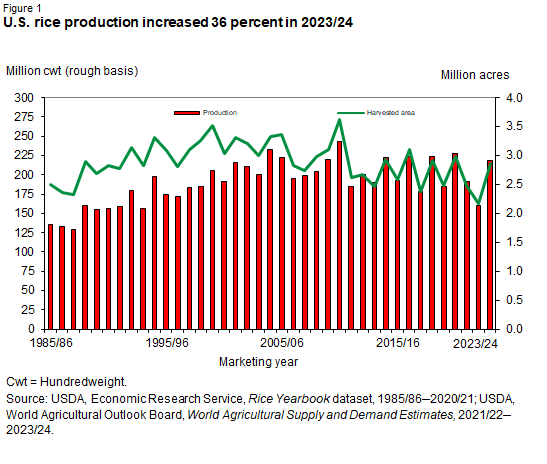
Bar graph depicts U.S. rice production (red) and harvested area (green) from the years 1985 to 2024. Rice production increased by nearly 1 million acres between 2023 and 2024. Courtesy of the United States Department of Agriculture.
The Nettleton School Board heard presentations on an initiative to educate students about rice and effective AI use in classrooms at its monthly meeting.
Rice in Schools Pilot Initiative
(Left) Leslie Tell, farm-to-school coordinator for the United States Department of Agriculture, explains the Rice in School program at the Tuesday, March 17, Nettleton School Board Meeting. According to the USDA website, the program, which is in a pilot phase, gives schools the tools to serve locally grown rice in healthy meals. Photo by Jerry Don Burton.
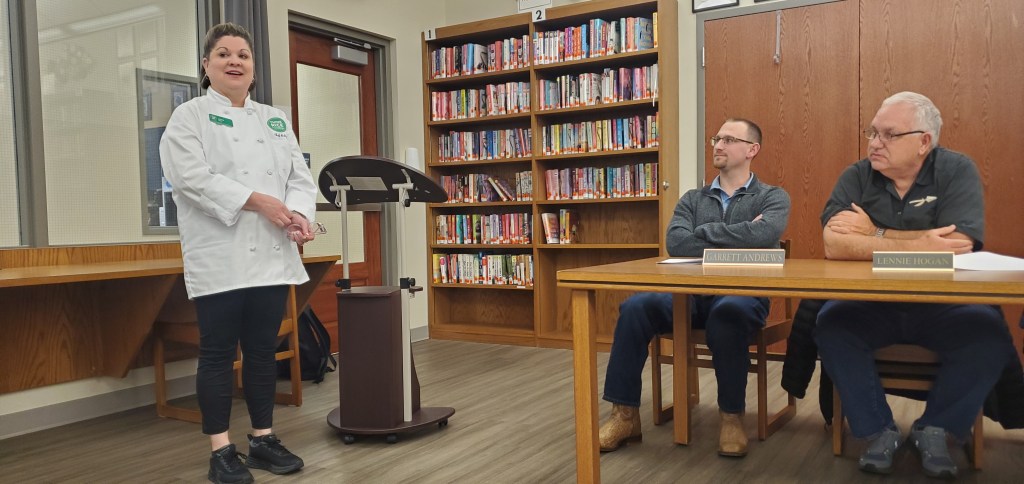
Leslee Tell, farm-to-school coordinator for the United States Department of Agriculture, addressed the board at the meeting Tuesday, March 17, to provide an overview of the Rice in Schools program.
Tell said the initiative aims to provide schools with the resources to serve local rice and educate students about the significance of rice in Arkansas. She said Arkansas Governor Sarah Sanders saw the importance of rice in the state and developed the initiative in fall 2025.
“So her idea was that, number one, students know where their food is coming from. Number two, that it’s local food as much as possible,” Tell said. “If we’re growing this much rice, then we should probably be serving rice and teaching kids to love rice as well.”
According to the USDA, the United States accounts for less than 2% of global rice production, but ships 5% of global exports. Arkansas is the largest rice-producing state, accounting for more than 40% of rice production in the U.S.
Tell said a majority of rice production in Arkansas is concentrated in the state’s northeast region.
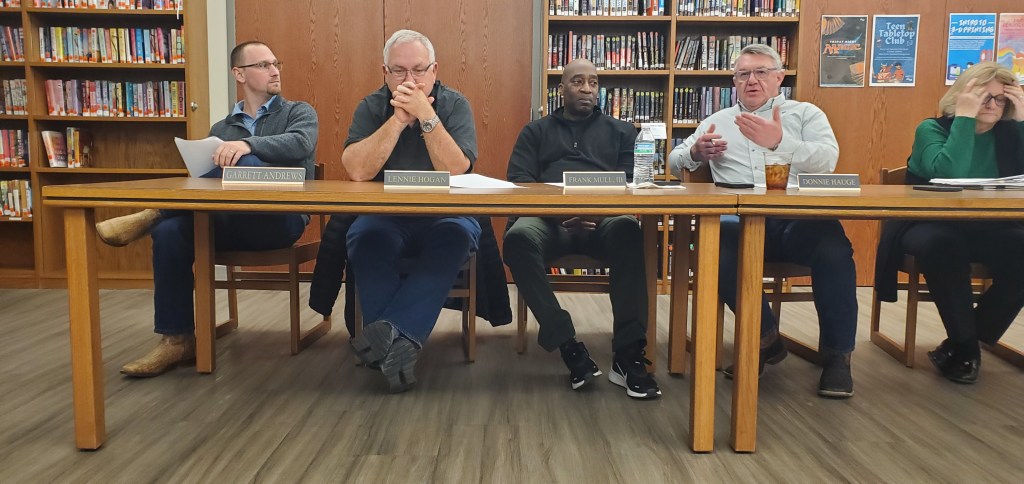
(Third from left) Donnie Hague, Nettleton School Board vice president, asks USDA Farm-To-School Coordinator Leslee Tell a question about the Rice in Schools program. Photo by Jerry Don Burton.
Donnie Hauge, Nettleton School Board vice president, said a program for helping kids understand where rice comes from and how to cook with it is a great idea.
The farm-to-school coordinator said about 20 schools have signed up for the program.
Participating schools will introduce classroom lessons on Arkansas agriculture, participate in hands-on cooking demonstrations, train cafeteria staff and include local rice in school meals at least once a month.
Tell said schools may also engage in taste tests and interactive experiences. She said the program is continuously expanding and introducing new ways to highlight Arkansas rice.
One such development is the creation of a cookbook containing 50 rice recipes for students to take home and prepare with their family.
“In the food banks and blessing boxes, there’s a lot of rice,” Tell said. “ If you have kids wanting to eat rice at school and they’ve made it at school, they get their recipe book, and they can go home, and maybe that bridge can happen between the parent and the child, and we could encourage that.”
Tell said the program also engages with the current national interest in eating real food.
“You can’t get any more real than this,” Tell said. “We’re eating real food, we’re eating real rice, real chicken, real vegetables and we’re making it right here from scratch, in front of the kids.”
Currently, the initiative is in a pilot phase. Tell said feedback from participating schools will be used to improve the program and shape future expansions.
Effective AI Usage in Classrooms
Following Tell’s presentation, the Nettleton High School principal, elementary school principal and three junior high school students addressed the school board to explain how they’ve implemented artificial intelligence in their respective fields.
Philip Cook, Nettleton High School career and technical academy principal, said he and other educators use AI to increase productivity and generate content. He said he uses AI to outsource elements of his workflow.
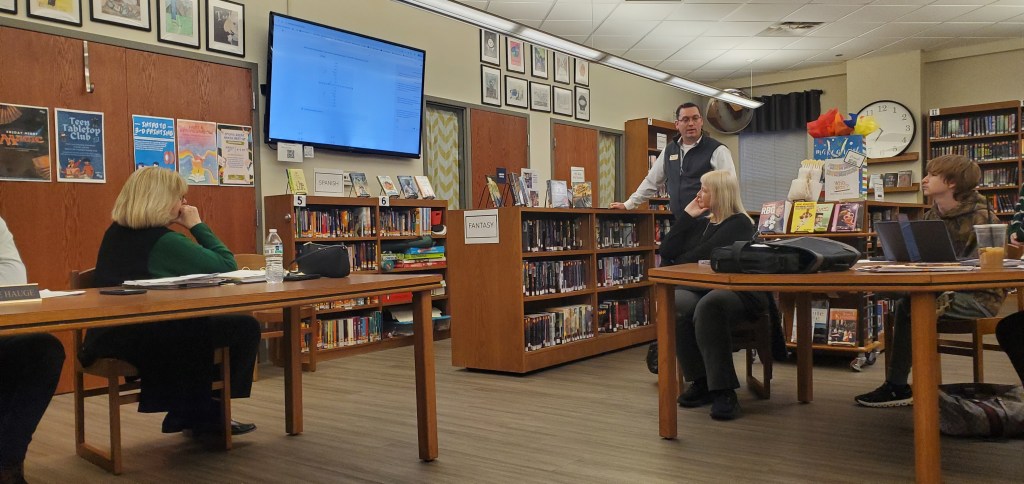
(Right) Philip Cook, Nettleton High School career and technical academy principal, explains how the high school uses AI coaching assistant Edia to those in attendance at the Nettleton School Board meeting. Cook said AI, when used properly, helps educator lessen their workload. Photo by Jerry Don Burton.
“What we do at NHS right now is we have teachers that use it to generate worksheets. We use it for coaching students and to help with our summative evaluations,” Cook said. “Then also, to look at and align some of our different curriculum with each other.”
The high school principal said projects like creating curricula that meet various standards, something which could take all summer to complete, are achievable in a single weekend with AI like ChatGPT.
Cook said Nettleton High School is also incorporating Edia, an AI coaching assistant, in the classroom.
Despite embracing AI, Cook said education will always need a human element.
“That’s what we’re trying to do in our critical algebra is not just turn it over to the AI–because then we become a facilitator–but use that where it’s appropriate to support that learning and then go ahead and let the teacher break kids into small groups, interact with them, give them those alternative learning methods,” Cook said. “I think it takes a good marriage of both to really be as effective as we can.”
University Heights Elementary Principal Sarah George said she uses Upraiser, an AI software designed to enhance teacher evaluations, in her administrative duties.
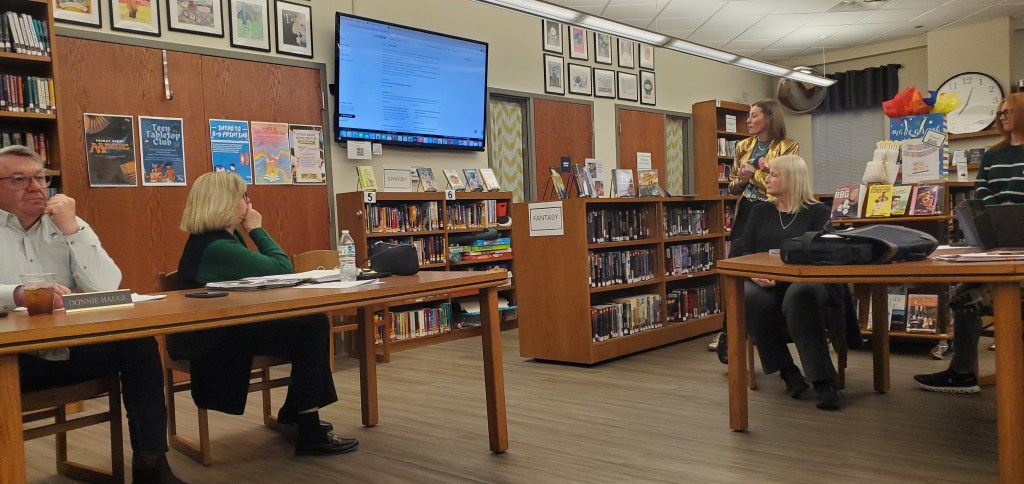
(Right) Sarah Geoge, University Heights Elementary principal, explains how she uses Upraiser AI when giving teacher evaluations. She said she uses Upraiser to provide actionable feedback to teachers. Photo by Jerry Don Burton.
“This platform has really helped, because it’s narrowed down the feedback that is given to teachers because it’s directly aligned to standards,” George said.
Garrett Andrews, the newest member of the Nettleton School Board, asked George if the AI she uses is accurate. George said Upraiser is mostly accurate, but agreed with Cook that a human element will always be necessary.
The elementary school principal said she is transparent with teachers and lets them know when the feedback they receive is partially AI-generated.
After George’s report, Nettleton Junior High School students Collins Baker, Jace Stegall and Brik Hogan presented a slideshow to detail how they use AI.
Baker said she learned how to use AI in 2025 and mostly utilizes it as a search engine, like Google. She said, while a helpful tool, AI can nonetheless introduce biases in its responses.
Stegall said he uses AI for coding help and in certain class assignments, specifically one project using drones to map hazardous conditions in Jonesboro.
“We want to know how to use it right, how to use it responsibly and how to use it for our school work instead of cheating,” Stegall said.
Hauge said the students’ presentation taught him how they use AI not for short answers or cheating, but productively and responsibly.
Other business
In other business, Athletics Director Tommy Raffo announced several upgrades and additions to the athletic facilities:
New track and field sand pit
New baseball bullpen
New televisions installed near concession stands
New and updated spirit banners installed in gym
Raffo also said he was proud of the boys and girls basketball teams, who were seeded fourth and second in the state, respectively.
Finally, the Nettleton High School Choir performed three songs ahead of the school’s production of “Hairspray.” Showings will be held April 24 and 25 at 7 p.m. and April 26 at 2 p.m. More information may be found on The Raider Spotlight’s Facebook page. The next school board meeting will be held at 6 p.m., April 21, at the Nettleton Central Office.
Craighead County Judge Marvin Day (center) explains one of the large ticket items on the annual transfer ordinance to District 4 Justice of the Peace Linda Allison (second from left). The item concerned a $2.5 million transfer from the county general fund to the capital fund to support department operations. Photo by Jerry Don Burton.
The Craighead County Quorum Court adopted an annual transfer ordinance, heard a hot check report and responded to a public comment regarding rising poverty.
Annual transfer appropriation ordinance
The annual transfer appropriation ordinance, adopted unanimously at the Tuesday, Feb. 23, Craighead County Quorum Court meeting, appropriated funds from special revenue accounts into the county general fund.
Craighead County Judge Marvin Day said the transfer ordinance is the first step of an annual cleanup process.
“So that’s basically what we’re doing is we transfer money from one spot to the other to keep those balances whole, and the quorum court, on an annual basis, has to acknowledge, you’re not spending any new money, any additional money,” Day said. “Just acknowledging what we’ve done to keep the budget afloat.”
Day said, to think of it in simpler terms, it’s like they have 50 different checking accounts and the court appropriates money out of each of those accounts based upon an estimated revenue.
“Somebody may want to spend something in February, but their money doesn’t necessarily come in until September, October, and so we move money around to keep those balances in the positive, best we can,” Day said.
Hot check report
Also in new business, Charlene Davidson, a prosecuting attorney for the second judicial district of Arkansas, presented a hot check report, as required by state law.
Craighead County Judge Marvin Day (center top) introduces Charlene Davidson (center) and Sarah Burnett (right) before they give the hot check report. The report is required by state law. Photo by Jerry Don Burton.
Davidson said while terminated in April 2021, the hot check program still takes in money the Craighead County Sheriff’s Office receives.
In 2025, Davidson said the hot check program:
Received $10,217.51 from the Craighead County Sheriff’s Office, to be entered as payments received from defendants for the hot check program prior to 2021.
Dispersed $3,770 toward merchant fees, which is a fee that merchants can charge the defendant if they write a hot check.
$2,899.95 in prosecutor fees, a statutory fee the office can charge for maintaining the program.
Davidson said the preceding fees were all previously ordered prior to 2021. She said the total check amount for 2025, not including journal entries, was $26,054.41. The current account balance for the hot check trust account is $28,653.41.
The court unanimously accepted the report as prepared.
Public comments
After Day opened the meeting for public comments, Jonesboro resident Robin Martin said she was concerned about rising poverty in Craighead County.
She said the poverty rate in Craighead County is 21.5%, almost double the 11% national rate and much higher than the 15.3% Arkansas poverty rate.
Martin said similarly sized Arkansas counties, such as Garland, Sebastian, Saline and Faulkner, also have poverty rates lower than Craighead.
Her data is nearly accurate with the latest census data from the American Community Survey. The national official poverty measure is 10.6%, while the Arkansas poverty rate is 15.5%.
“I don’t want to live in a district or a county that has a poverty rate of 20%,” Martin said. “I like Saline County’s 9% a whole lot better.”
District 11 Justice of the Peace Dan Pasmore said Craighead County’s rising population could be correlated to the rise in poverty.
“If you’ll check the population that moves into Jonesboro, there’s a lot of people that move from areas that are depressed, moving here for better opportunities,” Pasmore said. “They don’t always find it, but they’re coming here from other areas that are in worse shape than we are, and that’s driving ours up also.”
According to the United States Census Bureau, the estimated population in Craighead County rose from 111,242 in 2020 to 115,852 in 2024, an increase of 4,610.
Darrel Cook, district six justice of the peace, said he agreed with Pasmore.
“There’s a lot of rental opportunities here and there’s a lot of job opportunities, but sadly, some of the people moving here from other towns don’t want to take those jobs,” Cook said.
District Four Justice of the Peace Linda Allison said people with low income are attracted to Jonesboro when the city approves apartment complexes. She said this could also drive the poverty rate up.
Other business
In other business, the transportation and finance committees gave their reports.
Transportation Committee Chair and District 10 Justice of the Peace Steve Cline said the transportation committee met on Feb. 9. He said the committee, run by justices Garrett Barnes, David Tennison and Terry Couch, spoke with John James, the Craighead County road department superintendent, about current work projects and county road conditions following the recent snowstorm.
The committee reviewed and approved a motion for a construction plan on Highway 141.
Finance Committee Chair and District Nine Justice of the Peace Josh Longmire said the finance committee also met on Feb. 9. Longmire said, at the meeting, Craighead County Tax Collector Wes Eddington provided a tax collection report. The report stated tax collection rose 16%, while delinquent personal taxes fell 12.7%.
Craighead County Treasurer Terry McNatt presented the January 2026 financial report and 2025 annual financial report at this meeting as well.
Tennison, district eight justice of the peace, motioned to move the next quorum court meeting date, originally scheduled for March 23, to avoid it falling during spring break week. The motion passed unanimously.
The Craighead County Quorum Court will meet again at 5:30 p.m., March 16, after spring break.
Jonesboro Mayor Harold Copenhaver addressed previous concerns and responded to new complaints about the City Stars booster club during the City Council meeting.
Public and council interest in City Stars remained high at the Tuesday, Feb. 3 city council meeting. Discussion began with Copenhaver’s response to Public Facilities Board Chairman Matt Modelevsky’s presentation at the last meeting.
Copenhaver’s response
“ My responsibility as mayor is to administer city-operated programs, which City Stars was not, in accordance with city council-approved budgets,” Copenhaver said. “I presented verifiable facts, not feelings, not understandings or beliefs like many of the documents presented at the previous city council meeting contained.”
At the previous meeting, Modelevsky said Copenhaver failed to respond to past concerns he raised about City Stars and Danny Kapales, the now-resigned parks director who ran the program.
The City Stars booster club, a youth sports program, was created in 2001. Copenhaver said the original agreement between Jonesboro and the booster club was approved by the council in 2004. He said this contract established mutual agreements, such as the shared goal of providing athletics at no cost for Jonesboro youth.
Despite a shared vision for youth athletics in Jonesboro, Copenhaver said City Stars operated independently.
“Their revenue was their money, their business, not the city’s,” Copenhaver said. “ Fiduciary duties fall to the boards and management of private nonprofit organizations and cannot be delegated, giving them full and exclusive authority over their own money and how it is handled and how their chart of accounts is organized and how their accounting entries are made. Look it up.”
Copenhaver said he asked the management of City Stars to voluntarily undergo an audit, to which they agreed. The Thomas Speight and Noble firm completed the audit and presented it in June 2025.
“ The independent auditor’s report expressed the opinion that the City Stars financial statements present fairly in all material respects and assets, liabilities, net assets of the City Stars Booster Club,” Copenhaver said. “ In other words, clean audit.”
On Dec. 5, 2025, the City Stars board announced the club will cease operations as a private, 501(c)(3) nonprofit and will transfer operational responsibilities, including banking accounts, funds and sports equipment, to the city of Jonesboro.
Copenhaver said now should be an exciting time for the program and the upcoming generations who will make use of City Stars.
“Moving forward means moving beyond the past, and now we need to focus,” Copenhaver said.
However, in the public comments that followed, several citizens expressed a desire to stay on the topic of City Stars.
Public comments
Jeremy Terrell, who ran for Jonesboro mayor in 2024, addressed Copenhaver and said he does not understand why some act like the investigation is not a big deal. He said the mayor has the responsibility to ensure taxpayer money goes to organizations that act in the best interest of the public.
“This is about the responsibility that you hold and that the city council hold to make sure that taxpayer’s money is being dealt with in a manner that is proper and legal,” Terrell said. “So those of us that are asking questions, we deserve answers, period.”
Bill Campbell, who previously served as the mayor’s communication director, said citizens should exercise patience and not jump to conclusions during a federal investigation.
“I don’t know what the answers are. I do know that you have a mayor who has had clean audits every time,” Campbell said. “So I think I would lean on that and we can’t pretend we know something different.”
Dean Macdonald, a Jonesboro native, said he agrees with Terrell that any allegations of misconduct are serious and should be investigated. However, he said some of the discourse surrounding the investigation has broken down recently.
Following comments from the public, many city council members voiced support for Copenhaver, but agreed communication must be improved.
Council member comments
LJ Bryant, Ward 5, Position 1 council member, said the public clearly cares and the situation should not be dismissed as something minor.
“Despite any of the gaslighting going on tonight, the FBI didn’t show up for no reason. So we’re in a very serious situation and as the stewards of the taxpayer’s resources, I feel like we have to take action,” Bryant said.
Joe Hafner, Ward 5, Position 2 council member, said while he supports Copenhaver, the mayor should not have let concerns go unresolved for so long.
“I think that’s one thing that definitely needs to be improved and that’s let something fester, it turned from a little snowball into a big avalanche,” Hafner said. “And now that we got the public here with eroded public trust, just frustrated, the problems have escalated. I don’t take that lightly.”
Ward 2, Position 2 City Council Member Chris Moore said many issues would be absent today if Copenhaver addressed concerns sooner. He said trust should be restored between the council, mayor and community.
Hafner said the relationship between the mayor and council is built on trust. He said they must be transparent with each other.
Copenhaver said he understands many people had honest questions about the City Stars operation. He said while he never meant to come off as dismissive of these questions, the city council never had the answers.
“Those questions should be properly directed to its own officers and board of directors, which had the full fiduciary responsibilities and duties. The mayor’s office did not have answers about the accounting or handling of money of City Stars,” Copenhaver said. “Part of all the confusion has come from people asking questions or emailing or texting complaints and concerns about City Stars to the wrong place.”
Anthony Coleman, Ward 6, Position 1 council member, said while he appreciated Copenhaver sharing his side at the meeting, he believes the council does have a responsibility to ask questions and look into City Stars.
“ Maybe not handling a lot of it fiduciarily, but we do have a responsibility to share, to talk, to ask questions, to make certain that we are doing what’s right for our children,” Coleman said.
Chris Gibson, Ward 3, Position 2 council member, said the council has a good platform to build on moving forward and the future is optimistic.
Copenhaver said he appreciated the input from the council and is always up for constructive criticism.
“I apologize to this city council because the last thing I ever want to do is draw a wedge between us because that does not benefit our community,” Copenhaver said.
Looking ahead, Copenhaver said he is excited for the future of City Stars under the leadership of Jim Stearns, interim director of parks and recreation.
Other business
In other business, Copenhaver announced InnovAsian Cuisine Enterprise Inc. will construct a frozen food manufacturing facility in Jonesboro. He said this development will create about 200 jobs.
The council also read the following ordinances:
On first reading:
Ordinance 26:004 would amend a zoning ordinance providing for changes in zoning boundaries from R-1 to RS-7 for a property at 1306 Charles Drive.
On second reading:
Ordinance 26:001 would change the zoning boundaries from R-1 to C-3 general commercial district for a property at 2620 Alexander Drive.
Ordinance 26:002 requested approval of a private club permit for Monarca’s Mexican restaurant.
Ordinance 26:003 requested approval of a private club permit for Walk-On’s Sports Bistreaux.
The Jonesboro City Council meets at 5:30 p.m. on the first and third Tuesdays of each month at the Jonesboro Municipal Center. Meetings are also livestreamed on the City of Jonesboro Facebook page.
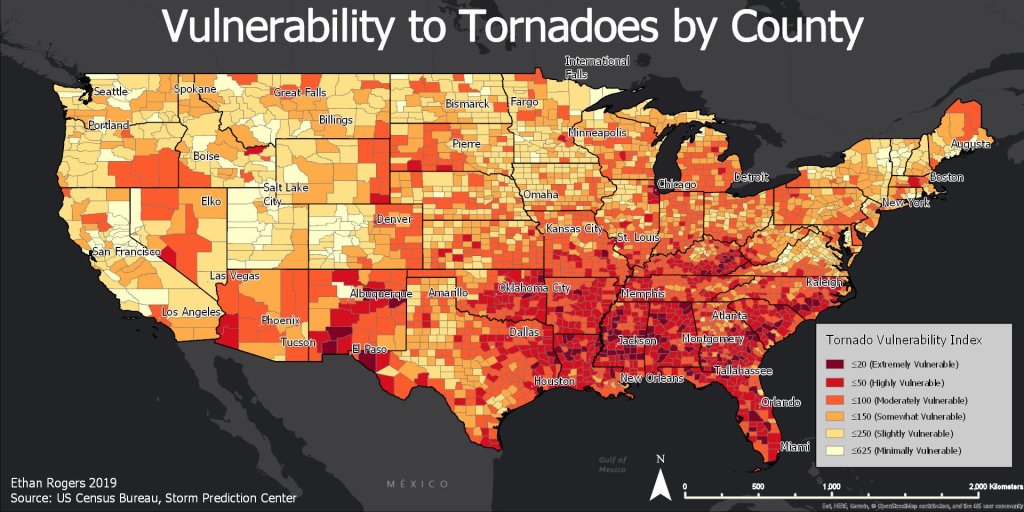
A graphic depicts the vulnerability of tornadoes in each county in the United States. Areas of greater vulnerability largely concentrate in the southeastern portion of the U.S. GRAPHIC COURTESY OF ETHAN ROGERS
Severe weather preparedness remains vital as Arkansas enters the peak of tornado season.
Kory Ward, fire chief for Wynne, Arkansas, said those who don’t take severe weather seriously are making a bad move.
“There’s people that think, ‘oh it’ll never hit here,’ and it’s been very true to hit here within the last two years,” Ward said. “I say it all the time, stay weather aware. Pay attention to the news. Pay attention to your local radio station. Don’t be surprised by it.”
How can I stay safe during tornado season?
Anthony Coy, director of the Craighead County Office of Emergency Management (OEM), said always knowing the location of a nearby safe spot is vital for tornado season preparedness.
Coy said those living in manufactured homes or mobile homes, also called trailers, should especially take advantage of these community safe rooms.
Manufactured homes are particularly susceptible to tornado damage because they are usually constructed with lighter, less durable materials.
In a 2018 research article published by the American Meteorological Society’s Weather, Climate, and Society journal, Stephen Strader and Walker Ashley found that 72% of all tornado fatalities occur in homes and 54% of these deaths occur in mobile or manufactured homes.
Amber Schlessiger, a National Weather Service (NWS) meteorologist, said overnight tornadoes are another distinct threat because they strike when most people are asleep. She said those who find themselves in the path of an overnight storm should set up multiple methods to receive warnings and be ready to wake up if a threat approaches.
Ward echoed this sentiment and said having some form of early warning system, such as phone notifications or a crank radio, is indispensable.
Coy said keeping up-to-date with the weather is always good advice.
“There are a hundred different ways you can get those weather warnings on your phone,” Coy said. “But almost every county has some sort of information platform. In Craighead County, we use CodeRED.”
CodeRED, a community emergency notification system, allows individuals to sign up for alerts on Jonesboro’s website. The CodeRED mobile app may also be downloaded on the Apple App Store and Google Play Store.
Coy also said to exercise caution when determining trusted sources. He said some severe weather information, especially on social media, may be misleading or originate from questionable sources.
The OEM director said creating and maintaining a preparedness kit is another step in staying safe.
A well-prepared kit may include the following items: Several days’ worth of food and water, a flashlight, batteries, first-aid, a change of clothes, a whistle, maps, hygiene items, prescription medicines and pet food, if applicable.
Ultimately, Coy said, even the most seasoned preppers will overlook something. Still, even small acts of preparation will make a lasting impact, he said.
“Each time you chip away at that, you’ll become more prepared than you were before,” Coy said. “Don’t ever let it become a back-burner item.”
What are the impacts of tornado season?
Tornadoes are one of the deadliest and most costly natural disasters in the United States.
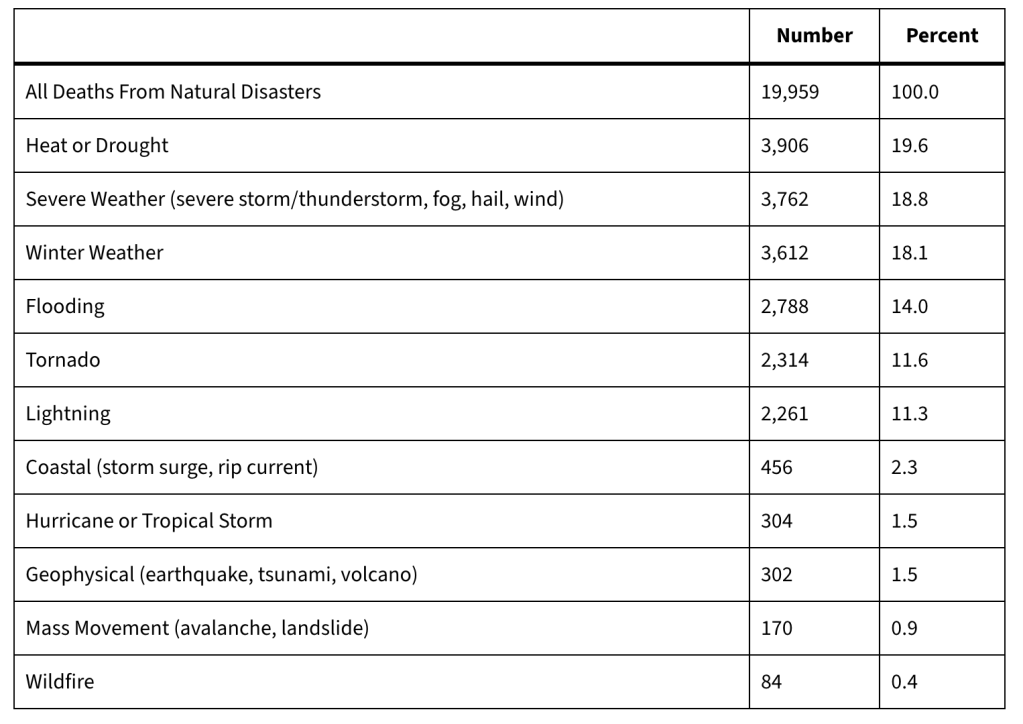
In a 2008 research article concerning patterns among natural disasters and mortality, Kevin Borden and Susan Cutter found, of 11 disasters researched, tornadoes accounted for the fifth-highest deaths in the U.S. between 1970 and 2004.
A list of natural disaster-related deaths recorded in the United States between 1970 and 2004. Tornadoes accounted for the fifth-most deaths in this list. LIST COURTESY OF KEVIN BORDEN AND SUSAN CUTTER
The article, published in the International Journal of Health Geographics, reported deaths caused by tornadoes constituted almost 12% of all natural disaster-related deaths in the U.S. during the same time.
Arkansas, in particular, shares a lengthy history with tornadoes.
From 1950 to 2024, 2,478 tornadoes hit Arkansas, killing 412 people, according to the NWS Little Rock office.
A study conducted by the National Oceanic and Atmospheric Administration (NOAA) found, from 1950 to 2025, tornadoes in Arkansas caused 5,567 direct injuries, $3.5 billion in property damage and $4 million in crop damage.
Northeast Arkansas is no stranger to lethal tornadoes either.
On March 31, 2023, an EF3 tornado tore through Wynne, Arkansas, killing 4 and causing over $150 million in property damage, according to the NWS Memphis office. The Wynne High School, which found itself directly in the center of the tornado’s path, was razed.
Three years prior, on March 28, 2020, another EF3 tornado damaged about 300 buildings, caused an estimated $300 million in damages and injured 200 people in Craighead County.
However, despite the destruction they cause, Coy said, blessings exist in every disaster.
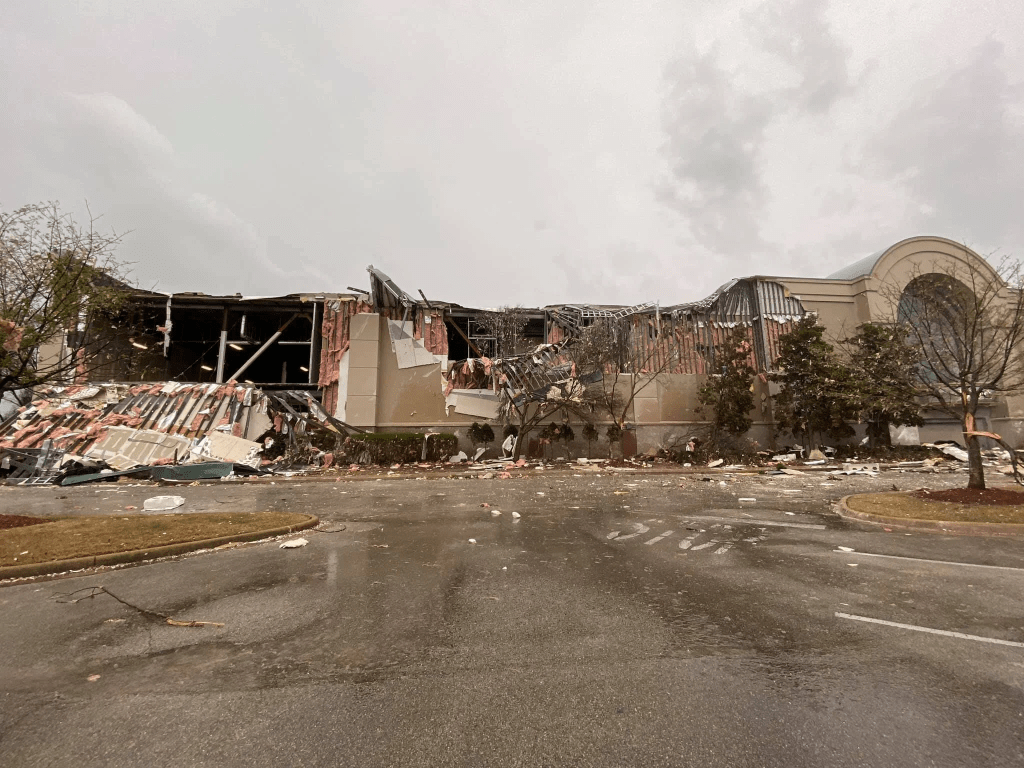
For example, Coy said the COVID-19 pandemic actually saved lives during the aforementioned 2020 tornado. He said the pandemic kept people at home rather than in commercial buildings, like The Mall at Turtle Creek in Jonesboro, which the tornado almost completely destroyed.
View of The Mall at Turtle Creek in Jonesboro after a tornado nearly destroyed the entire 73-acre plot. The tornado hit Craighead County on March 28, 2020. PHOTO COURTESY OF JONESBORO POLICE DEPARTMENT FACEBOOK
He said the tornado also taught him to have plans in place before disaster strikes.
“I was very new in the position at that time, I didn’t have my volunteer teams gathered yet, didn’t have changes to our emergency operations plan, none of that,” Coy said. “And here I am sitting at home on a Saturday and I watch a tornado drop down in the middle of Jonesboro. That’ll get your attention.”
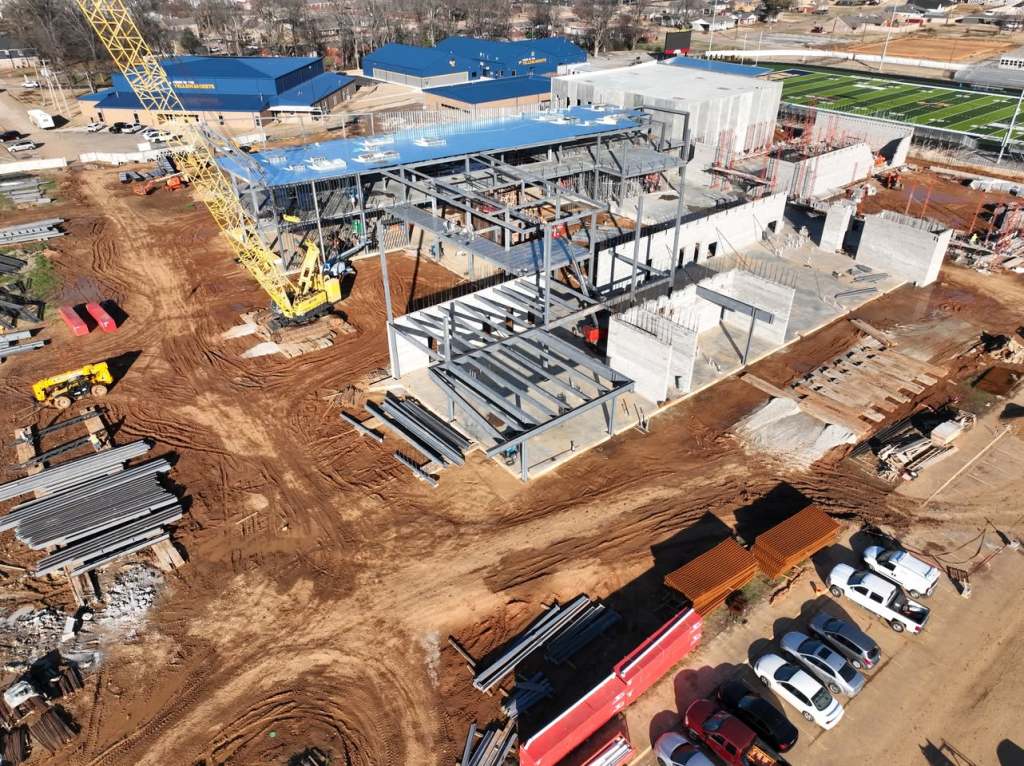
An aerial view shows ongoing construction at the site of the new Wynne High School. A tornado that struck Wynne, Arkansas on March 31, 2023, destroyed the previous high school. Nabholz Construction Corporation was contracted to lead construction on the high school. PHOTO COURTESY OF NABHOLZ CORPORATION FACEBOOK
As for Wynne, the company contracted to build a new campus for the high school, Nabholz Construction Corporation, stated in a Jan. 13 Facebook post that progress is moving steadily.
“It’s exciting to see this project transition from structure to the spaces that will soon support learning, creativity, and community,” Nabholz Corporation wrote.
Why is there a tornado season, anyway?
According to the NWS, the months of peak tornado occurrence, also known as tornado season, last from March to May in Arkansas.
As temperatures transition from colder to warmer in the spring, atmospheric instability creates conditions favorable for the formation of tornadoes. Since this transition happens at slightly different times throughout the country, tornado season varies depending on the state.
Other climate factors also play a role in creating a tornado season.
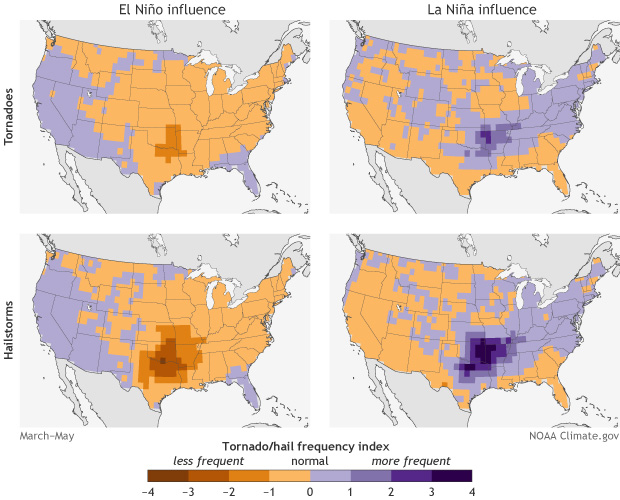
In a 2015 feature published by the NOAA, Michon Scott reported a relationship between tornado frequency and the natural weather patterns El Niño and La Niña.
Graphic depicts maps of the United States, representing the influence La Niña and El Niño have on the frequency of tornadoes and hailstorms in March and May, the peak months of tornado occurrences in Arkansas. The maps suggest La Niña increases the frequency of such severe weather in the southern U.S. GRAPHIC COURTESY OF NOAA
“Specifics vary, but in general, springtime tornadoes and hailstorms are less frequent in the southern central United States during El Niño and more frequent during La Niña,” Scott wrote.
El Niño is a natural weather pattern, usually lasting about a year, that occurs when warm water accumulates in the central and eastern Pacific Ocean. La Niña is the opposite and happens when cool water develops in the Pacific Ocean.
Coy, however, said Arkansas experiences severe weather regardless.
“The meteorologist will explain it has to do with whether you are in a El Niño or a La Nina and, I’ll be honest, they’ve explained it to me and I don’t always understand it,” Coy said. “It seems like we get severe weather regardless of which one we’re in.”
According to the NOAA’s National Severe Storms Laboratory, while tornado season denotes the period in which tornadoes are more frequent, a twister can form at any time of the year and in any location. Tornadoes occurred during all 12 months and in all 50 states.
According to a 2025 article published in the research database EBSCO, Mark Dziak wrote that “Tornado Alley” can be a misleading term because those living outside of its poorly-defined boundaries may believe they are less vulnerable to tornadoes.
Tornado Alley is a common geographic term used to define areas in the central U.S. where tornadoes are more frequent.
“Despite the focus on Tornado Alley, experts note that tornadoes can and do occur in every state, highlighting a phenomenon known as Dixie Alley in the southeastern U.S., where tornadoes may even be more frequent and damaging than in Tornado Alley,” Dziak wrote.
Is tornado season getting worse?
As of April 3, 2026, the NWS confirmed nine tornadoes in Arkansas, near the average for that time of year.
Coy said, in his time working in emergency management, he experienced increasingly frequent and deadly weather. Coy, who is also the treasurer of the Arkansas Emergency Management Association, has worked in the industry since 2006.
Research supports Coy’s experience.
The Arkansas Tornado Database, using data from all NWS offices serving Arkansas, found that between 1970 and 1999, Arkansas averaged 25 tornadoes per year.
Between 1991 and 2020, that number rose to an average of 37 tornadoes a year.
In a 2018 journal article published in the npj Climate and Atmospheric Science journal, Vittorio Gensini and Harold Brooks found while the national annual frequencies of tornado reports remained relatively constant, they documented positive trends in the Midwest and Southeast U.S.
While no definite reason exists for this increase in tornado sightings, several theories offer possible hints.
Hazards geographer and meteorologist Stephen Strader, in a 2024 interview with NPR, told host Ari Shapiro that advancements in detection technology contribute to the apparent increase in tornadoes. Strader said tornadoes – especially weaker, short-lived ones – posted on social media are sometimes added to severe weather databases, which also increases the statistics.
Strader said population growth and urban development may also be partly responsible for the increasing severity of tornadoes. Many areas once forested or used for farmland developed into dense population centers, thus increasing the likelihood of a tornado causing significant damage.
“There’s just more things to hit, which means more potential disasters,” Strader said.
A 2021 journal article published in Scientific Reports found population density and the installation of Doppler Radar systems contribute to the increasing trend of damaging tornadoes.
Another possible culprit, climate change, may offer more complex impacts on tornado season.
Climate change, a hotly politicized and controversial weather phenomenon, refers to long-term changes to Earth’s average weather patterns, according to NASA.
Strader said, while the connection between climate change and tornadoes is not fully understood, many researchers suspect tornado sightings will increase as the impacts of climate change create environments conducive to severe weather.
Data from the NOAA reports a greater risk of off-season tornadoes in a future warmer climate. However, the various intricate weather conditions at play during the formation of tornadoes make it difficult for scientists to determine the impact climate change is having or will have on tornado season.
A report from the Center for Climate and Energy Solutions (C2ES) also states factors such as limited data collection methods, high variability and the relatively small geographic size of tornadoes as challenges for attributing climate change to a worsening tornado season.
“As scientists improve their physical understanding of the processes that cause tornadoes, and as climate models are run at higher spatial resolutions, our understanding of the climate change influence on tornadoes will improve,” the C2ES report stated. “Likewise, as the observational record increases over time, trends will likely become more obvious.”
Coy said while some people debate whether climate change is to blame, he focuses more on preparation.
“Whatever reason that is, I don’t know and I don’t have to know,” Coy said. “I just need to know when’s the next one and how strong do we think it might be.”
Coy said Craighead County is due for a break from severe weather. He said every year he hopes the weather is better than the year before.
However, the OEM director said he will never suggest any particular tornado season might be less severe because that might encourage people to let their guard down.
“I don’t want to cry wolf, I’d rather people be prepared and then not need to use that preparedness as the other way around,” Coy said.
Where can I find more tornado season resources?
The Craighead County Office of Emergency Management may be called at (870) 933-4575, found online at craigheadcountyar.gov/oem, or visited in person at the Craighead County Courthouse Annex.
More local information about tornado preparedness from Craighead County may be found here.
Arkansas Weather Watchers, a digital media platform offering real-time coverage and community-driven reports from across the state, may be found here.
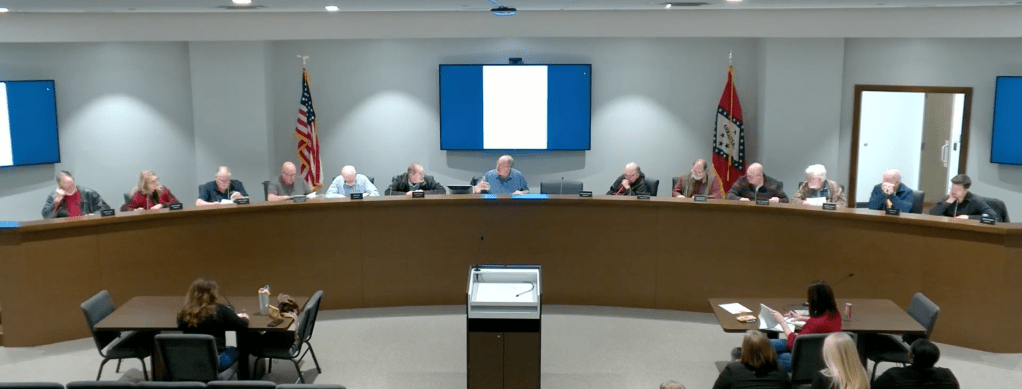
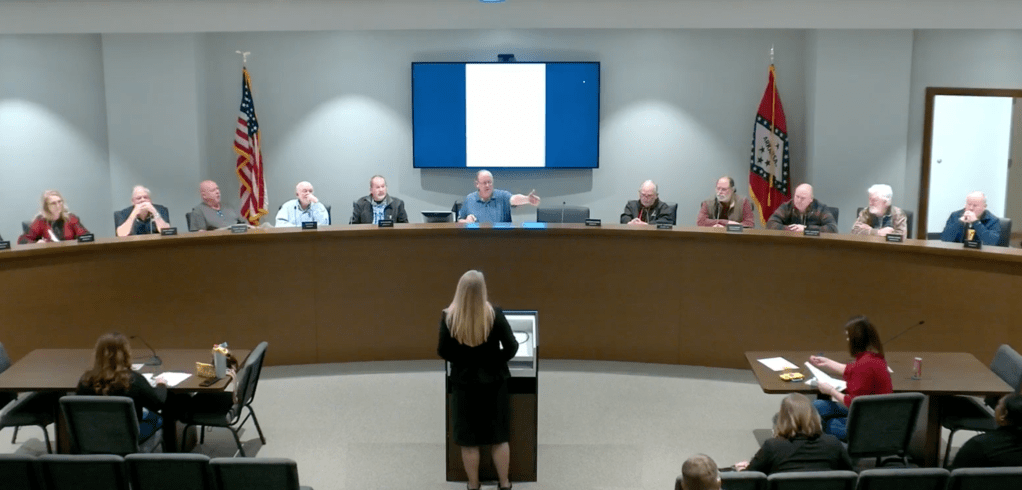
Members of the Craighead County Quorum Court meet. Photo by DDNS Reporter Mia Young.
JONESBORO, Ark. – The Craighead County Quorum Court advanced two ordinances to their next readings to amend the county’s salary administration policy and job classifications in the County Judge’s Office during its meeting on April 13.
During old business, the court held the second reading of an ordinance amending the county’s salary administration policy to include cost-of-living increases. The ordinance proposes employees would be eligible for cost-of-living raises after one year of employment. Supervisors, however, would be able to approve the increases after 90 days based on performance. The policy would be guided by the Consumer Price Index, but not a specific rate.
The 13 justices also voted to untable a recommendation from the Job Evaluation and Salary Administration Policy committee involving the County Judge’s office, which Judge Marvin Day previously tabled. The ordinance will reclassify and restructure the Secretary Coordinator I position as an Administrative Coordinator I position.
“We’re not changing the budget. This is just going to change the position,” Day said. “If we do decide we want to change the budget, we will come to finance.”
Wendy French previously served as Administrative Coordinator I, in which she worked with elected officials and department leaders to help with daily operations and coordinate internal processes. However, officials appointed French as Craighead County Administrator in January 2026. Since leaving the position, Day said French held skills the Judge’s Office would like to mandate and look for.
The county presented the changes as part of its efforts to retain employees, recognize and support their work and improve the county as a whole. Day said if there was a possibility of hiring someone with the skills in place, he would come back and ask for a salary adjustment.
Once the court broke into committee meetings, Shannon Kee made a second attempt before the Public Service Committee to open a restaurant and obtain a liquor license after the committee rejected his previous application last year. Kee plans to open 141 Prime at Sterling Springs, 2761 County Road 766, near the Highway 141 intersection.
“Born and raised, I’m 53 years old and never had anything out there other than a gas station,” Kee said. “Nowadays, we don’t really have a gas station because all the gas stations are shut down.”
He said North Jonesboro has no restaurants and if he wants customers to choose to come to his restaurant and not just “drive right past,” they will expect a beer with their dinner. The committee, after hearing no additional public comments, voted 3-1 to advance the proposal to the full Quorum Court for a vote when it meets again on April 28.
During public comments from the full Quorum Court, Robin Martin raised the issue that a recent Freedom of Information Act request showed Day’s email was included in the list of people emailed when someone emails quorumcourtmembers@craigheadcounty.org. However, Day’s name did not appear anywhere on the list of email recipients.
“That seems a little deceptive,” Martin said.
Martin also said there is no way for citizens to email Quorum Court members individually, as the only email address provided is the group email. Day said it would be possible for him to be removed. But the role was already set up that way when he took office, and he would not commit to anything during the meeting.
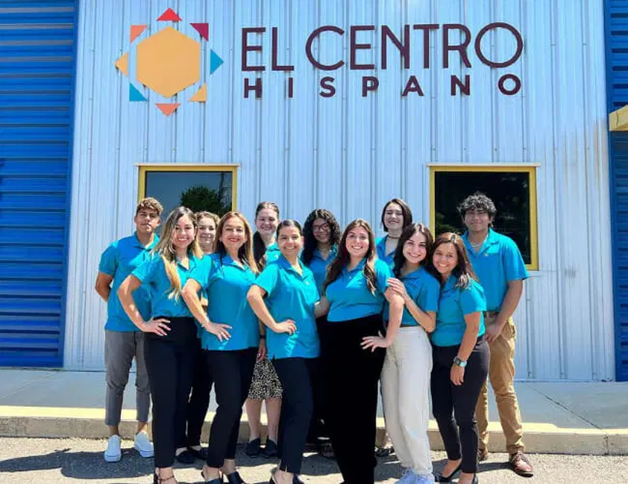
Staff members from the Hispanic Center pose outside their facility in Jonesboro, highlighting the organization’s role in supporting local families amid growing community concerns. Photo courtesy of The Hispanic Center via Facebook.
JONESBORO, Ark. — As immigration enforcement concerns grow in Jonesboro and across the country, leaders at the Hispanic Center say fear keeps some families from going to school, seeking medical care or accessing basic services. Immigration enforcement policies and increased activity by Immigration and Customs Enforcement have created uncertainty for many immigrant families, including those in northeast Arkansas.
The Hispanic Center is a nonprofit organization that serves the Hispanic community in Jonesboro, as well as others in need. The center offers services such as after-school programs, interpretation, translation, English classes, computer training and health fairs. The center also provides legal consultations, mental health sessions, and community events, while assisting families with food, transportation and housing support.
Carolina Elmore, assistant director at the Hispanic Center, said, “We serve the Hispanic community primarily, but we help anyone in need regardless of ethnicity, religion or race.”
Elmore said the Hispanic Center is a place she wants people to feel they could depend on anytime.
“We provide interpretation in hospitals, schools and legal settings so people who don’t speak English can still access essential services. Language is one of the biggest barriers, and we try to bridge that gap every day,” Elmore said.
Elmore said the Hispanic Center acts as a bridge between schools, the Hispanic community and local institutions. The center partners with local universities and organizations to provide students with educational support and expose them to career opportunities.
Elmore said one of the biggest challenges for the Hispanic Center has been increased activity by Immigration and Customs Enforcement.
“A lot of people are afraid to seek services because of immigration concerns. Some parents are even scared to send their kids to school or go to the doctor. We try to create a safe space where families feel supported despite those fears,” Elmore said.
Due to concerns about ICE, many community members are afraid to seek help or services at the Hispanic Center out of fear of being detained. That fear reflects what many immigrant communities are experiencing across the country, where enforcement actions can affect access to education, health care and other essential services. The center often works with churches and community partners to provide safe spaces and trusted environments for families.
“We help families with everything, from enrolling their kids in school to making doctor’s appointments. Sometimes it’s as simple as helping fill out a form, but that can change everything for a family,” Elmore said.
Elmore said she wants to continue serving her community during challenging times tied to immigration enforcement.
“Everything we do is about helping families feel supported, connected and valued in this community,” Elmore said.
Leo Hernández, program coordinator, helps facilitate the after-school program, which allows children to catch up on homework and receive tutoring.
“La Escuelita is here to support kids from kindergarten through ninth grade with their homework and academics. A lot of parents can’t help their kids with schoolwork, so we step in to guide them,” Hernández said.
La Escuelita runs Monday through Thursday during the school year and is divided into groups by age, allowing younger and older students to receive the support they need. Students work on subjects such as math, reading, writing, Spanish and public speaking, while also building communication and teamwork skills. The program also includes a summer component that helps students stay on track in a more engaging environment.
Hernández said the Hispanic Center also has a program called HELP, which gives high school students opportunities to explore life after high school. He said the program allows students to complete community service hours while visiting college campuses and local institutions.
“We’re not just helping with homework, we’re giving kids opportunities they might not have otherwise. It’s about building a foundation for their future,” Hernández said.
Hernández said education and guidance are some of the biggest needs in the Hispanic community, especially for students who struggle with English and need additional support.
Hernández said he wants the community to feel like a safe place where families can feel at home and that many people simply need direction.
“What’s happening with immigration affects families, especially the kids. We always encourage people to seek legal advice and handle things the right way. At the end of the day, we’re here to help people grow and succeed,” Hernández said.
Yesenia Dixon serves as a front desk receptionist, interpreter and after-school teacher at the Hispanic Center.
Dixon said many children struggle to express their emotions, and the center helps them build communication skills.
“It’s rewarding to see their faces light up when they realize they can do something,” Dixon said.
Dixon said she enjoys interpreting people but she also knows it is serious because she serves as the voice for others.
“I’m usually the first person people see, and they come in upset or needing help. I try to calm them down and let them know they’re in a safe place,” Dixon said.
Dixon said increased ICE activity has heightened fear in the Hispanic community, with some people choosing to handle everything virtually.
“During stressful times, we focus on giving people factual information so they don’t panic. There’s a lot of fear, so it’s important we don’t spread misinformation,” Dixon said.
Dixon said even if she does not have an immediate answer, she works to help people find one.
“We’re not just a place for handouts, we’re here to support people. We want to be known as a place where people can come without feeling judged,” Dixon said.
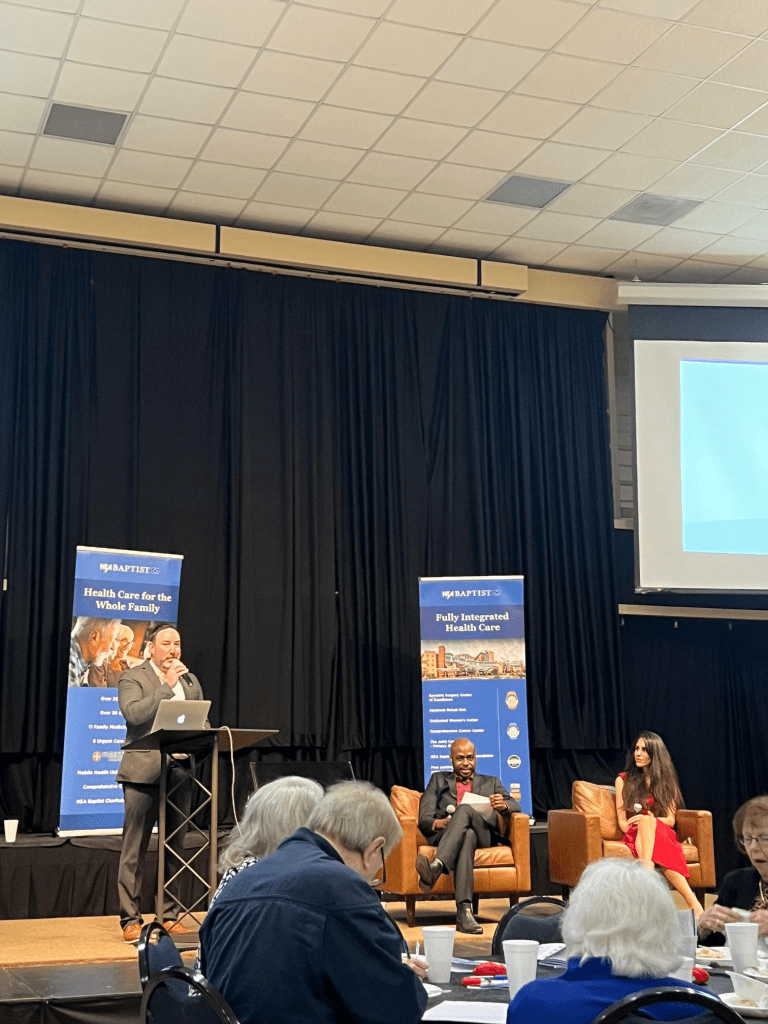
NEA Baptist hosts programs that promote heart-healthy behaviors through community screenings and educational programs that raise awareness of risk factors and promote healthy lifestyle choices.
NEA Baptist hosted a Heart Talk on Feb. 26, 2026, at Southwest Baptist Church.
Ty Jones, director of marketing at NEA Baptist, said his goal is to create opportunities for community engagement and education.
The organization focuses on community engagement and education through health screenings and risk-factor education. Outreach efforts include digital marketing, terrestrial radio, and television advertisements. Jones said balancing medical accuracy with creativity is crucial.
“As a company, we seek perfection every day, whether or not perfection is ever really attainable,” Jones said. “As human beings, we try to seek that in everything that we do. When you balance that with marketing and making sure you’re staying inside the box — which a lot of people find more difficult than just going with any creative whim — it’s a lot of fun.”
Jones said NEA Baptist always strives to partner with local schools, churches, and organizations to promote heart health and target the next generation of cardiologists.
“The big thing for us is making sure that we’re engaging students at a young age, letting them know not only what clinical health care careers look like — physicians and nursing — but also letting them meet residents to see what that educational track looks like from school to becoming a doctor,” Jones said.
Jones said balancing medical accuracy with creativity in marketing campaigns and materials helps convey heart health information in an engaging and impactful way.
“Understanding the roles in health care that may be behind the scenes — laboratory scientists who run tests to help physicians determine a patient’s root cause, as well as financial, billing, and marketing staff — is also important,” Jones said.
“Our goal at the end of the day is to take care of our community, whether that’s patients admitted to our emergency room, patients seeing primary care providers, establishing a baseline for preventive medicine, or providing free education,” Jones said.
Jones said community impact is measured by individualized patient care and tailoring medical services to each person. Lena Awar, an interventional cardiologist at NEA Baptist, said it is important to educate people to recognize and not ignore early warning signs of heart disease, such as fatigue, leg swelling, and chest pain.
“Coronary artery disease is very prevalent in this area,” Awar said. “We live in what’s called the Stroke Belt, and part of this talk discusses risk factors that contribute to that, including hypertension, obesity, and a sedentary lifestyle. All of that increases heart disease risk.”
Awar said stress management techniques such as walking in nature, reading, taking a hot bath, or practicing yoga or meditation can improve heart health.
“In our community, recommending smoking cessation is probably the most important thing, followed by getting in those 10,000 steps a day,” Awar said.
Awar said about 50% of health outcomes are genetically inherited and cannot be controlled. However, lifestyle choices can make a significant difference.
“One thing we can control is how we live our lives — diet, exercise, and routine checkups,” she said.
She also addressed misconceptions about heart medications.
“A lot of people think of us as drug pushers who just want to prescribe another medicine,” Awar said. “We wish all our patients could achieve their goals with diet and exercise alone, but sometimes that’s not enough. Some medications, like statins, have a bad reputation, but they save lives. We work with patients to tailor medications so they maintain a good quality of life.”
Oreoluwa Oladiran, a cardiac electrophysiologist at NEA Baptist, said it is important to recognize heart disease symptoms such as chest pain and heartburn, which are often overlooked.
He stressed the need for early heart health management beginning in a person’s 30s and highlighted preventive measures such as maintaining a healthy weight, eating well, and avoiding smoking.
“Heart disease is the most common cause of mortality not only in the United States, but worldwide,” Oladiran said. “In the United States, it kills nearly a million people every year,” Oladiran said.
Oladiran said monitoring blood pressure and blood sugar levels is an effective way to track heart health.
“We see patients in their 30s having heart attacks,” he said. “The earlier, the better. Don’t wait until you’re 40 to establish care with a primary care provider and pay attention to your health. Many of these issues are lifestyle-related, not necessarily medication-related.”