Tag Archives: East Arkansas Community College

Female farmer acts as spokesperson for industry

By Tristan Bennett
Delta Digital News Service

WALDENBURG – A young, female farmer is taking the Arkansas agricultural world by storm by acting as an ambassador and a role model for others like her.

Originally adopted from Russia, Jenna Martin grew up on her father’s, Dennis Martin, farm in Hickory Ridge, Arkansas. She went on to pursue a degree in agriculture business and continued her work in an industry dominated by men.

“This is just something in my gut. It’s just what I want to do,” Jenna said. “It’s what I think about all the time, it’s what I want to learn about, it’s what I talk to Dad about all the time.”

Men dominated the agriculture field for centuries, so a stigma surrounds women who work in the industry. However, the 2017 census stated 36% of U.S. farmers are female, and that number continues to rise. Jenna works as a role model for many young girls wishing to pursue a career in agriculture.

Both of her parents grew up around agriculture, so it became a part of Jenna’s life early on. She began helping Dennis on the family farm as soon as she could walk. Her mother homeschooled her, so the flexible schedule gave her plenty of time to spend where she said she really wanted to be: on the farm.

“When she first started, she would help us move equipment from field to field, and as she got a little bit older, she started driving tractors and putting out all the Polypipe,” Dennis said.

She solidified her choice to stay in agriculture while still in high school and began learning as much as she could and promoting the industry. Along with staying active in 4-H for 15 years, Martin also held the title of 2013 Miss Arkansas Rice. The Miss Rice program encourages agriculture education and promotes rice as a major part of Arkansas’ economy.

After graduation, Jenna chose to attend East Arkansas Community College in Wynne before transferring to Arkansas State University to pursue a degree in agriculture business and minor in strategic communication. Even though she wanted to farm, she said her parents wanted her to have a degree to fall back on.

“I chose community college because it was close to home and closer to the farm,” Jenna said. “EACC was a good transition before I went to A-State.”

During her time at A-State, Jenna remained involved in the College of Agriculture, held many leadership positions and created good working relationships with her classmates and professors. Bert Greenwalt, professor of agricultural economics at A-State, worked closely with Jenna during her time at A-State.

“She immediately became involved in all activities of the college,” Greenwalt said. “The thing about Jenna to me is she’s just so enthusiastic. Very positive, very enthusiastic and always ready to jump in, lend a hand and make a difference.”

Jenna served as the president of the A-State Collegiate Farm Bureau during her senior year, and worked as a teacher’s assistant under Greenwalt, assisting with the annual A-State Agribusiness Conference as well.

Jenna explored different careers in agriculture during her internships with Farm Credit Midsouth and Pioneer Seed, but ultimately returned to Dennis’ farm and chose to remain in production agriculture. During harvest, Jenna handles the grain carts as Dennis mans the combine.

“Usually day-to-day I go out to the shop, get everything ready and then go out to the field and stay there until 8:30 or 9,” Jenna said. “In the summer I go around and help Dad with all the water. Like I said, irrigation is huge.”

While she feels perfectly confident with her work in the field, Jenna still struggles with the business aspects of running a farm. Dennis runs his operation the old school way: everything on paper, and Jenna learned about how to handle finances on the farm from him. However, in a world where technology reigns, even farmers must adapt to new equipment and tools.

“Something I wish I could have done more of in my degree is more on the technology side,” Jenna said. “It’s growing so much, and I think that’s a big thing.”

As far as being a woman in a traditionally male industry, Jenna is not intimidated.

“I’m pretty good about just jumping in with the guys, and they’re pretty cool about responding,” she said.

More women pursue careers in agriculture today than ever before, and Jenna acts as a role model for each young girl.

“Jenna has an interest, ability and a passion for speaking about our industry,” Greenwalt said. “She is someone I know will continue to be a leader in the industry.”

Jenna said she hopes to take over the family farm someday. In the meantime, she continues to help Dennis on the farm and work on acquiring land to cultivate on her own.

“We’re leaving that 100% up to her,” Dennis said. “If she wants to pursue a future in farming, we’re behind her.”

Editor’s Note: Feature Photo shows Dennis, left, and Jenna Martin. Photo taken by Tristan Bennett


DeltaYou: EMTs Serve the Community

by Miranda Reynolds
Delta Digital News Service

Andrea Yates

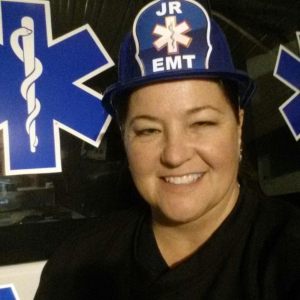
Angela Yates at work. Yates first became interested in becoming an EMT while working in Wynne. Photo courtesy of Angela Yates.

AUGUSTA, Arkansas – When medical emergencies arise in rural areas, Emergency Medical Technicians are responding to the life-threatening calls.

EMTs certifications depend on their level of education. A Basic EMT requires the least amount of schooling, whereas Intermediate EMT and a Paramedic EMT require more. Angela Yates, a Basic EMT,  received her certification at East Arkansas Community College, located in Forrest City. Yates said her certification prepared her for real-life emergencies.

“I think for the most part it did. But — also because I’m older than most people who enter this field — I did it when I was already turning 40 and most people are doing this in their 20s,” Yates said. “I had more life experience behind me already.”

Yates said paramedics and EMTs working in the Wynne hospital influenced her with their exciting stories of helping people. Yates said she believes being a woman is not a challenge in her line of work.

Yates said within rural areas, emergency airlift systems are something to consider.

“Because of my standpoint in EMS, I know it’s important to have (an emergency airlift system),” Yates said. “Being rural, we have different helicopter services available, and not everybody will accept the other’s insurance or the other’s coverage. It’s not feasible to have a membership with every service, but you never know what service you are going to get.”

Emergency Medical Technicians are vital to all communities because of their role in the emergency response chain. Yates said a patient’s medical insurance does not impact the work she does. Members of Pafford Emergency Medical Service provide emergency care while the hospital collects information; insurance comes after that.

The duties of an EMT vary among its members. Yates explained her duties to provide a full understanding of her everyday tasks.

Recertification for all EMTs is inevitable. As a Pafford EMS employee, Yates’ re-certification can be completed online by entering in her numbers, information and amount of hours taken. As far as original certification goes, members of Pafford EMS must meet in hands-on classes or groups.

Yates said prevention of accidents in emergency vehicles is important to the certification process. During an emergency that requires lights and horns to be activated, Yates is only allowed to drive 10 miles per hour over the speed limit.

Jay Atkins, police officer for Augusta and McCrory, said drivers on the highway do not pull over when meeting oncoming traffic and even drive close behind vehicles in pursuit of an emergency.

Yates said she built an endurance for coping with traumatizing calls after six years in the field. Yates’ husband, in his 25th year in the EMT field, helps her cope. Yates said having someone to confide in and someone who can relate to what she goes through is helpful.

Atkins said he finds other methods of coping.

“Separate myself from that call or if it’s ending my day … when I’m off, I’m off. I do not have a radio on, I don’t associate with this place,” Atkins said.


A-State Dedicates ‘The Circle’

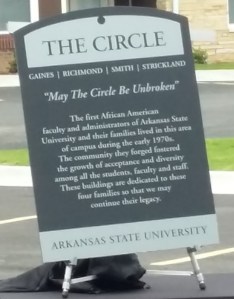
University officials unveiled a placard explaining “The Circle” during the dedication. The university named the apartment buildings for its first four black faculty. Photo by Kimberely Blackburn

by Kimberely Blackburn
Delta Digital News Service

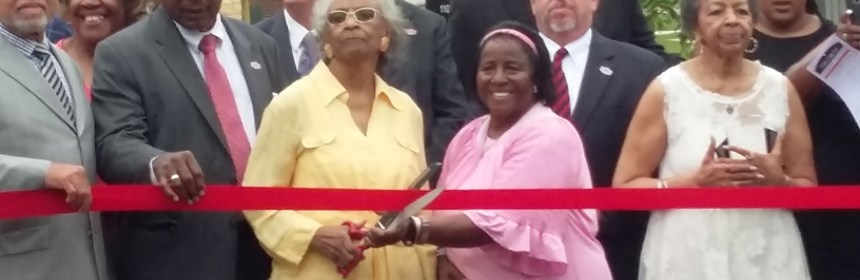
JONESBORO — Arkansas State University honored its pioneering black faculty Aug. 7 at the dedication of “The Circle,” a group of apartment buildings.

Chancellor Kelly Damphousse said such an honor sends a statement and begins many projects intended to make the campus a more welcoming place.

“We’ve come a long way in recognizing the important role that African-Americans play in our community, but we have a lot further to go,” he said.

A-State named the buildings — which will house A-State faculty, graduate students and New York Institute of Technology College of Osteopathic Medicine students — for the four men who taught at a time when many did not accept integration:

  • C. Calvin Smith, emeritus professor of history and A-State’s first black faculty member
  • Mossie Richmond, A-State interim president, vice president for student affairs and dean of University College
  • Herman Strickland Sr., emeritus associate professor of teacher education and dean of University College, and
  • Wilbert Gaines, emeritus associate professor of physical education.

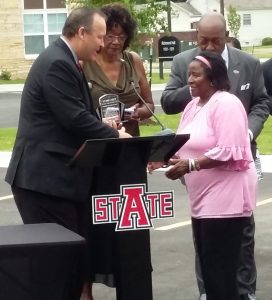
Chancellor Kelly Damphousse presents Earline Smith with a crystal award in honor of her late husband C. Calvin Smith. Each family received an award. Photo by Kimberely Blackburn

Smith lived in campus housing after being unable to find someone in Jonesboro willing to rent to his family. As the other families arrived, they became neighbors and formed “The Circle.”

Rick Stripling, vice chancellor for student affairs, said the dedication sends the statement that Arkansas State embraces diversity. He emphasized the importance of honoring the contributions of these men in the public eye.

Smith’s widow, Earline, said the families’ shared experience formed an extended family who truly loved each other. She said never in her wildest dreams did she expect so many people would attend the dedication. Richmond’s widow, Velmar, said the dedication honored and dumbfounded her.

Strickland said he came to A-State and found friends immediately. He said he gained acceptance as a teacher because of his friendship with Smith, who had done it first. He said he became a dean because Moss mentored him.

Gaines claimed the dedication shows A-State as, “a beacon of light to which other institutions can come for divine wisdom and insight.”

Richard Hartness Sr. authored a book illustrating the families’ lives called “The Circle: Coping With Integrated Life at AState, 1970-1978.” A former student of Smith’s, Hartness said he learned of the story at the celebration of Smith’s life after his death. Hartness said Smith brought important aspects of American and black history to his students that sometimes corrected the history books. Hartness said he now teaches these ideas to his students at East Arkansas Community College.

Richmond’s family member, Sandra Smith, works as principal of the BCH2 Academy at Wynne public schools. She said the dedication provided an opportunity for her to bring ideas to her students and teachers. Smith said she often quotes Frederick Douglass — who said, “Education can be an equalizer” — to show the importance of education to her students.

“In 2017 when we find there is still racial tension at times, this (dedication) establishes the fact hard work does pay off, and there is a facet of America that recognizes hard work,” she said. “As (Arkansas State) honored these founders and pioneers, they have honored themselves. As we lift others up, we lift ourselves up and if we understand that, we will be a greater America.”