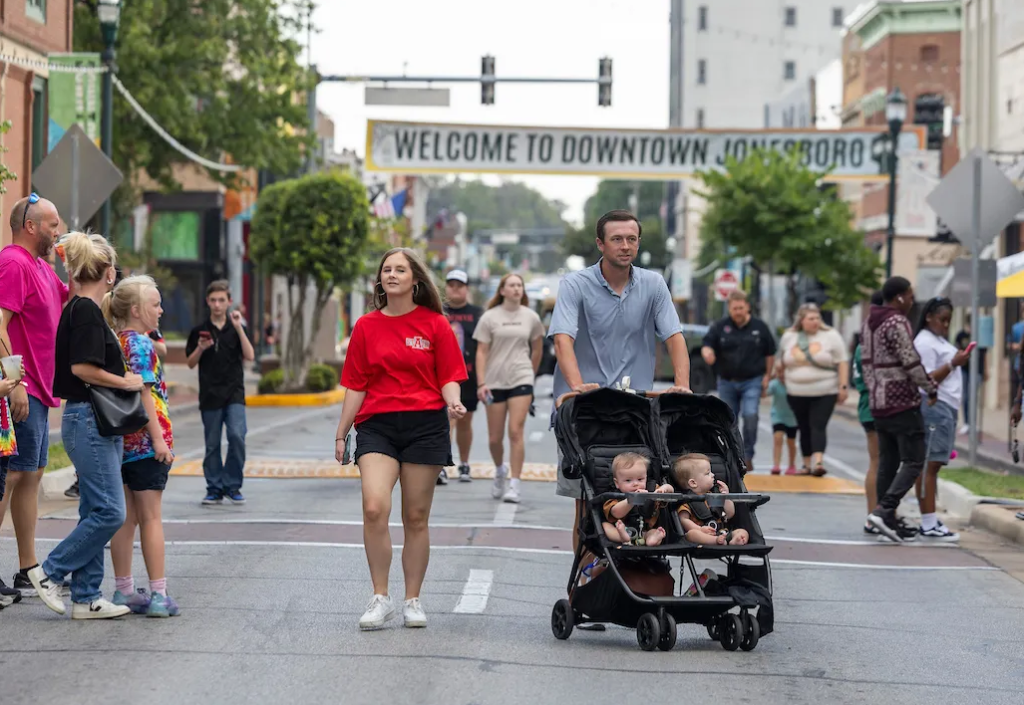
Pedestrians walk through downtown Jonesboro beneath a “Welcome to Downtown Jonesboro” banner, highlighting the connection between Arkansas State University and the local community. Photo courtesy of Arkansas State University.
JONESBORO, Ark. — As Arkansas State University continues to grow alongside the city of Jonesboro, students and community leaders say the relationship between campus and community is evolving, but not without challenges.
From economic inequality to shifting social values, both groups are working to better understand their roles in a shared space. While students often focus on academics, identity and campus life, many Jonesboro residents are more concerned with jobs, healthcare and the rising cost of living, highlighting a need for stronger collaboration.
Local organizations say collaboration is critical as community needs continue to grow.
At the Jonesboro Human Development Center, officials say demand for services has increased in recent years, creating new challenges for staffing and care.
“We are struggling to hire people to provide hands-on care for adults with disabilities,” said Diane Keith, a nursing home administrator at the facility. “We need employees with a CNA license.”
Keith said the center also maintains a waiting list for services, reflecting a broader need for support across Northeast Arkansas. She said A-State students help fill some of those gaps through internships in nursing, dietetics and speech therapy.
“We receive several A-State students for internships,” Keith said.
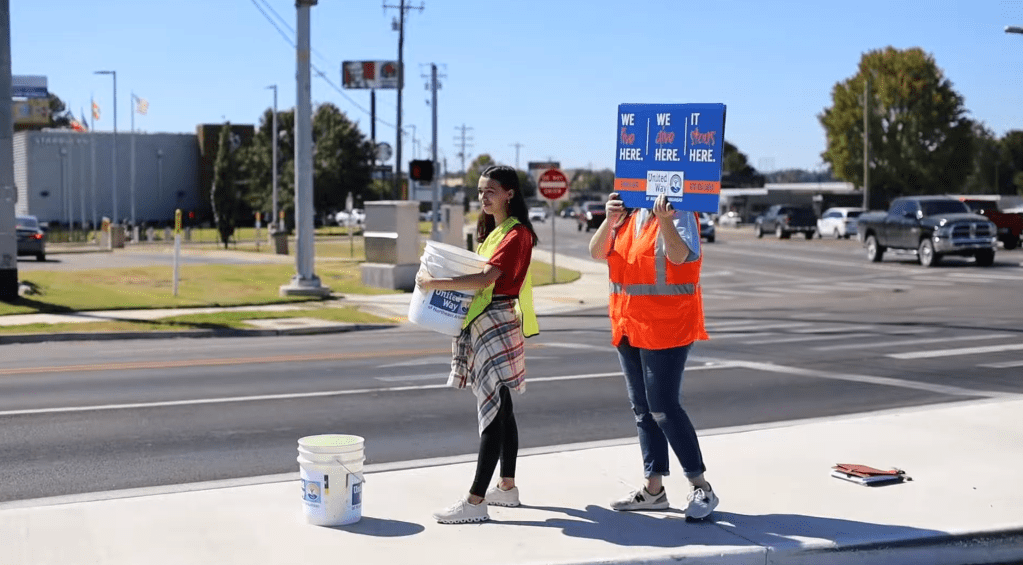
Volunteers request roadside donations for the 2022 United Way Day of Caring. More than 500 volunteers attended the event in 2022. Photo courtesy of UWNEA Jonesboro YouTube Channel.
Community leaders say those partnerships are key, but there is still room to grow.
Heather Coats, executive director of United Way, said A-State has already made strong efforts to connect students with the community.
“I think what’s important, and A-State already does a great job of this, is letting students, especially young adults, know what resources are available,” Coats said.
However, she believes the responsibility does not fall solely on the university.
“I think the community could do a better job of being present on campus when it’s not just for sporting events,” Coats said. “We need to have more of a presence that isn’t just about our own entertainment.”
Coats said increased engagement from Jonesboro residents could help integrate students into the community and encourage long-term involvement.
Erin Calhoon, development director for United Way, said improving awareness is essential to strengthening that connection.
“I would say finding ways for people on A-State’s campus to be more aware of what’s available in the community,” Calhoon said.
Student leaders agree that awareness remains one of the biggest barriers.
Jaycee Davis, president of Volunteer A-State, said her organization has made it a priority to connect students with local opportunities.
“Our mission last year was to connect campus to the community,” Davis said. “We had organizations from Jonesboro come to campus, and we introduced ourselves and shared how we could help each other.’
“Our goal this year is to have students make a bigger impact in the Jonesboro community by making them more aware of volunteer opportunities,” Davis said. “So many students don’t know what’s available in Jonesboro.”
Davis said students can get involved through activities like packing food boxes, participating in community events and supporting organizations like Hope Found, which raises awareness about human trafficking.
“Right now, the community gives a lot to the campus, which is great,” Davis said. “But I think our mission moving forward is to give that same energy back.”
Lavonda Evans, an instructor of sociology and criminology at Arkansas State, said differences in age and life experience often shape priorities.
“Students are in that space between being supported by their families and stepping into the real world,” Evans said.
Evans said campus conversations often focus on identity and diversity, while broader community concerns center on economic stability and infrastructure. She said there is a growing shift toward individualism.
“Everything is more individualized and specialized, which creates less collective support,” Evans said. “People tend to focus on their immediate circles rather than the community as a whole.”
Despite those differences, Evans said collaboration is both possible and necessary.
Click to View!
“Jonesboro is already making efforts to connect the campus with the city,” Evans said.
She said projects like walking trails and plans to better link the university to downtown are some examples of this effort.
Evans said expanding paid internships or job-shadowing opportunities could help students gain early experience while strengthening ties to the community.
“Overall, both city and university leaders are making strong efforts to connect students and the community, but there is always room for improvement,” Evans said.
As both sides continue to grow, leaders agree that bridging the gap will require greater awareness, stronger partnerships and a shared commitment to engagement on campus and in the community they will eventually call their own.
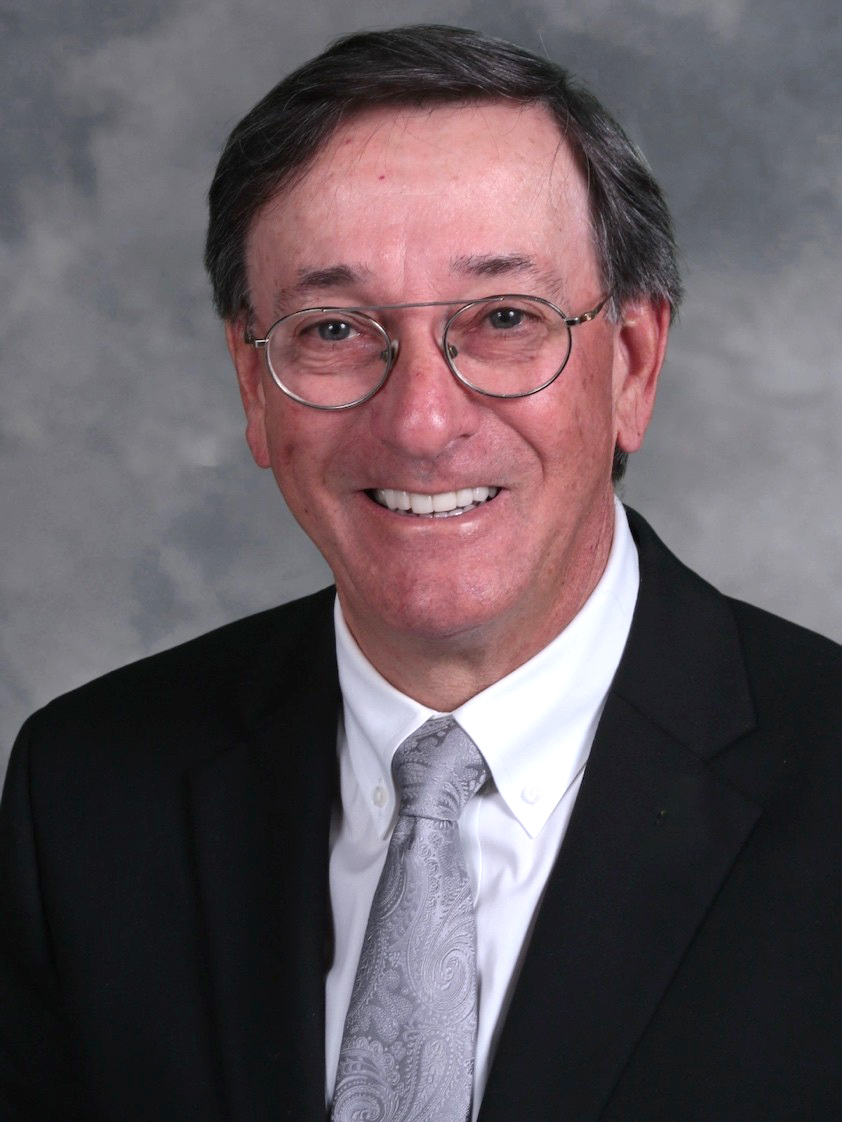
The Arkansas State University (ASU) System Board of Trustees named Robin Myers to return as interim president.
Myers, who previously served as ASU system interim president in 2024, was again named to the position on Dec. 12, 2025, following the previous president’s resignation. He said he was honored to return.
Jeff Hankins, ASU system vice president for strategic communications and economic development, said the chancellors and system staff were relieved by Myers’ second appointment. He said they are confident he was the best individual to step back into the interim president role.
“Dr. Myers is a calm, steady force who’s very experienced,” Hankins said.
In his role, Myers said he is responsible for enacting board policies and overseeing the operation of the system office as it interacts with each campus under the ASU system.
Regardless which campus they belong to, Myers said, students should know the ASU system works on their behalf to support and assist them.
“There is a group of people working on their behalf and I think that’s important to understand for students,” Myers said. “Unfortunately, because we are remote from the campuses, it is hard to have that interaction with students.”
Despite this limited contact, Myers said over 30 years of interactions with students in various educational positions gave him the experience needed to succeed as interim president.
Myers served as chancellor of ASU-Mountain Home for 11 years from 2012 to 2023, where he said he learned how students integrate and work together with campus operations.
“I think those are the things, just having that exposure and experience over the years, that provide me with a good background to understand what our campuses are going through on a day-to-day basis and the kinds of support and conversations that they need from me,” Myers said.
As a child, Myers said he worked closely with his dad’s business, gaining experiences and opportunities that shaped his current skill set.
The interim president said his greatest strength is his ability to listen to people and understand their perspective. He said he is not quick to judge or make decisions, but instead exhausts all information on a topic before moving forward.
However, Myers said his methodical nature is sometimes a weakness.
“I try to maybe do too much or get too involved sometimes, just because I want to help and assist,” Myers said. “Maybe I should take a step back occasionally.”
Jerry Morgan, ASU system board of trustees chair, said the board named Myers because of his previous experience as interim president and comprehension of system priorities.
Hankins said the board of trustees turning to Myers again is a significant compliment. He said he does not recall any particular challenges from Myers’ first appointment as interim president.
“If anything, we came away disappointed that he couldn’t have stayed on as president,” Hankins said.
The interim president said it’s too soon to tell if his current appointment will be different or similar to his first, although the circumstances are similar.
Myers was first named interim president in 2023, following the resignation of the second system president, Chuck Welch.
In 2024, Myers stepped down after the board completed its search for a permanent system president, naming Brendan Kelly to fill the position. However, Kelly resigned in early December 2025 upon being offered to serve as president of Eastern Michigan University, his alma mater.
Myers said he enjoyed his time working with Kelly through both transitions.
“Just an exceptional person, incredible skills and ability,” Myers said. “To be able to go back to his hometown and the school in which he graduated and be the president of that, no one can blame him.”
Hankins said the board of trustees held a special meeting to accept Kelly’s resignation. Soon after, at the next scheduled meeting, the board named Myers to be interim president.
Myers said the timing of the transition required him to pivot quickly.
“In addition to trying to transition and get an apartment and get moved to Little Rock, I had to also try to celebrate the holidays with my family,” Myers said. “It was a challenge, but it was also exciting and it worked out perfectly.”
In a statement published after Kelly’s resignation, A-State Chancellor Todd Shields said continuity of purpose is vital during system president transitions.
“As the trustees identify a new system president, our job is to stay the course and stick to the vital mission of educating tomorrow’s leaders and bridging our four-year and two-year colleges, industry and workforce needs for the ultimate good of Northeast Arkansas and the entire state,” Shields said.
Myers said he wants to be remembered as someone who cared about people, supported students and worked on behalf of everyone to find the best solutions for every issue presented to him.
“In the end, everything we do is focused on providing the best educational experience and opportunities we can for our students,” Myers said. “It is both an honor and a privilege to get to work with these folks.”
Myers will serve as interim president until the board of trustees completes its search for someone to fill the position in a long-term capacity. The board will meet again Feb. 13 to outline next steps in the search for an ASU system president.
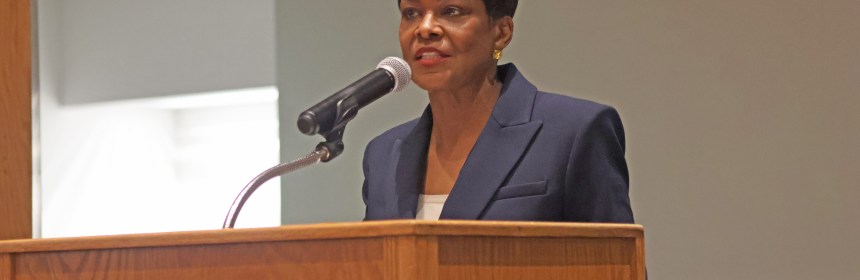
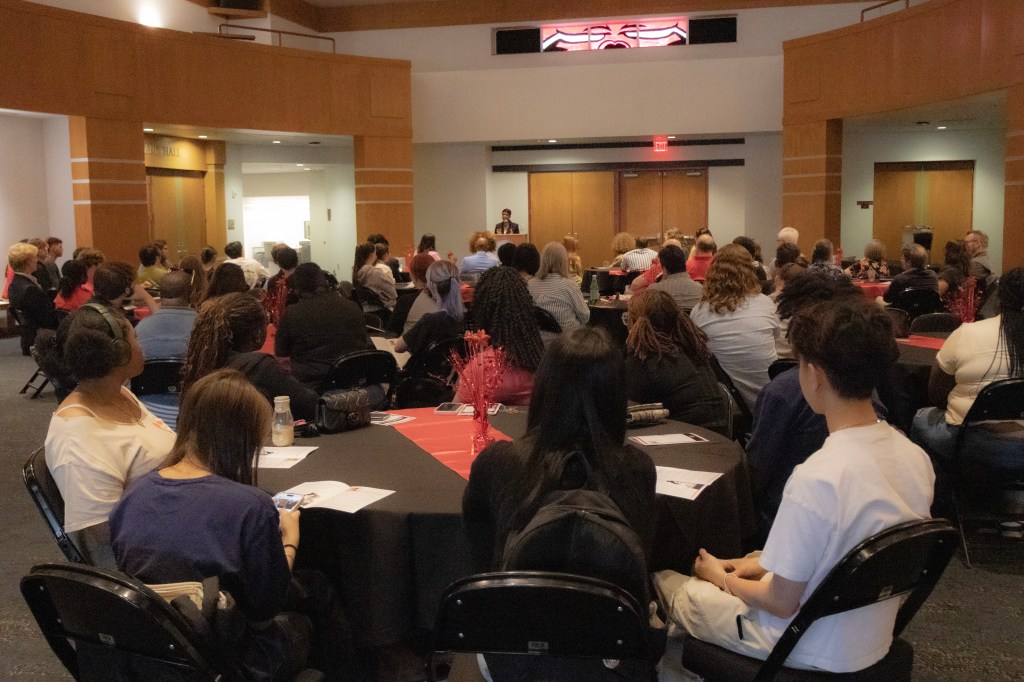
Students, faculty, staff, friends, and other Greenfield Lecture attendees listen to Rose Stuckey Kirk’s speech. Kirk is an Arkansas State University journalism alumna with a successful corporate career spanning 35 years. Photo courtesy of Ibuki Hinohara, Photo Editor, The Herald.
JONESBORO – Rose Stuckey Kirk, an Arkansas State University journalism alumna with a successful corporate career spanning 35 years, presented the annual Corinne Sternheimer Greenfield Lecture, sharing her journey with struggle, support, and success.
Kirk’s speech, titled “From Innocence to Innovation: A Lattice (not Ladder) Climb to the Top of Corporate America,” was given at 6:30 p.m. Sept. 17 in the Fowler Center at A-State.
Audio Story by DDNS Reporter Jerry Don Burton.
At the start of her speech, Kirk listed three things she wished to accomplish: break down the title of her speech, describe how she uses her support systems to have a successful corporate career and suggest how attendees can build on the platform of success she has laid out.
“It struck me a number of years ago that I was never climbing the corporate ladder, because when you are climbing a ladder, you are either going up or down and there are huge gaps in between those rungs and one wrong move, and you can seriously hurt yourself,” Kirk said. “Instead, I was clinging to a lattice. This grid-like structure is flexible and organic; its lines are sometimes diagonal, sometimes curved.”
The Greenfield Lecture speaker said she always made slow and steady progress, despite many missteps and lateral movements. She said that as she climbed, she never forgot her childhood aspirations.
“I never stopped remembering that little girl from Pine Bluff, Arkansas, who just knew one day she would take New York City by storm,” Kirk said.
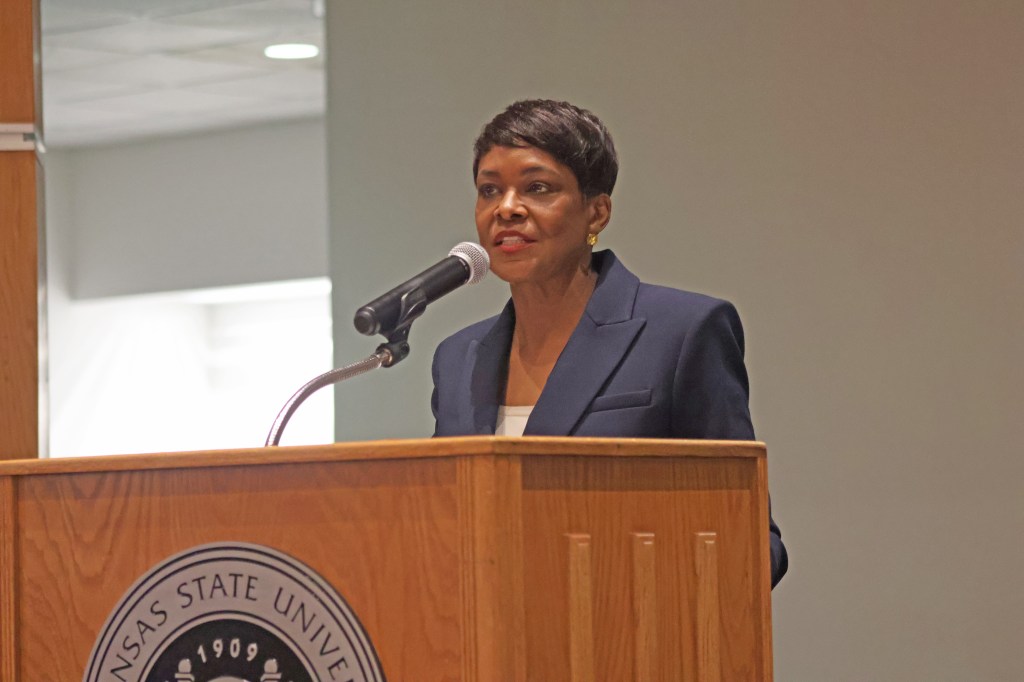
Rose Stuckey Kirk, presents her speech at the 2025 Greenfield Lecture. In her speech, titled “From Innocence to Innovation: A Lattice (not Ladder) Climb to the Top of Corporate America,” Kirk shared her journey with struggle, support, and success. Photo courtesy of Ibuki Hinohara, Photo Editor, The Herald.
Kirk said that while in elementary school, her teacher showed her class a picture of the Statue of Liberty and told everyone to remember what it looks like, because most of them would never make it to New York City to see the statue. She said this stirred something up inside her innocent self.
Decades later, Kirk said she lived in New Jersey and would drive to New York multiple times a week. Every single time the Statue of Liberty came into view during her commute, she said she would pause whatever she was doing and look at it until she could not see it anymore.
Kirk said she does not think her teacher meant any harm, but she would not let her life experiences be based upon what she saw in a book, but instead what she had personally experienced.
“Sometimes in life we look for signs, these big moments of lightning flashing or fireworks to affirm for us those dreams,” Kirk said. “But it’s often the quiet moments, the little things that come into your world that can and will set a path to live your best life.”
Kirk said her strategic mindset and self-reliance, developed from her childhood as one of eight children, helped her succeed as a student at A-State.
Lillie Fears, professor and interim director of the School of Media and Journalism at A-State, said she met Kirk when they were both undergraduates.
“I thought she was very energetic, very outgoing, popular, one of those outgoing personalities. When she said she was an introvert [during her speech], I thought, ‘you sure fooled me,’” Fears said.
Cherisse Jones-Branch, College of Liberal Arts and Communication (CLAC) dean, said Kirk’s status as an alum of A-State and CLAC set her apart from previous lecture hosts.
While hosts for the Greenfield Lecture series are not limited to A-State alumni, Jones-Branch said bringing successful graduates back to A-State to host the Greenfield Lecture is important.
“I like people like that to come back and talk to our students so that they can see what’s possible,” Jones-Branch said. “We saw someone who came from small-town Arkansas, who’s talking to students, many of whom come from small-town Arkansas. The way she was able to connect with them, because they come from the same place, was really special.”
During her time at A-State, Kirk worked at The Herald student newspaper, tutored students and attended a full course load, in addition to working as a clerk for the Social Security Administration. Kirk said college was one of the most impactful times of her life.
“I learned curiosity and how to translate that curiosity into written words that allowed me to explain both simple and complicated issues to the mass population,” Kirk said. “So you can only imagine how amusing it was to me when corporate America began to talk about attributes of successful leaders, and one of those key attributes is that great leaders, often, are great at storytelling.”
Before Kirk could face the corporate world, however, she first had to face rejection.
After graduating, Kirk said her eyes were set on working at the Southwestern Bell Telephone Company, one of the predecessor companies of AT&T. She sent her resume and was served back a rejection letter, stating they only hired people with at least two years of experience.
So, Kirk began work at the Pine Bluff Commercial newspaper. Eight months later, she moved out of state to work for The Times Daily, a set up from her hometown paper. However, she would soon face struggles again.
While working in Alabama, Kirk said she received news of her sister’s death. She said she grieved for weeks and was lost at work, which annoyed all but one of her coworkers.
She said one peer, a quiet man who was a Vietnam veteran, pulled her aside and spent time with her.
“He let me know he saw my suffering. He didn’t pry into my struggle, but instead, he told me a story about his own struggle,” Kirk said. “I learned from him the value of empathy and compassion in the workplace and the need to speak up for others when no one else will.”
Fears said the way Kirk confronted challenges, dealt with tragedy and helped others impressed her. Fears said a friend was having a hard time recently and she did not know how to help beyond listening. But, she said Kirk’s speech touched her and helped her understand what she can do to help in the future.
“It let me know that when I see somebody, it’s okay to reach out and help them,” Fears said.
While working in the journalism industry, Kirk earned awards from the Associated Press and the New York Times. Eventually, she updated her resume and applied again for a position at Southwestern Bell. Within weeks, she was hired.
“Rejection is not bad. What you do with it, how you learn from it, how you respond to feedback, is your choice,” Kirk said.
Even in the corporate industry, Kirk was not free from struggle. She said she spent six months under the leadership of someone who did not believe she was worthy of her position.
John Thompson, a sophomore political science pre-law major from Pine Bluff, Arkansas, attended the lecture. He said struggle was the most important theme Kirk explored in her speech.
“She really didn’t hold back on all the struggles that she experienced in her life. She claims that it did, in fact, shape her, but it shaped her in the best ways possible,” Thompson said.
John Thompson, a sophomore political science pre-law major from Pine, Bluff, Arkansas, asks Rose Stuckey Kirk a question following her speech. Thompson said he will take what he learned from Kirk’s speech about the inevitability of struggle and rejection and apply it going forward in his life. Photo courtesy of Ibuki Hinohara, Photo Editor, The Herald.
Years later, after Kirk said her career surpassed his, she bumped into her old boss. She said he was surprised by how far she had come in her career.
“I thought to myself, ‘my success is based upon my opinion of me.’ There will be many people along the way, for whatever reason, will not be your supporters. Sometimes you can change their minds, many times you cannot. Your goal is to build a massive amount of support in your circle so that non-believers don’t have the votes or the voice to block you.”
Thompson, a CLAC ambassador, said Kirk’s definition of success initially confused him. He said people usually gauge success by comparing themselves to others.
“I think I’m struggling with that concept of success,” Thompson said. “However, I do think that that is beneficial to me, because success really is in you and it is what you want out of this world.”
Carson Campbell, a junior creative media production major from Jonesboro, met Kirk during a breakfast event held before her speech. He said Kirk was very personable.
“She was a very down-to-earth person and very successful, so it was cool for her to come in and spend time with us and try to get to know us before her busy day,” Campbell said.
Kirk said she wanted to exhaust her life of all it has to give.
“When I die, I want the people at my funeral to go ‘yup, she did it. She exhausted this life,’” Kirk said.
Fears, Thompson and Jones-Branch said this phrase resonated with them.
Kirk concluded her speech by addressing A-State students.
“I hope that what you take from this is that you’ve got to believe in this institution. You’ve got to lean into whatever your professors are trying to teach you. You have to take advantage of everything that is here,” Kirk said. “Be flexible, build your lattice, network, be a good person and launch yourself into society in a way that you can make this institution proud and you can be proud that you are a graduate of Arkansas State University.”
Fears said one of the most important messages Kirk touched on is to take advantage of everything being taught in class.
“Even if you’re bored to death, you might be very surprised at how it’s going to help you later,” Fears said. “You can take the skills that you get here and take them to any workplace and keep developing them.”
Thompson said he anticipates rejection in his career and faces struggles already in college. However, he said he will take what he learned from Kirk’s speech about the inevitability of struggle and rejection and apply it going forward.
“In front of me was a woman who had struggled, not only in her adult life, but also as a young child, and here she is giving a lecture on 60 years of success,” Thompson said. “What I take from this is that struggle is going to be on my career path, but that’s just a part of the path itself.”
Thompson said he did not know much about Kirk before her speech, but loved her story. He said he had never been to a Greenfield lecture before, but believes the series is a great tradition because it allows students to spend a night listening to a success story from an A-State graduate.
Fears said even though she and Kirk are near the same age, she was still inspired by her speech.
“That lets me know you can never be too old, or too advanced, to get some inspiration from people,” Fears said.
After numerous promotions, setbacks and movements in all directions on the lattice, Kirk is successfully retired and said she is excited to work on her garden.
-30-
Rose Stuckey Kirk presents her award for hosting the 2025 Greenfield Lecture. The Greenfield Lecture is funded by an endowment established to honor Corinne Sternheimer Greenfield. Photo courtesy of Ibuki Hinohara, Photo Editor, The Herald.
LITTLE ROCK — Arkansas State University System institutions reported strong 11th-day preliminary fall total enrollment growth of 7.6% with multiple record-setting performances, System President Dr. Brendan Kelly announced today.
“Six of our seven campuses had an overall enrollment increase, including record enrollment for A-State and an extraordinary upswing for Henderson,” Kelly said. “Our two-year institutions also attracted more students as workforce training programs grew. I appreciate the work of our teams across the ASU System to seek out and meet the needs of students and Arkansas employers.”
Total ASU System preliminary 11th-day enrollment was 30,339, up 2,132 students or 7.6% compared with official final enrollment of 28,207 in fall 2024. Full-time equivalent totals were up 7.2%.
Kelly noted that the traditional 11th-day enrollment measure, while positive for the ASU System, has become antiquated in today’s higher education environment because it doesn’t reflect collective enrollment throughout the year.
“Our campuses are enrolling and serving new students almost every week through online and non-credit training programs,” he said. “And ASU-Newport is piloting an initiative for eight-week general education courses that simply doesn’t align with the traditional reporting periods. The ASU System’s ultimate service numbers throughout the year are substantially higher.”
Arkansas State led the growth for the system with a record 17,926 students – a 7.4% increase of 1,239 over last fall’s record of 16,687. First-year students totaled 2,222, a 12% rise over last year, and include 1,764 Arkansans – who make up 79% of the class and represent a 30% increase from a year ago.
“This class is a clear sign that Arkansas families see A-State as their home for opportunity,” A-State Chancellor Todd Shields said. “It means they believe in what we are building here, and they trust this institution to shape their future and strengthen our home state.”
A-State on-campus enrollment grew by 7.8% while online program enrollment is up 6.7%. The A-State total also includes 1,053 students at Campus Queretaro in Mexico, which is a 10% increase over fall 2024.
Total preliminary enrollment at Henderson climbed 9.9% to 2,258, up 203 students from the fall 2024 total of 2,055. The number of first-time freshmen jumped 46% to 572 compared with 391 a year ago while transfer students were up 32% to 196 compared with 149.
“The Reddie Spirit is alive and well on campus as we welcome our returning students and the largest freshman class in six years,” Henderson Chancellor Trey Berry said. “Our faculty, staff, alumni and friends are committed to the success of our students, and it is inspiring to see the growth and tremendous energy throughout our campus community.”
Leading the way for the system’s two-year institutions in the fall reporting are ASU-Beebe with 3,588 students, which is an 9.5% increase over 3,277 last fall; ASU-Newport with 2,118 students, a 13.4% increase over 1,868; ASU-Mountain Home with 1,318, a 0.2% increase over 1,315; and ASU Mid-South with 1,180, a 15.5% increase over 1,022. ASU Three Rivers reported 1,951 students, a 1.6% decrease from 1,983.
The two-year institutions and A-State reported robust growth in high school concurrent credit enrollment with 5,650 students as the ASU System works with the state’s high schools to fulfill goals outlined in the Arkansas ACCESS Act.
Photo and story courtesy of Arkansas State University.
JONESBORO – Arkansas State University is celebrating a record-breaking student body this fall with 11th-day enrollment surging to 17,926. Fueled by the largest freshman class ever and record credit hours, A-State’s growth marks another milestone in its rising trajectory as the destination for students across Arkansas and beyond.
The Class of 2029 includes 2,222 first-year students, a 12% increase compared to last year. Among them are 1,764 Arkansans, who make up 79% of the total class and represent a 30% increase from the previous year.
“This class is a clear sign that Arkansas families see A-State as their home for opportunity,” Chancellor Todd Shields said. “It means they believe in what we are building here and they trust this institution to shape their future and strengthen our home state.”
Total enrollment at A-State has increased by 28% since Dr. Shields arrived on campus in the summer of 2022.
This year’s Red Wolves are taking more classes as well, with total credit hours reaching 161,204, an 8% increase over last year and a university record.
A higher number of returning students is also driving enrollment growth, with nearly 750 more students resuming classes this fall, representing a 7% increase over the previous year.
“Our duty goes beyond recruitment. We must ensure that students persist, succeed and graduate ready to make a difference,” said Provost and Executive Vice Chancellor Calvin White Jr. “The historic number of credentials awarded last year and the improvement in returning students show that A-State is fulfilling its mission to advance student success at every level.”
During the 2024-25 academic year, A-State awarded more than 6,000 credentials, the highest total in its history.
This fall, more students are choosing the full A-State experience. On-campus enrollment grew by 7.8%, outpacing a 6.7% growth in online programs. The shift signals a rising demand for the traditional college environment, with students seeking the energy of campus life alongside strong academics. The trend also extends to A-State’s Campus Queretaro, which has seen enrollment grow to 1,053 students, up 10% from 2024.
Student life at A-State is thriving with residence halls filled to capacity. Currently, 3,242 Red Wolves and osteopathic medical students are living on campus, which accounts for 99.8% of the available beds. Meal plan selections rose 6.7% compared to last year, an additional sign of growing student engagement on campus.
“As someone new to A-State, I have been immediately impressed by the energy and excitement on campus,” said Vice Chancellor for Enrollment Management Amanda Nickerson. “It’s clear that students are drawn not only to our academic opportunities, but also to the sense of community here. That combination makes A-State an easy choice for families.”
Looking ahead, A-State is building on this year’s success with new opportunities for future students. The university has expanded its investment in merit scholarships, raising its top award to $18,000 per year and adding a new $10,000 A-State Trailblazer Scholarship for high-achieving students.
Innovative pathways are also fueling excitement, including the Freshman to Physician program that offers early admission to the NYIT College of Osteopathic Medicine at A-State. In addition, the new A-State College of Veterinary Medicine, anticipated to open in fall 2026, will provide Arkansans with the opportunity to pursue veterinary education closer to home while helping to meet the state’s critical need for veterinarians.
JONESBORO – INSIGHT Into Diversity magazine has recognized Arkansas State University as a winner of the Higher Education Excellence in Diversity (HEED) Award.
“Arkansas State University is dedicated to educating all students, and ensuring they have a home away from home. As we strive and continue to cultivate an environment where everyone belongs and thrives together, we must remember it starts with us,” said Dr. Carlitta Moore, vice chancellor for access and institutional engagement.
Nationwide, 114 higher education institutions, including A-State, are recipients of the HEED Award. The HEED Award is the only national honor highlighting U.S. colleges and universities that demonstrate an outstanding commitment to creating a diverse and inclusive campus environment.
The impact is felt across the university, according to Moore.
“We have seen under the leadership of Chancellor Todd Shields an increase in the number and diversity of students, as well as in leadership,” she said. “This award signals to prospective students, faculty and staff an academic community which values everyone, and can lead to improved retention rates, higher engagement and academic success. Additionally, it serves as both a symbol of progress and a motivator for continued work in a thriving environment.”
It marks the seventh consecutive year A-State will take home the award.
Moore says it was an honor to hear the university received the HEED Award again as it is the only institution on the list to represent the Natural State.
“I was excited to know A-State is continuing to carry the legacy and remain the only school in Arkansas to hold this designation, a uniqueness which sets A-State apart and indicates we are leading by example,” according to Moore. “This honor reinforces we are genuinely committed to creating a welcoming environment, and the continuous efforts made over time.”
The HEED Award is a testament to the work taking place at A-State to foster a welcoming campus for students and the university community.
“Our stakeholders take pride in fostering collaborations, enhancing partnerships with local, nation and international communities which benefit students, alumni, faculty and staff alike,” said Moore. “It is a representation of us actively taking steps towards making a real impact on the campus culture. It reflects successful efforts in fostering a sense of belonging, ensuring everyone has equitable access to resources, opportunities, and support systems.”
A-State will be featured in the November/December issue of INSIGHT Into Diversity magazine, the nation’s largest and oldest publication dedicated to diversity, equity, and inclusion in higher education. One can learn more about INSIGHT Into Diversity or the recipients online.
LITTLE ROCK – Dr. Brendan Kelly today officially began his appointment as only the third president of the Arkansas State University System. The ASU System Board of Trustees voted to hire Kelly, who had served as president of the University of West Georgia since 2020, on June 5. He succeeds interim president Dr. Robin Myers and the second system president, Dr. Chuck Welch, who left the system in January after nearly 13 years to become president and CEO of the American Association of State Colleges & Universities (AASCU) in Washington, D.C.
“The ASU System is open for business and will expand the state’s economy by improving lives and opportunities – starting with our students and their families,” Kelly said. “I believe strongly that if we do what’s right for a student, and then we make it work for the institution, we’ll never go wrong. The energy that exists in most communities emanates from institutions like the ones that we represent. I’m excited that the ASU System comprises not only seven outstanding campuses, but also some terrific communities in Arkansas.
“We have the opportunity to galvanize communities, look to the future to ensure the ASU System is ready to meet it and work to expand the impact of higher education within Arkansas and beyond,” he added. “From cutting-edge research initiatives to skilled workforce training, I’m confident the ASU System has the ability to meet the demands of our rapidly evolving economy.”
Kelly said the ASU System role appealed to him “because it represents one of a handful of roles in the United States in which one has the ability to influence and shape higher education throughout an entire state. I am grateful to each member of the ASU Board of Trustees for their faith in me to offer leadership to a university system that has the capacity to provide access to high quality, higher education to the vast majority of Arkansans and many more beyond the state borders. This is an opportunity to support the economic evolution of the state at large.”
Prior to joining UWG, Kelly was chancellor at the University of South Carolina Upstate in Spartanburg and Greenville from 2017-2020 and was appointed as interim president of the University of South Carolina in 2019. He was vice president of university advancement and president of the UWF Foundation, Inc., at the University of West Florida in Pensacola from 2013-2017, where he led a successful $50 million capital campaign. His teaching career spanned 13 years in Florida and Michigan in communication arts.
His focus at UWG has been innovative programming both inside and outside the classroom with an emphasis on creating valuable life and career outcomes for students, with a commitment to launch and advance student careers upon graduation. He served on the board of directors of multiple regional and state economic development entities, as well as the Atlanta Regional Higher Education Consortium.
While leading and implementing the “Becoming UWG” Institutional Strategic Plan, Kelly has led UWG to record-breaking fund-raising efforts, including the largest gift in institutional history, and oversaw an enrollment resurgence. The UWG campuses in Carrollton, Newnan and Douglasville have a combined 12,769 students and are expected to exceed 14,000 this fall. Its spring enrollment was 11.4% higher than last year, while its graduate enrollment surged 41%. UWG recently completed a move in athletics from the NCAA Division II Gulf South Conference to the Division I Atlantic Sun Conference.
“We’re thrilled to have Dr. Kelly officially beginning his leadership of the ASU System,” Board Chair Christy Clark said. “I know he is eager to get busy, and our board is eager to support him and his vision for the System and our campuses. We look forward to a smooth transition as he leads our experienced System team and chancellors.”
Trustee Price Gardner, who chaired the search on behalf of the board, said: “We are excited to welcome Brendan Kelly as our new System president. We believe Dr. Kelly’s experience and outstanding record of achievement throughout his career will continue the growth and development of our System and lead us in addressing the ever-changing challenges facing higher education and our focus on student success. He has been described as a visionary, talented communicator and a person with the ability to elevate the reputation of the institution and further its mission. Our board looks forward to the opportunity to work with him.”
Kelly is a member of the AASCU board of directors and was named “One of the Most Influential Georgians” by Georgia Trend magazine and James Magazine. He was active with the National Forensic Association (NFA) and speech/debate competitions for many years and was honored as a NFA Hall of Fame inductee and with the NFA Eddie Myers Distinguished Service Award.
He received a Bachelor of Science degree in public relations and a Master of Arts degree in communication at Eastern Michigan University and his Doctor of Philosophy in rhetoric and political communication at Wayne State University.
Kelly and his wife, Dr. Tressa Kelly, have three children – Bree Luckey (married to Drew Luckey), Liam and Kieran.