Story, photos, and video by DDNS Reporter Allie Carson
Jonesboro High School running back T.J. Brown scores a touchdown during homecoming. Video by DDNS Reporter Allie Carson.
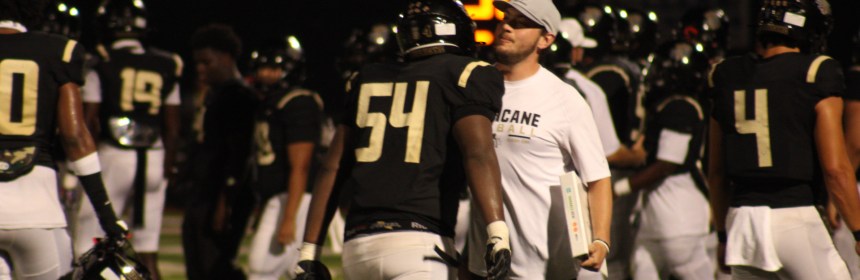
For Jonesboro’s “Hurricane Hits” Homecoming Week, the Golden Hurricane played Little Rock Catholic after a week of events.
With dress up days throughout the week, a parade on Wednesday followed by the seniors vs juniors and sophomores Powderpuff matchup, a pep rally on Friday afternoon and then a dance following the football matchup against Catholic, the Hurricane schedule was packed.
Hurricane Homecoming celebrated all things music: From hip hop to country to rock to headliners. Just in time for gameday, the Golden Hurricane ended the week off with a black and gold theme.
The parade, which took place on Wednesday instead of the usual Friday, blocked off Main Street in Jonesboro for the entirety of Jonesboro Public Schools.
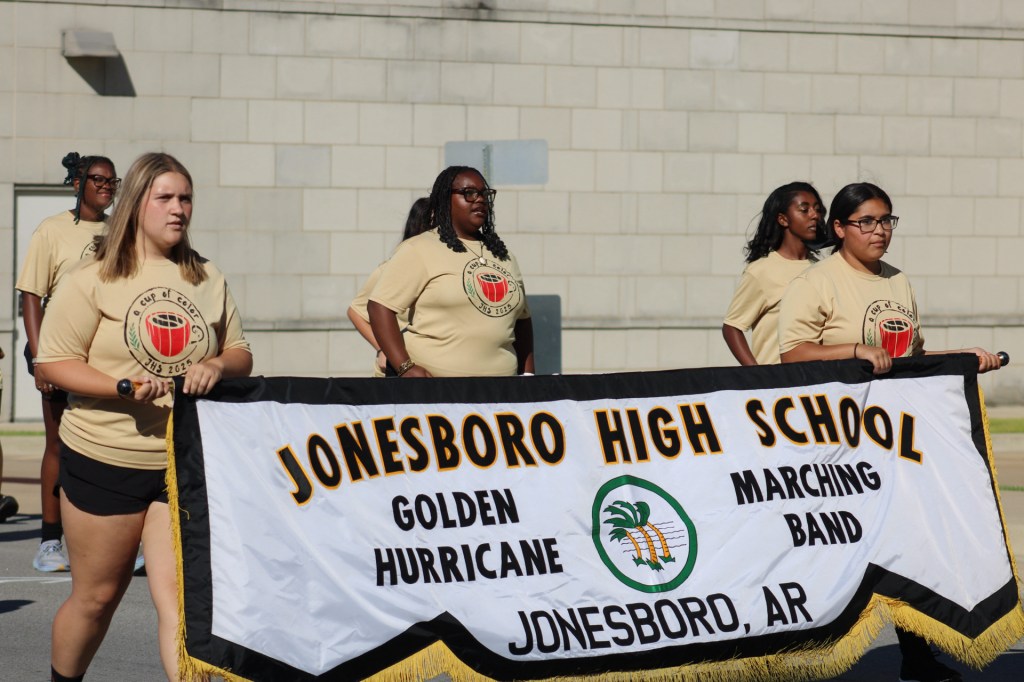
The Jonesboro band led the parade with Cane the mascot not far behind.
Photo by DDNS Reporter Allie Carson.
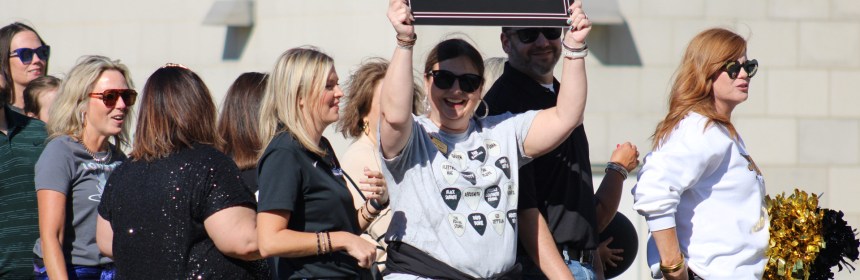
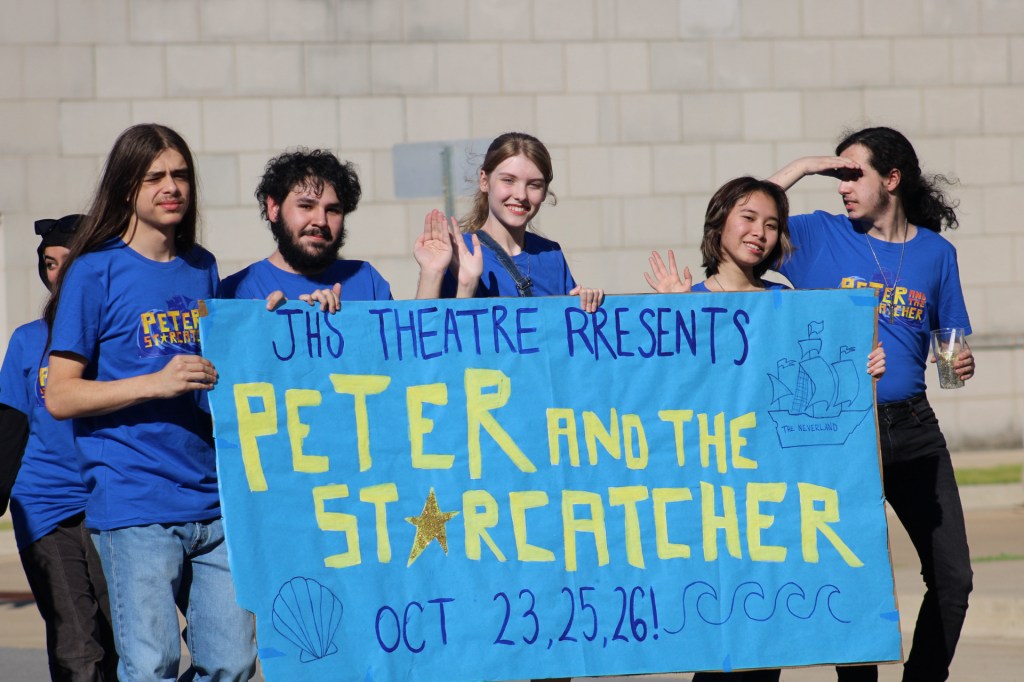
The Kindergarten Center brought their Taylor Swift “Showgirl” themed float, Visual and Performing Arts had a country themed float. The cheer and dance teams walked the route and the Jonesboro High theatre troupe entered the parade and promoted their upcoming play, “Peter and the Starcatcher.”
Photo by DDNS Reporter Allie Carson.
The Homecoming Court wrapped up the parade, riding in style at the end of the route.
Later that day, the senior class took home the victory against the underclassmen in the annual Powderpuff match.
The pep rally would headline the crowning of the Homecoming King and Queen after presenting the Homecoming Court for the second time that week and performances from the Jonesboro band and spirit squads.
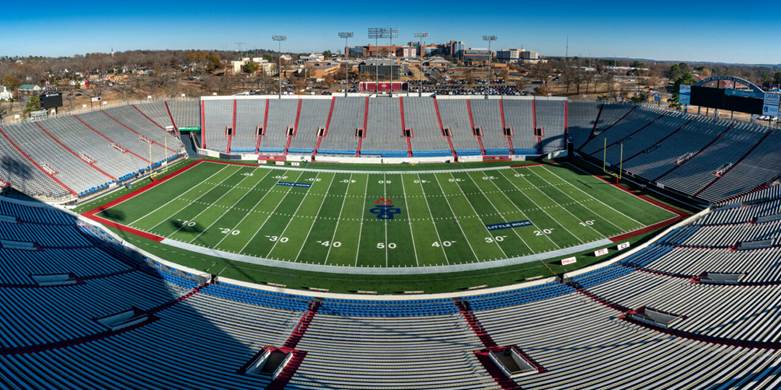
Homecoming Day came on Friday with a parking lot full and Hurricane alumni packing the stands, hoping to see a win from their alma mater.
And a win is what the Jonesboro fans got.
Getting their first back-to-back win since October of 2023, the Golden Hurricane played like they had something to prove.
“It’s Homecoming Week. There’s a lot going on. But I thought our kids did a good job of staying focused for the most part. It was a good week of practice and I thought they were ready to come out and perform,” Jonesboro head coach Tyler George said. “We really challenged them. You have people coming back from almost every decade. You have to perform and put a show on for them and they did that tonight.”
After a defensive first quarter where a field goal by Jonesboro kicker Alex Glomski, offense showed more in the second, Catholic scoring a touchdown on their first drive of the quarter off a quarterback keeper.
Jonesboro would score with three minutes to go in the half after running back K’Den Hawkins ran fifteen yards and proceeded to run it in for a touchdown on the next play, giving Jonesboro the lead back going into half.
The Golden Hurricane decided to go for it on fourth and seven on Catholic’s 36 yard line, too far to kick a field goal and too close to feel the need to punt.
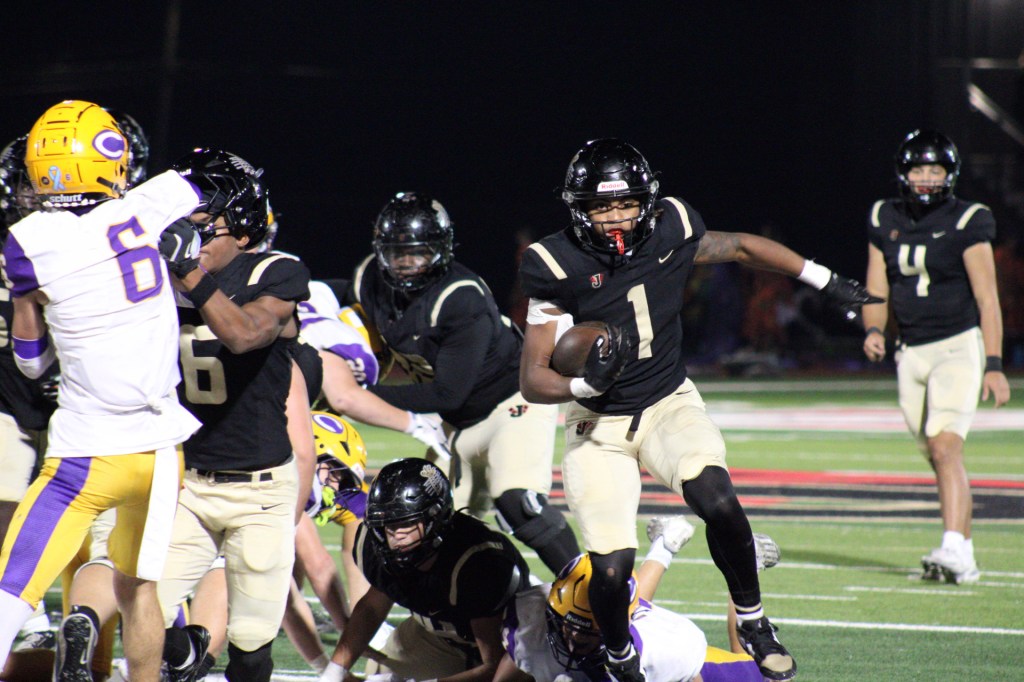
It worked out for the Golden Hurricane, however, after wide receiver Jaylen Heard gave them a first down and running back TJ Brown would break free at the five yard line to give Jonesboro another touchdown.
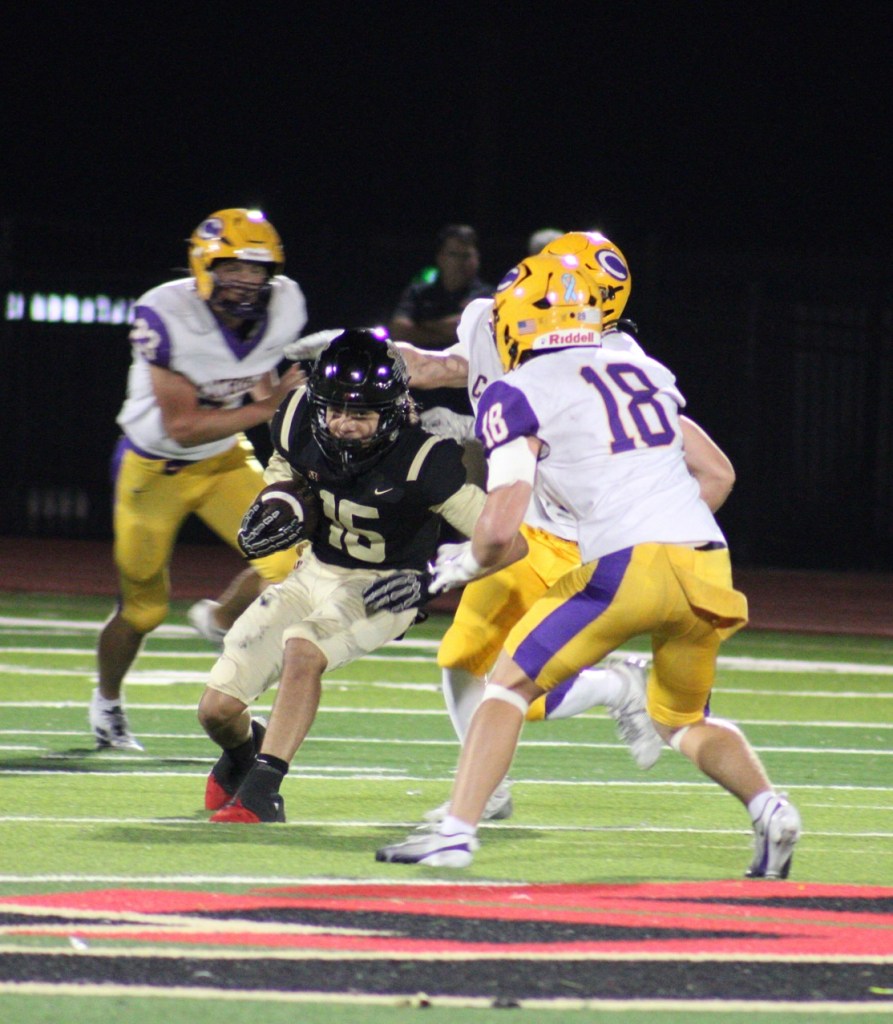
Jonesboro running back T.J. Brown. Photo by DDNS Reporter Allie Carson.
Catholic would have a turnover on downs on their next drive, trying and failing to repeat what Jonesboro had just done.
Jonesboro was given the ball at their 44 yard line but wouldn’t be there for long as on the first play of the drive, Brown would complete a 56 yard run, breaking multiple tackles from defenders, to give Jonesboro his second touchdown of the quarter.
It would go back to defense for both teams for the last four minutes of the quarter. A hard hitting block by Catholic cornerback Walt Menefee against Jonesboro wide receiver Kamari Fisher would give them the ball back.
Jonesboro wide receiver Jamarius Jackson evades Little Rock Catholic defenders during a drive. Photo by DDNS Reporter Allie Carson.
However, an interception by Jonesboro defensive back Clarence Mucherson, his third interception of the year, at the Golden Hurricane 8 yard line would bring in the final quarter of Homecoming Night.
Catholic would score their second touchdown of the night after multiple quarterback keepers by Phillips Blair on their first drive of the fourth would get them to the goal line before Blair would throw to middle linebacker Brock Hatchett for the score.
“We didn’t want the quarterback to beat us,” George said. “He’s a phenomenal player. Can really beat you with his legs and his arm. We lost contain on him but for the most part of the night, I thought we did a really good job at keeping him contained and not letting him beat us with his legs.”
After having the lead be cut to only 14, Jonesboro would run down the clock while getting enough first downs to get downfield and score after a five minute drive. Brown would get his third touchdown of the night on a fourth and three at the goal line.
“I wanted to kick the field. The kids wanted to go for it. Really challenged them. I put my trust in them and they got it. And then they let me know about it after,” George said. “Sometimes you gotta let the kids play, and that’s what we did right there. And it paid off for us big.”
A kickoff return that hit Catholic receivers in the helmet would be recovered by Jonesboro at Catholic’s 21 yard line. However, Jonesboro quarterback Asa Myers would take a knee to end the game, securing a 31-14 victory for the Golden Hurricane.
The Golden Hurricane would improve to 3-3 and 2-1 in conference on Homecoming Night.
Jonesboro moves on to play at Marion on Oct 17 while 2-4 Catholic plays Sheridan at home.
One of the touchdowns Benton scored against Jonesboro. Video courtesy of Allie Carson, DDNS Reporter.
After their first win of the season, the Jonesboro Golden Hurricane stayed at home to face off against Benton, a team they have always fallen short against. This meeting was no different, losing 55-24.
Jonesboro decided to defer to the second half so Benton started with the ball. And a touchdown.
Within the first 12 seconds of the game, Benton quarterback Drew Davis hit wide receiver Karson Collatt for a 55 yard gain to set the Panthers up at the Jonesboro 2. Free safety Gunner Deaton would sneak into the endzone on the very next play for a touchdown.
While running back TJ Brown would bring the Golden Hurricane to the Panthers’ 11 yard line off the kick return, Jonesboro would be forced to kick a field goal.
The Panthers wouldn’t give the Golden Hurricane time to breathe as the next drive ends in another quick touchdown and Jonesboro doesn’t get in good enough field position to score on their drive.
A fumble on Benton’s next drive would push them away from the Jonesboro 37 yard line all the way back to their own 26 yard line. While Jonesboro had all the opportunity to jump or scoop up the ball, they were unable to get under it, causing QB Davis to jump on the ball.
However, Benton wouldn’t be able to do anything on their drive, giving the ball back to Jonesboro.
A perfect slant pass to wide receiver Kameron Davis from Jonesboro quarterback Asa Myers gives the Golden Hurricane team their first touchdown of the night after Davis was given the opening for a 25 yard run.
After a made extra point, the deficit would be cut 14-10 Benton until the Panthers would break multiple tackles on their next drive, scoring their third touchdown of the quarter, the second touchdown run by QB Davis.
The second quarter was off to a slow start until Benton’s ball at the eight minute mark. QB Davis throws the ball up the middle, intended for wide receiver Easton Snellings, but is intercepted by defensive back Jaylen Alexander, his fourth interception of the season.
It’s Jonesboro’s ball at the 41 yard line of Benton. An overthrown pass intended for Jaylen Heard is awarded with a defensive pass interference call, giving the Golden Hurricane 15 yards and getting to the Panthers’ 30 yard line.
Brown would soon have back to back 15 yard runs, giving Jonesboro their second touchdown of the night. A made extra point would bring the Golden Hurricane their edge back, closing the Panthers’ lead to 21-17.
After penalties and breaking tackles, the Panthers scored another touchdown, Jon Curtis Barger breaking through multiple Jonesboro defenders to make it to the end zone.
The Golden Hurricane go into halftime down 28-17 but come out quickly like a second half team.
After a penalty on Benton, Jonesboro started at their own 16. QB Myers launched a deep ball down field into the hands of WR Davis who would catch it just past the Jonesboro 45 and reached the Benton 20, with a horsecaller penalty moving the Golden Hurricane into the Panthers’ 14.
While that early second half touchdown seemed promising for the Golden Hurricane, it’s where they stalled out, not scoring anything else the entire game. Instead, Jonesboro QB Myers would get hurt and taken out of the game early in the fourth quarter for a hamstring injury.
“He’s fine. I was proud of him for battling as long as he did tonight. We’ve got to get him back to 100 percent,” Jonesboro coach Tyler George said. “He’s kind of tweaked it throughout the week.”
Jonesboro would watch as Benton scored two field goals and three more touchdowns, making the 55 points the most the Panthers have ever scored all season.
This would include a 64 yard rushing touchdown by Panthers’ QB Davis, a 57 yard pass to Collatt and even a 49 yard field goal during the last minute of the game.
“Came out of half playing good on defense and it got away from us in the fourth,” George said. “I say it every week. Our kids are gonna continue to fight,”
With the final score being 55-24, this marks Jonesboro’s sixth straight loss to Benton and puts their season record at 1-3 with a game at Sheridan next on the schedule.
Benton would improve to eight straight away game wins and become 3-1 on the season before heading home to play rival Sylvan Hills.
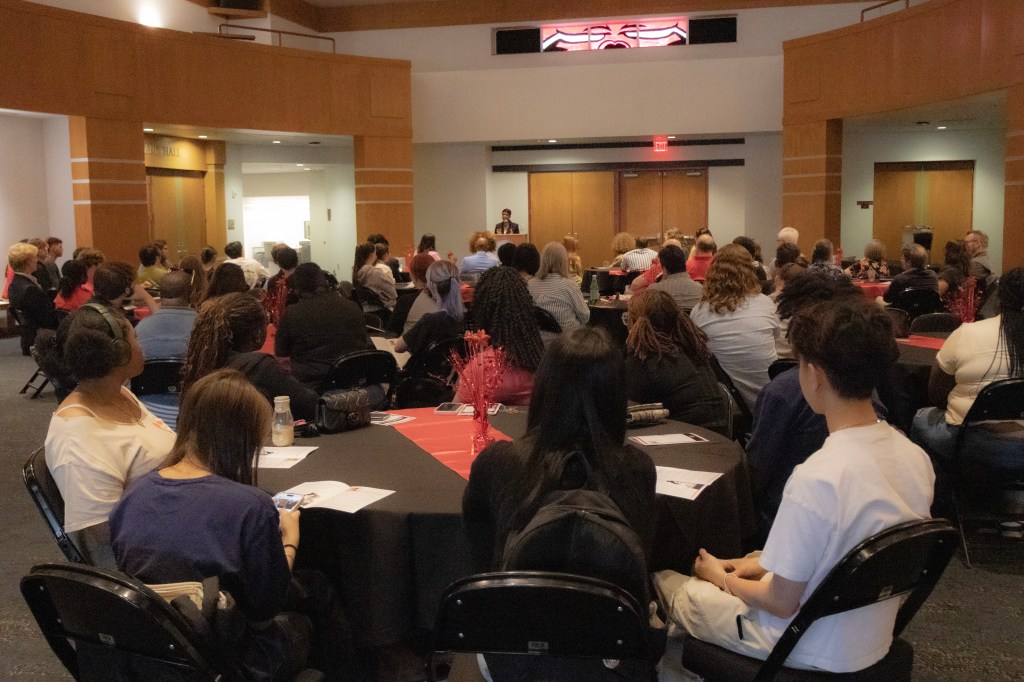
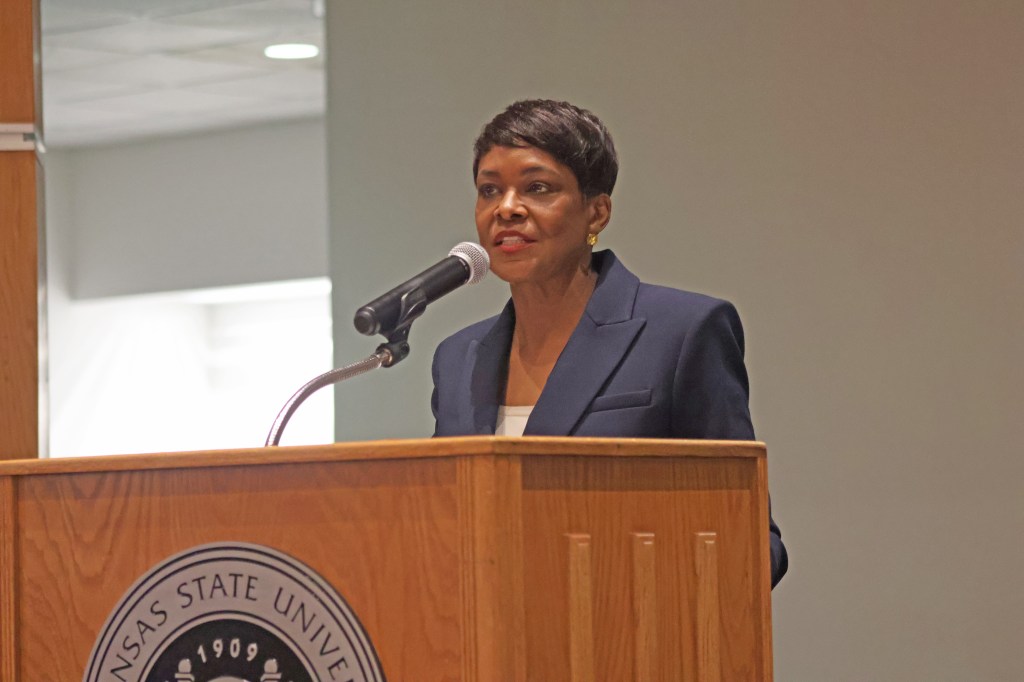
Students, faculty, staff, friends, and other Greenfield Lecture attendees listen to Rose Stuckey Kirk’s speech. Kirk is an Arkansas State University journalism alumna with a successful corporate career spanning 35 years. Photo courtesy of Ibuki Hinohara, Photo Editor, The Herald.
JONESBORO – Rose Stuckey Kirk, an Arkansas State University journalism alumna with a successful corporate career spanning 35 years, presented the annual Corinne Sternheimer Greenfield Lecture, sharing her journey with struggle, support, and success.
Kirk’s speech, titled “From Innocence to Innovation: A Lattice (not Ladder) Climb to the Top of Corporate America,” was given at 6:30 p.m. Sept. 17 in the Fowler Center at A-State.
Audio Story by DDNS Reporter Jerry Don Burton.
At the start of her speech, Kirk listed three things she wished to accomplish: break down the title of her speech, describe how she uses her support systems to have a successful corporate career and suggest how attendees can build on the platform of success she has laid out.
“It struck me a number of years ago that I was never climbing the corporate ladder, because when you are climbing a ladder, you are either going up or down and there are huge gaps in between those rungs and one wrong move, and you can seriously hurt yourself,” Kirk said. “Instead, I was clinging to a lattice. This grid-like structure is flexible and organic; its lines are sometimes diagonal, sometimes curved.”
The Greenfield Lecture speaker said she always made slow and steady progress, despite many missteps and lateral movements. She said that as she climbed, she never forgot her childhood aspirations.
“I never stopped remembering that little girl from Pine Bluff, Arkansas, who just knew one day she would take New York City by storm,” Kirk said.
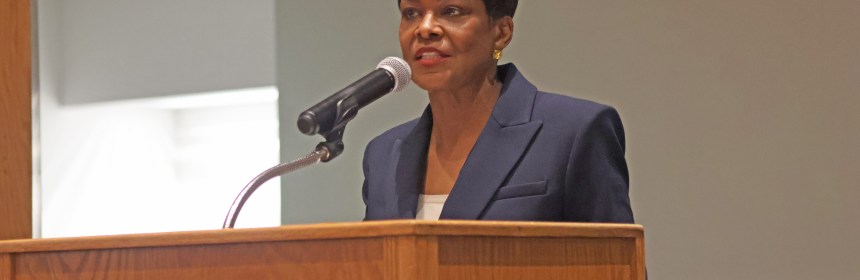
Rose Stuckey Kirk, presents her speech at the 2025 Greenfield Lecture. In her speech, titled “From Innocence to Innovation: A Lattice (not Ladder) Climb to the Top of Corporate America,” Kirk shared her journey with struggle, support, and success. Photo courtesy of Ibuki Hinohara, Photo Editor, The Herald.
Kirk said that while in elementary school, her teacher showed her class a picture of the Statue of Liberty and told everyone to remember what it looks like, because most of them would never make it to New York City to see the statue. She said this stirred something up inside her innocent self.
Decades later, Kirk said she lived in New Jersey and would drive to New York multiple times a week. Every single time the Statue of Liberty came into view during her commute, she said she would pause whatever she was doing and look at it until she could not see it anymore.
Kirk said she does not think her teacher meant any harm, but she would not let her life experiences be based upon what she saw in a book, but instead what she had personally experienced.
“Sometimes in life we look for signs, these big moments of lightning flashing or fireworks to affirm for us those dreams,” Kirk said. “But it’s often the quiet moments, the little things that come into your world that can and will set a path to live your best life.”
Kirk said her strategic mindset and self-reliance, developed from her childhood as one of eight children, helped her succeed as a student at A-State.
Lillie Fears, professor and interim director of the School of Media and Journalism at A-State, said she met Kirk when they were both undergraduates.
“I thought she was very energetic, very outgoing, popular, one of those outgoing personalities. When she said she was an introvert [during her speech], I thought, ‘you sure fooled me,’” Fears said.
Cherisse Jones-Branch, College of Liberal Arts and Communication (CLAC) dean, said Kirk’s status as an alum of A-State and CLAC set her apart from previous lecture hosts.
While hosts for the Greenfield Lecture series are not limited to A-State alumni, Jones-Branch said bringing successful graduates back to A-State to host the Greenfield Lecture is important.
“I like people like that to come back and talk to our students so that they can see what’s possible,” Jones-Branch said. “We saw someone who came from small-town Arkansas, who’s talking to students, many of whom come from small-town Arkansas. The way she was able to connect with them, because they come from the same place, was really special.”
During her time at A-State, Kirk worked at The Herald student newspaper, tutored students and attended a full course load, in addition to working as a clerk for the Social Security Administration. Kirk said college was one of the most impactful times of her life.
“I learned curiosity and how to translate that curiosity into written words that allowed me to explain both simple and complicated issues to the mass population,” Kirk said. “So you can only imagine how amusing it was to me when corporate America began to talk about attributes of successful leaders, and one of those key attributes is that great leaders, often, are great at storytelling.”
Before Kirk could face the corporate world, however, she first had to face rejection.
After graduating, Kirk said her eyes were set on working at the Southwestern Bell Telephone Company, one of the predecessor companies of AT&T. She sent her resume and was served back a rejection letter, stating they only hired people with at least two years of experience.
So, Kirk began work at the Pine Bluff Commercial newspaper. Eight months later, she moved out of state to work for The Times Daily, a set up from her hometown paper. However, she would soon face struggles again.
While working in Alabama, Kirk said she received news of her sister’s death. She said she grieved for weeks and was lost at work, which annoyed all but one of her coworkers.
She said one peer, a quiet man who was a Vietnam veteran, pulled her aside and spent time with her.
“He let me know he saw my suffering. He didn’t pry into my struggle, but instead, he told me a story about his own struggle,” Kirk said. “I learned from him the value of empathy and compassion in the workplace and the need to speak up for others when no one else will.”
Fears said the way Kirk confronted challenges, dealt with tragedy and helped others impressed her. Fears said a friend was having a hard time recently and she did not know how to help beyond listening. But, she said Kirk’s speech touched her and helped her understand what she can do to help in the future.
“It let me know that when I see somebody, it’s okay to reach out and help them,” Fears said.
While working in the journalism industry, Kirk earned awards from the Associated Press and the New York Times. Eventually, she updated her resume and applied again for a position at Southwestern Bell. Within weeks, she was hired.
“Rejection is not bad. What you do with it, how you learn from it, how you respond to feedback, is your choice,” Kirk said.
Even in the corporate industry, Kirk was not free from struggle. She said she spent six months under the leadership of someone who did not believe she was worthy of her position.
John Thompson, a sophomore political science pre-law major from Pine Bluff, Arkansas, attended the lecture. He said struggle was the most important theme Kirk explored in her speech.
“She really didn’t hold back on all the struggles that she experienced in her life. She claims that it did, in fact, shape her, but it shaped her in the best ways possible,” Thompson said.
John Thompson, a sophomore political science pre-law major from Pine, Bluff, Arkansas, asks Rose Stuckey Kirk a question following her speech. Thompson said he will take what he learned from Kirk’s speech about the inevitability of struggle and rejection and apply it going forward in his life. Photo courtesy of Ibuki Hinohara, Photo Editor, The Herald.
Years later, after Kirk said her career surpassed his, she bumped into her old boss. She said he was surprised by how far she had come in her career.
“I thought to myself, ‘my success is based upon my opinion of me.’ There will be many people along the way, for whatever reason, will not be your supporters. Sometimes you can change their minds, many times you cannot. Your goal is to build a massive amount of support in your circle so that non-believers don’t have the votes or the voice to block you.”
Thompson, a CLAC ambassador, said Kirk’s definition of success initially confused him. He said people usually gauge success by comparing themselves to others.
“I think I’m struggling with that concept of success,” Thompson said. “However, I do think that that is beneficial to me, because success really is in you and it is what you want out of this world.”
Carson Campbell, a junior creative media production major from Jonesboro, met Kirk during a breakfast event held before her speech. He said Kirk was very personable.
“She was a very down-to-earth person and very successful, so it was cool for her to come in and spend time with us and try to get to know us before her busy day,” Campbell said.
Kirk said she wanted to exhaust her life of all it has to give.
“When I die, I want the people at my funeral to go ‘yup, she did it. She exhausted this life,’” Kirk said.
Fears, Thompson and Jones-Branch said this phrase resonated with them.
Kirk concluded her speech by addressing A-State students.
“I hope that what you take from this is that you’ve got to believe in this institution. You’ve got to lean into whatever your professors are trying to teach you. You have to take advantage of everything that is here,” Kirk said. “Be flexible, build your lattice, network, be a good person and launch yourself into society in a way that you can make this institution proud and you can be proud that you are a graduate of Arkansas State University.”
Fears said one of the most important messages Kirk touched on is to take advantage of everything being taught in class.
“Even if you’re bored to death, you might be very surprised at how it’s going to help you later,” Fears said. “You can take the skills that you get here and take them to any workplace and keep developing them.”
Thompson said he anticipates rejection in his career and faces struggles already in college. However, he said he will take what he learned from Kirk’s speech about the inevitability of struggle and rejection and apply it going forward.
“In front of me was a woman who had struggled, not only in her adult life, but also as a young child, and here she is giving a lecture on 60 years of success,” Thompson said. “What I take from this is that struggle is going to be on my career path, but that’s just a part of the path itself.”
Thompson said he did not know much about Kirk before her speech, but loved her story. He said he had never been to a Greenfield lecture before, but believes the series is a great tradition because it allows students to spend a night listening to a success story from an A-State graduate.
Fears said even though she and Kirk are near the same age, she was still inspired by her speech.
“That lets me know you can never be too old, or too advanced, to get some inspiration from people,” Fears said.
After numerous promotions, setbacks and movements in all directions on the lattice, Kirk is successfully retired and said she is excited to work on her garden.
-30-
Rose Stuckey Kirk presents her award for hosting the 2025 Greenfield Lecture. The Greenfield Lecture is funded by an endowment established to honor Corinne Sternheimer Greenfield. Photo courtesy of Ibuki Hinohara, Photo Editor, The Herald.
Story and video by DDNS Reporter Benjamin McDowell
The Valley View Blazers left no doubt on Friday night, racing out to an early lead and never looking back in a 45-6 rout of West Memphis. The victory marked the Blazers’ second win at home this season and highlighted their ability to dominate in all three phases of the game — offense, defense, and special teams.
From the opening kickoff, Valley View seized control. West Memphis mishandled the return just 90 seconds into the contest, and the Blazers pounced on the loose ball with 10:51 left in the first quarter. A few plays later, running back Levi Manning powered in from 2 yards out to put Valley View on the board and give the home crowd an early reason to cheer.
The defense followed suit, applying heavy pressure on the Blue Devils’ offense. A strip sack on the next possession gave Valley View the ball back in favorable territory. Quarterback Taylor Hyneman quickly capitalized, delivering a 53-yard touchdown strike with just 1:37 remaining in the first quarter. In the span of a few minutes, the Blazers had built a double-digit lead and shifted all momentum in their favor.
The second quarter brought even more fireworks. Valley View’s offense continued to click, producing a 7-yard touchdown pass and later a 7-yard scoring run with 4:04 left before halftime. The Blazers’ special teams also made their presence felt, blocking two punts that set up short scoring drives. Each phase contributed to what would become a commanding 28-0 lead at the break.
“We had a fast start tonight,” Valley View head coach Sean Cockrell said. “We got up 28-0 and were playing well on both sides of the ball.”
That fast start carried over into the second half. The defense stayed aggressive, forcing hurried throws and disrupting West Memphis in the pocket. Midway through the third quarter, Valley View intercepted a pass with 7:54 left, once again flipping momentum back in their favor. Manning capped the ensuing drive with an 8-yard touchdown reception on fourth-and-7, extending the lead to 35-0 with 4:09 left in the period.
Before the quarter was over, the Blazers struck again. Another touchdown stretched the margin to 45-0, sealing the outcome and sending much of the Valley View crowd into celebration mode. With the game well in hand, Cockrell turned to his reserves in the fourth quarter, giving younger players valuable varsity reps while resting his starters.
West Memphis finally avoided the shutout late, punching in an 8-yard touchdown run with 4:21 to play. The score gave the Blue Devils a brief highlight, but it did little to change the overall storyline of the night: Valley View’s overwhelming dominance.
For Cockrell, the game was about more than just the lopsided margin. After describing his team’s previous effort as slower, he was pleased with the sharpness, energy, and balance his team displayed from start to finish.
The 45-6 win not only gave the Blazers another mark in the win column but also served as a reminder that when they start fast, they can be a tough team for anyone to slow down.
The Jonesboro Hurricane celebrate after the come back from behind victory. Video by DDNS Reporter Allie Carson.
In their first home game of the season, the Jonesboro Hurricanes defeated the DeSoto Jaguars after being down 21-34 at the half.
“Like I say every week, this group does not quit. They fight and fight and fight no matter what,” Jonesboro Head Coach Tyler George said.
DeSoto’s heavy rush offense was on full display on its opening drive. On a quarterback keeper, Eric Perry made it to the Jonesboro 25-yard line after a gain of 27 yards, soon followed by an 18-yard rush by running back Cade Rogers on 3rd and 4, pushing the Jaguars to the Jonesboro 2.
The Jaguars score and the Golden Hurricane received the ball. On 3 and 15, Hurricane QB Asa Myers throws one downfield and finds running back TJ Brown. A throw to wide receiver Kam Davis puts Jonesboro on the DeSoto 12, a 44-yard gain. Brown scored on the next play for the Golden Hurricane.
DeSoto wasted no time, however, scoring on their next drive, after some Jonesboro flags helped them move the chains and get out of trouble.
A pass-heavy Jonesboro soon tied the game once again after an endzone throw to Brown.
Rogers got into the end zone untouched by the Golden Hurricane defense to put the Jaguars ahead. The punt that followed ended up being recovered by Desoto after the football hit defensive back J’Karious Lattimore.
DeSoto gets the first big lead of the game, going up 14-28 against Jonesboro.
After Meyers gets tripped up after he’s forced to keep the ball, Jonesboro is forced to punt, handing the ball back to DeSoto at their 23.
Thankfully for the Golden Hurricane, their defense is able to hold the Jaguars and get the ball back after a three-and-out.
Clarence Mucherson returns the Desoto punt for 13 yards, putting the Jonesboro offense on the Jaguars’ 33-yard line.
Brown ran up the middle for his third score of the night, closing in on the Jaguars 21-28, but Desoto returned the favor for Perry’s fourth rushing touchdown of the night, making it a 13-point deficit going into the half after a blocked extra point.
The Golden Hurricane came out of the halftime break looking like a new team, scoring back to back touchdowns.
“Came in at halftime, made some simple adjustments, but really nothing major,” George said. “Just executing and doing our job. They came out in the second half on defense and did that. Got a big play on kickoff right there, offense scored back to back to back.”
Running back K’Den Hawkins scored a 67-yard rush 20 seconds into the half.
“We all know Hawkins is super explosive; those are things we can do. We’re trying to find different ways to get him a ball. We’ve been working that last week,” George said.
Hawkins’ touchdown was followed by a punt recovered by tight end Patrick Dutton on Jonesboro, which gave the Golden Hurricane the ball back immediately.
The very next play, Myers threw downfield to Davis, resulting in a 42-yard touchdown. For the first time all night, Jonesboro was in charge of the scoreboard 35-34.
On fourth and 5, Desoto was going for it, but a defender on Jonesboro knocked it away and it was recovered by the Golden Hurricane defense on their own 49-yard line. Soon, Davis scored a 45-yard touchdown, the third touchdown of the quarter, and there was still 8:45 to go.
Three punts later, and Jonesboro had the ball again with two minutes left in the quarter. Brown immediately finds a hole in the DeSoto defense and runs 52 yards to score his fourth touchdown of the night.
Stretching the lead 49-34, neither team scored in the fourth quarter, handing Jonesboro their first win of the season and DeSoto their second loss.
Myers had 299 passing yards throughout the night, while Perry of DeSoto had 90 yards. However, Perry recorded 141 rushing yards against Myers’ 24.
The rushing leaders on both teams, in comparison, were Rogers with 220 on DeSoto and Brown with 126 on Jonesboro.
Jonesboro defensive back Jaques Jordan had a total of 14 tackles on the night, 11 solo and three assists, and made the DeSoto offense lose 4 yards.
“Offensively, we can score the ball better than we have the last two years. So that’s really good. Defensively, it’s a scrappy group. They stay together no matter what, good, bad, or ugly,” George said.
JONESBORO – KASU is welcoming photographer Art Meripol to Arkansas State University with a reception and “art talk” for his photo exhibit, “We Shall Overcome.”
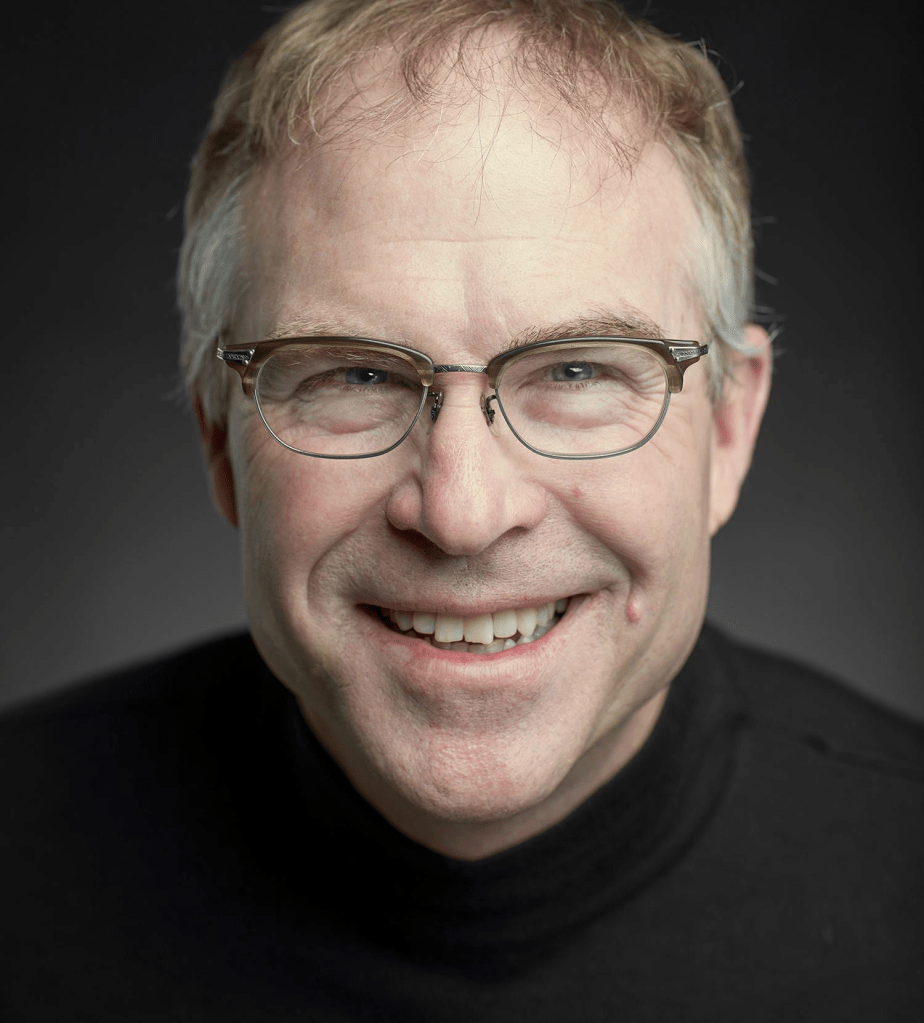
Headshot photo of Art Meripol. Photo courtesy of Art Meripol
The reception, hosted by KASU, will be held from 5:30 p.m. to 7:30 p.m., Oct. 29, in the Humanities and Social Sciences building atrium.
The photo exhibit, also located in the humanities building and presented by KASU, comprises 25 photographs of various landmarks along the Civil Rights Trail. The exhibit opened to the public June 13. Meripol said his Civil Rights Trail photography is some of his most rewarding work.
“I’ve had a 50-year career and I’m more proud of this work than probably anything I’ve done in those 50 years, and I wanted to share it,” Meripol said.
LaDawn Lee Fuhr, KASU corporate relations specialist, said Meripol’s background in journalism, passion for history and skill in photography will be of interest to a wide range of people at the “art talk” and reception.
“We feel like bringing this history and this art together is great for the overall community,” Fuhr said. “We’re hoping that people will come out and see it and meet Art, talk to him, and understand his process.”
Audio story by DDNS Reporter Jerry Don Burton
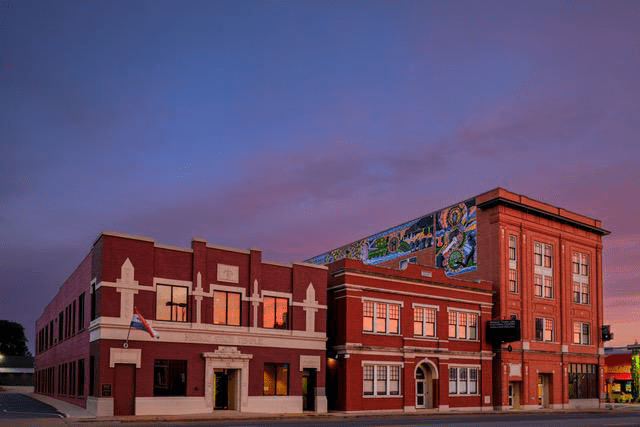
Mosaic Templars Cultural Center. Meripol said he woke up at 4:30 a.m. to capture the center in pre-dawn light. Photo courtesy of Art Meripol.
Fuhr was a major force in bringing Meripol’s photography to A-State. She said the concept of the exhibit and reception blossomed from a conversation between her and Meripol.
After not having seen each other for decades, Fuhr and Meripol reconnected at the Old State House Museum in Little Rock on July 12, 2024. Fuhr said she was impressed by his photography work on “The Official United States Civil Rights Trail: What Happened Here Changed the World,” a book published in 2021 by Alabama tourism director Lee Sentell, and wanted to create an exhibit of his Civil Rights Trail photographs.
Meripol said he knew the project would be worthwhile, but was initially daunted by the work, time and logistics it would take to complete such an exhibit.
“Once I got started, I got pretty excited about the possibilities to go through all the work I did on the U.S. Civil Rights Trail and narrow it down,” Meripol said. “I think that was what intimidated me more than anything was trying to pick 20 or 25 pictures out of all that.”
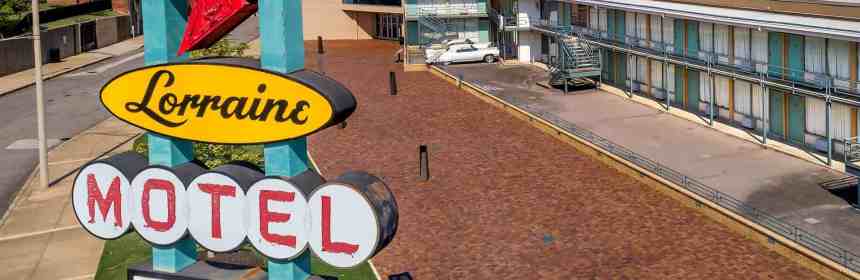
A majority of the photos featured in the exhibit were taken in 2017, when Meripol said he traveled to 10 states in 12 days to expand coverage of the Civil Rights Trail. Starting in Alabama, where he is based currently, Meripol covered sites in Louisiana, Mississippi, Arkansas, Kansas, Washington, D.C., Virginia, North Carolina, South Carolina, Georgia and Tennessee.
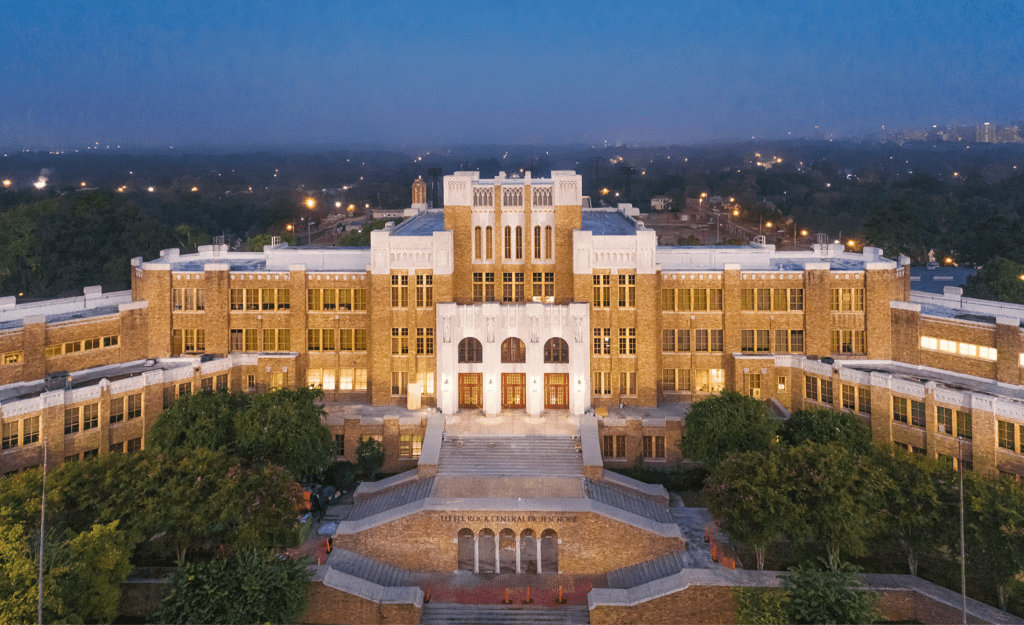
Little Rock Central High School. In 1957, nine teens known as the “Little Rock Nine” were the first African American students to enter the school following the 1954 Brown v. Board of Education Supreme Court ruling that made segregated schools illegal. Photo courtesy of Art Meripol.
Meripol said some of his favorite career experiences came from his work photographing the Civil Rights Trail.
Meripol said one such experience was his visit to Medgar Evers’ home. Evers, a civil rights activist and the first NAACP field secretary in Mississippi, was assassinated in the driveway of his home in 1963.
Prior to his arrival, Meripol said the caretaker of the home did not know he was coming to take photos. He said she was suspicious at first, but they ended up having a wonderful time together.
“We ended up sitting at the kitchen table at Medgar Evers’ home with her, and she was telling stories of when she was in high school and how they all adored Medgar Evers,” Meripol said. “Just seeing her face as her mind went back to that time and her memories was just magic.”
Evers’ home was designated a National Historic Landmark in 2017.
Medgar Evers’ home. Evers was dedicated to ending racial segregation at the University of Mississippi, enforcing voting rights and expanding opportunities for African Americans prior to his assassination in 1963. Photo courtesy of Art Meripol.
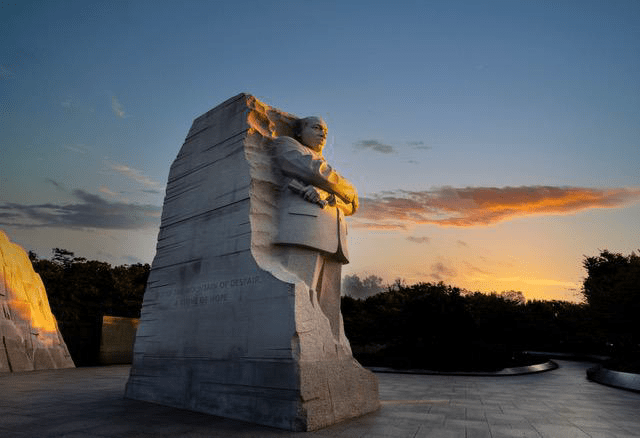
Meripol said another particularly memorable experience was his time in Washington photographing the Martin Luther King Jr. and Lincoln memorials.
Due to flight delays caused by storms, Meripol didn’t arrive in Washington until midnight. He took an Uber at 4 a.m. to the memorial to capture it before sunrise. He said he could not have asked for better lighting and was so inspired in fact, he decided to walk to the nearby Lincoln Memorial.
Martin Luther King Jr. Memorial, located in Washington, D.C. Photo courtesy of Art Meripol.
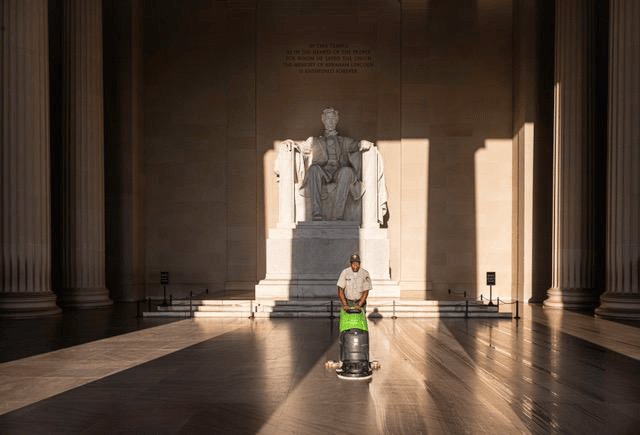
The Lincoln Memorial is typically a high-traffic tourist attraction, making it hard to photograph. But, due to the storms, Meripol said the memorial was empty, save for one employee.
“A U.S. government employee, an older Black man, was polishing the floors in front of Abraham Lincoln with the morning lights streaming through the columns and lighting him up,” Meripol said. “And I shot maybe one of my single favorite pictures of my life.”
Lincoln Memorial. Photo courtesy of Art Meripol.
Meripol said he hopes his work inspires viewers to visit the historic landmarks in his photos.
“I have a picture of the Edmund Pettus Bridge where the Bloody Sunday marches happened for voting rights,” Meripol said. “I hope they see that picture and want to go experience the bridge themselves. If they do, they’ll walk over the bridge as the marchers did back in the early sixties.”
Edmund Pettus Bridge, located in Selma, Alabama. The bridge was the site of Bloody Sunday, a conflict on March 7, 1965, when police attacked civil rights demonstrators as they were marching to the state capital. Photo courtesy of Art Meripol.
Fuhr said Meripol’s photography is important for preserving and highlighting the history of the United States.
“It’s a trite statement, but it’s true. If we don’t know our history, we’re doomed to repeat it,” Fuhr said. “I think any of us have a connection to the history that made this country. I feel it’s important to be seen in such a beautiful way. Because there was such pain, but it’s presented in such an appealing, beautiful way that people can appreciate.”
Meripol said the United States has always acknowledged its failures, but the current political climate is leading to the burial of some history.
“When we start hiding those failures, then you don’t know what needs to be paid attention to,” Meripol said.
In March, President Donald Trump signed an executive order targeting funding for programs that “degrade shared American values, divide Americans based on race, or promote programs or ideologies inconsistent with federal law and policy.” A few months later, in August, the Wall Street Journal reported that the White House ordered a review of exhibits at the Smithsonian Museum to align with Trump’s interpretation of American history.
Civil rights leaders, advocates and historians have criticized these moves as singling out content on slavery and civil rights in an effort to minimize the contributions of Black Americans.
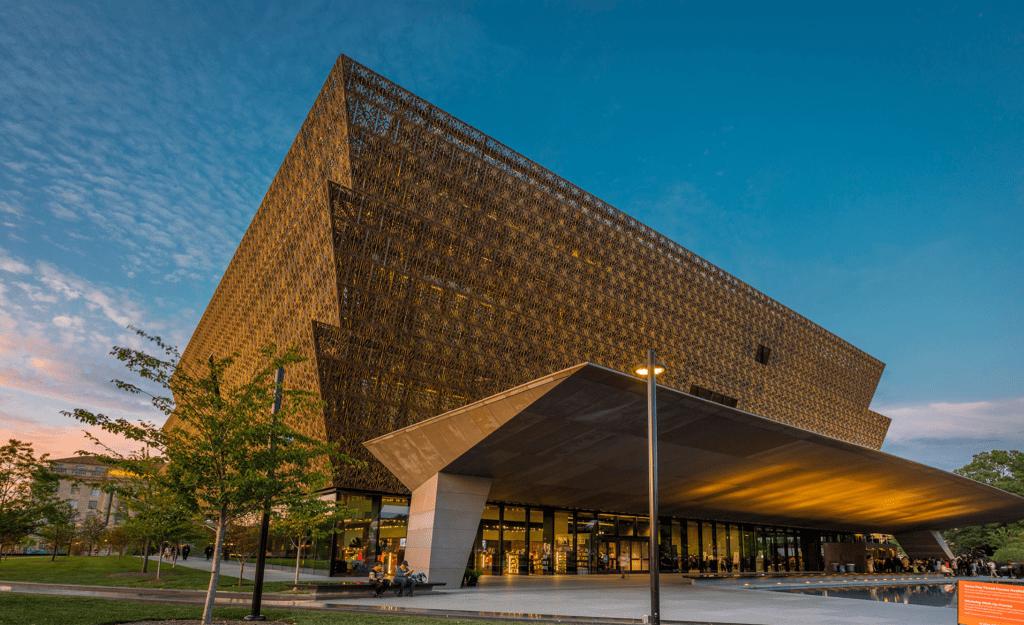
National Museum of African American History. Photo Courtesy of Art Meripol.
“There is an effort to try to hide those things, hiding Black history, which is American history. It hurts to see it happen,” Meripol said. “I’m hoping this exhibit will keep people discussing these things and finding ways to move forward.”
Fuhr said KASU’s involvement in creating the exhibit and reception aligns with the non-commercial public radio station’s mission to be a resource for the community.
“This is the kind of thing that public radio does that others don’t really do, which is to go deeper in the world and be able to bring this to the community.”
Mark Smith, KASU station manager, said the radio station is excited to bring Meripol’s photographs to the community. He said viewers will be immersed in the rich history and the craftsmanship on display.
Fuhr said bringing the exhibit to A-State was a joint effort between many individuals, both within and outside of A-State.
The event is sponsored by the A-State Office of the Provost, A-State College of Liberal Arts and Communication, Mosaic Templars Cultural Center and Arisa Health.
Kendall Moody, interior/exterior team leader for facilities management project services at A-State, was responsible for much of the physical preparation regarding the exhibit. Fuhr said his contributions were integral in ensuring the photos were placed properly without damaging the walls and columns of the humanities building.
Fuhr said the exhibit is planned to stay up until early 2026, but is interested in presenting the photos at other venues as a traveling exhibit.
“Each time I look at a photograph, I get a different sense of it, and so I want it up long enough for people to really appreciate it and really feel it,” Fuhr said.
LITTLE ROCK — Arkansas State University System institutions reported strong 11th-day preliminary fall total enrollment growth of 7.6% with multiple record-setting performances, System President Dr. Brendan Kelly announced today.
“Six of our seven campuses had an overall enrollment increase, including record enrollment for A-State and an extraordinary upswing for Henderson,” Kelly said. “Our two-year institutions also attracted more students as workforce training programs grew. I appreciate the work of our teams across the ASU System to seek out and meet the needs of students and Arkansas employers.”
Total ASU System preliminary 11th-day enrollment was 30,339, up 2,132 students or 7.6% compared with official final enrollment of 28,207 in fall 2024. Full-time equivalent totals were up 7.2%.
Kelly noted that the traditional 11th-day enrollment measure, while positive for the ASU System, has become antiquated in today’s higher education environment because it doesn’t reflect collective enrollment throughout the year.
“Our campuses are enrolling and serving new students almost every week through online and non-credit training programs,” he said. “And ASU-Newport is piloting an initiative for eight-week general education courses that simply doesn’t align with the traditional reporting periods. The ASU System’s ultimate service numbers throughout the year are substantially higher.”
Arkansas State led the growth for the system with a record 17,926 students – a 7.4% increase of 1,239 over last fall’s record of 16,687. First-year students totaled 2,222, a 12% rise over last year, and include 1,764 Arkansans – who make up 79% of the class and represent a 30% increase from a year ago.
“This class is a clear sign that Arkansas families see A-State as their home for opportunity,” A-State Chancellor Todd Shields said. “It means they believe in what we are building here, and they trust this institution to shape their future and strengthen our home state.”
A-State on-campus enrollment grew by 7.8% while online program enrollment is up 6.7%. The A-State total also includes 1,053 students at Campus Queretaro in Mexico, which is a 10% increase over fall 2024.
Total preliminary enrollment at Henderson climbed 9.9% to 2,258, up 203 students from the fall 2024 total of 2,055. The number of first-time freshmen jumped 46% to 572 compared with 391 a year ago while transfer students were up 32% to 196 compared with 149.
“The Reddie Spirit is alive and well on campus as we welcome our returning students and the largest freshman class in six years,” Henderson Chancellor Trey Berry said. “Our faculty, staff, alumni and friends are committed to the success of our students, and it is inspiring to see the growth and tremendous energy throughout our campus community.”
Leading the way for the system’s two-year institutions in the fall reporting are ASU-Beebe with 3,588 students, which is an 9.5% increase over 3,277 last fall; ASU-Newport with 2,118 students, a 13.4% increase over 1,868; ASU-Mountain Home with 1,318, a 0.2% increase over 1,315; and ASU Mid-South with 1,180, a 15.5% increase over 1,022. ASU Three Rivers reported 1,951 students, a 1.6% decrease from 1,983.
The two-year institutions and A-State reported robust growth in high school concurrent credit enrollment with 5,650 students as the ASU System works with the state’s high schools to fulfill goals outlined in the Arkansas ACCESS Act.
On September 6th, 2025, for the first time, the Arkansas Razorbacks will take on the Arkansas State Red Wolves at War Memorial Stadium in Little Rock, with kickoff scheduled for 4:00 pm. This is a historic matchup as it is the first time that the FBS schools in the state of Arkansas will finally play each other. Many people would not have thought it would happen because of a statement made by the previous Arkansas Razorbacks Athletic Director John Barnhill, who said that the hogs would not play against in-state schools like A-State, UCA, UALR, and UAPB. This policy was continued by his successors, Frank Broyles and Jeff Long.
But Jeff Long’s successor, Hunter Yurachek, broke this policy in 2018 by having Arkansas play against in-state schools for the first time in Arkansas Athletics history. Still, those games were scheduled for sports outside of football and basketball. However, on February 3, 2021, a jaw-dropping announcement was made, stating that hogs and red wolves would play a football game against each other on September 6, 2025, in Little Rock. Finally, the game that everyone has been waiting for in the entire state of Arkansas has a date. Fans of both programs were split on this, as A-State fans wanted this game to happen in the early 2010s when both Arkansas and Arkansas State were doing really well in football, with the hogs ranking inside the top 25, while the Red Wolves were winning conference titles and going to bowl games with a new head coach every single season.
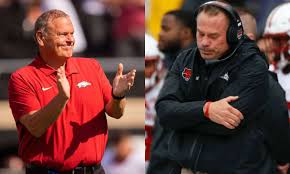
Coach of the University of Arkansas Sam Pittman (left) and Coach of the Arkansas State Butch Jones (right) will coach the Arkansas-Arkansas State game.
Butch Jones and his players, Jaylon Raynor and Brandon Barnes, were asked about this matchup at the 2025 Sun Belt media days in New Orleans, LA.
“ Being able to go play in our state capital against the University of Arkansas, and you look at the excitement, you look at the revenue that it’s going to bring to the entire state comes to one place for a weekend, it is going to be a great challenge for us, but I think it is a great opportunity for us, and it’s truly a great opportunity for the entire state of Arkansas” said Coach Jones.
Junior Quarterback Jaylon Raynor said,” Definitely, it is a great opportunity for us to play Arkansas.” Sophomore safety Brandon Barnes said,” I would say that there is some excitement about being able to play a team like Arkansas.” Both players are excited for the game, but are focused on the fall camp and the first game against Southeast Missouri. Coach Jones was asked again about this matchup at the Sun Belt media day with the host of the Locked-on Sun Belt podcast, Dave Schultz.
“I will say it is in the world of college football expansion and conference expansion and coast to coast for two in-state schools to come together at a neutral site in Little Rock or the state capitol and play. That’s as big for our players or their players, it is for the entire state and the fan bases, but also the economic value that it brings to the state in Little Rock, AR.
Before the Sun Belt Media Days this year, Coach Jones was asked about the game between the Hogs and the Red Wolves back in March of this year on the Coaches and the Mouth Show with hosts Jeff Williams and Brey Cook.
“Obviously it’s a great challenge for us and it’s an uphill battle for us, but have so much respect uh, you know for everyone in that program, but when you look at what it does to the entire state of Arkansas, the excitement, the economy, you know, everybody going to Little Rock for the weekend, I think it’s really going to be a unique atmosphere and it’ll be a great experience for really both of our players, but especially our players playing a program and a team that’s, you know, been very, very competitive in the Southeastern Conference in terms of our program.” Said Coach Butch Jones.
Fans, players, and coaches of either team are not the only ones excited about this game; media members are excited about this game as well. One of the media members who is excited about this game is Chris Hudgison of Kait8 Sports, where he covers both the Razorbacks and the Red Wolves. Chris was asked about this matchup on Aug. 6 on the Chuck and Bo show with hosts Chuck Barrett and Bo Mattingly.
“It’s been fascinating, I think it was 2021 when the game first got announced, and it has been kind of like a snowball that slowly kind of getting down the hill, and then once it got closer, okay, now it’s 2025, now it’s actually happening, it’s been a combination of things.” Said Chris Hudgison of Kait8 Sports. Later in the show, Chris was asked about the matchup and whether could A-State pull off the upset against Arkansas. “It is possible, yes, because in college football, anything could happen. I think matchup wise, I think a-state has a decent chance offensively against the Razorback defense just because of all the experience coming back, obviously there is a big question mark at offensive line, but in terms of the skill position, there’s a lot of depth there, and having a essentially a 3-year quarterback, which doesn’t happen very often in the sunbelt with Jaylon Raynor, having experience in these type of settings against power 4 is gonna help. What I’m gonna be interested to see is the matchup between the very new A-State defense goes up against the Razorback offense, and special teams has been an ace in the hole for A-State, so if the game is close on the sixth, A-State has a definite more than a puncher’s chance to pull it off.” Said Chris Hudgison.
War Memorial Stadium will be the site of this first-ever game between the hogs and red wolves.
War Memorial Stadium in Little Rock will be the site of this first-ever meeting between the hogs and red wolves. Both teams have a history of playing in this stadium. Razorbacks have played at War Memorial more often than the Red Wolves, which has led fans to call the stadium the Razorbacks’ second home stadium, with Donald W. Reynolds Razorback Stadium in Fayetteville being the primary home stadium for the Hogs. The Red Wolves have not played at War Memorial Stadium since 2006, and have played their home games at Centennial Bank Stadium in Jonesboro. The game on September 6th will be the first Red Wolves game at War Memorial Stadium in 19 years.
Everyone in the state of Arkansas is excited about this game. Fans of both programs will be divided when the game kicks off on September 6th, but they can all agree that September 6th will be a historic day for college football in the Natural State.
Arkansas State University Chancellor Dr. Todd Shields (left) and Jonesboro Mayor Harold Copenhavor (right) after the unveiling of new street signs in downtown Jonesboro that have the new Red Wolves logo on them. Photo courtesy of Arkansas State University.
JONESBORO, Ark. – The Jonesboro community showed up Friday for the annual Paint the Town Red block party downtown, signaling a new season of Arkansas State football. (You can see the video below, provided by Allie Carson.)
With the football season officially underway, the Jonesboro Chamber of Commerce hosted a community event in downtown Jonesboro, featuring local band “Bloodhound,” speakers, games, food, prizes, and a rap performance by Dr. Todd Shields himself. (You can listen to the rap below.)
Cody Slater, the vice president of programming with the Chamber of Commerce, said that Jonesboro isn’t what it is without the partnership and cooperation with A-State.
“Jonesboro has grown exponentially. It (Arkansas State) has been a shining light. But I don’t think that happens without Arkansas State,” Slater said.
The winners of the Paint the Town Red decorating contest were announced during the event. Delta Zeta won the campus category, Divots Golf Lounge won the newcomer award, and the best small business award went to Fizz Facial Bar.
The overall best-decorated winner, for the second year in a row, was Kalmer Solutions.
A surprise unveiling of a secret project by Shields and Mayor Harold Copenhaver happened during the event.
The secret project was unveiled at the north end of Main Street, where Burke Avenue meets Cate Avenue, and was shown to be A-State logos on the street signs.
Coach Butch Jones had challenged Mayor Copenhaver for three years to make Arkansas State part of Jonesboro.
“I want to thank Mayor Copenhaver and the entire city because this was a vision about three years ago,” Jones said regarding the new street signs.
The logo will be displayed on every road that comes into A-State, already visible on multiple road signs near campus.
According to Shields, everyone loved the idea of having Red Wolves branding on street signs, something very prominent in other college towns.
“We talked to the mayor, he was all about it, but we had to go through the Arkansas Department of Transportation. They had to get the right approvals and that kind of thing,” Shields said. “It took a while, but that was the big thing.”
With the new signs and the entire event in general, A-State fans were hyped for the football season, with 18,241 total people turning up to Centennial Bank the next night to watch a 42-24 Red Wolves win. This Saturday will be the historic game between Arkansas State and the Arkansas Razorbacks at War Memorial Stadium in Little Rock.
Players compete in a tabletop miniature game during NEA Game Fest. The four-day convention brings together gaming enthusiasts for tournaments, open play, and charity fundraising in support of the Friends of the Library. Photo courtesy of Rachel Simpson, NEA Game Fest Organizers.
JONESBORO, Ark. – The Northeast Arkansas Game Fest 2025 is set to return to Jonesboro on July 17. The game fest will bring four days of tabletop games and events to the Red Wolf Convention Center.
From July 17 to July 20, NEA Game Fest is a gaming convention run by the NEA Gamers Guild to raise money for charity. The game fest has been running since 2017 and is growing steadily as it gains popularity in the Arkansas area. This year’s charity being supported is the Friends of the Craighead County Jonesboro Public Library.
The game fest will feature many different types of board games. NEA Game Fest includes four days of open gaming, game demos, board games, role-playing games, card games, miniature games, tournaments and more.
Badges are sold online, and there are multiple types of badges you can purchase to get into the event. For ages 16 and up, an adult badge costs $50 online. These badges grant access to the play-and-win library, prizes, giveaways, a silent auction and most events at no additional cost. Adult badges will cost $60 at the door.
“The money raised will assist with funding library programming, resources and materials. NEA Game Fest 2024’s fundraising total was more than $11,000 for the Friends of the Craighead County Jonesboro Public Library, so we hope to meet or exceed this total for NEA Game Fest 2025,” said Rachel Simpson, NEA Game Fest coordinator.
Simpson said they are expecting around 250 attendees. Many people are returning to the event to enjoy the various board games and tabletop games available to play. Simpson also said that this year the event is in a new venue, the Embassy Suites by Hilton Jonesboro Red Wolf Convention Center, to fit more people.
Attendees play board and card games at NEA Game Fest. The annual event draws hundreds of gamers of all ages to support local charities through a weekend of gaming and community activities. Photo courtesy of Rachel Simpson, NEA Game Fest Organizers.
“From the humble beginnings at the Hoxie Community Center to our largest NEA Game Fest yet, it’s evident that tabletop gamers in the Mid-South and our sponsors are passionate about the hobby while supporting local charities — it’s infectious,” Simpson said.
“I’m coming back to NEA Game Fest as a yearly event, which I personally adore because it’s three whole days of games, companionship and rest. Tabletop games are a spectacular way to relax and make good friends. It’s something my fiancée and I, whom I actually met through the hobby of tabletop RPGs, love to do,” said Matthew Randle, an NEA Game Fest attendee.
Randle has attended the last two years of the game fest, with this year being his third. He said he is thrilled to see new games and role-playing games featured at this year’s event. Randle also said the festival is important for Jonesboro as a whole, giving families who are less inclined toward sports a chance to get out and have fun while supporting the public library.
“I feel like events in Jonesboro are important, but don’t foster that sense of community that something like NEA Game Fest does. That, and certain events in town really only pertain to people of certain age groups, while I feel like Game Fest caters to multiple age groups at once,” said Sebastian Stokes, an NEA Game Fest attendee.
Stokes said they have met many new people at the game fest, as well as discovered new games to play. Some of Stokes’ favorite games featured at NEA Game Fest are Blood on the Clocktower and Weird Frontiers. Stokes also said the game fest is a safe place for people of all backgrounds, and even if you can’t pay to get in, there are free board games for people to enjoy.
With four days of games, tournaments and fellowship, NEA Game Fest 2025 promises to bring players of all ages together for fun and charity. Organizers say they hope the growing event will continue to strengthen northeast Arkansas’s gaming community while supporting local causes one roll of the dice at a time.
State Senator Dan Sullivan (R) speaks during a town hall meeting in Jonesboro. Photo courtesy of DDNS reporter Shailey Wooldridge.
State Sen. Dan Sullivan hosted a town hall on May 3 at the Craighead County Jonesboro Public Library. The conversation centered on Diversity, Equity, and Inclusion, emergency funding for severe weather victims, and library funding.
Robert Steinbuch, professor of law at the William H. School of Law at the University of Arkansas Little Rock and columnist for the Arkansas Democrat-Gazette, co-hosted the event with Sullivan.
Some attendees expressed a disinterest in hearing Steinbuch’s answers to their questions, calling only for Sullivan to speak.
“We want to hear from Senator Sullivan,” Kimberly Warmth said to Steinbuch. “We didn’t vote for you. Your opinion doesn’t matter.”
The Jonesboro Police Department (JPD) was called early on into the meeting during a discussion about DEI, and officers stayed throughout the meeting.
“If it’s going to be this way, I want JPD here,” Sullivan said.
Sullivan asked for the removal of one attendee who left of their own volition.
Library funding
Kimberly Warmth, a NEA Regional Library Board chairperson, asked Sullivan about Senate Bill 184, which he had filed. The bill was unsuccessful and would have abolished the Arkansas Educational Television Commission and the State Library Board and placed them under the Arkansas Department of Education.
“I would like to know how you saw that as being something that was supportive of your district and what your thought process behind that was because I do not understand that,” Warmth said.
In response, Sullivan said PBS had a terrible audit, and the board refused to take action regarding the results. He asked the board to release a statement that it would protect children from sexually explicit content, and he said the board refused to do that.
DEI
A post made by Sullivan regarding free rides on Jonesboro buses for Social Justice and Equality Day, as well as legislation sponsored by Sullivan to end DEI initiatives in local government were discussed in length at this event.
“Why is the city using your tax $$ honoring a divisive concept such as Social Justice & Equality Day?” Sullivan said in a Facebook post regarding the free rides.
Sullivan said he questioned multiple City of Jonesboro Officials, including Mayor Harold Copenhaver, four members of the city council and Jonesboro director of communications, Donna Malone, about the free rides and didn’t get a response.
Shamal Carter, President of the Craighead County Chapter of the National Association for the Advancement of Colored People (NAACP) and a guest speaker at the Social Justice and Equality Day event, attended the town hall. Sullivan said his remarks at the event were partisan.
Carter defended his comments during the town hall. He said the event was inclusive and had nothing to do with race, party or gender.
“As you (referring to Sullivan) went to social media, you made sure you pointed out it was more party-affiliated and had nothing to do with party,” Carter said. “I understand that it may not be comfortable, but we have to have uncomfortable conversations because you are, whether we elect you or not, and you represent us.”
John Thompson, a student at Arkansas State University, also attended this event. He asked Sullivan about his vote in support of Act 116, which ends DEI in public schools and higher education.
“I’m sure you know DEI stands for diversity, equity, and inclusion. I know that you and I may not ever agree on the equity part, but I just want to get some reassurance that you did not vote for that bill because you didn’t agree with diversity and inclusion on college campuses like Arkansas State,” Thompson said.
He also invited Sullivan to visit the A-State Black Student Association (BSA) and Multicultural Center, which Sullivan accepted and said he would.
Thompson voiced concern that organizations like the BSA might be banned from college campuses under Act 116. Sullivan said the bill states that universities cannot give preferential treatment, but students can form organizations as long as they are student-led.
Thompson then asked for assurance that the university wouldn’t face repercussions for allowing groups like the BSA if they were perceived as giving preferential treatment.
“You asked me to assure you that nobody will take action. I can’t do that,” Sullivan said.
Emergency funding for natural disaster relief
One attendee, Kimberly Roberts, asked Sullivan what his plan was regarding funding for those affected by severe weather as Gov. Sarah Huckabee-Sanders’s request for federal emergency aid (FEMA) from President Donald Trump was denied.
“How are you going to help? Since we’re moving back towards states’ rights and smaller government, what is your plan to help all these completely devastated people who now have no plan because nobody else is trying to help them,” Roberts said.
Sullivan said a caucus was scheduled for May 5, in which legislators would discuss using state emergency funds for disaster relief. He said there would be no vote on this issue, but he would provide an update on social media after the meeting.
Members of Red Wolves for St. Judge who attended the Scarlet Formal pose with a check of the amount raised for the 2024-2025 fundraising year, totaling $71,475. Members who raised $100 or more for St. Judge were invited to the Scarlet Formal.
Red Wolves for St. Jude, a philanthropic initiative organized and operated by students at Arkansas State University to support St. Jude Children’s Research Hospital, hosted the Scarlet Formal at the Woodard McAlister Family Club to celebrate the end of the fundraising year with dinner from Olive Garden, dancing and giveaways.
At the end of the Scarlet Formal, Red Wolves for St. Jude executives announced the total amount of money raised in the 2024-25 fundraising effort: $71,475, surpassing their goal of $65,000.
“It’s super impressive what they have done. I mean, you go to other colleges. This is not normal at all, but it’s super inspiring, and it really helps us inspire the next generation,” Sebastian Villegas, a development representative for St. Jude and a Memphis native, said. “I think that’s super important, is getting the messaging out and Arkansas State does an amazing job with that.”
Olivia Wham, executive director of Red Wolves for St. Jude, said the Scarlet Formal culminates everything they have worked towards for the year.
“Showing students that their hard work comes together is very important to create a sense of community,” the senior finance and global supply chain double major from Mountain Home, Arkansas, said. “Red Wolves for St. Jude is not only an organization to raise money for St. Jude Children’s Hospital but also to spread awareness of what we have in our backyard in Memphis.”
Kristin Rodgers, a Jonesboro woman and mother of a St. Jude patient, attended the event.
Rodgers said St. Jude gives people hope in the darkest moments of their lives and allows them to focus on getting their children better.
“You don’t have to worry about bills, you don’t have to worry about where you’re going to eat, anything like that. They just try to make it the happiest place for your child while they’re sick and the least stressful place for a parent,” Rodgers said. “We will do anything to help raise money for St. Jude because we’ve been the recipients of the money raised.”
Rodgers said she was blown away by how much money was raised by college students.
“I’m very thankful that college kids can think outside themselves and do something for others when they could do so many other things. They are busy with college and choose to spend time getting donations and raising money for such a wonderful place,” Rodgers said.
Wham said it’s hard not to be passionate about raising money for St. Jude.
“St. Jude is a children’s hospital that provides research from its findings worldwide and has significantly strengthened and advanced the medical community. They also give children world-class medical care for free. So that takes a lot of stress off of families,” Wham said. “In my family, we’ve had people pass away from cancer, and being able to give back and donate to a place that can advance medical care like this really warms my heart.”
Christina Green, a first-year nursing major from Memphis, raised $1840 and was recognized as the highest individual fundraiser.
Green said St. Jude means a lot to her and her family.
“My mom always worked in the restaurant industry, but she always saw St. Jude as her dream job, and she worked hard for it, and she got there, and she’s been there for coming up on four years now, and it moved us up to Memphis,” Green said. “It’s cool to know your mom works there, but to know you’re making a difference, kind of on your own adds a little bit more. I feel a bit of pride for it, a good amount of pride.”
During the annual meeting, Jonesboro Mayor Harold Copenhaver addressed plans to grow the city’s population to 100,000 people, the city’s strong financial health, and projected 2025 projects and revenues.
The mayor spoke for around 30 minutes to a packed crowd at Embassy Suites.
“The state of the city of Jonesboro, Arkansas is strong. It’s filled with potential because of the people it’s filled with,” Copehaver said. “Jonesboro is anything but static.”
Copenhaver said the city has $33 million in reserves and projected 2025 revenues of $93 million. Its achievements in 2024 include a 106-ton neighborhood cleanup, a revived glass recycling program, and numerous park and infrastructure improvements.
He said preparing for 100,000 people will require constant effort to maintain the city’s growth and prosperity.
This month, Jonesboro will break ground on the $70 million Sportsplex, which Copenhaver said will increase revenue for Jonesboro businesses.
Additionally, he said plans for repairing and adding miscellaneous streets, sidewalks, and road overlay projects will cost another seven figures.
“Among the most critical projects that need funding is extensive work on South Caraway Road and the associated pedestrian accommodations,” Coperhaver said.
The city will fund foundational pieces of the master parks plan, provide new vehicles and equipment for the police and fire departments, and update the Jonesboro E-911 center.
He said community engagement is necessary to address crime, provide opportunities for youth, and support local nonprofits and businesses.
Copenhaver said quality of life for parents is knowing their kids can safely cross streets, call 911 in an emergency, and receive a kind and experienced dispatcher on the other end.
“We all love to think big, but we can’t overlook the basic responsibility as leaders of this community. I believe, like you, we have a moral responsibility, a moral mandate, to prioritize projects that will save lives,” Copenhaver said. “Kids can’t be it if they can’t see it.”