Monthly Archives: May 2019

Nature Center Promotes Outdoor Education

by Chase Gage
Delta Digital News Service

JONESBORO — Summer is coming and children across the nation need activities to fill their time other than cellphones and tablets. The Crowley’s Ridge Nature Center offers several educational programs for children and adults alike over the break.

In a world of technological overload, screens dominate while nature sits on the backburner. The Forrest L. Wood Crowley’s Ridge Nature center is combating this issue through various educational programs in hunting, fishing, trapping and more.

Lifelong outdoor enthusiast and Education Program Specialist Cody Walker said he hopes to spread his passion for the outdoors through programs at the nature center.

32724966407_03b063bcf5_k

One of the many animals on display at the Crowley’s Ridge Nature Center is a coyote, a canine species found in Northeast Arkansas. This display, along with several others, functions as a learning mechanism for visitors at the center. (Photo by Chase Gage)

“I didn’t have a cellphone until college. I went outside to play. My parents wouldn’t allow me to stay inside and I see that trend declining. It’s important to get kids and adults outside doing these activities not because it’s my job, but because it’s a passion for me. I like passing that (passion) on to other folks,” Walker said.

The nature center provides programs across the outdoor spectrum, from Hunter and Boating Education courses to simple fish feedings. Two programs available during the spring were the “Crankin’ Good Time” introduction to fishing course, where participants learned the basics of fishing and get to create a unique fishing lure to take home, and a “Turkey Fan Seminar” that taught hunters how to mount their trophy gobblers.  

Watching screens can be addictive. Studies conducted by Dr. Piush Mandane, associate professor of pediatrics at the University of Alberta, conclude that screen time in children can be directly linked to ADHD.

“Children should develop a healthy relationship with screens as young as 3-to-5 years of age,” Mandhane said in an interview with ABC News. “Our data suggests that between zero and 30 minutes per day is the optimal amount of screen time.”

With screens dominating American society, it can be hard to escape them. Televisions, tablets, cellphones and more have made their way into nearly every aspect of life. 

Some local parents are facing this issue head-on, using the nature center as an outlet for education and an escape from the digital world. Kalob Welch, a history teacher at Blytheville High School, took his 4-year-old daughter, Arden, to the center as a Saturday getaway.

“She loves being outside, she loves animals. I think it’s important for kids to get outside. We need a healthy balance (of outdoors and technology). It’s definitely nice to bring her out here to exert some of her energy,” Welch said.

The nature center provides several classes every Saturday and Sunday year-round.

This summer, residents of Northeast Arkansas have the opportunity to go outside and experience the beauty of the natural world around them, or to stay inside and strengthen addictions to screens.

Watch the full interview with Walker here.

Concealed Carry Price Lowered

by Chloe Short
Delta Digital News Service

CHERRY VALLEY — A new law in Arkansas brings down the price of obtaining a concealed carry license.

Arkansas law originally charged citizens $100 to obtain a concealed carry. Following the passage of HB1036, the price decreased to $50 or only $25 for those 65 years or older. Renewal prices for concealed carry license decreased from $35 to $25.

In Arkansas a person does not need a concealed carry license to carry, it does help when entering into federal prohibited places and carrying to different states if they’re in compliance with Arkansas.

Jim Dotson, the state representative from Bentonville behind the law, said the price decrease opens doors for more individuals to attain a concealed carry license. Dotson said the act will go into full effect sometime around August.

“It makes it easier for folks that have limited means to exercise their right of self defense in a legal manner by getting a concealed carry license,” Dotson said.

Dotson said with a concealed carry license, citizens can skip the background check when purchasing firearms since a concealed-carry license requires all background conditions to be met. This makes purchasing firearms an easier process.

Buck Morris, a concealed-carry class instructor from Wynne, said the price decrease allows more people to get their license. He touted the benefits of taking the course.

“You will get hands-on, know how to shoot your gun, and the law states that you have to have six hours of classroom experience,” Morris said.

Citizens fill out an application during a concealed carry class or they can register for a concealed carry license online through usconcealedonline.com for $150. If registered online, they must still fulfill the requirement of completing classes, which is an additional fee.

Concern over the Arkansas State Police’s revenue brought in by the money spent on concealed carry license can be put to rest.

EDITOR’S NOTE: Featured photo of “Phalanx Defense Stealth Operator OWB Holster with Gun” by huntingmark is licensed under CC BY 2.0

The Road Ahead: A-State Prepares New Teachers

By Matthew Emery
Delta Digital News Service

JONESBORO — The second floor of the Education and Communication building on the campus of Arkansas State University features a lot of traffic. Throughout the day, hundreds of students will rest on the wooden benches that align the narrow halls and line up outside classrooms as they await the start of class.

Inside the Department of Education and Behavioral Science at A-State, the program increased enrollment from 203 to 215 students over the last school year. 

However, with teacher strikes continuing to pop up all over the nation and the number of Arkansas teachers quitting after three years in the profession trending upward, some question if A-State students are being prepared for the profession that awaits them.

“Those first few years feel like survival of the fittest, unfortunately,” said Mary Jane Bradley, dean of the College of Education and Behavioral Science at A-State.

Bradley noted a “support network” developed by the university that offers regular meetings and conferences to aid newer teachers.

“We focus on self-care, mental health, stress and so on,” she said. Bradley also mentioned a state-provided mentorship program eases the burden that may accompany a new teacher.

As for students currently in the program, Bradley is faithful that the program is sufficiently preparing future teachers. She touts a required internship program designed to be the last course most students take before graduation as a huge factor in teacher readiness for students at A-State.

The internship provides the “capstone experience,” according to Bradley and is a “hands-on, performance semester where the students act like a full-time teacher for three or four weeks” while under the supervision of local classroom teachers from schools that have partnered with the university.

On top of this internship, A-State developed a program in the late 1990s to ensure students gain experience in a range of schools. The university has three categories for partnering public schools, differentiated by the diversity of race, socioeconomic levels, language, and so on. Each student who participates will spend some time with a school in each of those categories.

“We want our students to be able to teach at any school in Arkansas,” Bradley said.

The shortage of teachers in Arkansas and in rural areas seems due in part to poor and unfortunate press coverage and a lack of excitement around the teaching profession, according to Bradley.

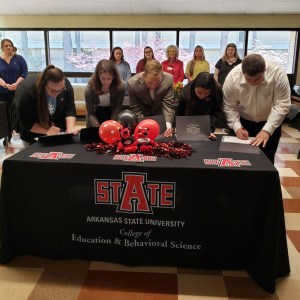
Educator Signing Day (Photo by Matthew Emery)

In an attempt to spread positive, exciting news about the future of teaching, A-State held a teacher signing ceremony in April, where current students attended and signed pledges to educate among their peers and administration in the education department. The ceremony was similar to athletic commitment signing days.

Sarah Palmer, an elementary education student from Bryant, was one of the dozens of students that signed the pledge. Her commitment to become an educator comes from her desire to work with children.

“I always knew I wanted to work with kids and the more I researched teaching, the more I fell in love,” she said.

While only a sophomore and solely an observer of local classrooms, Palmer said she felt like her time in A-State had been beneficial so far, saying the courses have helped her understand what and how to teach.

Palmer is from central Arkansas and went to a large school and feels a natural affinity to return to a school like that one day. However, she currently observes a smaller school and it has been an enlightening experience for her.

“It’s shown me how close the teachers are with each other and with the students. That’s awesome to me. I would be very open to teaching there,” she said.

Palmer has had a positive experience with the program at A-State, but another student who attended the signing, Sophie Rottinghaus, an English education major from Bay, offered a different perspective.

20190416_101841

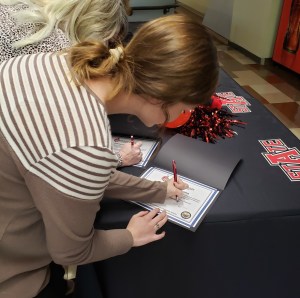
Sophie Rottinghaus, a junior, signs her pledge to become an educator. (Photo by Matthew Emery)

While she has not yet had the “capstone experience” mentioned by Bradley, Rottinghaus is currently in her “field one experience,” which she described as “mostly observing.” She said she believes teachers should use time wisely with their students and give them tools they can use in life.

“I want to teach them how to learn,” Rottinghaus said. “I don’t feel prepared. I don’t think ASU, or other institutions, equip potential teachers for all the adaptations teachers must make for their students to maximize their learning capabilities.”

Rottinghaus said she believes students are exposed to teachers who lack passion, which sends a bad message to students about learning.

“It’s been a lot of content knowledge and little instruction. I would like for the university to offer more classes on instructional strategies,” Rottinghaus said.

Rottinghaus said she hopes she can help revolutionize the teaching field for a new generation of teachers and their students, stating that people simply are not as passionate about education as they should be.

Bradley echoed the need for passionate teachers.

“There’s no occupation like teaching,” she said. “You make a difference in lives that desperately need you. Every occupation needs a teacher to assist and guide them along the way.”

CORRECTION: In-crop Dicamba applications end May 25

By Camden Metheny
Delta Digital News Service

JONESBORO — Arkansas farmers must stop in-crop applications of dicamba pesticide no later than Saturday, May 25 or potentially face fines up to $25,0000.

The rule applies to all dicamba products registered for in-crop use in the state, which includes Engenia, Fexapan, Tavium Plus Vaporgrip, and Xtendimax. While the cutoff affects the vast majority of state farmers, farmers within the Mississippi River levee areas can apply for a special permit as they typically plant later due to high river levels in the spring, according to the Arkansas State Plant Board. The board changed usage rules in March, including:

  • A half-mile buffer zone required around all non-dicamba crops when dicamba is applied.
  • A one-mile buffer zone for university and USDA research stations, certified organic crops and commercially grown specialty crops between April 16 and May 25.
  • Prohibiting the mixing of dicamba with glyphosate between April 16 and May 25.
  • Requiring applicators to provide proof of training to pesticide dealers prior to purchasing dicamba in-crop products.

Controversy surrounds the use of dicamba due to the pesticide damaging non-resistant crops. An estimated 3.8 million acres of soybeans have shown symptoms of dicamba damage. Because of this, many farmers have complaints.

Dan Hosman, a farmer from Craighead County, is one of many in Arkansas who are opposed to using dicamba.

“As a steward of the land, after a good deal of research, it’s just too volatile to use,” Hosman said. “There’s different alternatives that we should employ before hurting someone else’s crops.”

The reason dicamba is so dangerous is due to its volatility, meaning it can vaporize instantly. This causes it to spread to more crops and without the genetic resistance it can cause serious harm to those plants.

However, dicamba isn’t just dangerous to plants.

Richard Coy, a bee farmer in Arkansas, is also affected by the use of dicamba. In 2017, he noticed a significant drop in honey production due to the use of the pesticide in fields where Coy’s hives are located. With the loosening of restrictions on the cutoff date for use of the pesticide, this puts several Arkansas beekeepers in jeopardy as the season moves forward. In an interview with KASU, Coy said dicamba wasn’t killing the bees but the plants they needed in order to pollinate.

“The plants that produce the honey that we were selling to the retail market are the plants that have been severely damaged and the honey that are our bees collect off of other vegetation is not as desirable and I did not want to put a product that is undesirable on the shelf,” he said

The use of dicamba has been a contentious topic in Arkansas to the point where one farmer was shot and killed over the use of dicamba. Mike Wallace, a farmer in Monette, died in a 2016 altercation with a farmhand due to the pesticide drifting into Wallace’s fields. He had always been a vocal opponent of dicamba, appearing in a Wall Street Journal describing how the chemical killed 40 percent of his soybeans.

EDITOR’s NOTE: A previous version of this article incorrectly stated that dicamba pesticide could be applied between May 26-Oct. 31 if a half-mile buffer was maintained between non-treated plants. Although DDNS does not knowingly publish inaccuracies, errors are corrected as soon as possible regardless of the source of the error.