Monthly Archives: September 2019

High School Bands perform during A-State Band Day

By Krishnan Collins
Delta Digital News Service

JONESBORO – High schools from across the Delta traveled to Arkansas State University on Sept. 21 for A-State Band Day. 

 The event provided an opportunity for high school bands to get a taste of what the next level of band is truly like. For some band members, the experience transcended their everyday high school routine. 

 “I think it’s a wonderful experience,” Margaret Teeling, band director of St. Joseph School in Conway, said. “We don’t have a football team. So, we just do basketball. That means my students get to come out here and experience what it’s like to play with a huge band.”

Since Band St. Joseph Band members do not have the opportunity to participate in a marching band, participating in A-State Band Day presents a new challenges the students.

   “Well, our high school band is a lot smaller than the college band,” Teeling said. “This is a different experience for them. College band has a lot more freedom than high school band does and I think it’s great for them to have that experience.”

   That opportunity to march means everything to St. Joseph students. Sid Davenport, a ninth grade percussion student from St. Joseph, attended his second Band Day at A-State. He last came to Jonesboro for the event as a seventh grader.

   “I look forward to the opportunity to march,” Davenport said. “Our school is so small that we don’t really get a chance to march. My first time was difficult.”

   A-State Band Day’s annual event brings students into a fast-paced afternoon of rehearsing, playing and enjoying a college game day.  

   Members of The Sound of the Natural State, the university’s band, coached the high school students and gave pointers on how to perform on a football field. The intense rehearsal prepped everyone in attendance for the halftime show. 

   Steven Riley, director of athletic bands and assistant director of bands at A-State, explained the importance of the fast-paced rehearsal. 

   “At halftime, they will all be on the field with us,” Riley said. “That’s why we got to get this rehearsal in beforehand. It’s a lot of extra people.” 

   Riley noted this was not everyone’s first band day appearance. Whether returning A-State band members or returning high school band students, some people knew ahead of time what the day entailed. 

   Dalton Austin, band director at Osceola High School, returned to his alma mater in a different role. Austin experienced band day as a member of the A-State band; now the 22-year-old teacher decided to give his students a valuable experience in his first year of teaching.

   “I’d love for my students to get involved in band after high school,” Austin said. “I want them to know they do have a place in music after high school. I think this is a great event for that.”

   Austin knows he cannot teach his students everything there is to know about band. 

   “I hope they learn that they can perform after high school,” he said. “I hope they learn things that they might not have learned from me. In high school you’re usually competing against area bands. In college it is more of an entertainment thing. I think it’s a lot more fun.” 

   Gregory Brown, one of Austin’s students, attended his second band day. Brown liked the social aspect of the event. Brown plans to be in band wherever he attends college. 

   “Band day could help me know what it’s like to march on the field in front of everybody and calm my nerves,” Brown said. “I would fight for band.”

   The Osceola student specializes in trombone but also plays some other instruments on the side. Band day gave students an opportunity to meet new people from all over the state. 

   “I look forward to meeting new people,” Brown said. “Last year was really fun and collaborative.”

   After rehearsal, both The Sound and high school students took a well deserved break. Visiting schools received black Band Day themed shirts to match the color pattern planned for Centennial Bank Stadium at the A-State Red Wolves’ football game.

   The high school band members watched The Sound perform pregame before watching the football game itself. The halftime performance wrapped up the visiting bands’ performance for Band Day and brought the event to a close.

   “There’s nothing like a college game day,” Riley said. “Especially from the perspective of a marching band member. Getting to be on the field performing for thousands and thousands of people is unlike anything else. The camaraderie and the spirit is unparalleled. Giving high school bands that opportunity is something we cherish.”

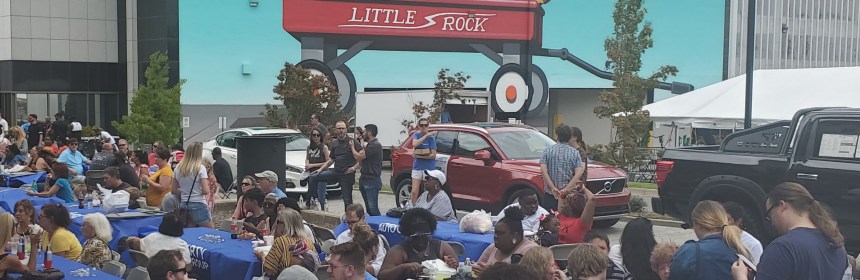
 

Little Rock hosts annual food truck festival

By Crystal Carter Harrell
Delta Digital News Service

JONESBORO – The Downtown Little Rock Partnership held its 9th annual Main Street Food Truck Festival on Sept. 22 from 11 a.m. to 6 p.m.

The DLRP and the Main Street Revitalization Committee started the event to help bring people back to Main Street. A record number of 86 food trucks registered for the free event. Twenty-five artists and marketplace vendors provided shopping and fun activities for festival goers.

Kimberly Bratton said she has been looking forward to the Food Truck Festival for weeks. Bratton’s home-based bakery features temperature-sensitive treats which provide options for vegan and diabetic clientele.

“I started baking when I was 9 and fell in love with it. I went to culinary school. After getting out, I said that is what I’m going to do. Once I get a food truck, I plan on expanding,” Bratton said.

Chicago native Melanie Jackson and her family attended the festival.

“We were here last year. My favorite food is tacos, but I think I’m going to get a stuffed turkey leg with chicken and dressing. Mac and cheese sounds good too,” Jackson said.

Vinnie Osmun of Kansas City, Missouri, ordered from a Cajun food truck while visiting his brother, Cody.

“We were like, ‘Let’s check it out’. Gumbo is a staple in Cajun cooking. Good gumbo really defines a restaurant. We also got some chicken and shrimp alfredo,” Osmun said.

Registered food trucks included: A Little Crepesy, Adobo To Go, Banana Leaf, Beaver Tails, Blue Sage Vegan, Bragg’s Big Bites, Bryant’s BBQ, Cheesecake On Point, Comida Rapida Mr. Casas, Cousins Maine Lobster, Crepe Coop, Delta Biscuit Co., Dippin’ Dots Ice Cream, Down Home Blues BBQ, Eat At Eric’s Grill & Catering, Eat My Catfish, El Sur Street Food Co., Flossie’s Funnel Cakes Inc., Food Hut, Fresh Gulf Shrimp and more.

Music lovers enjoyed 55 hours of entertainment. Artists performed song covers from old school Michael Jackson to modern day Taylor Swift. DLRP supplied a watering hole for pets and a rock-climbing wall for kids to enjoy.

The deck at Scott and 6th streets granted free parking all day.  

Editor’s Note: Feature photo shows attendees of the 9th annual Main Street Food Truck Festival in Little Rock. Photo by Crystal Carter

Students turn out for Global Climate Strike

By Melissa  Palumbo
Delta Digital News Service

Memphis, Tenn. – Millions of people from over 150 countries took to the streets Sept. 20 to demand action for climate change.

Protests and strikes led by young activists and students around the world will run through until Sept. 27 in a movement known as Global Climate Strike. There were local protests in Memphis and West Plains, Missouri, and a strike is scheduled at the Arkansas State University campus in Jonesboro Friday.

This new wave of environmental awareness began with 16-year-old Greta Thunberg, who walked out of her Friday classes each week to bring awareness to crises affecting the planet. 

“We will do everything in our power to stop this crisis,” the Swedish activist said Sept. 20 at City Hall in New York City.

One Memphis local brought the global climate strike closer to the Delta. Jojo Sigala, president of the Progressive Student Alliance University of Memphis chapter, led an afternoon protest in front of City Hall in Memphis. 

“Our kids will learn about the Great Barrier Reef like we learned about the dinosaurs,” she said during her speech.

While the global climate movement this week is led by the younger generations, those who have been protesting climate change for decades made appearances, as well as organizations that stand on behalf of the earth. 

For over 65 years, The Nature Conservancy has been working to combat the climate crisis in all 50 states and 72 different countries. 

Two representatives for The Nature Conservancy attended the Memphis Strike, where they were fundraising and helping to raise awareness of issues impacting the environment. 

“We focus on water shortages and pollution, and we replant trees for a more sustainable tomorrow,” Nathan Murray, a Memphis representative, said. “We’re here for the cause.”

The estimated 4 million participants from around the world this week will make this the largest climate protest in history. 

Citizens are demanding people in power to take action, as they chanted in the streets “No more coal, no more oil, keep your carbon in the soil,” with signs that read “Don’t defund the EPA.”

Jillian Johnson, an Interdisciplinary Studies student at Memphis University and environmental activist, participated in the protest at Memphis. 

“I’m here because the wrong Amazon is burning and the wrong ice is dissolving, so I think change needs to happen. The only way it’s going to happen is for us to do something about it, because, obviously, the people in power haven’t done anything and don’t want to do anything.”

Local 4-H Clubs showcase work at fair

By Tristan Bennett
Delta Digital News Service

JONESBORO, Ark. – Members of local 4-H Clubs participated in animal competitions at the Northeast Arkansas District Fair. The organization uses fair shows as a way to showcase members’ hands-on projects to the public.

The University of Arkansas Cooperative Extension Service runs the 4-H program across the state. The organization encourages young people to take on societal issues and work to make their communities better. Club members choose their own projects and must take on the responsibility of the project, whether it takes weeks or years to finish.

Greene County Cooperative Extension agent Lance Blythe said, “It’s a learn by doing organization. Kids learn by project work that they do on their own time. An animal or a project is a way to teach kids life skills.”

Arkansas 4-H members can choose projects in areas such as agriculture, animal science and plant science. Many members of the Greene and Craighead County 4-H Clubs chose projects in the animal science category, and they raised animals to compete at the fair.

Members choose projects based on the time commitment they are willing to contribute as well as their financial abilities.

Blythe said, “These projects range anywhere from a few weeks along with chickens and rabbits all the way to cattle and horse projects, which can last for years. It’s a time dedication and financial as well.”

After choosing a project, members must find the animal they would like to raise. Members receive help from the club and the Cooperative Extension to find one, but many buy locally with some buying from all over the country.

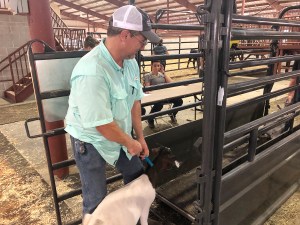
Lance Blythe, Greene County Cooperative Extension agent, leads a goat to the scale for weigh-in before the showing. Photo by Tristan Bennett

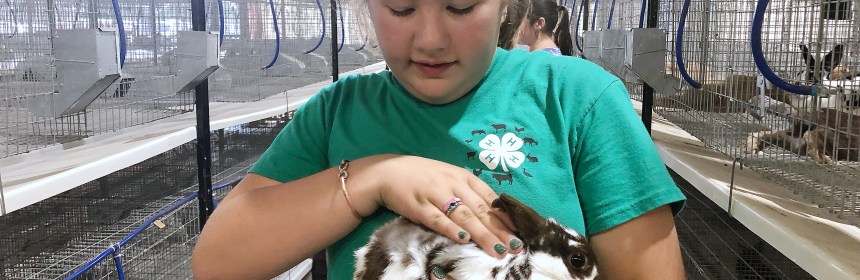
Lainey Walling, a member of the Craighead County 4-H, raised a Polish rabbit for her project. She worked with her rabbit for several months before the fair.

“You have to make sure they are not shedding, and you have to brush them out,” Lainey said. “You also have to make sure that they’re not sick because that will put them out of the competition.”

Members learn how to properly care for the animal they are raising, including feeding, maintaining health and training.

“They learn about health and nutrition and train the animal to lead so they can show the animal to a judge when it comes time,” Blythe said. “They are taking care of something besides their self.”

When it comes time to showcase the animal, judges look for certain characteristics in every species and breed. Rabbits compete in classes based on breed, age and gender. Members must enter their rabbit in the correct class or it may be disqualified.

Carrie Walling, Lainey’s mother and a 4-H Club alumna said, “Each rabbit breed has its own set of expectations. For example, our rabbits are Polish, and a big characteristic is little ears and big eyes.”

As they raise their animal, members must also keep a record book. It shows their goals for the project, what they learned, how they managed their project on a daily basis and the opportunities they took to learn more about their project.

Members of 4-H show their animals at fairs as a way to showcase their work, and judging tells them how good they did. Blythe said 4-H members are not necessarily at an advantage in competition against other animals.

“The advantage comes from how well you do all the things involved in a project. Beginning with genetics. Where did you get the animal? How well did you feed it, train it, take care of it?” Blythe said.

Depending on which project they choose, members also have opportunities to go on to compete in more 4-H competitions. They can show off their projects in other ways such as 4-H O-Rama, a district and statewide program. Members who raise animals for their projects qualify for several 4-H O-Rama competitions such as the speaking contest, livestock judging and quiz bowls.

Arkansas 4-H helps more than 134,000 young people acquire new skills and develop healthy lifestyles that they will need for the rest of their lives. Members not only learn about livestock, but also have opportunities to learn about science, citizenship, leadership, public speaking and many more topics.

“They do a lot of public speaking, so I learned to get over my shyness and a love of animals,” Carrie said.

Four-H clubs in areas such as baking and dogs allow the organization to reach more young people outside of the traditional clubs. Arkansas 4-H offers free participation in all 75 state counties.

Editor’s Note: Lainey Walling, Craighead County 4-H member, demonstrates how rabbits are judged at the fair. Photo by Tristan Bennett

Women engage the outdoors at Craighead Forest Park

By Crystal Carter Harrell
Delta Digital News Service

JONESBORO – Arkansas Game and Fish Commission hosted the first Becoming an Outdoors Woman event at Craighead Forest Park where participants learned about the workshop, upcoming events and kayaking.

According to the Centers for Disease and Control and Prevention, more than 60% of U.S. women do not engage in the recommended amount of physical activity. The CDC’s website suggests providing community-based programs and environmental inducements that meet the needs of all women.

The BOW program focuses on providing opportunities for women to learn skills such as cleaning deer, harvesting edible plants, nature observation, setting up game cameras, archery, quail hunting, canoeing, hiking, fishing, trapping, mountain biking and more.

“We just want to get people outdoors and enjoy it outdoors,” State Coordinator Lea Gray said.

Gray discussed safety protocols regarding life jackets for kids and adults, kayak size, adjustable equipment, proper paddle use and rowing techniques. She also informed the group on what to expect if the kayak flips over.

“Lightness of the kayak is important for women. I recommend falling out of it in a calm river so you’ll know what to do when it happens. Don’t ever get between the kayak and flowing water. Don’t get pinned,” Gray said.

Heather Custer, a biological sciences major and graduate student at Arkansas State University, said she decided to buy a kayak because her work in the Ozark National Forest needed some fun.

“I have flipped over before, so I came to get more tips and pointers. My friend Amanda told me about the group. I think it’s awesome to get women out here doing stuff together. While the men do their outdoorsy stuff, we’re not feeling left out,” Custer said.

Amanda Dunavant, volunteer for KLEK 102.5 FM, said she has always been interested in the outdoors. She grew up on the riverbank hunting and fishing. In her spare time, she kayaks with her sister-in-law at Spring River.

“Kayaking isn’t just a male sport. It’s a female sport too. Also, emergency awareness and preparedness is my title. People think emergencies are just tornadoes and earthquakes. It is not. It is everyday life. We are preparing for an emergency that we don’t want to be in the middle of and to be safe on the water,” Dunavant said.

Lee Elkins, Forrest L. Wood Crowley’s Ridge Nature Center educator and coordinator of the Women Outdoor Network in Northeast Arkansas, said this event was the first in Jonesboro.

“We’re just getting started. Any woman that wants to be apart of a group of women who go outdoors or needs a buddy to go with, you can find one in this group,” Elkins said.

Women can learn about the permit system for game and fish and more at the Ozark Natural Science Center in Huntsville in November.

A maximum of 140 women may register for BOW.

State fish hatchery prepares for upcoming fishing derby

By Tristan Bennett
DELTA DIGITAL NEWS SERVICE

CORNING, Ark. — A local fish hatchery prepares to celebrate as National Hunting and Fishing Day approaches.

For the first time, Donham State Fish Hatchery, along with the other five state hatcheries, will host a fishing derby to celebrate National Hunting and Fishing Day.

The holiday began as a day of thanks for sportsmen who contributed to conservation and sustainable use of fish and game, according to the National Fishing and Hunting Day website. President Richard Nixon first proclaimed the holiday in 1972 as a day to enjoy the outdoors and encourage proper management of natural resources.

This year, National Hunting and Fishing Day falls on Sept. 28.

The employees at Donham hatchery work year-round to ensure derbies such as this one go off without a hitch. They must plan ahead each year to ensure each derby site gets the proper amount of fish.

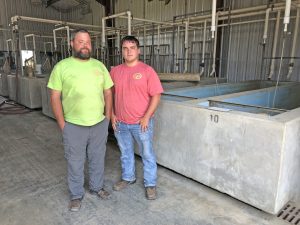
Robert Zimmer, left, and Erik Jordan pose by fish vats. Photo by Tristan Bennett

Mark Harness, hatchery manager, said, “In January or February, I’ll know how many fish I’ve got to produce for the whole year.”

Preparing these fish is no small task. The technicians keep themselves busy taking care of the fish and helping maintain the hatchery itself.

Robert Zimmer, senior technician, said, “We do everything from mowing to cleaning the bathrooms and everything in between.”

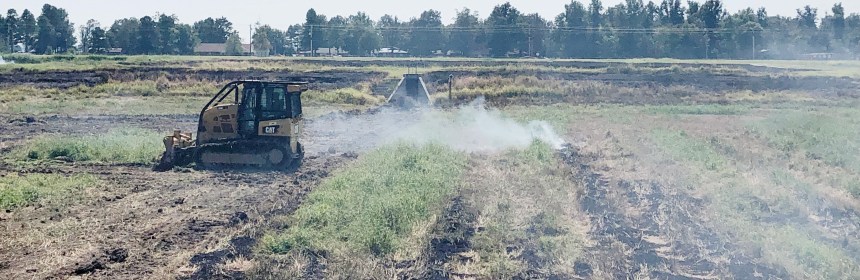
In the fall, the employees rework the ponds by draining them and mowing the grass in them down as well as work on their second round of fish harvesting for the year. In the spring, they put fish in spawning nests and usually begin harvesting by June or July.

“Checking all the oxygen levels is the first thing we have to do every morning,” said Erik Jordan, a technician at the hatchery.

The technicians keep a close eye on oxygen levels to ensure the fish are in a healthy environment. Fish must also be fed and checked on regularly to confirm proper growth.

When the time comes to send those fish out into the community, the hatchery employees harvest the ponds using a method called dragging.

“We have a seine that reaches across one of our 1 1/2-acre ponds, and we’ll drag the whole pond to a corner and slowly pull it in,” Harness said.

From there, they take a sample to get an approximate weight of the fish.

“Let’s say these fish are one pound,” Harness said, “that means one fish weighs one pound, so if we’ve got to have 500 fish, we know we’ve got to have 500 pounds.”

Then, technicians load the fish onto trucks and take them to their new homes for communities to enjoy.

Harness’s hatchery stocks catchable catfish, one pound or over, in many of the Family and Community Fishing Ponds in Northeast Arkansas. Several of these ponds will hold derbies throughout the summer and fall.

Family and Community Fishing Ponds get stocked with catfish in April, May, June, September and October. Trout come to the ponds in November through February. Lakes and ponds get stocked according to what the biologist wants, so it varies from year to year.

Zimmer said, “We may stock Lake Charles this year, but we may not stock it next year.”

The biologist is in charge of deciding how many fish and of what species a lake needs.

The hatchery’s job does not always stop there. Donham holds its own derby at the hatchery every year as well as the National Hunting and Fishing Day derby, which will take place on the Arkansas State University campus.

“We are not doing it here (at the hatchery) because we reach the local people with our derby in June. So, we are going to move to Jonesboro with this one to see about getting a different group of people,” Harness said.

Hatchery employees will be there working educational booths and a casting contest to teach people how to cast correctly. The A-State American Fisheries Society will also be there with information on endangered species. In the past, Donham hatchery has also done a BB gun range, a knot-tying station and kayaking at their derbies, Jordan said.

Admission to the derby is free, and anyone is welcome to fish from 8 a.m. to noon at the Pavilion Pond on the A-State campus. Family and Community Fishing Program rules apply, so someone could even go by themselves to the derby. There is a three fish limit per person.

“It’s designed to get families back to fishing or even get the young kids interested in fishing,” said Harness.

National Hunt and Fishing Day is all about enjoying the outdoors, and Harness hopes this derby will provide Northeast Arkansas with a chance to do so as well as learn about conservation and wildlife.

Editor’s Note: Featured photo shows hatchery staff reworking ponds in preparation of spawning season. Photo by Tristan Bennett