Monthly Archives: November 2019

Small businesses gear up for the holidays

By Maddison Smith
Delta Digital News Service 

JONESBORO – Small Business Saturday is a big deal for some, for others – not so much. 

   Small Business Saturday was first observed in the U.S. on November 27, 2010 and was trademarked by American Express. 

   Refinery Store Manager Amy Willhite said their company will be participating in Small Business Saturday, along with Black Friday and Cyber Monday. 

   “We want people to shop local and to keep business here in town,” Willhite said, “We want them to come into the store.” 

   On the contrary, Smoothie King Owner Linda Bradley said she did not know about Small Business Saturday and if she did, she would have participated. 

   Bradley does support shopping local. “Your helping those local businesses to stay in business,” Bradley said, “It gives a more ‘hometown’ feel. Instead of spending your money on cooperate businesses, you should shop local to help our community.” 

   Shop local supporter Jessica Blevins said she shops local because it supports the community and those who live there.

   Blevins said, “It’s about being able to communicate about small businesses and being able to put a spotlight on a few of those locations on Small Business Saturday.” 

   “Black Friday absolutely helps us, and Small Business Saturday is just an extension of that,” Willhite said, “People are still wanting to shop local, but they are also wanting a deal.” 

   Bradley said, “We can’t offer that much of a deal on Black Friday, but if there was a small shop festival, where we could get our products into consumer’s hands, that would benefit us more.” 

Willhite said that consumers should shop local because they have good customer service, people that wait on you and want to talk to you.

   Willhite said, “You’re going to get a one-on-one experience and you’re going to talk to someone who has knowledge about the products in store.” 

   American Express also holds what is called “Neighborhood Champions,” which are towns or cities who have pledged to put small businesses first. 

   Conway, Paragould, Little Rock and West Memphis, to name a few, are part of Neighborhood Champions. Jonesboro is not included in this list. 

Editor’s Note: Feature Photo taken by Maddison Smith

Tablets provide JHS students with next level experiences

By Krishnan Collins
Delta Digital News Service

JONESBORO – The Foundation for Jonesboro Public Schools awarded a Jonesboro High School art teacher $1,000 so he could provide drawing tablets for his class and expand the abilities of his students. 

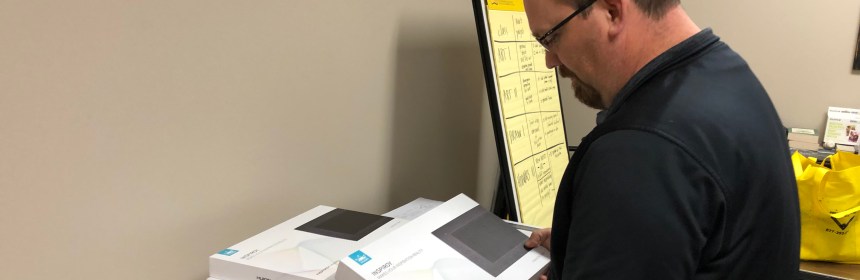
David Leggett used the money he received from a grant to purchase Huion 610pro tablets for his digital art media class. Although the tablets are a staple of the digital art media class, Leggett said other art classes should eventually be able to use them. 

After applying for a grant from the foundation, Leggett did not find out he won until foundation members visited his class during a school day. The awarding of the money surprised the art teacher. Members of the foundation walked through the halls of JHS ringing a cowbell as they approached his door. 

   “They don’t tell you you’re awarded,” Leggett said. “You submit your thing and then you wait. If you’re lucky enough to hear the cowbell come to your door, then you’re like OK. I didn’t realize it until they opened the door. It was right outside the door, I was like, that noise seems to be getting louder. Then it dawned on me, it clicked. I might’ve won. I can be excited now.”

   Leggett bought 17 tablets with the grant money and the tablets helped students achieve goals they might not have been able to achieve in the past. 

   “It helps a lot of the kids,” Leggett said. “A lot of kids feel like they can’t draw. So, they get into the computer side of it and know they can undo stuff and redo. They feel like they have a little bit more control over their media.”

   In classes like digital art media, students now approach projects with more confidence. 

   “In the digital classes, if I was to set a piece of paper in front of them and say we’re going to draw a face, a lot of the kids would say I can’t do that,” Leggett said. “So what we’re doing right now is practicing on using the tools and then we’re learning how to trace the face and the contours of the face.”

   Maddy Grubb, a junior at JHS, said she never really used a lot of technology in her art classes in the past and the tablets were her first experience with high-tech equipment when it comes to art. She noted how the tablets changed the game in her art classes recently. 

   “I feel like it definitely makes it easier for us,” Grubb said about the tablets. “When we have to use computers in our art class, it’s a little bit harder. It’s not as accessible as when you can use a tablet. The tablets definitely make it easier for us to draw and trace for our art projects.” 

   Grubb said she was nervous at first using technology to create art, but in the end, she realized how helpful the tablets were to use. 

   “I was a little nervous because I wasn’t really sure what it was going to be about,” Grubb said. “But it’s actually a lot easier than you think. You just plug it up to the computer and press a couple buttons. It’s very easy.”

  Another student, Brian Holmes, held more experience with high tech art equipment. The JHS sophomore used other tablets in the past and commented on why tablets are so important for art students. 

   “Being able to undo and redo and free transform objects is really helpful,” Holmes said. “So I don’t have to manually go back and erase it.”

   Holmes used a variety of tablets in the past and mentioned some of the advantages of the Huion tablets in Leggett’s art class.

  “The hot keys are really simple and the pressure sensitivity is pretty good too,” Holmes said. “Overall it’s just a really nice, simple tablet.”
  JHS offers a variety of different art classes and both Grubb and Holmes acknowledged the focus on technology at JHS. The technology helps improve the classroom. 

   “The classes do care about the quality of the classes and what they give out,” Holmes said. “They know that higher quality things can help students produce higher quality work.”

   The impact of the tablets on students shows in the classroom. Leggett noted how the tablets help create art in ways that just takes a lot of pressure away from his students. 

   “I do think it will actually help them in observation,” Leggett said. “(It will help them) in drawing something that they can always go back and undo a line and redo a line. They can do this much easier when they have a tablet in front of them by pushing a button. There are so many options they can do. Their anxiety is so much lower.”

  Even with the success of the tablets in the classroom so far, Leggett still looked into the future and saw more ways to improve his classroom. 

   “Anytime I can get money for my kids, I’m definitely going to try and do that,” Leggett said. “I was not able to provide a classroom set of tablets this year. We got 17 with the money we got. I would love to be able to have a class set of 30. I would love to go back and just keep getting tablets or really anything.”

   Leggett applied for a foundation grant for the first time when he applied for the tablet money. He noted how the foundation’s impact really matters.

   “I think it’s great,” Leggett said. “We’re given a budget. We have 1,500 kids. We try our best and buy everything we can. When we needed to get something like those tablets, I was able to write that grant. They were able to get me the grant money to do that. (It’s great) to see the kids working with these things and just my overall excitement for being able to provide these for the kids.”

   Leggett’s passion for teaching showed when he talked about the impact of the grant. It is clear JHS and the district as a whole has an organization on its side ready to chip in when needed most.

   “They’ve provided grant, after grant, after grant,” Leggett said. It’s been great, that’s what we’re here for, we’re here to provide for the students.”

Editor’s Note: Art teacher David Leggett looks at a Huion 610Pro tablet. Leggett purchased the tablets for his class with money he received from a Foundation for Jonesboro Public Schools grant.  

Female farmer acts as spokesperson for industry

By Tristan Bennett
Delta Digital News Service

WALDENBURG – A young, female farmer is taking the Arkansas agricultural world by storm by acting as an ambassador and a role model for others like her.

Originally adopted from Russia, Jenna Martin grew up on her father’s, Dennis Martin, farm in Hickory Ridge, Arkansas. She went on to pursue a degree in agriculture business and continued her work in an industry dominated by men.

“This is just something in my gut. It’s just what I want to do,” Jenna said. “It’s what I think about all the time, it’s what I want to learn about, it’s what I talk to Dad about all the time.”

Men dominated the agriculture field for centuries, so a stigma surrounds women who work in the industry. However, the 2017 census stated 36% of U.S. farmers are female, and that number continues to rise. Jenna works as a role model for many young girls wishing to pursue a career in agriculture.

Both of her parents grew up around agriculture, so it became a part of Jenna’s life early on. She began helping Dennis on the family farm as soon as she could walk. Her mother homeschooled her, so the flexible schedule gave her plenty of time to spend where she said she really wanted to be: on the farm.

“When she first started, she would help us move equipment from field to field, and as she got a little bit older, she started driving tractors and putting out all the Polypipe,” Dennis said.

She solidified her choice to stay in agriculture while still in high school and began learning as much as she could and promoting the industry. Along with staying active in 4-H for 15 years, Martin also held the title of 2013 Miss Arkansas Rice. The Miss Rice program encourages agriculture education and promotes rice as a major part of Arkansas’ economy.

After graduation, Jenna chose to attend East Arkansas Community College in Wynne before transferring to Arkansas State University to pursue a degree in agriculture business and minor in strategic communication. Even though she wanted to farm, she said her parents wanted her to have a degree to fall back on.

“I chose community college because it was close to home and closer to the farm,” Jenna said. “EACC was a good transition before I went to A-State.”

During her time at A-State, Jenna remained involved in the College of Agriculture, held many leadership positions and created good working relationships with her classmates and professors. Bert Greenwalt, professor of agricultural economics at A-State, worked closely with Jenna during her time at A-State.

“She immediately became involved in all activities of the college,” Greenwalt said. “The thing about Jenna to me is she’s just so enthusiastic. Very positive, very enthusiastic and always ready to jump in, lend a hand and make a difference.”

Jenna served as the president of the A-State Collegiate Farm Bureau during her senior year, and worked as a teacher’s assistant under Greenwalt, assisting with the annual A-State Agribusiness Conference as well.

Jenna explored different careers in agriculture during her internships with Farm Credit Midsouth and Pioneer Seed, but ultimately returned to Dennis’ farm and chose to remain in production agriculture. During harvest, Jenna handles the grain carts as Dennis mans the combine.

“Usually day-to-day I go out to the shop, get everything ready and then go out to the field and stay there until 8:30 or 9,” Jenna said. “In the summer I go around and help Dad with all the water. Like I said, irrigation is huge.”

While she feels perfectly confident with her work in the field, Jenna still struggles with the business aspects of running a farm. Dennis runs his operation the old school way: everything on paper, and Jenna learned about how to handle finances on the farm from him. However, in a world where technology reigns, even farmers must adapt to new equipment and tools.

“Something I wish I could have done more of in my degree is more on the technology side,” Jenna said. “It’s growing so much, and I think that’s a big thing.”

As far as being a woman in a traditionally male industry, Jenna is not intimidated.

“I’m pretty good about just jumping in with the guys, and they’re pretty cool about responding,” she said.

More women pursue careers in agriculture today than ever before, and Jenna acts as a role model for each young girl.

“Jenna has an interest, ability and a passion for speaking about our industry,” Greenwalt said. “She is someone I know will continue to be a leader in the industry.”

Jenna said she hopes to take over the family farm someday. In the meantime, she continues to help Dennis on the farm and work on acquiring land to cultivate on her own.

“We’re leaving that 100% up to her,” Dennis said. “If she wants to pursue a future in farming, we’re behind her.”

Editor’s Note: Feature Photo shows Dennis, left, and Jenna Martin. Photo taken by Tristan Bennett