JONESBORO, Ark. — The College of Education & Behavioral Sciences’ interconnection with the Northeast Arkansas community benefits education majors, NEA school districts and Arkansas State University.
Makenzi Davis graduated in December with a bachelor’s degree in physical education. A-State awarded her the Chancellor’s Scholar at the College of Education & Behavioral Sciences Convocation of Scholars Ceremony.
She was also one of the first students at the college to be accepted into the new Aspiring Teacher Program. The program allows students who make a high enough score on their exam to waive their year of residency and become full-time teachers immediately.
“Before, I was just a college kid who stuck to their inner circle and this really stretched me as a person. It’s made me a lot more connections than what I had before I got here,” Davis said.
Davis now teaches physical education at the Nettleton Intermediate School and serves as the junior high girls’ head basketball coach. She said this position has made her feel a lot closer to the NEA community.
Lacy Baker, the Nettleton School District Assistant Superintendent of Curriculum and Assessment, has been involved in the district’s hiring process for many years. She said at least half of the Nettleton School District teaching staff working there currently has some sort of certification degree from A-State.
The school district also takes in as many A-State residency placements as possible. For the 2026 fall semester, the district had 27 placement requests and she predicts they’ll be able to take in all of them.
“Anything we can do here at Nettleton to reinforce what A-State is doing there and, of course, keep up our numbers of teachers,” Baker said.
Baker said she’s a big fan of the Aspiring Teacher Program because it’s good for the students. It gives college students early access to teacher benefits and salary. She said A-State graduates come to the workplace very well prepared.
“Arkansas State is doing beautifully by preparing their students. I think it’s such a wonderful opportunity for student that are already ready to go ahead and go on into that third year,” Baker said.
Baker said student-athlete visits, professor presentations and staff meetings are some other ways A-State stays involved in the Nettleton School District.
Valarie Hilson, an assistant professor and program coordinator of Physical Education Teacher Education at A-State, said the Aspiring Teacher Program strengthens collaboration with the NEA school districts.
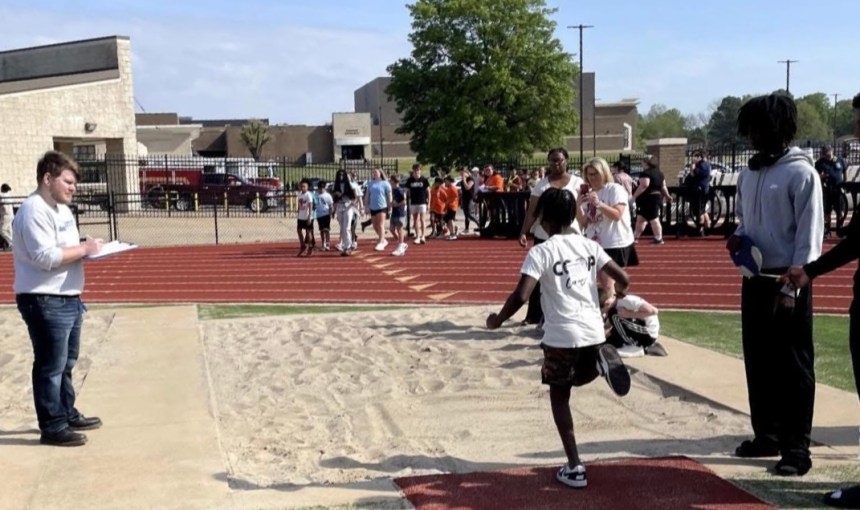
Faculty from Community Care & Miracle Kids volunteer at the Area Seven Special Olympics Track Meet, held April 10 at Jonesboro High School. Photo courtesy of Special Olympics Arkansas Area Seven
Click to View!
Hilson, who coaches the Special Olympics of Arkansas and serves as the Area Seven training director, has served as a Special Olympics coach for over 20 years. An A-State colleague introduced her to the nonprofit organization. The organization hosts regular sporting events across the state.
Jonesboro High School hosted the last event April 10, which included 565 athletes ranging in ages from 2 to 60 participating. The Nettleton High School track team, local businesses and A-State faculty and students were all involved in the event.
The commitment to helping one another succeed is vital in maintaining the relationship between the education majors, NEA school districts and A-State.
JONESBORO — The Arkansas State University Aggie Market is doing more than selling locally processed meat. The market to many students and community members provides a visible connection between A-State and the larger city.
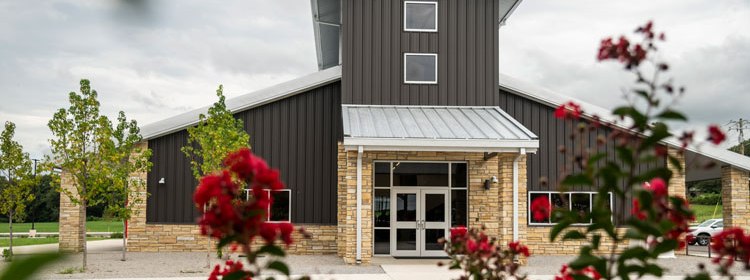
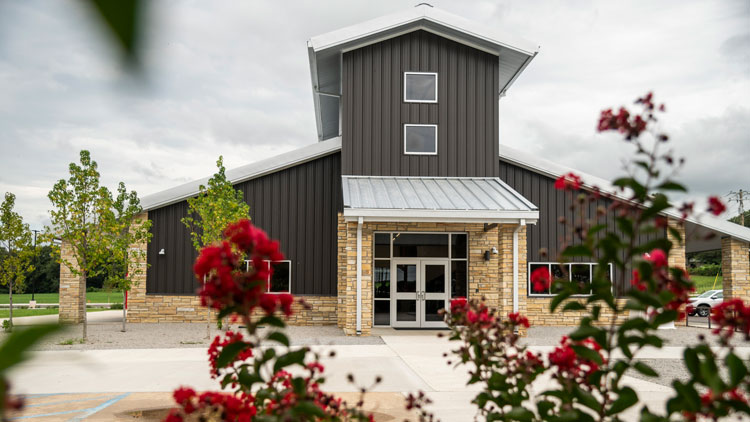
View of the front of the Arkansas State University Aggie Market. Photo courtesy of Arkansas State University
Part of the College of Agriculture, the Aggie Market serves as both a student learning facility and a public retail space. Students help process, market and sell products while interacting directly with Jonesboro residents during weekly retail hours and community events.
Richard Readnour, meat laboratory manager, said the market’s role extends beyond education by creating direct interaction between students and the Jonesboro community.
“The Aggie Market’s target audience is anyone within the Jonesboro community, or surrounding areas. We seek to build relationships with students, staff, faculty, and strengthen our community ties,” Readnour said.
The Aggie Market first opened in 1971 as the ASU Meat Lab under the leadership of Raymond Hostetler. The meat lab originally focused primarily on teaching and USDA-inspected processing.
In 2021, the College of Agriculture received grant funding from the Arkansas Department of Agriculture that allowed the facility to undergo major renovations. The market reopened in 2023 under the new name A-State Aggie Market as the first state-inspected facility in Arkansas.
The renovation also expanded opportunities for students beyond meat processing. Students can now participate in nearly every step of production, from raising livestock at the university farm to developing and marketing retail products sold to the public. Students working inside the market are often the face of those interactions.
Hannah Johns, a student employee at the Aggie Market, said they provide hands-on learning opportunities and even employment for students.
“We are committed to producing products handmade by students and being engaged with the community,” Johns said.
The market opens weekly to the public, allowing residents to purchase products directly from students working in the facility. Readnour said those face-to-face interactions help students gain experience while also giving customers a better understanding of agriculture and food production.
According to Readnour, the market isn’t a one-time stop.
“We have several repeat customers who come back often to pick up their favorite products. We use this as an opportunity to tell them about the importance of agriculture, and our students who help us through every stage of production,” Readnour said.
Still, awareness of the Aggie Market itself may not be widespread throughout Jonesboro.
Craig Rickert of the Jonesboro Advertising and Promotion Commission said he was more familiar with the broader Judd Hill Farmers’ Market than the Aggie Market specifically. Rickert said community-centered agriculture events hosted through A-State play an important role in connecting the university with Jonesboro residents.
“The great appeal of the Judd Hill Farmers’ Market is that it brings people to campus,” Rickert said. “Those Saturday morning and Tuesday afternoon trips can be as much about being social as shopping. You can get great local products in a lot of places. But the farmers’ market gives you community on top of that.”
Click to View!
Rickert said the Aggie Market should be viewed as a community resource and not exclusive to the university.
“When you see the full parking lot, the families, the kids running around snagging a free taste of something, that’s special,” Rickert said. This most definitely strengthens the connection between the city and the university. A-State is the heart of our city.”
While the Aggie Market operates on a relatively small scale compared to other university outreach efforts, it continues to provide one of the few spaces where students and Jonesboro residents regularly interact through a shared local experience.
“We need to drop the sentiment that something is only A-State or only Jonesboro. The city and the university live together hand-in-hand,” Rickert said.
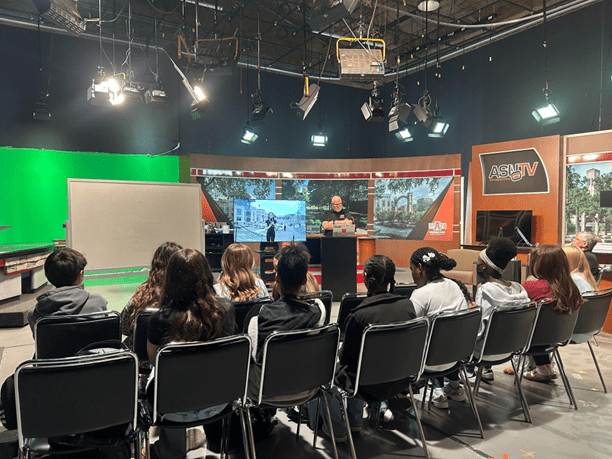
Nettleton BRIDGE program students presenting and watching their final video projects about Nelson Mandela and Zodwa Dlamini. Photo by Mia Young.
JONESBORO, Ark.- The Nettleton BRIDGE program introduces middle school students at Nettleton Junior High to the learning environment of a college student by teaching them about multimedia journalism in the School of Media & Journalism.
The Nettleton BRIDGE program began as a way to help Nettleton Junior High students experience what it is like on a university campus, so they can imagine themselves as a student at Arkansas State University or any other university. Many first-generation college students struggle to imagine college life.
Chris Moss, principal of Nettleton Junior High, contacted Gina Houge, associate dean for the College of Liberal Arts and Communication, because he wanted to target his eighth-grade students young enough to benefit from an experience that could encourage them to become college students. Last year, the program began by bringing in a small group of Nettleton students who were interested in multimedia journalism, especially the media aspect.
“I mean, that’s what students know, right? They have their phones, and they’re engaged in media constantly,” Hogue said. “But to get an experience within an academic field was what Mr. Moss wanted them to experience.”
Hogue and Moss also wanted to add a historical component to the program, as they are both passionate about history. But last year’s pilot program focused on building the students’ multimedia journalism skills, and they were unable to build out any historical component. Jonathan Reaves, instructor in the school of media and journalism, played a critical role in working with the students and developing their multimedia journalism skills.
“The first year of the program (last year) was a challenge in that we were developing a program from scratch,” Reaves said. “In the first year, we had to decide which media we wanted to use. We primarily focused on video packages, and I have been working on audio podcasts separately. I expect we will incorporate more audio podcasting next year.”
The program changed significantly from the first year to the second. Last year, the group of students interested in media activities merged with the group who were interested in STEM activities. This meant some Mondays, the group would work on multimedia projects and other Mondays, they would work on STEM projects.
This year, the two groups remained separate, and they focused on adding a historical component along with learning the elements of writing, audio and video.
“So we wanted to continue with street talks, and we wanted to expand and add the audio component in so they could do more audio editing. Then Alina and Jonathan wanted them this semester to do an actual video report that encompassed all of these elements of interview, audio and also video,” Hogue said. “To build in the historical component, we wanted students to be able to meet people from many places around the world and learn about the culture in other places and to interview people, so that they’re doing their research, ’cause when you research like a journalist, you’re researching like a historian.”
Throughout the last year, students completed several multimedia projects based on what they learned about different historical topics in the Nettleton BRIDGE program class.
One of the first things Alina Sakayeva taught the students about was her hometown of Kazan, Russia. Sakayeva talked about her family traditions, the food they eat and the relationship between her and her family. She showed them some of the historic buildings and contemporary athletic facilities where they host global soccer matches, and taught the students about the ancient culture and the traditions there.
“The students sat on the edge of their seats, listening and looking at the images, and watching the videos of the cultural dancers in Kazan, conveying the history of that region of the world to these young people, these eighth graders, from Nettleton Jr. High School,” Hogue said.
At the end of the nine weeks, the students created their video story about Kazan and something from Sakayeva’s culture they were interested in, and then presented it to the class.
“The Kazan video (was my favorite), it gave us a lot of freedom to do whatever with the video, and it was super fun to learn about,” Brylin Smallman, eighth grader in the Nettleton BRIDGE program, said.
During the second nine weeks, the students learned about the Pine Ridge Indian Reservation in South Dakota. They also individually created videos on the topic using interviews with Alice Phelps, a former educator on the reservation, and their own research.
During the third nine weeks, they read “The Story of Nelson Mandela” by Floyd Stokes and learned about him, and Zodwa Dlamini, who was in his administration in South Africa and who brought several school districts together there. The students also interviewed Dlamini over Zoom.
For their final projects in the fourth nine weeks, the students spent time in the K-labs learning about audio production and editing their videos about what they learned from their reading, their research and the interview with Dlamini.
Not only are the students learning audio, video, storytelling and a little bit about history but they are also learning life lessons they will carry with them throughout their lives.
“(I learned) to be open-minded. I wasn’t very open-minded at the beginning, and now I’m just like ‘OK, this is what’s going to happen, and that’s OK,’” Fielder Franks, an eighth grader in the Nettleton BRIDGE program, said. “Sometimes life happens, and it doesn’t go your way, and sometimes that’s just how it works, and so, you’ve just gotta be OK with that and move on.”
Every Monday, the group of 12 students would meet in the TV studio in the A-State College of Media and Journalism for two hours. This means these students would be missing three class periods and would be responsible for making up the classwork they missed. To be in the BRIDGE program, the students have to meet certain requirements, like having good grades (because they miss a lot of work) and not having any behavioral issues at school.
Karley Barnes incorporates multimedia elements into her EAST class, which each of the students attends. Barnes, an A-State alum, also travels with the students to and from the A-State campus and gives students a participation grade based on whether or not they came out and did their best.
“I think it benefits them because they get out of the classroom, they get to be challenged. It might be kind of taboo to say, but public school education is very watered down, and it’s not watered down out here,” Barnes said.
Click to View!
Next year, the program will see a new group of eighth graders with many of the same and many different projects. Each year the students move up in school, the program continues to support them, but they have less time to visit campus. Reaves and Hogue are still excited for what next year will bring, even though the current eighth graders may not be on campus as much next year as they are now.
“I would tell these students to stay curious, keep working on their editing skills and be proud of what they have done,” Reaves said.
The Nettleton BRIDGE program does not just give students a chance to learn and improve their media skills, but “to help them, to inspire their learning, and to find their pathway in life. That’s the goal,” Hogue said.
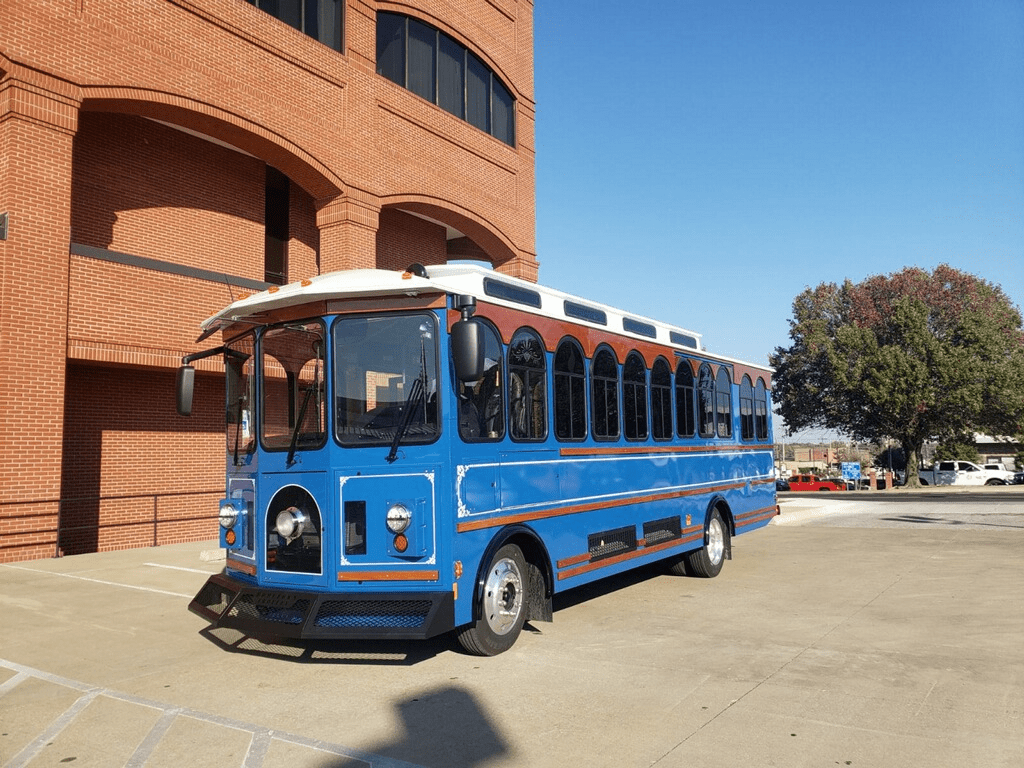
A blue trolley-style bus parked at the Jonesboro City Hall building. These buses offer transportation services using the GoJo Transportation System. Photo courtesy of the City of Jonesboro website.
JONESBORO, Ark. — The City of Jonesboro’s new GoJo Transportation System provides a convenient service to Arkansas State University students, offering free, campus-wide transportation. However, limited outreach to students has kept many from using the service.
The new GoJo system, previously JET, provides service to A-State and the surrounding Jonesboro area. It features six routes, ranging from on-campus hotspots to countless places in the city. The new Let’s GOJO! The app and website provide a map of all stops and routes to help users locate the nearest available transportation, as well as live tracking of all buses and trolleys.
The service is free to students with a valid student ID, providing an accessible alternative to driving or walking.
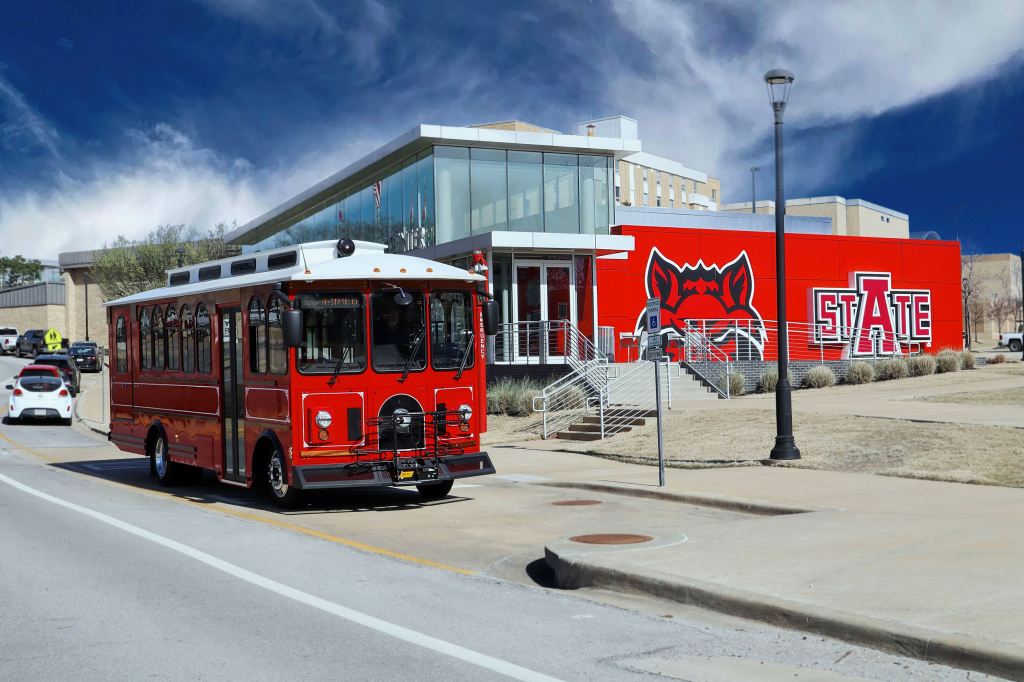
One of the most notable features of the system is the new Trolley-style buses. These vehicles provide classic aesthetics with modern functionality, which gives students a comfortable ride that is also more visually appealing than traditional transportation options.
A red trolley-style bus parked in front of the Arkansas State University Welcome Center. Photo courtesy of the City of Jonesboro website.
City officials and transportation coordinators said GoJo is meant to connect residents, visitors and students to the city of Jonesboro through expanded connections throughout the city, including A-State.
Despite the advantages to students, GoJo is relatively unknown amongst them. International student Boaz Muteba said she followed the news surrounding the new system.
“In the fall of 2024, when public transportation options were expected to increase, I was one of the individuals who participated in the meeting to get more buses,” Muteba said. “Recently, when the idea took shape, I spotted the bus on campus and even saw it featured on Instagram. Unfortunately, I never got the chance to utilize it.”
The system’s impact goes beyond convenience. By encouraging students to use public transit, Gojo supports sustainable efforts and accessibility for those without personal vehicles and eases parking demand that comes with a growing campus.
As Jonesboro and student enrollment at A-State continue to grow, GoJo presents an opportunity to strengthen connections between the city and it’s academia scene. However, its success will depend on public awareness of this new system.
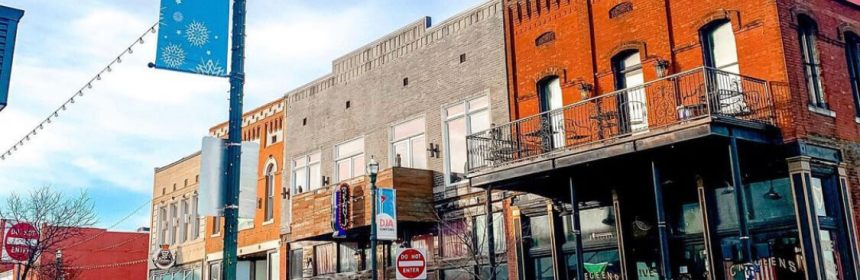
Pedestrians walk through downtown Jonesboro beneath a “Welcome to Downtown Jonesboro” banner, highlighting the connection between Arkansas State University and the local community. Photo courtesy of Arkansas State University.
JONESBORO, Ark. — As Arkansas State University continues to grow alongside the city of Jonesboro, students and community leaders say the relationship between campus and community is evolving, but not without challenges.
From economic inequality to shifting social values, both groups are working to better understand their roles in a shared space. While students often focus on academics, identity and campus life, many Jonesboro residents are more concerned with jobs, healthcare and the rising cost of living, highlighting a need for stronger collaboration.
Local organizations say collaboration is critical as community needs continue to grow.
At the Jonesboro Human Development Center, officials say demand for services has increased in recent years, creating new challenges for staffing and care.
“We are struggling to hire people to provide hands-on care for adults with disabilities,” said Diane Keith, a nursing home administrator at the facility. “We need employees with a CNA license.”
Keith said the center also maintains a waiting list for services, reflecting a broader need for support across Northeast Arkansas. She said A-State students help fill some of those gaps through internships in nursing, dietetics and speech therapy.
“We receive several A-State students for internships,” Keith said.
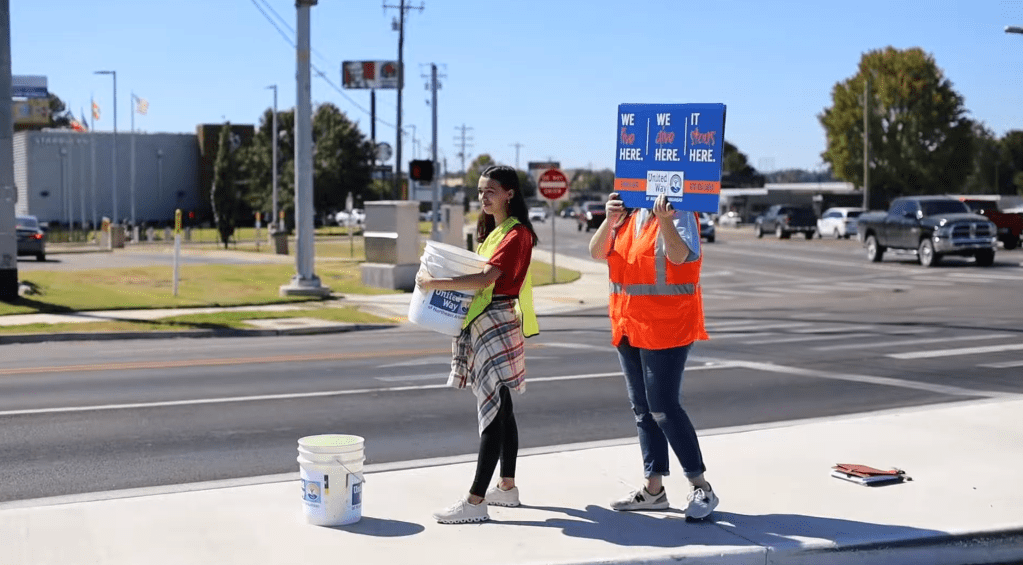
Volunteers request roadside donations for the 2022 United Way Day of Caring. More than 500 volunteers attended the event in 2022. Photo courtesy of UWNEA Jonesboro YouTube Channel.
Community leaders say those partnerships are key, but there is still room to grow.
Heather Coats, executive director of United Way, said A-State has already made strong efforts to connect students with the community.
“I think what’s important, and A-State already does a great job of this, is letting students, especially young adults, know what resources are available,” Coats said.
However, she believes the responsibility does not fall solely on the university.
“I think the community could do a better job of being present on campus when it’s not just for sporting events,” Coats said. “We need to have more of a presence that isn’t just about our own entertainment.”
Coats said increased engagement from Jonesboro residents could help integrate students into the community and encourage long-term involvement.
Erin Calhoon, development director for United Way, said improving awareness is essential to strengthening that connection.
“I would say finding ways for people on A-State’s campus to be more aware of what’s available in the community,” Calhoon said.
Student leaders agree that awareness remains one of the biggest barriers.
Jaycee Davis, president of Volunteer A-State, said her organization has made it a priority to connect students with local opportunities.
“Our mission last year was to connect campus to the community,” Davis said. “We had organizations from Jonesboro come to campus, and we introduced ourselves and shared how we could help each other.’
“Our goal this year is to have students make a bigger impact in the Jonesboro community by making them more aware of volunteer opportunities,” Davis said. “So many students don’t know what’s available in Jonesboro.”
Davis said students can get involved through activities like packing food boxes, participating in community events and supporting organizations like Hope Found, which raises awareness about human trafficking.
“Right now, the community gives a lot to the campus, which is great,” Davis said. “But I think our mission moving forward is to give that same energy back.”
Lavonda Evans, an instructor of sociology and criminology at Arkansas State, said differences in age and life experience often shape priorities.
“Students are in that space between being supported by their families and stepping into the real world,” Evans said.
Evans said campus conversations often focus on identity and diversity, while broader community concerns center on economic stability and infrastructure. She said there is a growing shift toward individualism.
“Everything is more individualized and specialized, which creates less collective support,” Evans said. “People tend to focus on their immediate circles rather than the community as a whole.”
Despite those differences, Evans said collaboration is both possible and necessary.
Click to View!
“Jonesboro is already making efforts to connect the campus with the city,” Evans said.
She said projects like walking trails and plans to better link the university to downtown are some examples of this effort.
Evans said expanding paid internships or job-shadowing opportunities could help students gain early experience while strengthening ties to the community.
“Overall, both city and university leaders are making strong efforts to connect students and the community, but there is always room for improvement,” Evans said.
As both sides continue to grow, leaders agree that bridging the gap will require greater awareness, stronger partnerships and a shared commitment to engagement on campus and in the community they will eventually call their own.
JONESBORO, Ark. – The Arkansas State University Museum is not only a place where people can see parts of history, but also an educational resource for teachers, professors and students.
Many students spend four or more years at A-State without visiting the museum, missing a valuable interactive educational experience that could help them better understand what they learn in history classes. The museum focuses not only on Arkansas history, but also on preserving and showcasing the history of northeast Arkansas and the Delta region.
The museum serves as an informal learning environment, according to Elisabeth Engel, director of the A-State Museum.
“You don’t have to be here. It’s not like class,” Engel said. “So, you know, we value the people that come through because they’ve made an effort to come see us. We hope that they walk away feeling like that effort to brave campus, find a parking spot, and all of those kinds of things, in our particular environment, was well worth it.”
Students, faculty, staff and Jonesboro residents can visit the museum on their own or book a tour with Jill Kary, curator of education at the museum. For teachers and professors, the experience can be especially valuable.
Lillie Fears, professor and interim director in the School of Media and Journalism, brings her classes to the museum every semester to help students understand historical events in ways a textbook cannot.
“My favorite part about taking students to the museum is seeing their reactions when they see something old that we’ve talked about in class, or that is mentioned in our book or in a documentary. These types of experiences can allow them to step out of present-mindedness and to realize how the tools and technology they use in modern times evolved at different eras in U.S. and world history,” Fears said.
Many groups, Engel said, visit the museum with a specific purpose. For some groups, Engel pulls artifacts from storage and creates a “mini exhibit” tailored to their interests.
Fears prefers tours focused on communication history and artifacts, so Engel often brings out old newspapers, cameras and photographs for her students.
“I really appreciate how the director, Elisabeth Engel, is always willing to bring out old artifacts that pertain to mass communications and provide us with special lectures on the history of these media tools. A textbook or video could never do what she and Jill Kary, education coordinator, do for my classes,”
For some students, a focused tour helps them better understand what they have been learning in class.
“It made a lot of the concepts feel more real. In class, we talk about the history of media, but actually seeing the artifacts and examples in person helped me connect everything more clearly, especially how media has evolved and impacted society,” Kaysen Lomax, a junior creative media production major from Jonesboro, said.
For other students, seeing everything the museum offers gives them a perspective they otherwise might not have considered.
“Yes, I did thoroughly enjoy the tour Dr. Fears took us on. Seeing how passionate Jill Kary was about the black business district was inspirational. I enjoyed looking at all the old pictures of old businesses and equipment/technology, and find it crazy to see how much those things have changed,” Alexander Riggs, a junior creative media major from Forrest City, Arkansas, said.
While the museum serves as a tool for professors on campus, teachers in surrounding school districts also can use it as a resource.
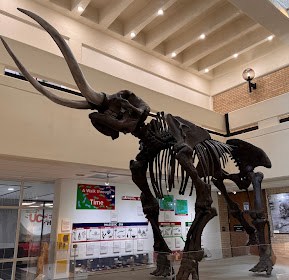
Photo courtesy of Arkansas State University.
Traveling suitcase exhibits are smaller exhibits teachers can check out for two weeks at a time. They offer hands-on materials, visual aids and lesson plans for each exhibit. Teachers can choose from five options, including Pioneer Living, Portals of the Soul: Native American Culture, World War II on the Arkansas Homefront and more.
“All of them are linked to the educational standards that are dictated by the state,” Kary said.
Visitors can also explore the tinkering studio to test whether they have the same innovation skills as people on the Arkansas frontier.
“If the kids have been paying attention, in every gallery they’re seeing innovation happen,” Kary said. “So they are told to invent things, make something, and if it doesn’t work, tweak it, fix it.”
Learning does not just happen in the classroom; it can happen in many places, including the museum. And learning is not just for students. Anyone who visits the museum is welcome, whether for a specific purpose or simply for fun.
Schools across Arkansas are learning to embrace the natural state’s top crop as the Rice in Schools program pilot run continues.
The Arkansas Rice in Schools program, launched by the Arkansas Department of Agriculture in collaboration with Arkansas Rice and USA Rice, is an initiative to teach students how to cook with rice and educate them on the significance of the grain.
Leslee Tell, the farm-to-school coordinator for the United States Department of Agriculture, directs the program. She said Rice in Schools will teach students where their food comes from.
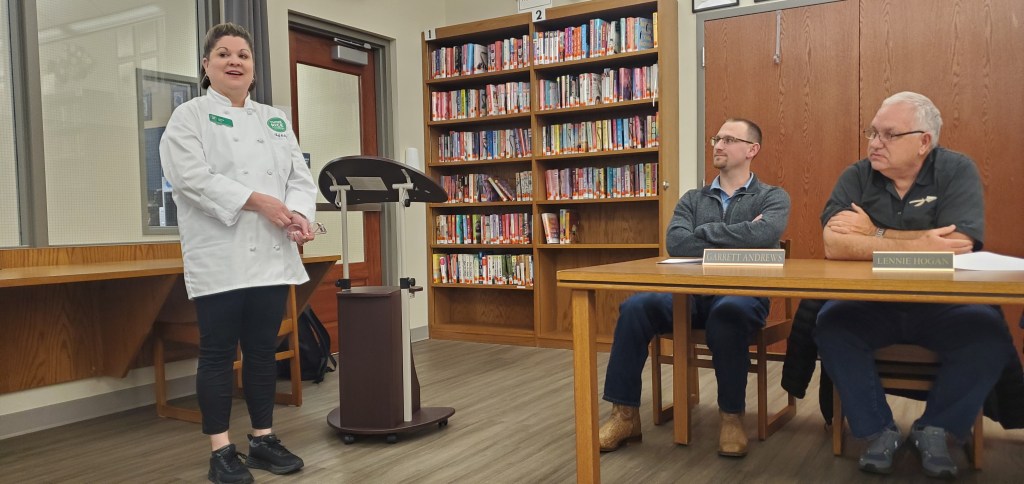
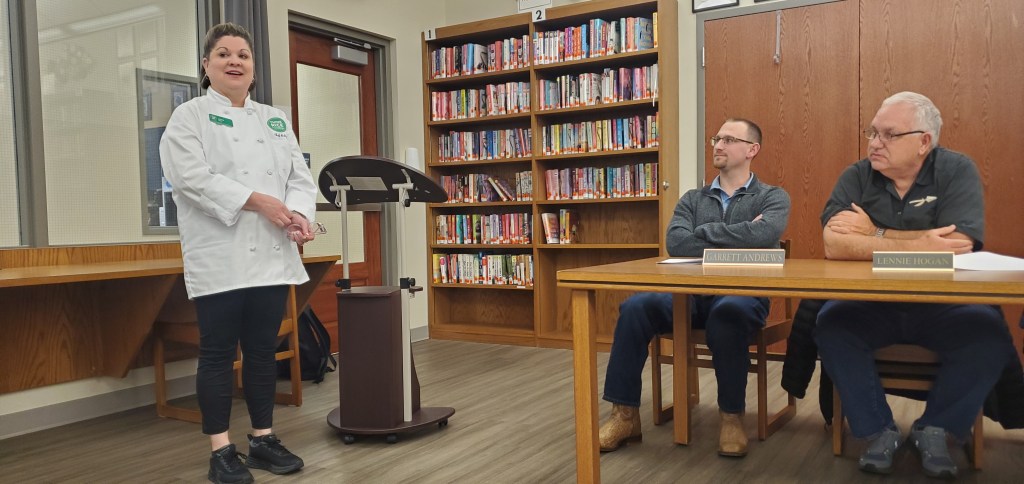
(Left) Leslee Tell, farm-to-school coordinator for the United States Department of Agriculture, describes the Rice in School Program to the Nettleton School Board at a March 17 meeting. According to the USDA website, the program, which is in a pilot phase, gives schools the tools to serve locally grown rice in healthy meals. PHOTO COURTESY OF JERRY DON BURTON
“Our goal is simple, increase the use of Arkansas-grown rice in schools, while helping students learn about agriculture, nutrition and where their food comes from,” Tell said in a YouTube video introducing the program. “This program is about more than just meals, it’s about connecting students to Arkansas agriculture and supporting our local farmers.”
Arkansas Governor Sarah Sanders developed the program in fall 2025, following the transition of nutrition programs to the Arkansas Department of Agriculture.
In December 2025, the Arkansas Rice Research and Promotion Board approved $15,000 in funding to support the program’s implementation. These funds provided schools with equipment to encourage the usage of Arkansas rice in their menus.
Sanders said the new program will teach students how farmers use rice to feed families around the world. She said students will use food made in Arkansas to develop healthy eating habits.
“Rice isn’t just part of Arkansas’ economy; it’s part of who we are,” Sanders said in a press release published Nov. 13, 2025.
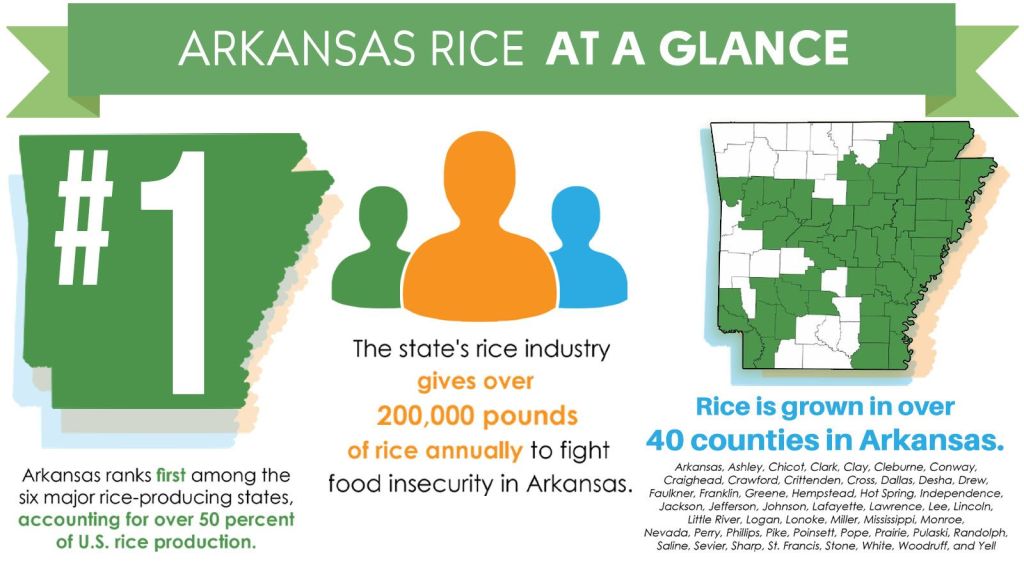
Arkansas is the largest rice-producing state, accounting for more than 40% of rice production in the United States, according to Arkansas Rice. Tell said a majority of this rice is produced in Arkansas’ northeast region.
A graphic presents quick facts about Arkansas rice production. Arkansas is the largest rice-producing state, accounting for more than 40% of rice production in the United States, according to Arkansas Rice. GRAPHIC COURTESY OF ARAKNAS HOUSE OF REPRESENTATIVES
Almost 20 Arkansas schools and districts are scheduled to participate in the program’s pilot phase, which began in February at Ward Central Elementary in Cabot, Arkansas. The pilot will wrap up in May at Forest Park Elementary in Little Rock.
As part of the program, Tell travels to participating schools with a team to involve students in cooking demonstrations and interactive educational lessons. She also introduces meals with local rice to school menus and trains cafeteria staff in preparing them.
On April 9, Tell traveled to Newport, Arkansas, to introduce the program to students at Newport High School.
Leanne Bradley, the family and consumer science teacher at Newport High School, said Rice in Schools was a beneficial experience for her students.
Bradley said rice’s significance to Arkansas demonstrates the program’s importance.
“I think everybody is aware that if you don’t take care of what you have, you can lose it,” Bradley said. “(Rice) is something that we have that not every other state has.”
Bradley said her food production and culinary students passed out stir-fried rice samples Tell made for elementary students. After sampling different meals made using rice, students placed stickers on a bulletin board to indicate how much or little they enjoyed the meals.
Tell said they compile student opinion data from every participating school. Then, in June, she said they will analyze the data to determine which recipes students liked most and least and make appropriate changes.
Bradley said the students greatly enjoyed the Rice in Schools program. She said her students cooked with rice before, but Tell’s contributions provided them with new ways to use the grain.
The family and consumer science teacher said she appreciated how the program helped her students realize how much rice Jackson County, where the Newport School District is located, produces.
According to the 2022 USDA Census of Agriculture, Jackson County produced almost 80,000 acres of rice, second only to soybeans.
“So just for the kids to realize this is a huge staple that Arkansas provides for the state, and it’s easy and it does not have to be Minute Rice,” Bradley said. “It really doesn’t take that much longer to actually cook your own rice and the quality is just so much better.”
Julie Isbell, superintendent at the Harrisburg School District, where Tell visited in March,
also said she loved how the program connected her students with local rice production.
Poinsett County, where Harrisburg is located, produced about 90,000 acres of rice, according to the same USDA census.
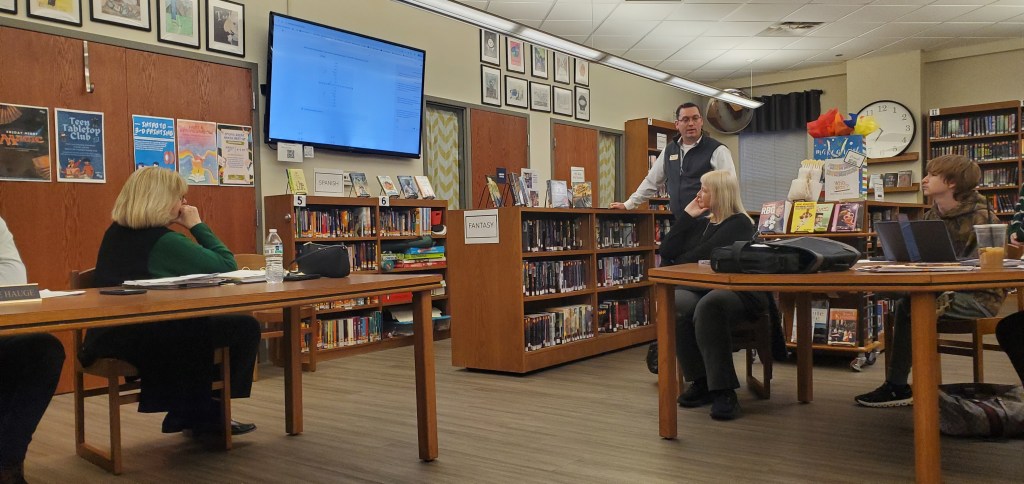
Tell also brought the program to the Nettleton School District in March. Nettleton School Board Vice President, Donnie Hauge, said he supported the program and thinks helping kids learn cooking skills and understand where their food comes from is an important undertaking.
Wes Ward, Arkansas secretary of agriculture, said the program emphasizes how Arkansas’ dominance over rice production could be used to support students and education. He said the program is a good step toward getting Arkansas to buy and use more of its own rice.
Bradley said rice is also versatile and can be stretched further than other ingredients. She said this is especially important for those who cannot afford as much food.
“It’s a very quick and easy staple that you can keep in your pantry and it can go for a wide variety of different types of food,” Bradley said. “If your family is financially disadvantaged, you can pair beans and rice together, and that actually makes a complete protein.”
Bradley said her favorite part of the program was how it helped students interact with and cook rice in different ways than they’re used to. For some, Bradley said this program represents an introduction to rice as an ingredient.
However, the family and consumer science teacher said Tell’s visit to Newport was not without challenges.
Tell was scheduled to return to Newport High School on April 10, but Bradley said she fell ill and missed the second day.
“She could have talked so much more and given the information about it. She did not get to go into depth like she would at other places,” Bradley said.
In the time they did spend together, Bradley said Tell was a very energetic and fun, but professional person to work with.
“I think she’s phenomenal and I liked having the opportunity,” Bradley said. “I hope that this is something that takes off and is able to be utilized in schools across Arkansas.”
Tell said the student feedback, recipe evaluations and participation data gathered in the pilot will refine the program and prepare it for statewide expansion.
In the final iteration of the program, Bradley said she would like to see taste testing and activities for all grade levels.
Tell said the program continuously searches for and develops new and more effective methods of engaging schools.
Bradley said the school will continue building on the foundation laid by Tell and the Rice in Schools Program. She said the school’s student-run restaurant, the Hungry Hound Cafe, started implementing rice meals based on what they learned from the program.
Tell said she is a teacher at heart and loves to cook, so working with students to prepare recipes in the classroom was a great combination.
“We are bringing Arkansas-grown rice to schools across the state,” Tell said. “One plate at a time.” More information about the Rice in Schools program may be found on the Arkansas Department of Agriculture’s website. Program organizers also created a digital guide featuring rice data and recipes from USA Rice.
Photos and Story from DDNS Reporter Jerry Don Burton
March 18, 2026
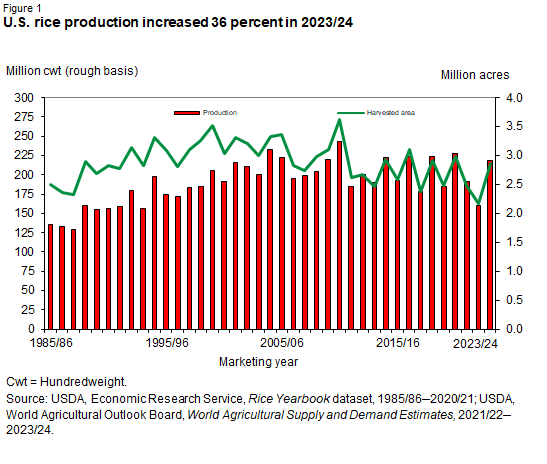
Bar graph depicts U.S. rice production (red) and harvested area (green) from the years 1985 to 2024. Rice production increased by nearly 1 million acres between 2023 and 2024. Courtesy of the United States Department of Agriculture.
The Nettleton School Board heard presentations on an initiative to educate students about rice and effective AI use in classrooms at its monthly meeting.
Rice in Schools Pilot Initiative
(Left) Leslie Tell, farm-to-school coordinator for the United States Department of Agriculture, explains the Rice in School program at the Tuesday, March 17, Nettleton School Board Meeting. According to the USDA website, the program, which is in a pilot phase, gives schools the tools to serve locally grown rice in healthy meals. Photo by Jerry Don Burton.
Leslee Tell, farm-to-school coordinator for the United States Department of Agriculture, addressed the board at the meeting Tuesday, March 17, to provide an overview of the Rice in Schools program.
Tell said the initiative aims to provide schools with the resources to serve local rice and educate students about the significance of rice in Arkansas. She said Arkansas Governor Sarah Sanders saw the importance of rice in the state and developed the initiative in fall 2025.
“So her idea was that, number one, students know where their food is coming from. Number two, that it’s local food as much as possible,” Tell said. “If we’re growing this much rice, then we should probably be serving rice and teaching kids to love rice as well.”
According to the USDA, the United States accounts for less than 2% of global rice production, but ships 5% of global exports. Arkansas is the largest rice-producing state, accounting for more than 40% of rice production in the U.S.
Tell said a majority of rice production in Arkansas is concentrated in the state’s northeast region.
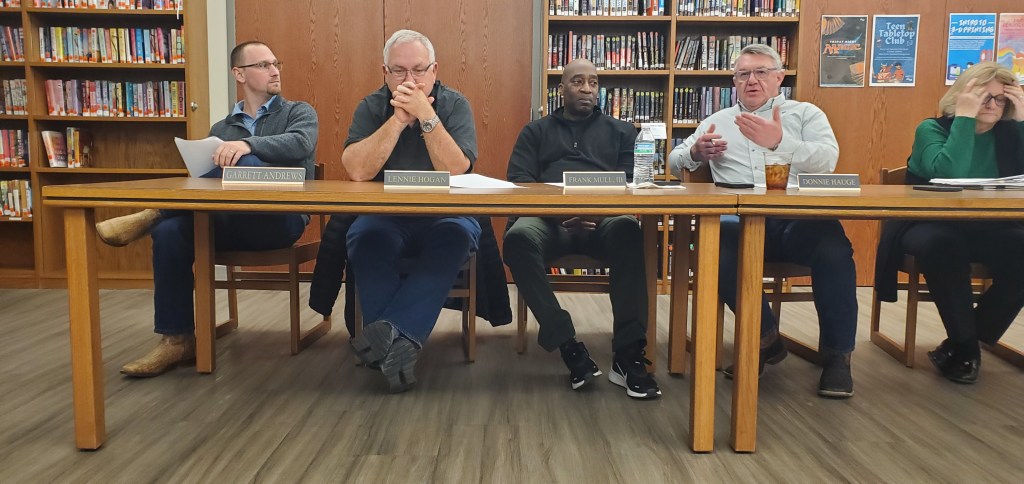
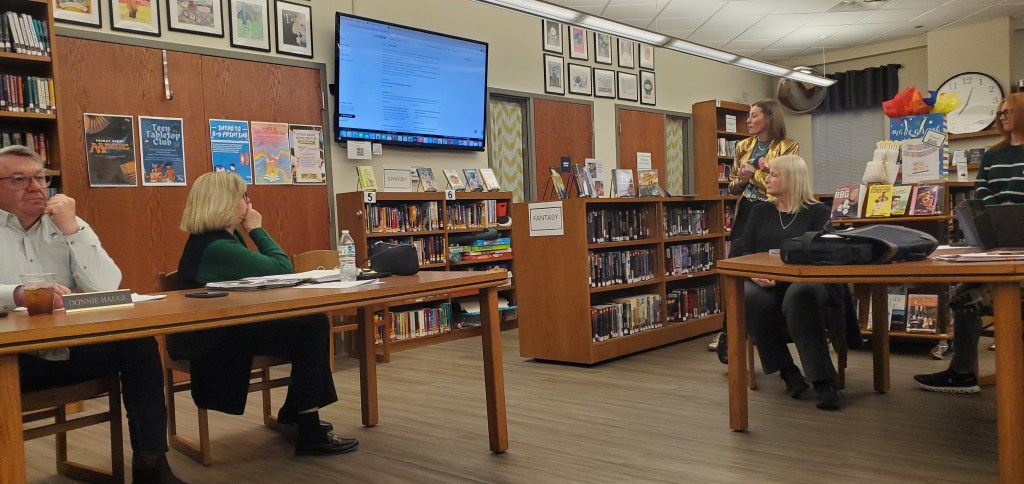
(Third from left) Donnie Hague, Nettleton School Board vice president, asks USDA Farm-To-School Coordinator Leslee Tell a question about the Rice in Schools program. Photo by Jerry Don Burton.
Donnie Hauge, Nettleton School Board vice president, said a program for helping kids understand where rice comes from and how to cook with it is a great idea.
The farm-to-school coordinator said about 20 schools have signed up for the program.
Participating schools will introduce classroom lessons on Arkansas agriculture, participate in hands-on cooking demonstrations, train cafeteria staff and include local rice in school meals at least once a month.
Tell said schools may also engage in taste tests and interactive experiences. She said the program is continuously expanding and introducing new ways to highlight Arkansas rice.
One such development is the creation of a cookbook containing 50 rice recipes for students to take home and prepare with their family.
“In the food banks and blessing boxes, there’s a lot of rice,” Tell said. “ If you have kids wanting to eat rice at school and they’ve made it at school, they get their recipe book, and they can go home, and maybe that bridge can happen between the parent and the child, and we could encourage that.”
Tell said the program also engages with the current national interest in eating real food.
“You can’t get any more real than this,” Tell said. “We’re eating real food, we’re eating real rice, real chicken, real vegetables and we’re making it right here from scratch, in front of the kids.”
Currently, the initiative is in a pilot phase. Tell said feedback from participating schools will be used to improve the program and shape future expansions.
Effective AI Usage in Classrooms
Following Tell’s presentation, the Nettleton High School principal, elementary school principal and three junior high school students addressed the school board to explain how they’ve implemented artificial intelligence in their respective fields.
Philip Cook, Nettleton High School career and technical academy principal, said he and other educators use AI to increase productivity and generate content. He said he uses AI to outsource elements of his workflow.
(Right) Philip Cook, Nettleton High School career and technical academy principal, explains how the high school uses AI coaching assistant Edia to those in attendance at the Nettleton School Board meeting. Cook said AI, when used properly, helps educator lessen their workload. Photo by Jerry Don Burton.
“What we do at NHS right now is we have teachers that use it to generate worksheets. We use it for coaching students and to help with our summative evaluations,” Cook said. “Then also, to look at and align some of our different curriculum with each other.”
The high school principal said projects like creating curricula that meet various standards, something which could take all summer to complete, are achievable in a single weekend with AI like ChatGPT.
Cook said Nettleton High School is also incorporating Edia, an AI coaching assistant, in the classroom.
Despite embracing AI, Cook said education will always need a human element.
“That’s what we’re trying to do in our critical algebra is not just turn it over to the AI–because then we become a facilitator–but use that where it’s appropriate to support that learning and then go ahead and let the teacher break kids into small groups, interact with them, give them those alternative learning methods,” Cook said. “I think it takes a good marriage of both to really be as effective as we can.”
University Heights Elementary Principal Sarah George said she uses Upraiser, an AI software designed to enhance teacher evaluations, in her administrative duties.
(Right) Sarah Geoge, University Heights Elementary principal, explains how she uses Upraiser AI when giving teacher evaluations. She said she uses Upraiser to provide actionable feedback to teachers. Photo by Jerry Don Burton.
“This platform has really helped, because it’s narrowed down the feedback that is given to teachers because it’s directly aligned to standards,” George said.
Garrett Andrews, the newest member of the Nettleton School Board, asked George if the AI she uses is accurate. George said Upraiser is mostly accurate, but agreed with Cook that a human element will always be necessary.
The elementary school principal said she is transparent with teachers and lets them know when the feedback they receive is partially AI-generated.
After George’s report, Nettleton Junior High School students Collins Baker, Jace Stegall and Brik Hogan presented a slideshow to detail how they use AI.
Baker said she learned how to use AI in 2025 and mostly utilizes it as a search engine, like Google. She said, while a helpful tool, AI can nonetheless introduce biases in its responses.
Stegall said he uses AI for coding help and in certain class assignments, specifically one project using drones to map hazardous conditions in Jonesboro.
“We want to know how to use it right, how to use it responsibly and how to use it for our school work instead of cheating,” Stegall said.
Hauge said the students’ presentation taught him how they use AI not for short answers or cheating, but productively and responsibly.
Other business
In other business, Athletics Director Tommy Raffo announced several upgrades and additions to the athletic facilities:
New track and field sand pit
New baseball bullpen
New televisions installed near concession stands
New and updated spirit banners installed in gym
Raffo also said he was proud of the boys and girls basketball teams, who were seeded fourth and second in the state, respectively.
Finally, the Nettleton High School Choir performed three songs ahead of the school’s production of “Hairspray.” Showings will be held April 24 and 25 at 7 p.m. and April 26 at 2 p.m. More information may be found on The Raider Spotlight’s Facebook page. The next school board meeting will be held at 6 p.m., April 21, at the Nettleton Central Office.
The Arkansas State University (ASU) System Board of Trustees named Robin Myers to return as interim president.
Myers, who previously served as ASU system interim president in 2024, was again named to the position on Dec. 12, 2025, following the previous president’s resignation. He said he was honored to return.
Jeff Hankins, ASU system vice president for strategic communications and economic development, said the chancellors and system staff were relieved by Myers’ second appointment. He said they are confident he was the best individual to step back into the interim president role.
“Dr. Myers is a calm, steady force who’s very experienced,” Hankins said.
In his role, Myers said he is responsible for enacting board policies and overseeing the operation of the system office as it interacts with each campus under the ASU system.
Regardless which campus they belong to, Myers said, students should know the ASU system works on their behalf to support and assist them.
“There is a group of people working on their behalf and I think that’s important to understand for students,” Myers said. “Unfortunately, because we are remote from the campuses, it is hard to have that interaction with students.”
Despite this limited contact, Myers said over 30 years of interactions with students in various educational positions gave him the experience needed to succeed as interim president.
Myers served as chancellor of ASU-Mountain Home for 11 years from 2012 to 2023, where he said he learned how students integrate and work together with campus operations.
“I think those are the things, just having that exposure and experience over the years, that provide me with a good background to understand what our campuses are going through on a day-to-day basis and the kinds of support and conversations that they need from me,” Myers said.
As a child, Myers said he worked closely with his dad’s business, gaining experiences and opportunities that shaped his current skill set.
The interim president said his greatest strength is his ability to listen to people and understand their perspective. He said he is not quick to judge or make decisions, but instead exhausts all information on a topic before moving forward.
However, Myers said his methodical nature is sometimes a weakness.
“I try to maybe do too much or get too involved sometimes, just because I want to help and assist,” Myers said. “Maybe I should take a step back occasionally.”
Jerry Morgan, ASU system board of trustees chair, said the board named Myers because of his previous experience as interim president and comprehension of system priorities.
Hankins said the board of trustees turning to Myers again is a significant compliment. He said he does not recall any particular challenges from Myers’ first appointment as interim president.
“If anything, we came away disappointed that he couldn’t have stayed on as president,” Hankins said.
The interim president said it’s too soon to tell if his current appointment will be different or similar to his first, although the circumstances are similar.
Myers was first named interim president in 2023, following the resignation of the second system president, Chuck Welch.
In 2024, Myers stepped down after the board completed its search for a permanent system president, naming Brendan Kelly to fill the position. However, Kelly resigned in early December 2025 upon being offered to serve as president of Eastern Michigan University, his alma mater.
Myers said he enjoyed his time working with Kelly through both transitions.
“Just an exceptional person, incredible skills and ability,” Myers said. “To be able to go back to his hometown and the school in which he graduated and be the president of that, no one can blame him.”
Hankins said the board of trustees held a special meeting to accept Kelly’s resignation. Soon after, at the next scheduled meeting, the board named Myers to be interim president.
Myers said the timing of the transition required him to pivot quickly.
“In addition to trying to transition and get an apartment and get moved to Little Rock, I had to also try to celebrate the holidays with my family,” Myers said. “It was a challenge, but it was also exciting and it worked out perfectly.”
In a statement published after Kelly’s resignation, A-State Chancellor Todd Shields said continuity of purpose is vital during system president transitions.
“As the trustees identify a new system president, our job is to stay the course and stick to the vital mission of educating tomorrow’s leaders and bridging our four-year and two-year colleges, industry and workforce needs for the ultimate good of Northeast Arkansas and the entire state,” Shields said.
Myers said he wants to be remembered as someone who cared about people, supported students and worked on behalf of everyone to find the best solutions for every issue presented to him.
“In the end, everything we do is focused on providing the best educational experience and opportunities we can for our students,” Myers said. “It is both an honor and a privilege to get to work with these folks.”
Myers will serve as interim president until the board of trustees completes its search for someone to fill the position in a long-term capacity. The board will meet again Feb. 13 to outline next steps in the search for an ASU system president.
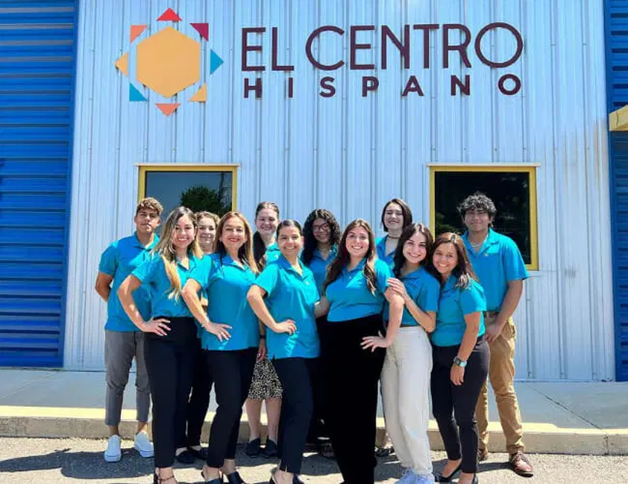
Staff members from the Hispanic Center pose outside their facility in Jonesboro, highlighting the organization’s role in supporting local families amid growing community concerns. Photo courtesy of The Hispanic Center via Facebook.
JONESBORO, Ark. — As immigration enforcement concerns grow in Jonesboro and across the country, leaders at the Hispanic Center say fear keeps some families from going to school, seeking medical care or accessing basic services. Immigration enforcement policies and increased activity by Immigration and Customs Enforcement have created uncertainty for many immigrant families, including those in northeast Arkansas.
The Hispanic Center is a nonprofit organization that serves the Hispanic community in Jonesboro, as well as others in need. The center offers services such as after-school programs, interpretation, translation, English classes, computer training and health fairs. The center also provides legal consultations, mental health sessions, and community events, while assisting families with food, transportation and housing support.
Carolina Elmore, assistant director at the Hispanic Center, said, “We serve the Hispanic community primarily, but we help anyone in need regardless of ethnicity, religion or race.”
Elmore said the Hispanic Center is a place she wants people to feel they could depend on anytime.
“We provide interpretation in hospitals, schools and legal settings so people who don’t speak English can still access essential services. Language is one of the biggest barriers, and we try to bridge that gap every day,” Elmore said.
Elmore said the Hispanic Center acts as a bridge between schools, the Hispanic community and local institutions. The center partners with local universities and organizations to provide students with educational support and expose them to career opportunities.
Elmore said one of the biggest challenges for the Hispanic Center has been increased activity by Immigration and Customs Enforcement.
“A lot of people are afraid to seek services because of immigration concerns. Some parents are even scared to send their kids to school or go to the doctor. We try to create a safe space where families feel supported despite those fears,” Elmore said.
Due to concerns about ICE, many community members are afraid to seek help or services at the Hispanic Center out of fear of being detained. That fear reflects what many immigrant communities are experiencing across the country, where enforcement actions can affect access to education, health care and other essential services. The center often works with churches and community partners to provide safe spaces and trusted environments for families.
“We help families with everything, from enrolling their kids in school to making doctor’s appointments. Sometimes it’s as simple as helping fill out a form, but that can change everything for a family,” Elmore said.
Elmore said she wants to continue serving her community during challenging times tied to immigration enforcement.
“Everything we do is about helping families feel supported, connected and valued in this community,” Elmore said.
Leo Hernández, program coordinator, helps facilitate the after-school program, which allows children to catch up on homework and receive tutoring.
“La Escuelita is here to support kids from kindergarten through ninth grade with their homework and academics. A lot of parents can’t help their kids with schoolwork, so we step in to guide them,” Hernández said.
La Escuelita runs Monday through Thursday during the school year and is divided into groups by age, allowing younger and older students to receive the support they need. Students work on subjects such as math, reading, writing, Spanish and public speaking, while also building communication and teamwork skills. The program also includes a summer component that helps students stay on track in a more engaging environment.
Hernández said the Hispanic Center also has a program called HELP, which gives high school students opportunities to explore life after high school. He said the program allows students to complete community service hours while visiting college campuses and local institutions.
“We’re not just helping with homework, we’re giving kids opportunities they might not have otherwise. It’s about building a foundation for their future,” Hernández said.
Hernández said education and guidance are some of the biggest needs in the Hispanic community, especially for students who struggle with English and need additional support.
Hernández said he wants the community to feel like a safe place where families can feel at home and that many people simply need direction.
“What’s happening with immigration affects families, especially the kids. We always encourage people to seek legal advice and handle things the right way. At the end of the day, we’re here to help people grow and succeed,” Hernández said.
Yesenia Dixon serves as a front desk receptionist, interpreter and after-school teacher at the Hispanic Center.
Dixon said many children struggle to express their emotions, and the center helps them build communication skills.
“It’s rewarding to see their faces light up when they realize they can do something,” Dixon said.
Dixon said she enjoys interpreting people but she also knows it is serious because she serves as the voice for others.
“I’m usually the first person people see, and they come in upset or needing help. I try to calm them down and let them know they’re in a safe place,” Dixon said.
Dixon said increased ICE activity has heightened fear in the Hispanic community, with some people choosing to handle everything virtually.
“During stressful times, we focus on giving people factual information so they don’t panic. There’s a lot of fear, so it’s important we don’t spread misinformation,” Dixon said.
Dixon said even if she does not have an immediate answer, she works to help people find one.
“We’re not just a place for handouts, we’re here to support people. We want to be known as a place where people can come without feeling judged,” Dixon said.
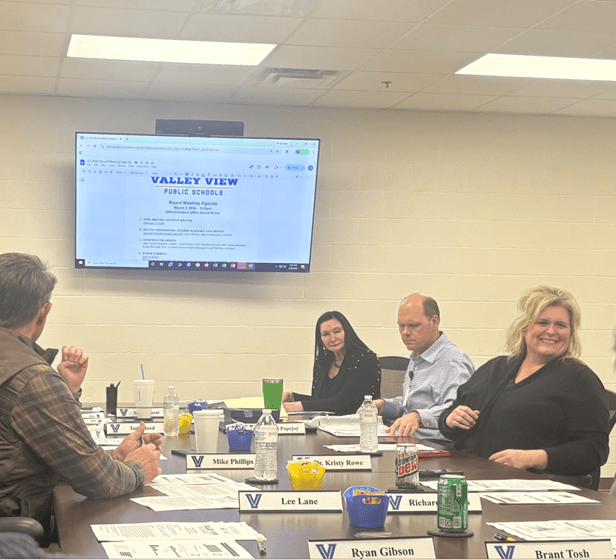
Members of the Valley View School Board, as well as Superintendent Roland Popejoy (second from right). Photo by Benjamin McDowell.
JONESBORO, Ark. — The Valley View School Board honored longtime member Richard Rogers, celebrated the success of the theater program, and approved major technology purchases during its recent meeting.
The board recognized the Valley View theater program, which took its one-act play Eurydice to competition in Russellville and earned a score of 97 out of 100. Judges selected the group as one of four schools in the state to showcase their one-act play at the State Thespian Festival in February.
Students later performed in Springdale, receiving a superior rating, along with awards for ensemble work and music design, and earned $100,000 in scholarships for theater education.
The board also heard updates on the Fine Arts Center lighting project, which improved stage and auditorium lighting for performances. The new lights allow different colors, enhancing plays, festivals, and shows.
Chromebook purchases and finances
The committee reviewed financial reports showing a $2.7 million deficit due to building project expenditures, though revenue collections are currently 51% ahead of budgeted expenses. Members approved the purchase of 750 Acer 514 Chromebooks for $373,525 and 250 Lenovo L16 Chromebooks for $223,223, citing cost-effectiveness and vendor reliability.
Superintendent Roland Popejoy discussed the Chromebook purchases and technology replacement plan.
“I have shared with you guys previously that we’ve been working on a replacement plan for laptops. That is an area where, whenever I came into this role, it was very important for me to make sure that we work toward getting a specific line item per year for technology replacement,” Popejoy said.
Popejoy emphasized that students should have access to the tools they need to succeed.
“Previously, we made really big purchases and then kind of saw how long they would last as part of our process. I really want to make sure that we have a solid replacement plan. And so that’s what we’ve been working on. We’re moving to one-to-one,” he said.
Honoring Richard Rogers
Board members recognized Richard Rogers for his 11 years of service, noting his role in overseeing several major school projects.
“He has served on our board since October of 2011, and so this will be his last meeting. Mr. Richard Rogers has played a pivotal role in multiple things in his time here. He oversaw the building of our high school while he was on the board, also the women’s field house, the additions here at the intermediate and the intermediate junior high, and now our high school addition,” Popejoy said.
He also praised Rogers’ contributions to athletic facilities.
“In addition, one thing that I think is really important is that he has played an integral role in the efforts to improve our athletic facilities, with our turf project for our football field, baseball field and softball field,” Popejoy said. “Anybody that knows this board over the years knows Richard is a voice that a lot of people reach out to. Richard is one that has a unique way of his advocacy.”
Special education and facility updates
Special education director Carol Brown provided an overview of services.
“As of December, there were 2,827 students enrolled in our district, and out of those, there are 448 receiving special education services, which is 15.85%,” Brown said.
Brown explained that the district serves students with a variety of disabilities, including specific learning disabilities and other health impairments such as ADHD, seizure disorders, and other medical conditions. She said the district provides multiple therapists and therapy options to support students academically, mentally, and medically.
Senior project manager Angie Berryhill gave an update on facility improvements.
“What I’d like to do is dwell on the path moving forward, and our message is still the same to this board and this community, that we’re going to move as expeditiously as possible. When we understand things, we will make that known, and we’re going to be here until the very end,” Berryhill said.
Berryhill added that the improvements will not cost taxpayers extra money.
“We have processes and procedures in place now that are going to prevent things like this from happening again,” she said.
Courtesy of Jonesboro Public Schools Facebook Page
JONESBORO, Ark. – Jonesboro Public Schools launched a new counselor website and approved additional compensation for teachers who teach more than 150 students per day and more during its monthly school board meeting on March 10.
Mandy Zipful, district school improvement specialist, presented the new counselor website, highlighting the new and improved course catalog for Jonesboro High School. The JPS School Counselors’ website provides a hub for connecting students with counselors, finding mental health resources, booking appointments, accessing grades and graduation requirements, and viewing a detailed course catalog. While the site is live, the district is working to connect the site to each school’s tab.
“This is a great tool for the students and parents,” Zipful said. “We’re super proud of this work.”
Zipful highlighted the new “Academics at Jonesboro High” course catalog, noting that the old version was just a Word document, while the new one lists every course offered and includes a detailed description. The new catalog also makes it easier to find graduation requirements, concurrent credit courses at both Arkansas State University and Black River Technical College, Success-Ready Pathways, and more.
“What would it look like to be more supported socially and emotionally?” Superintendent Misty Doyle asked students. Students said to be able to better get in touch with their counselor.
The website helps students easily book appointments with their counselor in 30-minute increments. Students can schedule an appointment by going to the JPS School Counselors website, clicking “Academics at JHS,” clicking the “Counselor Appointment” tab, selecting the counselor they wish to meet with and choosing a time that works best for them. Doyle even gave an example of how a student had an appointment scheduled for 9 a.m. and was surprised to actually be called out of class on time.
During the superintendent’s report, Doyle asked Von McDaniel, director of student health services to give an update on mental health.
“As of today, we’ve had 167 student contacts for this school year. Some of them we spend a lot of time with, and some of those we don’t,” McDaniel said.
Counselors meet with and contact students for a variety of behavioral and mental health concerns. Students can meet with counselors as many or as few times as needed. While some students have the resources needed to head in the right direction, others don’t and the district recognizes that.
Photo courtesy of JPS School Counselors website. (Left) Lene Pierce, Jonesboro High School Health and Human Services counselor, and Emily Aycock, Visual and Performing Arts Magnet school counselor.
The board passed the motion to approve additional compensation for teachers teaching more than 150 students per day for the first semester in the 2025-26 school year. The JPS finance office recommended six teachers, including two from JHS, two from Douglas MacArthur Junior High School and two from Annie Camp Junior High School, for the supplemental teacher contract pay.
“A teacher is not required to teach more than the maximum number of students permitted per day under the Standards for Accreditation of Arkansas Public Schools and School Districts, but a teacher may agree to teach more than the maximum number of students permitted per day,” according to Arkansas Code § 6-17-812 (2024).
The district will pay the teachers an additional amount in addition to their regular salary, proportionate to the additional number of students they taught.
The board also passed the motion to approve the purchase of a new $153,054 77-passenger school bus.
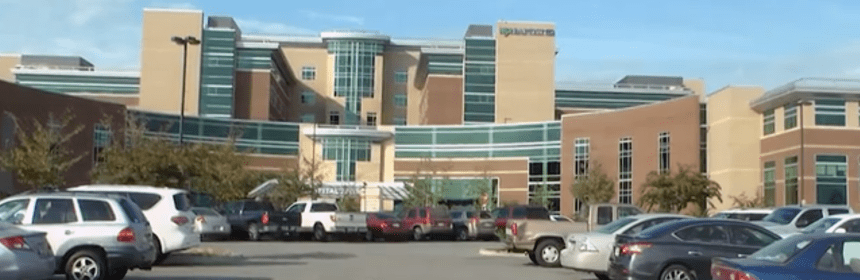
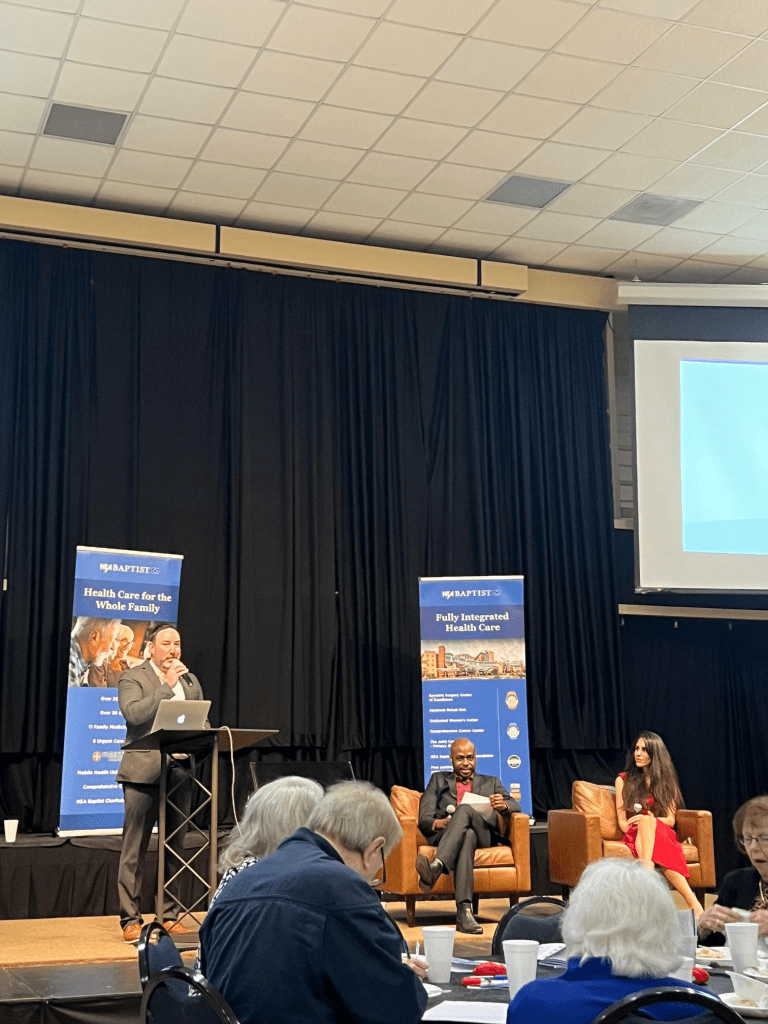
NEA Baptist hosts programs that promote heart-healthy behaviors through community screenings and educational programs that raise awareness of risk factors and promote healthy lifestyle choices.
NEA Baptist hosted a Heart Talk on Feb. 26, 2026, at Southwest Baptist Church.
Ty Jones, director of marketing at NEA Baptist, said his goal is to create opportunities for community engagement and education.
The organization focuses on community engagement and education through health screenings and risk-factor education. Outreach efforts include digital marketing, terrestrial radio, and television advertisements. Jones said balancing medical accuracy with creativity is crucial.
“As a company, we seek perfection every day, whether or not perfection is ever really attainable,” Jones said. “As human beings, we try to seek that in everything that we do. When you balance that with marketing and making sure you’re staying inside the box — which a lot of people find more difficult than just going with any creative whim — it’s a lot of fun.”
Jones said NEA Baptist always strives to partner with local schools, churches, and organizations to promote heart health and target the next generation of cardiologists.
“The big thing for us is making sure that we’re engaging students at a young age, letting them know not only what clinical health care careers look like — physicians and nursing — but also letting them meet residents to see what that educational track looks like from school to becoming a doctor,” Jones said.
Jones said balancing medical accuracy with creativity in marketing campaigns and materials helps convey heart health information in an engaging and impactful way.
“Understanding the roles in health care that may be behind the scenes — laboratory scientists who run tests to help physicians determine a patient’s root cause, as well as financial, billing, and marketing staff — is also important,” Jones said.
“Our goal at the end of the day is to take care of our community, whether that’s patients admitted to our emergency room, patients seeing primary care providers, establishing a baseline for preventive medicine, or providing free education,” Jones said.
Jones said community impact is measured by individualized patient care and tailoring medical services to each person. Lena Awar, an interventional cardiologist at NEA Baptist, said it is important to educate people to recognize and not ignore early warning signs of heart disease, such as fatigue, leg swelling, and chest pain.
“Coronary artery disease is very prevalent in this area,” Awar said. “We live in what’s called the Stroke Belt, and part of this talk discusses risk factors that contribute to that, including hypertension, obesity, and a sedentary lifestyle. All of that increases heart disease risk.”
Awar said stress management techniques such as walking in nature, reading, taking a hot bath, or practicing yoga or meditation can improve heart health.
“In our community, recommending smoking cessation is probably the most important thing, followed by getting in those 10,000 steps a day,” Awar said.
Awar said about 50% of health outcomes are genetically inherited and cannot be controlled. However, lifestyle choices can make a significant difference.
“One thing we can control is how we live our lives — diet, exercise, and routine checkups,” she said.
She also addressed misconceptions about heart medications.
“A lot of people think of us as drug pushers who just want to prescribe another medicine,” Awar said. “We wish all our patients could achieve their goals with diet and exercise alone, but sometimes that’s not enough. Some medications, like statins, have a bad reputation, but they save lives. We work with patients to tailor medications so they maintain a good quality of life.”
Oreoluwa Oladiran, a cardiac electrophysiologist at NEA Baptist, said it is important to recognize heart disease symptoms such as chest pain and heartburn, which are often overlooked.
He stressed the need for early heart health management beginning in a person’s 30s and highlighted preventive measures such as maintaining a healthy weight, eating well, and avoiding smoking.
“Heart disease is the most common cause of mortality not only in the United States, but worldwide,” Oladiran said. “In the United States, it kills nearly a million people every year,” Oladiran said.
Oladiran said monitoring blood pressure and blood sugar levels is an effective way to track heart health.
“We see patients in their 30s having heart attacks,” he said. “The earlier, the better. Don’t wait until you’re 40 to establish care with a primary care provider and pay attention to your health. Many of these issues are lifestyle-related, not necessarily medication-related.”