Tag Archives: education

West Memphis Three attorneys participate in panel discussion

DDNS Story by Jerry Don Burton

(From left) Jeff Rosenzweig and Paul Ford listen as Dan Stidham speaks during the West Memphis Three panel discussion. All three men were attorneys involved in the defense of the West Memphis Three and were invited by the Arkansas State University Sociology and Criminology Association to attend the panel. Photo by Jerry Don Burton.

JONESBORO – Attorneys who defended three freed men convicted as teenagers, known as the West Memphis Three, spoke in a panel discussion at Arkansas State University to share insight, advice, and theories regarding the case.

The highly publicized and controversial case originated from the murders of three boys in West Memphis, Arkansas, in 1993. Damien Echols, Jessie Miskelley Jr., and Jason Baldwin were convicted of the murders, despite questionable evidence.

The A-State Sociology and Criminology Association (SCA) hosted the public panel on Thursday, Nov. 6, in the Reng Student Union Auditorium.

Stacy Dewald, faculty co-adviser for the SCA, said she wanted the event to bring attention that the criminal justice system is flawed, show wrongful convictions exist and offer new perspectives for those who still think the West Memphis Three are guilty. She said she believes the panel discussion achieved this goal.

The three attorneys who participated in the panel, Jeff Rosenzweig, Paul Ford, and Dan Stidham, began the discussion by detailing their connection to the case. Rosenzweig was on the team responsible for releasing the West Memphis Three in 2011, Ford was on the original defense team for Baldwin, and Stidham represented Miskelley as an attorney.
Ford said this case highlights the power of confirmation bias.

“Once you have this notion, all new information is going to be sorted to reaffirm whatever that notion is. If your first notion is ‘they’re guilty,’ you’re going to hold on to that,” Ford said. “So when you meet people who are less than 40 years of age and their first involvement in this proceeding was to watch the HBO documentaries, they can’t believe they were convicted. Because that was the first story that they heard, but that was not the first story that people heard in 1993.”

Ford said the citizens of West Memphis needed somebody to blame so they could feel their community was safe.
The existence of multiple potential suspects other than the West Memphis Three contributes to the controversial nature of the case and is the topic of many ongoing debates.

The three panelists said they are confident the West Memphis Three are innocent and have their own theories as to who committed the murders.

Rosenzweig said one valid suspect is “Mr.Bojangles,” referring to a bleeding man who was seen entering the nearby Bojangles restaurant about two hours after the boys were reported missing. Witnesses said the man was mentally disoriented and entered the women’s restroom. The next day, police took blood samples from the restroom that were later lost.

Ford said he has always been suspicious of Chris Morgan, a teenager who unexpectedly traveled to California with Brian Holland, another teenager, four days after the bodies were found. During questioning, Morgan said he had a history of drug and alcohol use and experienced blackouts and memory lapses. He said he might have killed the victims, but recanted this statement. This recanted statement was debated in the trial, but was found inadmissible as evidence.

Stidham said he has a suspect, a serial killer, whom he can place in the vicinity of the murders. He said he will explore the lead further and hopefully have more information to present before he retires.

Prevalent media coverage represents another element that generated controversy for the case.

Ford said national attention in the case, specifically from the media, was a double-edged sword.

“To have a CNN truck pull up outside of the courthouse in Corning, Arkansas, that’s like finding Bigfoot,” Ford said. “It was a big deal. Everywhere you went, there were reporters, cameras, people wanting interviews, producers from talk shows.”

Ford said if he could do anything differently in the trial, he would trust the media less. However, without a relationship with the media, he said, there would never have been a documentary and the West Memphis Three would still be in prison.

Dewald said the 1996 HBO documentary, “Paradise Lost: The Child Murders at Robin Hood Hills,” saved Echol’s life. Echols was the only teenager sentenced to death in the trial.

The case is also associated with the Satanic panic, due to the prosecution’s assertion that the children were murdered as part of a Satanic ritual. The Satanic panic was a social panic that began in the 1980s and continued throughout the late 1990s, involving widespread cases and accusations of Satanic ritual abuse.

Rosenzweig said some still believe the West Memphis Three are guilty for a number of reasons, ranging from having personal connections to being ill-informed.

“You’re never going to convince everyone, no matter what,” Rosenzweig said. “You just have to move on and go to the next person.”

Stidham said the use of the Alford Plea in the case is a common source of confusion that many people struggle to understand.

In 2011, the West Memphis Three entered an Alford Plea, meaning they pleaded guilty while maintaining their innocence. Judge David Laser accepted the plea, which simultaneously freed the men after serving 18 years in prison and put the case to rest.

Rosenzweig said he agrees with Stidham that the Alford Plea is a confusing part of the case and is controversial in its own right. Rosenzweig said if the state really thought the West Memphis Three killed the boys, they would still be in prison.

Ford said if the prosecution felt the teenagers actually killed the three eight-year-old boys, they should feel ashamed for letting them go free.

“Why would you ever agree to let people you think killed eight-year-olds walk free?” Ford said. “That, to me, is the greatest evidence that they really didn’t believe it.”

Scott Ellington, the prosecuting attorney at the time, said he recognized the compromise was not ideal. Still, he said, it gave the state the guilty plea it wanted and the defendants the ability to continue asserting their innocence.

“It certainly was not a perfect resolution to the case for the state, but it was much better than having three trials, trying to convince 36 jurors of the defendants’ guilt using old evidence, failed memories, changed minds, dead witnesses and the parents of two of the victims who now say they believe the defendants are innocent of the crimes,” Ellington said in a 2011 article from the Thomas Jefferson School of Law.

Rosenzweig said procedural mechanisms, which are rules designed to secure a fair and consistent application of due process, have not improved in Arkansas since the original West Memphis Three trial. He said forensic advancements make scientific evidence much more precise, but misunderstandings still persist and proliferate on social media.

Stidham said documenting is important, and interrogations should be recorded in their entirety. Ford said what he found egregious about the case was that adolescents were questioned by law enforcement without a parent present or knowledge.

The discussion ended after the panelists advised the audience on what to do if they are ever falsely accused of a crime. Stidham and Ford said to stay quiet and get a good lawyer, and Rosenzweig said to recognize that the exoneration process takes time.

Dewald, who is also an assistant professor of criminology, said planning for the event began in August, when A-State students Lesleigh Sullivan and Anna Hartley expressed an interest in the West Memphis Three for their honors project.
Dewald said she feels a connection to the West Memphis Three because she grew up around the same time and shared similar interests in music and books.

“I kind of felt connected to them, but what was different is they grew up in the South, I grew up in the North,” Dewald said. “So it wasn’t so frowned upon in the North to like Metallica and Stephen King.”

The assistant professor of criminology said the case remains nationally relevant because DNA evidence remains to be tested and many questions remain unanswered. She said community interest endures because many people feel a local connection to the case.

Stidham said interest in the case will persist for many years.

“People are going to be talking about this case in 300 years, like we talked about the Salem witch trials,” Stidham said. “It’s essentially the same thing.”

Dewald said she didn’t think the panel would draw as many attendees as it did. Nevertheless, she said she appreciates the interest and hopes the event raises awareness and helps dispel some myths surrounding the West Memphis Three and the criminal justice system.

On Aug. 1, 2025, new DNA testing for evidence from the original crime scene was ordered by Crittenden County Circuit Court Judge Tonya Alexander. At the time of writing, however, no other updates have been announced.


-30-

Freshman to Physician Partnership Formed

DDNS Story and Audio by reporter Mia Young

Young: Arkansas State University and the NYIT College of Osteopathic Medicine are working together to make the path to becoming a doctor a little bit smoother for Arkansas State students. The Freshman to Physician Pathway is a new partnership this year between A-State and NYITCOM that lets qualified students secure early admission to medical school while they are still undergraduates. Jennifer Wharton, media contact for the program, knows the ins and outs of the program and how it can help students. [0:31]

Wharton: Our goal is to help students who are interested in going into healthcare, specifically becoming a physician, become more confident and a more competitive applicant for medical school. We’re seeing a lot of need in the delta region for students who not just have an education, but have a quality education. And one of the things we know about medical education is that students who are from an area, who are able to stay in that area and go to school are going to be more likely to in turn, practice medicine in that area. [0:34]

Young: Students in the pathway will major in biological sciences with a pre-professional emphasis. If they maintain at least a 3.5 GPA, complete the required coursework, and pass an interview, they will earn a spot in NYITCOM after graduation. Program leaders say the collaboration between the two schools will give students extra mentoring, academic support, and confidence, along with peace of mind about their medical future. Jamie Howell is a prospective student for the Freshman to Physician pathway. [0:30]

Howell: I would like to do this program because it provides me with a quicker opportunity to pursue my dream of becoming a doctor. I also believe, if I understand the program correctly, that it can help you get into med school without taking the Mcat. This can be beneficial to me because I typically struggle with test anxiety and tend to not do as well as I should or as well as I believe my knowledge permits. [0:23]

For more information about the program go to AState.edu/FreshmanToPhysician. I’m Mia Young and you’re listening to KASU. [0:09]

Journalism alumna hosts 2025 Greenfield Lecture

Story by DDNS Reporter Jerry Don Burton

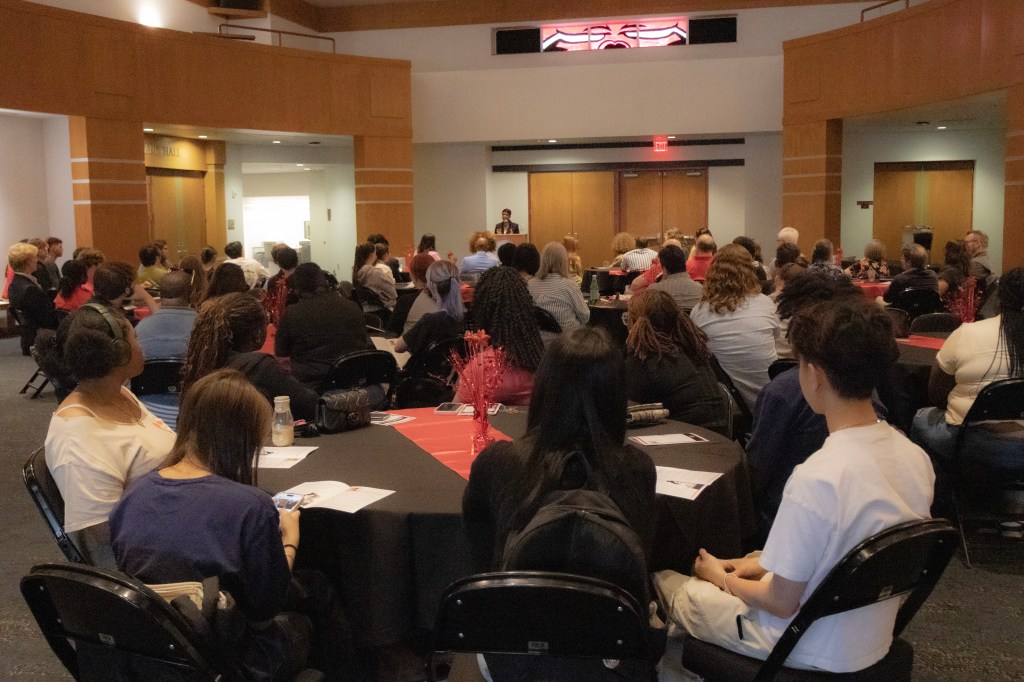
Students, faculty, staff, friends, and other Greenfield Lecture attendees listen to Rose Stuckey Kirk’s speech. Kirk is an Arkansas State University journalism alumna with a successful corporate career spanning 35 years. Photo courtesy of Ibuki Hinohara, Photo Editor, The Herald.

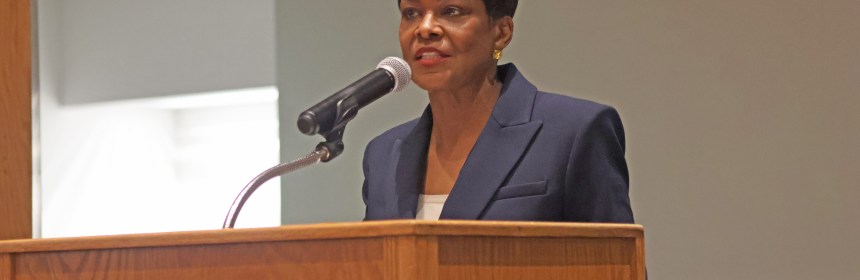
JONESBORO – Rose Stuckey Kirk, an Arkansas State University journalism alumna with a successful corporate career spanning 35 years, presented the annual Corinne Sternheimer Greenfield Lecture, sharing her journey with struggle, support, and success.

Kirk’s speech, titled “From Innocence to Innovation: A Lattice (not Ladder) Climb to the Top of Corporate America,” was given at 6:30 p.m. Sept. 17 in the Fowler Center at A-State.

Audio Story by DDNS Reporter Jerry Don Burton.

At the start of her speech, Kirk listed three things she wished to accomplish: break down the title of her speech, describe how she uses her support systems to have a successful corporate career and suggest how attendees can build on the platform of success she has laid out.

“It struck me a number of years ago that I was never climbing the corporate ladder, because when you are climbing a ladder, you are either going up or down and there are huge gaps in between those rungs and one wrong move, and you can seriously hurt yourself,” Kirk said. “Instead, I was clinging to a lattice. This grid-like structure is flexible and organic; its lines are sometimes diagonal, sometimes curved.”

The Greenfield Lecture speaker said she always made slow and steady progress, despite many missteps and lateral movements. She said that as she climbed, she never forgot her childhood aspirations.

“I never stopped remembering that little girl from Pine Bluff, Arkansas, who just knew one day she would take New York City by storm,” Kirk said.

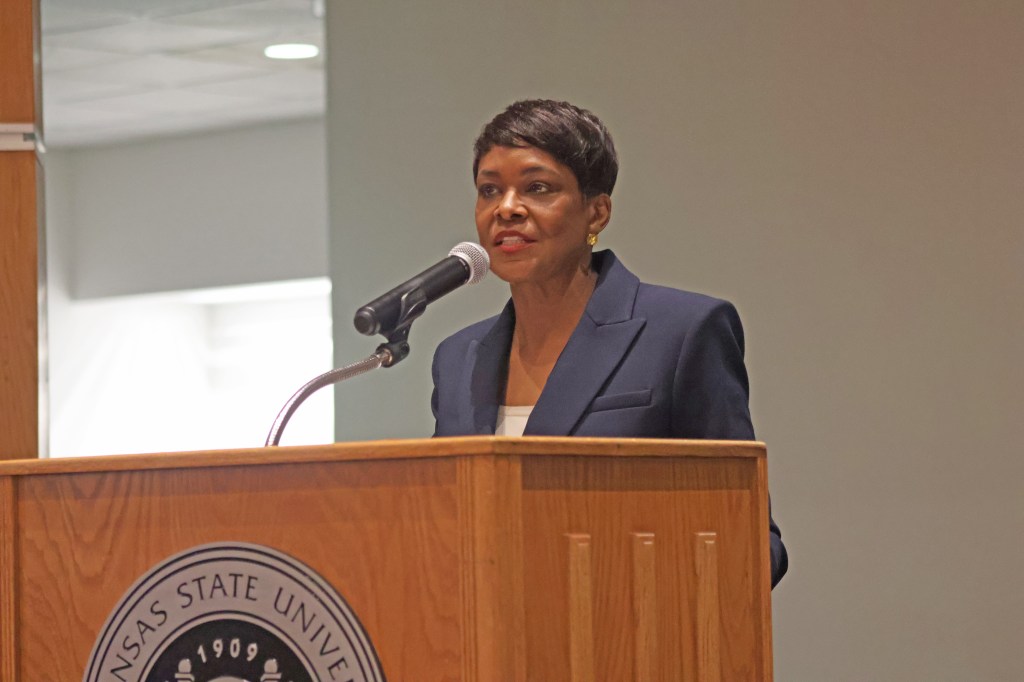
Rose Stuckey Kirk, presents her speech at the 2025 Greenfield Lecture. In her speech, titled “From Innocence to Innovation: A Lattice (not Ladder) Climb to the Top of Corporate America,” Kirk shared her journey with struggle, support, and success. Photo courtesy of Ibuki Hinohara, Photo Editor, The Herald.

Kirk said that while in elementary school, her teacher showed her class a picture of the Statue of Liberty and told everyone to remember what it looks like, because most of them would never make it to New York City to see the statue. She said this stirred something up inside her innocent self.

Decades later, Kirk said she lived in New Jersey and would drive to New York multiple times a week. Every single time the Statue of Liberty came into view during her commute, she said she would pause whatever she was doing and look at it until she could not see it anymore.

Kirk said she does not think her teacher meant any harm, but she would not let her life experiences be based upon what she saw in a book, but instead what she had personally experienced.

“Sometimes in life we look for signs, these big moments of lightning flashing or fireworks to affirm for us those dreams,” Kirk said. “But it’s often the quiet moments, the little things that come into your world that can and will set a path to live your best life.”

Kirk said her strategic mindset and self-reliance, developed from her childhood as one of eight children, helped her succeed as a student at A-State.

Lillie Fears, professor and interim director of the School of Media and Journalism at A-State, said she met Kirk when they were both undergraduates.

“I thought she was very energetic, very outgoing, popular, one of those outgoing personalities. When she said she was an introvert [during her speech], I thought, ‘you sure fooled me,’” Fears said.

Cherisse Jones-Branch, College of Liberal Arts and Communication (CLAC) dean, said Kirk’s status as an alum of A-State and CLAC set her apart from previous lecture hosts.

While hosts for the Greenfield Lecture series are not limited to A-State alumni, Jones-Branch said bringing successful graduates back to A-State to host the Greenfield Lecture is important.

“I like people like that to come back and talk to our students so that they can see what’s possible,” Jones-Branch said. “We saw someone who came from small-town Arkansas, who’s talking to students, many of whom come from small-town Arkansas. The way she was able to connect with them, because they come from the same place, was really special.”

During her time at A-State, Kirk worked at The Herald student newspaper, tutored students and attended a full course load, in addition to working as a clerk for the Social Security Administration. Kirk said college was one of the most impactful times of her life.

“I learned curiosity and how to translate that curiosity into written words that allowed me to explain both simple and complicated issues to the mass population,” Kirk said. “So you can only imagine how amusing it was to me when corporate America began to talk about attributes of successful leaders, and one of those key attributes is that great leaders, often, are great at storytelling.”

Before Kirk could face the corporate world, however, she first had to face rejection.

After graduating, Kirk said her eyes were set on working at the Southwestern Bell Telephone Company, one of the predecessor companies of AT&T. She sent her resume and was served back a rejection letter, stating they only hired people with at least two years of experience.

So, Kirk began work at the Pine Bluff Commercial newspaper. Eight months later, she moved out of state to work for The Times Daily, a set up from her hometown paper. However, she would soon face struggles again.

While working in Alabama, Kirk said she received news of her sister’s death. She said she grieved for weeks and was lost at work, which annoyed all but one of her coworkers.

She said one peer, a quiet man who was a Vietnam veteran, pulled her aside and spent time with her.

“He let me know he saw my suffering. He didn’t pry into my struggle, but instead, he told me a story about his own struggle,” Kirk said. “I learned from him the value of empathy and compassion in the workplace and the need to speak up for others when no one else will.”

Fears said the way Kirk confronted challenges, dealt with tragedy and helped others impressed her. Fears said a friend was having a hard time recently and she did not know how to help beyond listening. But, she said Kirk’s speech touched her and helped her understand what she can do to help in the future.

“It let me know that when I see somebody, it’s okay to reach out and help them,” Fears said.

While working in the journalism industry, Kirk earned awards from the Associated Press and the New York Times. Eventually, she updated her resume and applied again for a position at Southwestern Bell. Within weeks, she was hired.

“Rejection is not bad. What you do with it, how you learn from it, how you respond to feedback, is your choice,” Kirk said.

Even in the corporate industry, Kirk was not free from struggle. She said she spent six months under the leadership of someone who did not believe she was worthy of her position.

John Thompson, a sophomore political science pre-law major from Pine Bluff, Arkansas, attended the lecture. He said struggle was the most important theme Kirk explored in her speech.

“She really didn’t hold back on all the struggles that she experienced in her life. She claims that it did, in fact, shape her, but it shaped her in the best ways possible,” Thompson said.

John Thompson, a sophomore political science pre-law major from Pine, Bluff, Arkansas, asks Rose Stuckey Kirk a question following her speech. Thompson said he will take what he learned from Kirk’s speech about the inevitability of struggle and rejection and apply it going forward in his life. Photo courtesy of Ibuki Hinohara, Photo Editor, The Herald.

Years later, after Kirk said her career surpassed his, she bumped into her old boss. She said he was surprised by how far she had come in her career.

“I thought to myself, ‘my success is based upon my opinion of me.’ There will be many people along the way, for whatever reason, will not be your supporters. Sometimes you can change their minds, many times you cannot. Your goal is to build a massive amount of support in your circle so that non-believers don’t have the votes or the voice to block you.”

Thompson, a CLAC ambassador, said Kirk’s definition of success initially confused him. He said people usually gauge success by comparing themselves to others.

“I think I’m struggling with that concept of success,” Thompson said. “However, I do think that that is beneficial to me, because success really is in you and it is what you want out of this world.”

Carson Campbell, a junior creative media production major from Jonesboro, met Kirk during a breakfast event held before her speech. He said Kirk was very personable.

“She was a very down-to-earth person and very successful, so it was cool for her to come in and spend time with us and try to get to know us before her busy day,” Campbell said.

Kirk said she wanted to exhaust her life of all it has to give.

“When I die, I want the people at my funeral to go ‘yup, she did it. She exhausted this life,’” Kirk said.

Fears, Thompson and Jones-Branch said this phrase resonated with them.

Kirk concluded her speech by addressing A-State students.

“I hope that what you take from this is that you’ve got to believe in this institution. You’ve got to lean into whatever your professors are trying to teach you. You have to take advantage of everything that is here,” Kirk said. “Be flexible, build your lattice, network, be a good person and launch yourself into society in a way that you can make this institution proud and you can be proud that you are a graduate of Arkansas State University.”

Fears said one of the most important messages Kirk touched on is to take advantage of everything being taught in class.

“Even if you’re bored to death, you might be very surprised at how it’s going to help you later,” Fears said. “You can take the skills that you get here and take them to any workplace and keep developing them.”

Thompson said he anticipates rejection in his career and faces struggles already in college. However, he said he will take what he learned from Kirk’s speech about the inevitability of struggle and rejection and apply it going forward.

“In front of me was a woman who had struggled, not only in her adult life, but also as a young child, and here she is giving a lecture on 60 years of success,” Thompson said. “What I take from this is that struggle is going to be on my career path, but that’s just a part of the path itself.”

Thompson said he did not know much about Kirk before her speech, but loved her story. He said he had never been to a Greenfield lecture before, but believes the series is a great tradition because it allows students to spend a night listening to a success story from an A-State graduate.

Fears said even though she and Kirk are near the same age, she was still inspired by her speech.

“That lets me know you can never be too old, or too advanced, to get some inspiration from people,” Fears said.

After numerous promotions, setbacks and movements in all directions on the lattice, Kirk is successfully retired and said she is excited to work on her garden.


-30-

Rose Stuckey Kirk presents her award for hosting the 2025 Greenfield Lecture. The Greenfield Lecture is funded by an endowment established to honor Corinne Sternheimer Greenfield. Photo courtesy of Ibuki Hinohara, Photo Editor, The Herald.

ASU System Reports Preliminary Fall Total Enrollment Growth

Picture and story by ASU System.

LITTLE ROCK — Arkansas State University System institutions reported strong 11th-day preliminary fall total enrollment growth of 7.6% with multiple record-setting performances, System President Dr. Brendan Kelly announced today.

“Six of our seven campuses had an overall enrollment increase, including record enrollment for A-State and an extraordinary upswing for Henderson,” Kelly said. “Our two-year institutions also attracted more students as workforce training programs grew. I appreciate the work of our teams across the ASU System to seek out and meet the needs of students and Arkansas employers.”

Total ASU System preliminary 11th-day enrollment was 30,339, up 2,132 students or 7.6% compared with official final enrollment of 28,207 in fall 2024. Full-time equivalent totals were up 7.2%.

Kelly noted that the traditional 11th-day enrollment measure, while positive for the ASU System, has become antiquated in today’s higher education environment because it doesn’t reflect collective enrollment throughout the year.

“Our campuses are enrolling and serving new students almost every week through online and non-credit training programs,” he said. “And ASU-Newport is piloting an initiative for eight-week general education courses that simply doesn’t align with the traditional reporting periods. The ASU System’s ultimate service numbers throughout the year are substantially higher.”

Arkansas State led the growth for the system with a record 17,926 students – a 7.4% increase of 1,239 over last fall’s record of 16,687. First-year students totaled 2,222, a 12% rise over last year, and include 1,764 Arkansans – who make up 79% of the class and represent a 30% increase from a year ago.

“This class is a clear sign that Arkansas families see A-State as their home for opportunity,” A-State Chancellor Todd Shields said. “It means they believe in what we are building here, and they trust this institution to shape their future and strengthen our home state.”

A-State on-campus enrollment grew by 7.8% while online program enrollment is up 6.7%. The A-State total also includes 1,053 students at Campus Queretaro in Mexico, which is a 10% increase over fall 2024.

Total preliminary enrollment at Henderson climbed 9.9% to 2,258, up 203 students from the fall 2024 total of 2,055. The number of first-time freshmen jumped 46% to 572 compared with 391 a year ago while transfer students were up 32% to 196 compared with 149.

“The Reddie Spirit is alive and well on campus as we welcome our returning students and the largest freshman class in six years,” Henderson Chancellor Trey Berry said. “Our faculty, staff, alumni and friends are committed to the success of our students, and it is inspiring to see the growth and tremendous energy throughout our campus community.”

Leading the way for the system’s two-year institutions in the fall reporting are ASU-Beebe with 3,588 students, which is an 9.5% increase over 3,277 last fall; ASU-Newport with 2,118 students, a 13.4% increase over 1,868; ASU-Mountain Home with 1,318, a 0.2% increase over 1,315; and ASU Mid-South with 1,180, a 15.5% increase over 1,022. ASU Three Rivers reported 1,951 students, a 1.6% decrease from 1,983.

The two-year institutions and A-State reported robust growth in high school concurrent credit enrollment with 5,650 students as the ASU System works with the state’s high schools to fulfill goals outlined in the Arkansas ACCESS Act.

A-State, NYIT to Train More Doctors for Arkansas

Wilson Hall at Arkansas State, home of NYIT College of Osteopathic Medicine. Story and photo courtesy of Arkansas State University.

JONESBORO – Arkansas State University and the NYIT College of Osteopathic Medicine (NYITCOM) at A-State today announced the launch of the Freshman to Physician Pathway, a new opportunity for Arkansas students to secure early admission to medical school and begin preparing for careers in healthcare from the first day of college.

The initiative is designed to grow the number of physicians serving rural and underserved areas of Arkansas. Since opening its Jonesboro campus in Wilson Hall in 2016, NYITCOM has graduated 650 new doctors in six classes — and nearly 70 percent of those from Arkansas have chosen to stay and practice in the state.

“This is a game-changer for the health of Arkansas,” said A-State Chancellor Todd Shields. “By eliminating traditional barriers and offering early admission assurance, we’re making medical education more accessible for high-achieving students who want to stay and serve right here at home. This is about investing in the next generation of healthcare leaders — and in the well-being of every corner of our state.”

A Streamlined Pathway to a Medical Degree

The Freshman to Physician Pathway offers a direct route from undergraduate enrollment at A-State to NYITCOM, provided students meet clearly defined academic and professional standards. Participants pursue a Bachelor of Science in biological sciences with a pre-professional studies emphasis and apply for admission to NYITCOM during their third year.

To qualify, students must maintain a 3.5 GPA in science and overall coursework (with a one-time waiver option for a single semester), complete all required pre-med classes, receive a favorable recommendation from A-State’s pre-medical committee and pass an admissions interview with NYITCOM faculty. Students who meet these criteria will not be required to take the MCAT, significantly reducing the cost and complexity of applying to medical school.

“The path to medical school is difficult and challenging, however there are hurdles that can be overcome when we have strong academic partners at the collegiate level that are preparing the students for the rigor of medical education,” said Dr. Shane Speights, dean of NYIT College of Osteopathic Medicine at Arkansas State. “Leveraging our higher education relationships creates a stronger university, medical school, and most importantly, future physicians.”

A Proven Commitment to Arkansas

NYITCOM’s osteopathic philosophy emphasizes whole-person wellness, prevention and community health — making it particularly aligned with the needs of Arkansas. Graduates go on to pursue a wide range of specialties, with many choosing family medicine, internal medicine, emergency care and OB-GYN — fields in especially high demand throughout the state.

With access to world-class instruction, early clinical experience and the full resources of the A-State campus, students in the pathway program are well prepared for the demands of medical school and a future of serving Arkansas communities.

“At most colleges, the path to becoming a doctor feels far removed from the undergraduate experience. But at A-State, it’s a part of everyday life,” said Chancellor Shields. “Having a medical school in the heart of campus creates a culture that few universities can offer.  It sets A-State apart, giving our students a front-row seat to the next chapter of healthcare, and in many cases, the inspiration to pursue their own bold career path.”

Applications for the Freshman to Physician Pathway open this fall for students entering A-State in 2025. A similar program is in development for A-State’s College of Veterinary Medicine, expected to launch in fall 2026.

For more details, one may visit AState.edu/FreshmanToPhysician.

A-State Sets Fall Enrollment Record

Photo and story courtesy of Arkansas State University.

JONESBORO – Arkansas State University is celebrating a record-breaking student body this fall with 11th-day enrollment surging to 17,926. Fueled by the largest freshman class ever and record credit hours, A-State’s growth marks another milestone in its rising trajectory as the destination for students across Arkansas and beyond.

The Class of 2029 includes 2,222 first-year students, a 12% increase compared to last year. Among them are 1,764 Arkansans, who make up 79% of the total class and represent a 30% increase from the previous year.

“This class is a clear sign that Arkansas families see A-State as their home for opportunity,” Chancellor Todd Shields said. “It means they believe in what we are building here and they trust this institution to shape their future and strengthen our home state.”

Total enrollment at A-State has increased by 28% since Dr. Shields arrived on campus in the summer of 2022.

This year’s Red Wolves are taking more classes as well, with total credit hours reaching 161,204, an 8% increase over last year and a university record.

A higher number of returning students is also driving enrollment growth, with nearly 750 more students resuming classes this fall, representing a 7% increase over the previous year.

“Our duty goes beyond recruitment. We must ensure that students persist, succeed and graduate ready to make a difference,” said Provost and Executive Vice Chancellor Calvin White Jr. “The historic number of credentials awarded last year and the improvement in returning students show that A-State is fulfilling its mission to advance student success at every level.”

During the 2024-25 academic year, A-State awarded more than 6,000 credentials, the highest total in its history.

This fall, more students are choosing the full A-State experience. On-campus enrollment grew by 7.8%, outpacing a 6.7% growth in online programs. The shift signals a rising demand for the traditional college environment, with students seeking the energy of campus life alongside strong academics. The trend also extends to A-State’s Campus Queretaro, which has seen enrollment grow to 1,053 students, up 10% from 2024.

Student life at A-State is thriving with residence halls filled to capacity. Currently, 3,242 Red Wolves and osteopathic medical students are living on campus, which accounts for 99.8% of the available beds. Meal plan selections rose 6.7% compared to last year, an additional sign of growing student engagement on campus.

“As someone new to A-State, I have been immediately impressed by the energy and excitement on campus,” said Vice Chancellor for Enrollment Management Amanda Nickerson. “It’s clear that students are drawn not only to our academic opportunities, but also to the sense of community here. That combination makes A-State an easy choice for families.”

Looking ahead, A-State is building on this year’s success with new opportunities for future students. The university has expanded its investment in merit scholarships, raising its top award to $18,000 per year and adding a new $10,000 A-State Trailblazer Scholarship for high-achieving students.

Innovative pathways are also fueling excitement, including the Freshman to Physician program that offers early admission to the NYIT College of Osteopathic Medicine at A-State. In addition, the new A-State College of Veterinary Medicine, anticipated to open in fall 2026, will provide Arkansans with the opportunity to pursue veterinary education closer to home while helping to meet the state’s critical need for veterinarians.

Red Wolves for St. Jude Surpasses Goal

Story from DDNS Reporter Shailey Wooldridge

Members of Red Wolves for St. Judge who attended the Scarlet Formal pose with a check of the amount raised for the 2024-2025 fundraising year, totaling $71,475. Members who raised $100 or more for St. Judge were invited to the Scarlet Formal.

Red Wolves for St. Jude, a philanthropic initiative organized and operated by students at Arkansas State University to support St. Jude Children’s Research Hospital, hosted the Scarlet Formal at the Woodard McAlister Family Club to celebrate the end of the fundraising year with dinner from Olive Garden, dancing and giveaways. 

At the end of the Scarlet Formal, Red Wolves for St. Jude executives announced the total amount of money raised in the 2024-25 fundraising effort: $71,475, surpassing their goal of $65,000.

“It’s super impressive what they have done. I mean, you go to other colleges. This is not normal at all, but it’s super inspiring, and it really helps us inspire the next generation,” Sebastian Villegas, a development representative for St. Jude and a Memphis native, said. “I think that’s super important, is getting the messaging out and Arkansas State does an amazing job with that.”

Olivia Wham, executive director of Red Wolves for St. Jude, said the Scarlet Formal culminates everything they have worked towards for the year.

“Showing students that their hard work comes together is very important to create a sense of community,” the senior finance and global supply chain double major from Mountain Home, Arkansas, said. “Red Wolves for St. Jude is not only an organization to raise money for St. Jude Children’s Hospital but also to spread awareness of what we have in our backyard in Memphis.”

Kristin Rodgers, a Jonesboro woman and mother of a St. Jude patient, attended the event.

Rodgers said St. Jude gives people hope in the darkest moments of their lives and allows them to focus on getting their children better.

“You don’t have to worry about bills, you don’t have to worry about where you’re going to eat, anything like that. They just try to make it the happiest place for your child while they’re sick and the least stressful place for a parent,” Rodgers said. “We will do anything to help raise money for St. Jude because we’ve been the recipients of the money raised.”

Rodgers said she was blown away by how much money was raised by college students.

“I’m very thankful that college kids can think outside themselves and do something for others when they could do so many other things. They are busy with college and choose to spend time getting donations and raising money for such a wonderful place,” Rodgers said.

Wham said it’s hard not to be passionate about raising money for St. Jude.

“St. Jude is a children’s hospital that provides research from its findings worldwide and has significantly strengthened and advanced the medical community. They also give children world-class medical care for free. So that takes a lot of stress off of families,” Wham said. “In my family, we’ve had people pass away from cancer, and being able to give back and donate to a place that can advance medical care like this really warms my heart.”

Christina Green, a first-year nursing major from Memphis, raised $1840 and was recognized as the highest individual fundraiser.

Green said St. Jude means a lot to her and her family.

“My mom always worked in the restaurant industry, but she always saw St. Jude as her dream job, and she worked hard for it, and she got there, and she’s been there for coming up on four years now, and it moved us up to Memphis,” Green said. “It’s cool to know your mom works there, but to know you’re making a difference, kind of on your own adds a little bit more. I feel a bit of pride for it, a good amount of pride.”

Six A-State Students Selected for Distinguished Service Awards

Courtesy of Arkansas State University

JONESBORO – Six outstanding students from Arkansas State University have been selected as Distinguished Service Award (DSA) winners for 2024-2025. The DSA recipients will be recognized during the Convocation of Scholars as the institution’s most outstanding graduates based on their record of leadership, scholarship, and citizenship. 
 
One of these students will be announced as the 2025 recipient of the university’s highest honor, the R.E. Lee Wilson Award, on Thursday, April 24, at a campus dinner for the DSA winners.  
 
This year, the recipients are Elizabeth England of Piedmont, Mo.; Rachel Mooneyham of Jonesboro; Sabrina Pierce of Maumelle; Braden M. Ross of Nashville, Ark.; Jonathan Schaufler of Salem; and Amber Yates of Salem. 
 
Faculty, staff, and advisers nominate top students for the prestigious annual awards.  
 
All of the nominees have achieved excellent academic records and provided countless hours of service to the community, their classmates, campus organizations, their departments and colleges, and Arkansas State University. 
 
A committee comprised of students, faculty, staff, and previous Wilson Award recipients makes the final selections. Here are some highlights about each of this year’s DSA winners. 
 
Elizabeth England of Piedmont, Mo.  
With a double major in political science through the College of Liberal Arts and Communication and economics with the Neil Griffin College of Business, England will graduate in May. During her time at A-State, she has been on the Chancellor’s and Dean’s Lists and been awarded numerous scholarships.  
 
England interned at the Washington Center, was a Truman Scholarship nominee, and was awarded the Public Policy and International Affairs Graduate School Scholarship. She served as director of food pantry operations with the A-State Volunteer Council, was a senator of the Student Government Association, and volunteered with the A-State Women’s Business Leadership Center. 
 
Following graduation, England plans to pursue a master’s degree in public policy. Her advisers are Natasha Neal, instructor in political science and Dr. Chris Brown, professor of economics.  
 
Rachel Mooneyham of Jonesboro 
Mooneyham will graduate from the College of Liberal Arts and Communication in May with a bachelor’s degree in strategic communication with a minor in marketing. During her time at A-State, she achieved a 4.0 GPA and was named to the Chancellor’s list for the past four years. 
 
The awardee of many scholarships, Mooneyham received the Gena and Neil Griffin Business Scholarship, Alpha Gamma Delta Foundation Pearl Johnson Essay Scholarship, and Adrian Headley Memorial Textbook Scholarship.  
 
She wore many hats as part of the Student Government Association serving as a senator, chief of staff, and public relations director. She is a member of Alpha Gamma Delta, where she served in leadership roles. She is currently studying in England for her final semester. Her adviser is Rachel Freeze, instructor in strategic communication. 
 

Sabrina Pierce of Maumelle 
A psychology major in the College of Education and Behavioral Science, Pierce will graduate in May. With a cumulative GPA of 4.0, Pierce has been on the Chancellor’s and Honors Director’s Lists and was also named the 2024-2025 Bachelor of Science Psychology Student of the Year.  
 
A recipient of numerous scholarships, Pierce was awarded the Global Student Leaders Scholarship, Jo Anne J. Trow Scholarship, and was a Barry Goldwater Scholarship nominee in 2024. In addition to her studies, Pierce has been involved in several extracurricular activities. She serves as president for Psi Chi: International Honor Society in Psychology, A-State Society for Neuroscience, and vice-president of Alpha Lambda Delta. On campus, she was part of the Student Activities Board, Volunteer A-State, the Honors College, and several more organizations. 
 
She worked as a Communication Center coach on campus and said that experience gave her a sense of belonging and connection. Following graduation, she plans to attend graduate school seeking a Specialist in Education degree in clinical mental health counseling. Her adviser is Dr. Anthony Eldridge, assistant professor of psychology. 
 
Braden M. Ross of Nashville, Ark.  
A pre-professional studies biological sciences major in the Beck College of Sciences and Mathematics (BCSM), Ross will graduate in May. He has been on the Chancellor’s and Dean’s Lists, as well as the Honors Director’s List.  
 
Ross is the winner of several scholarships. He interned as a grant-funded research assistant with New York Institute of Technology’s neuroscience research lab, held numerous leadership roles within the Student Government Association, served as a tutor and ambassador for BSCM, and was involved in the pre-professional club. 
 
Described as being a very determined student, Ross plans to continue his education at A-State to attend graduate school. He also plans to attend flight school. His adviser is Dr. Kyle Gustafson, assistant professor of biology and environmental health. 
 
Jonathan Schaufler of Salem 
Graduating in May with a bachelor’s degree in nursing from the College of Nursing and Health Professions, Schaufler has been on the Chancellor’s and Dean’s Lists and was the 2024 Arkansas Nursing Student of the Year.  
 
He serves as president of the Student Nurses Association, president pro tempore of the Student Government Association, and is a member of the College of Nursing and Health Professions Dean’s Student Advisory Board. A Chancellor’s Ambassador, Schaufler has also served in leadership roles in his fraternity, Phi Delta Theta.  
 
In addition to his campus involvement, Schaufler has been involved with the community. He has interned at NEA Baptist Memorial Hospital where his ingenuity and drive were recognized. His adviser is Addie Fleming, associate professor of nursing. 
 
Amber Yates of Salem 
Yates graduated in December with a bachelor’s degree in communication studies from the College of Liberal Arts and Communication. She has been on the Chancellor’s and Deans’s Lists and is the winner the Excellence in Student Diversity Award in 2022, and the Black Student Association (BSA) Advocate and BSA Humanitarian awards in 2024.  
 
She served as president of the National Pan-Hellenic Council and held several leadership roles with the Omicron Tau chapter of Sigma Gamma Rho Sorority. In her time at A-State, she was pivotal in reactivating the sorority on campus after a 16-year hiatus. Yates was a volunteer with the A-State Food Pantry, a Pack Leader, a Communication Center coach, and served on the Student Government Association. Yates also served as an ambassador for the Multicultural Center. 
 
Her adviser was Matthew Robins, instructor in communication studies and director of the Communication Center.

Carole Farmer Appointed to ASU System Board of Trustees

Carole Farmer, ASU System Board of Trustees. Image courtesy of the ASU System.

LITTLE ROCK — Gov. Sarah Huckabee Sanders has appointed Carole Farmer of Fayetteville to a seven-year term on the Arkansas State University System Board of Trustees.


Farmer succeeds immediate past board chair Christy Clark of Little Rock, who served seven years after being appointed by Gov. Asa Hutchinson in 2018 and reappointed by Gov. Sanders in 2023.

ASU System President Brendan Kelly said he welcomes Farmer to the board.


“Carole Farmer will be an outstanding addition to our Board of Trustees,” Kelly said. “Her experiences in health care, management and finance will be welcome on the board and in the ASU System. We look forward to working with her in the years ahead.”


“I’m also grateful to Christy Clark for her service during the past seven years,” Kelly added. “She has been part of many significant achievements in the ASU System, and I worked closely with her as board chair during the last six months as I came on board as president. She’s been a tremendous resource and asset to the ASU System.”

Farmer is a Certified Medical Practice Executive (CMPE) and owns Arkansas Medical Management Consulting, LLC, a medical consulting firm that provides support for physician-owned practices. She worked 17 years for the largest multi-specialty physician medical clinic in northeast Arkansas. Her last seven years, she served as the clinic’s administrator and managed more than 120 employees.

She served for five years on the Board of Directors for Arkansas Medical Group Managers Association, her last year as chair of the organization.  Prior to her medical management career, she worked in the banking industry focusing on internal auditing and regulatory compliance. She is a member of the board of directors of Farmer Enterprises Inc.

“First, I want to thank Governor Sanders for her confidence in me,” Farmer said. “I look forward to working with President Kelly and the other trustees to improve educational and workforce opportunities for our students and all Arkansans.” 

Farmer is a graduate of Arkansas State University with both her bachelor’s degree in accounting (2005) and master’s in business administration (2008). She also served as an adjunct professor of accounting at A-State for two years, primarily focused on managerial accounting. 

A native of Palestine, she is married to Alec Farmer, a 1986 Arkansas State University graduate.  They are 1924 Sustaining Life Members of the A-State Alumni Association and endowed the Dalton A. Farmer Family Scholarship in 2015.

Together they have four adult daughters. Emily, their youngest daughter, is an A-State graduate. The ASU System, based in Little Rock, serves 35,000 students annually through on-site and online options. Member institutions include Arkansas State University in Jonesboro with an additional campus in Queretaro, Mexico; ASU-Beebe, with additional campuses in Heber Springs and Searcy and an instructional site at the Little Rock Air Force Base; ASU-Mountain Home; ASU-Newport, with additional campuses in Jonesboro and Marked Tree; ASU Mid-South in West Memphis; ASU Three Rivers in Malvern; and Henderson State University in Arkadelphia. For more information about the ASU System, visit ASUSystem.edu or follow on X @ASUSystem.

A-State College of Veterinary Medicine to Open Fall 2026

Rendering of the forthcoming College of Veterinary Medicine at Arkansas State University.

Story by DDNS Reporter Shailey Wooldridge.

The Arkansas State University College of Veterinary Medicine (CVM) will open in Fall 2026, pending accreditation, giving students an experience differing from the average veterinary medical school. 

Heidi Banse, dean of the College of Veterinary Medicine, said the college will have unique aspects based on how they have structured their curriculum, such as using a distributive model where students participate in clinicals in their final year of schooling. 

Dr. Heidi Banse, Dean for the College of Veterinary Medicine at Arkansas State University

“It’s a very community-centered program, which I think fits the state of Arkansas and does position us with some educational elements that other programs may not be able to offer. All programs have their niches and own areas that they emphasize, and for us, it’s community.“ Banse said. 

Banse formerly served as associate dean for educational strategy at Louisiana State University School of Veterinary Medicine (LSU Vet Med).

At LSU Vet Med, Banse led implementation of a new competency-based veterinary program by restructuring the educational framework to ensure students are prepared to enter practice when they graduate. 

“The thing that enticed me here at Arkansas State University was the opportunity to build a program, really starting at the ground floor,” Banse said. “Having just built a new curriculum at LSU, it seemed the next logical step in a career progression to build an entire program.”

In the first three years, Banse said A-State’s vet school curriculum will focus on developing skills, communication, ethics, practice management, and clinical reasoning. In the final year, students will go out into community practices across Arkansas and in other states to hone their skills and prepare to enter into practice.

Len Frey, senior advisor for strategic initiatives and senior associate dean of the CVM, said the distributive model of structuring veterinary medical schools is becoming more common. 

“We’re very comfortable with the distributed model because we saw it work at NYIT (New York Institute of Technology),” Frey said. “Again, it’s not the norm. It’s not the way it’s always been done. It’s a newer theory on delivering practice-ready doctors or practice-ready veterinary medicine physicians.”

Banse said one of the college’s primary goals is to train veterinarians across the breadth of species to prepare them to enter general practice. To accomplish this, something she wants to leave behind as much as they can is the traditional lecture format of education. 

“Our goal is to ensure that our students are engaged in learning and have active learning experiences,” Banse said. “Our classrooms that we’re constructing in our new building are flexible-use classrooms so they can be used for lectures, but we hope we’re doing a lot of small group learning to support some of the clinical reasoning.” 

Banse said around 190 practices, 85 in Arkansas, have signed up to be part of the clinical year teaching network. 

Since there is no veterinary school in Arkansas, students hoping to become veterinarians must go to college out of state to finish their schooling in veterinary medicine.  

“We are one of the most underserved states regarding the number of veterinarians per capita. We have 10 counties currently with no veterinarians, making it harder for clients to seek care,” Banse said. 

Amy Schmidt, director of the Northeast Arkansas Humane Society (NEAHS), said one of the reasons veterinary costs are so high right now is the lack of veterinarians. She said one of the problems in the community they see often is people who love their animals but can’t afford to take care of them. 

“The more vets we have in the area, the more we’ll be able to service the community in an accessible way,” Schmidt said. “I think there’s a great need to have a vet school in the area, and I’m super excited that we’re getting it here in Jonesboro.” 

NEAHS is one practice that will partner with the veterinary school for students in clinicals to give them hands-on experience. 

Banse said students will be able to practice doing physical exams on dogs and cats at the shelter and learn to provide veterinary care under the oversight of a practicing veterinarian. 

“They’ll get lots of experience talking to clients, working with animals in the community to make the quality of life for animals and hopefully make client experiences meaningful,” Banse said. 

Schmidt said a room in the isolation building on-site at NEAHS will be explicitly remodeled so students can learn isolation protocols. 

The NEAHS does a low-cost clinic three days a week that offers spays, neuters, and vaccinations. Schmidt said they have difficulty keeping up with the demand, with low-cost surgeries booked until May. 

“The vet school is going to help us with some of that volume so that they will be helping with low-cost surgeries. Not just helping us, but helping the community,” Schmidt said. “We also have that indoor dog kennel area; they’ve talked about using that to teach students how to make clinical rounds and assess everyone, especially post op.”

Banse said the vet school will include two flexible-use classrooms with tables that can be set up in multiple ways to easily change the room’s configuration. 

The building will also feature an almost 3000-square-foot clinical skills lab where students will learn procedures, an anatomy lab, cooler, freezer, a place to store anatomy specimens, a clinical skills laboratory space, storage for models from suture pads to full sized horses and cows, a practice lab for students that will be set up with 24/7 key-card access, a surgical skills training suite with a pre operative area, a sterile surgical area for their spay experience, for their spay surgeries and kennels for dogs and cats in case they need to be housed overnight.

Banse said plans for continuous improvement include collecting feedback from students, instructors, and course coordinators as the program is built and as students go through and making adjustments as needed. She said they will also use the national standardized exams, the veterinary education assessment, and the North American Veterinary Licensing Examination, all veterinarians take as part of their licensure, to help inform changes immediately.

 “One of the things that’s important for us too is once our students go out into the community, we then collect feedback from them one year out and five years out as well as from their employers one year out, to see how prepared they were when they entered into practice,” Banse said. 

She said it will also be vital for them to keep tabs on the changes and anticipated changes in the field of veterinary medicine and industry trends to ensure they’re responding to any needs within Arkansas.

The college has collaborated with the College of Agriculture and will continue to do so. Banse said they will use the Equine Center and one of the bovine barns to teach students skills-based training. 

“Hopefully, that creates better facilities for animal science students, too. It’s not like those are ours only; we share all of that,” Banse said. “I’m grateful that the College of Ag has invited us in. And feel like part of the same part of the same team training students.”

Sarah Hooper, associate dean for student programs and admissions, joined the CVM on February 27.  She will oversee student programs from recruitment through graduation and refine admission processes and the recruitment of students when that time comes. 

Hooper said she will be working on creating new website content for admissions. 

“I’m just excited to be able to help start the first state vet school in Arkansas. I had the advantage of going to a state university with a vet school in my home state, and it’s beneficial and advantageous when students like myself have our support systems,” Hooper said. “It’s exciting in my mind to help initiate this new school and to give the residents of Arkansas something that they’ve not been able to access before.”

The proposed class size is 120 students admitted once per year in the fall. In-state tuition will be $35,000 yearly, and out-of-state tuition will be $55,000 yearly. 

The groundbreaking ceremony for the CVM was held today at 11 a.m., and construction will begin later this month to early April. 

Banse said they can start recruiting students after receiving a letter of reasonable assurance from the Council of Education, which they may receive after a comprehensive visit this summer. 

“I’m most excited to have students. It’s exciting to build a program and think about how we construct a student-centered curriculum, but ultimately, it doesn’t feel real until the students are on site,” Banse said. “We’re doing it for the students, and it’s really fun to hear the excitement on campus from our students about the vet school, and I just can’t wait for them to get here.” 

Living Legends Awards to Honor Seven Individuals

JONESBORO — The seventh annual Living Legends Awards will be held at Arkansas State University to honor five new recipients as well as honor two individuals posthumously.  
 
The ceremony honors those who have enriched the community, excelled at their fields, and inspired younger generations.  
 
This year, honorees include the following:

Dr. Jenifer Rice-Mason retired from A-State in 2020 after serving more than 40 years where she led the department of Access and Accommodation Services. 

Dr. Wilbert Gaines, an emeritus professor of physical education, was one of the first Black professors on campus. During his tenure he taught countless numbers of students and helped guide them to success through his work in the classroom and with campus organizations.  

Shamal C. Carter, has spent his career working in the non-profit sector, volunteering in the community, and serving on various boards to benefit Jonesboro residents. 

Dr. Nikesha Nesbitt is dean of the University College at A-State. She is part of several committees on campus and in the community. 

Jervonne Newsome is an A-State graduate who remains the highest-ranked moot court competitor in university history. She works as a partner at a law firm in Dallas. 
 
Legacy Awards will be presented to the families of two late members of the community: 

Rennell Woods was an A-State graduate and a longtime member of the Jonesboro community. He was a licensed minister and received numerous accolades due to his giving nature. 

Tierre Hamilton, a 2005 A-State graduate, was part of Kappa Alpha Psi where he provided metorship and support for others. He was known for volunteering and being an active member of the community.  

“Selections are made by a committee and are based not on the quantity of nominations but the quality of the submitted nominations. We deliberate on both the A-State influence and the impact the nominee has made on the community,” said Ian Buchanan, Living Legends committee chairman.  
 
“This event shines light on those who may not get it elsewhere. It also shows students that the impact they make can be legendary in the future. We believe this honor and distinction help recognize the work and footprints that are sometimes not noticed or given their proper due,” Buchanan added.  

This event is held in conjunction with events at A-State for Black History Month. The Multicultural Center oversees the month of activities with the assistance of campus employees and student organizations. 

Technology Summit Coming to Arkansas This Year

The Arkansas Dr. Martin Luther King Junior Commission partners with the Dr. Martin Luther King Junior Commission in Nevada. This partnership bridges the most active commission in the nation (Arkansas) and the world’s largest Dr. Martin Luther King Junior parade in Las Vegas. The parade in Las Vegas started in 1981 and has attracted commissions from across the nation to Las Vegas for the parade.

            As part of the work done in Nevada around the celebration of the late Dr. Martin Luther King Junior, a technology summit is held annually to inform freshman through high school seniors about job opportunities. The technology summit was started seven years ago by Duana Malone, known as the Tech Queen.

            “We wanted to serve by letting students know about the technology opportunities available,” says Malone. “This was especially important for outreach to go toward students who are in underserved and underrepresented communities. Back then, students did not know about high-tech opportunities, robotics, and other areas. We want to ensure that today’s students know about all available technological opportunities”.  

            Malone said that when the community started learning about the technology summit, it grew exponentially. One challenge was finding a space large enough to hold it. The Friday summit was held at Las Vegas City Hall in the city council chambers, which was large enough to hold a couple hundred students from area high schools to learn about technology and jobs.

            The Arkansas Dr. Martin Luthe King Junior Commission is one of the most active commissions in the nation. Executive Director of the Commission Dushun Scarbrough has been excited about the partnership between Arkansas and Nevada.

            “We have one of the largest days of service on Dr. Martin Luther King, Junior’s Day, and we participate in over 70 activities statewide through the year,” says Scarbrough. Scarbrough has been grateful for the partnership and says the Technology Summit coming to Arkansas will be a game changer. “Just as this did for Nevada, we are going to do the same thing in Arkansas and positively impact the children in Arkansas.”

            Malone expects to be in Arkansas later this year to help with the establishment of a technology summit in Arkansas. More details on the technology summit in Arkansas will be released as soon as everything is finalized.

Future Housing Scholarships at Arkansas State Being Explored By Student Government Association

Story by DDNS Reporters Shailey Wooldridge and Jerry Burton

Photo by Jerry Don Burton, DDNS

In its final meeting of the semester, the Student Government Association (SGA) reflected on the work accomplished, including passing a resolution to create a committee for a housing scholarship at the Nov. 20, meeting

Micayla McGowen, SGA president and a senior marketing major from East End, Arkansas, said she is very thankful that they are finally having a good conversation about the housing scholarship.

Louis Gonzalez, a sophomore biology major from Kansas City, Missouri, said the recently passed housing scholarship committee resolution has the potential to help many people.

“I fought so hard for just the scholarship committee. I would say that out of everything I’ve done this semester, it is probably the most rewarding one because I can continue to work with that, and it can turn out to be something big,” Gonzalez said.

McGowen said SGA is still determining the right direction for the housing scholarship, but she hopes students will see more progress and impact from it next semester.

Gonzalez said he plans to continue working on the housing scholarship during the Spring semester.

“If I don’t do it, nobody else will, so I’m most definitely behind that. I’m rooting for that so it doesn’t get abolished,” Gonzalez said.

Gonzalez said students can expect progress when it comes to the housing scholarship next semester, but it probably wouldn’t be active for another year because there is a lot of foundational work that needs to be put in.

Gonzalez said the next steps will be finding donors, forming a scholarship committee, and adding a subsection on the SGA website with scholarship guidelines. He said there is no concrete plan yet on how to get donors for the scholarship, and some senators still oppose the scholarship committee.

“It’s gonna take some time to build up some confidence from the senate and the senators to have a functioning scholarship committee,” Gonzalez said. “If I’m not working on it constantly and making consistent progress, I believe it might end up like the previous housing scholarship, abolished.”

Micayla McGowen, president of SGA and a senior marketing major from East End, Arkansas, said the resolution passing is excellent news because it means SGA is moving in the right direction to make a substantial impact.

“Considering that this is something that has started, I want to say, fall of 2023, this is honestly fantastic,” McGowen said. “It’s getting to a point where we’re going to make some progress, and there’s going to be something that actually happens now.”

Gonzalez said he thinks the reason the resolution didn’t pass unanimously is that some senators believe the scholarship will be detrimental. He said this is because the former housing scholarship resolution proposed pulling from the SGA budget.

“We formed it this way, so it’s not taking anything away from SGA. Rather, it’s just giving to the student body,” Gonzalez said. “It’s a donation-based scholarship, so we’re hoping for donations from alumni and local businesses, which we can give to students.”

McGowen said the resolution was well-written when initially proposed and that Gonzalez did a great job ensuring the resolution had content that would benefit students in need.

The SGA president said she hopes the scholarship committee will help the SGA find a solution for students struggling to pay for housing. This issue has become prominent over the past year, so she is glad SGA is making progress toward helping these students.

Chauncy Betts, a sophomore strategic communications major from McGee, Arkansas, is one of the senators who helped create this resolution.

Betts said he helped Gonzalez with the resolution’s grammar and content. He said they thought a lot about how future senators would react to the resolution, and he is happy it was passed.

“We have all worked on it for a long time, but especially Louis, he’s very passionate about SGA and this scholarship resolution,” Betts said. “College can be costly, and many students now tend to continue to live on campus. So, this resolution will help decrease the amount the students will have to pay.”

« Older Entries Recent Entries »