JONESBORO – The Women’s Business Leadership Center (WBLC) at Arkansas State University strives to positively impact the lives and futures of young women on campus. The center, founded in 2016, provides many opportunities for ladies attending the university including mentoring, scholarships, internships and other educational opportunities.
“This year has been one of rapid growth and change,” said Dr. Patricia Quinn Robertson Johnston, executive director of the Women’s Business Leadership Center.
Johnston said they have added Gwennette Confer in a new position as director of student engagement and outreach.
“I want to focus on building strong, meaningful connections between students, mentors and the broader community,” said Confer.
Confer said she will work to create and facilitate a wide range of opportunities for student engagement, including leadership academies, mentoring events, conferences, workshops and retreats.
“A significant part of my work will be leading initiatives that connect university students, high school and junior high girls to participate in leadership development at an early stage. Additionally, I will oversee WBLC service projects, ensuring leadership interns gain valuable, hands-on learning experiences,” she continued.
The number of students who participate in the variety of programs offered by WBLC has quadrupled. Students across campus from different majors have been part of programs such as step up, reach back; career readiness; service project “Leadership Interns” and scholarships.
This year, 23 students traveled to New York and 11 students traveled to Atlanta for a conference this month.
“Since 2016 we have provided thousands of hours of mentoring and career preparation for WBLC Leadership Interns who are A-State students,” Johnston added.
The annual Women’s Leadership Conference, which is free for all attendees, usually hosts about 500 people including high school students, college students and professionals.
“I want students to know that the WBLC is a welcoming and inclusive space where they can grow both personally and professionally, regardless of their major. While the center focuses on leadership development, it is open to all students, not just those in business-related fields,” Confer added.
She added that they typically award more than 20 scholarships each year and expect the funding for those scholarships to continue to grow.
More information on the WBLC may be found at AState.edu/wblc.
JONESBORO – A program that Arkansas State University students are part of is making a dream a reality.
The Washington Center (TWC) Academic Internship Program allows students to intern in Washington, D.C., giving them exposure to work in government and politics while staying up-to-date on their coursework.
“The student will complete an internship anywhere in D.C., take an academic course, and complete a professional development program. The internship and course vary based on student interests,” said Dr. Jordan Butcher, assistant professor of political science at A-State.
Taylor McIntyre, a junior political science student at A-State, is enrolled in the semester-long internship. The Beebe native arrived in D.C. in September and is already immersing herself in the program.
“The program gives us opportunities to grow in our personal and career realms, from hearing speakers and getting to speak with them afterwards, to exploring the city, networking with new friends, and meeting with impressive minds from a variety of different fields and disciplines,” said McIntyre.
During the week, she commutes via the Metro to her internship at a law firm in Alexandria, Va.
“I do think this internship has helped me, and at the very least has given me connections and opportunities that will help me through my professional career,” according to McIntyre.
An aspiring lawyer, McIntyre says the program allows her to get a peek at her future while staying on track with her studies.
“On Tuesdays from 6:30 p.m. to 9:30 p.m., I attend my class for this semester which is over U.S. foreign policy,” she said. “This class has taught me a lot about the inner workings of every foreign policy decision that gets made.”
TWC offers semester-long internships in the fall, spring and summer semesters.
“Taylor will be the 11th student at A-State to complete the internship program since we began in spring of 2023,” said Butcher.
Recruitment for TWC Academic Internship Program is underway for the spring, summer and fall 2025.
“Currently, preference on participation is given to students in the Department of Government, Law & Policy, but it tends to be a more natural fit for those students,” according to Butcher. “Our upcoming May seminar, however, can also be great for criminology students given the focus on national security.”
McIntyre is one of 150 college students from higher education institutions participating in TWC program. She credits Butcher for helping pave the way for A-State students to attend TWC, creating a pipeline for those interested in government or law to get their foot in the door.
The program and university work alongside students to help alleviate financial barriers that might stand in the way of preventing a student from enrolling.
“This roun,d everything is state-funded, but students can apply for the Berry Public Service Scholarship and have used that to fund part of their trip in the past. Arkansas residents can receive $6,000 in state scholarships toward the program fee and $1,000 off the housing fee from the state,” Butcher said.
The Berry Scholarship was established by the family and associates of the late Marion Berry, who represented Arkansas’ First Congressional District from 1997 to 2011.
To learn more information about TWC, one may contact Butcher at jbutcher@AState.edu or by phone at 870-680-8045.
JONESBORO—The Jonesboro Public School Board president, Chris Harrell, received a 12-year service plaque at Tuesday’s meeting. He will be stepping down next year.
Superintendent Dr. Kim Wilbanks shared her thoughts on Harrell’s time on the board and expressed her gratitude for him.
“I could say a lot of sappy things, but I’ll skip those. Mr. Harrell has been a loyal board member. He has led through many different opportunities that he had, and it’s been my pleasure to work beside Mr. Harrell. We greatly appreciate your service to the Jonesboro Public Schools,” Wilbanks said.
Brock Ferguson of Zone 5 will replace Harrell as president in the upcoming school year. Harrell explained the importance of the school board and how it brings the community together.
“The church is the hope of the world and I think second place goes to the school. I think the work that the school does is vitally important and life-changing. It’s been a real honor and privilege to work with these folks (school board). I’m excited for Brock, he’s going to do a great job. We do our best and don’t always get it right, because we’re human. These folks labor over decisions for the sake of the district,” Harrell said.
Later in the agenda, the district’s enrollment numbers and financial construction numbers on newly built buildings were released.
The district enrolled 6,451 students in 2024-25, which was 31 less than last year. The 13 school campuses include 816 employees, with 530 of them being licensed and 206 being classified.
“You can see that we’re slightly down from the previous year. We’re seeing pretty good growth, and since COVID, our numbers are similar to those seen in other districts. We still have not totally rebounded from those years when students were virtual and choosing other education options. We’re currently very full in the 7th through 12th grade with large classes in each of those grades,” Wilbanks said.
Later in the meeting, three students were denied legal transfers due to large enrollment throughout their desired grades. Also, none of the student’s parents showed up for representation at the meeting.
Disbursing officer Tim Stewart said the board should deny all three students, with the rest of the school board agreeing.
JONESBORO – INSIGHT Into Diversity magazine has recognized Arkansas State University as a winner of the Higher Education Excellence in Diversity (HEED) Award.
“Arkansas State University is dedicated to educating all students, and ensuring they have a home away from home. As we strive and continue to cultivate an environment where everyone belongs and thrives together, we must remember it starts with us,” said Dr. Carlitta Moore, vice chancellor for access and institutional engagement.
Nationwide, 114 higher education institutions, including A-State, are recipients of the HEED Award. The HEED Award is the only national honor highlighting U.S. colleges and universities that demonstrate an outstanding commitment to creating a diverse and inclusive campus environment.
The impact is felt across the university, according to Moore.
“We have seen under the leadership of Chancellor Todd Shields an increase in the number and diversity of students, as well as in leadership,” she said. “This award signals to prospective students, faculty and staff an academic community which values everyone, and can lead to improved retention rates, higher engagement and academic success. Additionally, it serves as both a symbol of progress and a motivator for continued work in a thriving environment.”
It marks the seventh consecutive year A-State will take home the award.
Moore says it was an honor to hear the university received the HEED Award again as it is the only institution on the list to represent the Natural State.
“I was excited to know A-State is continuing to carry the legacy and remain the only school in Arkansas to hold this designation, a uniqueness which sets A-State apart and indicates we are leading by example,” according to Moore. “This honor reinforces we are genuinely committed to creating a welcoming environment, and the continuous efforts made over time.”
The HEED Award is a testament to the work taking place at A-State to foster a welcoming campus for students and the university community.
“Our stakeholders take pride in fostering collaborations, enhancing partnerships with local, nation and international communities which benefit students, alumni, faculty and staff alike,” said Moore. “It is a representation of us actively taking steps towards making a real impact on the campus culture. It reflects successful efforts in fostering a sense of belonging, ensuring everyone has equitable access to resources, opportunities, and support systems.”
A-State will be featured in the November/December issue of INSIGHT Into Diversity magazine, the nation’s largest and oldest publication dedicated to diversity, equity, and inclusion in higher education. One can learn more about INSIGHT Into Diversity or the recipients online.
LITTLE ROCK – Dr. Brendan Kelly today officially began his appointment as only the third president of the Arkansas State University System. The ASU System Board of Trustees voted to hire Kelly, who had served as president of the University of West Georgia since 2020, on June 5. He succeeds interim president Dr. Robin Myers and the second system president, Dr. Chuck Welch, who left the system in January after nearly 13 years to become president and CEO of the American Association of State Colleges & Universities (AASCU) in Washington, D.C.
“The ASU System is open for business and will expand the state’s economy by improving lives and opportunities – starting with our students and their families,” Kelly said. “I believe strongly that if we do what’s right for a student, and then we make it work for the institution, we’ll never go wrong. The energy that exists in most communities emanates from institutions like the ones that we represent. I’m excited that the ASU System comprises not only seven outstanding campuses, but also some terrific communities in Arkansas.
“We have the opportunity to galvanize communities, look to the future to ensure the ASU System is ready to meet it and work to expand the impact of higher education within Arkansas and beyond,” he added. “From cutting-edge research initiatives to skilled workforce training, I’m confident the ASU System has the ability to meet the demands of our rapidly evolving economy.”
Kelly said the ASU System role appealed to him “because it represents one of a handful of roles in the United States in which one has the ability to influence and shape higher education throughout an entire state. I am grateful to each member of the ASU Board of Trustees for their faith in me to offer leadership to a university system that has the capacity to provide access to high quality, higher education to the vast majority of Arkansans and many more beyond the state borders. This is an opportunity to support the economic evolution of the state at large.”
Prior to joining UWG, Kelly was chancellor at the University of South Carolina Upstate in Spartanburg and Greenville from 2017-2020 and was appointed as interim president of the University of South Carolina in 2019. He was vice president of university advancement and president of the UWF Foundation, Inc., at the University of West Florida in Pensacola from 2013-2017, where he led a successful $50 million capital campaign. His teaching career spanned 13 years in Florida and Michigan in communication arts.
His focus at UWG has been innovative programming both inside and outside the classroom with an emphasis on creating valuable life and career outcomes for students, with a commitment to launch and advance student careers upon graduation. He served on the board of directors of multiple regional and state economic development entities, as well as the Atlanta Regional Higher Education Consortium.
While leading and implementing the “Becoming UWG” Institutional Strategic Plan, Kelly has led UWG to record-breaking fund-raising efforts, including the largest gift in institutional history, and oversaw an enrollment resurgence. The UWG campuses in Carrollton, Newnan and Douglasville have a combined 12,769 students and are expected to exceed 14,000 this fall. Its spring enrollment was 11.4% higher than last year, while its graduate enrollment surged 41%. UWG recently completed a move in athletics from the NCAA Division II Gulf South Conference to the Division I Atlantic Sun Conference.
“We’re thrilled to have Dr. Kelly officially beginning his leadership of the ASU System,” Board Chair Christy Clark said. “I know he is eager to get busy, and our board is eager to support him and his vision for the System and our campuses. We look forward to a smooth transition as he leads our experienced System team and chancellors.”
Trustee Price Gardner, who chaired the search on behalf of the board, said: “We are excited to welcome Brendan Kelly as our new System president. We believe Dr. Kelly’s experience and outstanding record of achievement throughout his career will continue the growth and development of our System and lead us in addressing the ever-changing challenges facing higher education and our focus on student success. He has been described as a visionary, talented communicator and a person with the ability to elevate the reputation of the institution and further its mission. Our board looks forward to the opportunity to work with him.”
Kelly is a member of the AASCU board of directors and was named “One of the Most Influential Georgians” by Georgia Trend magazine and James Magazine. He was active with the National Forensic Association (NFA) and speech/debate competitions for many years and was honored as a NFA Hall of Fame inductee and with the NFA Eddie Myers Distinguished Service Award.
He received a Bachelor of Science degree in public relations and a Master of Arts degree in communication at Eastern Michigan University and his Doctor of Philosophy in rhetoric and political communication at Wayne State University.
Kelly and his wife, Dr. Tressa Kelly, have three children – Bree Luckey (married to Drew Luckey), Liam and Kieran.
PARAGOULD, ARK – Paragould School District is seeking approval for a bond restructure to improve its existing facilities as well as new add ons.
The bond restructure will be on the March 2024 ballot, and if approved, the district will use the funds to finance projects within the “Master Facility Plan.” This plan includes various projects such as building a new arena, HVAC projects, baseball/softball complex improvements, a potential renovation of the main high school campus, and parking lot improvements.
Jimmy C. Dodd, Jr. of the Paragould Rams Sports Network said he believes this is the most significant opportunity the district has had in a long time. He said this would benefit both the students and the community. Dodd said the district has this opportunity because of their excellent stewardship.
“It’s because of that that we have the opportunity to do this without a millage increase,” He said. “That’s a really big statement about accountability and using taxpayer money well.”
In a public forum held by the Paragould School District on Feb. 9, the superintendent, Nick Jankoviak, said it is essential for the community to know the bond restructuring will not cause an increase in the tax rate. He said it is similar to getting a loan on a home.
“We are extending our home loan, but by doing that, we can generate funds that can be used for construction projects,” Jankoviak said.
Jankoviak said the construction projects involve building a new arena just east of the current arena, Doc Paynter Court, which the school has outgrown.
“The reality is, it’s no longer adequate for the students, for the coaches,” he said. “The reality is that we can do something better.”
Jankoviak said the plan does not involve tearing down Doc Paynter Court, seeing how the building is special to the district.
Paragould School District media coordinator Danielle Honeycutt said she thinks building a new arena will help the students build new memories they will cherish the way her family, who graduated from PHS, do.
“We’re like a family, and we’ve outgrown the house we’re living in.” She said.
Doc Paynter Court currently has a capacity of 851, but the new arena will hold 1,400.
Jankoviak said the ballot question can be confusing because the district could not change all of the language on the question. The district was only able to change one sentence at the top of the ballot, which reads,
“The total proposed school tax levy of 37.62 mills represents the same tax rate presently being collected.”
The options listed are “for tax” and “against tax,” which Jankoviak said may be confusing, but the district is not asking for an increase in the tax rate.
The community will vote on the bond restructure on March 5.
PARAGOULD, Ark. – Greene County Technical School Board approved a waiver to revise the 2023-2024 school year calendar in a special school board meeting yesterday.
The Greene County Technical School administration recommended the school board approve a waiver from the state department allowing the district to change the school year calendar from a traditional to an alternate calendar to make up for school days lost to inclement weather.
The waiver would allow the district to count the instructional minutes on the first day of school, Aug. 14, 2023, and count to the end of the calendar school year, May 24, 2024. The district has already been gathering extra instructional minutes throughout the school year but could not bank those minutes under a traditional calendar. Currently, the high school banks 365 instructional minutes daily, five minutes over the daily minimum. With the alternate calendar, the district can bank those extra five minutes a day and put them towards covering for inclement weather.
“By approving this waiver, we’ve banked enough time that out of the three snow days we missed this year, we can take two off and only be needing to make up one snow day,” GCT’s Supt. Scott Gerrish said.
“By approving this waiver, we’ve banked enough time that out of the three snow days we missed this year, we can take two off and only be needing to make up one snow day,”
GCT’s Supt. Scott Gerrish
The board voted to approve the waiver, which will remedy the school’s inability to use alternative methods of instruction, or AMI, days, due to the Arkansas Learns Act. The approval of this will mean the school now expects students to attend school Feb. 19, 2024, making up for instructional time lost during inclement weather. The school plans to announce the change through social media as early as Thursday, Feb. 1, 2024. Going forward, the state will expect the school board to revote on the alternate calendar each school year. President of the school board Tim Roswell said since there are no longer AMI days, banking extra instructional hours seems like the most logical way to make up for lost time and keep students from having to attend school in the last week of May 2024.
After time spent in executive session, the school board voted to suspend the expulsion of a student for the remainder of the 2023-2024 school year for breaking rule 10 of the GCT Junior High Handbook. Rule 10 prohibits students from possessing, receiving, huffing/inhaling or dispensing a controlled substance.
According to Tony Boyd, assistant principal of GCT Junior High School, he caught the student in question with a controlled substance Jan. 19. Once Boyd and the Student Resource Officer on duty confiscated the substance and had it tested, the substance came back positive for Tetrahydrocannabinol (THC). The Junior High School recommended the school board consider the student for suspended expulsion. Boyd said alternative school for one semester may be the best option for the student.
“I think that is going to be his best avenue. He deserves to at least have that shot,” Boyd said.
Suspended expulsion allows the student to still attend school but in a location of the school board’s choice. This option will stand as long as both the student and guardian comply with the rules set for suspended expulsion, which may include but are not limited to receiving school-based mental health counseling services, referral to Narcotics Anonymous or Alcoholics Anonymous programs, drug testing, passing classes and so on.
Christi Sims, GCT administrative assistant, said, “Not all schools do the suspended expulsion. It’s just something we do to give our students another chance.”
The guardian of the student initially intended to read an apology letter the student wrote to the school board but was unable to attend the meeting due to personal reasons.
In other business:
The board read the first revisions of Licensed and Classified Personnel Policies, which did not require the board to take action.
The board also approved an annual trip to St. Louis, Missouri, for GCT’s gifted and talented program, PACE.
The board approved outgoing student transfer petitions and a personnel list.
On Friday, November 10, the ASU mechanical engineering department hosted a robotics competition for local middle school students. The event took place at Centennial Hall in the Student Union from 9:30 AM to 1 PM.
The competition was mostly for eighth grade students that are participating in their schools’ EAST program. EAST (Environmental and Spatial Technology) is a national education model, first established in Arkansas, that fosters technology training, teamwork, problem solving, and service projects.
Nine teams from nearby schools were expected to show up, including Buffalo Island Central Junior High, Annie Camp Junior High, Jonesboro Visual and Performing Arts School, Highland Middle School, Marked Tree Elementary, and East Poinsett County High School.
The purpose of the event was to reach out to local schools, promote ASU, and foster a love of engineering, according to mechanical engineering student ambassador Morgan Diamond. It was completely arranged by mechanical engineering students and supported by the Kays Foundation.
“We want to reach out to the schools, tell them about Arkansas State University, but also foster hopefully a love for engineering and robotics, STEM careers,” Diamond said. “Getting them involved…in a design-oriented competition pretty early on is big for development…”
“So even if they don’t go here, they go somewhere else,” said Landon Perdue, another student ambassador. “We want to foster the next generation.”
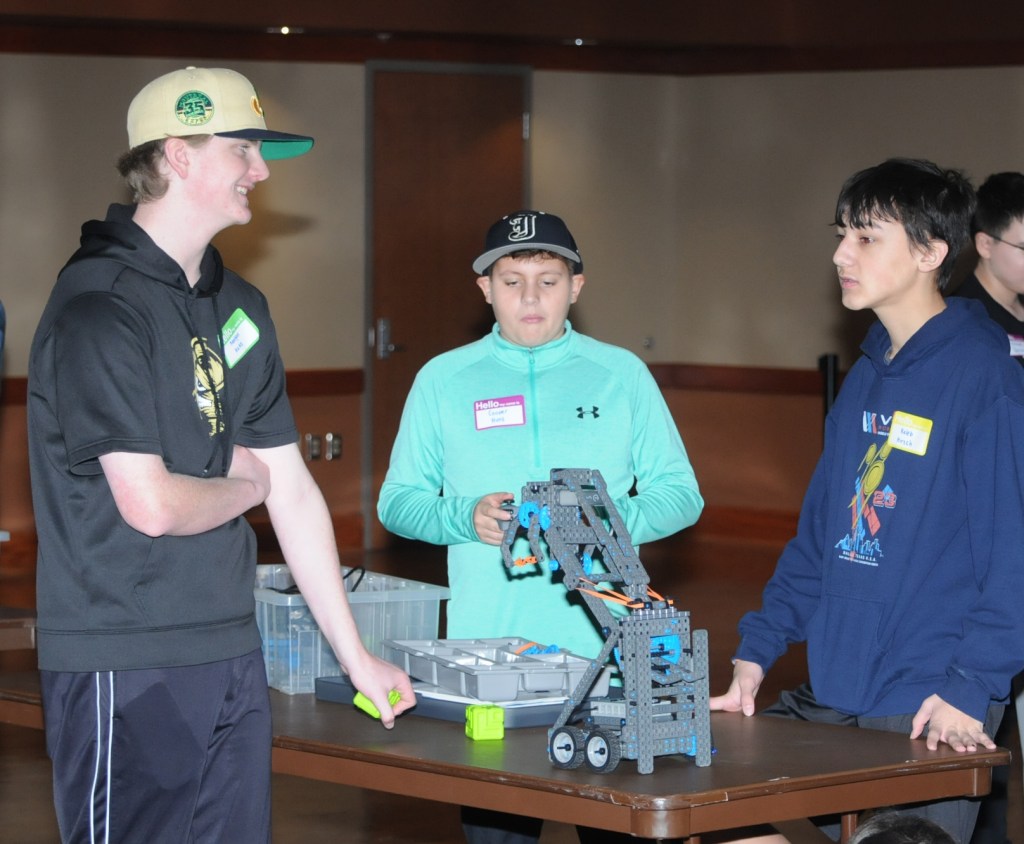
Students Keagan Hicks, Cooper Hunt, and Kaleb Hirsch work on their robot.
The competition is usually held every year during fall. It was previously hosted at other local schools for several years, but they decided to have it on campus this year. They wanted for the event to be more accessible to other schools that are further away.
Every school attending is allowed two teams consisting of four students. Some chose to only bring one team. Altogether, they expected around thirty-five to forty students to show up. Teachers, family members, and friends were also allowed to attend for support.
Each of the teams is provided with a kit a couple of weeks before the competition that they can use to build a robot. At the competition, they have to use that robot to pick up blocks and navigate an obstacle course to drop the blocks in a basket.
“There are several schools that do not have a robotics program, they’re starting fresh, so we are most happy to help,” said Dr. Shivan Haran, the director and a professor of mechanical engineering overseeing the event. “We even told them…come by, we’ll even show your kids how to put this together…”
Whichever team deposits the most blocks wins the competition. Points are deducted if the robot breaks things. The blocks are strategically placed, some in areas that are difficult to reach and some that are easier.
“The goal of that was actually to maybe help develop critical thinking skills and time management and time management, like we don’t want to go for that block, that’s in a hard spot, instead we’re going to try and take a route to get all the easy ones,” Diamond said.
Additionally, because every team designs their robot in a different way, some blocks will be hard to get for one team while they will be easy for another, and vice-versa. The top three teams that get the most blocks each win a trophy.
“We don’t want them to think robotics is something stressful and hard. We want them to think of it as easy and fun, something accessible,” Diamond said.
“The goal here is to get a basic foundation of what robotics is like,” Perdue said.
For a student there from Buffalo Island Central named Henry Sills, it was his second time competing. He’s in eighth grade and learned about robotics in his EAST class, which he has been in for a year.
“Robotics has always been something I’ve been interested in, the actual building of it and the coding,” Sills said.
A group of students from East Poinsett–Christopher, Dalton, Bella, and Jumaro–was there for the first time. They’re also all in the eighth grade, and it’s their first year learning robotics in their EAST program.
Avery Jonesis a junior in the Department of English and Philosophy at Arkansas State University in Jonesboro. She can be reached at: avery.jones@smail.astate.edu
NOTE: Feature photo by Atsuki Ohbuchi of students Annie Shepherd and Vignesh Nair. Other photo in article also by Atsuki Ohbuchi.
Lauren McDaniel-Carter, founder of ACRES, with a student, Jonah Sharma.
Microschooling is a growing trend in education. According to The Reform Alliance, a nonprofit in Arkansas concerned with connecting families with education options, microschooling is comparable to the one-room schoolhouse concept. In a microschool, a small group of students meets for a certain amount of days a week to learn together.
It’s separate from a public or private school and falls under the category of homeschooling. Microschooling can either be a child’s main form of learning or a supplement to their homeschooling.
Laurie Lee from The Reform Alliance said that microschooling is becoming more popular because of the past closures of schools due to the recent pandemic; parents have also become more concerned with the state of education. Families want to have a stronger role in their children’s education.
“The great thing about a microschool is that you can’t put it in a box…It’s truly family, community-led,” Lee said.
There’s no definite beginning point for when microschools became a concept. There have been communities and homeschool families who have engaged in group learning before microschooling became popular. However, Lee states that a significant turning point in the microschool movement was the establishment of Prenda, an organization that helps to start microschools.
Prenda was inadvertently started by Kelly Smith in Arizona. He thought students needed a bigger emphasis on STEM in their education. His group grew, and now the organization helps other microschools by providing curricula and advice regarding the technicalities of microschooling.
“I think the verbiage, microschool, the name, might be more new than the concept,” Lee said.
According to Lauren McDaniel-Carter, founder of ACRES, a local microschool, there’s no strict definition of a microschool because the group gets to define it for themselves. There’s a lot of gray area.
“I’ve been calling mine somewhere between a homeschool co-op and a private school,” McDaniel-Carter said.
Her school opened this August. She planned to take no more than fifteen students from the age groups of kindergarteners to fourth graders.
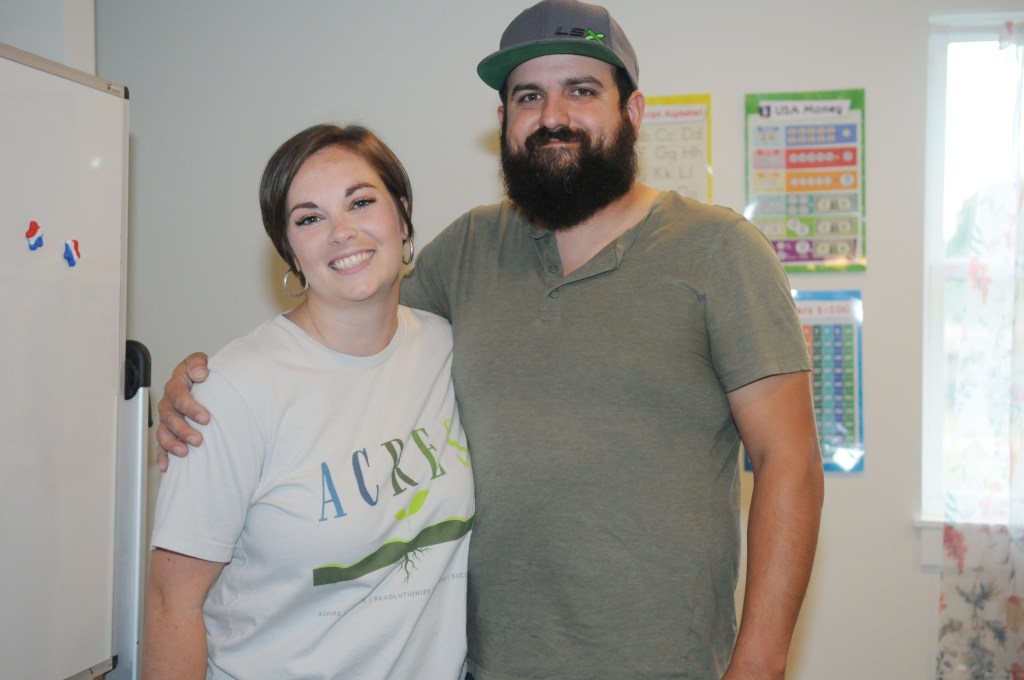
Lauren McDaniel-Carter and her husband, Nathan Carter.
According to Lee, microschools aren’t limited by age group. Some of the schools that The Reform Alliance has helped to set up only take students from kindergarten to third grade whereas others are K-12. The kids usually aren’t separated by age group or grade, either; they all learn together.
“I think the environment breeds a different day every day,” Lee said. “This model is set up to fit the needs of the people that are using it…We’ve seen extreme growth in students in these models over the last three or four years we’ve been actively working in them.”
McDaniel-Carter’s ACRES will focus on the core subjects of language arts and math. The students will use mainly online curricula and depending on the individual’s pace, it will probably take about two hours a day.
The programs used will be completely secular. McDaniel-Carter doesn’t plan to incorporate any religious teachings into the students’ work.
The students will work on computers, but they will be allowed to take breaks and go at their own pace. Additionally, the students don’t have to work on the same subject or curriculum at the same time.
“Rather than [having] these long, extended blocks where kids have to sit still in desks…they can be kind of where they want, they can take breaks…” McDaniel-Carter said. “They may be working on different programs, too. It’s not a one-size-fits-all curriculum…It’s just whatever the kids kind of need at that moment.”
For other subjects like science and social studies, she plans to use a projects-based and hands-on approach. She will also offer “enrichment” subjects like arts and language learning as well as time for unstructured socialization and play.
Her vision is to have the kids “take ownership of their learning.” She wants to have them determine what subject they want to master in a certain amount of time.
“This is the stuff that gets kids excited about school and learning, when they get to do stuff that they’re interested in, and a lot of the times in public school, you only see those opportunities being given to the kids who are excelling,” McDaniel-Carter said. “That kind of learning should not be just reserved for the ‘gifted’ kids. Anybody should have access to it. The fact that kids don’t like school is not a reflection of them, it’s a reflection of the school.”
Nathan Carter with students Skyler Armitage and Hazel Sharma.
McDaniel-Carter will guide the kids in the learning process. According to The Reform Alliance, it’s normal for microschools to have “learning guides,” but they don’t have to be certified teachers. McDaniel-Carter wants to eventually be able to hire a part-time learning guide to help.
Unlike public or private school, mastery will not be determined by a score on a standardized test. Students will move on when they’re ready instead of whenever the teacher determines they can move on.
In this way, the kids will not be compared to each other. They aren’t competing with grades, and since each student will be allowed to go at their own pace, they won’t be pulled out of the class for intervention or forced to move on before they’re ready.
Lee said that “Educators are starting to understand that student-focused and student-led days are more productive for kids to learn than a very rote, lecture-style classroom.”
She further stated that children should be taught like they’re going to be adults, which they will be eventually. Adults get to structure their own day and have to prioritize.
If they don’t complete their tasks for the day, those tasks have to roll over into the next day. Children need to learn these skills in environments which will teach them real-life consequences.
At ACRES, to measure her students’ progress, McDaniel-Carter will be able to see how they’re doing on their online programs and what they’re struggling with. She can share progress reports with the students’ families to keep them involved.
Additionally, everything the students do in their project-based learning time will be compiled in a portfolio. She also hopes to implement a badge system in which students will earn badges for certain achievements. Eventually, she wants to be able to host an end-of-the-year showcase to share the students’ accomplishments.
Measuring progress is usually up to the learning guide, according to Lee, but with the new LEARNS act, any school taking EFA funds will have to test students every year with a test set up at the national level. These tests will determine the sustainability of that program.
At ACRES, families will be able to determine how many days their children will attend. Some people might want to only come two days a week as a way to supplement their education at home, while others will want to come all five days as their main source of education.
Additionally, the tuition cost depends on how many days they want to attend. This makes it more accessible for even low-income families.
McDaniel-Carter has also invested much of her personal funds into the school. The school is located at her house in a room they built specifically to be multipurpose.
Lee at The Reform Alliance stated that microschools can be hosted virtually anywhere. She’s seen schools held in someone’s kitchen, repurposed buildings, and churches.
Before McDaniel-Carter decided to start a microschool, she worked as a public school teacher for eleven years. However, it wasn’t for her, and when her husband suggested that she start a “pod school,” she liked the concept of that.
“I can’t believe I lasted that long,” McDaniel-Carter said. “Honestly, I can remember doing my student teaching and thinking, I can’t do this for thirty years.”
She posted in a Facebook group to ask if anyone would be interested in a microschool, and in a couple of hours, she had around eighty responses. The process of starting a microschool has been “surprisingly smooth” for her. She said that she felt like she was following a path instead of trying to carve one.
The most difficult part was trying to get people to commit to the school. People are often reluctant to try something new. In June, she had eleven applications, but people are often prone to drop out or apply at the last minute.
Also, there’s not much clarity on the mandates regarding homeschooling, especially with the added confusion of the new Arkansas LEARNS act. The money provided by the act would be beneficial for her school.
“It would be nice, I feel like, if there was some clarity on what a microschool is and what governs it,” McDaniel-Carter said. “I would love to have access to that money. How that’s going to happen, I don’t know because there’s so little clarity in the act…if the financial barrier is removed, that opens us up to a lot more people.”
According to Lee, The Reform Alliance has set up and assisted in setting up several microschools. On July 22, they hosted a microschool conference in Little Rock where attendees learned about microschooling from the National Microschooling Center.
Avery Jonesis a junior in the Department of English and Philosophy at Arkansas State University in Jonesboro. She can be reached at: avery.jones@smail.astate.edu
NOTE: Feature photo of Lauren McDaniel-Carter and her students at ACRES by Atsuki Ohbuchi.All other photos in article also by Atsuki Ohbuchi.
JONESBORO, Ark. – Constitution Day was on Sept. 17. The holiday celebrates the adoption of the U.S. Constitution. The day is especially important for public schools because they must recognize the day and use the opportunity to teach students about the Constitution according to a federal requirement.
Local schools in Jonesboro are no different and had some activities planned for Constitution Day. According to Jon Newman, an Advanced Placement U.S. History and Government teacher from The Academies at Jonesboro High School, his school didn’t have a school-wide event planned but each teacher covered the topic in their classrooms.
Since Constitution Day was on a Sunday, Newman chose to recognize the day on Tuesday. He and his students were discussing the development of the Constitution. He also brought in Senator Dan Sullivan to talk about his role in the government and our state legislature’s role in the system that was created by the Constitution.
According to Newman, the goal of this day in schools is to “help students to see how the document that established our current government was created out of a need that arose with Shay’s Rebellion.” He makes sure that he stresses to students the importance of how the Constitution was created to adapt to the country as it grew and changed.
In past years, the high school used to invite the Arkansas National Guard to speak to all of the classes about the importance of the National Guard. However, because the requirements for what must be taught has increased, more teachers are unwilling to give up an entire day for such a presentation. Newman doesn’t mind occasionally using a day, though, to allow an elected official to come talk to his students.
Newman says that his students usually respond pretty well to the day. Because of his classes’ subject matter, it’s easy to fit in the lesson.
However, one problem that comes up for other classes not about history and government is that they have to pause their usual lessons to teach about the Constitution for only one day. This lesson can seem arbitrary to students since it doesn’t flow well with the usual subject matter.
At Valley View Schools, the teachers are all doing different activities in their classrooms as well. Matt Mink, a social studies teacher at the junior high school, recognized Constitution Day on Monday the 18th.
He put together a “Constitution Day Escape Room” for his students. Each student works with a partner to decipher four clues which will provide a four-digit code. This code unlocks a lockbox that contains the “stolen” Constitution.
Mink’s goal of this activity is to allow the students to experience something different and to learn from it while having fun. He and his class discussed the Constitution prior to the activity. Mink has been doing this activity for four or five years.
“The students love this activity,” Mink said. “Once they figure out how to decipher each clue, it becomes real competitive. They all want to be the first ones done.”
Melissa Mayfield, a history and government teacher at Valley View High School, also planned special activities for Constitution Day. The school rolled Constitution Day into Freedom Week, which is celebrated during the last week of September.
The purpose of Freedom Week is to emphasize teachings on the development of the U.S. and its founding documents, including the Constitution. It’s an official holiday only in Arkansas, Florida, Kansas, Oklahoma, and Texas.
The social studies department at Valley View High School, which Mayfield is a part of, planned a recital of the Bill of Rights during lunch on Sept. 25. It was recited by students from the American History and Government classes on the balcony that overlooks the school cafeteria.
The students from Mayfield’s AP World History class made posters with the amendments on them to display in the hallways of the social studies department. Additionally, Mayfield taught about different constitutions from around the world and compared them to that of the U.S.
Mayfield does the constitution comparison each year, but this is the first time that the social studies department has collaborated for the Bill of Rights recital. Mayfield said that in general, some students are more engaged than others.
The sophomores have a basic understanding of government structure, but haven’t extensively learned about the amendments. As a result, the teachings of Freedom Week focus on the individual rights that come from the Bill of Rights and comparing our government structure with that of other countries’.
“I want students to understand our Constitution, but I also want them to see how it influenced the creation of other constitutions and how other documents, like the English Bill of Rights, influenced the creation of our state,” Mayfield said.
Avery Jonesis a junior in the Department of English and Philosophy at Arkansas State University in Jonesboro. She can be reached at: avery.jones@smail.astate.edu