Tag Archives: News

Shoffner, Wadlin Debate in U.S. Senate Race; Cotton Does Not Show

Story by DDNS Reporters Gracie Lunceford and Kinley Rainwater
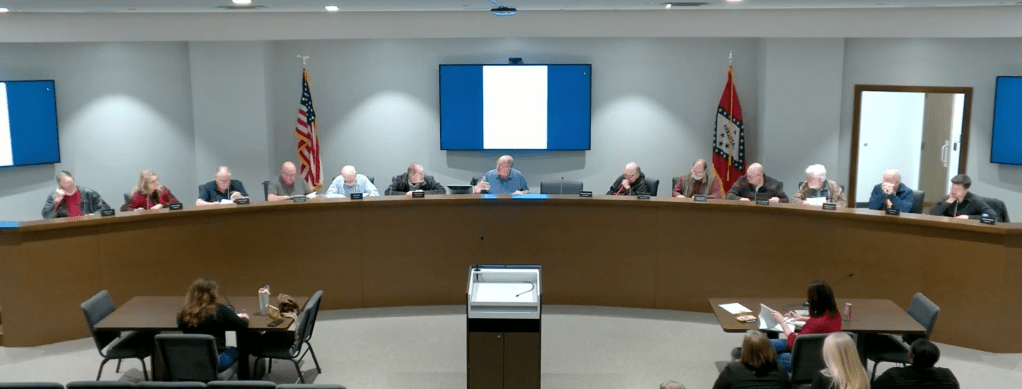
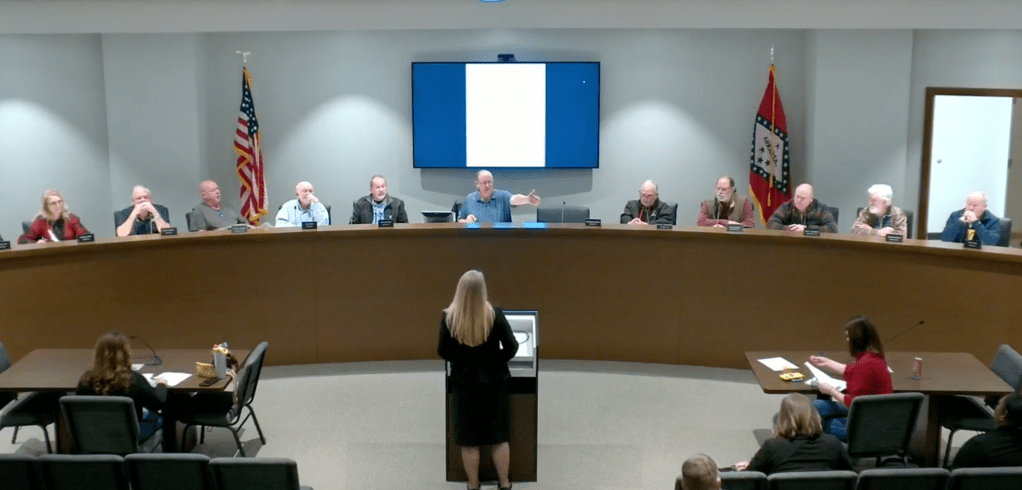
In the third and final political debate at ASUTV, Democratic candidate Hallie Shoffner and Libertarian candidate Jeff Wadlin faced off for Arkansas’s Senate seat. Republican incumbent Tom Cotton was invited to join, but did not respond.

Marty Scarbrough moderated the event, with panelists Johnathan Reaves, Lexi Burns, Allie Carson, and Levi Seward.

Hallie Shoffner began the opening-statement segment by sharing her family’s long history of farming in Arkansas.

“I am a sixth-generation farmer. I am the daughter of farmers. I am a wife, a mom, and a caregiver, and I am running to put Arkansas first.”

Shoffner touched on incumbent Tom Cotton’s choices during his time in the Senate, including voting against the farm bill twice, shutting down 25% of family farming operations in Arkansas— including her own.

“I am here because last year I had to close my family’s 150-year-old farm because of the farm crisis. I have lived the rising costs, I have lived the broken system, and I decided I wouldn’t surrender.”

She says showing up for Arkansans is her main commitment every day, not just for the duration of election season.

“If I can’t farm, I’m going to fight for Arkansas. I’m going to fight for you.”

Jeff Wadlin, running as a Libertarian candidate, started his opening statement by establishing his career as an engineer and businessman, working for large corporations such as Sam’s Club and Capital One, and building his own businesses.

“My expertise is in solving complex problems, which is exactly what Washington, DC needs.”

His top concerns included lowering inflation, encouraging economic development, fixing Social Security, and ending foreign wars. Diverting from the two-party system that dominates US government, he wants to give citizens a third option.

“A true pragmatic centrist who’s only interested in solving problems to make everyone healthier and wealthier regardless of where you are on the political spectrum.”

Regarding the absentee incumbent, Wadlin disagrees with Cotton’s choices to support foreign wars at Arkansas taxpayers’ expense.

“He’s happy to take a million dollars from APAC to buy an election, to be an ambassador for Israel, instead of being an ambassador for Arkansas.”

On the panel first was Johnathan Reaves, an instructor of Mass Communications at Arkansas State University and faculty advisor of Delta Digital News Service. After the 76-day partial government shutdown of 2026, Reaves raised a two-part question for Shoffner: “How do you propose that we do not go through government shutdowns again? And second, what are your thoughts on lawmakers getting paid when federal employees are not?”

Shoffner starts with the second part of the question, affirming that she would not accept a salary during government shutdowns.

“I do not believe that if the government is not working, in the same way if an Arkansans does not go to work, we should also not be paid.”

Regarding the first portion of the question, Shoffner says she’s seen citizens across the state feel neglected by Congress. She attributes this to elected officials being more “extreme” than many Arkansans.

“All of us live somewhere in the middle. Look no further than the fact that the last two Congresses have been two of the most unproductive in history…If a government shutdown does occur, I will not take a salary, but I will do everything in my power to ensure that doesn’t happen to the detriment of the people in Arkansas.”

Wadlin attributed these long government shutdowns to conflict between the democratic and republican parties, which leads to other issues such as Social Security going bankrupt and a struggling healthcare system.

“These sorts of things are not acceptable,” Wadlin states. “And certainly, the legislators should not be paid when there is a government shutdown.”

He mentioned that select legislators believe that their yearly salaries of $174,000 aren’t enough, and encourages those who are concerned about making money to pursue other high-paying careers.

“That’s pretty insulting to the average Arkansan who makes 50-60 thousand dollars a year… if they’re so worried about making money, they can vote their conscience, risk being primaried, or risk being voted out, and go be an attorney or a lobbyist, and go make more money.”

In her retort, Shoffner returns to why the shutdown first occurred: disagreement over the Department of Homeland Security. This shutdown unintentionally affected Supplemental Nutrition Assistance Program (SNAP) benefits, which many rely on to afford groceries. This financial stress affected many Arkansans. Shoffner affirms that, if elected, she would continue traveling between Washington, D.C., and Arkansas to better understand and communicate with citizens about their specific community needs.

“You can only legislate well for the people you represent if you include them in the conversation and give them a seat at the table.”

Reaves asked his second question to Wadlin: “If you were elected, at the end of your first term, what measurable accomplishments should Arkansas voters use to judge whether you’ve earned re-election?”

Wadlin says his main concerns are economic issues that affect everyone, like a balanced-budget amendment and reducing the trillions of dollars in debt.

“I will seek placements on committees like the finance committee, where we need to work on not just balancing the budget, but also bringing the debt down. We need to reduce our deficits. We can’t keep running up these trillions of dollars of debt.”

Additionally, he wants to fund Social Security for senior citizens, make it more lucrative for young people in the long term, and help repair the healthcare system to ensure people across Arkansas have access to affordable healthcare.

In Shoffner’s response to the same question, if elected, she also aims to support the healthcare system by strengthening rural hospitals and protecting Medicaid and Medicare for senior citizens. Veterans are also at the top of her list of priorities.

“The story I hear across Arkansas is too often, they have to fight their own government to get the benefits they have earned.”

Foreign wars and the money spent are also major concerns for her, as is a sustainable food system that would help end the farming crisis and provide neutral, homegrown food for families and schoolchildren alike.

Shoffner says, “I know that is a long list for someone to want to fight for, but this is Arkansas. We have problems, and it’s time for us to have a representative that not only acknowledges and understands those problems, but is willing to fight tooth and nail every single day to solve those issues.”

Wadlin agrees with the sentiment about foreign wars, noting that despite the large sums of money, nothing is changing, and saying, “We need to not be involved in these foreign wars of aggression.”

Lexie Burns, a reporter and co-producer for KASU’s Morning Edition, asked Wadlin about Arkansas’s high maternal mortality rates, with Northeast Arkansas having the highest rate in the state: 16.3 events per 10,000 births. Seeing as Arkansas is the only state in the US not to expand postpartum Medicaid coverage from 60 days to 12 months, Burns asked, “Is expanded Medicaid postpartum coverage something you support? And how would you work with your colleagues to strengthen and increase access to prenatal care during pregnancy and postpartum healthcare?”

Wadlin shared support for expanding postpartum Medicaid coverage and his distaste for the current state of medical insurance in the state.

“Arkansas definitely needs to have 12 months of postpartum care. That’s unacceptable that we were the only state not to do that.”

Wadlin says not everybody is covered by insurance because healthcare is so expensive in the country. He says this cost is most definitely able to be cut.

With lower healthcare costs, Wadlin says everyone would be able to get health insurance, which would in turn help mothers and babies.

The rural healthcare crisis came forward as a harm to maternal health when Wadlin explained the lack of access to emergency and labor and delivery services. He says the fix is to ensure there’s labor and delivery and emergency services within 30 minutes, primary care within 60 minutes, and specialty care within 90 minutes.

While Wadlin says these things are sure to help maternal healthcare, economic development is important to solving these issues. He says wealth helps not only with healthcare, but also with nutrition and crime rates that “make our communities more violent.”

Shoffner supports expanding coverage to 12 months of postpartum care, but she says that’s only part of the problem.

“To be perfectly honest, our healthcare system as a whole is incredibly flawed. And the reason is that too few companies control the entire system.”

Shoffner says the simplest way to change that is to make sure everyone has access to affordable health insurance. She says this can strengthen rural hospitals, and when it does, they will better understand what the community needs, ensuring residents who work there can also live there and give the hospitals a community to serve.

Another important aspect Shoffner emphasizes is ensuring that preventative care, prenatal care, and postnatal care are all covered.

Agriculture remains Arkansas’s biggest industry, generating $ 20 billion annually; despite this, food insecurity in Arkansas remains a troubling and prominent issue. In 2018, Congress extended the Farm Bill three times to fund major programs like SNAP. In September of this year, the bill expired, and no new bill has replaced it.

Burns asked, “Given that Arkansas desperately needs both agriculture protection and nutrition funding, where would you compromise? And, if elected, where would your priorities lie?”

Shoffner began, “I have long been trying to understand the relationship between the fact that our largest industry is agriculture and yet we are the hungriest state in the country.”

She points out that we need an entirely new farm bill and, additionally, a food bill to strengthen the relationship between farmers and their communities. Allowing farmers to sell their crops directly back into their communities provides fresher, healthier food for citizens and is also lucrative for farmers.

“Not only are we growing food that we’re feeding back into the communities in which it is grown, but we are also rebuilding rural economies step by step with a brand new kind of farm bill.”

In Wadlin’s response, he credits the stagnant farm bill to another issue Republicans and Democrats are gridlocked on.

“It’s been years since a farm bill has been passed. And of course, we need to pass a more current farm bill as soon as possible. And this is just another example of… where Republicans and Democrats working together are giving us terrible outcomes.”

He explains how the government can affect farming businesses both directly and indirectly, through high tariffs, rising diesel prices, and “trapping” farmers in low-margin commodity crops.

Shoffner reinforced her support for Arkansas agriculture and her eagerness to put new farming initiatives into place.

“This is an idea that could truly remake the face of Arkansas’s economy and our health and our well-being.”

Allie Carson, an aspiring multimedia journalist and student, raised concerns in agriculture for newly emerging professionals out of college.

“What specific steps would you take in the Senate to help farmers remain comfortable, support that next generation of agriculture professionals, and to prevent trade policies from further hurting Arkansas?”

Shoffner says the first step is ending the war in Iran. She says incumbent Tom Cotton wants this war and refuses to end it, however.

“To be clear, this is the war that Tom Cotton has wanted in the last 14 years. He finally got it, and we are paying the price. And some of the folks paying the price are not just families at the gas station. It’s also farmers who are buying fertilizer; they’re buying diesel.”

Beyond the Iran war, Shoffner says the second step is to end the “chaotic” trade war. She explains that input costs for farmers and families have skyrocketed not only because of the tariffs, but also because of the retaliations that followed.

That said, Shoffner also points out that tariffs can be useful if used strategically. She says this is especially true for sensitive crops, such as rice.

For her third point, Shoffner returned to her previously mentioned farm, or “food bill.” She says she wants to ensure farmers can diversify into more crops by giving them risk-management tools so they can take risks on other crops and build more infrastructure.

The mass consolidation of farmland in Arkansas is Shoffner’s last concern. She says farmers are going out of business, and when they do, high-net-worth individuals and corporations consolidate the land.

“And that’s dangerous because land is the foundation of our whole system. Now, I am all for folks doing whatever they please with their own property. But we have to consider, at what point does mass land consolidation constitute market manipulation, and constitute human monopoly?”

Shoffner says she wants to keep the land in the hands of active Arkansas farmers, and she believes those four actions can do that.

Wadlin started by reinforcing Shoffner’s ideas, such as passing a farm bill, ending tariffs, and ending the war in Iran. However, he says that alongside those options, we need to stop regulating and subsidizing to ensure farmers can get into crops, livestock, and other profitable industries.

Wadlin also adds that many farming inputs are highly consolidated. He cites Bayer’s 2018 acquisition of Monsanto as an example.

Wadlin feels right-to-repair laws need to change to better support farmers and allow more independence.

“If a farmer buys a tractor or a combine, they should be able to repair that themselves. They should be able to get the manuals for a reasonable price. 
They should be able to buy their own parts and have their own technician do the repairs. They should not be held captive to large equipment manufacturers.”

Shoffner brought the conversation back to rural communities. She says if a farm bill passes that allows for more infrastructure, that’s great, but these communities still need investment in their schools, hospitals, roads, waterways, sewers, and electrical grids.

“One of the things I’d like to do is set up an office to provide technical assistance for our cities and counties to be able to apply for federal grants to ensure they can build that kind of foundation that they need to build the industry that’s going to provide new jobs, new wages, in communities that right now are struggling.”

Carson’s next question focused on the rising cost of living and the pressure it puts on young adults leaving college.

“What specific federal policy would you support to help college graduates afford to build lives in Arkansas?”

Wadlin says the blame for the rising cost of living is on multiple things, and he never hears his opponents mention debt or the Federal Reserve.

Wadlin says the debt and the Federal Reserve are invisibly driving inflation, which is driving up costs.

Specifically about the debt, Wadlin brings up the Big Beautiful Bill as an example. He says we raised 5 trillion dollars, yet we’re spending 7 trillion dollars, leaving a 2 trillion dollar deficit that adds to the debt, which is now up to 40 trillion dollars. He says government spending money they don’t have is inflationary and will cause a crisis down the road for young adults, since someone has to take on that debt.

Wadlin explained that every time we have a hiccup like the 2008 banking crisis or the 2020 pandemic, the Fed prints more money to try and soften the landing for citizens. He says this is also inflationary and that since 2020, the money supply has risen 50%, which, according to Wadlin, results in a ⅓ paycheck cut for citizens.

“..And so, this is the type of thing that needs to be addressed. The Fed needs stricter monetary policies so they’re not so loose with printing money whenever there’s an economic blip. And those are the things that I’m going to be focused on in the Senate.”

Shoffner says that although they have already talked about building an economy in general, ultimately, when a student graduates, they want a job with a good wage, a home, health insurance, and a vehicle. However, the current situation is making this very difficult, according to Shoffner.

According to Shoffner, she has met many college students who feel that they are doing everything they are supposed to do, but aren’t seeing the benefits. She says this is because a rigged system has failed them and continues to fail them, benefiting the powerful rather than the citizens.

“It’s not because they failed. It’s because the system is rigged against them,” says Shoffner. “And it’s been rigged by and in favor of politicians like Tom Cotton and his biggest donors and his own national political ambitions, instead of the people of Arkansas, instead of young people. That has to change.”

While ending the Iran war and the trade war might lower costs, Shoffner says economic development in places like Jonesboro and continued support for the city as it grows are also important. She points to housing as a concern.

Shoffner says we need more affordable housing, and she suggests more infill housing. She says we need houses that young people can afford to buy.

“Because one of the most important things that you can do is live in the place that you work,” says Shoffner.

Shoffner herself has met too many young adults who have to drive up to an hour to get from their home to their workplace, and she says, “That means they’re just shoving their paycheck into their gas tanks. I want to change that.”

According to Shoffner, affordable housing is within reach. She says it just needs to start with having the conversation with young people and contractors to start getting creative.

“We just need to start having this conversation, and until we have new representation, I don’t think that’s going to happen.”

Wadlin says Social Security reform is on his to-do list. He says the payroll tax that funds Social Security is our most regressive tax and says that the burden falls primarily on the young people.

“That’s 15% right off the top that they’re paying for the healthcare and retirement of their grandparents.”

According to Wadlin, his proposal to expand children’s investment accounts would allow the payroll tax to taper over time. He says this idea would save young people, in particular.

Wadlin also agrees there is room for concern about economic development. He says that is the major difference between a struggling community and a thriving community. Wadlin says his approach is to work with state and local officials to bring more economic development from across the country, or even the world, back to Arkansas.

Levi Seward, a political science and philosophy student and President of Arkansas State University’s Pre-law club, was the final panelist.

“Should domestic lobbying groups that heavily advance a foreign state’s policy goals, such as AIPAC (American Israel Public Affairs Committee), be required to register under FARA (Foreign Agents Registration Act)?” asked Seward.

Wadlin says they should absolutely have to register, and that in general we need to get away from the foreign influence of super PACs such as AIPAC that are aligned with foreign governments.

Wadlin says Citizens v. United needs to be overturned. He says it was wrongly decided and that he will work to get it overturned in the Senate. He says it just needs to be re-litigated.

Technically, there is a $3,500 limit on how much money you can donate to a federal candidate’s campaign. Wadlin says this is due to the quid pro quo because in the court’s eyes, he says they see it as, “You gave me that money and now I owe you a big favor.” He says this remains true of super PACs.

“When AIPAC funds attack ads against Tom Cotton’s opponents, he knows where that money comes from, and he certainly owes them a favor, and he certainly is repaying those favors daily,” says Wadlin.

Shoffner starts by agreeing with Wadlin. She says she supports ensuring anti-corruption laws in our Constitution, reforming campaign financing, and overturning Citizens United.

Shoffner says she wants to take this a step further, however. She says she believes in term limits for Congress and for Supreme Court justices as well as ethics laws. Shoffner says she believes in ending stock trading among cabinet appointees and justices, not just for elected officials.

Shoffner stated if chosen, she will put everything that she and her husband own into a true blind trust. She will not be able to touch those things for as long as she holds the seat.

“…so that the people of Arkansas know that whatever information I hear in any room in the halls of power, I will not be able to use that to enrich myself. I want the people of Arkansas to know that I am going to Washington, D.C., not for myself, not for some political game, or political points. This is all about the people of Arkansas and fighting for them and not Washington insiders.”

On Wadlin’s side, he says he already has his stocks in index funds, so trading individual stocks shouldn’t be a problem for him. However, he agrees that legislators should not trade stocks.

Wadlin mentions political gerrymandering as a major concern. He says that regardless of which side it comes from, it’s bad for democracy. According to Wadlin, neutral boards should make those decisions to ensure fairness and representation for all voters.

Seward notes the incumbents’ lack of attendance and uses it for his next question.

“If he were sitting here right now, what is the single vote or decision of his you’d make him defend? And what answer would you expect from him?”

Shoffner says that she couldn’t possibly think of just one. She says she thinks of the war in Iran, the loss of healthcare, the support of the chaotic trade war. She says it’s because he voted for the one Big Beautiful Bill. Shoffner says it goes beyond just voting for it, though.

“Tom Cotton didn’t just vote for the one Big Beautiful Bill; his name is on the bottom of it,” says Shoffner.

As for his answer, Shoffner says it’s exactly why he didn’t show up. She says he cannot answer for it, whether it’s fear, a lack of care, or both. Shoffner says neither works for Arkansas.

According to Shoffner, after a bad meeting in Springdale 10 years ago, incumbent Cotton stopped holding town hall meetings, and now Arkansas has gone 9 ½ years without a single one.

Wadlin starts off his response by reiterating his feelings on the incumbent.

“As I said in the last debate, Tom Cotton is a coward and a hypocrite for not being here. And there is a long laundry list of things that he’s doing that are terrible for Arkansans.”

In Wadlin’s eyes, a large part of the blame for the Iran war falls on incumbent Cotton.

Cotton was one of the most vocal and prominent opponents of the JCPOA, and Wadlin says he tried to scuttle it while it was being negotiated. When it was ripped up in Trump’s first term, Cotton was in full support but with nothing to replace it, Iran began enriching their uranium again according to Wadlin.

With Cotton often saying, “we need to finish the job militarily,” Wadlin asks what that really means.

“Did we finish the job militarily in Afghanistan? Did we finish the job militarily in Iraq? We need to stop these foreign wars of aggression that are unwinnable.”

Wadlin feels that Cotton is not working for the average Arkansan, but for the powerful and the wealthy.

Some examples of this were given, such as Cotton’s support of the Protect College Sports Act, which Wadlin feels is unfair to college athletes.

“In every decision where Tom Cotton can go left or right, and make a decision for the little guy or the big guy, he’s always going to leave Arkansans in a lurch.”

Shoffner starts her response by saying there’s one thing she can point to that Cotton says he’s done: building the munitions plant in East Camden.

Shoffner admits this created 5000 jobs, but the hospital 15 minutes away is in bankruptcy proceedings and has laid off 40 people. She says Camden wants people to move there, but the industry that was built up hasn’t actually benefited the community.

According to Shoffner, a senator’s job is to negotiate with the state, the cities, the counties, and the industries to ensure no one takes wealth without giving anything back in return.

The industry Shoffner points to is the food industry. She says Cotton doesn’t understand the connection between farming and food.

“Let’s put a farmer in the Senate, and we can change that,” says Shoffner.

Closing statements began with Wadlin, who says voters will have an option between two parties that have swapped power for the last 40 years, and he says, have gotten Arkansans nowhere.

Wadlin reiterates his reasoning, from Social Security and health care, agriculture, foreign wars, inflation, and stagnant income. He says everyone is angry with each other.

“They say that the definition of insanity is doing the same thing over and over and expecting a different result. You can vote Democrat or Republican; it doesn’t really matter. We’ll just end up with the same old failed policies that have gotten us nowhere.”

Wadlin offers another option.

“Or you can vote differently this time. You can make a statement. Are you afraid of splitting the vote?”

250 years ago, our forefathers were willing to go to war to stop a government that wasn’t working for them, according to Wadlin. He says this time you just need to vote differently to have a “peaceful revolution at the ballot box.”

Wadlin ended with a final quote.

“We can build a brighter future, but only if we do it together. United we will stand, but divided we will fall.”

Shoffner targets her closing to the students. She says she already introduced herself, and she wants to talk about you now.

Shoffner says she has met many people on the campaign trail over the last year and a half, and many of those stories were hard to hear. She said tears were shed, some of them being hers, but at the end of every conversation, she hears the word “hope.”

Arkansans have hope for a better future, whether through her campaign or hope for Arkansas, and Shoffner says that hope is powerful.

While many people may feel powerless and like no one is listening, Shoffner says people are listening. They are just scared.

“When we speak with one voice, that is how change happens for the better,” says Shoffner.

Early voting has officially started and will go until November 2nd. National Election Day is November 3rd, and voters in Craighead County can cast their ballots at the Election Annex, 315 W. Jefferson Street, Jonesboro, AR, open from 7:30 am to 7:30 pm.


Mental Health Struggles on the Rise for Farmers

Story by DDNS Reporter Kinley Rainwater

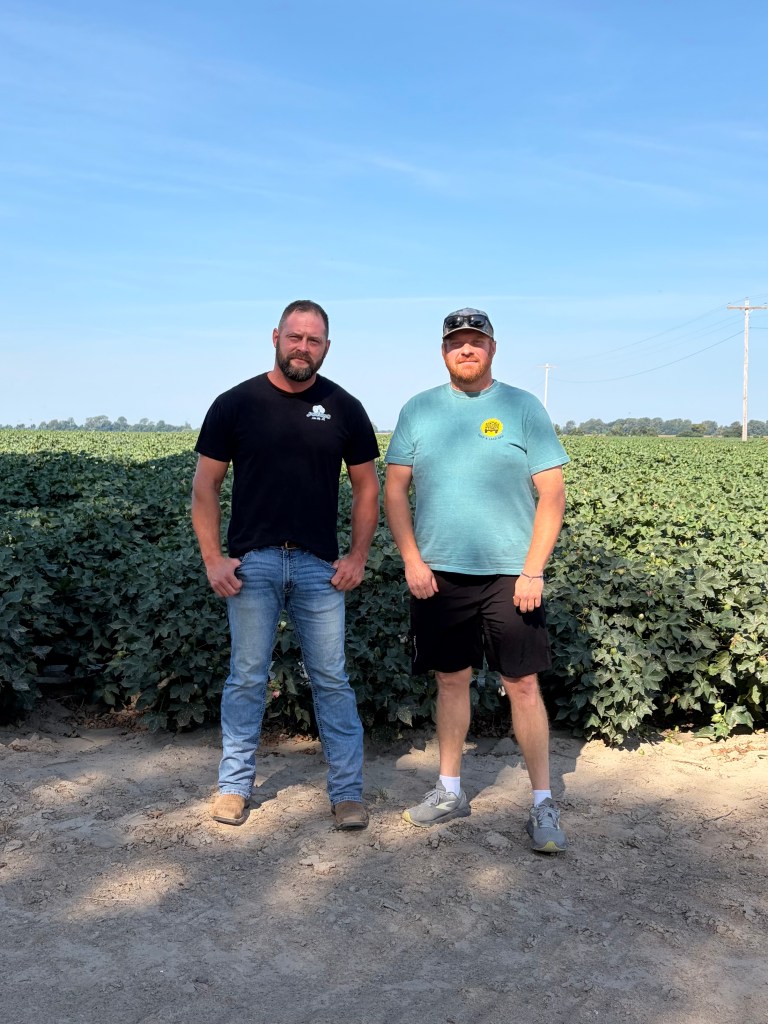
Jonathan Bobbitt (left) and Ryan Bane (right) stand near field at Apex Ag Solutions. Photo courtesy of DDNS reporter Kinley Rainwater.

For farmers, the stress of running a farm can extend far beyond long hours and unpredictable weather. With financial uncertainty, rising costs, and pressure to keep their farms afloat, farmers’ mental health has taken a toll. These challenges make an already demanding lifestyle even harder.

Jonathan Bobbitt is a fourth-generation farmer who runs JAB Farms in Bay, Arkansas. He grows corn, cotton, and peanuts. Bobbitt bought his first acres in 2004 and has been adding on for the last 22 years. He grew up on a farm where he regularly saw and assisted with farm work. Bobbitt started driving tractors at thirteen, and after graduating, he worked full time for his father on the farm before getting his own farm loan at 19.

“Even on the days I don’t want to do it anymore, there’s still nothing else I want to do,” says Bobbitt. 

 Bobbitt spoke about his struggles both on and off the farm. Bobbitt says the current financial crisis has been going on for years. Bobbitt says his major struggles started in the early 2020s. 
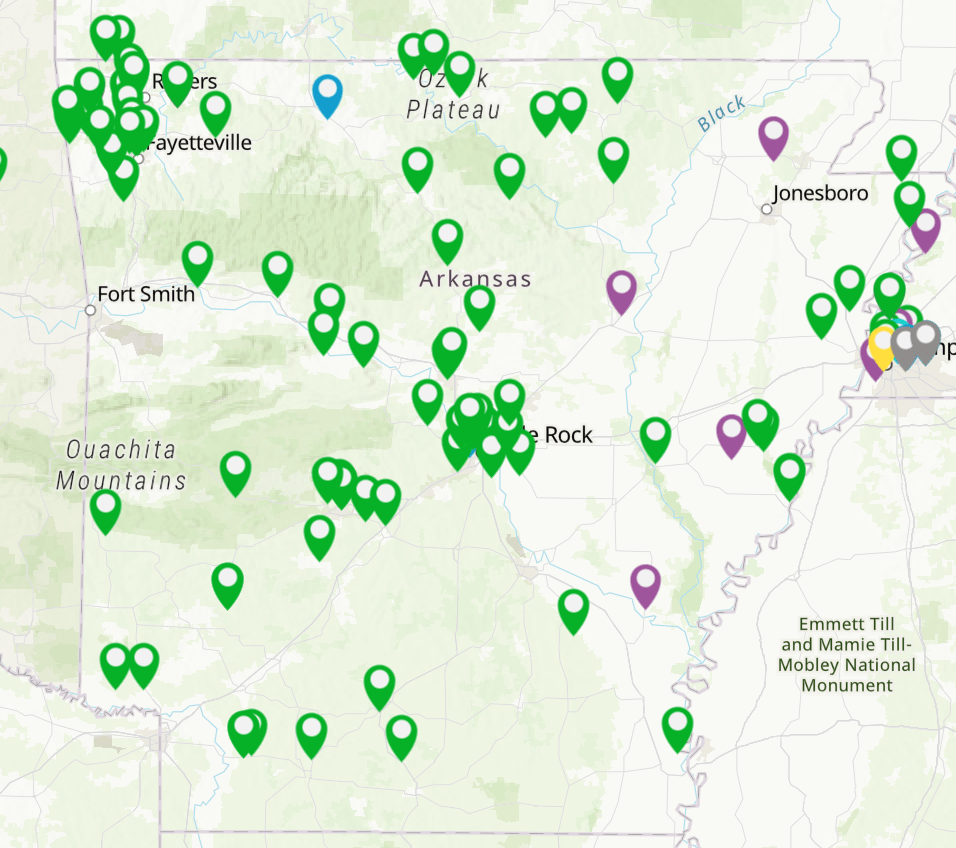

“We’re doing our jobs, we’re producing good crops, but we aren’t getting paid for them,” said Bobbitt. Bobbitt described the uncertainty and financial concerns farmers across the state faced as a time of despair. Bobbitt states the worst time for his mental health struggles started in 2022. “ The financial crisis that we’re in has been this steady bottleneck effect to the point where it’s just gushing out all over everybody.” He states that farmers are making crops but not being paid for them, which has had a detrimental effect on his mental health. 

Branon Thiesse is the Staff chair of the Craighead County extension and works with the University of Arkansas System Division of Agriculture. He says farmers are facing an issue that has been a topic of discussion for years but has grown in the last year. 

“Well, just about like every year, but this year is even worse, is the price that they’re receiving for their commodities. You know, all those are low,” says Bobbitt. “The input costs that they’ve experienced this year have been extraordinarily high, and that’s causing them to have money flow problems. Plus the diesel prices and that kind of stuff is just out of sight right now, and it’s not getting any better, and we’re in the meat of harvest right now, so it’s costing them more to harvest their crop.”

Thiesse says this is leading to the loss of 4th- and 5th-generation farmers. 

“You know, the farmer is one of the only occupations that I know that they don’t set their price for the goods that they sell. They just have to rely on what the market will pay. You know, if you have a restaurant or something and your food costs go up, you just raise the price of the menu to cover those costs. Farmers don’t have that ability to do that, and that’s kind of how we’ve gotten in this shape.”

Thiesse shares a concern about what could happen if no change arrives. He says the possibility of corporate farming lingers in this issue, and he doesn’t believe it’s good for farmers or the economy. 

“I don’t think that’s a good thing for our farmers because, you know, especially in Arkansas, you know, farming provides so much income and things for the state, you know, it’s a multimillion-dollar operation, and we start losing that, and farmers start losing their identities, and I just don’t like that.”

Thiesse says he is concerned about the loss of small farms in Arkansas.

“I don’t think that it would be a good idea to have these big corporate farms running, you know, because well people will be losing their jobs, and so, you know, it’ll hurt the economy of these small towns that the farmers use, you know, buy goods and services from them.”

From a citizen’s standpoint, Thiesse says you would notice this in the control of these farms. They wouldn’t be run and regulated by a local farmer, but by a corporation that may not even be based in Arkansas.

Thiesse says the Craighead County Agriculture Extension tries to be a resource for farmers to reach out to with economic questions, fertilizer recommendations, and help with insect and disease control.

 Bobbitt shared the thoughts he carried during his struggle. “You do it year after year for four years, and you aren’t promised any hope.” He says there’s some hope on the market now, but for years there wasn’t.

Another stress Bobbitt shared was maintaining his personal life off the farm while feeling needed there. 

“It’s just this crushing factor that you have with a job you love and don’t want to let go of, and then you have your personal life on top of that. Whether you’re going through a divorce, or relationship problems in general, or just anything in general, it combines to a point where it’s just a crushing situation where you don’t have anywhere to really turn.”

He said depression led up to him seeking out a therapist because he felt he “had become cynical and bitter.” This led to a new set of challenges, however.

Farming comes with a unique set of struggles, and that became evident in my conversation with Bobbitt. “We’re built different. We talk different. We’re just different individuals,” said Bobbitt. Bobbitt said the therapist he had did get through to him enough to help, but that it wasn’t the same as sitting and talking with someone who understood.

Pride was a word given by Bobbitt to explain why a lot of farmers don’t reach out. “Farmers don’t like to be seen involved in any of this. It’s a very egotistical type of situation,” said Bobbitt.  Throughout the conversation with Bobbitt, phrases such as “Men don’t get help” and “Pick yourself up by your bootstraps” were brought up as ideas that stop many farmers from reaching out.

Bobbitt says, “We’re supposed to toughen up through it, and we’re losing too many, so that situation is not working. So it’s time to do something else. We have to somehow get over that barrier of letting people know that it’s okay, you know, to reach out for help. That there’s no harm in it.” Bobbitt’s story led him to use it to help others and inspire them to reach out, too.

Tailgate Time is a non-profit located in Bay. This is a mental health service centered around the agriculture industry by getting rid of the red tape and financial concerns. 

Ryan Bane is the co-executive director of Tailgate Time, as well as the CEO of Apex Ag. Solutions in Bay. He has worked in the agriculture industry for 24 years, mainly on the retail side. 

Bane shares that he had gone to a meeting at a church in Brookland where a woman stood up and said her area alone had lost three farmers. He knew he needed to do something to help.

After seeing Bobbitt post on Facebook offering an ear to those struggling, he reached out to talk, and they agreed something needed to be done; Bobbitt just said he wanted to be a part of it. 

Bane says he doesn’t know a lot about mental health, but he knows how to build a team. So he played to his strengths and found Mandy Young, who he describes as “the best of both worlds.” She knows how to relate to the farmers, but she also knew the gray areas he didn’t.

Mandy Young is a licensed clinical social worker, community outreach, and educator for Tailgate Time. She grew up with an agriculture background and started working in the mental health field in 2007/2008, so she truly felt she was in the middle of both worlds.

She says their partnership began with a coffee date, where they discussed non-profit work and how to reach men in agriculture.

Bane states that he has never found a group quite like Tailgate Time. The closest things were hotlines and other small groups in other states or countries. There were campus groups that offered telehealth visits every so often, but nothing like what they offer.

Young says this therapy is unlike anything you would receive locally or even nationally. She says it isn’t restricted by the same red tape most therapists face, such as confined spaces or time limits. 

Tailgate Time will go to the farmer, whether you want to talk at your tailgate, the shop, or on the combine. They can meet for as long as the farmer needs, but typical sessions run about 50-60 minutes. Young says this sets them apart.

When a farmer first reaches out, they don’t schedule therapy right away unless requested. They maintain a working relationship with Young and are eventually matched with a therapist when the farmer is ready.

When meeting with farmers, Young says the main goal is to let them know they aren’t alone. 

“They often are very private individuals. They care deeply, but sometimes that comes out in very inappropriate emotions or reactions to behaviors that have been a pattern in their families for years.”

Young mentions again that they often have mentalities of “picking yourself up by the bootstraps,” and they often forget to check on themselves or on their families and to assess how they are coping.

Tailgate time eliminates the financial worry from therapy, so they do not charge for their services.

They mainly run on donations. They receive not only monetary donations, but also items like furniture and flooring for their physical therapy space and office, and even citizens’ time and labor.

As a 501 C3, they are tax-exempt and can apply for some grants, which they are currently looking into, as well as some fundraising options.

Young says the ones benefiting are also the ones choosing to donate so heavily.

Bane also believes pride to be the biggest barrier between farmers and the mental health care they need. He says they often would rather hurt themselves than see someone else hurt.

Bane gives an example with air masks on an airplane. He says you’re told to put your mask on first in an emergency so you are strong enough to help someone else, even if it feels selfish in the moment.

A misconception Bane says people often have is that you have to be in full crisis mode to reach out. This is far from the case; they can make one phone call to let you know you aren’t alone, or offer multiple sessions depending on the farmer’s needs. 

One thing Bane thinks helps farmers feel more comfortable is that he’s also had therapy, as he considers himself the “first line of defense.” He can give you a listening ear, or he can direct you to one of the therapists.

“We have people in place, whether it’s personal or on the business side. It’s something that we believe in. It’s something all of Apex believes in. And we’ll make sure at least that part of the structure will carry on and move forward.

Young says they actively see about 6 people at this time. She says even though the number may seem small, the volume of calls they get isn’t. They allow call-ins to continue calling and often express appreciation for it.

The name originated from the idea that there are two times you spend with a farmer. Windshield time and tailgate time, and tailgate time is usually the end of the day.

“I think that kind of signifies the end of a journey or a crossroads. That there’s a lot of problems solved around a tailgate.”

Bane jokes that there’s an Irish goodbye where you leave without saying goodbye, and there’s an Arkansas goodbye where you tell each other goodbye about 10 times and you’re still standing around the tailgate talking.

#####

BAM Provides More than Art

by Shawna Whitehurst
Delta Digital News Service

JONESBORO, ARK – The Bradbury Art Museum is working to expand its connection with the Jonesboro community through outreach, partnerships and access to free art.

BAM Education coordinator Paden DeVita said building trust in a largely rural community has been key to the museum’s growth.

“We’ve built a lot of trust with the community. We hope to continue expanding programs while strengthening relationships we already have,” DeVita said.

The museum started as a gallery in 2001 and became a museum in 2007. It serves both Arkansas State University and the surrounding community.

The museum increased its outreach and programming in recent years, including partnering with the fine arts department on campus to showcase art, as well as expanding its reach to other colleges on the university campus. Outreach efforts expanded through summer workshops and partnerships with local organizations such as the Craighead County Public Library, offering programs and activities for students.

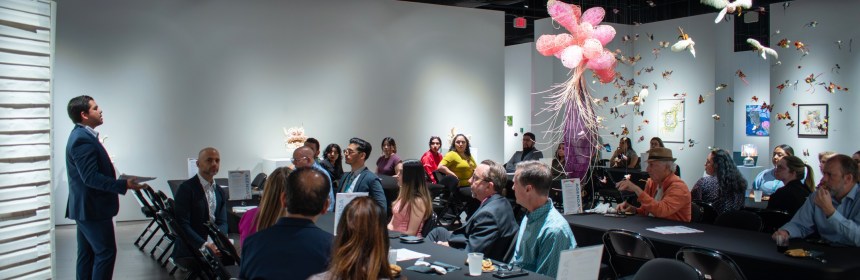
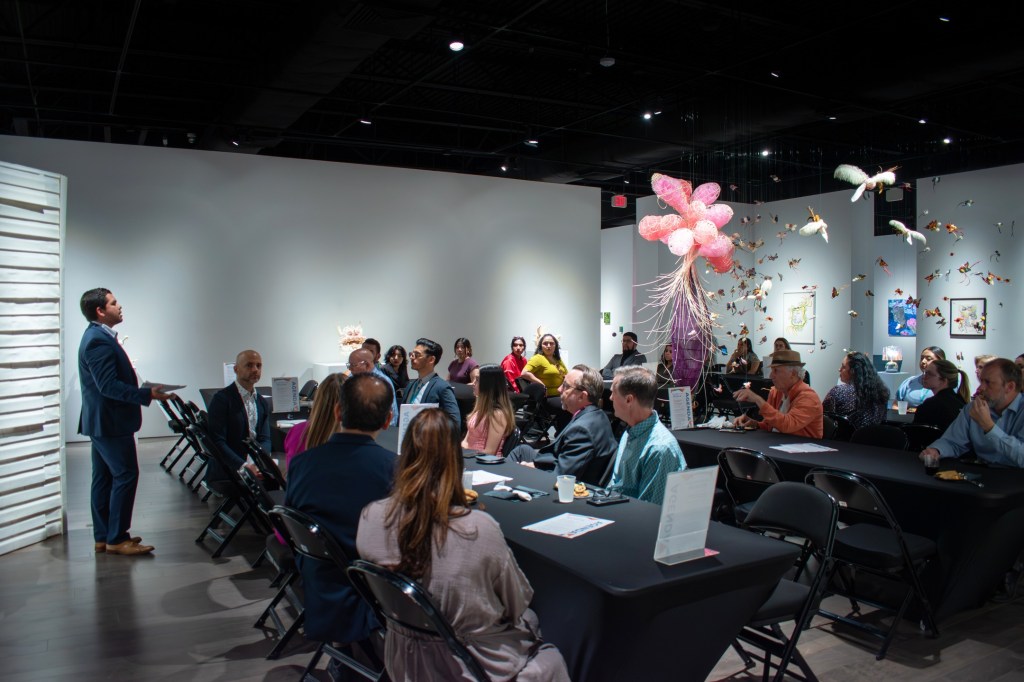
Attendees listen to a presentation at An Evening At The Museum, an event hosted by BAM and the Northeast Arkansas Hispanic Professional Network. The event, held April 23, 2026, represented a partnership between BAM and local organizations. Photo Courtesy of BAM Facebook page.

One recent workshop focused on linocut printmaking, a hands-on art form that allows students to carve designs and create prints. Museum photographer and outreach assistant Savannah Sifford said programs like these help introduce different types of art to the community.

“These workshops give people the chance to experience art in a hands-on way,” Sifford said.

Being located on a college campus, the museum draws a mix of students and local residents. Front desk manager and Graphic Designer AnnEllise Jarrett said recent visitors have included students and adults in their 20s and 30s.

Click to View!

“Recently, many have said they have found the museum through social media and online searches,” Jarrett said.

Even with increased engagement, visibility remains a challenge as the museum is tucked away on the side of the Fowler Center.

“Getting people through the door is one of the biggest challenges. We’re always trying to increase engagement,” DeVita said.

Jarret said having a museum like BAM is important, especially in rural communities, for allowing students and adults the opportunity to engage with art.

The museum plans to continue expanding its programming with additional gallery activities and partnerships aimed at increasing community engagement.

NEARK Helped by Recent Grads

by Ali Lara
Delta Digital News Service

JONESBORO, Ark. — The College of Education & Behavioral Sciences’ interconnection with the Northeast Arkansas community benefits education majors, NEA school districts and Arkansas State University.

Makenzi Davis graduated in December with a bachelor’s degree in physical education. A-State awarded her the Chancellor’s Scholar at the College of Education & Behavioral Sciences Convocation of Scholars Ceremony.

She was also one of the first students at the college to be accepted into the new Aspiring Teacher Program. The program allows students who make a high enough score on their exam to waive their year of residency and become full-time teachers immediately.

“Before, I was just a college kid who stuck to their inner circle and this really stretched me as a person. It’s made me a lot more connections than what I had before I got here,” Davis said.

Davis now teaches physical education at the Nettleton Intermediate School and serves as the junior high girls’ head basketball coach. She said this position has made her feel a lot closer to the NEA community.

Lacy Baker, the Nettleton School District Assistant Superintendent of Curriculum and Assessment, has been involved in the district’s hiring process for many years. She said at least half of the Nettleton School District teaching staff working there currently has some sort of certification degree from A-State.

The school district also takes in as many A-State residency placements as possible. For the 2026 fall semester, the district had 27 placement requests and she predicts they’ll be able to take in all of them.

“Anything we can do here at Nettleton to reinforce what A-State is doing there and, of course, keep up our numbers of teachers,” Baker said.

Baker said she’s a big fan of the Aspiring Teacher Program because it’s good for the students. It gives college students early access to teacher benefits and salary. She said A-State graduates come to the workplace very well prepared.

“Arkansas State is doing beautifully by preparing their students. I think it’s such a wonderful opportunity for student that are already ready to go ahead and go on into that third year,” Baker said.

Baker said student-athlete visits, professor presentations and staff meetings are some other ways A-State stays involved in the Nettleton School District.

Valarie Hilson, an assistant professor and program coordinator of Physical Education Teacher Education at A-State, said the Aspiring Teacher Program strengthens collaboration with the NEA school districts.

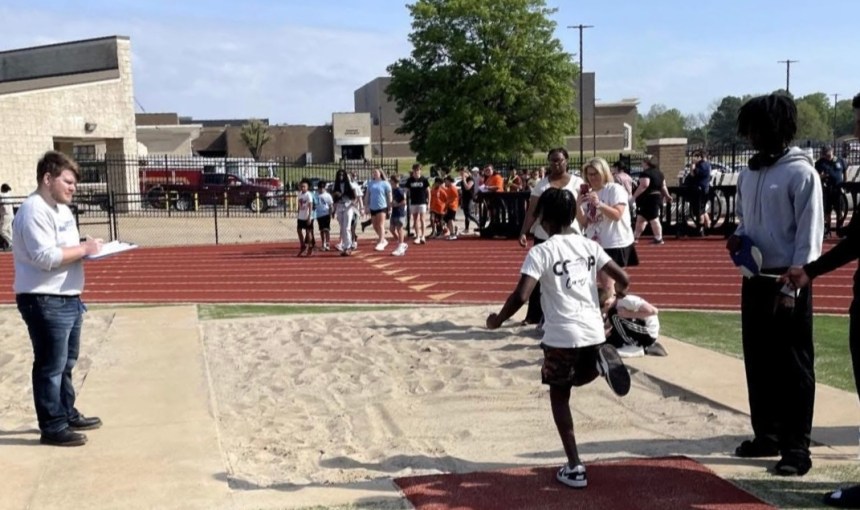
Faculty from Community Care & Miracle Kids volunteer at the Area Seven Special Olympics Track Meet, held April 10 at Jonesboro High School. Photo courtesy of Special Olympics Arkansas Area Seven
Click to View!

Hilson, who coaches the Special Olympics of Arkansas and serves as the Area Seven training director, has served as a Special Olympics coach for over 20 years. An A-State colleague introduced her to the nonprofit organization. The organization hosts regular sporting events across the state.

Jonesboro High School hosted the last event April 10, which included 565 athletes ranging in ages from 2 to 60 participating. The Nettleton High School track team, local businesses and A-State faculty and students were all involved in the event.

The commitment to helping one another succeed is vital in maintaining the relationship between the education majors, NEA school districts and A-State.

Aggie Market Helps Feed NEARK

by Levi Collins
Delta Digital News Service

JONESBORO — The Arkansas State University Aggie Market is doing more than selling locally processed meat. The market to many students and community members provides a visible connection between A-State and the larger city.

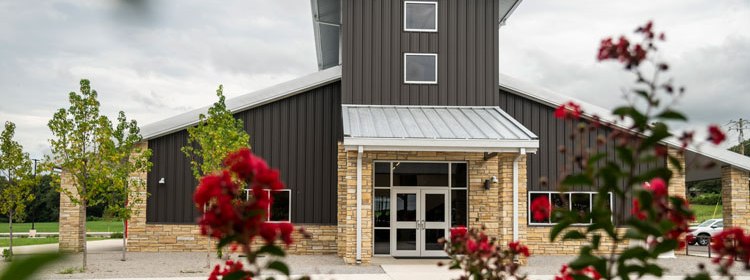
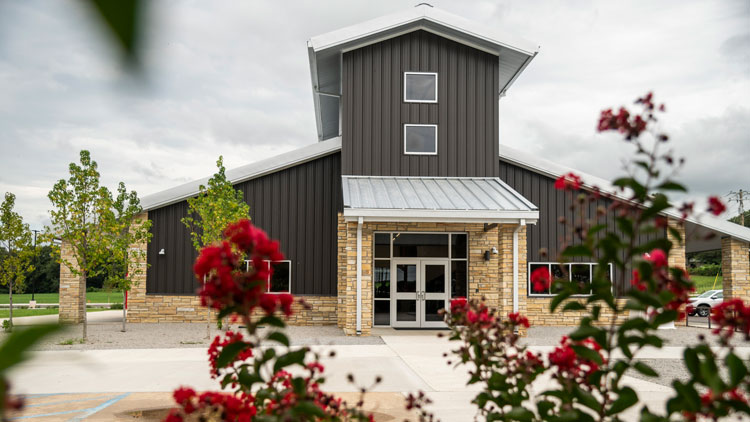
View of the front of the Arkansas State University Aggie Market. Photo courtesy of Arkansas State University


Part of the College of Agriculture, the Aggie Market serves as both a student learning facility and a public retail space. Students help process, market and sell products while interacting directly with Jonesboro residents during weekly retail hours and community events.

Richard Readnour, meat laboratory manager, said the market’s role extends beyond education by creating direct interaction between students and the Jonesboro community.

“The Aggie Market’s target audience is anyone within the Jonesboro community, or surrounding areas. We seek to build relationships with students, staff, faculty, and strengthen our community ties,” Readnour said.

The Aggie Market first opened in 1971 as the ASU Meat Lab under the leadership of Raymond Hostetler. The meat lab originally focused primarily on teaching and USDA-inspected processing.

In 2021, the College of Agriculture received grant funding from the Arkansas Department of Agriculture that allowed the facility to undergo major renovations. The market reopened in 2023 under the new name A-State Aggie Market as the first state-inspected facility in Arkansas.

The renovation also expanded opportunities for students beyond meat processing. Students can now participate in nearly every step of production, from raising livestock at the university farm to developing and marketing retail products sold to the public. Students working inside the market are often the face of those interactions.

Hannah Johns, a student employee at the Aggie Market, said they provide hands-on learning opportunities and even employment for students.

“We are committed to producing products handmade by students and being engaged with the community,” Johns said.

The market opens weekly to the public, allowing residents to purchase products directly from students working in the facility. Readnour said those face-to-face interactions help students gain experience while also giving customers a better understanding of agriculture and food production.

According to Readnour, the market isn’t a one-time stop.

“We have several repeat customers who come back often to pick up their favorite products. We use this as an opportunity to tell them about the importance of agriculture, and our students who help us through every stage of
production,” Readnour said.

Still, awareness of the Aggie Market itself may not be widespread throughout Jonesboro.

Craig Rickert of the Jonesboro Advertising and Promotion Commission said he was more familiar with the broader Judd Hill Farmers’ Market than the Aggie Market specifically. Rickert said community-centered agriculture events hosted through A-State play an important role in connecting the university with Jonesboro residents.

“The great appeal of the Judd Hill Farmers’ Market is that it brings people to campus,” Rickert said. “Those Saturday morning and Tuesday afternoon trips can be as much about being social as shopping. You can get great local products in a lot of places. But the farmers’ market gives you community on top of that.”

Click to View!

Rickert said the Aggie Market should be viewed as a community resource and not exclusive to the university.

“When you see the full parking lot, the families, the kids running around snagging a free taste of something, that’s special,” Rickert said. This most definitely strengthens the connection between the city and the university. A-State is the heart of our city.”

While the Aggie Market operates on a relatively small scale compared to other university outreach efforts, it continues to provide one of the few spaces where students and Jonesboro residents regularly interact through a shared local experience.

“We need to drop the sentiment that something is only A-State or only Jonesboro. The city and the university live together hand-in-hand,” Rickert said.

Partnership Engages Jr. High Students

by Mia Young
Delta Digital News Service

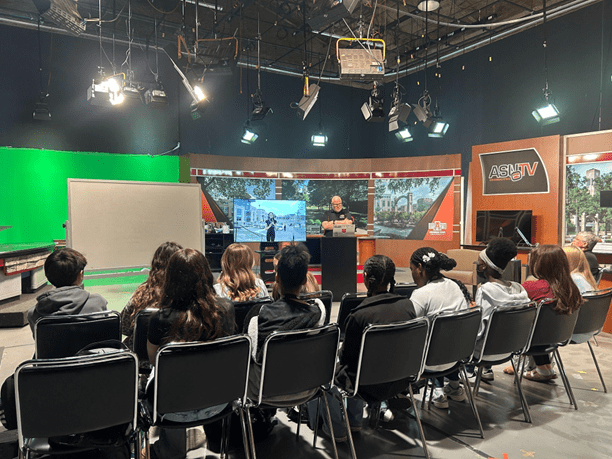
Nettleton BRIDGE program students presenting and watching their final video projects about Nelson Mandela and Zodwa Dlamini. Photo by Mia Young.

JONESBORO, Ark.- The Nettleton BRIDGE program introduces middle school students at Nettleton Junior High to the learning environment of a college student by teaching them about multimedia journalism in the School of Media & Journalism.

The Nettleton BRIDGE program began as a way to help Nettleton Junior High students experience what it is like on a university campus, so they can imagine themselves as a student at Arkansas State University or any other university. Many first-generation college students struggle to imagine college life.

Chris Moss, principal of Nettleton Junior High, contacted Gina Houge, associate dean for the College of Liberal Arts and Communication, because he wanted to target his eighth-grade students young enough to benefit from an experience that could encourage them to become college students. Last year, the program began by bringing in a small group of Nettleton students who were interested in multimedia journalism, especially the media aspect.

“I mean, that’s what students know, right? They have their phones, and they’re engaged in media constantly,” Hogue said. “But to get an experience within an academic field was what Mr. Moss wanted them to experience.”

Hogue and Moss also wanted to add a historical component to the program, as they are both passionate about history. But last year’s pilot program focused on building the students’ multimedia journalism skills, and they were unable to build out any historical component. Jonathan Reaves, instructor in the school of media and journalism, played a critical role in working with the students and developing their multimedia journalism skills.

“The first year of the program (last year) was a challenge in that we were developing a program from scratch,” Reaves said. “In the first year, we had to decide which media we wanted to use.  We primarily focused on video packages, and I have been working on audio podcasts separately.  I expect we will incorporate more audio podcasting next year.”

The program changed significantly from the first year to the second. Last year, the group of students interested in media activities merged with the group who were interested in STEM activities. This meant some Mondays, the group would work on multimedia projects and other Mondays, they would work on STEM projects.

This year, the two groups remained separate, and they focused on adding a historical component along with learning the elements of writing, audio and video.

“So we wanted to continue with street talks, and we wanted to expand and add the audio component in so they could do more audio editing. Then Alina and Jonathan wanted them this semester to do an actual video report that encompassed all of these elements of interview, audio and also video,” Hogue said. “To build in the historical component, we wanted students to be able to meet people from many places around the world and learn about the culture in other places and to interview people, so that they’re doing their research, ’cause when you research like a journalist, you’re researching like a historian.”

Throughout the last year, students completed several multimedia projects based on what they learned about different historical topics in the Nettleton BRIDGE program class.

One of the first things Alina Sakayeva taught the students about was her hometown of Kazan, Russia. Sakayeva talked about her family traditions, the food they eat and the relationship between her and her family. She showed them some of the historic buildings and contemporary athletic facilities where they host global soccer matches, and taught the students about the ancient culture and the traditions there.

“The students sat on the edge of their seats, listening and looking at the images, and watching the videos of the cultural dancers in Kazan, conveying the history of that region of the world to these young people, these eighth graders, from Nettleton Jr. High School,” Hogue said.

At the end of the nine weeks, the students created their video story about Kazan and something from Sakayeva’s culture they were interested in, and then presented it to the class.

“The Kazan video (was my favorite), it gave us a lot of freedom to do whatever with the video, and it was super fun to learn about,” Brylin Smallman, eighth grader in the Nettleton BRIDGE program, said.

During the second nine weeks, the students learned about the Pine Ridge Indian Reservation in South Dakota. They also individually created videos on the topic using interviews with Alice Phelps, a former educator on the reservation, and their own research.

During the third nine weeks, they read “The Story of Nelson Mandela” by Floyd Stokes and learned about him, and Zodwa Dlamini, who was in his administration in South Africa and who brought several school districts together there. The students also interviewed Dlamini over Zoom.

For their final projects in the fourth nine weeks, the students spent time in the K-labs learning about audio production and editing their videos about what they learned from their reading, their research and the interview with Dlamini.

Not only are the students learning audio, video, storytelling and a little bit about history but they are also learning life lessons they will carry with them throughout their lives.

“(I learned) to be open-minded. I wasn’t very open-minded at the beginning, and now I’m just like ‘OK, this is what’s going to happen, and that’s OK,’” Fielder Franks, an eighth grader in the Nettleton BRIDGE program, said. “Sometimes life happens, and it doesn’t go your way, and sometimes that’s just how it works, and so, you’ve just gotta be OK with that and move on.”

Every Monday, the group of 12 students would meet in the TV studio in the A-State College of Media and Journalism for two hours. This means these students would be missing three class periods and would be responsible for making up the classwork they missed. To be in the BRIDGE program, the students have to meet certain requirements, like having good grades (because they miss a lot of work) and not having any behavioral issues at school.

Karley Barnes incorporates multimedia elements into her EAST class, which each of the students attends. Barnes, an A-State alum, also travels with the students to and from the A-State campus and gives students a participation grade based on whether or not they came out and did their best.

“I think it benefits them because they get out of the classroom, they get to be challenged. It might be kind of taboo to say, but public school education is very watered down, and it’s not watered down out here,” Barnes said. 

Click to View!

Next year, the program will see a new group of eighth graders with many of the same and many different projects. Each year the students move up in school, the program continues to support them, but they have less time to visit campus. Reaves and Hogue are still excited for what next year will bring, even though the current eighth graders may not be on campus as much next year as they are now.

“I would tell these students to stay curious, keep working on their editing skills and be proud of what they have done,” Reaves said.

The Nettleton BRIDGE program does not just give students a chance to learn and improve their media skills, but “to help them, to inspire their learning, and to find their pathway in life. That’s the goal,” Hogue said.

City Trolleys Offer Free Transportation to A-State Students

Story by DDNS Reporter Kinley Rainwater

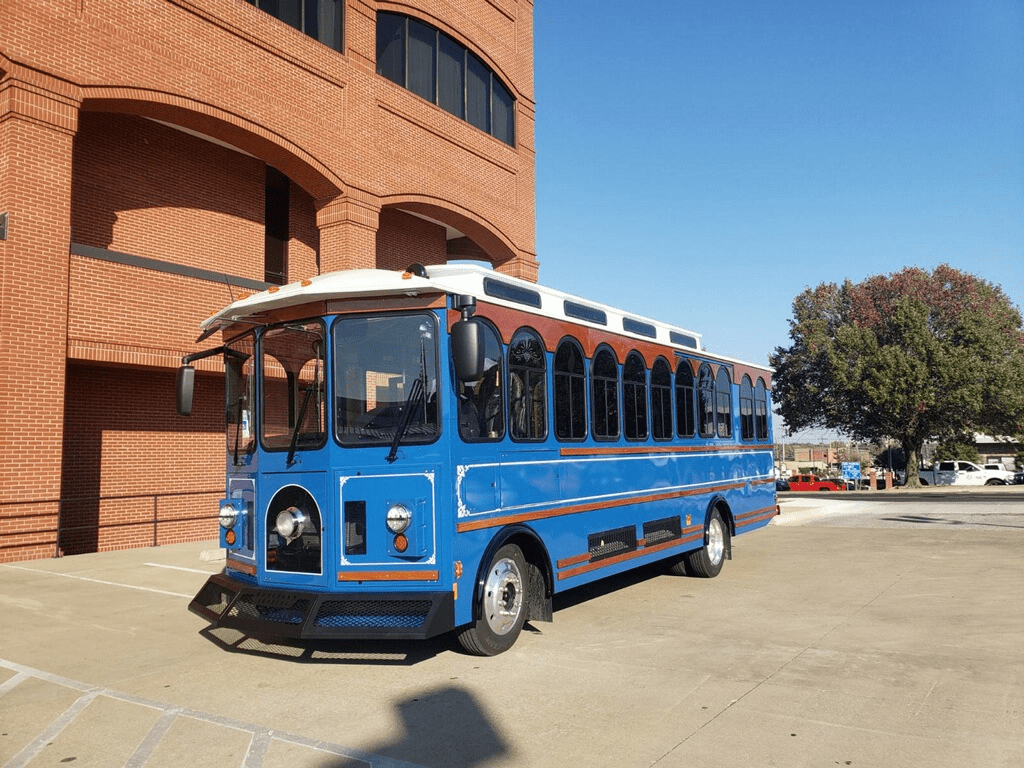
A blue trolley-style bus parked at the Jonesboro City Hall building. These buses offer transportation services using the GoJo Transportation System. Photo courtesy of the City of Jonesboro website.

JONESBORO, Ark. — The City of Jonesboro’s new GoJo Transportation System provides a convenient service to Arkansas State University students, offering free, campus-wide transportation. However, limited outreach to students has kept many from using the service.

The new GoJo system, previously JET, provides service to A-State and the surrounding Jonesboro area. It features six routes, ranging from on-campus hotspots to countless places in the city. The new Let’s GOJO! The app and website provide a map of all stops and routes to help users locate the nearest available transportation, as well as live tracking of all buses and trolleys.

The service is free to students with a valid student ID, providing an accessible alternative to driving or walking.

One of the most notable features of the system is the new Trolley-style buses. These vehicles provide classic aesthetics with modern functionality, which gives students a comfortable ride that is also more visually appealing than traditional transportation options.

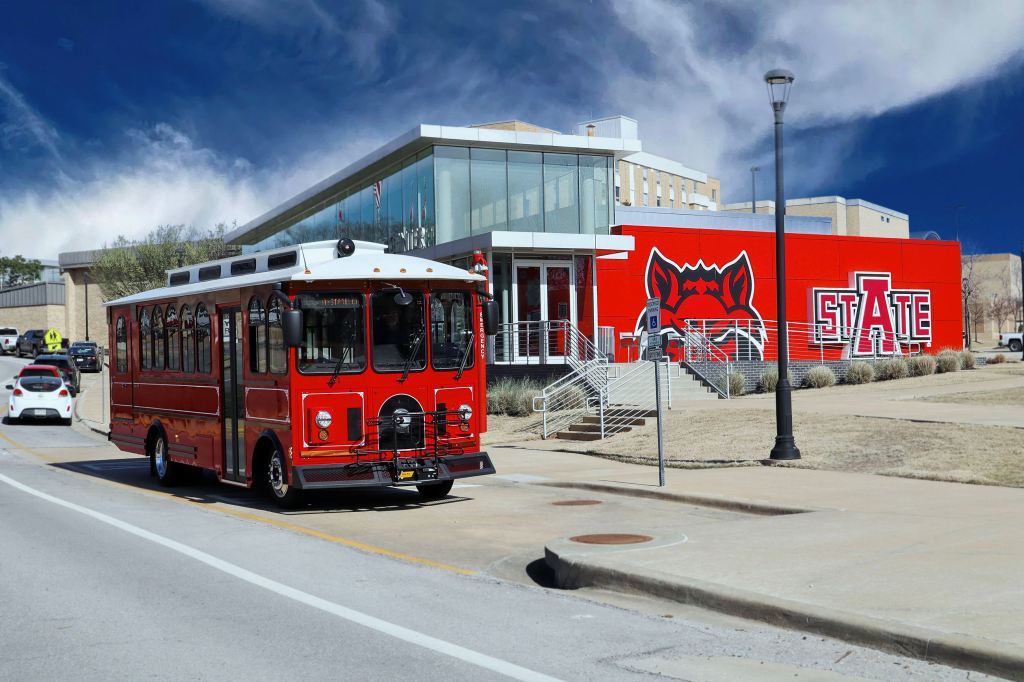
A red trolley-style bus parked in front of the Arkansas State University Welcome Center. Photo courtesy of the City of Jonesboro website.

City officials and transportation coordinators said GoJo is meant to connect residents, visitors and students to the city of Jonesboro through expanded connections throughout the city, including A-State.

Despite the advantages to students, GoJo is relatively unknown amongst them. International student Boaz Muteba said she followed the news surrounding the new system.

“In the fall of 2024, when public transportation options were expected to increase, I was one of the individuals who participated in the meeting to get more buses,” Muteba said. “Recently, when the idea took shape, I spotted the bus on campus and even saw it featured on Instagram. Unfortunately, I never got the chance to utilize it.”

The system’s impact goes beyond convenience. By encouraging students to use public transit, Gojo supports sustainable efforts and accessibility for those without personal vehicles and eases parking demand that comes with a growing campus.

As Jonesboro and student enrollment at A-State continue to grow, GoJo presents an opportunity to strengthen connections between the city and it’s academia scene. However, its success will depend on public awareness of this new system.

Students Provide Help, Seek Outlets

by Benjamin McDowell
Delta Digital News Service

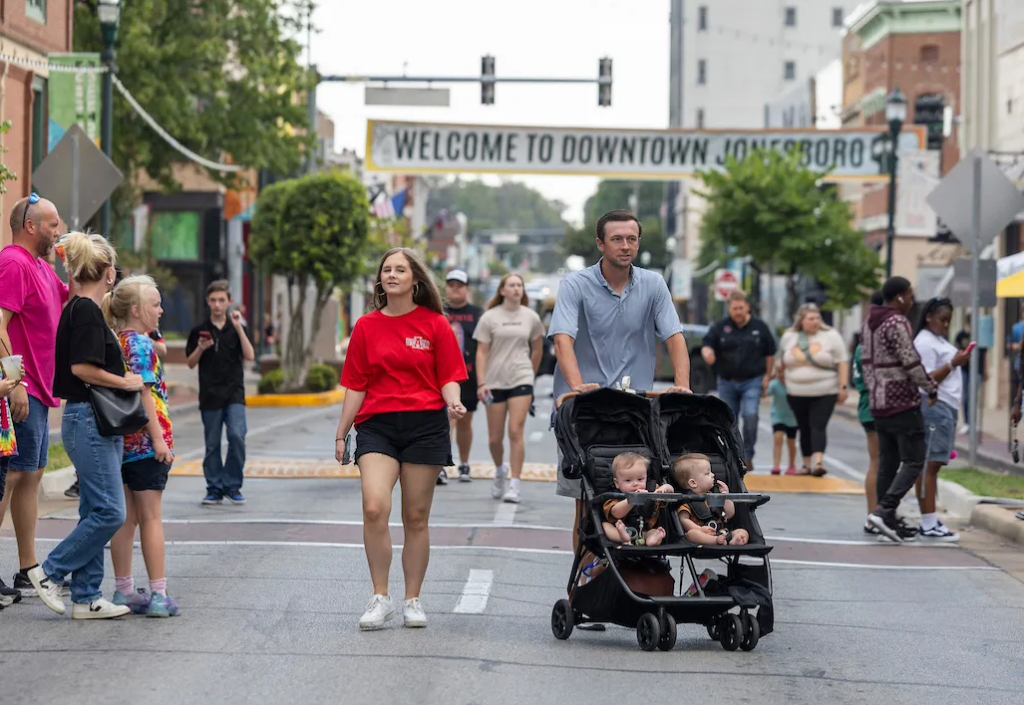
Pedestrians walk through downtown Jonesboro beneath a “Welcome to Downtown Jonesboro” banner, highlighting the connection between Arkansas State University and the local community. Photo courtesy of Arkansas State University.

JONESBORO, Ark. — As Arkansas State University continues to grow alongside the city of Jonesboro, students and community leaders say the relationship between campus and community is evolving, but not without challenges.

From economic inequality to shifting social values, both groups are working to better understand their roles in a shared space. While students often focus on academics, identity and campus life, many Jonesboro residents are more concerned with jobs, healthcare and the rising cost of living, highlighting a need for stronger collaboration.

Local organizations say collaboration is critical as community needs continue to grow.

At the Jonesboro Human Development Center, officials say demand for services has increased in recent years, creating new challenges for staffing and care.

“We are struggling to hire people to provide hands-on care for adults with disabilities,” said Diane Keith, a nursing home administrator at the facility. “We need employees with a CNA license.”

Keith said the center also maintains a waiting list for services, reflecting a broader need for support across Northeast Arkansas. She said A-State students help fill some of those gaps through internships in nursing, dietetics and speech therapy.

“We receive several A-State students for internships,” Keith said.

She said the organization remains active in the community through events like Oasis Fest, blood drives and the United Way’s Day of Caring.

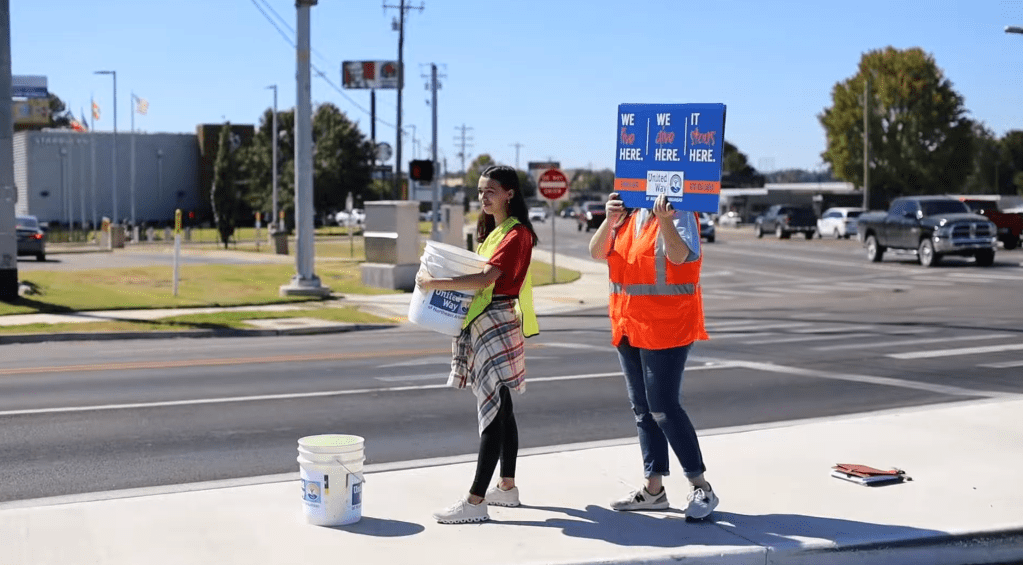
Volunteers request roadside donations for the 2022 United Way Day of Caring. More than 500 volunteers attended the event in 2022. Photo courtesy of UWNEA Jonesboro YouTube Channel.

Community leaders say those partnerships are key, but there is still room to grow.

Heather Coats, executive director of United Way, said A-State has already made strong efforts to connect students with the community.

“I think what’s important, and A-State already does a great job of this, is letting students, especially young adults, know what resources are available,” Coats said.

However, she believes the responsibility does not fall solely on the university.

“I think the community could do a better job of being present on campus when it’s not just for sporting events,” Coats said. “We need to have more of a presence that isn’t just about our own entertainment.”

Coats said increased engagement from Jonesboro residents could help integrate students into the community and encourage long-term involvement.

Erin Calhoon, development director for United Way, said improving awareness is essential to strengthening that connection.

“I would say finding ways for people on A-State’s campus to be more aware of what’s available in the community,” Calhoon said.

Student leaders agree that awareness remains one of the biggest barriers.

Jaycee Davis, president of Volunteer A-State, said her organization has made it a priority to connect students with local opportunities.

“Our mission last year was to connect campus to the community,” Davis said. “We had organizations from Jonesboro come to campus, and we introduced ourselves and shared how we could help each other.’

Volunteer A-State works with organizations such as United Way, the Northeast Arkansas Food Bank and the Craighead County Public Library, helping students find ways to give back through service and outreach.

“Our goal this year is to have students make a bigger impact in the Jonesboro community by making them more aware of volunteer opportunities,” Davis said. “So many students don’t know what’s available in Jonesboro.”

Davis said students can get involved through activities like packing food boxes, participating in community events and supporting organizations like Hope Found, which raises awareness about human trafficking.

“Right now, the community gives a lot to the campus, which is great,” Davis said. “But I think our mission moving forward is to give that same energy back.”

Lavonda Evans, an instructor of sociology and criminology at Arkansas State, said differences in age and life experience often shape priorities.

“Students are in that space between being supported by their families and stepping into the real world,” Evans said.

Evans said campus conversations often focus on identity and diversity, while broader community concerns center on economic stability and infrastructure. She said there is a growing shift toward individualism.

“Everything is more individualized and specialized, which creates less collective support,” Evans said. “People tend to focus on their immediate circles rather than the community as a whole.”

Despite those differences, Evans said collaboration is both possible and necessary.

Click to View!

“Jonesboro is already making efforts to connect the campus with the city,” Evans said.

She said projects like walking trails and plans to better link the university to downtown are some examples of this effort.

Evans said expanding paid internships or job-shadowing opportunities could help students gain early experience while strengthening ties to the community.

“Overall, both city and university leaders are making strong efforts to connect students and the community, but there is always room for improvement,” Evans said.

As both sides continue to grow, leaders agree that bridging the gap will require greater awareness, stronger partnerships and a shared commitment to engagement on campus and in the community they will eventually call their own.

Local Hospital Navigates Rising Costs, Growing Demand

Stethoscope with dark blue tubing and metallic chest piece on a white background

Story by DDNS Reporter Benjamin McDowell

St. Bernard’s health care physician Dr. Christina Carl (right) performs a heart and lung auscultation for a patient during a routine wellness exam in Jonesboro, Arkansas. Photo courtesy of St. Bernard’s.

JONESBORO, Ark. — As St. Bernard’s Health Care approaches its 126th anniversary on July 5, leaders say the oganization is balancing a legacy of community care with the growing challenges of modern health care.

St. Bernard’s has been in medicine for 125 years, evolving alongside the social service industry rather than the city, economy, or technology. Kevin Hodges, senior vice president, said rising costs and increasing insurance requirements continue to strain providers in the post-COVID era.

“Every time they add requirements, it adds cost to us,” Hodges said. “Someone has to make sure those requirements are met just for us to get paid. Those are uncompensated burdens.”

Health care systems face high operational costs, including labor, transportation, utilities, and food insecurity. Hodges said balancing expenses while navigating reimbursement challenges has become increasingly difficult. Hodges also noted funding for social service programs has stagnated, often coming from federal and state sources, and emphasized the importance of volunteers from churches, students, and other community groups.

“To have high-level social services in communities, you have to have strong volunteer programs,” he said.

Michael Givens, administrator and chief operating officer, said the vision of the Sisters who founded St. Bernard’s 126 years ago continues to guide the hospital. Over his 25 years, Givens has seen growth in heart care, stroke care, robotic surgery, and technology, including artificial intelligence.

“We already use a system called Rapidan. It works with our CAT scanners to analyze brain scans and quickly identify strokes or aneurysms,” Givens said. “That kind of speed can save lives.”

Givens said St. Bernard’s aims to expand services further, recruit specialists, and become a top-10% hospital in the U.S.
Kevin Byron, assistant vice president for Behavioral Health Services, said the rise in mental health issues has driven growth in inpatient and outpatient care. The hospital has 108 beds serving patients with a wide range of needs, from severe psychosis to depression and suicidal thoughts.

Mental health remains central to St. Bernard’s mission, he said, inspired by the founding Sisters. Programs like the recuperative care program at the CSU allow patients to stay up to three months post-discharge, supporting those experiencing homelessness.

“I’ve been in health care for about 27 years, and Jonesboro has grown significantly. As the population grows, so does the need for infrastructure and services,” Byron said. He hopes to create a crisis response team that works with law enforcement and 911 and a psychiatric residency program to train new psychiatrists locally.

Mitchell Nail, media relations manager, said his role has shifted since the pandemic from health guidance to encouraging residents to address health issues early, including finding primary care providers and attending screenings.

Increased awareness of social services has led St. Bernard’s to provide prenatal and postpartum care regardless of a patient’s ability to pay. Nail said patient stories remain the hospital’s most effective way to connect with the community.

“I want people to see St. Bernard’s as their trusted source for health information and care,” he said. “I want them to feel confident they can find expert guidance and treatment right here in their community.”

-30

Food insecurity rises in northeast Arkansas as costs climb

Story by DDNS reporter Benjamin McDowell

Photo courtesy of the Food Bank of Northeast Arkansas

As grocery prices climb and paychecks fall short, more Northeast Arkansas families are waiting in food bank lines to make ends meet.

Food insecurity is rising in northeast Arkansas as inflation drives up the cost of groceries, gas and housing, putting increased pressure on local food banks.

The Food Bank of Northeast Arkansas secures donations from food and grocery industries, government agencies, individuals and other organizations to provide for people in need. The food is stored in the organization’s 59,600-square-foot distribution facility in Jonesboro.

Terry Austin, a development officer focused on fundraising and communications, said demand for food assistance has increased over the past year due to inflation, rising gas prices and cuts to federal support programs such as the Supplemental Nutrition Assistance Program, or SNAP.

“Demand has risen already just from the cuts that we’ve taken so far from the economy being in rough shape,” Austin said.

Austin said donors are also feeling financial strain, forcing them to be more cautious with their contributions as they balance their own household expenses. He said the food bank has seen an increase in senior citizens and families seeking assistance.

“Everybody right now is watching gas prices go through the roof,” Austin said. “Everything is more expensive at the grocery store.”

According to Feeding America, about 240,000 people in Arkansas benefit from SNAP, including 113,000 children and 36,000 senior citizens. A University of Arkansas study estimates that 28.8% of Arkansans face food insecurity.
“The price of one pound of ground beef is now higher than the federal hourly minimum wage,” Austin said, describing the current conditions as a “perfect storm” of rising costs and reduced assistance.

Austin said he is concerned about the food bank’s ability to meet growing demand as grocery prices continue to rise and federal assistance programs face potential cuts.

“I’m honestly worried about making sure that we’re able to meet the needs that may be coming our way,” Austin said.
Feeding America estimates that cuts to SNAP benefits could result in a loss of up to 41 million meals for Arkansas families.

Laura Dunivan, who works on the programs team managing fundraising and grant efforts, said rising costs are bringing more first-time clients to food pantries.

“What used to be occasional support for some families is now something they rely on more heavily,” Dunivan said. “We’re consistently serving more households each month.”

Dunivan said many families use food assistance to fill gaps during financial hardship, allowing them to afford other essentials such as gas, rent or medication.

“Would you sit in a car line for an hour for a box of food if you could just go to Walmart and get it in 10 minutes?” Dunivan said.

She said transportation remains a major barrier in rural communities, where access to food pantries can be limited. To address this, the food bank operates the Nourish Mobile, which delivers fresh produce at no cost to underserved areas.
“Some of the people can’t come to the pantries, we have to go out to them,” Dunivan said.

Natalie Neal, the USDA coordinator for the food bank, said federal food programs play a critical role in addressing hunger across the state.

“With the rising price of food, it is more expensive to purchase food, and our neighbors can’t afford everything they need,” Neal said. “It really starts to feel like there’s a greater gap.”

Neal said the food bank has seen a decrease in USDA food shipments, limiting the amount of food available for distribution.

“We are seeing less come into the food bank, so we have less to go out to the community,” Neal said.

She said the organization works with mayors, churches and community partners to expand access and reach new households.

“USDA foods provide a pivotal source of food,” Neal said. “It helps keep food in the pantry to help us all get through difficult times.”

Bonnie Mamula, office manager at the food bank, said rising food costs combined with stagnant incomes are key drivers of food insecurity.

She said senior citizens are especially vulnerable because many live on fixed incomes while expenses continue to rise.
“Some counties only have a few pantries, and they’re only open a couple of times a month,” Mamula said. “People in more remote areas have fewer choices.”

Mamula said the food bank is also seeing more working individuals and recently unemployed residents seeking assistance.

“Even people with jobs can’t make ends meet,” Mamula said.

Jennifer Hannah, chief program officer, said inflation has affected not only how many people the organization serves but also the quality of food it can provide.

“If we look at our data over the last few years, what we’re seeing is consistently serving more people,” Hannah said. “Demand is always there; it’s just how urgent it is.”

Hannah said many families fall into a gap where they earn too much to qualify for assistance programs but not enough to consistently support their households.

“It’s not so much changing the services we deliver, it’s changing how much we’re able to deliver,” Hannah said. “When prices go up, the quality of people’s food is going to decrease.”

-30-

A-State Museum more than just a museum

Story by DDNS Reporter Mia Young

Photo courtesy of Arkansas State University.

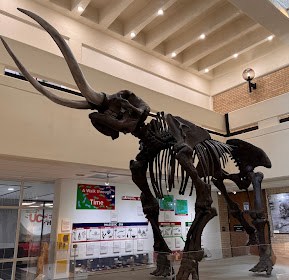
JONESBORO, Ark. – The Arkansas State University Museum is not only a place where people can see parts of history, but also an educational resource for teachers, professors and students.

Many students spend four or more years at A-State without visiting the museum, missing a valuable interactive educational experience that could help them better understand what they learn in history classes. The museum focuses not only on Arkansas history, but also on preserving and showcasing the history of northeast Arkansas and the Delta region.

The museum serves as an informal learning environment, according to Elisabeth Engel, director of the A-State Museum.

“You don’t have to be here. It’s not like class,” Engel said. “So, you know, we value the people that come through because they’ve made an effort to come see us. We hope that they walk away feeling like that effort to brave campus, find a parking spot, and all of those kinds of things, in our particular environment, was well worth it.”

Students, faculty, staff and Jonesboro residents can visit the museum on their own or book a tour with Jill Kary, curator of education at the museum. For teachers and professors, the experience can be especially valuable.

Lillie Fears, professor and interim director in the School of Media and Journalism, brings her classes to the museum every semester to help students understand historical events in ways a textbook cannot.

“My favorite part about taking students to the museum is seeing their reactions when they see something old that we’ve talked about in class, or that is mentioned in our book or in a documentary. These types of experiences can allow them to step out of present-mindedness and to realize how the tools and technology they use in modern times evolved at different eras in U.S. and world history,” Fears said.

Many groups, Engel said, visit the museum with a specific purpose. For some groups, Engel pulls artifacts from storage and creates a “mini exhibit” tailored to their interests.

Fears prefers tours focused on communication history and artifacts, so Engel often brings out old newspapers, cameras and photographs for her students.

“I really appreciate how the director, Elisabeth Engel, is always willing to bring out old artifacts that pertain to mass communications and provide us with special lectures on the history of these media tools. A textbook or video could never do what she and Jill Kary, education coordinator, do for my classes,”

For some students, a focused tour helps them better understand what they have been learning in class.

“It made a lot of the concepts feel more real. In class, we talk about the history of media, but actually seeing the artifacts and examples in person helped me connect everything more clearly, especially how media has evolved and impacted society,” Kaysen Lomax, a junior creative media production major from Jonesboro, said.

For other students, seeing everything the museum offers gives them a perspective they otherwise might not have considered.

“Yes, I did thoroughly enjoy the tour Dr. Fears took us on. Seeing how passionate Jill Kary was about the black business district was inspirational. I enjoyed looking at all the old pictures of old businesses and equipment/technology, and find it crazy to see how much those things have changed,” Alexander Riggs, a junior creative media major from Forrest City, Arkansas, said.

While the museum serves as a tool for professors on campus, teachers in surrounding school districts also can use it as a resource.

Photo courtesy of Arkansas State University.

Traveling suitcase exhibits are smaller exhibits teachers can check out for two weeks at a time. They offer hands-on materials, visual aids and lesson plans for each exhibit. Teachers can choose from five options, including Pioneer Living, Portals of the Soul: Native American Culture, World War II on the Arkansas Homefront and more.

“All of them are linked to the educational standards that are dictated by the state,” Kary said.

Visitors can also explore the tinkering studio to test whether they have the same innovation skills as people on the Arkansas frontier.

“If the kids have been paying attention, in every gallery they’re seeing innovation happen,” Kary said. “So they are told to invent things, make something, and if it doesn’t work, tweak it, fix it.”

Learning does not just happen in the classroom; it can happen in many places, including the museum. And learning is not just for students. Anyone who visits the museum is welcome, whether for a specific purpose or simply for fun.

-30-

Earth Day: A great time to review the natural state’s environmental practices, policies

Story by DDNS Reporter Jerry Don Burton

April 16, 2026

From city-wide cleanups to research demonstrations, several organizations are gearing up to host events for Earth Day in Arkansas.

Earth Day, held on April 22 every year since 1970, is a global event observed to spread awareness and support for environmental issues and practices.  

Melissa Dooley, director of the Arkansas State University environmental, health and safety office, said Earth Day assigns a specific day in which people can sit down and talk about what they are doing or could be doing to help the environment.

“Earth Day is a kind of celebration and a recognition and awareness of things that we can do to help maintain and improve our environment,” Dooley said. “But it’s also a celebration of the Earth as a whole and that we all are here sharing this big rock floating in space together and it’s all our home.”

EARTHDAY.ORG, the global coordinator for Earth Day events, announces a unique theme for Earth Day every year. This year, they chose “Our Power, Our Planet.”

Dooley said centering Earth Day around a theme keeps everyone on their toes and prevents the same events from happening each year. 

Upcoming events

Over 10,000 Earth Day events are scheduled worldwide. More than 60 official EARTHDAY.ORG events are registered in Arkansas alone. 

EARTHDAY.ORG offers an interactive map on its website with the locations and dates of all registered events.

A map of Arkansas with pins denote Earth Day events registered through EARTHDAY.ORG. Organizers registered over 60 events in Arkansas as of April 16, 2026. MAP GRAPHIC COURTESY OF EARTHDAY.ORG.

Keep Arkansas Beautiful lists seven pages of environmentally focused events across Arkansas on its website, though not all are organized specifically for Earth Day. 

Keep Arkansas Beautiful is a division of the Arkansas Department of Parks, Heritage and Tourism and a certified affiliate of Keep America Beautiful Inc.

In Jonesboro, an Earth Day event is scheduled from 10 a.m. to 2 p.m., April 22, at the Heritage Plaza Lawn on the A-State campus. 

Several clubs and organizations will table at the annual event to spread awareness on several topics related to Earth Day. Dooley said some participants will even present their research. 

“We also invite a lot of local vendors who might be interested in setting up a table and talking about what they’re doing for environmental progress, sustainability and whether they have a focus on that this year,” Dooley said. 

An art contest is also scheduled, which will feature works made from recycled materials by local primary school students.

Dooley said the main goal of the event is to reach out to the younger generation and open their eyes to their impact on the world and the importance of sustainability. 

“It’s making them knowledgeable, so as they grow up, and they see mom and dad throw something out the window, they’re like, ‘you shouldn’t litter, mom and dad,’” Dooley said. “If we get everybody as they’re young, they grow up with these good responsibilities of being a steward for this planet and that also gives an opportunity to start thinking of things outside the box that this generation didn’t think of.”

Beverly Parker, Keep Jonesboro Beautiful commission chair, said giving children early experience with practices like litter removal and proper trash maintenance will establish more eco-friendly habits in the future.

Dooley said while the event is generally geared toward elementary and middle school students, anyone can come out and learn something.

The event is funded entirely by donations and volunteering. The EHS director said her department sponsors the event alongside Jennifer Bouldin, dean of the science and mathematics department and director of the ecotoxicology research facility. Dooley said this event represents a significant collaboration between several campus organizations. 

One town over and three days later, Paragould will host a city-wide cleanup from 8 a.m. to noon. The event is led by volunteers and designed to bring together residents and local businesses to improve public areas.

More Earth Day events across the Arkansas Delta are listed below:

  • Marianna/Lee County cleanup
    • When: April 18, 2026, from 8:30 a.m. to 12:30 p.m.
    • Where: No. 1 Court Square, Marianna, Arkansas
    • What: Volunteers will clean up litter in downtown Marianna
    • Coordinator: Pat Audirsch, 870-821-1403, pataud@sbcglobal.net 
  • Lake Chicot cleanup
    • When: April 18, 2026, at 9 a.m.
    • Where: Lake Chicot State Park
    • What: Volunteers will clean up areas across Lake Chicot State Park 
    • Coordinator: Brandi Hanson, 870-265-5480, brandi.hanson@arkansas.gov 
  • Helen-West Helena cleanup
    • When: April 25, 2026, from 9 a.m. to 1 p.m.
    • Where: 319 Philips St., Helena-West Helena, Arkansas
    • What: Volunteers will engage in a city-wide cleanup across Helena-West Helena
    • Coordinator: Chris Schaffhauser, 501-410-5562, schaffhauserchris@gmail.com 

More important than ever

Cherie O’Mary, executive director of the Arkansas Recycling Coalition, said Earth Day excels at highlighting advancements in environmental policies, practices and issues. 

Dooley said one of the biggest environmental issues facing Arkansas now is the amount of trash on the interstates, highways and parking lots.

“You can go anywhere, there’s just trash everywhere,” Dooley said. “All of that trash eventually makes it ways into our stormwater systems and our rivers, our streams, our lakes, where it clogs up the heavy, dense areas in the woods where animals are, and it affects their habitats as well.”

Parker said areas with poor litter or debris management give off an unsafe feeling. 

Arkansas Department of Transportation assistance chief engineer for maintenance, Steve Frisbee, said litter is a problem, from the largest interstate to the smallest back road.

Emma Goad, a writer for ARDOT, said the department spent about $8 million on cleanup efforts. She said the cost comes from several programs, contracts and other services intended to keep Arkansas highways litter-free.

Frisbee said organizations like Keep Arkansas Beautiful help engage the community in cleanup efforts and reduce the environmental damage litter causes.

A litter report form may be filed on the IDrive Arkansas website here.

Recent environmental policy also highlights the significance of Earth Day. 

On July 25, 2025, Arkansas Republican Representative Bruce Westerman introduced the Standardizing Permitting and Expediting Economic Development Act. 

The SPEED Act limits the scope of the National Environmental Policy Act and changes the environmental review of major federal actions under NEPA to restrict the number of federal actions that trigger NEPA review and expedite the review process. 

According to House Majority Whip Tom Emmer, more than 300 stakeholders support the bill. Organizations like the Aluminum Association, Steel Manufacturers Association, Data Center Coalition and even Google state they support the SPEED Act because it will accelerate projects and lower costs.

Despite this support, the bill remains controversial legislation.

David Watkins, director of government affairs for the climate and energy program at the Union of Concerned Scientists, said this bill means bad news for the environment.

“It includes goodies like shielding fossil fuel projects from meaningful review or public input before they are permitted, then shielding them from legal recourse after they are approved,” Watkins wrote in a UCS article. “Circumventing science and denying reality will only lead to greater harm to our environment and worse outcomes for communities.”

The SPEED Act is pending approval from the Senate after the House of Representatives voted to pass the SPEED Act on Dec. 18, 2025.

Despite the controversy surrounding this bill and others, Dooley said she thinks, generally, Arkansas does its fair share for the environment.

“We have beautiful parks, beautiful places to go and visit, enjoy and we have some rules in place,” Dooley said. “Could we do better? Yeah, I mean, there’s always room for improvement. But I think we’re headed in a good direction.”

Dooley said stormwater permit requirements are an example of good policy in Arkansas.

The Arkansas Division of Environmental Quality requires any construction project over one acre to apply for a stormwater permit under the National Pollutant Discharge Elimination System program. 

An infographic illustrates how rain or melted snow carries construction waste like concrete, oils and pesticides, into stormwater drains. These construction pollutants cause ecological damage when they drain into bodies of water. INFOGRAPHIC COURTESY OF NEVADA DIVISION OF ENVIRONMENTAL PROTECTION.

According to the ADEQ website, stormwater carries dirt, chemicals and other pollutants that could harm water quality. Stormwater permits regulate this runoff and prevent pollutants from entering streams, creeks, ditches and other waterways.

While Dooley said the laws in place and penalties for breaking them are effective, she knows there will always be bad actors. She said this is why speaking up is important.

The ADEQ pollution complaint form may be found here.

O’Mary said Arkansas’ glass recycling programs are another example of how Arkansas is leading the charge in certain areas of sustainability.

The ARC executive director said the real impact of Earth Day may only be felt in the future. Still, O’Mary said now is always the best time to get involved.

Keep the conversation going

Although Earth Day is only celebrated on a single day, Dooley said awareness should continue year-round. She said people are constantly interacting with the environment, making Earth Day an everyday conversation. 

O’Mary, who has served the recycling industry for 15 years, said she feels Earth Day is more prevalent now than in previous years. 

In her five years as the EHS director, Dooley said she noticed younger people becoming more interested in sustainability. Dooley, who also sits on the Keep Jonesboro Beautiful commission, said the community has expressed interest in Earth Day events like city cleanups.

“I was relatively surprised with the amount of people that really want those types of things,” Dooley said.

O’Mary and Dooley said one does not have to wait until Earth Day to start taking care of the planet. 

Dooley said many people do not realize all the different ways they can participate in Earth Day.

O’Mary said calling the local solid waste district and asking how to offer support is a good first step for those interested in recycling but unsure how to start.

The ARC executive director said she is constantly on the phone, helping direct people to where they can recycle unwanted items.

“That’s the ultimate goal, keep it out of the landfill,” O’Mary said. “Reuse, reuse, reuse.”

The ARC may be contacted by calling 866-290-1429 or emailing mail@recycleark.org.

Dooley said events like clothing swaps and practices like electronic recycling are things people don’t think about often, but still help the environment.

The EHS director said, even if Earth Day did not exist, people would still raise awareness for environmental issues and engage in eco-friendly practices. 

“I think we, as a race, as a human race, all recognize that something should be done,” Dooley said.

More information about Earth Day, local events and environmental issues may be found linked below:

Quorum court adopts transfer ordinance, hears hot check report, responds to poverty concerns

Story by DDNS Reporter Jerry Don Burton

February 23, 2026

Craighead County Judge Marvin Day (center) explains one of the large ticket items on the annual transfer ordinance to District 4 Justice of the Peace Linda Allison (second from left). The item concerned a $2.5 million transfer from the county general fund to the capital fund to support department operations. Photo by Jerry Don Burton.

The Craighead County Quorum Court adopted an annual transfer ordinance, heard a hot check report and responded to a public comment regarding rising poverty. 

Annual transfer appropriation ordinance

The annual transfer appropriation ordinance, adopted unanimously at the Tuesday, Feb. 23, Craighead County Quorum Court meeting, appropriated funds from special revenue accounts into the county general fund.

Craighead County Judge Marvin Day said the transfer ordinance is the first step of an annual cleanup process. 

“So that’s basically what we’re doing is we transfer money from one spot to the other to keep those balances whole, and the quorum court, on an annual basis, has to acknowledge, you’re not spending any new money, any additional money,” Day said. “Just acknowledging what we’ve done to keep the budget afloat.”

Day said, to think of it in simpler terms, it’s like they have 50 different checking accounts and the court appropriates money out of each of those accounts based upon an estimated revenue.

“Somebody may want to spend something in February, but their money doesn’t necessarily come in until September, October, and so we move money around to keep those balances in the positive, best we can,” Day said.

Hot check report

Also in new business, Charlene Davidson, a prosecuting attorney for the second judicial district of Arkansas, presented a hot check report, as required by state law. 

Craighead County Judge Marvin Day (center top) introduces Charlene Davidson (center) and Sarah Burnett (right) before they give the hot check report. The report is required by state law. Photo by Jerry Don Burton.

Davidson said while terminated in April 2021, the hot check program still takes in money the Craighead County Sheriff’s Office receives.

In 2025, Davidson said the hot check program:

  • Received $10,217.51 from the Craighead County Sheriff’s Office, to be entered as payments received from defendants for the hot check program prior to 2021.
  • Distributed $19,384.46 toward merchant restitution
  • Dispersed $3,770 toward merchant fees, which is a fee that merchants can charge the defendant if they write a hot check.
  • $2,899.95 in prosecutor fees, a statutory fee the office can charge for maintaining the program.

Davidson said the preceding fees were all previously ordered prior to 2021. She said the total check amount for 2025, not including journal entries, was $26,054.41. The current account balance for the hot check trust account is $28,653.41.

The court unanimously accepted the report as prepared.

Public comments

After Day opened the meeting for public comments, Jonesboro resident Robin Martin said she was concerned about rising poverty in Craighead County.

She said the poverty rate in Craighead County is 21.5%, almost double the 11% national rate and much higher than the 15.3% Arkansas poverty rate.

Martin said similarly sized Arkansas counties, such as Garland, Sebastian, Saline and Faulkner, also have poverty rates lower than Craighead.

Her data is nearly accurate with the latest census data from the American Community Survey. The national official poverty measure is 10.6%, while the Arkansas poverty rate is 15.5%.

“I don’t want to live in a district or a county that has a poverty rate of 20%,” Martin said. “I like Saline County’s 9% a whole lot better.”

District 11 Justice of the Peace Dan Pasmore said Craighead County’s rising population could be correlated to the rise in poverty.

“If you’ll check the population that moves into Jonesboro, there’s a lot of people that move from areas that are depressed, moving here for better opportunities,” Pasmore said. “They don’t always find it, but they’re coming here from other areas that are in worse shape than we are, and that’s driving ours up also.”

According to the United States Census Bureau, the estimated population in Craighead County rose from 111,242 in 2020 to 115,852 in 2024, an increase of 4,610.

Darrel Cook, district six justice of the peace, said he agreed with Pasmore.

“There’s a lot of rental opportunities here and there’s a lot of job opportunities, but sadly, some of the people moving here from other towns don’t want to take those jobs,” Cook said.

District Four Justice of the Peace Linda Allison said people with low income are attracted to Jonesboro when the city approves apartment complexes. She said this could also drive the poverty rate up.

Other business

In other business, the transportation and finance committees gave their reports.

Transportation Committee Chair and District 10 Justice of the Peace Steve Cline said the transportation committee met on Feb. 9. He said the committee, run by justices Garrett Barnes, David Tennison and Terry Couch, spoke with John James, the Craighead County road department superintendent, about current work projects and county road conditions following the recent snowstorm. 

The committee reviewed and approved a motion for a construction plan on Highway 141.

Finance Committee Chair and District Nine Justice of the Peace Josh Longmire said the finance committee also met on Feb. 9. Longmire said, at the meeting, Craighead County Tax Collector Wes Eddington provided a tax collection report. The report stated tax collection rose 16%, while delinquent personal taxes fell 12.7%.

Craighead County Treasurer Terry McNatt presented the January 2026 financial report and 2025 annual financial report at this meeting as well.

Tennison, district eight justice of the peace, motioned to move the next quorum court meeting date, originally scheduled for March 23, to avoid it falling during spring break week. The motion passed unanimously. 

The Craighead County Quorum Court will meet again at 5:30 p.m., March 16, after spring break.

« Older Entries