Tag Archives: Technology

Local Hospital Navigates Rising Costs, Growing Demand

Stethoscope with dark blue tubing and metallic chest piece on a white background

Story by DDNS Reporter Benjamin McDowell

St. Bernard’s health care physician Dr. Christina Carl (right) performs a heart and lung auscultation for a patient during a routine wellness exam in Jonesboro, Arkansas. Photo courtesy of St. Bernard’s.

JONESBORO, Ark. — As St. Bernard’s Health Care approaches its 126th anniversary on July 5, leaders say the oganization is balancing a legacy of community care with the growing challenges of modern health care.

St. Bernard’s has been in medicine for 125 years, evolving alongside the social service industry rather than the city, economy, or technology. Kevin Hodges, senior vice president, said rising costs and increasing insurance requirements continue to strain providers in the post-COVID era.

“Every time they add requirements, it adds cost to us,” Hodges said. “Someone has to make sure those requirements are met just for us to get paid. Those are uncompensated burdens.”

Health care systems face high operational costs, including labor, transportation, utilities, and food insecurity. Hodges said balancing expenses while navigating reimbursement challenges has become increasingly difficult. Hodges also noted funding for social service programs has stagnated, often coming from federal and state sources, and emphasized the importance of volunteers from churches, students, and other community groups.

“To have high-level social services in communities, you have to have strong volunteer programs,” he said.

Michael Givens, administrator and chief operating officer, said the vision of the Sisters who founded St. Bernard’s 126 years ago continues to guide the hospital. Over his 25 years, Givens has seen growth in heart care, stroke care, robotic surgery, and technology, including artificial intelligence.

“We already use a system called Rapidan. It works with our CAT scanners to analyze brain scans and quickly identify strokes or aneurysms,” Givens said. “That kind of speed can save lives.”

Givens said St. Bernard’s aims to expand services further, recruit specialists, and become a top-10% hospital in the U.S.
Kevin Byron, assistant vice president for Behavioral Health Services, said the rise in mental health issues has driven growth in inpatient and outpatient care. The hospital has 108 beds serving patients with a wide range of needs, from severe psychosis to depression and suicidal thoughts.

Mental health remains central to St. Bernard’s mission, he said, inspired by the founding Sisters. Programs like the recuperative care program at the CSU allow patients to stay up to three months post-discharge, supporting those experiencing homelessness.

“I’ve been in health care for about 27 years, and Jonesboro has grown significantly. As the population grows, so does the need for infrastructure and services,” Byron said. He hopes to create a crisis response team that works with law enforcement and 911 and a psychiatric residency program to train new psychiatrists locally.

Mitchell Nail, media relations manager, said his role has shifted since the pandemic from health guidance to encouraging residents to address health issues early, including finding primary care providers and attending screenings.

Increased awareness of social services has led St. Bernard’s to provide prenatal and postpartum care regardless of a patient’s ability to pay. Nail said patient stories remain the hospital’s most effective way to connect with the community.

“I want people to see St. Bernard’s as their trusted source for health information and care,” he said. “I want them to feel confident they can find expert guidance and treatment right here in their community.”

-30

LISTEN: Students have a new food delivery service option this semester: Kiwibots.

Audio and story by Jerry Don Burton

The cube-shaped robots on wheels autonomously deliver from Godfather’s Pizza, Einstein Bros Bagels and Freshens to over 60 locations on campus. The Kiwibots also deliver food from virtual dining services including Mr. Beast Burger and AQ BBQ.

Richard Matthews, Sodexo interim general manager, said Arkansas State University is the first college in Arkansas to use the Kiwibot service.

“This was the technology that Sodexo suggested that might benefit the campus,” Matthews said. “We want to make sure this is something that is not only utilized but something that you guys want here.”

Around 300 Kiwibot deliveries have been completed since the semester began. Matthews said A-State’s current fleet of 15 Kiwibots could comfortably handle 500 to 700 deliveries every day.

Luke Caldwell, a senior history major from Conway, Arkansas, used the Kiwibot service during the first week of school.

“I heard about it, I downloaded the app and I gave it a shot,” Caldwell said. “It was fairly user friendly.”

Orders are placed using the Everyday app. From the app, users can select a delivery location, arrange a time for pickup and choose a payment method. The Everyday app accepts payment via Flex dollars.

Caldwell said his order was cheaper than he anticipated. He said his order cost the same as it would if he had ordered in person because there was no delivery fee.

Justin Lewandowski, retail operations manager for Sodexo, said Sodexo uses Everyday as their food hub app. Kiwibots cannot deliver food from Chick-Fil-A and Starbucks because they partner with Grub Hub, a competitor food delivery app.

Caldwell said his experience ordering with Kiwibot was pleasant overall, but the wait time was slower than expected.

“I think the estimated time was 15 or 20 minutes. An hour and a half later, it had not even left the Union yet,” Caldwell said.

Matthews said Kiwibots may encounter issues in very cloudy conditions or when the network is busy or slow. He said they ordered network boosters to increase the effectiveness of Kiwibots in areas that may see disruptions.

Caldwell said he submitted a support ticket concerning his delayed order. He said a Kiwibot customer employee messaged him apologizing for the wait and offered free orders as compensation.

He said when he received his order, the Kiwibot stopped at a designated location outside his dorm at North Park Quads. Caldwell said he scanned a QR code on the Kiwibot to open the chassis and retrieve his food.

Caldwell said he will keep using the Kiwibot service, but would like to see more accurate wait times in the app.

According to Kiwibot’s website, the bots can detect people, cars, and other bots. Kiwibots utilize GPS, artificial intelligence, cameras and sensors to travel autonomously, plan routes and avoid obstructions.

Matthews said Kiwi Campus, the company that owns the Kiwibot service, sent an employee to A-State for two weeks over the summer to help create routes for the Kiwibots. He said they utilized geo-mapping to plot out optimal pickup locations and delivery routes.

Sodexo employees underwent training over the summer to learn how to use the Kiwibots. Matthews said there are also two Kiwi Campus employees stationed at A-State.

“Each employee has been trained on how to load it, how to accept the orders, how to open the bot and load the food in,” Matthews said.

Lewandowski said employees use a tablet to accept orders and open the Kiwibot. Employees then load the order, close the bot and the rest of the process is hands-off.

Matthews said Sodexo is looking to promote the Kiwibots across campus. He said he wants to raise awareness by having the Kiwibots participate in events like football games and hosting giveaways.

“We are going to make things fun with Kiwi. This October, coming up, you should start seeing more,” Matthews said. “We are going to have you guys name the robots so instead of them having a number they would have a name and they can respond to their name.”

Lewandowski said they run their ideas and plans through Kiwi Campus. He said the two Kiwi Campus employees at A-State also help with planning.

Lewandowski said he wants Kiwibot to become another member of the A-State community.

“We really want it to be a part of this campus where it is a reliable resource for the students,” Lewandowski said. “This is a partnership with Kiwi that we want to see grow and expand in the future.”

ASU hosts robotics competition for middle schoolers

Delta Digital News Service

Friday, Dec. 1, 2023

By Avery Jones | Editor

On Friday, November 10, the ASU mechanical engineering department hosted a robotics competition for local middle school students. The event took place at Centennial Hall in the Student Union from 9:30 AM to 1 PM. 

The competition was mostly for eighth grade students that are participating in their schools’ EAST program. EAST (Environmental and Spatial Technology) is a national education model, first established in Arkansas, that fosters technology training, teamwork, problem solving, and service projects.

Nine teams from nearby schools were expected to show up, including Buffalo Island Central Junior High, Annie Camp Junior High, Jonesboro Visual and Performing Arts School, Highland Middle School, Marked Tree Elementary, and East Poinsett County High School.

The purpose of the event was to reach out to local schools, promote ASU, and foster a love of engineering, according to mechanical engineering student ambassador Morgan Diamond. It was completely arranged by mechanical engineering students and supported by the Kays Foundation.

“We want to reach out to the schools, tell them about Arkansas State University, but also foster hopefully a love for engineering and robotics, STEM careers,” Diamond said. “Getting them involved…in a design-oriented competition pretty early on is big for development…”

“So even if they don’t go here, they go somewhere else,” said Landon Perdue, another student ambassador. “We want to foster the next generation.”

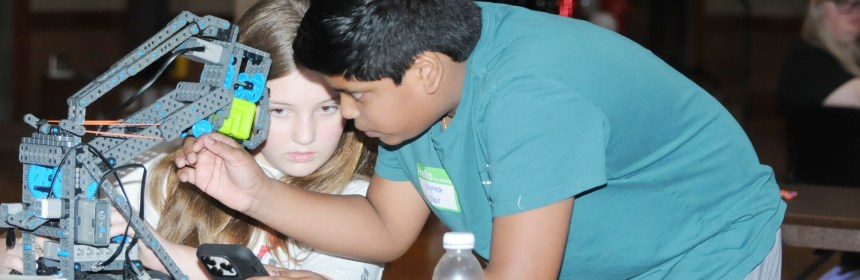
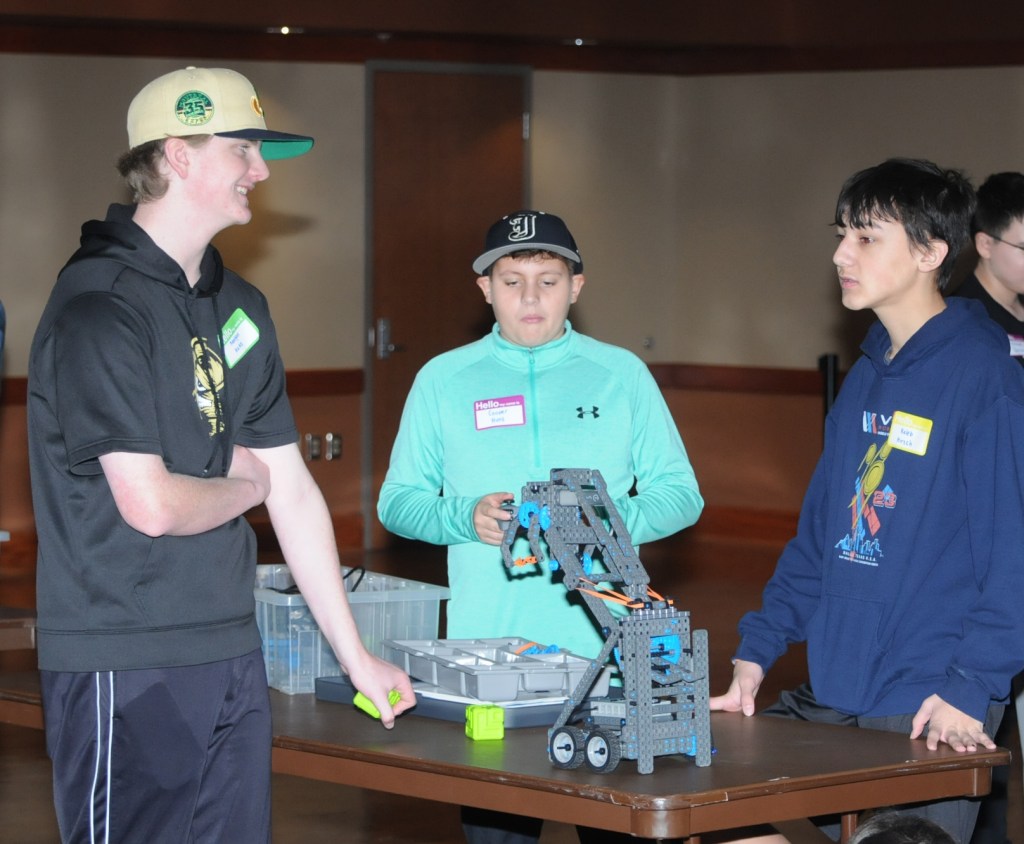
Students Keagan Hicks, Cooper Hunt, and Kaleb Hirsch work on their robot.

The competition is usually held every year during fall. It was previously hosted at other local schools for several years, but they decided to have it on campus this year. They wanted for the event to be more accessible to other schools that are further away.

Every school attending is allowed two teams consisting of four students. Some chose to only bring one team. Altogether, they expected around thirty-five to forty students to show up. Teachers, family members, and friends were also allowed to attend for support.

Each of the teams is provided with a kit a couple of weeks before the competition that they can use to build a robot. At the competition, they have to use that robot to pick up blocks and navigate an obstacle course to drop the blocks in a basket. 

“There are several schools that do not have a robotics program, they’re starting fresh, so we are most happy to help,” said Dr. Shivan Haran, the director and a professor of mechanical engineering overseeing the event. “We even told them…come by, we’ll even show your kids how to put this together…”

Whichever team deposits the most blocks wins the competition. Points are deducted if the robot breaks things. The blocks are strategically placed, some in areas that are difficult to reach and some that are easier. 

“The goal of that was actually to maybe help develop critical thinking skills and time management and time management, like we don’t want to go for that block, that’s in a hard spot, instead we’re going to try and take a route to get all the easy ones,” Diamond said.

Additionally, because every team designs their robot in a different way, some blocks will be hard to get for one team while they will be easy for another, and vice-versa. The top three teams that get the most blocks each win a trophy.

“We don’t want them to think robotics is something stressful and hard. We want them to think of it as easy and fun, something accessible,” Diamond said. 

“The goal here is to get a basic foundation of what robotics is like,” Perdue said.

For a student there from Buffalo Island Central named Henry Sills, it was his second time competing. He’s in eighth grade and learned about robotics in his EAST class, which he has been in for a year.

“Robotics has always been something I’ve been interested in, the actual building of it and the coding,” Sills said.

A group of students from East Poinsett–Christopher, Dalton, Bella, and Jumaro–was there for the first time. They’re also all in the eighth grade, and it’s their first year learning robotics in their EAST program.

“Building stuff is cool,” Christopher said.

-30-


NOTE: Feature photo by Atsuki Ohbuchi of students Annie Shepherd and Vignesh Nair. Other photo in article also by Atsuki Ohbuchi.

OPINION: TikTok’s Dilemma in U.S. — Should it be banned?

By Yu Bai
Delta Digital News Service

Yu Bai is a Chinese national and multimedia journalism major at Arkansas State University.

JONESBORO – TikTok is a Chinese video-sharing social networking service by ByteDance, and is used to create videos such as short music, lip-sync, and comedy of 3 to 15 seconds. The app’s most popular function amongst its users is to create lip-syncing and dancing videos. It is simple but omnipotent. TikTok includes interesting videos like Youtube, music like Myspace, filters like Instagram or Snapchat, and communication like Whatsapp.

Recently, President Donald Trump suddenly announced that the U.S. government would consider banning the use of TikTok because of concerns about national security. The executive orders argue the Chinese government can access data from TikTok which utilizes an artificial intelligence algorithm to grab content from its user’s information stream and push it after deep mining, which can be potentially leveraged for espionage or blackmail.

I think this is absurd hegemonic behavior of the American government. The Chinese government responded strongly believing the U.S. has blurred the concept of national security, and made resumptions of guilt and issued threats to relevant companies without any evidence, which violated the principles of market economy. TikTok should not be banned and treated in such a threatening way.

TikTok operates strictly in accordance with the laws of the United States. As a short video application, it aims to provide entertainment for the public. Donald Trump should not use political means to suppress U.S. competitors. It is an example of extreme protectionism, which directly disrupts the free market economy.

According to investment bank Piper Sandler’s report, TikTok surpassed Instagram in the United States and became the second favorite social application amongst teenagers.

Also, the ban has been widely resisted by well-known bloggers on TikTok. Nine bloggers with around 54 million fans stated in an open letter to Trump that TikTok has achieved interactions that cannot be achieved on social media such as Facebook and Instagram. TikTok gives them a platform to show their talents and bring joy to other people. If the platform is banned, they will lose a major source of creativity and their happiness in life.

I disagree with the argument that TikTok is an urgent threat to U.S. national security. Like all Chinese technology companies, ByteDance must comply with Chinese censorship laws, which forces the app to provide user data to the Chinese government. But TikTok’s content review work is led by the American team and is not effected by any foreign government. In addition, if TikTok is a threat to American national security, so then are popular video games such as League of Legends, whose maker Riot Games is owned by China’s Tencent.

If all countries in the world use imaginary risks to make things difficult for these popular social platforms, will there still be common applications in this world? If such unfounded national security principles are promoted globally, the biggest losses will undoubtedly be American tech giants such as Apple and Microsoft.

For people who are not American citizens, such as me, an international student, this ban order will have a great negative impact on our lives. TikTok is a platform for us to communicate with family and friends far away in the United States, and it means that we will lose the opportunity for long-distance communication if it’s banned. Trump’s executive order is going to make the U.S. a hostile place to visit, study in, or immigrate to. For a diversified immigration country like the United States, banning TikTok is not a wise decision.

The current series of American crackdowns on TikTok are actually an act of anger under the failure of competition. Behind the legitimate success of Chinese companies and the suppression of a Chinese app that is highly recognized by the American people, is an unfair ban that attempts to obviously make the Trump administration gain favorable interests.

If the government really cares about privacy and data collection, then it is better to find an unbiased solution to their problem than to ban the app by using mandatory administrative orders.