Journalist, Artist Pass Through on Western Trek
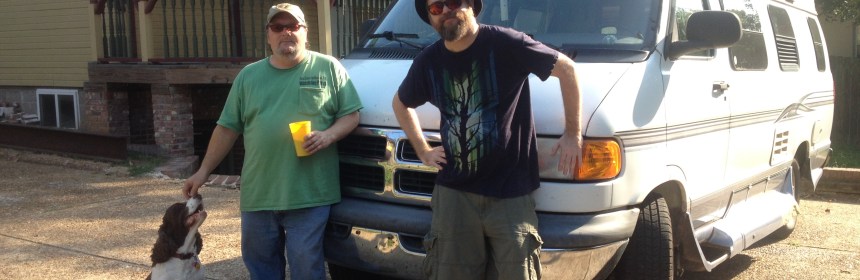
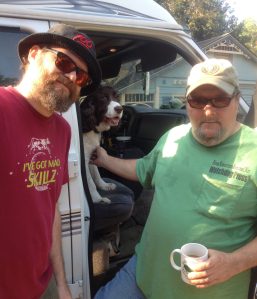
Artist Walter Simon, Jefferson the English Springer Spaniel, and Glynn Wilson of the New American Journal.
JONESBORO, Ark. – A journalist and artist team from Alabama stopped through Jonesboro during their quest to bring public attention to problems with privatization of the national parks.
Loosely traveling the same path Capt. Meriwether Louis and 2nd Lt. William Clark took in 1804, Glynn Wilson and Walter Simon of Alabama plan to travel to St. Louis next on their way west. While Louis and Clark originally traveled this path to explore new found territory and blaze a trail westward, Wilson and Simon hope to raise the public’s awareness on important issues. Wilson said he hopes he can simply make a difference.
“I have a long history of making a difference on stories where science, politics, the law and the environment meet,” Wilson said.
Wilson calls it watchdog journalism. He said he believes holding those in power accountable stands to be more important than making money.
Privatization of the National Parks
Wilson said the commercialization of the National Park System compelled him to make the trip. NPS celebrates its centennial this year.
“The story about the commercialization and privatization of the national parks is not really being covered at all,” Wilson said. “That’s where we can come in and make a difference.”
In “What the National Press and the Park Service Won’t Tell You on the 100th Anniversary of NPS,” Wilson claims the problem isn’t the lack of visitors to the national parks. The issue lies in the lack of government-provided funding needed for maintenance.
Washington Post environmental reporter Darryl Fears previously wrote no one questions the natural beauty of the national parks, it’s the human elements – the restrooms and roads – that are in dire need of repair.
SA 838 approved by Congress in March 2015 with a vote of 51-49, would allow for the privatization of our national parks. While Sen. Maria Cantwell (D-Wash.) introduced the National Park Service Centennial Act — which would provide much-needed repairs and maintenance to national parks — to Congress in November 2015, it remains in committee.
Wilson said the parks already generate the money needed for maintenance. However, the money gets diverted to private companies already contracted to provide lodging and food, among other services designed to attract tourists.
Having worked in journalism since the 1980s, Wilson began his career working in various newspapers in Alabama. More recently, he worked as a freelance contributor to several large media outlets, such as The New York Times. He started New American Journal in February 2014.
Wilson said he designed New American Journal to be an independent mobile journalism news site that relies on contributions and site advertisements to survive. Wilson said this keeps it independent compared to other, more mainstream media outlets.
An artist, Simon said he plans on capturing much of the vivid scenery on canvas. He said he will contribute to the art of the National Parks System, created a century ago with the help of different American artists such as Thomas Moran, whose art helped contribute to the creation of Yellowstone National Park in Wyoming.
“I go in that same romantic spirit to renew the specialness of these parks in the public mind before they are broken up and destroyed by fossil-fuel industrialists and other irresponsible private enterprises,” Simon said.
You can learn more about Simon’s art by following his Facebook page, or by his 100th Anniversary National Park painting and photography tour.
Native American Protest
As they travel West, Wilson and Simon will also travel to the Standing Rock Sioux reservation in North Dakota. Native Americans have gathered there to protest the Dakota Access pipeline, a proposed 1,170-mile system that would take crude oil from North Dakota Bakken region to Illinois.
Wilson said now after the occurrence of physical conflict, the mainstream media jumped aboard to cover this issue.
“So the issue there is not just to go there and cover a story that is not being covered,” Wilson said. “It is being covered, but I still think we can do something original and better than most by being on the ground.”
Read more about the pipeline here.
Oil Transported by Train
Wilson said while some media attention focuses on the protest, the same Canadian tar sands oil, already in transport to the Gulf Coast, remains essentially ignored the mainstream media outlets. He said companies use trains for transport due to the lack of pipelines.
Wilson wrote of a community meeting in Mobile held in January 2015, during which citizens expressed their concerns for two proposed giant petrochemical storage tank farms, holding millions of gallons of oil that would be built on the riverfront. Wilson said the Canadian National Railroad plans to increase the volume of the present oil transport if larger storage tanks are approved by the government. Read more about the potential risks such a storage facility could hold for the community here.
Wilson said letting the American People know the true story remains the compelling reason for this trek. He said he plans to produce a series of stories with photos, videos, paintings and illustrations to accomplish this goal.
“This full story is not being covered by the corporate media,” Wilson said.
To learn more about Wilson and Simon’s trip, or to help, visit the Go Fund Me page here.
***
EDITOR’S NOTE: Glynn Wilson worked with DDNS adviser Ron Sitton on The Southerner during the late 1990s.