
Partnership between A-State, Nettleton Schools engages junior high students

Story by DDNS Reporter Mia Young
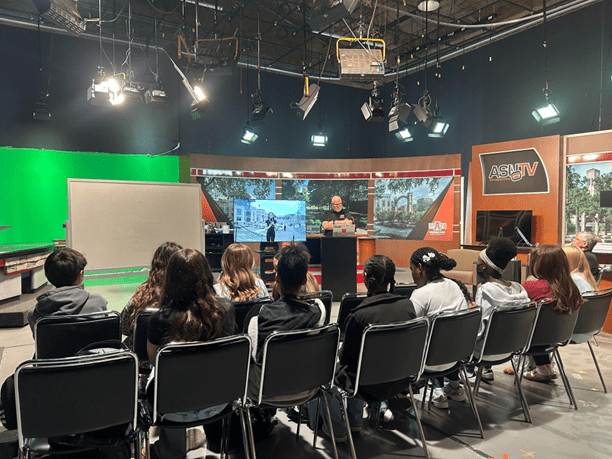
JONESBORO, Ark.- The Nettleton BRIDGE program introduces middle school students at Nettleton Junior High to the learning environment of a college student by teaching them about multimedia journalism in the School of Media and Journalism.
The Nettleton BRIDGE program began as a way to help Nettleton Junior High students experience what it is like on a university campus, so they can imagine themselves as a student at Arkansas State University or any other university. Many first-generation college students struggle to imagine college life.
Chris Moss, principal of Nettleton Junior High, contacted Gina Houge, associate dean for the College of Liberal Arts and Communication, because he wanted to target his eighth-grade students young enough to benefit from an experience that could encourage them to become college students. Last year, the program began by bringing in a small group of Nettleton students who were interested in multimedia journalism, especially the media aspect.
“I mean, that’s what students know, right? They have their phones, and they’re engaged in media constantly,” Hogue said. “But to get an experience within an academic field was what Mr. Moss wanted them to experience.”
Hogue and Moss also wanted to add a historical component to the program, as they are both passionate about history. But last year’s pilot program focused on building the students’ multimedia journalism skills, and they were unable to build out any historical component. Jonathan Reaves, instructor in the school of media and journalism, played a critical role in working with the students and developing their multimedia journalism skills.
“The first year of the program (last year) was a challenge in that we were developing a program from scratch,” Reaves said. “In the first year, we had to decide which media we wanted to use. We primarily focused on video packages, and I have been working on audio podcasts separately. I expect we will incorporate more audio podcasting next year.”
The program changed significantly from the first year to the second. Last year, the group of students interested in media activities merged with the group who were interested in STEM activities. This meant some Mondays, the group would work on multimedia projects and other Mondays, they would work on STEM projects.
This year, the two groups remained separate, and they focused on adding a historical component along with learning the elements of writing, audio and video.
“So we wanted to continue with street talks, and we wanted to expand and add the audio component in so they could do more audio editing. Then Alina and Jonathan wanted them this semester to do an actual video report that encompassed all of these elements of interview, audio and also video,” Hogue said. “To build in the historical component, we wanted students to be able to meet people from many places around the world and learn about the culture in other places and to interview people, so that they’re doing their research, ’cause when you research like a journalist, you’re researching like a historian.”
Throughout the last year, students completed several multimedia projects based on what they learned about different historical topics in the Nettleton BRIDGE program class.
One of the first things Alina Sakayeva taught the students about was her hometown of Kazan, Russia. Sakayeva talked about her family traditions, the food they eat and the relationship between her and her family. She showed them some of the historic buildings and contemporary athletic facilities where they host global soccer matches, and taught the students about the ancient culture and the traditions there.
“The students sat on the edge of their seats, listening and looking at the images, and watching the videos of the cultural dancers in Kazan, conveying the history of that region of the world to these young people, these eighth graders, from Nettleton Jr. High School,” Hogue said.
At the end of the nine weeks, the students created their video story about Kazan and something from Sakayeva’s culture they were interested in, and then presented it to the class.
“The Kazan video (was my favorite), it gave us a lot of freedom to do whatever with the video, and it was super fun to learn about,” Brylin Smallman, eighth grader in the Nettleton BRIDGE program, said.
During the second nine weeks, the students learned about the Pine Ridge Indian Reservation in South Dakota. They also individually created videos on the topic using interviews with Alice Phelps, a former educator on the reservation, and their own research.
During the third nine weeks, they read “The Story of Nelson Mandela” by Floyd Stokes and learned about him, and Zodwa Dlamini, who was in his administration in South Africa and who brought several school districts together there. The students also interviewed Dlamini over Zoom.
For their final projects in the fourth nine weeks, the students spent time in the K-labs learning about audio production and editing their videos about what they learned from their reading, their research and the interview with Dlamini.
Not only are the students learning audio, video, storytelling and a little bit about history but they are also learning life lessons they will carry with them throughout their lives.
“(I learned) to be open-minded. I wasn’t very open-minded at the beginning, and now I’m just like ‘OK, this is what’s going to happen, and that’s OK,’” Fielder Franks, an eighth grader in the Nettleton BRIDGE program, said. “Sometimes life happens, and it doesn’t go your way, and sometimes that’s just how it works, and so, you’ve just gotta be OK with that and move on.”
Every Monday, the group of 12 students would meet in the TV studio in the A-State College of Media and Journalism for two hours. This means these students would be missing three class periods and would be responsible for making up the classwork they missed. To be in the BRIDGE program, the students have to meet certain requirements, like having good grades (because they miss a lot of work) and not having any behavioral issues at school.
Karley Barnes incorporates multimedia elements into her EAST class, which each of the students attends. Barnes, an A-State alum, also travels with the students to and from the A-State campus and gives students a participation grade based on whether or not they came out and did their best.
“I think it benefits them because they get out of the classroom, they get to be challenged. It might be kind of taboo to say, but public school education is very watered down, and it’s not watered down out here,” Barnes said.
Next year, the program will see a new group of eighth graders with many of the same and many different projects. Each year the students move up in school, the program continues to support them, but they have less time to visit campus. Reaves and Hogue are still excited for what next year will bring, even though the current eighth graders may not be on campus as much next year as they are now.
“I would tell these students to stay curious, keep working on their editing skills and be proud of what they have done,” Reaves said.
The Nettleton BRIDGE program does not just give students a chance to learn and improve their media skills, but “to help them, to inspire their learning, and to find their pathway in life. That’s the goal,” Hogue said.
-30-

 Delta Digital News Service