Category Archives: News

New Arkansas State University website coming in 2025

Arkansas State University is in the process of creating the next Astate.edu website which is set to launch summer 2025.

Todd Clark, chief marketing and communications officer and member of the website redesign committee, said the website is the front door of A-State.

“Oftentimes it’s our students’ first experience with A-State, so we want to make sure we’re showcasing the university in the best light,” Clark said.

Clark said a university website lasts five to six years, and Astate.edu was last redesigned in 2012.

The committee is building the website from the ground up with external partner iFactory, a digital marketing agency specializing in higher education. They are also in collaboration with Modern Campus, a company that provides software and web content management services for higher education institutions.

“We’ve just so radically changed in the last twelve years that we had to go back and just kind of, for lack of a better word, blow it up and start over,” Melanie Wicinski, associate vice chancellor for accreditation and assessment and member of the website redesign committee, said.

Justin Coats, a junior computer science major from Cherry Valley, Arkansas, said the current website is good at overall presentation, but does a lackluster job at purveying information.

“I find that I often get lost on it. So when I heard that they were recreating the website I was certainly happy about it, because it definitely needs updating,” Coats said.

Coats said he often goes on the website to look for his class bulletins but can’t find them because they’re hidden so deep within sub pages. He said it’s difficult to find databases on the website unless his professors link directly them.

“The databases and the bulletins are both so important and they’re just kind of sandwiched in the middle of nowhere in the website,” Coats said. “I think that definitely is a symptom of having so many pages that are just thrown about and added post making a main framework of the website, as opposed to considering all of that at one time and then designing the website.”

Priorities for the new website include having program pages with more dynamic information, the ability for faculty to update these pages with ease, an accessible mobile-first design and removing the a-z index.

Wicinski said the a-z index is a crutch for faculty and staff and a well-designed website shouldn’t need one.

“I would die on the hill that we should not have to have an A to Z index,” Wicinski said.

Clark said the biggest issue with the current website is its age and how bloated it is. He said the Astate.edu domain has about 40,000 pages of information.

Clark and Wicinski hosted an open forum to provide an update on the project and share prototype designs.

Jim Washam, Neil Griffin College of Business dean, attended the open forum. He said he wanted to see what the new website was going to look like so he could start planning a layout for the new College of Business page.

Washam said the current website has too much clutter.

“I think building the new website will help us clean out a whole lot of that clutter and streamline things,” Washam said. “So I’m excited about that.”

Clark said iFactory audited every page of content on the A-State website.

“We went through and inventoried our content and audited as a committee to figure out how we can try to really reduce the amount of pages,” Clark said. “There’s no need for A-State to have 40,000 pages. If we can cut that down to 10,000 it’d be great, 5000 would be even better.”

Washam said the website redesign committee should prioritize a combination of design and content to catch people’s eye and lead them to the information they need.

Wicinski said the redesign in 2012 cost over $200,000 and the committee will keep the new website continually updated to avoid having to redesign the website in five years.

To increase governance among faculty, the committee will implement transparent rules, expectations and guidelines for updating the website.

“Modern campus has tools that will remind faculty and staff when content is dated. The new system we’re migrating to will really help us make sure that we can keep this website current,” Clark said.  “If we see a section of the website hasn’t been maintained properly or is way out of date, we’ll know who on campus is responsible for updating that information and we can work with them, work with those people to get updated.”

Clark said faculty and staff can prepare for the website launch by taking a look at the pages they have now, taking inventory of outdated information or broken links, auditing employees, getting involved in building directories and putting together a small team who have ownership accountability for their pages.

The chief marketing and communications officer said hosting the open forums is important for transparency and so the committee can receive feedback.

“The university website has so many different layers and audiences, everything from the department of biological science to the library to the A-State museum, all these users use the website differently and have different types of content,” Clark said. “It’s good to get that kind of open opinion from everyone so, as we move forward with the project, we’re best informed.”

Clark said the feedback so far has been overwhelmingly positive.

“I think people are excited about the new website, the new look and I know our campus users are excited about the ease and functionality,” Clark said.

Construction underway on new Wynne High School

Story by DDNS Reporter Jerry Burton

Construction has begun on a new high school in the Wynne School District, more than a year
after an EF-3 tornado destroyed most of the campus. Faculty and staff are expected to transition to the new building in early 2027, assuming no delays.

Currently, site prep and dirt work for the area where the building will be constructed is complete.
Dusty Meek, Wynne senior high school principal, said contractors will bid for the concrete and
foundational construction soon. He said the rest of the bidding process will happen in January.
Aaron Russell, Wynne school district communications officer, said he thinks the reopening of the
high school will be a day of healing for the community.

“The high school is the heart and soul of a community, and losing one creates a huge missing
piece,” Russell said. “We hope that by re-opening our high school campus, we can heal that
scar and the new Wynne High School will serve as a new beginning and a lasting memorial to
the old campus.”

Meek said the new building will feature several upgrades, including a modern cafeteria, media
center, auditorium and internal courtyard. He said the building will also contain multiple stories,
which will help most facilities stay clustered, instead of being spread out. Russell said the
design will give students a more collegiate feel, with multiple indoor and outdoor learning
spaces and bright, open interiors.

The high school principal said the reconstruction is based on current enrollment to meet
eligibility requirements for insurance and state funds. Nevertheless, he said the new building
was designed in mind for future additions, if needed.

Russell also said the school will have storm shelters and safe rooms to ensure the staff and
students are protected from any future hazardous weather events.

The communications director said the school and architects met with faculty, staff and
community members in multiple interest meetings to learn what they would like to see
incorporated into the new building. He said there is a lot of excitement among the community
associated with the construction.

“The modern look and the spaces included are something unique to our area and we feel we will
be a huge draw for faculty, staff and future students,” Russell said.
However, Meek said not every suggestion will be incorporated in the reconstruction. He said
decisions will be made after the bids are finalized to see what will fit within the budget.

“Ultimately, like everything else, it comes down to affordability,” Meek said. “There are probably some things that people would love to see in it that we either didn’t have in the old buildings, so therefore it’s not going to be replaced, or it’s things that are not cost-effective.”

When designing the look of the new school, Russell said the district tried creating a campus that
integrated the Wynne brand and identity. Renderings of the new building showcase a campus
with highlights of the school’s blue and gold colors. The new building also incorporates Wynne’s
mascot, the yellowjacket, in its design. Meek said they also wanted easily identifiable front entrances and the ability to section off parts of the school for different events.

The high school principal said insurance will help with part of the funding for reconstruction and
the district is looking for further support from state partnerships and FEMA.
Kenneth Moore, Wynne school district superintendent, said cost estimates cannot be released
because insurance negotiations are still ongoing.
Russell said weather is the biggest challenge the school has faced in the reconstruction process.

“The things we cannot control provide the most significant challenges,” Russell said. “We are in
constant contact with our architect and contractor to limit delays.”

Meek said another challenge is monitoring the reconstruction project while also actively running
the temporary campus, where the Wynne High School is operating following the tornado.
Meek said the new high school building will be very exciting for the community and he hopes it
raises morale. He said moving from the temporary campus to a 21st-century building with
modern amenities will be very exciting.

“Just having indoor restrooms will be exciting for most of us, because everything we have now
you have to travel outside to it,” Meek said. “It’ll be really exciting at the time but, just like
anything else that you find, once you get into it, it just becomes your norm.”

Despite the excitement, Meek said the students who experienced the tornado and will graduate
before the construction is complete must not be forgotten. He said these students will likely never set foot in the new building and bringing it up reminds them of bad memories, so they
don’t discuss it often.

“One of the things that we’ve tried to do is provide as close to a real experience as we can on
this campus and make this campus a home in itself and understand that this is their high
school,” Meek said. “This is what they’re going to graduate from, let’s make memories here.”
Moore said he wants students to enter the new building and see a fresh start that will lead to
new memories.

Russell and Meek said they want to give their students the best opportunities possible, provide
a positive culture on campus and want them excited about coming to school.

“The biggest hope is that we will return to normalcy and continue to grow as a school and
community,” Russell said. “A disaster is a challenging time. You learn a lot about resilience and
strength. Seeing how our faculty, staff, and students carried that burden and overcame it has
been nothing short of inspirational.”

ASU Trustees Approve $30.6 Million Bond Issue to Finance New A-State Veterinary School Facility

LITTLE ROCK — The Arkansas State University System Board of Trustees today in a special meeting approved a $30.6 million bond issue to finance construction for the new College of Veterinary Medicine at the A-State campus in Jonesboro.

Design and construction of the College of Veterinary Medicine facility is estimated at $33.2 million. The university plans to finance the building through the issuance of taxable Student Fee Revenue Bonds and use of institutional reserve funds. Tuition and fees from CVM students will ultimately fund debt service for the construction.

The move follows a recent consultative site visit by the American Veterinary Medical Association’s Council on Education, which reviewed A-State’s progress on facilities, policies and personnel for the college. The university plans to admit its first cohort of students in 2026 in what would become the state’s only public vet school.

The bond funding plan also allows for the refunding and reissuance of $11.6 million in existing student fee revenue bonds that were used for capital improvements on the A-State campus. The total 30-year bond issue must have an interest cost of no more than 7%, and the refunding must produce a savings of at least 4%.

Stephens Inc. and Crews & Associates Inc. will serve as bond underwriters. PFM Financial Advisors LLC is the financial advisor, and Friday, Eldredge & Clark is the bond counsel. 

In other action, the board authorized Henderson State University to explore the disposition of three university-owned houses as part of its efforts to pursue cost savings and future growth.

The properties in Arkadelphia include the Ramsauer House at 327 North 11th Street, the Smith Garner House at 324 North 12th Street and the Evans Street House/Lot at 1228/1226 Evans Street.

Disposition may include the sale of each property, which would require surveys and appraisals.

Arkansas State Red Wolves Bowl-Eligible after Georgia State Win

Photos and story courtesy of Cooper Melder and Tristan Harlen/ASU-TV Red Wolf Roundtable

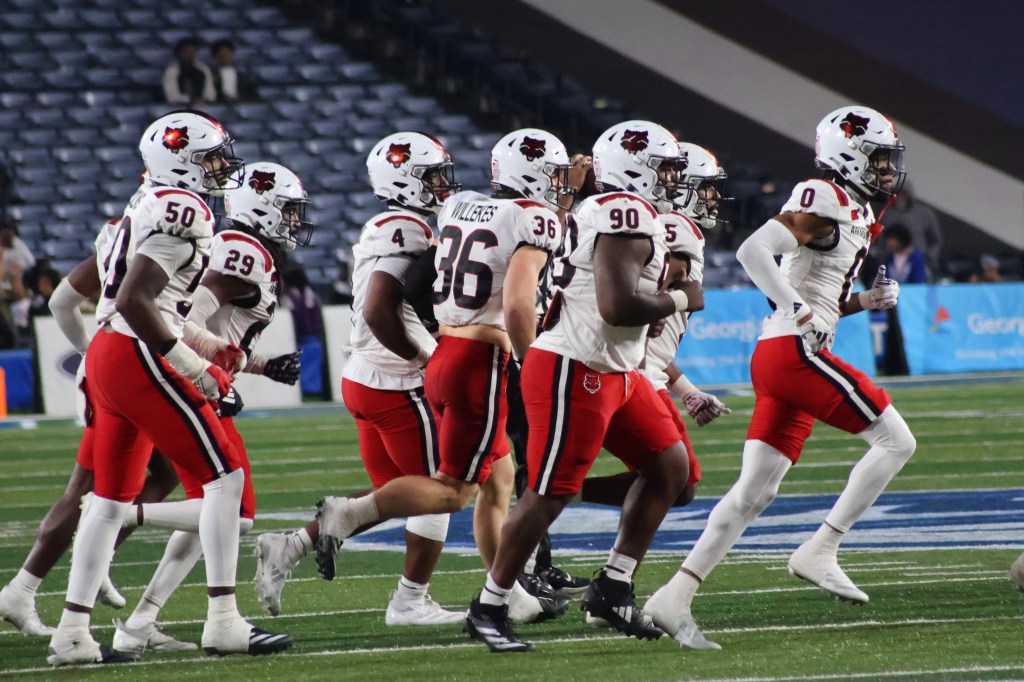
The Arkansas State Red Wolves secured bowl eligibility for the second-consecutive season by defeating the Georgia State Panthers this past Saturday, 27-20, behind a dominate performance by the Red Wolves’ run game. The Red Wolves’ running game would account for 261 total yards of offense and three touchdowns against the Panthers at Center Parc Stadium in Atlanta, Georgia.

With the win, Arkansas State moves to 6-4 on the season with their final two games of the season at home against Louisiana-Monroe and Old Dominion.

A-State quarterback Jaylon Raynor lead the Red Wolves with 97 passing yards and 114 rushing yards on the night.  Red Wolves’ running back Zak Wallace lead the team with two touchdowns, while running the ball for 62 yards.

The first half did not start well for A-State as the Red Wolves could not capitalize on a 10-play, 40-yard opening drive as they were stopped on a forth and short distance down to come up empty-handed on their first possession of the game. Georgia State would then take the ball on the ensuing possession and score the game’s first touchdown on a 24-yard pass from Zach Gibson to Ted Hurst, giving the Panthers a 7-0 lead. A-State quarterback Jaylen Raynor would lead the Red Wolves with the ground game late in the first quarter, putting up 58 yards on the ground in leading Arkansas State to tie the game at 7-7 when running back Zak Wallace would also use his running abilities on a 13-yard touchdown with 3:34 left in the first quarter.

 A Red Wolves’ interception by Justin Parks would halt an 11-play, 45-yard drive by Georgia State in the second quarter. Parks’ second interception of the season would keep the score at 7-7.

At halftime with the score 7-7, Arkansas State’s offense would only account for 176 yards of total offense and 29 passing yards. Before halftime, Georgia State starting quarterback Gibson would suffer a leg injury and would be replaced by backup quarterback Christian Veilleux.

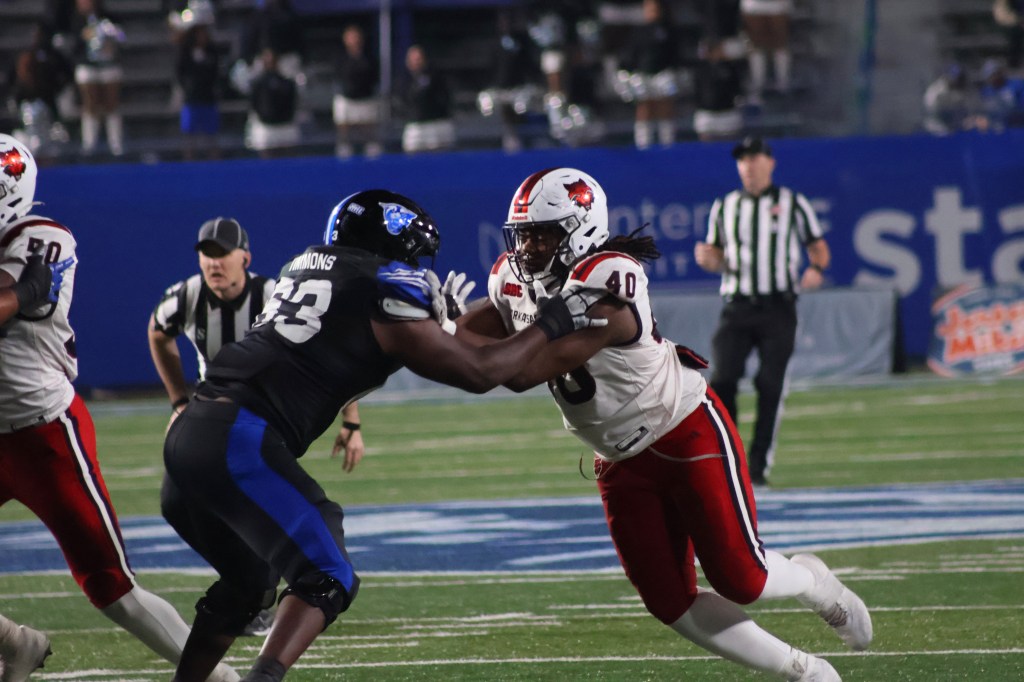
Arkansas State’s defense made key stops to secure the win.

The second half started with Arkansas State’s defense keeping Georgia State from scoring on the opening drive, highlighted by a key stop by Charles Willekes on a fourth and short to halt the Panthers. The Red Wolves would capitalize on the turnover on downs with a Zak Wallace one-yard touchdown to give A-State a 14-7 left with 9:32 left in the third.

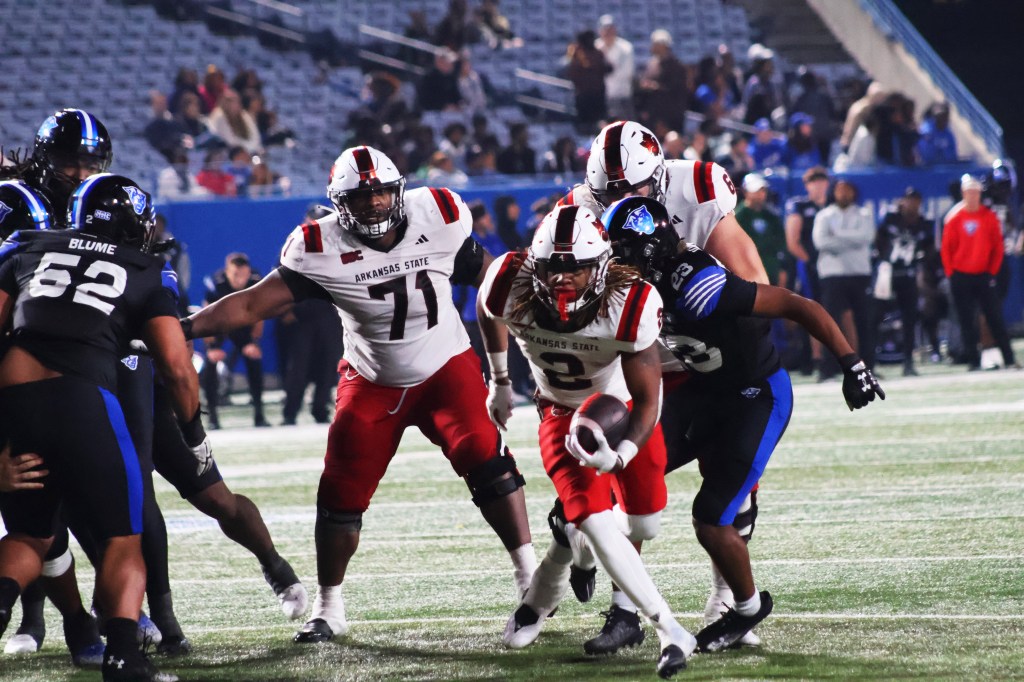
The Red Wolves’ offense would be in sync all throughout the second half, outscoring Georgia State, 20-13 in the third and fourth quarters, to secure the win. Touchdowns by running backs Wallace and Ja’Quez Cross would end up putting the Red Wolves in the win column in Atlanta.

Arkansas State running back Ja’Quez cross on the move.
Ja’Quez Cross celebrates after a key touchdown for the Red Wolves.

While Georgia State outgained the Red Wolves in total offensive yards, 419-336, the Red Wolves would out rush the Panthers, 261-73. The A-State defense would sack Georgia State quarterbacks twice and force two interceptions in the win.

The Red Wolves will be back in action on Saturday, November 23, as they take on the Louisiana-Monroe Warhawks at 2 PM at Centennial Bank Stadium.

Ridgefield Christian Academy’s Evan Ellenburg featured for DDNS

By Garrett Finnicum for Delta Digital News Service

Garrett: Hello everyone, my name is Garrett Finnicum. Today, we take you behind the scenes with Evan Ellenburg, a senior standout from Ridgefield Christian and a true “Warrior” on the basketball court. With his sights set on playing at the college level, Evan’s journey is about more than just stats. It’s a story of passion, resilience, and leadership.

Garrett: Evan’s commitment to the game goes beyond high school. He is driven by a dream to play college basketball, a goal he has worked towards since he first stepped on the court. This is the next chapter in his story, one he is ready to face with unshakeable dedication.

Garrett: On the court, Evan’s strengths shine through. His ability to sink tough shots and tenacity on defense make him a formidable opponent, but he is also a player who acknowledges where he can grow, always striving to sharpen his skills and refine his game.

Garrett’s question: So, what are some short-term goals that you would like to accomplish before the season begins, or going back to what you were working on during the offseason?

Evan’s answer: Getting stronger is something a lot of teams have pushed us to do, and it’s something I need to be as well.

Garrett’s question: Are there any specific skills you didn’t have last year that you want to improve this year, going into your senior season?

Evan’s answer: I think getting to the rim a lot more, just going in, creating contact, and finishing.

Garrett’s question: So those are kind of talking about your weaknesses. What strengths would you say you have on the court?

Evan’s answer: Shooting. I think I’m a pretty good shooter, and I can see the floor and make the right pass, which I think helps us out a lot.

Garrett: As a senior, Evan has taken on the role of a mentor, guiding younger teammates with a steady hand and a positive example.

Evan: Just telling them what’s expected and showing them, since they don’t have the most experience, and just showing them what to do.

Garrett: At the core of Evan’s drive is a deep sense of purpose. His motivation comes not just from his dreams of college basketball, but from the support of his family, teammates, and coaches. Every practice, every game, is a step towards proving to himself what he is capable of achieving.

Garrett: With his senior year in full swing, Evan Ellenburg is ready to leave his mark for Ridgefield Christian and improve on his individual stats from his junior season, as shown on the screen: averaging 15.3 PPG, 2.8 APG, and 5.3 RPG.

Garrett: He is more than just a player, he’s a leader, a motivator, and a Warrior. The future looks bright for Evan and any team lucky enough to have him will gain not only a talent player, but a true team leader.

Team: Be humble, be hungry.


Applications Open for Hemingway-Pfeiffer Writer-In-Residence Program

PIGGOTT – The Hemingway-Pfeiffer Museum and Educational Center in Piggott is announcing its 2025 writer-in-residence position.

The residency will be for June 1-30, 2025, and includes lodging at a loft apartment over the City Market coffee shop on the downtown square in Piggott.

The writer-in-residence will be able to work in the studio where Ernest Hemingway worked on “A Farewell to Arms” during an extended stay with his wife’s family in 1928. The residency includes a $1,000 stipend to help cover food and transportation.

“The writer-in-residence will be expected to serve as a mentor for a week-long retreat for writers at the educational center,” stated Dr. Adam Long, executive director of the A-State heritage sites.

This retreat will be open to eight to 10 writers from the region. The recipient may be asked to hold one or two readings of his/her work. The remainder of the month will be free to the writer-in-residence to work on his/her work.

Candidates with a Master of Arts or Master of Fine Arts in a relevant field are preferred.

Applicants should send a cover letter, curriculum vitae (CV), and writing sample of roughly 20 pages, in any genre, to Long at adamlong@AState.edu by Feb. 28, 2025.

Questions about the program can be directed to Long. For more information about the museum or lodging (the Inn at Piggott), one may visit Hemingway.AState.edu.

Incomplete applications cannot be accepted. Due to the expected high volume of applications, confirmation of receipt of applications cannot be guaranteed.

The writer-in-residence program is made possible through underwriting sponsorship by Piggott State Bank.

The Hemingway-Pfeiffer Museum and Educational Center, an Arkansas State University Heritage Site, contributes to the understanding of the regional, national and global history of the 1920s and 1930s eras by focusing on the internationally connected Pfeiffer family of Piggott and their son-in-law and regular guest Ernest Hemingway.

This includes drawing on Hemingway’s influence as a noted American author to foster interest in literature and the arts and promote excellence in both.

Women’s Business Leadership Center Adds Director of Student Engagement and Leadership

JONESBORO – The Women’s Business Leadership Center (WBLC) at Arkansas State University strives to positively impact the lives and futures of young women on campus. The center, founded in 2016, provides many opportunities for ladies attending the university including mentoring, scholarships, internships and other educational opportunities.  

“This year has been one of rapid growth and change,” said Dr. Patricia Quinn Robertson Johnston, executive director of the Women’s Business Leadership Center. 
 
Johnston said they have added Gwennette Confer in a new position as director of student engagement and outreach.  
 
“I want to focus on building strong, meaningful connections between students, mentors and the broader community,” said Confer. 
 
Confer said she will work to create and facilitate a wide range of opportunities for student engagement, including leadership academies, mentoring events, conferences, workshops and retreats. 
 
“A significant part of my work will be leading initiatives that connect university students, high school and junior high girls to participate in leadership development at an early stage. Additionally, I will oversee WBLC service projects, ensuring leadership interns gain valuable, hands-on learning experiences,” she continued.  
 

The number of students who participate in the variety of programs offered by WBLC has quadrupled. Students across campus from different majors have been part of programs such as step up, reach back; career readiness; service project “Leadership Interns” and scholarships.  

This year, 23 students traveled to New York and 11 students traveled to Atlanta for a conference this month.  
 
“Since 2016 we have provided thousands of hours of mentoring and career preparation for WBLC Leadership Interns who are A-State students,” Johnston added. 
 
The annual Women’s Leadership Conference, which is free for all attendees, usually hosts about 500 people including high school students, college students and professionals. 

“I want students to know that the WBLC is a welcoming and inclusive space where they can grow both personally and professionally, regardless of their major. While the center focuses on leadership development, it is open to all students, not just those in business-related fields,” Confer added.   

She added that they typically award more than 20 scholarships each year and expect the funding for those scholarships to continue to grow.  
 
More information on the WBLC may be found at AState.edu/wblc.

A-State Political Science student takes part in Washington, D.C. Law Internship

JONESBORO – A program that Arkansas State University students are part of is making a dream a reality.   

The Washington Center (TWC) Academic Internship Program allows students to intern in Washington, D.C., giving them exposure to work in government and politics while staying up-to-date on their coursework.   

“The student will complete an internship anywhere in D.C., take an academic course, and complete a professional development program. The internship and course vary based on student interests,” said Dr. Jordan Butcher, assistant professor of political science at A-State.   

Taylor McIntyre, a junior political science student at A-State, is enrolled in the semester-long internship. The Beebe native arrived in D.C. in September and is already immersing herself in the program.   

“The program gives us opportunities to grow in our personal and career realms, from hearing speakers and getting to speak with them afterwards, to exploring the city, networking with new friends, and meeting with impressive minds from a variety of different fields and disciplines,” said McIntyre.   

During the week, she commutes via the Metro to her internship at a law firm in Alexandria, Va.  

“I do think this internship has helped me, and at the very least has given me connections and opportunities that will help me through my professional career,” according to McIntyre. 

An aspiring lawyer, McIntyre says the program allows her to get a peek at her future while staying on track with her studies.    

“On Tuesdays from 6:30 p.m. to 9:30 p.m., I attend my class for this semester which is over U.S. foreign policy,” she said. “This class has taught me a lot about the inner workings of every foreign policy decision that gets made.”    

TWC offers semester-long internships in the fall, spring and summer semesters. 

“Taylor will be the 11th student at A-State to complete the internship program since we began in spring of 2023,” said Butcher.   

Recruitment for TWC Academic Internship Program is underway for the spring, summer and fall 2025.   

“Currently, preference on participation is given to students in the Department of Government, Law & Policy, but it tends to be a more natural fit for those students,” according to Butcher. “Our upcoming May seminar, however, can also be great for criminology students given the focus on national security.”   

McIntyre is one of 150 college students from higher education institutions participating in TWC program. She credits Butcher for helping pave the way for A-State students to attend TWC, creating a pipeline for those interested in government or law to get their foot in the door.   

The program and university work alongside students to help alleviate financial barriers that might stand in the way of preventing a student from enrolling.   

“This roun,d everything is state-funded, but students can apply for the Berry Public Service Scholarship and have used that to fund part of their trip in the past. Arkansas residents can receive $6,000 in state scholarships toward the program fee and $1,000 off the housing fee from the state,” Butcher said.  

The Berry Scholarship was established by the family and associates of the late Marion Berry, who represented Arkansas’ First Congressional District from 1997 to 2011.  

To learn more information about TWC, one may contact Butcher at jbutcher@AState.edu or by phone at 870-680-8045. 

Jonesboro Public Schools Board President Harrell recognized for service

This report from DDNS reporter Brayden Morse.

JONESBORO—The Jonesboro Public School Board president, Chris Harrell, received a 12-year service plaque at Tuesday’s meeting. He will be stepping down next year.

Superintendent Dr. Kim Wilbanks shared her thoughts on Harrell’s time on the board and expressed her gratitude for him.

“I could say a lot of sappy things, but I’ll skip those. Mr. Harrell has been a loyal board member. He has led through many different opportunities that he had, and it’s been my pleasure to work beside Mr. Harrell. We greatly appreciate your service to the Jonesboro Public Schools,” Wilbanks said.

Brock Ferguson of Zone 5 will replace Harrell as president in the upcoming school year. Harrell explained the importance of the school board and how it brings the community together.

“The church is the hope of the world and I think second place goes to the school. I think the work that the school does is vitally important and life-changing. It’s been a real honor and privilege to work with these folks (school board). I’m excited for Brock, he’s going to do a great job. We do our best and don’t always get it right, because we’re human. These folks labor over decisions for the sake of the district,” Harrell said.

Later in the agenda, the district’s enrollment numbers and financial construction numbers on newly built buildings were released.

The district enrolled 6,451 students in 2024-25, which was 31 less than last year. The 13 school campuses include 816 employees, with 530 of them being licensed and 206 being classified.

“You can see that we’re slightly down from the previous year. We’re seeing pretty good growth, and since COVID, our numbers are similar to those seen in other districts. We still have not totally rebounded from those years when students were virtual and choosing other education options. We’re currently very full in the 7th through 12th grade with large classes in each of those grades,” Wilbanks said.

Later in the meeting, three students were denied legal transfers due to large enrollment throughout their desired grades. Also, none of the student’s parents showed up for representation at the meeting.

Disbursing officer Tim Stewart said the board should deny all three students, with the rest of the school board agreeing.

Arkansas State University hosts U.S. House Debate, minus Crawford

This report is from DDNS reporter Shailey Wooldridge.

 Arkansas State University’s School of Media and Journalism hosted the first live broadcast debate of this 2024 election season with running candidates for U.S. Representative District 1 Oct. 3 at six p.m.

ASU-TV, The Herald, KLEK-FM, KASU-FM, and Red Wolf Radio sponsored the first of three political debates scheduled for this month, beginning on Oct. 3 at 6 p.m. at the ASU-TV studio.

Debate panelists included Brandon Tabor, KASU News Director; LaGanzie Kale, KLEK General Manager; and Jerry Don Burton, Editor-in-Chief of A-State’s The Herald.

The debate was filmed live from the ASU-TV studio as part of the class video production II taught by Galen Perkins.

Perkins, an instructor of creative media production, said it is important to have student involvement in our elections as many of the topics addressed affect students.

Having it here on campus, we’re inviting these politicians to our local turf so that they get to know the students and they get to know different people from the community that they might not otherwise get a chance to interact with,” Perkins said.

Democratic candidate Rodney Govens and libertarian candidate Steven Parsons participated in this debate. In their opening remarks, both candidates said the system is not working.

Parsons said that in the two-party system, both had failed his family. Govens said he believes the time for change has come.

Parsons’ platform includes advocating for immigration reform to reduce bureaucracy.

“First we have to change the work visa and Green Card rule so that you can bring workers into this country legally,” Parsons’ said. “Let’s change the policy so that there is a meaningful legal mechanism to bring immigrants into this country. One of the second ones would be, if you think you’re going to build a wall, then we can build a wall around the safety net program and welfare.”

Goven’s platform includes expanding access to healthcare in rural areas and expanding broadband infrastructure.

“Our population is going down because we can’t keep them healthy. That’s one issue. The second issue is infrastructure. In many counties across this state, we still don’t have adequate broadband infrastructure,” Govens said. “You should have every resource to be successful, no matter where you live.”

Govens supports policy initiatives such as updating the Farm Bill and creating fair labor policies for farmers. He aims to address income inequality. He promotes criminal justice reform, affordable housing, investment in education, environmental sustainability, and student loan forgiveness. He also privatizes cybersecurity for public schools, veterans’ support, health care, and mental health services. He focuses on creating economic stability, promoting small business, and reforming the foster care system.

Parsons’ platform focuses on reducing inflation by eliminating trade tariffs, cutting federal regulations, and lowering federal spending. He advocates for immigration reform. He supports prison reform, particularly for nonviolent offenses, and opposes high military spending and student loan forgiveness. His economic approach centers on limiting federal intervention and creating clearer paths to residency for immigrants.

Republican incumbent Rick Crawford was invited to the debate but did not respond in a timely manner.

Govens said the incumbent, Crawford, feels he is untouchable because he did not attend the debate.

We need to go ahead and help Mr. Crawford secure some fruitful employment because currently, he is suing the American taxpayer, everybody within earshot of my voice,” Givens said. “He is suing you because he doesn’t think he makes enough money.”

Parsons said he was disappointed that incumbent Rick Crawford did not show up and would have preferred he had been there.

When incumbents across the board in US Congress win 97% of the time, and he’s been an incumbent for 14 years in a super red district in some sense, it’s easy for him, it’s easy for anybody, to understand why he feels like he doesn’t need to come to the debate. He feels like he’s going to win anyway,” Parsons said.

The next political debate will be on Oct. 10 at 6 p.m. between AR Senate District 20 candidates Dan Sullivan and Erika Askeland.

                                                                        -30-

Despite Political Divides, Students Call for Bipartisan Engagement

Report from Delta Digital News Reporter Jerry Burton.

Despite political contrast, civic engagement remains a priority for students.

America is often cited as being more divided than ever. With the presidential election drawing near, political discourse is heating up, and it may seem like neither party can agree on anything. Despite this apparent schism, Arkansas State University students across the political divide agree that civic engagement is vital, irrespective of political affiliation.

Hunter Redburn, a junior radiologic sciences major from Saint James, Missouri, said everyone who can vote should vote, regardless of where their vote goes.

“I will never tell somebody that you can’t or shouldn’t vote because I think regardless of who you support or what you do, voting is your right, and I will never try to take that right away from you,” Hunter Redburn said.

Chris Smith, a senior history and communications studies double major from Cabot, Arkansas, agreed with Redburn.

“I definitely value civic engagement, voting, researching, and learning about candidates more than just party loyalty,” Smith said. “Truly, I’m just happy when people vote, regardless of how they vote, I’m just happy they do it.”

Redburn is the president of Students For Life, an anti-abortion student organization. He said his morals most closely align with the Republican party. Smith is the president of the A-State Young Democrats. She said she most closely aligns with the Democrat party. These two students are opposed politically, but both agree that voting, one of the most active forms of civic engagement, is imperative.

Cameron Wimpy, an associate professor of political science, said these students’ encouraging people to vote, regardless of who they vote for, is an interesting situation that challenges common media coverage.

“There are a lot of discussions out there about one side wanting to get more people to vote and the other side wanting to get fewer people to vote; specifically, Democrats want to have, for example, undocumented migrants voting, and Republicans want it to be more strict. That’s the argument the media often makes,” Wimpy said. “Here you have student groups who advocate for issues, but above that, they’re participating and being part of the process, irrespective of what position you take, because they don’t know how you’re going to vote.”

Lily Redburn, vice president of Students For Life, said she does not want anyone to discourage her from voting, so she won’t put anyone else in a similar position.


“I think it has to go both ways. If a Democrat saw me voting Republican, would I want them to somehow discourage or prevent me from voting? Absolutely not,” Lily Redburn said. “I should not impede somebody’s ability to vote one way or the other. That’s the beauty of this country; we all get to have our own ideas.”


Students outside political student organizations also agree that civic engagement is a priority.


Jaden Holley, a sophomore social work major from Brooklyn, said civic engagement is important because it allows citizens to influence the direction of their country.


“Some people vote for Trump, some vote for Kamala, and it determines our future. It ultimately solidifies our rights and our process towards equality,” Holley said. “It is one of the most important things we can do as United States citizens.”


Isaiah Wallis, a first-year musical theater major from Harrison, Arkansas, said civic engagement is especially important among students because they tend to vote less than older adults.


“The majority of voters, especially on the local level, tend to be on the older side of life, like middle-aged and elderly,” Wallis said. “Because of that, you do not get the voice of younger generations, which is very important, especially regarding how quickly technology and culture is changing.”

Leaders from both the A-State Young Democrats and Students For Life organizations criticized party allegiance. Smith said remaining strictly loyal to a party stifles research into other candidates who may have better policies.

“If you just stick to your party, you’re not engaging civically; you’re just staying loyal to a party that will tell you what to do instead of encouraging you to learn about other candidates,” Smith said.


Hunter Redburn said he doesn’t think pledging allegiance to a particular party is productive. “I think many people are almost obsessed with party allegiance,” Hunter said. “You actually need to do your research on candidates, on party stances and make your decision based off that.”


Hunter Redburn and Lily Redburn said they vote according to the candidate or issue that aligns closest to their morals, derived primarily from religion.

“My moral compass is the Bible, and either it aligns with that, or it doesn’t,” Lily Redburn said. “Other people may not have that moral compass, but they still base their morals in something else.”


Smith said collectivism is a value she considers when going to the polls. When someone votes, they are not only voting for themselves but also their community.


“When you go into the polls, I think not only should you think for yourself and what you’re aligned with but think about your neighbor, the dude who lives across the street from you and the guy who lives 10 minutes away from you.”


Hunter Redburn, Lily Redburn, and Smith have different morals when considering how to vote. Nonetheless, they agree that morals play a major role in voting and respect that other people may not share their same values. While they don’t value civic engagement in all the same ways, all three students agree that disagreements are healthy. Hunter said he thinks citizens have lost the ability to have civil debates with people or groups with opposing views.


“I think that dialogue is never a bad thing. I think disagreement fuels progress, and without disagreement, we would never get anywhere,” Hunter said. “There have to be two sides to every story.”


Although Smith also said the lack of civility in politics is a problem, she said it is not new. The Vietnam War, the civil rights movement, and the 2000 presidential election are examples of periods when the country was divided and civic discussion was low.

While Lily Redburn and Smith agreed civic disagreements can be productive, they said compromises cannot always be reached. Lily Redburn said she feels strongly about abortion and doesn’t see an avenue where she could compromise without betraying her morals, while Smith said she is not flexible in her stance toward transgender rights. Even so, Smith said people should interact with others they oppose. She said difficult conversations are the most important and lead to a more informed population.


“If I have one idea and everyone agrees with me, how do I know if my idea has a flaw? If someone isn’t there to point that out and disagree with my idea, then nothing would ever get done,” Smith said.


Hunter Redburn said that even though someone might strongly disagree or even hate another’s stance, they should still treat them respectfully and kindly.


“I hate abortion, I think abortion is evil, and I think that what you stand for could be evil, but that doesn’t change the way I view or treat you as a human being,” Hunter Redburn said. “I think having a civil conversation is ultimately way more important than anything else.”


Wimpy said civil disagreement is a part of participating in a healthy democracy.


“We should be able to agree that we win some, we lose some, we come up with better ideas, better candidates, and do better next time,” Wimpy said.


Students from both organizations also had similar strategies for increasing civic engagement. Hunter Redburn said candidates or representatives engaging in civil debate allows potential voters to engage with both parties or sides of an issue equally and make an informed decision.


“I think it is much more productive and effective when you can watch these two ideas go head to head and, with logic and reason, you can see which one makes more logical sense with how we want to move forward in the country,” Hunter Redburn said.


Wimpy said education and cultivating interest are necessary to increase young adults’ civic engagement.

“I think more programming around what’s going on in the world would help, and that can’t just come from political science classes,” Wimpy said. “It needs to be things that students organize, whether guest speakers or voter registration drives.”


Smith said increasing civic engagement requires showing that engagement works and can be productive. She said showing productive political conversations, such as the recent vice presidential debate between JD Vance and Tim Walz, lets citizens know that politics isn’t supposed to be filled with disrespectful fights and constant bickering.


“Because that idea has circulated so much now, a lot of people have started to have large screaming matches of their own,” Smith said. “So if we shine light on productive conversations actually happening and we highlight those more then the media starts to encourage it more and then we find that the people themselves are doing it more.“

-30-

A-State receives HEED Award

JONESBORO – INSIGHT Into Diversity magazine has recognized Arkansas State University as a winner of the Higher Education Excellence in Diversity (HEED) Award. 

“Arkansas State University is dedicated to educating all students, and ensuring they have a home away from home. As we strive and continue to cultivate an environment where everyone belongs and thrives together, we must remember it starts with us,” said Dr. Carlitta Moore, vice chancellor for access and institutional engagement. 

Nationwide, 114 higher education institutions, including A-State, are recipients of the HEED Award. The HEED Award is the only national honor highlighting U.S. colleges and universities that demonstrate an outstanding commitment to creating a diverse and inclusive campus environment. 

The impact is felt across the university, according to Moore.  

“We have seen under the leadership of Chancellor Todd Shields an increase in the number and diversity of students, as well as in leadership,” she said. “This award signals to prospective students, faculty and staff an academic community which values everyone, and can lead to improved retention rates, higher engagement and academic success. Additionally, it serves as both a symbol of progress and a motivator for continued work in a thriving environment.” 

It marks the seventh consecutive year A-State will take home the award. 

Moore says it was an honor to hear the university received the HEED Award again as it is the only institution on the list to represent the Natural State. 

“I was excited to know A-State is continuing to carry the legacy and remain the only school in Arkansas to hold this designation, a uniqueness which sets A-State apart and indicates we are leading by example,” according to Moore. “This honor reinforces we are genuinely committed to creating a welcoming environment, and the continuous efforts made over time.”

The HEED Award is a testament to the work taking place at A-State to foster a welcoming campus for students and the university community. 

“Our stakeholders take pride in fostering collaborations, enhancing partnerships with local, nation and international communities which benefit students, alumni, faculty and staff alike,” said Moore. “It is a representation of us actively taking steps towards making a real impact on the campus culture. It reflects successful efforts in fostering a sense of belonging, ensuring everyone has equitable access to resources, opportunities, and support systems.” 

A-State will be featured in the November/December issue of INSIGHT Into Diversity magazine, the nation’s largest and oldest publication dedicated to diversity, equity, and inclusion in higher education. One can learn more about INSIGHT Into Diversity or the recipients online.

City of Jonesboro receives $1M grant for Community Park

The City of Jonesboro has been awarded a $1,000,000 grant from the United States Department of the Interior’s National Park Services, through the Outdoor Recreation Legacy Program. This significant award will be administered by the State of Arkansas Department of Parks, Heritage, and Tourism. Jonesboro City Council previously approved a local match of $1,129,675 which is represented in the 2024 Annual Budget. The Junior Auxiliary of Jonesboro has also committed $100,000 toward the development of this project.

“This is exciting news for our city and reinforces the great work of our Grants, Parks and Engineering departments who put together a great application for a long overdue park in Northeast Jonesboro,” said Jonesboro Mayor Copenhaver. “This park is a key investment in the well-being and quality of life for residents of Northeast Jonesboro. We are grateful to the National Park Service, the State of Arkansas, Junior Auxiliary, and both Cornerstone and Journey Churches for their partnership in making this vision a reality.”

The funds will be allocated to the creation of a new community park in Northeast Jonesboro, at the end of Disciple Drive. The park will cover at least 13 acres, with potential to expand to 23 acres, contingent on further land acquisition. Planned features will include:

  • A fully accessible adventure playground
  • Walking and biking trails
  • Tennis Courts
  • Pickleball Courts
  • A Dog Park
  • Multiuse Sports fields
  • An expanded entrance road
  • Parking lot
  • An abundance of natural greenspace

“When we first met with Mayor Copenhaver about how we could help improve Jonesboro, his pitch for a park in east Jonesboro was an immediate ‘yes’ as it lined up perfectly with our mission to improve lives for local youth. We are so proud to be a part of this wonderful project,” commented Junior Auxiliary President, Jessica Baker.

The City of Jonesboro’s Parks and Recreation Director Danny Kapales stated, “As the Master Parks Plan indicated, this location was lacking in park space and was a priority. This grant and future park represent what is possible to achieve as a collective group.”

This project aligns with the Social Determinants of Health Plan, with plans for the new park to be fully accessible to residents of all abilities. Notably, there is currently no city park within one and a half miles of the project site, making this development a resource for the surrounding community. Thousands of residents who live and work near the project area will have better access to outdoor recreation.

“This project is a culmination of more than two years of coordination between the City, the State of Arkansas, and the National Parks Service. We are excited any time we win a grant, but to secure the largest parks grant the City of Jonesboro has ever received is special and personal for our hard-working staff,” commented Jeremy Biggs, Director of Grants for the City of Jonesboro.

Next, the Jonesboro City Council will hear a resolution to accept the grant and purchase the property, to be presented to the Public Services Committee later this week. After approval from Public Services Committee, full council will consider next week. If approved, construction will begin in the Summer of 2025.

« Older Entries Recent Entries »