Category Archives: Profile

DeltaYou: EMTs Serve the Community
by Miranda Reynolds
Delta Digital News Service
Andrea Yates

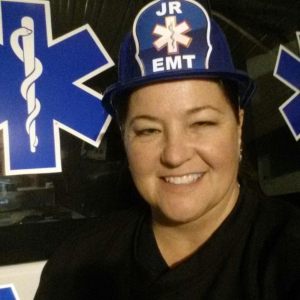
Angela Yates at work. Yates first became interested in becoming an EMT while working in Wynne. Photo courtesy of Angela Yates.

AUGUSTA, Arkansas – When medical emergencies arise in rural areas, Emergency Medical Technicians are responding to the life-threatening calls.

EMTs certifications depend on their level of education. A Basic EMT requires the least amount of schooling, whereas Intermediate EMT and a Paramedic EMT require more. Angela Yates, a Basic EMT,  received her certification at East Arkansas Community College, located in Forrest City. Yates said her certification prepared her for real-life emergencies.

“I think for the most part it did. But — also because I’m older than most people who enter this field — I did it when I was already turning 40 and most people are doing this in their 20s,” Yates said. “I had more life experience behind me already.”

Yates said paramedics and EMTs working in the Wynne hospital influenced her with their exciting stories of helping people. Yates said she believes being a woman is not a challenge in her line of work.

Yates said within rural areas, emergency airlift systems are something to consider.

“Because of my standpoint in EMS, I know it’s important to have (an emergency airlift system),” Yates said. “Being rural, we have different helicopter services available, and not everybody will accept the other’s insurance or the other’s coverage. It’s not feasible to have a membership with every service, but you never know what service you are going to get.”

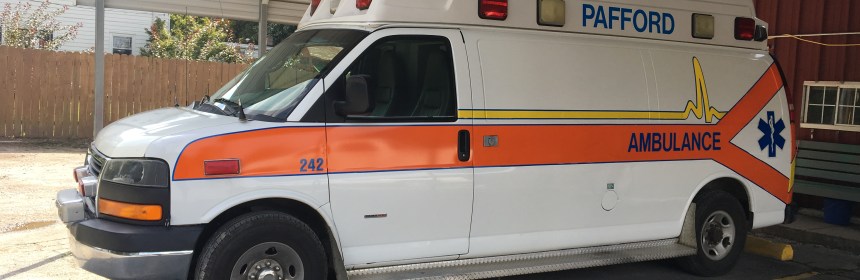
Emergency Medical Technicians are vital to all communities because of their role in the emergency response chain. Yates said a patient’s medical insurance does not impact the work she does. Members of Pafford Emergency Medical Service provide emergency care while the hospital collects information; insurance comes after that.

The duties of an EMT vary among its members. Yates explained her duties to provide a full understanding of her everyday tasks.

Recertification for all EMTs is inevitable. As a Pafford EMS employee, Yates’ re-certification can be completed online by entering in her numbers, information and amount of hours taken. As far as original certification goes, members of Pafford EMS must meet in hands-on classes or groups.

Yates said prevention of accidents in emergency vehicles is important to the certification process. During an emergency that requires lights and horns to be activated, Yates is only allowed to drive 10 miles per hour over the speed limit.

Jay Atkins, police officer for Augusta and McCrory, said drivers on the highway do not pull over when meeting oncoming traffic and even drive close behind vehicles in pursuit of an emergency.

Yates said she built an endurance for coping with traumatizing calls after six years in the field. Yates’ husband, in his 25th year in the EMT field, helps her cope. Yates said having someone to confide in and someone who can relate to what she goes through is helpful.

Atkins said he finds other methods of coping.

“Separate myself from that call or if it’s ending my day … when I’m off, I’m off. I do not have a radio on, I don’t associate with this place,” Atkins said.

 

Media Specialist Visits A-State in Speaker Series

by Tucker Crain
Delta Digital News Service

JONESBORO – A media relations specialist returned to Arkansas State University as a speaker in the Joel Gambill Alumni Speaker Series during Homecoming Week to talk about his media experiences.

Aaron Sadler, who graduated from A-State in 1999, currently works at Ghidotti Communications in Little Rock. As a third-generation A-State graduate, Sadler said his family’s history with A-State steered him toward the university.

“I’d heard so much – as someone who had an interest in journalism – of the College of Communications, and how well-received a diploma and a degree from ASU’s College of Communications and the journalism department was across the world,” Sadler said.

Before making it to Ghidotti, Sadler worked for various attorneys general in Arkansas, Louisiana, Mississippi and Pennsylvania. During his time at these offices, Sadler came to the forefront of consumer-awareness initiatives.

Sadler’s love for all things media and communication began at a young age. When he was only 5, Sadler said he asked for a typewriter for Christmas instead of more conventional toys.

Sadler’s grandfather was a justice of the peace in Arkansas, and his influence led him to initially pursue a career in law. After coming to A-State, Sadler said his interactions with department chair at the time, Joel Gambill, led him to instead pursue a career in media.

“When I was a freshman, (Dr. Gambill) asked me why I was majoring in political science. He said journalism is a more appropriate major for you, because you learn writing,” Sadler said.

As he became more involved in the department, Sadler said he realized journalism was indeed the right path for him.

While in college, Sadler said his biggest struggles came when he would try to cram before a test. Quoting Mark Twain, Sadler said if you must “eat a frog,” you might as well do it in the morning and get it over with.

Now, as a professional who interacts with clients every day, Sadler said he looks to John Brummett for inspiration. Brummett is a political columnist based in Little Rock. In addition, Sadler said he can always look to his boss, Natalie Ghidotti, for the know-how needed for accomplishing his goals.

Since Ghidotti is located in Little Rock, most of Sadler’s clients are based in the area. He said this location influenced how he interacts with the media, looking primarily toward Little Rock- and Arkansas-based news outlets.

Sadler said the most important evolution of modern media is the decline of newspapers.

“Reporters (need) to be fundamentally sound and comfortable in additional disciplines, like broadcast media and content marketing,” Sadler said. “Being a reporter in the 21st century involves much more than a pen, a pad and an ability to write.”


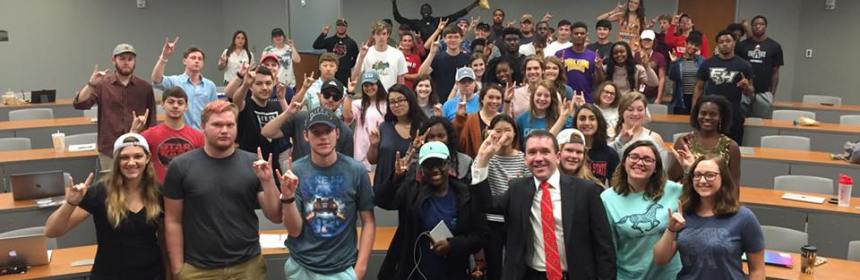
Editor’s Note: Sadler, pictured in tie, spoke with a Mass Communication in Modern Society class in the featured photo.

Damphousse Seeks Community Ties

By Kimberely Blackburn
Delta Digital News Service

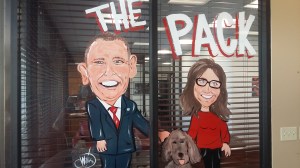
Damphousse Window Art

Window art featuring Kelly, Beth and Maple Leif Damphousse decorated the window of the Chancellor’s office. Damphousse became A-State’s chancellor on July 1. Photo by Kimberely Blackburn

JONESBORO – A native Canadian and Montréal Canadians fan, Arkansas State University’s new chancellor aspired to become either a goaltender for the NHL or a Mountie before coming to Northeast Arkansas by way of Oklahoma.

Chancellor Kelly Damphousse said he planned to stay at his last position as dean of the College of Arts and Sciences at the University of Oklahoma until retirement, but an email sent by A-State President Chuck Welch prompted him to apply. When he first visited the campus, Damphousse saw the challenges but viewed A-State as a diamond in the rough. He said he can impact a community as a chancellor in a much different way than he could as a dean.

“It’s important for us to have a relationship with the people on our campus. Sometimes it’s easy for someone who in administration to get removed from the reality of the world that they’re serving,” Damphousse said.

Damphousse explained why he creates relationships:

Campus and Community

Damphousse said his main concern will always be the students, faculty and staff. He said he understands he can only see a few students per day due to his position. Yet faculty and staff members interact with hundreds.

Damphousse said he wants to use his position to help bridge the gap between campus and community. He said there seems to be a strain between the two due to past events. He said he believes strains occur due to a lack of communication, meaning people do not truly know each other.

To remedy this, Damphousse said he speaks to any community club that extends an invitation, as well as local merchants and companies to see how A-State can help their business. Jonesboro Mayor Harold Perrin said he and Damphousse agreed to work together on several projects.

Perrin said he hopes to help get the word out of what A-State offers the community. He said A-State remains a driving force in the Craighead County community.

Perrin said A-State can help employers by providing both new employees and education for existing workers. Perrin said he believes A-State and the Jonesboro community can achieve this by fine-tuning programs already on campus.

“I’ve always learned in business, you build and become strong on what you have. If you’ll continue to build and to redefine what you’ve got, you’ll be highly successful,” Perrin said.

Damphousse explained his plans to keep A-State movng forward:

United Way

Damphousse recently announced on his Facebook account that The United Way of Northeast Arkansas named him and his wife, Beth, as co-chairs of Arkansas State University’s United Way Campaign.

Nanette Heard, executive director of United Way of Northeast Arkansas, said the Damphousses will encourage the A-State community to designate part of their salary to help fund projects throughout the eight-county region.

UWNEA covers residents of Clay, Craighead, Cross, Greene, Jackson, Lawrence, Poinsett and Randolph counties. Heard said the projects include shelters, after-school programs and programs that help feed the hungry.

Damphousse said the community matters to him and to A-State. Because the campus and community will always be tied together, he said if one rises, they both rise. Damphousse said he and Beth plan to be around for the long run.

He mentioned an analogy about planting trees you never get to sit under. But Damphousse said he wants to sit under the trees he plants. He said he wants to see the efforts that come from the changes he implements.

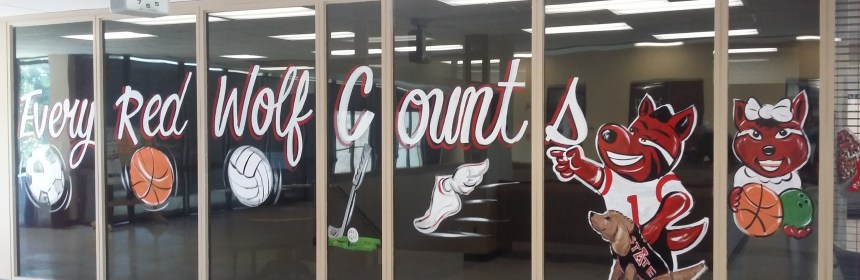
This is why, Damphousse said, the motto “Every Red Wolf Counts” truly encompasses everyone.

“Every Red Wolf Counts. That means every student, every faculty member, every staff member, every alumnus, every member of the Jonesboro community,” Damphousse said. “I see them all as Red Wolves because we’re all tied together.”

He even let students name the family dog:

Listen to the entire interview:

DeltaYou: Bradley Ledgerwood’s Fight

by Jiayue Liao
Delta Digital News Service

CASH, ARKANSAS — Though confined to a wheelchair for 34 years, Bradley “Brad” Ledgerwood continues fighting for his personal rights.

Ledgerwood was born with cerebral palsy, which keeps him from independently standing, walking, taking care of his personal hygiene and feeding himself. The only parts of his body he can move by himself are his hands, but they have a limited range of movement.

“I can’t do anything by myself,” Ledgerwood said.

Ledgerwood lives in Cash, a very small town with fewer than 400 residents and no hospitals.

When Ledgerwood joined the ARChoices program in 2002, he was approved for 56 hours per week of in-home personal care Medicaid services, which was the maximum allowed. In January 2016, the Arkansas Department of Human Services introduced a new system for setting the maximum number of hours for ARChoices’ participants. The new system relies on computer algorithms rather than caregiver discretion.

LISTEN: Bradley Ledgerwood explains the difference in his care hours.

The Arkansas Department of Human Services twice cut Ledgerwood’s in-home personal care services from 56 hours per week down to 32 hours per week since he’s not on a respirator, according to the Ledgerwood family. Although two appeals have kept services at 56 hours a week, Ledgerwood must undergo another evaluation in January 2017.

He said the slash of personal care services would take his life away.

“I can’t drive, so if I want to go anywhere, I have to ask my mom to take me there,” Ledgerwood said.

The Ledgerwood family at Paragould's Lincoln Day Dinner.

David and Ann Ledgerwood kneel for a picture with Bradley at Paragould’s Lincoln Day Dinner. Bradley Ledgerwood will start his third term as alderman for Cash in January. (photo by Alice Mellow, courtesy of the Ledgerwood family)

When DHS first cut Ledgerwood’s hours, his mother had to quit her job to take care of him. If a life-threatening emergency happened, she might not be able to make it back in time from Jonesboro — an approximate 30-minute one-way commute.

Ann Ledgerwood said the system changed the service hours without reasoning other than a computer system that only allots so much time.

“We just know the last two years, his hours have been cut from 56 to 32 with no improvement,” she said.

Critics note a recent ruling only makes DHS explain to ARChoices’ participants why their allocated hours will be cut, and claim hours are being cut even more drastically. But testimony from the professor who invented the algorithm suggests the state’s software may be faulty and DHS does not understand the tool it uses.

“If you going to do a program, you are knowing how it works,” Ledgerwood said. “Nobody in state government knows how the computer program works.”

His father, David, notes technology may not always be the answer.

“I have a love/hate relationship with technology,” he said. “Algorithms do work, but there’s a human element that has to be there.”

Since DHS started using the new system in January 2016, 47 percent of participants in ARChoices have seen a reduction in service hours, according to a Nov. 6 Jonesboro Sun article.

“I feel like the people in government are just wanting to make a name for themselves … the ones who are supporting the cuts are just wanting to make a name for themselves and I don’t think they care about people,” Ledgerwood said.

LISTEN: Ledgerwood voices his frustration with those in government.

Journalist, Artist Pass Through on Western Trek

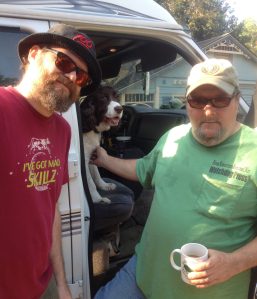
Artist Walter Simon, Jefferson the English Springer Spaniel, and Glynn Wilson of the New American Journal.

Artist Walter Simon, Jefferson the English Springer Spaniel, and Glynn Wilson of the New American Journal.

JONESBORO, Ark. – A journalist and artist team from Alabama stopped through Jonesboro during their quest to bring public attention to problems with privatization of the national parks.

Loosely traveling the same path Capt. Meriwether Louis and 2nd Lt. William Clark took in 1804, Glynn Wilson and Walter Simon of Alabama plan to travel to St. Louis next on their way west. While Louis and Clark originally traveled this path to explore new found territory and blaze a trail westward, Wilson and Simon hope to raise the public’s awareness on important issues.  Wilson said he hopes he can simply make a difference.

“I have a long history of making a difference on stories where science, politics, the law and the environment meet,” Wilson said.

Wilson calls it watchdog journalism. He said he believes holding those in power accountable stands to be more important than making money.

Privatization of the National Parks

Wilson said the commercialization of the National Park System compelled him to make the trip. NPS celebrates its centennial this year.

“The story about the commercialization and privatization of the national parks is not really being covered at all,” Wilson said. “That’s where we can come in and make a difference.”

In “What the National Press and the Park Service Won’t Tell You on the 100th Anniversary of NPS,” Wilson claims the problem isn’t the lack of visitors to the national parks. The issue lies in the lack of government-provided funding needed for maintenance.

Washington Post environmental reporter Darryl Fears previously wrote no one questions the natural beauty of the national parks, it’s the human elements – the restrooms and roads – that are in dire need of repair.

SA 838 approved by Congress in March 2015 with a vote of 51-49, would allow for the privatization of our national parks. While Sen. Maria Cantwell (D-Wash.) introduced the National Park Service Centennial Act — which would provide much-needed repairs and maintenance to national parks — to Congress in November 2015, it remains in committee.

Wilson said the parks already generate the money needed for maintenance. However, the money gets diverted to private companies already contracted to provide lodging and food, among other services designed to attract tourists.

Having worked in journalism since the 1980s, Wilson began his career working in various newspapers in Alabama. More recently, he worked as a freelance contributor to several large media outlets, such as The New York Times. He started New American Journal in February 2014.

Wilson said he designed New American Journal to be an independent mobile journalism news site that relies on contributions and site advertisements to survive. Wilson said this keeps it independent compared to other, more mainstream media outlets.

An artist, Simon said he plans on capturing much of the vivid scenery on canvas. He said he will contribute to the art of the National Parks System, created a century ago with the help of different American artists such as Thomas Moran, whose art helped contribute to the creation of Yellowstone National Park in Wyoming.

“I go in that same romantic spirit to renew the specialness of these parks in the public mind before they are broken up and destroyed by fossil-fuel industrialists and other irresponsible private enterprises,” Simon said.

You can learn more about Simon’s art by following his Facebook page, or by his 100th Anniversary National Park painting and photography tour.

Native American Protest

As they travel West, Wilson and Simon will also travel to the Standing Rock Sioux reservation in North Dakota. Native Americans have gathered there to protest the Dakota Access pipeline, a proposed 1,170-mile system that would take crude oil from North Dakota Bakken region to Illinois.

Wilson said now after the occurrence of physical conflict, the mainstream media jumped aboard to cover this issue.

“So the issue there is not just to go there and cover a story that is not being covered,” Wilson said. “It is being covered, but I still think we can do something original and better than most by being on the ground.”

Read more about the pipeline here.

Oil Transported by Train

Wilson said while some media attention focuses on the protest, the same Canadian tar sands oil, already in transport to the Gulf Coast, remains essentially ignored the mainstream media outlets. He said companies use trains for transport due to the lack of pipelines.

Wilson wrote of a community meeting in Mobile held in January 2015, during which citizens expressed their concerns for two proposed giant petrochemical storage tank farms, holding millions of gallons of oil that would be built on the riverfront. Wilson said the Canadian National Railroad plans to increase the volume of the present oil transport if larger storage tanks are approved by the government. Read more about the potential risks such a storage facility could hold for the community here.

Wilson said letting the American People know the true story remains the compelling reason for this trek. He said he plans to produce a series of stories with photos, videos, paintings and illustrations to accomplish this goal.

“This full story is not being covered by the corporate media,” Wilson said.

To learn more about Wilson and Simon’s trip, or to help, visit the Go Fund Me page here.

***
EDITOR’S NOTE: Glynn Wilson worked with DDNS adviser Ron Sitton on The Southerner during the late 1990s.

DeltaYou: Beau Jones

By Rachel Moore
Delta Digital News Service

Paragould Man Keeps Blacksmithing Tradition Alive

By Kirsten May
Delta Digital News Service

“Blacksmiths have been the foundation of society since the beginning of time.”

Lloyd Clayton works to keep a centuries-old tradition alive, despite the modern conveniences available to us today.

“Every trade revolved around the blacksmith. The blacksmith made all their tools. If it wasn’t for the blacksmith, the local communities would not thrive,” he said.

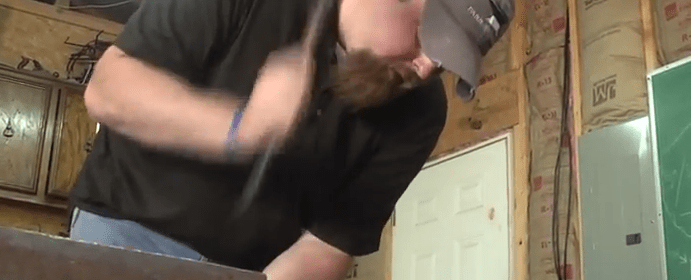
Clayton has been a farrier for 13 years. He spends his days working around Northeast Arkansas to trim and shoe horses’ hooves. He also travels across the country to compete in horseshoeing competitions.

“It’s opened my world up a lot. I’m close friends with people throughout the country and even worldwide,” he said.

After graduating from Oklahoma State horseshoeing school, Clayton worked with his mentor — Lonnie Lindsey — for four years. He’s now passing on what he knows to younger generations that come to work with him.

“A person is only able to do this for so long. So after so many years, your body’s not going to allow you to keep doing it. So you’ve got to bring new people up,” he said.

That includes his 9-year-old son Jasper, who loves to be in the shop with his dad.

“I get to work with him. I learn how to make horseshoes, knives and other things,” Jasper said.

“He says right now that he wants to continue it, but he’s really not old enough right now to do a lot by himself. So hopefully, he will continue that,” his mom said.

Clayton’s wife, Tera, said she thinks blacksmithing is good for him and she enjoys that he gets to travel and meet people who are as passionate as he is. Clayton is also part of a local blacksmith organization that teaches classes and informs people about the trade. They want people to understand how important it is to our history … and our future.

“They made everything. Everything that we needed was made by a blacksmith if it had metal in it. They were very, very important and they are still important today. We have new technology that allows us to do things easier to where you don’t have to do everything in the forge like they used to, but the blacksmith is still a very important part of society. And without the blacksmith, society wouldn’t make it,” Clayton said.

Recent Entries »