Tag Archives: Food

Food insecurity rises in northeast Arkansas as costs climb

Story by DDNS reporter Benjamin McDowell

Photo courtesy of the Food Bank of Northeast Arkansas

As grocery prices climb and paychecks fall short, more Northeast Arkansas families are waiting in food bank lines to make ends meet.

Food insecurity is rising in northeast Arkansas as inflation drives up the cost of groceries, gas and housing, putting increased pressure on local food banks.

The Food Bank of Northeast Arkansas secures donations from food and grocery industries, government agencies, individuals and other organizations to provide for people in need. The food is stored in the organization’s 59,600-square-foot distribution facility in Jonesboro.

Terry Austin, a development officer focused on fundraising and communications, said demand for food assistance has increased over the past year due to inflation, rising gas prices and cuts to federal support programs such as the Supplemental Nutrition Assistance Program, or SNAP.

“Demand has risen already just from the cuts that we’ve taken so far from the economy being in rough shape,” Austin said.

Austin said donors are also feeling financial strain, forcing them to be more cautious with their contributions as they balance their own household expenses. He said the food bank has seen an increase in senior citizens and families seeking assistance.

“Everybody right now is watching gas prices go through the roof,” Austin said. “Everything is more expensive at the grocery store.”

According to Feeding America, about 240,000 people in Arkansas benefit from SNAP, including 113,000 children and 36,000 senior citizens. A University of Arkansas study estimates that 28.8% of Arkansans face food insecurity.
“The price of one pound of ground beef is now higher than the federal hourly minimum wage,” Austin said, describing the current conditions as a “perfect storm” of rising costs and reduced assistance.

Austin said he is concerned about the food bank’s ability to meet growing demand as grocery prices continue to rise and federal assistance programs face potential cuts.

“I’m honestly worried about making sure that we’re able to meet the needs that may be coming our way,” Austin said.
Feeding America estimates that cuts to SNAP benefits could result in a loss of up to 41 million meals for Arkansas families.

Laura Dunivan, who works on the programs team managing fundraising and grant efforts, said rising costs are bringing more first-time clients to food pantries.

“What used to be occasional support for some families is now something they rely on more heavily,” Dunivan said. “We’re consistently serving more households each month.”

Dunivan said many families use food assistance to fill gaps during financial hardship, allowing them to afford other essentials such as gas, rent or medication.

“Would you sit in a car line for an hour for a box of food if you could just go to Walmart and get it in 10 minutes?” Dunivan said.

She said transportation remains a major barrier in rural communities, where access to food pantries can be limited. To address this, the food bank operates the Nourish Mobile, which delivers fresh produce at no cost to underserved areas.
“Some of the people can’t come to the pantries, we have to go out to them,” Dunivan said.

Natalie Neal, the USDA coordinator for the food bank, said federal food programs play a critical role in addressing hunger across the state.

“With the rising price of food, it is more expensive to purchase food, and our neighbors can’t afford everything they need,” Neal said. “It really starts to feel like there’s a greater gap.”

Neal said the food bank has seen a decrease in USDA food shipments, limiting the amount of food available for distribution.

“We are seeing less come into the food bank, so we have less to go out to the community,” Neal said.

She said the organization works with mayors, churches and community partners to expand access and reach new households.

“USDA foods provide a pivotal source of food,” Neal said. “It helps keep food in the pantry to help us all get through difficult times.”

Bonnie Mamula, office manager at the food bank, said rising food costs combined with stagnant incomes are key drivers of food insecurity.

She said senior citizens are especially vulnerable because many live on fixed incomes while expenses continue to rise.
“Some counties only have a few pantries, and they’re only open a couple of times a month,” Mamula said. “People in more remote areas have fewer choices.”

Mamula said the food bank is also seeing more working individuals and recently unemployed residents seeking assistance.

“Even people with jobs can’t make ends meet,” Mamula said.

Jennifer Hannah, chief program officer, said inflation has affected not only how many people the organization serves but also the quality of food it can provide.

“If we look at our data over the last few years, what we’re seeing is consistently serving more people,” Hannah said. “Demand is always there; it’s just how urgent it is.”

Hannah said many families fall into a gap where they earn too much to qualify for assistance programs but not enough to consistently support their households.

“It’s not so much changing the services we deliver, it’s changing how much we’re able to deliver,” Hannah said. “When prices go up, the quality of people’s food is going to decrease.”

-30-

Rice in Schools plants seeds of learning statewide

Story by DDNS Reporter Jerry Don Burton

Schools across Arkansas are learning to embrace the natural state’s top crop as the Rice in Schools program pilot run continues.

The Arkansas Rice in Schools program, launched by the Arkansas Department of Agriculture in collaboration with Arkansas Rice and USA Rice, is an initiative to teach students how to cook with rice and educate them on the significance of the grain.

Leslee Tell, the farm-to-school coordinator for the United States Department of Agriculture, directs the program. She said Rice in Schools will teach students where their food comes from.

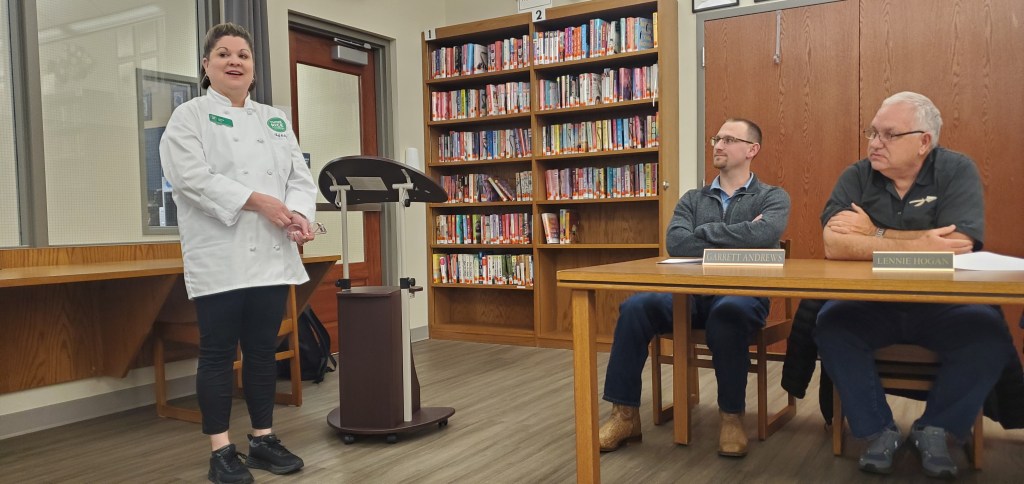
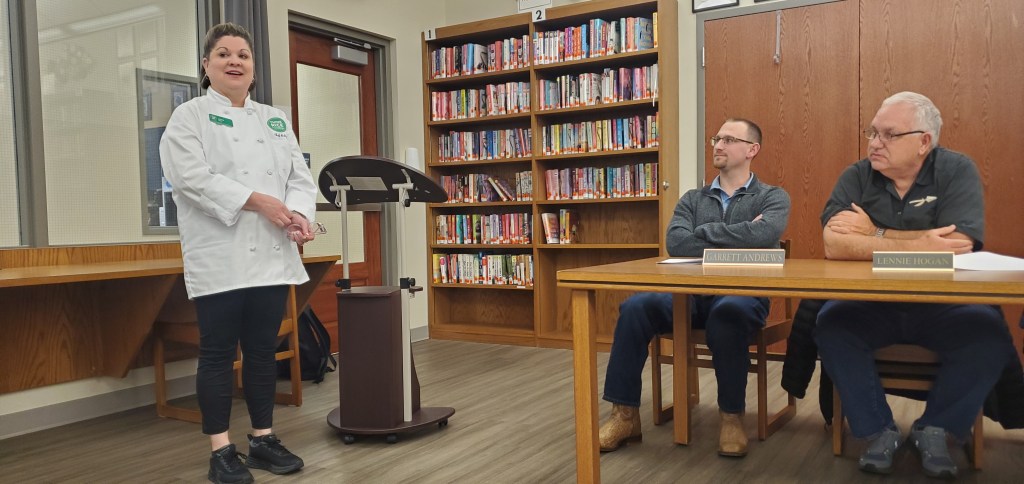
(Left) Leslee Tell, farm-to-school coordinator for the United States Department of Agriculture, describes the Rice in School Program to the Nettleton School Board at a March 17 meeting. According to the USDA website, the program, which is in a pilot phase, gives schools the tools to serve locally grown rice in healthy meals. PHOTO COURTESY OF JERRY DON BURTON

“Our goal is simple, increase the use of Arkansas-grown rice in schools, while helping students learn about agriculture, nutrition and where their food comes from,” Tell said in a YouTube video introducing the program. “This program is about more than just meals, it’s about connecting students to Arkansas agriculture and supporting our local farmers.”

Arkansas Governor Sarah Sanders developed the program in fall 2025, following the transition of nutrition programs to the Arkansas Department of Agriculture.

In December 2025, the Arkansas Rice Research and Promotion Board approved $15,000 in funding to support the program’s implementation. These funds provided schools with equipment to encourage the usage of Arkansas rice in their menus.

Sanders said the new program will teach students how farmers use rice to feed families around the world. She said students will use food made in Arkansas to develop healthy eating habits.

“Rice isn’t just part of Arkansas’ economy; it’s part of who we are,” Sanders said in a press release published Nov. 13, 2025.

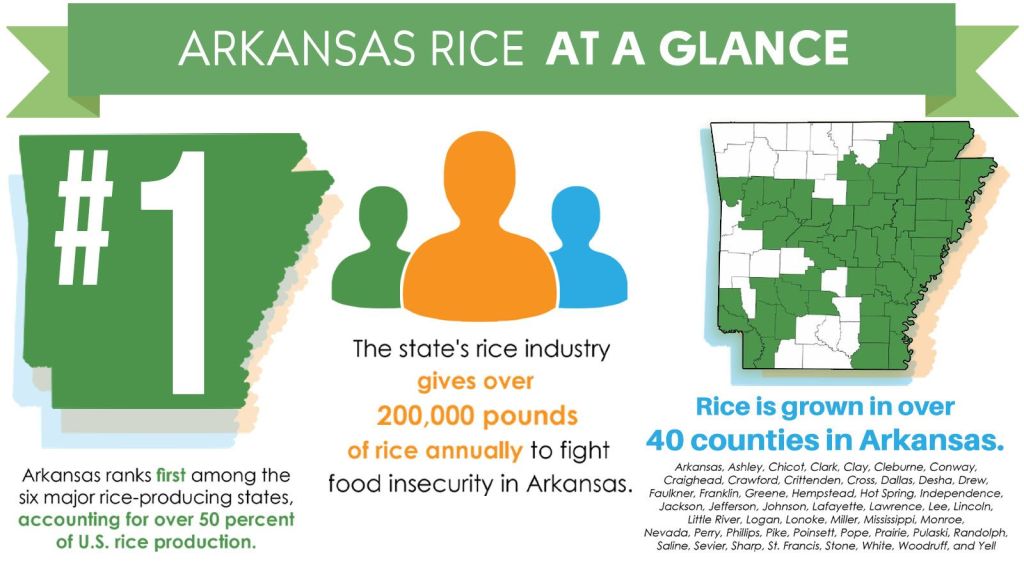
Arkansas is the largest rice-producing state, accounting for more than 40% of rice production in the United States, according to Arkansas Rice. Tell said a majority of this rice is produced in Arkansas’ northeast region. 

A graphic presents quick facts about Arkansas rice production. Arkansas is the largest rice-producing state, accounting for more than 40% of rice production in the United States, according to Arkansas Rice. GRAPHIC COURTESY OF ARAKNAS HOUSE OF REPRESENTATIVES

Almost 20 Arkansas schools and districts are scheduled to participate in the program’s pilot phase, which began in February at Ward Central Elementary in Cabot, Arkansas. The pilot will wrap up in May at Forest Park Elementary in Little Rock.

As part of the program, Tell travels to participating schools with a team to involve students in cooking demonstrations and interactive educational lessons. She also introduces meals with local rice to school menus and trains cafeteria staff in preparing them.

On April 9, Tell traveled to Newport, Arkansas, to introduce the program to students at Newport High School.

Leanne Bradley, the family and consumer science teacher at Newport High School, said Rice in Schools was a beneficial experience for her students. 

Bradley said rice’s significance to Arkansas demonstrates the program’s importance.

“I think everybody is aware that if you don’t take care of what you have, you can lose it,” Bradley said. “(Rice) is something that we have that not every other state has.”

Bradley said her food production and culinary students passed out stir-fried rice samples Tell made for elementary students. After sampling different meals made using rice, students placed stickers on a bulletin board to indicate how much or little they enjoyed the meals.

Tell said they compile student opinion data from every participating school. Then, in June, she said they will analyze the data to determine which recipes students liked most and least and make appropriate changes.

Bradley said the students greatly enjoyed the Rice in Schools program. She said her students cooked with rice before, but Tell’s contributions provided them with new ways to use the grain.

The family and consumer science teacher said she appreciated how the program helped her students realize how much rice Jackson County, where the Newport School District is located, produces.

According to the 2022 USDA Census of Agriculture, Jackson County produced almost 80,000 acres of rice, second only to soybeans.

“So just for the kids to realize this is a huge staple that Arkansas provides for the state, and it’s easy and it does not have to be Minute Rice,” Bradley said. “It really doesn’t take that much longer to actually cook your own rice and the quality is just so much better.”

Julie Isbell, superintendent at the Harrisburg School District, where Tell visited in March,

also said she loved how the program connected her students with local rice production.

Poinsett County, where Harrisburg is located, produced about 90,000 acres of rice, according to the same USDA census.

Tell also brought the program to the Nettleton School District in March. Nettleton School Board Vice President, Donnie Hauge, said he supported the program and thinks helping kids learn cooking skills and understand where their food comes from is an important undertaking.

Wes Ward, Arkansas secretary of agriculture, said the program emphasizes how Arkansas’ dominance over rice production could be used to support students and education. He said the program is a good step toward getting Arkansas to buy and use more of its own rice.

Bradley said rice is also versatile and can be stretched further than other ingredients. She said this is especially important for those who cannot afford as much food.  

“It’s a very quick and easy staple that you can keep in your pantry and it can go for a wide variety of different types of food,” Bradley said. “If your family is financially disadvantaged, you can pair beans and rice together, and that actually makes a complete protein.”

Bradley said her favorite part of the program was how it helped students interact with and cook rice in different ways than they’re used to. For some, Bradley said this program represents an introduction to rice as an ingredient.

However, the family and consumer science teacher said Tell’s visit to Newport was not without challenges. 

Tell was scheduled to return to Newport High School on April 10, but Bradley said she fell ill and missed the second day. 

“She could have talked so much more and given the information about it. She did not get to go into depth like she would at other places,” Bradley said.

In the time they did spend together, Bradley said Tell was a very energetic and fun, but professional person to work with.

“I think she’s phenomenal and I liked having the opportunity,” Bradley said. “I hope that this is something that takes off and is able to be utilized in schools across Arkansas.”

Tell said the student feedback, recipe evaluations and participation data gathered in the pilot will refine the program and prepare it for statewide expansion.

In the final iteration of the program, Bradley said she would like to see taste testing and activities for all grade levels.

Tell said the program continuously searches for and develops new and more effective methods of engaging schools.

Bradley said the school will continue building on the foundation laid by Tell and the Rice in Schools Program. She said the school’s student-run restaurant, the Hungry Hound Cafe, started implementing rice meals based on what they learned from the program.

Tell said she is a teacher at heart and loves to cook, so working with students to prepare recipes in the classroom was a great combination.

“We are bringing Arkansas-grown rice to schools across the state,” Tell said. “One plate at a time.”
More information about the Rice in Schools program may be found on the Arkansas Department of Agriculture’s website. Program organizers also created a digital guide featuring rice data and recipes from USA Rice.

Nettleton School Board discuss educational rice program, effective AI usage

Photos and Story from DDNS Reporter Jerry Don Burton

March 18, 2026

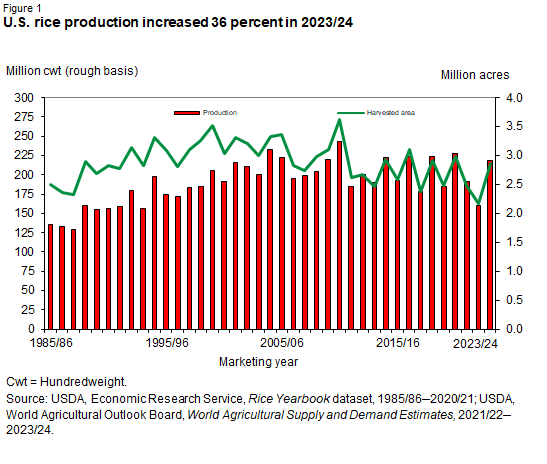
Bar graph depicts U.S. rice production (red) and harvested area (green) from the years 1985 to 2024. Rice production increased by nearly 1 million acres between 2023 and 2024. Courtesy of the United States Department of Agriculture.

The Nettleton School Board heard presentations on an initiative to educate students about rice and effective AI use in classrooms at its monthly meeting.

Rice in Schools Pilot Initiative

(Left) Leslie Tell, farm-to-school coordinator for the United States Department of Agriculture, explains the Rice in School program at the Tuesday, March 17, Nettleton School Board Meeting. According to the USDA website, the program, which is in a pilot phase, gives schools the tools to serve locally grown rice in healthy meals. Photo by Jerry Don Burton.

Leslee Tell, farm-to-school coordinator for the United States Department of Agriculture, addressed the board at the meeting Tuesday, March 17, to provide an overview of the Rice in Schools program.

Tell said the initiative aims to provide schools with the resources to serve local rice and educate students about the significance of rice in Arkansas. She said Arkansas Governor Sarah Sanders saw the importance of rice in the state and developed the initiative in fall 2025.

“So her idea was that, number one, students know where their food is coming from. Number two, that it’s local food as much as possible,” Tell said. “If we’re growing this much rice, then we should probably be serving rice and teaching kids to love rice as well.”

According to the USDA, the United States accounts for less than 2% of global rice production, but ships 5% of global exports. Arkansas is the largest rice-producing state, accounting for more than 40% of rice production in the U.S.

Tell said a majority of rice production in Arkansas is concentrated in the state’s northeast region. 

(Third from left) Donnie Hague, Nettleton School Board vice president, asks USDA Farm-To-School Coordinator Leslee Tell a question about the Rice in Schools program. Photo by Jerry Don Burton.

Donnie Hauge, Nettleton School Board vice president, said a program for helping kids understand where rice comes from and how to cook with it is a great idea.

The farm-to-school coordinator said about 20 schools have signed up for the program. 

Participating schools will introduce classroom lessons on Arkansas agriculture, participate in hands-on cooking demonstrations, train cafeteria staff and include local rice in school meals at least once a month.

Tell said schools may also engage in taste tests and interactive experiences. She said the program is continuously expanding and introducing new ways to highlight Arkansas rice. 

One such development is the creation of a cookbook containing 50 rice recipes for students to take home and prepare with their family. 

“In the food banks and blessing boxes, there’s a lot of rice,” Tell said. “ If you have kids wanting to eat rice at school and they’ve made it at school, they get their recipe book, and they can go home, and maybe that bridge can happen between the parent and the child, and we could encourage that.”

Tell said the program also engages with the current national interest in eating real food. 

“You can’t get any more real than this,” Tell said. “We’re eating real food, we’re eating real rice, real chicken, real vegetables and we’re making it right here from scratch, in front of the kids.”

Currently, the initiative is in a pilot phase. Tell said feedback from participating schools will be used to improve the program and shape future expansions.

Effective AI Usage in Classrooms

Following Tell’s presentation, the Nettleton High School principal, elementary school principal and three junior high school students addressed the school board to explain how they’ve implemented artificial intelligence in their respective fields.

Philip Cook, Nettleton High School career and technical academy principal, said he and other educators use AI to increase productivity and generate content. He said he uses AI to outsource elements of his workflow. 

(Right) Philip Cook, Nettleton High School career and technical academy principal, explains how the high school uses AI coaching assistant Edia to those in attendance at the Nettleton School Board meeting. Cook said AI, when used properly, helps educator lessen their workload. Photo by Jerry Don Burton.

“What we do at NHS right now is we have teachers that use it to generate worksheets. We use it for coaching students and to help with our summative evaluations,” Cook said. “Then also, to look at and align some of our different curriculum with each other.”

Using the Arkansas academic standards and ATLAS achievement level descriptors for geometry as an example, Cook demonstrated how AI can be used to parse and summarize dense information. 

The high school principal said projects like creating curricula that meet various standards, something which could take all summer to complete, are achievable in a single weekend with AI like ChatGPT. 

Cook said Nettleton High School is also incorporating Edia, an AI coaching assistant, in the classroom.

Despite embracing AI, Cook said education will always need a human element. 

“That’s what we’re trying to do in our critical algebra is not just turn it over to the AI–because then we become a facilitator–but use that where it’s appropriate to support that learning and then go ahead and let the teacher break kids into small groups, interact with them, give them those alternative learning methods,” Cook said. “I think it takes a good marriage of both to really be as effective as we can.”

University Heights Elementary Principal Sarah George said she uses Upraiser, an AI software designed to enhance teacher evaluations, in her administrative duties.

(Right) Sarah Geoge, University Heights Elementary principal, explains how she uses Upraiser AI when giving teacher evaluations. She said she uses Upraiser to provide actionable feedback to teachers. Photo by Jerry Don Burton.

“This platform has really helped, because it’s narrowed down the feedback that is given to teachers because it’s directly aligned to standards,” George said.

Garrett Andrews, the newest member of the Nettleton School Board, asked George if the AI she uses is accurate. George said Upraiser is mostly accurate, but agreed with Cook that a human element will always be necessary.

The elementary school principal said she is transparent with teachers and lets them know when the feedback they receive is partially AI-generated.

After George’s report, Nettleton Junior High School students Collins Baker, Jace Stegall and Brik Hogan presented a slideshow to detail how they use AI.

Baker said she learned how to use AI in 2025 and mostly utilizes it as a search engine, like Google. She said, while a helpful tool, AI can nonetheless introduce biases in its responses.

Stegall said he uses AI for coding help and in certain class assignments, specifically one project using drones to map hazardous conditions in Jonesboro.

“We want to know how to use it right, how to use it responsibly and how to use it for our school work instead of cheating,” Stegall said.

Hauge said the students’ presentation taught him how they use AI not for short answers or cheating, but productively and responsibly.

Other business 

In other business, Athletics Director Tommy Raffo announced several upgrades and additions to the athletic facilities:

  • New track and field sand pit
  • New baseball bullpen
  • New televisions installed near concession stands
  • New and updated spirit banners installed in gym

Raffo also said he was proud of the boys and girls basketball teams, who were seeded fourth and second in the state, respectively.

Finally, the Nettleton High School Choir performed three songs ahead of the school’s production of “Hairspray.” Showings will be held April 24 and 25 at 7 p.m. and April 26 at 2 p.m. More information may be found on The Raider Spotlight’s Facebook page.
The next school board meeting will be held at 6 p.m., April 21, at the Nettleton Central Office.

Food insecurity remains challenge for Food Bank of NEA

Story by DDNS Reporter Jerry Don Burton

JONESBORO – Following the government shutdown and with the holiday season approaching, food insecurity in Northeast Arkansas (NEA) remains a challenge for food banks.

Arkansas faces the highest rate of food insecurity in the nation, according to a since-discontinued annual report published in 2024 from the U.S. Department of Agriculture (USDA). The USDA defines food insecurity as a household-level economic and social condition of limited or uncertain access to adequate food.

Terry Austin, development officer at the Food Bank of NEA, said the rural nature of Northeast Arkansas contributes to the high rates of food insecurity. Many areas of Arkansas are also classified as food deserts.

Food deserts are areas where access to affordable, healthy food is restricted or nonexistent due to the absence of grocery stories within convenient distances, as defined by Food Empowerment Project.

“Statistically speaking, 21% of Northeast Arkansas citizens are in food insecure households,” Austin said. “Which is a staggering statistic to me.”

The Food Bank of NEA entrance, located at 3414 One Place in Jonesboro. Photo courtesy of Food Bank of NEA Facebook.

Food deserts are not the only elements worsening food security in NEA, though. National factors have further increased demand for food banks.

Lingering Impacts of Government Shutdown
Austin said the latest government shutdown, which lasted from Oct. 1 to Nov. 12 put a spotlight on food insecurity. He said those who depend on food assistance, such as the Supplemental Nutrition Assistance Program (SNAP) and federal employees, were particularly impacted.

The Food Bank of NEA saw a 16% increase in SNAP recipients who received food assistance during the shutdown compared to that same period in 2024. 8% of those served were new households that had never received assistance from the Food Bank of NEA before.

The One Big Beautiful Bill Act, signed into law by President Donald Trump on July 4, is also expected to impact food security nationwide.

President Donald Trump displays the One Big Beautiful Bill Act, after signing it. Photo Courtesy of Leah Millis, Reuters.

“[The act] is estimated to reduce the number of meals for SNAP beneficiaries in the nation by some six billion meals year to year over the next 10 years,” Austin said. “We’re gonna see that kind of cut in food assistance and that’s going to mean a very steady rise in demand.”

Another factor influencing the increased pressure on food banks is the approaching holiday season.

Holiday Season Challenges
“Regardless of what your family’s financial picture may be, you still want to have those holiday gatherings,” Austin said. “You want to have a table of food to share with your loved ones.”

The holiday season further contributes to an increase in demand because, since many children will be on break, they’ll miss out on school-provided meals. One in three children are at risk for hunger in NEA.

Austin said the Food Bank of NEA orders traditional seasonal food during this time of year to give families in need the food to make a holiday meal.
Food insecurity is not an issue limited to NEA, either.

The River Valley Regional Food Bank entrance, located a 1617 Zero Street in Fort Smith.

Food Insecurity Affects Arkansans Everywhere
On the opposite side of the state, the River Valley Regional Food Bank in Fort Smith serves 140 pantries across eight counties in Western Arkansas.

Hattie Hamilton, interim food bank director and operations manager for the River Valley Regional Food Bank, said they have reached out to Feeding America for extra food. She said the additional product will help the food bank better supply the pantries as need increases.

Feeding America is a non-profit network of food banks nationwide that helps feed more than 46 million people.

“Our battle here to help fight against it is just to get the food in to help get to the neighbors in need,” Hamilton said.

State Funding Support
In an effort to combat SNAP cuts and relieve pressure on food banks, state funds have provided support to food banks across Arkansas.

On Oct. 31, Arkansas Governor Sarah Sanders directed $500,000 to be split among the six Feeding America partnered food banks in the state. On Nov. 9, with the shutdown still in effect, Sanders assigned $500,000 more to food banks.

“As the shutdown continues, my administration will stand with our partners in the legislature, at churches and in food banks to help Arkansans stay fed,” Sanders said.

Back in NEA, Austin said their food bank received about $83,000 from the state. He said the Food Bank of NEA priortized buying protein products with the funds.

“Protein is a critical part of a diet and it’s also part of a diet that’s hard for us to provide enough of in our distributions,” Austin said. “We get a lot of canned goods and a lot of dry goods. Protein can be tricky to fit into that parameter, so that’s why we focused using those dollars on protein purchases.”

Austin said he wants to stress that the food bank is grateful for the money, but more help is needed to meet the rising need.

Demand Rising in Northeast Arkansas
One of six food banks in Arkansas, the Food Bank of NEA serves a 12-county area in the northeast region of the state, serving about 8,000 square miles.

Austin said the Food Bank of NEA primarily raises money and food and then distributes products to 176 partner agencies. These agencies include churches, schools, food pantries and homeless shelters.

In 2024, the Food Bank of NEA distributed 8.2 million pounds of food to those facing food insecurity. 25% of that food was fresh products like meat, vegetables and fruit.

A Food Bank of NEA delivery truck, parked in the loading dock of the Food Bank of NEA. Photo Courtesy of the Food Bank of NEA website.

In addition to distributing food to partner agencies, Austin said the Food Bank of NEA travels to each of the 12 counties as least four times a year to hold a mobile distribution.

Through these distributions, Austin said the food bank arrives to a central location and hands out food themselves. He said the increased demand is felt even in these mobile distributions.

During a mobile distribution held in Craighead County in early October, Austin said the food bank brought 24 more boxes of food than normal and still had to turn away about 30 households because they ran out of food.
Similarly, during a distribution in Lawrence County, Austin said they brought 64 additional boxes of food and had to turn away 42 households.

“We simply ran out of food,” Austin said. “The demand has definitely spiked and it spiked in part because of the shutdown, but honestly, the demand was already beginning to climb.”

How to Receive Assistance and Offer Support
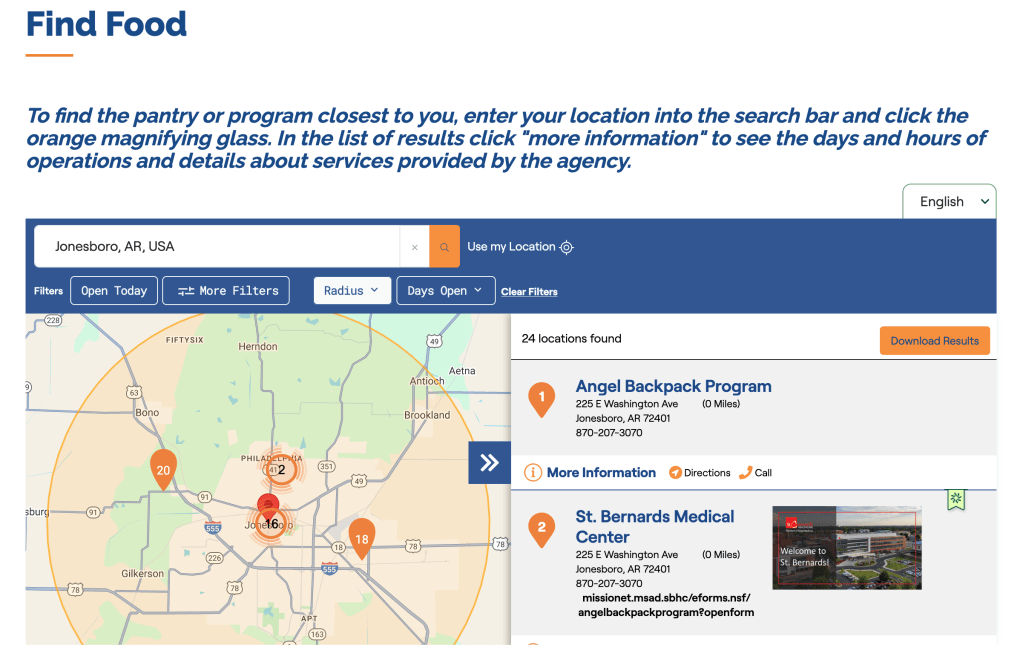
For those in need of food assistance, Austin said one of the best resources they offer is an interactive map on their website that allows users to find what food distributors in NEA are closest to them. Phone numbers, addresses and more information is included in the map to help guide users to help they need.

A screenshot of the Food Bank of NEA interactive map. The map allows users to search for food distributors in their location. Screenshot retrieved from the Food Bank of NEA website.


“We have done this a long time and we know all the ins and outs and the best way, the most efficient ways to get food to people who need it,” Austin said. “We stand ready to help if we need to.”

The Food Bank of NEA also has links under the “How to Help” section of their website for those interested in donating or volunteering. 1,157 volunteers donated 3,847 hours in 2024 to support the Food Bank of NEA.

Some of the most needed food items include peanut butter, canned soups, pasta, cereal, boxed meals, canned meats, and canned fruits and vegetables.

Austin said fresh food is always a challenge, so shelf-stable products are preferred. He also said popular foods that are flexible in meal prep are favored, such as spaghetti, corn, green beans and macaroni and cheese.

More than food, though, Austin said the Food Bank of NEA–and most food banks in general–actually prefer money donations.

Austin said donating money directly would serve the food bank more than canned goods, as the food bank buys product in bulk at reduced prices.
“We typically say that $1 donated can provide up to three meals,” Austin said. “We’re able to really stretch those dollars a long way.”

Austin said money donations can be used to pay for freight costs and other fees needed to keep the food bank running, too.

Still, Austin said any form of support–food donations, money donations, volunteer work or otherwise–is greatly appreciated.

The Food Bank of NEA is open from 8 a.m. to 5 p.m. weekdays and is located at 3414 One Place in Jonesboro. The food bank can also be reached by phone by calling 870-932-3663.
-30-

Arkansas State Hosts Annual Thanksgiving Dinner

Story and photos by DDNS Reporter Jerry Burton

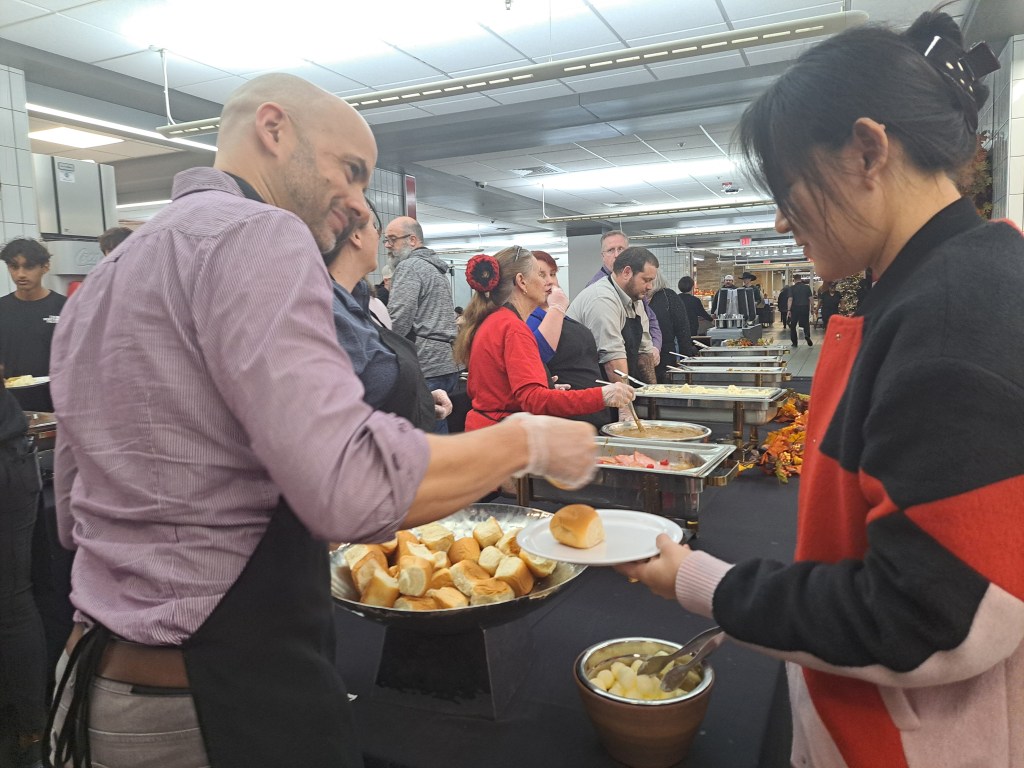
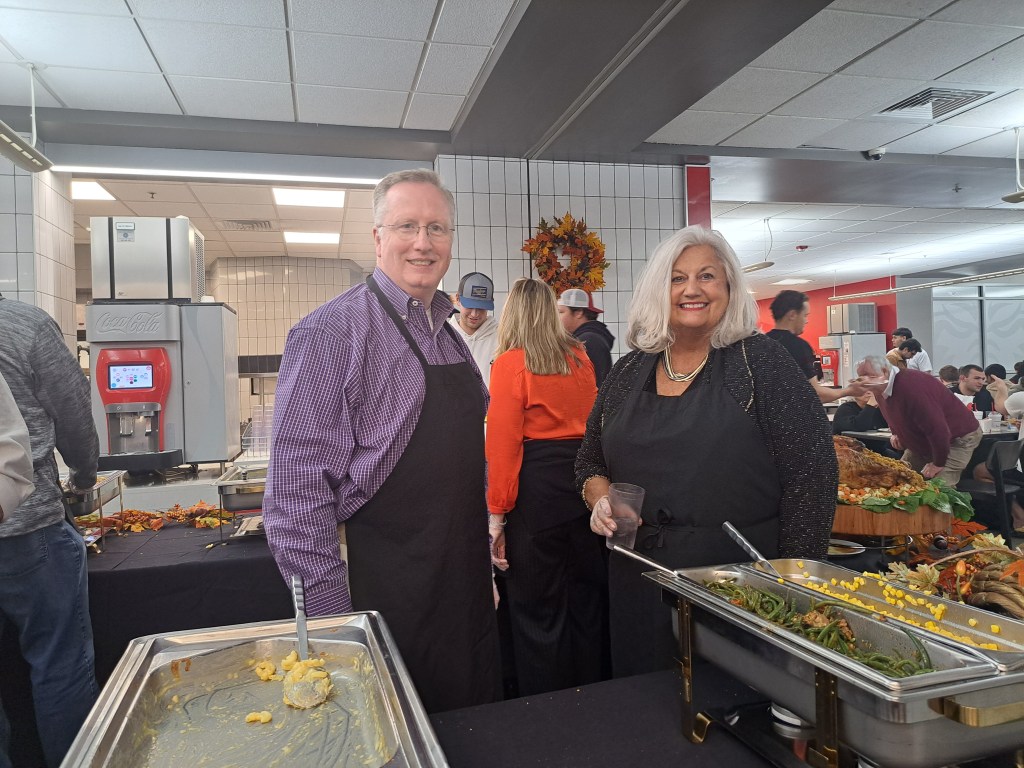
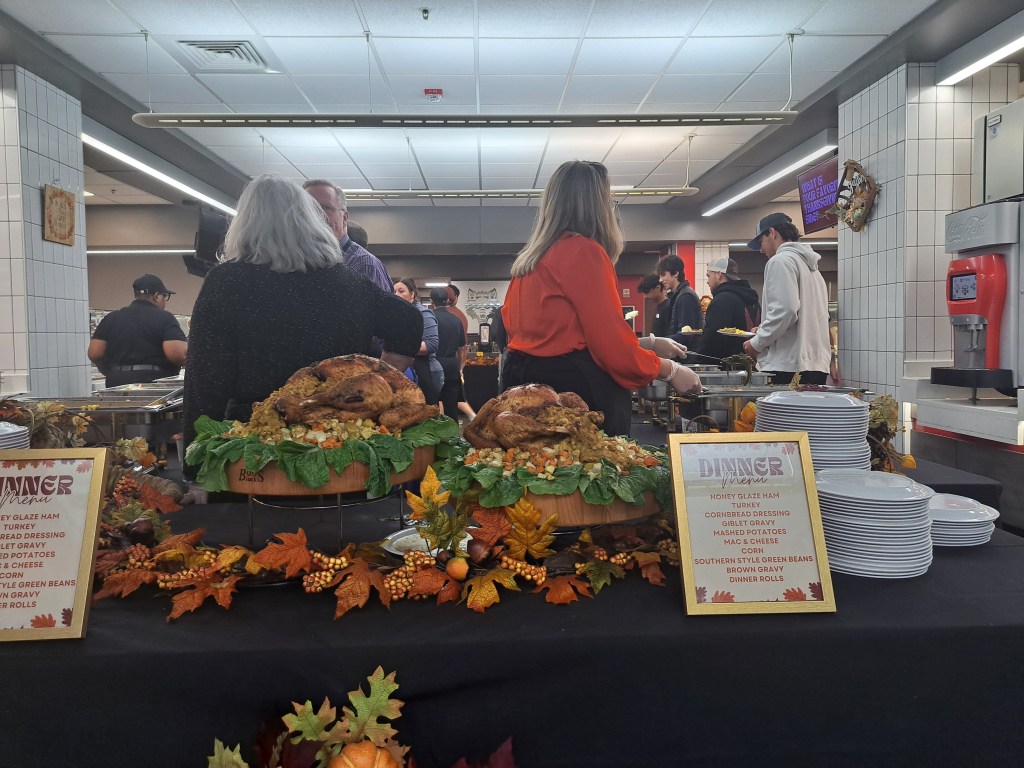
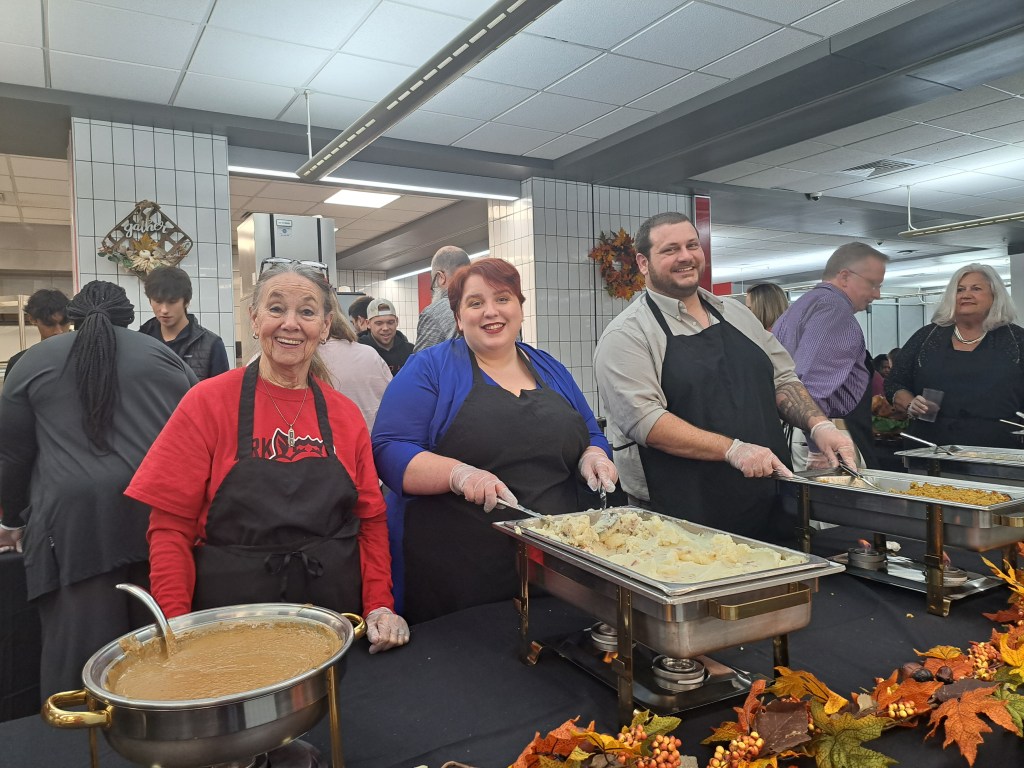
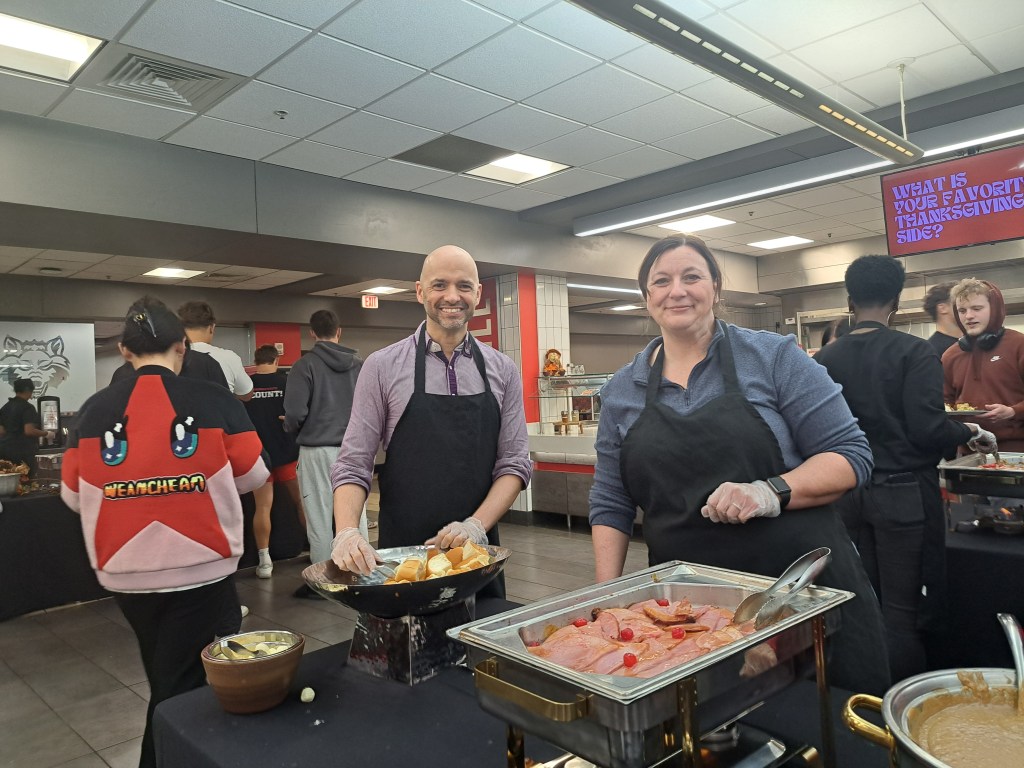
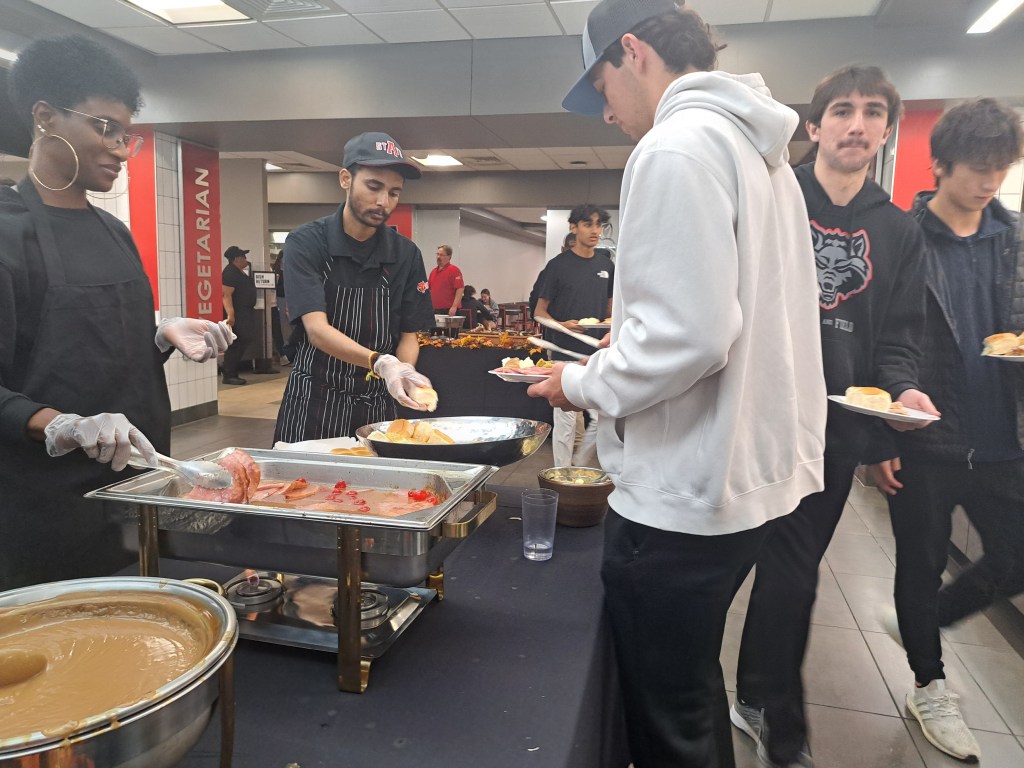
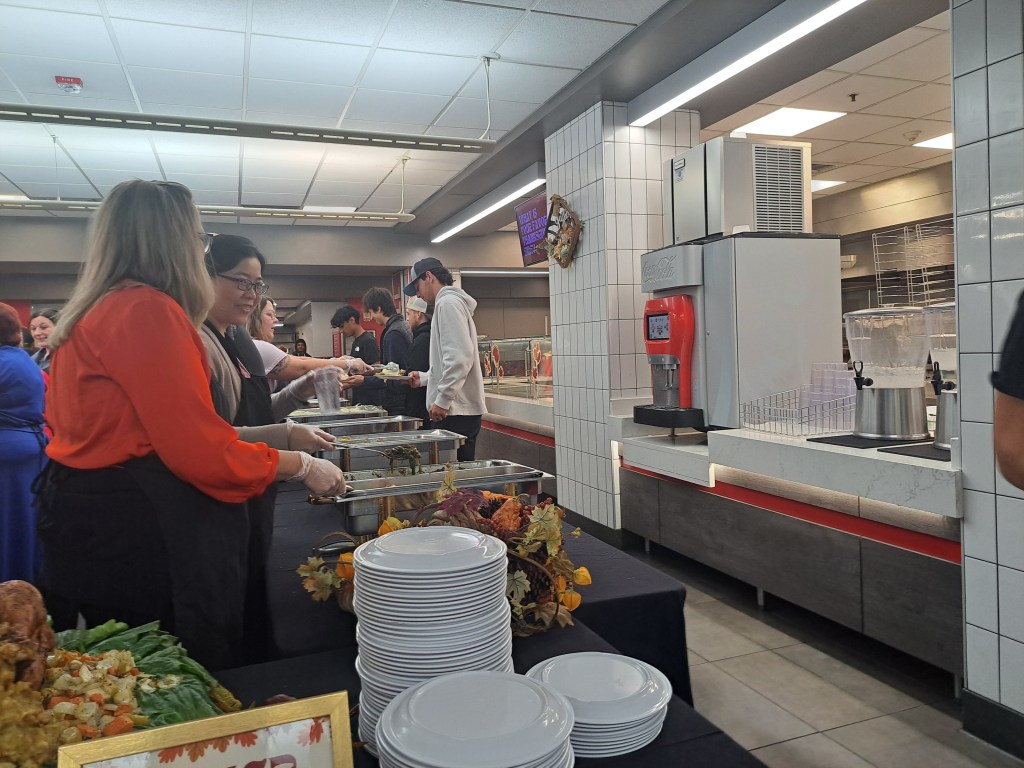
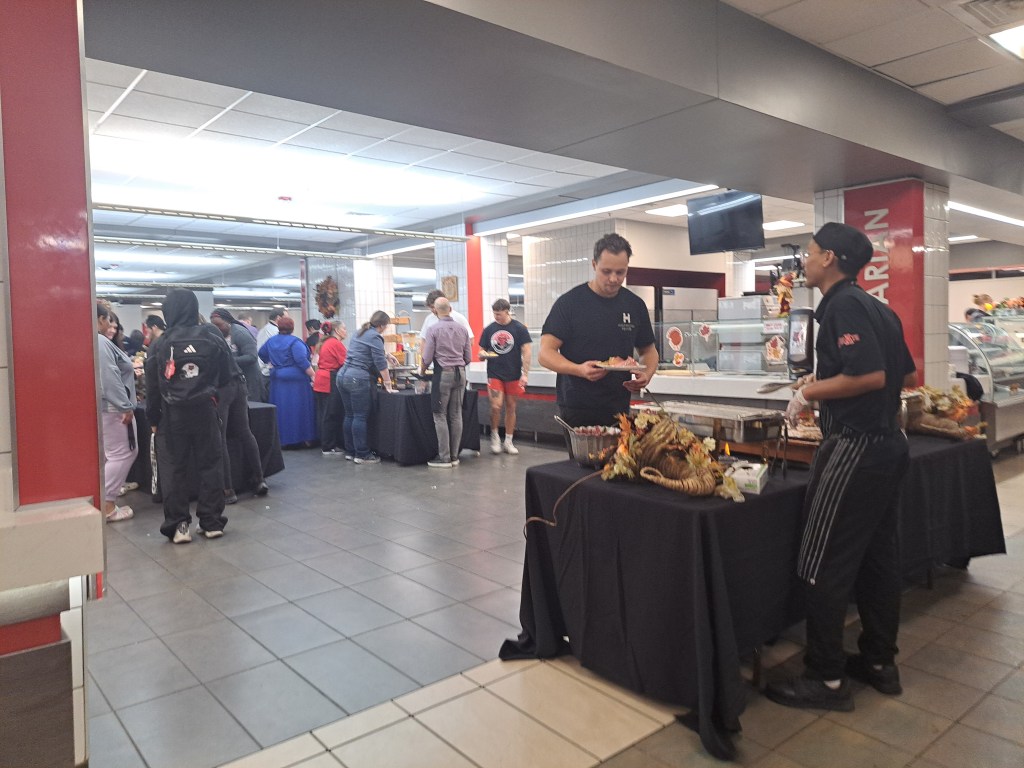
Arkansas State University held the annual Thanksgiving dinner in the Acansa Dining Hall Wednesday.

Craig Johnson, assistant vice chancellor for auxiliary services and volunteer coordinator for the Thanksgiving dinner, said the event provides for faculty, staff and students alike.

“For faculty, this gives them interactions outside of the classroom or outside of the offices,” Johnson said. “For our students, it gives them an opportunity to meet with faculty and staff in a different environment. It provides for those folks who can’t be able to go home for Thanksgiving.”

Emily Martin, a first-year nursing major from Viola, Arkansas, attended the Thanksgiving dinner. She said her favorite food served at the event was the macaroni and cheese, while her least favorite was the stuffing. Martin said the food lines never felt slow and the servers were very hospitable.

“We probably got here at a good time, we got in right after the initial people,” Martin said. “I had to go back and get mac and cheese because they were out, though.”

Yurizzia Macias, a first-year nursing major from Little Rock, said the food was great overall. She also said the stuffing was her least favorite food served at the event. She said while the food for the Thanksgiving dinner was being served in the middle of the Acansa Dining Hall, the space never felt claustrophobic and the food lines were never congested.

Johnson said he has helped plan the annual Thanksgiving dinner for 27 years. He said it was harder to find volunteers in the early 2000s. This year, Johnson said he had to turn people away because so many wanted to help.

The volunteer coordinator said he sent an email at 9 a.m. asking faculty and staff to help with the event and by 9:19, the first shift of volunteers was already full.

43 volunteers comprising faculty and staff members helped serve food at the event. Johnson said volunteers receive no formal training other than guidance on giving equal food portion sizes to students.

“We really just put an apron on, put gloves on and say ‘serve’”, Johnson said.

The volunteer coordinator said 100 students were already through the line in only the first half hour of the event. He said he thinks the volunteers served about 600 to 650 students during the event.

Johnson said it was fun to see a full cafeteria again. He said A-State is still rebounding from COVID-19, which caused a drop in the on-campus student population

“I consider a place like this to be the heartbeat, where folks have the ability to engage and interact,” Johnson said.

Macias said she thinks the Thanksgiving dinner will have a positive impact on students, especially those who won’t be able to go home or see their family during Thanksgiving or Christmas break.

“If they see how it is all family-friendly, they will be more motivated to stay here,” Macias said.

Johnson said he hopes the Thanksgiving dinner provided a warm holiday experience for students who cannot travel home while on break.

“I don’t think you can ever replace what it means to go home, we just can’t match that,” Johnson said. “But it does give that holiday feeling that you have during Thanksgiving.”

Johnson said since Thanksgiving is a holiday based on American history, some international students may not celebrate it. He said this event still serves to give these students another taste of American culture and what the holiday is all about.

Martin said while she enjoyed the event, she did notice areas that could be improved. Martin and Macias said having another table for serving food would have helped students get more food. Five volunteers couldn’t attend the event to help because they had the flu. Johnson said their absence didn’t affect the event very much because he probably had more volunteers than he needed anyway.

Johnson said he would like to see more food options served next year when the event is held again. He said he told the head of operations for the event he would particularly like to have candied yams available for students next year.

Macias said she would be interested in coming to the same event next year and similar events in the future.

LISTEN: Students have a new food delivery service option this semester: Kiwibots.

Audio and story by Jerry Don Burton

The cube-shaped robots on wheels autonomously deliver from Godfather’s Pizza, Einstein Bros Bagels and Freshens to over 60 locations on campus. The Kiwibots also deliver food from virtual dining services including Mr. Beast Burger and AQ BBQ.

Richard Matthews, Sodexo interim general manager, said Arkansas State University is the first college in Arkansas to use the Kiwibot service.

“This was the technology that Sodexo suggested that might benefit the campus,” Matthews said. “We want to make sure this is something that is not only utilized but something that you guys want here.”

Around 300 Kiwibot deliveries have been completed since the semester began. Matthews said A-State’s current fleet of 15 Kiwibots could comfortably handle 500 to 700 deliveries every day.

Luke Caldwell, a senior history major from Conway, Arkansas, used the Kiwibot service during the first week of school.

“I heard about it, I downloaded the app and I gave it a shot,” Caldwell said. “It was fairly user friendly.”

Orders are placed using the Everyday app. From the app, users can select a delivery location, arrange a time for pickup and choose a payment method. The Everyday app accepts payment via Flex dollars.

Caldwell said his order was cheaper than he anticipated. He said his order cost the same as it would if he had ordered in person because there was no delivery fee.

Justin Lewandowski, retail operations manager for Sodexo, said Sodexo uses Everyday as their food hub app. Kiwibots cannot deliver food from Chick-Fil-A and Starbucks because they partner with Grub Hub, a competitor food delivery app.

Caldwell said his experience ordering with Kiwibot was pleasant overall, but the wait time was slower than expected.

“I think the estimated time was 15 or 20 minutes. An hour and a half later, it had not even left the Union yet,” Caldwell said.

Matthews said Kiwibots may encounter issues in very cloudy conditions or when the network is busy or slow. He said they ordered network boosters to increase the effectiveness of Kiwibots in areas that may see disruptions.

Caldwell said he submitted a support ticket concerning his delayed order. He said a Kiwibot customer employee messaged him apologizing for the wait and offered free orders as compensation.

He said when he received his order, the Kiwibot stopped at a designated location outside his dorm at North Park Quads. Caldwell said he scanned a QR code on the Kiwibot to open the chassis and retrieve his food.

Caldwell said he will keep using the Kiwibot service, but would like to see more accurate wait times in the app.

According to Kiwibot’s website, the bots can detect people, cars, and other bots. Kiwibots utilize GPS, artificial intelligence, cameras and sensors to travel autonomously, plan routes and avoid obstructions.

Matthews said Kiwi Campus, the company that owns the Kiwibot service, sent an employee to A-State for two weeks over the summer to help create routes for the Kiwibots. He said they utilized geo-mapping to plot out optimal pickup locations and delivery routes.

Sodexo employees underwent training over the summer to learn how to use the Kiwibots. Matthews said there are also two Kiwi Campus employees stationed at A-State.

“Each employee has been trained on how to load it, how to accept the orders, how to open the bot and load the food in,” Matthews said.

Lewandowski said employees use a tablet to accept orders and open the Kiwibot. Employees then load the order, close the bot and the rest of the process is hands-off.

Matthews said Sodexo is looking to promote the Kiwibots across campus. He said he wants to raise awareness by having the Kiwibots participate in events like football games and hosting giveaways.

“We are going to make things fun with Kiwi. This October, coming up, you should start seeing more,” Matthews said. “We are going to have you guys name the robots so instead of them having a number they would have a name and they can respond to their name.”

Lewandowski said they run their ideas and plans through Kiwi Campus. He said the two Kiwi Campus employees at A-State also help with planning.

Lewandowski said he wants Kiwibot to become another member of the A-State community.

“We really want it to be a part of this campus where it is a reliable resource for the students,” Lewandowski said. “This is a partnership with Kiwi that we want to see grow and expand in the future.”

Grocery store offers all-natural foods

By Melissa A. Palumbo
Delta Digital News Service

MOUNTAIN HOME – Local grocery store Truck Patch offers bulk foods and spices, all-natural beauty products and plant-based meals. 

Named after small farmers’ markets from the 1800s, the Truck Patch grocery store opened May 23, 2010 in Mountain Home. From there, the store added a larger Jonesboro location.

“We don’t currently have plans for another location, but we’re always open to expand,” said Mountain Home Manager Virginia Embry. 

Truck Patch sells ingredients by bulk, allowing customers to bring their own reusable jars, bags and containers with which to shop. 

Tori Forkum, assistant manager at the Truck Patch Jonesboro, said they tare the container before the customer shops. 

“You can bring your own jar and we weigh it,” she said. “Then we take the weight of the container off the final price.”

Many ingredients cost less to to buy in bulk than in individually packaged portions, such as spices and grains.

Olivia Simpson, an employee who works in the kitchen at the Jonesboro location, suggests reusable glass bottles and jars to cut back on waste.

“Buy bulk and ditch plastic,” she said. “Use glass whenever you can.”

The store carries plastic-free, plant-based and biodegradable household products. Products made from plants have a lower environmental impact than hard plastics made from oil, and paper packaging decomposes much faster than plastic wrapping. 

They also sell pet products, like biodegradable doggie bags, organic treats and food.

Truck Patch focuses not only on reducing plastic packaging, but also increasing healthy eating. Employees at Truck Patch help customers find ingredients to suit any diet, from vegan to paleo. They also help those with allergies, diabetes and other health needs find appropriate meals.

“Our staff is well versed in different diets, and we are more than happy to help,” Embry said.

Camron Collins began working at Truck Patch as a cashier about four months ago. He said he was drawn to his job because of his interest in health-conscious eating and reducing environmental impact.
“When we started damaging our environment, it was fast,” he said. “We’re starting to revert that now. It took a lifetime to realize it, but we’re a force.”

Truck Patch strives for zero-waste within the business and community, according to Embry. Because of the large population of farmers in the area, the Mountain Home location established a composting system. 

“We are considerably smaller than the Jonesboro location, but we do pack a big punch,” Embry said. 

The Truck Patch Jonesboro plans to carry composting supplies in the future.

When the Jonesboro location opened in 2015, the Stem and Spoon Cafe was added within the store. The cafe offers a variety of sandwiches, salads, sides and drinks. All the ingredients Truck Patch uses stay organic and hormone-free.

“We use ingredients from the store,” Forkum said. “The kitchen workers will ‘grocery shop’ for the cafe.”

To avoid waste, fruits and vegetables that aren’t as pretty as the rest are turned into smoothies. Food that doesn’t sell is often given to employees.

“We don’t throw anything away,” Embry said. 

Editor’s Note: Photos by Melissa Palumbo.

Soul Food Comes to Jonesboro

***

by Miranda Reynolds
Delta Digital News Service

JONESBORO – The opening of a small restaurant in the downtown area uses family recipes to bring new customers in.

Cynthia Jones, owner of Addie’s Soul Food and Grill, named her restaurant after her mother Willie Addie, who died about 10 years ago. She learned everything she knows from her mother and wants to share her recipes with others.

“I always cooked for my family. I come from a family of 10, but I never knew people enjoyed my cooking until I actually started cooking for the church and that’s when I thought ‘Maybe I should venture out and do it,'” Jones said.

Many family members work with Jones in the restaurant. A sister, nephew, cousins and friends help out when needed. Lacretia Ray, assistant director of Addie’s Soul Food and Grill and sister to Jones, said family remains important to her.

“Cynthia is a very family-oriented person. They push her to keep going. They know she likes to cook and her kids do, too. Her family steps in and helps when they can, so her family, they do a lot. They encourage her a lot,” Ray said.

Not only did Jones learn a few recipes from her mother, but so did Ray.

“When my siblings eat my food, they say, ‘This reminds me of Mom.’ She left a big impact, so every time they eat they always think of her because they say it tastes just like hers,” Ray said.

Among some favorite recipes, Jones remembers her mother’s favorites.

“Her favorite recipe, maybe her turnip and mustard greens, and her dressing was probably her favorite,” Jones said.

One of the restaurant’s employees working under Jones, Amber Hunter, says the atmosphere reminds her of family.

“The sense of family, like it feels like family even though I’m not a part of her family, I feel like I am in a way,” Hunter said.

Jones hopes many people come out and try the new restaurant in the community.

“My goal is for everyone to come out, enjoy and just try it to see if they enjoy it. Just share some of the recipes and stuff, and if they really enjoy it or not, and tell me what I can do to make it better. It’s just for the community. I enjoy to give to people,” Jones said.

Hunter said she plans on working at the restaurant for Jones in the future.

“Working for someone like Cynthia is amazing. You’ll see me here for a while,” Hunter said.

While the restaurant’s soul food cooks, it can be smelled from blocks around in the downtown area.